Specs are compiled from manufacturer listings and verified buyer reviews and can change over time — please confirm the key details on the product page before buying.
Buying a furnace is not like buying a space heater. You are choosing the appliance that runs all winter, sits in a closet or basement for years, and costs real money to install wrong. Start with your calculated heat load and your cabinet width, then decide if you want single-stage or two-stage heat. Get the BTU rating and the cabinet width right, and the brand loyalty argument mostly takes care of itself.
This guide is built by comparing the manufacturers’ published specifications and the patterns across verified customer reviews, so you get each pick’s real strengths and trade-offs instead of marketing spin.
What follows is a working shortlist of Goodman gas furnaces sorted by how people actually use them, from narrow-closet single-stages to high-capacity two-stage units. That is the core of picking top ranked furnaces without overpaying for heat you will never use.
Top Picks

How To Choose The Best Top Ranked Furnaces
Most furnace regrets trace back to one of three numbers: the BTU input, the AFUE percentage, and the cabinet width. Get those three right and the efficiency and stage choices fall into place. Get one wrong and you are either short on heat on the coldest night or paying a contractor to rework ductwork that never should have been touched.
Start with BTU input, not with brand
The BTU number tells you how much gas the furnace burns, not how much heat reaches the room. An 80,000 BTU unit and a 60,000 BTU unit look nearly identical on the outside, but the 80,000 model is built for a bigger envelope. Oversizing is the classic mistake: it heats fast, then cycles off, and the rooms far from the thermostat never quite settle.
Understand AFUE before you fall for 96%
AFUE stands for Annual Fuel Utilization Efficiency, a percentage of the gas that becomes usable heat rather than escaping up the flue. An 80% unit sends roughly a fifth of its fuel out the vent; a 96% condensing unit captures more of that heat by cooling the exhaust. The gap matters most in cold climates where the furnace runs for months, not weeks.
Match the cabinet width to your space and ducts
Cabinet width is the real physical constraint. A 14-inch cabinet slides into tight closets that a 21-inch or 24.5-inch cabinet will never clear. Measure the closet opening and the return plenum before you buy anything, because width determines whether the install is a swap or a rebuild.
Single-stage or two-stage — the comfort question
A single-stage gas valve runs at full fire or off, nothing between. A two-stage valve adds a lower first stage so the furnace holds a steadier temperature and ramps up only when needed. Two-stage units tend to run longer at low output, which is easier on your ears and on temperature swings between rooms.
Side-by-Side Comparison
| Model | Best For | BTU Input | AFUE | Cabinet Width | Amazon |
|---|---|---|---|---|---|
| Goodman GR9S800803BN | Best all-around single-stage for most homes | 80,000 BTU | 80% | 17.5 in | Amazon |
| Goodman GR9S800804BN | Mid-size homes with a four-ton cooling coil | 80,000 BTU | 80% | 17.5 in | Amazon |
| Goodman GR9S960803BN | Cold-climate efficiency on a single stage | 80,000 BTU | 96% | 17.5 in | Amazon |
Detailed Reviews
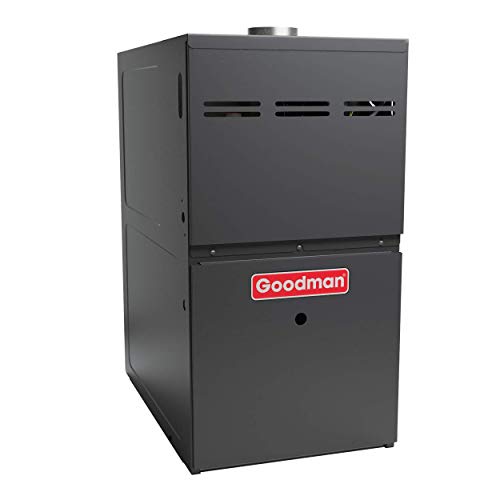
1. Goodman GR9S800803BN Furnace
The 80,000 BTU workhorse that slots into a standard 17.5-inch closet and quietly does the job.
Here is the balance point of the whole lineup: 80,000 BTU of gas input at 80% AFUE (Annual Fuel Utilization Efficiency, the share of fuel that turns into room heat), packed into a 17.5-inch-wide cabinet. That width is the number that matters most on install day, because it drops straight into the space most older furnaces vacated. The multi-speed ECM motor (a blower that changes speed to match demand instead of running flat out) spreads heat more evenly and takes the edge off the noise.
Buyers keep praising the build quality, and that is the main theme in the feedback. Reviewers describe a solid, well-made box that works exactly as the listing says. A furnace that simply works as listed is rarer than it should be. Installation feedback agrees: buyers who know their way around a mechanical closet call the swap straightforward.
Set expectations honestly, though. This is a single-stage gas valve, so it fires at full output and shuts off rather than idling at a lower stage. If your house has rooms that run hot and cold, a two-stage model higher up this list will smooth that out better. The other catch is the install direction: this is an upflow/horizontal unit and cannot be installed as a downflow, so if your ductwork exits the bottom, look for a model number starting with GD9 instead.
single-stage simplicity
- 80,000 BTU at 80% AFUE suits a mid-size home without oversizing the burn
- 17.5-inch cabinet is a direct fit for the standard closet width
- Multi-speed ECM blower evens out airflow and trims noise versus a fixed-speed motor
- Aluminized steel primary heat exchanger is the durable, common-sense build
eighty percent ceiling
- Single-stage valve means full-fire-or-off cycling, not a gentle low stage
- Upflow/horizontal only — a downflow duct layout rules this model out
- Thermostat, linesets, and LP conversion kit are all sold separately
budget installs: a mid-size house with a standard 17.5-inch closet and upflow or horizontal ductwork, where the install is a straight replacement.
high-efficiency goals: your ducts leave the bottom of the unit — this one physically cannot be flipped to downflow.
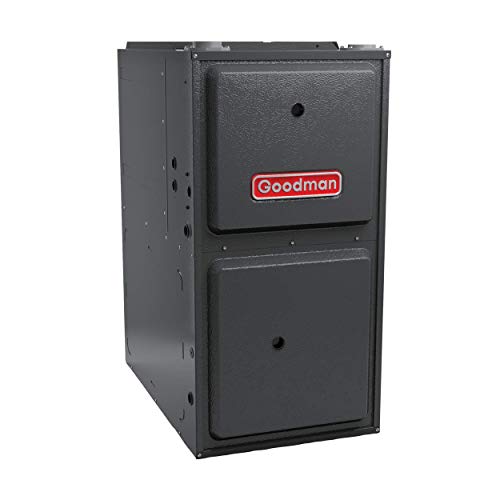
2. Goodman GR9S800804BN Furnace
Same 80,000 BTU burn as the top pick, but paired with a four-ton cooling coil and a longer warranty story.
The headline here is the 40-ton capacity rating on the spec sheet, and the practical read is that this furnace is set up to carry a four-ton air-conditioning coil on top of its 80,000 BTU heating load. For a household that wants one cabinet handling both heat and cooling, that pairing is the whole reason to pick this version over the model above. It runs the same 80% AFUE and the same multi-speed ECM blower, so efficiency and airflow character are unchanged.
What buyers come back to is the sense that this is serious equipment rather than a builder-grade box — the kind of unit an installer nods at and a homeowner stops worrying about. The function reports match: it heats, it holds, and it does not fuss. The warranty terms are the quiet bonus. Installed by a qualified installer and registered online within 60 days, this comes with a 10-year parts limited warranty plus a 10-year unit replacement limited warranty.
Compare it honestly to the 96% model further down: both deliver 80,000 BTU, but that one converts 96% of its fuel to heat versus this unit’s 80%. Over a long cold season that efficiency gap is real money. Where this one pulls ahead is total system value — if you need the cooling coil capacity, buying a furnace that already carries it saves you a separate component decision.
multi-speed blower: You are paying for the 40-ton capacity rating and the registered 10-year parts and unit replacement coverage, not for a higher AFUE number. If a four-ton coil is in your plans, this is the more complete cabinet.
single-stage cycling: the included-components listing on this model is muddled and mentions welding accessories, which nobody expects in a furnace box — confirm what actually ships before install day.
steady airflow: you are replacing a furnace and coil together and want the 40-ton capacity rating plus the registered warranty coverage.
premium efficiency: fuel efficiency is your priority — the 96% single-stage below does the same BTU with far less waste.
3. Goodman GR9S960803BN Furnace
The efficiency jump: identical 80,000 BTU heat, but 96% of the fuel becomes warmth instead of venting away.
This is where the math gets interesting. The GR9S960803BN delivers the same 80,000 BTU as the two models above, yet it scores 96% AFUE against their 80%. In plain terms, that is a big slice of every gas bill no longer leaving through the flue. For a house in a genuinely cold climate, where the furnace runs for months rather than weeks, that gap is the single most consequential number in this whole article.
You still get the multi-speed ECM motor, the aluminized steel primary heat exchanger, and the same upflow/horizontal-only installation rule. At 114 pounds it also comes in lighter than the 175-pound 80% model at the top of this list, which the installer will notice on the stairs. The cabinet stays at 17.5 inches, so the fit question does not change.
Reliability is the theme in the feedback, and it lines up with the build: the blower motor in particular gets described as running clean with no drama. The honest trade-off is one of flexibility. A single-stage valve means no low-fire stage to lean on, and at this efficiency level the venting gets fussier — condensing furnaces need proper vent kit planning, and vent kits here are sold separately. Budget for the installer to get that right.
cold-climate fuel savings: cold-climate homeowners who keep the same 80,000 BTU heat load but want far less fuel going up the chimney.
variable-speed wants: if you were counting on a variable low stage for gentle shoulder-season heating — this one fires at a single output.
4. Goodman GR9T800803BN Furnace
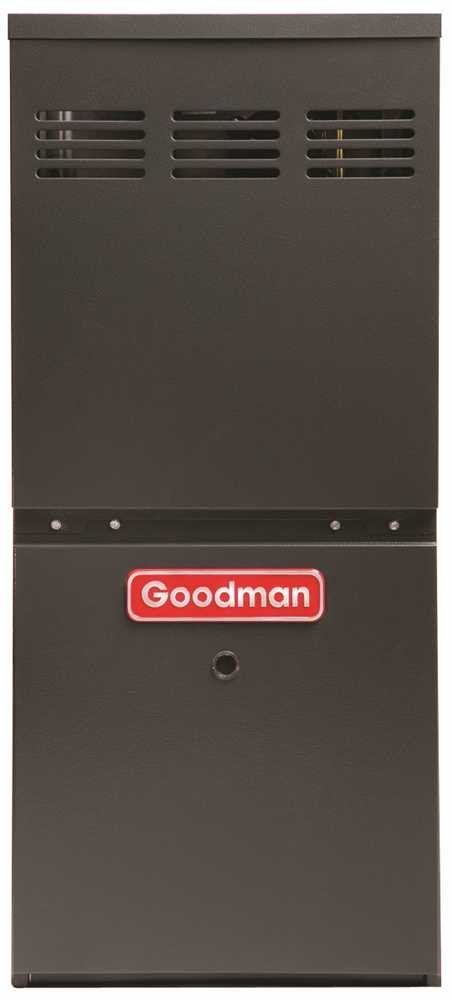
Two-stage heating in a 17.5-inch cabinet, for the homeowner who hates the on-off roar.
The two-stage gas valve is the whole argument for this model. Instead of firing at full output every time the thermostat calls, it can run a first stage and only step up when the house really needs it. That means longer, gentler run cycles and fewer cold-then-hot swings. The switch to two-stage operation even ships ready for the installer to activate with a dipswitch, so the flexibility is baked in. It does all of this at 80% AFUE with 80,000 BTU input.
Owners describe it as quiet in operation, and that tracks with a two-stage design that spends most of its life at lower fire. The patented TuffTube dual-diameter tubular heat exchanger is the durable core here, and the Silicon Nitride igniter uses an adaptive learning control aimed at long igniter life. The control board keeps the last five diagnostic codes in memory, which makes future service calls faster and cheaper — a detail you appreciate two winters in, not on day one.
The sensible comparison is against the efficiency pick: this one gives you the smoother two-stage heat but stays at 80% AFUE rather than 96%. You are choosing comfort character over fuel economy.
two-stage comfort: the two-stage valve and stored diagnostic codes are genuine quality-of-life features that show up every single day, not just at purchase.
eighty percent cap: at 80% AFUE it sheds more heat upbuy goes wrong.
Common Questions
How do I know which BTU furnace my house actually needs?
Is 96% AFUE worth it over 80% AFUE?
Can this furnace be installed in a downflow configuration?
What is the difference between single-stage and two-stage heating?
Will a 14-inch cabinet furnace fit where a 17.5-inch one will not?
What does the multi-speed ECM motor actually do for me?
Do I need to buy a thermostat and vent kit separately?
What is a low-NOx furnace and do I need one?
How heavy is a gas furnace and what does installation involve?
What warranty comes with these Goodman furnaces?
The Bottom Line
For most homes, the strongest buy among these top ranked furnaces is the Goodman GR9S800803BN. It delivers 80,000 BTU (British thermal units, a measure of heat output) at 80% AFUE (annual fuel utilization efficiency, the share of fuel turned into heat). That fits a standard 17.5-inch cabinet, so it slots into the most installs and handles the most heat loads.
If your winters are long and cold, reach for the GR9S960803BN instead — the same 80,000 BTU burn, but at 96% AFUE where far less fuel escapes the flue. And if quiet, even heat is the priority, the two-stage GR9T800803BN smooths out the cycle while keeping the 17.5-inch fit.
Let your calculated heat load and your cabinet width pick the model, then choose AFUE and stage count within that fit. Get the sizing right and you stop thinking about the furnace; get it wrong and you hear it every winter.
How we choose
We do not accept paid placement. Every pick is matched to a real buyer and a real use-case; we do not hands-on test units.
Sources
Specifications: manufacturer listings and product documentation. Review insights: verified customer reviews, as of November 2026. Pricing: not shown on this page (it changes often); check the current price via the retailer link.
As an Amazon Associate, Tactical Gear Guy earns from qualifying purchases. This does not affect which products we feature.