Specs are compiled from manufacturer listings and verified buyer reviews and can change over time — please confirm the key details on the product page before buying.
You want a movie night that actually feels like a movie night — dialogue you never strain to hear, explosions that land in your chest, and a setup that doesn’t require an engineering degree. A home theater system does that with a receiver, five speakers, and a subwoofer working together so sound comes from where the action is. The picks below span plug-and-play starter kits and component systems, from small rooms to large ones.
This guide is built by comparing the manufacturers’ published specifications and the patterns across verified customer reviews, so you get each pick’s real strengths and trade-offs instead of marketing spin.
The hard part is matching channel count, subwoofer size, and connectivity to the room you actually own. These nine picks are sorted by exactly those trade-offs. The right top home theater systems should match your room, your inputs, and your tolerance for wiring.
Top Picks

How To Choose The Best Top Home Theater Systems
The biggest mistake buyers make is choosing speakers before checking which inputs their TV offers. Your TV is the source, so the connection type between the TV and the system decides whether you hear true surround or a downmixed stereo signal. Settle that one question before anything else.
Start with the connection your TV actually has
HDMI ARC (Audio Return Channel) sends sound from the TV to the system over a single HDMI cable — one wire, no optical cable hunting. Optical is the older fallback and still works fine for standard surround. Bluetooth is convenient for music from your phone, but it is not how you get 5.1 surround from a movie. A system that lists ARC, optical, coaxial, and RCA covers every TV made in the last decade.
Match subwoofer size to your room
An 8 inch subwoofer driver moves less air than a 10 inch or 12 inch one, so it fills a small-to-medium room well and can sound strained in a big open space. The 12 inch subwoofer in the Klipsch package is built for room-filling low end. For an apartment with neighbors on the other side of the wall, the smaller driver is often the smarter and friendlier choice.
Decide if you want a built-in amp or a separate receiver
A kit with a built-in receiver in the subwoofer is one box, one power cable, and you are done — the trade-off is fewer upgrade paths. A separate AV receiver gives you HDMI switching, room correction, and the ability to swap speakers later. Budget-friendly kits lean toward the first; premium packages lean toward the second.
Count your sources before you buy
Game console, streaming stick, Blu-ray player, cable box — each one needs a home. A receiver with multiple HDMI inputs lets everything route through it and switch with one remote. A wired speaker kit with a single optical input expects the TV to do all the switching instead.
Side-by-Side Comparison
| Model | Best For | Channels | Subwoofer Driver | Peak Power | Amazon |
|---|---|---|---|---|---|
| Klipsch Reference R-26FA 5.1 Pack★ Best Overall | Best overall sound and Atmos height | 5.1 | 12 inches | — | Amazon |
| Bobtot 1000W Peak Surround SystemStarter Kit | Starter kit with karaoke inputs | 5.1 / 2.1 | 8 inches | 1000W | Amazon |
| Rockville HTS56Budget Champion | Big-room parties on a tight budget | 5.1 | 8 inches | 1000W | Amazon |
| Bobtot 1200 Watts Peak | Loudest bass per dollar | 5.1 / 2.1 | 10 inches | 1200W | Amazon |
| Logitech Z906 | THX-certified desktop and living room | 5.1 | 6.5 inches | 1000W | Amazon |
| Technical Pro 4 Channel 1600W | In-ceiling installs and multi-room audio | 4 channel | — | 1600W | Amazon |
| Yamaha YHT-4950U | 4K TV owners who want a real receiver | 5.1 | 8 inches | 400W total | Amazon |
| Fluance Elite SX51BR | Music-first listeners with floor space | 5.1 | 10 inches | — | Amazon |
| Yamaha YHT-4970U | 8K and next-gen gaming setups | 5.1 | — | — | Amazon |
Detailed Reviews
1. Klipsch Reference R-26FA 5.1 Home Theater Pack
Our pick — 4.5+★ from 400+ verified ratings; the strongest balance of quality and price.
The full-size tower system that puts Atmos height channels overhead without a single ceiling speaker.
What sets this package apart is where the sound comes from. The two R-26FA floorstanding towers carry built-in elevation speakers on top that fire upward, and those are the dedicated height channels that make Dolby Atmos sound like it is raining down from your ceiling. It is a genuinely different experience from a flat five-speaker ring — a helicopter passes over your head rather than around it.
The drivers underneath are serious hardware. Each tower runs dual 6.5 inch copper-spun woofers plus a 1 inch aluminum tweeter, and the box set includes the R-25C center speaker, a pair of R-41M bookshelf surrounds, and a 12 inch all-digital subwoofer. That is a real 12 inch driver handling low frequencies, which is the largest subwoofer in this lineup. Compare that to the Klipsch-vs-Bobtot gap on driver size: this package’s 6.5 inch tower driver against the 10 inch driver in the Bobtot 1200W kit, which is roughly a 54% larger cone on the Bobtot side. Klipsch answers back with tower cabinets and true Atmos rather than a single big bass bin.
Owners are overwhelmingly happy with what they hear, and the sound quality is the clear headline across the feedback. Value lands second — people are surprised at how much speaker comes in one box. Setup is described as straightforward, and the brushed black polymer veneer finish reads as furniture rather than gadget. The one thread worth flagging is compatibility: a handful of buyers hit friction pairing these with certain gear, so check that your receiver or amplifier matches the speaker load before you commit. The built-in elevation and stereo pairing features are worth reading up on if you plan to run a second zone.
What earns the top spot
- Built-in elevation speakers deliver real Dolby Atmos height effects from the towers themselves
- 12 inch subwoofer is the biggest bass driver in this lineup
- Complete kit: towers, bookshelf surrounds, center, sub, and grilles in one box
- Backed by a 5-year warranty, the longest in this lineup
Worth knowing before you buy
- Floorstanding towers need real floor space and a room that can breathe around them
- Compatibility drew mixed notes from some buyers — verify your amp match first
- No AV receiver in the box, so you supply the switching and decoding hub
Best fit for: a dedicated movie room where you can place tower speakers properly and want Atmos height without ceiling work.
Think twice if: your space is a compact apartment or you want a one-box system with the amp already built in.
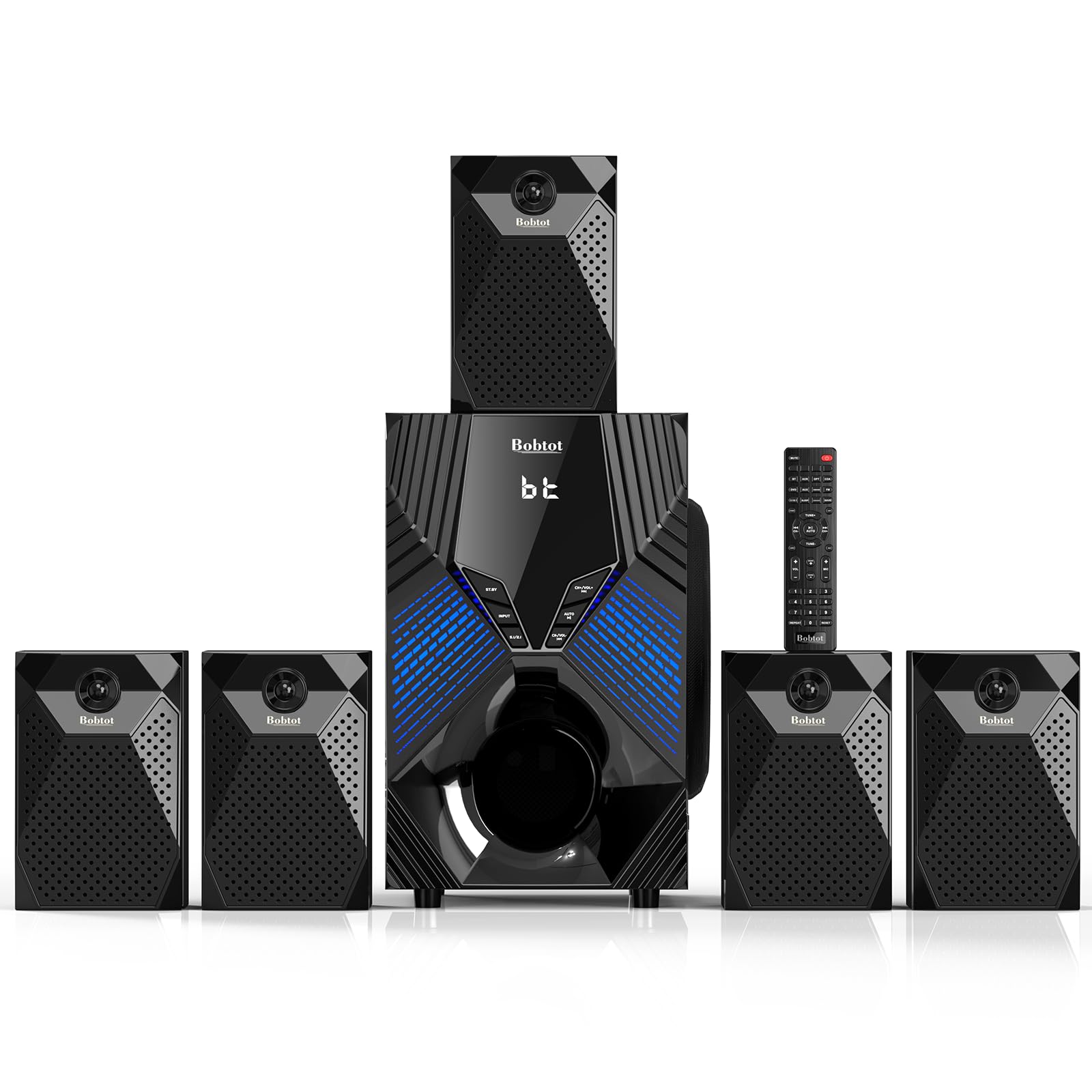
2. Bobtot 1000W Peak Surround System 8 inch Subwoofer
The plug-it-in-and-go kit for a first surround setup, karaoke nights included.
Here is the simplest possible path to five-channel sound: one subwoofer with the receiver built into it, five wired satellite speakers, and every cable you need in the box — ARC, optical, and a 3.5mm-to-RCA lead. You plug in your TV, pick an input, and you are watching a movie. The 1000W peak power rating and 8 inch subwoofer driver are sized for a small-to-medium room, which is exactly where most first systems live.
Input coverage is broader than the tier suggests. You get TV ARC, optical, coaxial, AUX, USB, and Bluetooth, plus DVD support and USB/SD card playback. The Bluetooth radio connects to the subwoofer, and a 33 inch stated range means you keep your phone close — fine for queuing up a song, not for wandering the house. The two mic inputs with echo control turn the system into a party machine, and the six multi-colored LED flashing modes add atmosphere if that is your thing.
The bass is the part owners talk about most, and it holds up with a decent punch in a normal living room. Value and easy setup round out the praise. Two areas sit in mixed territory: reliability and volume. Some units reportedly don’t hold up long term, and a few wish the system pushed harder at the top end. Treat this as a well-priced entry point rather than a forever system, and you will be pleased.
Where it shines: One box, one power lead, and a full set of cables means the setup window is measured in minutes, not an afternoon.
Honest caveat: Peak power ratings describe short bursts, not sustained output, so judge this by your room size rather than the number on the box.
Reach for this if: you want genuine 5.1 surround in a modest room without buying a receiver separately, and karaoke matters to you.
Look elsewhere if: you need long-term reliability above all else, or your living room is large and open-plan.
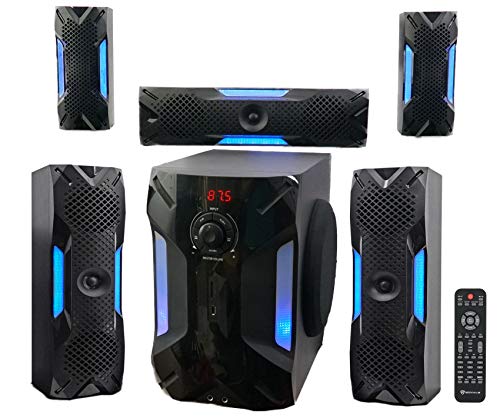
3. Rockville HTS56 5.1-Channel Bluetooth Home Theater System
Five satellites, an 8 inch sub, and a feature list that reads like a party DJ’s wish list.
The HTS56 is the most feature-dense budget system here. 1000W peak power across five satellite speakers and an 8 inch subwoofer, plus Bluetooth, USB, SD, RCA, and optical inputs so almost any source has a home. A 5-band equalizer lets you shape the tone yourself, and the two mic inputs with echo control make karaoke a first-class feature rather than an afterthought.
The installation package is unusually complete for the tier. The LED display and subwoofer/satellite lights include blink-to-beat and spectrum analyzer modes, all controllable from the included remote. Bluetooth range is listed at 10 meters, and there is an FM radio tuner built in.
Sound quality is where this system wins people over — the volume of praise in that department dwarfs everything else, and value for money is a close second. Setup gets consistent nods too. The honest notes sit in durability and noise: some reports describe speakers giving out within the first month, and a handful of smart TVs gave buyers Bluetooth pairing headaches. That is a real caveat, though it sits against a very large pool of happy owners. If you want max features per dollar and can accept a little risk, this delivers.
The feature argument: EQ control, FM radio, two mic inputs, 30-foot speaker runs, and mounting hardware in one budget package is a lot of capability in a single box.
The trade-off to weigh: Durability is the recurring weak spot in the feedback, so treat this as a value play you might replace rather than an heirloom component.
The right buyer: someone furnishing a rec room or garage theater where loud, feature-rich sound matters more than long-term component longevity.
Not the right buyer: an audiophile building a permanent main-room setup who needs drivers to survive years of daily use.
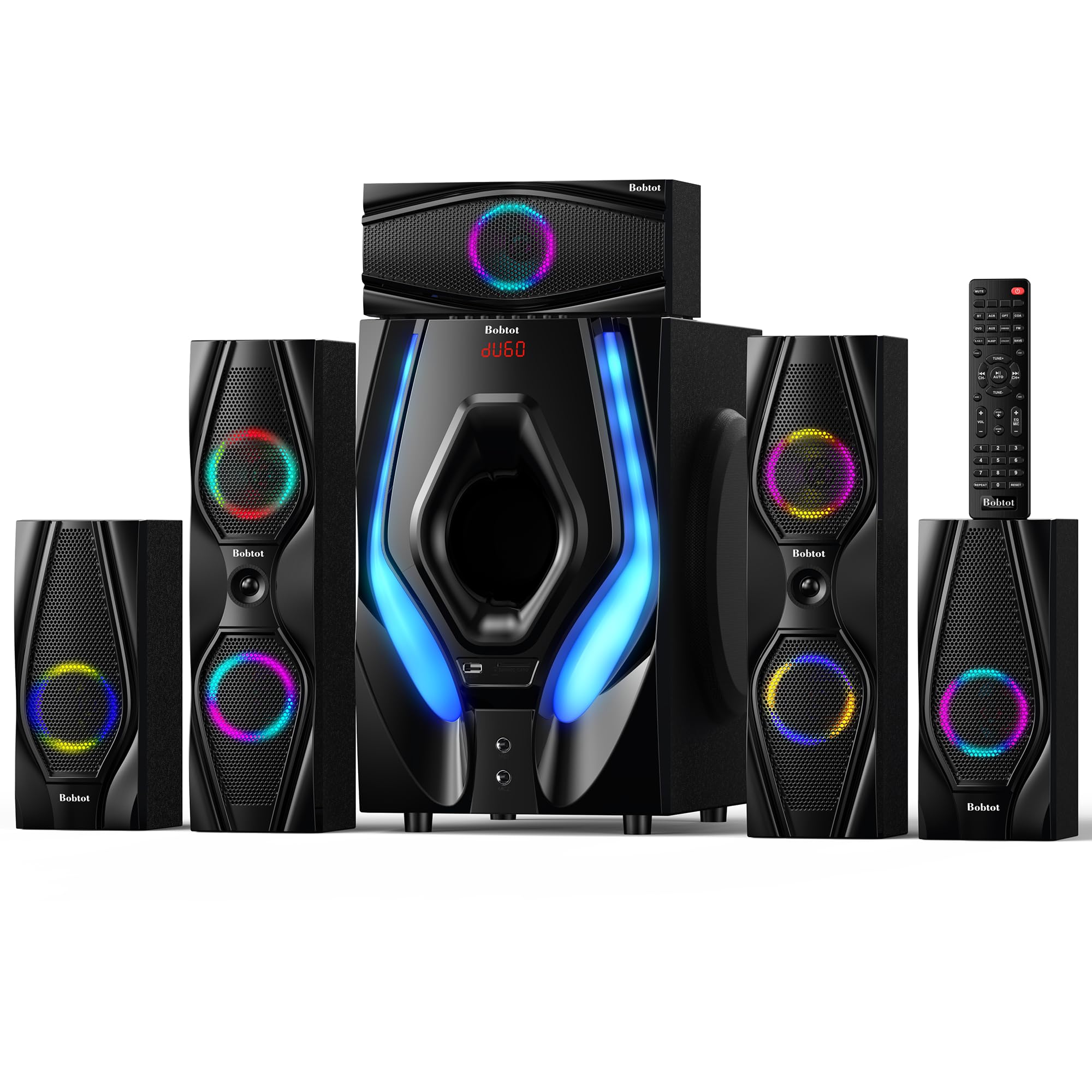
4. Bobtot 1200 Watts Peak Surround Sound Speakers
A 10 inch subwoofer and 1200W peak rating aimed squarely at people who want to feel the floor move.
Start with the number that matters: 10 inches. That is the diameter of the subwoofer driver in this Bobtot kit, and it is the spec that separates it from the 8 inch systems in the same family. Compared with the 6.5 inch driver in the Logitech Z906, that is a meaningfully larger cone — the Bobtot driver spans roughly 54% more across. Bigger cones move more air, and more air means deeper, heavier bass at the low end.
The rest of the package keeps pace. You get 1200W peak power (the most the built-in receiver can push at once) through a built-in receiver, switchable between 5.1 and 2.1 surround modes via remote or the subwoofer’s front panel. Bluetooth V5.3 (the current wireless standard for pairing your phone) handles direct connection from your phone, and ARC, optical, coaxial, AUX, USB, and DVD inputs cover the TV-and-console crowd. Cable runs are generous where it counts: 31 feet to the rear speakers, 13 feet to the front pair, and 10 feet to the center — enough slack to put surrounds behind a sofa in a normal room without splicing.
Four LED lighting modes on the subwoofer (blink to the beat, solid, spectrum analyzer, off) and a full-function remote that adjusts each speaker’s volume independently are the fun extras. Bass and sound quality carry the feedback, with value close behind. Where it gets muddier: reliability and the remote. Some buyers report partial speaker function or pairing trouble, and cable length drew a few wishes for more. Those sit in mixed territory rather than as a rule — this is a popular, capable kit with occasional rough units.
What you are really buying: the largest subwoofer driver in this mid-tier family paired with enough cable length to actually position surround speakers correctly.
The catch: all wiring between satellites and the subwoofer is physical, so plan the cable routes before you move furniture — nothing here is wireless except Bluetooth audio.
Built for: a medium room where you want bass you can feel and you don’t mind running speaker wire along the baseboards.
Skip if: you need a fully wireless surround arrangement or a receiver with HDMI switching built in.
5. Logitech Z906 5.1 Surround Sound Speaker System

The desk-and-living-room workhorse with THX certification and six devices able to share it.
THX certification is the headline, and it is not a marketing badge you can buy freely — it means the system met a defined performance standard for home theater playback. Add built-in Dolby Digital and DTS decoding, and the Z906 processes surround soundtracks itself rather than relying on your TV to do it. Power lands at 1000W peak and 500W RMS, the latter being the number that describes sustained output rather than a momentary burst.
Connectivity is where this beats most of the field. Six compatible devices can connect at once across 3.5mm, RCA, six-channel direct, digital coaxial, and optical inputs — so a game console, a PC, a TV, and a music player can all stay plugged in permanently. Controls come two ways: an integrated control console on the desk and a wireless remote. The five satellites and center channel are wall mountable, and individual speaker levels are adjustable so you can lift dialogue without drowning the room in bass.
Owners mention sound quality as the runaway strength, with value and ease of setup close behind. Input options get steady praise too. The recurring caveat is durability: customers note individual speakers failing months into ownership, and functionality draws mixed notes overall. Volume control and level adjustment also split opinion slightly. Against that, this is among the most proven systems in the category, and the 6.5 inch subwoofer driver is modest compared with the 10 inch Bobtot above — you buy this for processing and connectivity, not for bass volume.
Reasons this earns its reputation
- THX certification plus built-in Dolby Digital and DTS decoding — it processes surround itself
- Six simultaneous inputs across 3.5mm, RCA, six-channel direct, coaxial, and optical
- 500W RMS sustained output alongside the 1000W peak rating
- Satellites and center channel are wall mountable for a clean install
The honest reservations
- 6.5 inch subwoofer driver is smaller than most in this lineup, so bass is tight rather than floor-shaking
- Long-term durability shows up as the weak point in owner reports
- No HDMI inputs — you connect by optical, coaxial, or analog instead
The strong match: a desk or mid-size room where a gaming PC, console, and TV all need to share one speaker set with proper decoding.
The mismatch: a buyer who wants HDMI switching and room correction — that lives in a dedicated AV receiver instead.
6. Technical Pro 4 Channel 1600 Watts

Four pairs of flush-mount speakers and a 1600W amplifier for people who want sound with no boxes on the floor.
This is a different shape of product from everything else here, and you should know that going in. Instead of five satellites and a subwoofer, you get an amplifier plus four pairs of 5.25 inch in-wall or in-ceiling speakers. The amp pushes 1600W peak and 120W RMS, with rotary knobs for equalization and master volume, plus blue LED-illuminated buttons for visibility in a dark room.
The installation story is the real selling point. Flush-mount speakers sit inside the wall or ceiling, so a finished room stays finished — no floor stands, no cable runs across the carpet, no speakers to knock over. Speaker terminals are designed for quick wire connection, and the 1 inch high-temperature voice coil is built to handle sustained output. Bluetooth works at a stated 30 foot range, and there are RCA ports for wired sources. Note that HDMI is not native: reaching an HDMI device means an RCA-to-HDMI adapter, which is not included.
Feedback on this one is thin, so read it as an early picture rather than a proven track record. Sound quality draws positive notes. Build quality is the split issue — some buyers are happy with the construction, others are disappointed. Because this is an install product, the finish and fit of the flush-mount hardware matters as much as the audio, and that is exactly where opinion divides.
The real appeal: four pairs of ceiling speakers and a 1600W amplifier turns a whole room — or several — into a distributed audio zone without a single visible speaker cabinet.
The planning burden: this is a cutting-and-wiring job. Budget the time and tools for wall or ceiling work before you order.
Made for: a remodel, a finished basement, or a room where visible speakers are not welcome and distributed audio across multiple zones is the goal.
Pass on this: if you want a standard 5.1 movie surround arrangement you can set up this weekend — this is a different job entirely.
7. YAMAHA YHT-4950U 4K Ultra HD 5.1-Channel System

A real AV receiver in the box, with room correction that tunes the sound to your walls.
The jump to a component receiver is the reason to pick this one. Total output power reaches up to 400W, delivered through a discrete amp configuration and a low-jitter PLL circuit — that second part is a clocking design meant to keep digital audio clean. The 8 inch powered subwoofer handles 50W RMS, and the five-channel setup supports HD audio formats including Dolby TrueHD and DTS-HD Master Audio.
YPAO sound optimization is the feature that separates this from a plain speaker kit. It analyzes your room’s acoustics and adjusts the audio parameters to suit — useful in a living room with an odd shape or a lot of hard surfaces. Cinema DSP goes further, reproducing the acoustic character of named venues so a concert can sound like a concert hall. If rear speaker placement is impossible, Virtual Cinema Front simulates five-channel surround from the front pair alone.
On the video side, 4K UHD pass-through runs at 60 frames per second with HDR10, Dolby Vision, and HLG support, plus HDMI with ARC, eARC, 3D, upscaling, and CEC. Bluetooth handles wireless streaming, and the Compressed Music Enhancer works to restore sparkle to compressed tracks. Reviewers point out strong quality and sound, with easy setup close behind. The mixed note is reliability — most units run flawlessly, while some report the system shutting down. The bundle adds cable management ties and a cleaning kit.
Why the receiver matters: YPAO room tuning and Cinema DSP are things a passive speaker kit simply cannot do — they adapt the sound to your actual room instead of assuming a perfect one.
What to watch: 400W is total system output, not a per-channel figure, so match this to a normal living room rather than a large dedicated theater.
Choose this when: you own a 4K TV with HDR and want a system that switches your sources and tunes itself to the room.
Keep looking if: you need the highest sustained power for a very large space, or 8K video passthrough for a next-gen console.
8. Fluance Elite High Definition 5.1 Speaker System (SX51BR)

Wood-cabinet towers and a 10 inch sub built for stereo listening as much as movie night.
These are speakers, not a system with a brain — and that is the point. The Fluance Elite package is a timbre-matched set of five speakers plus a DB10 powered subwoofer. The floorstanding towers run a three-way design: separate high-frequency tweeters, dedicated midrange drivers, and the bass handled by the sub. Splitting the frequency range across three driver types is what keeps vocals clean and instruments separated when a soundtrack gets busy.
Cabinet construction is a genuine differentiator here. The engineered MDF wood enclosures are built to suppress resonance, and the black ash woodgrain finish makes them look like furniture rather than electronics. Isolation floor spikes come included for the towers — eight of them — so the cabinets couple to the floor rather than wobbling on carpet. The 10 inch subwoofer driver is the bass anchor, and the package is matched so every speaker shares a tonal family.
The feedback story is short and positive: sound quality leads, build quality follows, and value rounds it out. Buyers describe crisp highs and well-crafted cabinets. Note what is absent from the spec sheet, though: there is no receiver, no HDMI, and no decoding — connections are RCA or 3.5mm only, so you must supply an amplifier or AV receiver to drive them. Warranty coverage is unusually strong: a lifetime parts-and-labor warranty direct from the manufacturer on the speakers, and 2 years on the subwoofer.
What makes it stand out
- Three-way tower design separates highs, mids, and bass across dedicated drivers
- Engineered MDF cabinets with black ash woodgrain finish suppress distortion and look good doing it
- 10 inch DB10 powered subwoofer anchors the low end
- Lifetime parts-and-labor warranty on the speakers, 2 years on the subwoofer
Before you commit
- No amplifier, receiver, or decoding in the box — you supply the hub
- RCA and 3.5mm only, so HDMI sources need a receiver in the chain
- Floorstanding towers demand real floor space and careful placement
Where this fits: a listener who already owns or plans to buy a receiver, values cabinet craftsmanship, and wants music to sound as good as movies.
Where it doesn’t: anyone hoping to unbox a system and plug a TV straight into it — nothing here decodes a surround signal on its own.
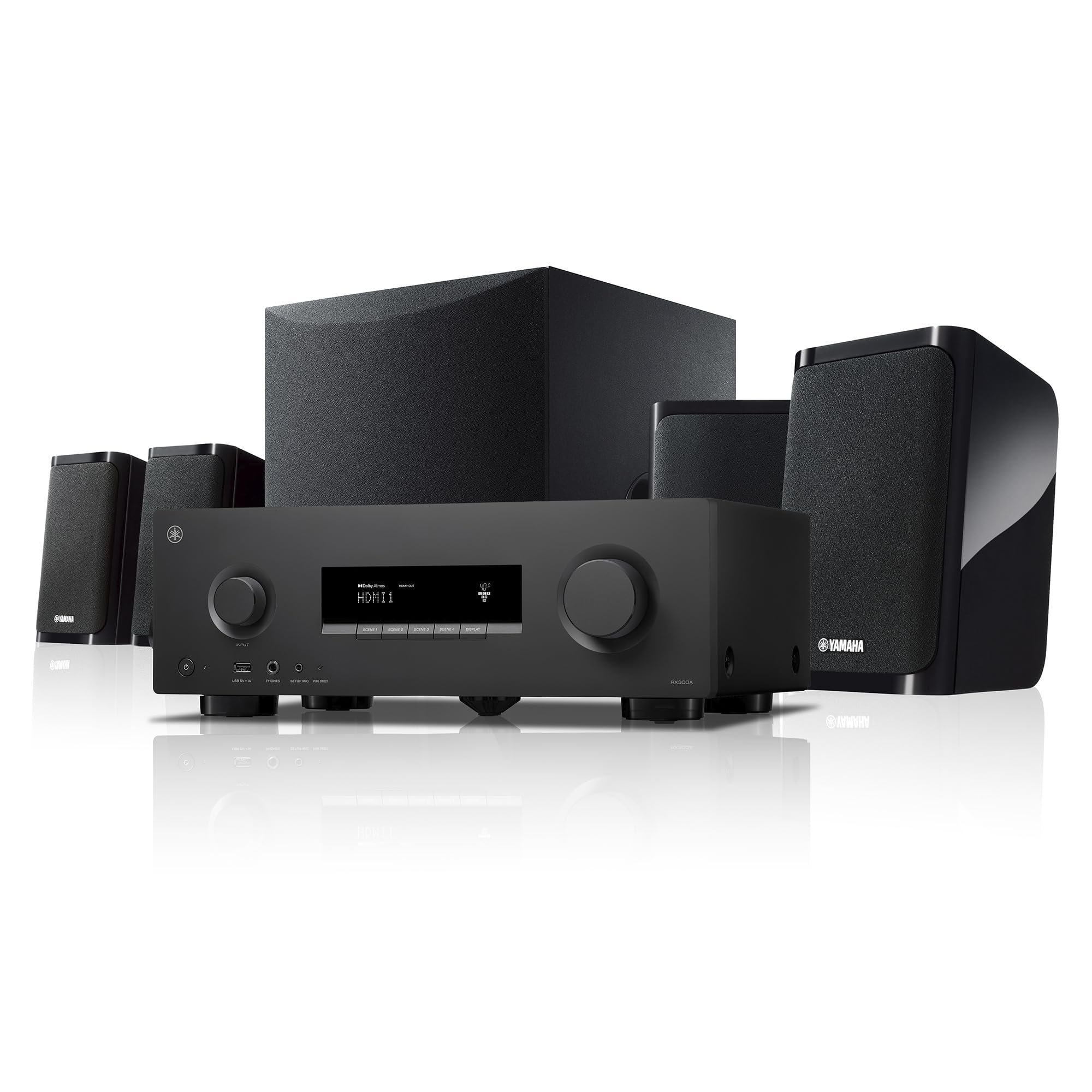
9. YAMAHA YHT-4970U 5.1-Channel System with Dolby Atmos
The one built for a next-gen console: 4K at 120 frames per second and 8K at 60.
Video bandwidth is the defining feature, and it is worth being precise about it. This package passes 4K resolution at 120 frames per second and 8K at 60 frames per second, so a fast console or 8K screen runs at full speed instead of being throttled by the receiver. It also supports Dolby Vision and HDR10+ dynamic range (formats that keep bright and dark scenes detailed), HDMI eARC/ARC (the audio return channel that sends TV sound back through one cable), and gaming features including ALLM (auto low latency mode, which cuts input lag) and VRR (variable refresh rate, which stops screen tearing). If you own a current-generation console or an 8K display, those are the specs that stop your TV from being the bottleneck.
The audio side runs Dolby Atmos and DTS Virtual:X for dimensional sound, so effects move around and above you rather than staying stuck at the screen. The box includes a Yamaha RX300A AV receiver with its own remote, two AAA batteries, an FM antenna, a setup microphone on a cardboard stand, the five speakers, a powered subwoofer, 80 feet of speaker wire, and a 16 foot subwoofer cable. That setup microphone measures your room’s acoustics and speaker characteristics so the receiver can tune itself. Bluetooth Multipoint pairs two source devices at once, so you can switch from a phone to a tablet without re-pairing.
The whole package weighs 50.4 pounds, so plan for a two-person unboxing. Owner feedback here is genuinely split, and you should hear both sides. Some call the receiver great and appreciate the system as an entry point into surround sound. Others describe the speakers as the weak link, saying it entirely lacks bass and that voices sound hollow. This is a newer release with a smaller feedback pool, so weigh the video capability against the speaker quality honestly — the electronics are ahead of the included speakers.
The video case is strong: 4K/120, 8K/60, VRR, and ALLM mean this receiver will not hold back a modern console or display for years.
The audio caveat is real: the receiver is the star and the bundled speakers are the compromise — budget to upgrade them later if bass depth matters to you.
Best suited to: a gamer with a 4K/120 or 8K display who wants Atmos, room correction, and full HDMI switching from one box.
Not the right call: if deep bass and premium speakers top your list — put the money into a speaker-first package and add a receiver separately.
Know the Specs
Peak Power vs RMS Power
Peak power is the maximum burst a system can produce for an instant — the loudest single hit. RMS (root mean square) is the sustained power it can hold continuously. A 1000W peak rating with 500W RMS means the system settles at 500W for normal listening. When comparing systems, RMS is the fairer number; peak figures flatter the spec sheet. If only a peak number is published, judge by subwoofer driver size and room size instead.
Channel Count: 5.1, 2.1, and Multizone
The number before the decimal is how many speakers carry the sound; the number after is the subwoofer. A 5.1 system places three speakers across the front (left, center, right) and two behind you — that rear pair is what makes a sound feel like it came from behind. A 2.1 setup uses just two speakers and the sub, so effects stay in front of you. Some kits switch between the two modes depending on the source.
Subwoofer Driver Size
The driver is the cone that moves air. An 8 inch driver handles small-to-medium rooms comfortably; a 10 inch or 12 inch driver moves more air and reaches deeper. Bigger is not automatically better — a 12 inch sub in a small apartment will overpower the room and annoy the neighbors. Match driver size to the space, not to the spec sheet.
HDMI ARC, eARC, and Optical
ARC (Audio Return Channel) sends sound from your TV back down the HDMI cable to your system — one cable carries video up and audio down. eARC is the newer version with more bandwidth for uncompressed formats. Optical does the same job with a light-based cable and works on older TVs, but carries less data. Bluetooth is for phone-to-system music, not surround sound from a movie.
Common Questions
Will a 5.1 home theater system work with any TV?
Do I need a separate AV receiver to run these systems?
How much bass does an 8 inch subwoofer actually deliver?
What does THX certification on the Logitech Z906 mean?
Is Dolby Atmos worth paying extra for?
Can I wall mount the surround speakers?
How long do speaker wires need to be for rear surround placement?
Why do some home theater systems shut down or lose speakers?
Do I need a subwoofer cable and speaker wire separately?
Can an in-ceiling speaker system replace a 5.1 surround setup?
The Bottom Line
For a movie room where you can place real speakers and want overhead sound without drilling into the ceiling, the Klipsch Reference R-26FA 5.1 Pack is the clear winner — dedicated Atmos elevation speakers (up-firing drivers that bounce sound off the ceiling), a 12 inch subwoofer, and a 5-year warranty make it the most complete package in this lineup. If you would rather have a receiver that switches your sources and tunes itself to the room, the Yamaha YHT-4950U handles that job with 4K pass-through and YPAO room correction (Yamaha’s auto-calibration that adjusts the sound to your room). And for a next-gen console on a 4K/120 or 8K display, the Yamaha YHT-4970U is the one built for that bandwidth.
If bass is what you crave, the Bobtot 1200W kit puts the largest subwoofer driver in the mid-tier family under your TV for far less than a component system. If you want the most proven processing and the broadest input selection, the THX-certified Logitech Z906 has earned its following the hard way, and it is the safe bet for anyone who values connectivity over raw bass. And if you are remodeling and want no visible speakers at all, the Technical Pro four-channel in-ceiling kit turns the whole room into a speaker.
One last nudge: the Klipsch package is the crowd favorite here, and it holds both the highest rating and the largest warranty in this lineup — if you can give its towers floor space, that is the one to buy.
How we choose
We do not accept paid placement. Every pick is matched to a real buyer and a real use-case; we do not hands-on test units.
Sources
Specifications: manufacturer listings and product documentation. Review insights: verified customer reviews, as of November 2026. Pricing: not shown on this page (it changes often); check the current price via the retailer link.
As an Amazon Associate, Tactical Gear Guy earns from qualifying purchases. This does not affect which products we feature.