Specs are compiled from manufacturer listings and verified buyer reviews and can change over time — please confirm the key details on the product page before buying.
If your picture keeps freezing during the fourth quarter, the fix is almost never a new TV — it is the antenna. This guide covers what actually pulls in free broadcast channels, how far each design really reaches, and which ones are built for a rooftop versus a windowsill. Below are nine antennas worth your attention, from thin indoor panels to motorized outdoor masts, all rated for 4K or NextGen TV where the broadcaster offers it.
This guide is built by comparing the manufacturers’ published specifications and the patterns across verified customer reviews, so you get each pick’s real strengths and trade-offs instead of marketing spin.
You will see how range, amplifier design, and mounting location decide whether you get forty channels or four. Here is the practical breakdown of a Top HD TV Antenna, plus which design suits a city apartment versus a rural rooftop.
Top Picks

How To Choose The Best Top HD TV Antenna
Start by finding out where your local broadcast towers sit relative to your house — most station lookup tools draw a map with a compass bearing. That single step decides more than any spec on the box, because an antenna pointed at a tower pulls in signal your neighbor’s random setup never finds.
Match the range claim to your actual distance
Range figures are stated for an ideal install with a clear line of sight. Trees, hills, brick walls, and metal siding all eat into that number, so a 70-mile antenna mounted indoors may behave like a 25-mile one. Aim for headroom on paper: if towers are 30 miles out, an antenna rated well beyond that gives you margin for bad weather.
Directional versus multidirectional reception
A multidirectional antenna (often called omnidirectional) picks up UHF and VHF signals from several compass directions at once — useful when your towers are scattered and you do not want to climb up to re-aim. A directional design with a reflector focuses harder on one bearing and generally rejects more interference, which helps if all your stations cluster in one direction.
Indoor panel or outdoor mast
An ultra-thin indoor panel mounts to a wall or window and takes minutes to set up, making it the easy pick for an apartment or a renter. An outdoor mast on the roof or in the attic reaches further and sits above obstructions. If you have an attic outlet and a coax run already in place, an attic mount splits the difference nicely — out of the weather, out of sight.
Amplifier and 4G LTE filter
An amplified antenna boosts the signal right at the antenna head, which makes up for loss over a long coax run. A 4G LTE filter strips out interference from nearby mobile-phone towers, a common cause of channels dropping out on one set but not another. If your towers are close, an unamplified antenna can actually work better — too much boost can overload the tuner and cost you channels.
Side-by-Side Comparison
| Model | Best For | Max Range | Mount Type | Reception Style | Amazon |
|---|---|---|---|---|---|
| GE Outdoor HD Digital TV Antenna (29884)★ Best Overall | Attic or rooftop on a budget | 70 miles | Outdoor / attic | Directional | Amazon |
| Channel Master FLATennaBest for City Windows | Urban windows and tabletops | 35 miles | Indoor wall / window / tabletop | Multidirectional | Amazon |
| GE Outdoor HD Digital TV Antenna (33685)Longest Single-Tower Reach | Long-distance single-tower aiming | 80 miles | Outdoor / attic | Yagi directional | Amazon |
| pbd Outdoor 360° Rotation | Two TVs, one antenna | 150 miles | Outdoor pole | Motorized rotatable | Amazon |
| 1byone Omni-Directional Outdoor | Set-and-forget rooftop | 100 miles | Outdoor / attic / RV | 360° omnidirectional | Amazon |
| Winegard FlatWave FL5500A | Upstairs windows in metro areas | 60 miles | Indoor | Multidirectional | Amazon |
| Channel Master Omni+ 50 | Rooftop or RV full-circle pickup | 50 miles | Indoor / outdoor / RV | 360° omnidirectional | Amazon |
| Five Star Outdoor HDTV Antenna | Feeding multiple TVs | 200 miles | Outdoor / attic / roof | Multidirectional | Amazon |
| Antennas Direct ClearStream 2V | Long-range UHF plus Hi-VHF | 316,800 feet | Indoor / attic / outdoor | Multi-directional with reflector | Amazon |
Detailed Reviews
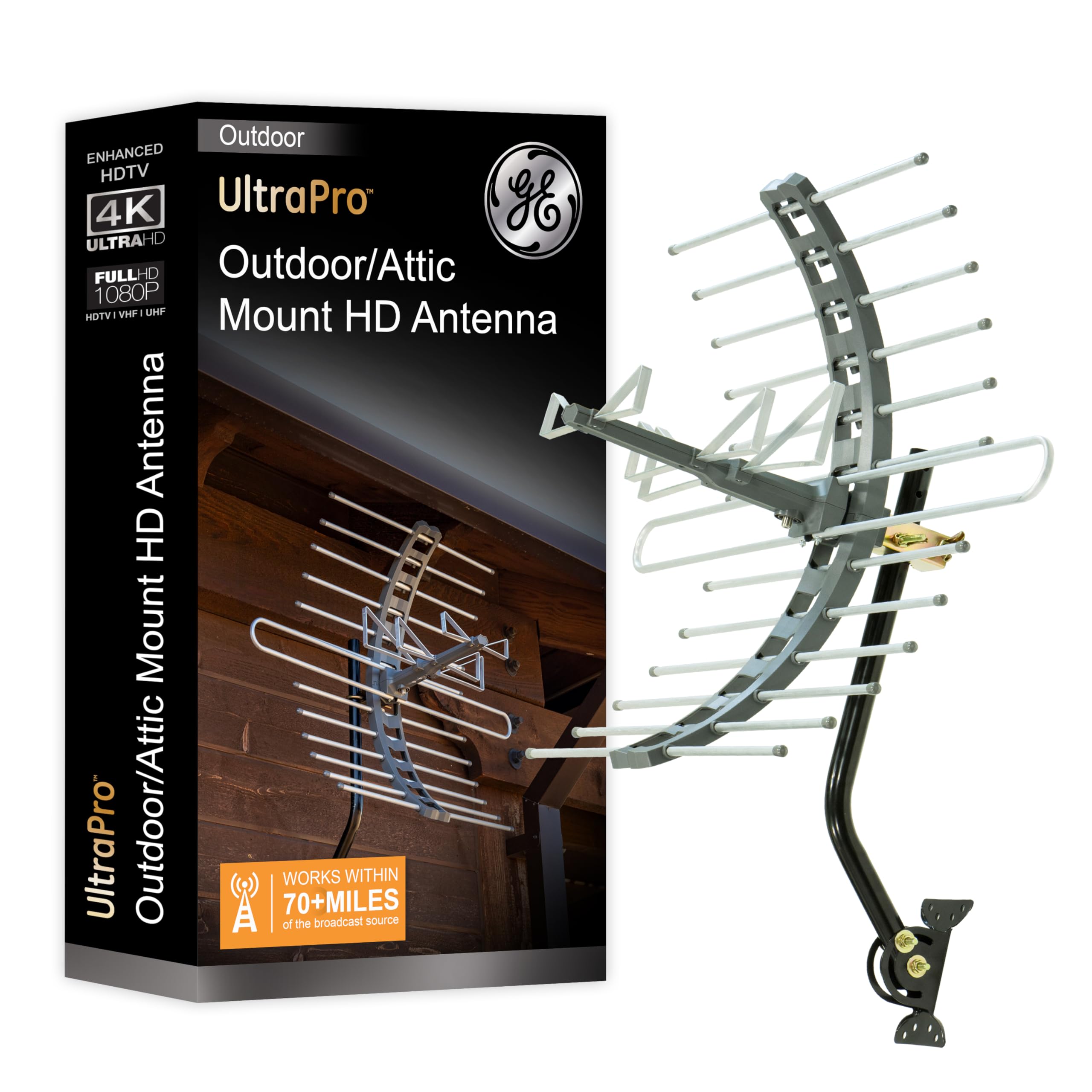
1. GE Outdoor HD Digital TV Antenna
Our pick — 4.0+★ from 10,500+ verified ratings; the strongest balance of quality and price.
A 70-mile outdoor antenna that slots into your attic and disappears.
The number that sells this one is 70 miles — the stated range for pulling in VHF and UHF broadcast signals, the two frequency bands local stations use. That is double the 35 miles the Channel Master FLATenna promises, and it is the reason this GE holds the top spot for anyone outside the city core. It ships with a J mount, the L-shaped bracket that lets you hang it from a wall, roof, or existing mast, and it can also sit inside an attic where weather never touches it.
The build is weather resistant and rated for outdoor roof or mast use, and it weighs 3 pounds — light enough that one person can haul it up a ladder. It handles 4K and 1080p today and supports ATSC 3.0, the newer broadcast standard that a growing number of stations use for stronger signal and better sound. A 75-ohm impedance rating is the standard match for home coax, so it plugs into any TV brand or converter box with a normal antenna jack.
What wins people over is simple reliability — functionality is the thing the antenna is praised for most across the owner reviews, and the channel count reports back that up. Buyers report “50+ channels over 50 miles from the source,” roughly three-quarters of the 70-mile rating. The honest catch is setup guidance: assembly and the instruction sheet draw the most friction, so plan on a little patience or a quick search for a mounting walkthrough. It is a 4.0+ star product with a huge base of 10,000+ ratings, and that volume tells you the core works.
Why it earns the crown
- 70-mile stated range handles suburban towers comfortably
- Ships with a J mount for wall, roof, or mast hanging
- ATSC 3.0 ready for NextGen TV broadcasts where available
- 3 pounds — manageable for a solo ladder install
- Attic option keeps it out of the weather entirely
Where it asks for patience
- Assembly and instructions are the recurring friction point
- Indoor attic placement can cut the rated range noticeably
Made for: anyone 30 to 70 miles from the towers who wants one antenna on the roof or in the attic and done.
Think twice if: your stations are all inside 20 miles and you want a plug-and-play indoor panel instead.
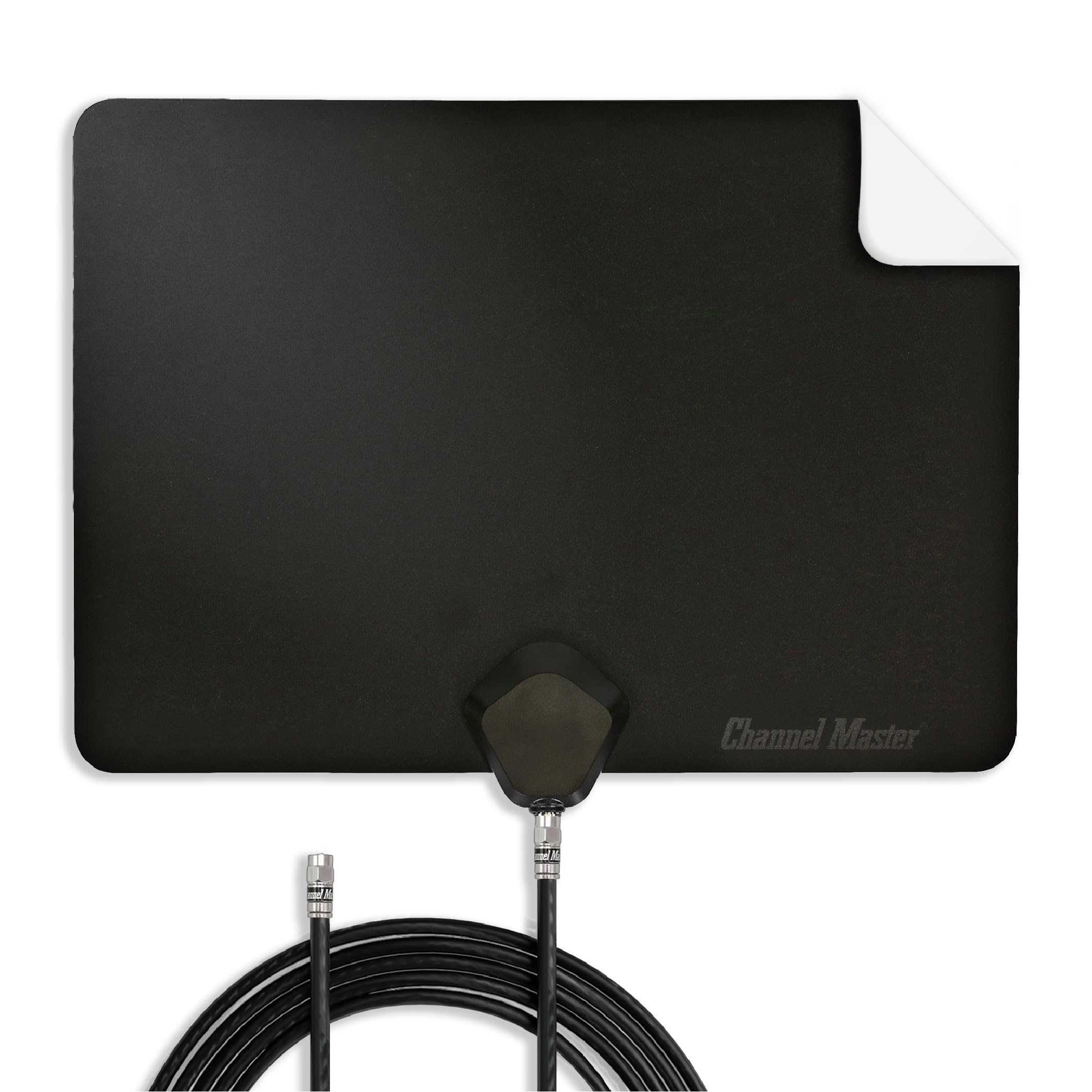
2. Channel Master FLATenna Indoor Digital HDTV Antenna
A paper-thin panel that sticks to a window and starts scanning.
Channel Master rates this at 35 miles, and that is deliberate honesty rather than a weakness — the company builds the figure around real-world obstructions and interference instead of an open-sky ideal. It measures 12 inches by 15 inches, so it hangs on a wall, stands on a tabletop, or presses against a window without hogging a frame. The black-and-white reversible finish lets you flip it to match the room.
The kit includes a 12-foot RG6 coaxial cable, the thicker shielded type that loses less signal than a skinny wire, and a 75-ohm impedance match keeps it friendly with any TV. Ninety-nine channels is the count owners mention reaching with it, and reception is what the panel is praised for most. Customers note “receiving up to 99 live digital local channels and providing clear reception,” a strong result for a 35-mile indoor panel.
The trade-off sits in that cable. Twelve feet is short, so your antenna placement is tied closely to your TV or wall outlet unless you add a coax extension. Some owners find that reach limiting. The pre-drilled holes make wall mounting quick, and 4.0+ stars across 2,000+ ratings reflects a panel that does its best work in a metro apartment where towers are nearby.
Signal value: The short-range spec is a fit guide, not a flaw — if your towers are within about 35 miles and you face a window, this delivers clear local channels with almost no setup hassle.
The cable caveat: That 12-foot RG6 lead dictates where the panel can live, so measure your run before you commit to a window mount.
Reach for this if: you rent, want nothing on the roof, and have towers within a short drive.
Look elsewhere if: your stations are far out and you need a mast-mounted long-range design.
3. GE Outdoor HD Digital TV Antenna OTA
A Yagi-style rooftop antenna built to reach 80 miles in one direction.
This is the bigger sibling of the top pick, and its 80-mile stated range edges past that antenna’s 70. It is a Yagi design — a row of parallel elements that focuses reception in one direction, which is exactly what you want when your stations cluster on a single bearing. At 37 inches long by 26.5 inches wide by 19 inches high, it is a genuine rooftop fixture, and it comes with a weather-resistant mounting bracket, mast clamp, and J mount for wall, roof, or standard mast hanging.
Channel reception is what buyers praise most here, and the reports bear out the reach. Reviewers point out the antenna “receives over 100 channels and works well within 20-mile range,” so it delivers a heavy channel count even well inside its 80-mile rating. Picture quality comes out clean with no pixelation, and it is ATSC 3.0 compatible for NextGen TV where the standard is live. It also handles 4K and 1080p, and a 75-ohm impedance keeps it matched to standard home coax.
Two things to know before you buy. The assembly instructions are the weakest link and draw criticism, so a second set of hands and a mounting guide help. And the physical size draws mixed feelings — one crowd likes the compact footprint, another expected more antenna for the money. But installation gets solid marks, and 4.0+ stars across 700+ ratings says the aiming pays off for long-distance viewers.
Who it fits: a rural or edge-of-suburb home where every station sits in the same direction and you are willing to aim the antenna carefully.
The build note: The weather-resistant bracket and J mount mean it stays put through seasons, but the confusing instructions mean you should budget setup time.
Go for it if: you are chasing towers 40 to 80 miles out and want focused gain with the included mounting hardware.
Pass if: your local stations sit in several directions — a multidirectional antenna will do less work for you.
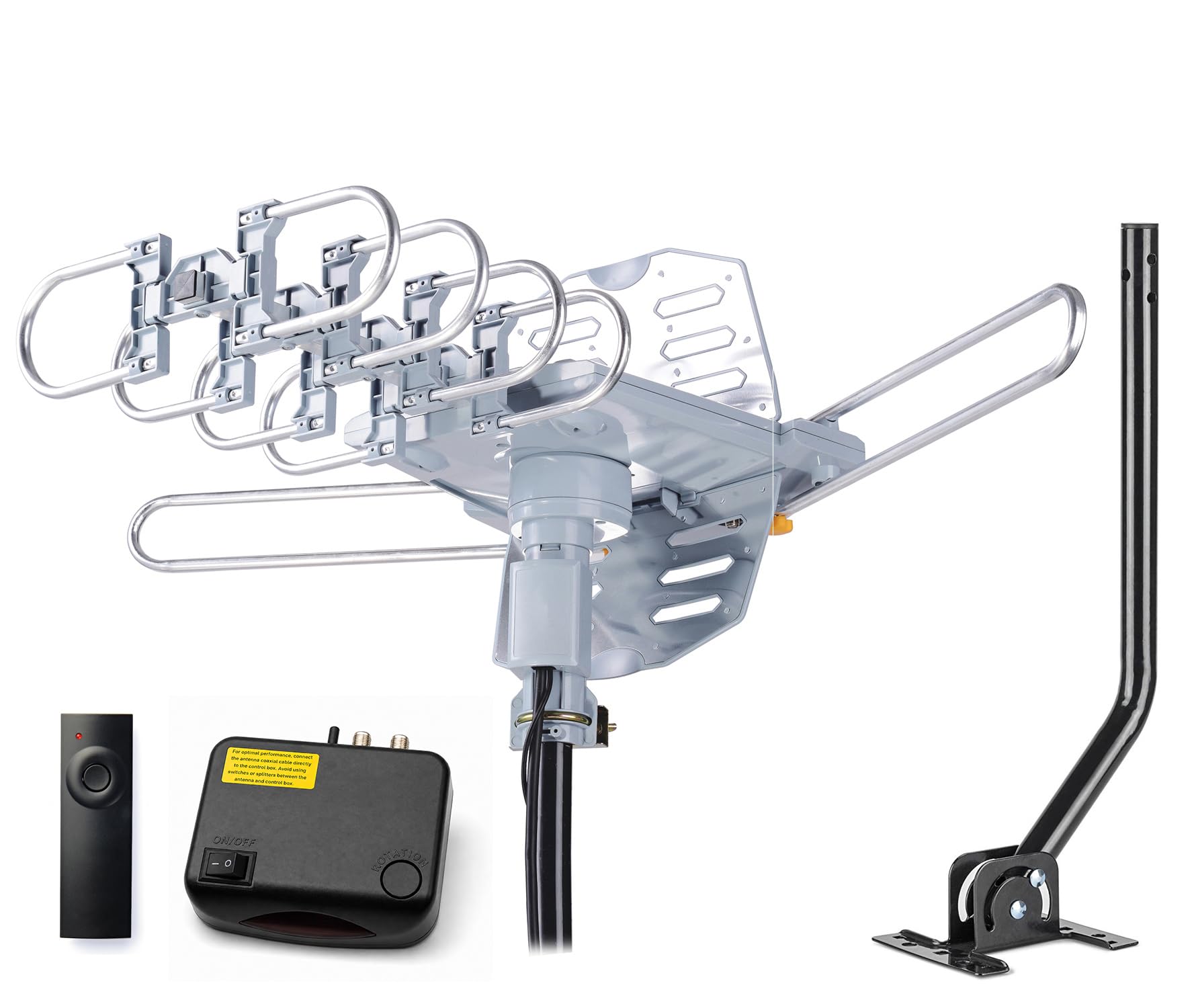
4. pbd Outdoor TV Antenna, 360° Remote Rotation
Spin the antenna from your couch and feed two televisions at once.
The headline is 150 miles of stated range, which is a big jump past the 35 miles the FLATenna above lists — on paper, this is the antenna for people far from the towers. What makes it friendly in practice is the wireless remote: a motor rotates the antenna head 360 degrees so you can re-aim at different towers without climbing onto the roof. A built-in high-gain amplifier boosts the signal right where it is captured, and a low-noise circuit keeps the boost from dragging in interference.
Two TVs can connect at the same time without a splitter, which matters because each added splitter leaks signal. It comes with a 40-foot RG6 coaxial cable, mounting hardware, and a mounting pole — enough cable to run from the roof down to the living room without splicing. It handles 4K and 1080p and is ATSC 3.0 ready for NextGen broadcasts. At 6.3 pounds, it is the heaviest antenna in this lineup, and the GE outdoor model above comes in at less than half that.
Owners find it easy to install and worth the price, with clean picture quality and channels coming in volume — shoppers say over 70 stations on a good setup. Buyers report “exceptional reception that can pull in signals from up to 35 miles away” in real conditions, a reminder that the 150-mile rating assumes clear sightlines. If your home is hemmed in by hills or trees, expect results closer to that real range. It holds 4.0+ stars across a very large base of 19,000+ ratings.
The clever part: That motorized rotation gives you one antenna that can chase several towers, and the remote means you do the adjusting seated.
Sizing the range: Treat 150 miles as an open-sky ceiling; wooded or hilly terrain brings actual reception much closer to the neighborhood you see in the reviews.
Best match: a household with two TVs and local towers spread wide, where re-aiming from the couch beats a rooftop climb.
Consider the weight: 6.3 pounds and a mounting pole mean you need a solid spot and a helper for the install.
5. 1byone Outdoor TV Antenna, 360° Omni-Directional Reception

One dome, no aiming — it listens in every direction at once.
This antenna pulls UHF and VHF signals from all directions, so there is no rotor, no remote, and no pointing it at a specific tower. That 360-degree pickup is the whole pitch, and it suits a rooftop where the broadcast towers are scattered across the map. It is rated to 100 miles and built from moisture-proof, flame-retardant materials, so weather is not a worry.
The electronics do real work. A built-in pre-amplifier boosts signal right at the antenna, and a 4G LTE filter strips out interference from nearby mobile-phone towers — a common cause of channels vanishing on one set. It handles 4K and includes a 32-foot coax cable, enough to run down from a roof. At 11.81 by 11.81 by 8.86 inches, it is a compact dome compared with a sprawling Yagi, and it mounts on an attic, RV, or boat as easily as a house.
Quality is what buyers rave about most here, and the volume of happy feedback is enormous — 41,000+ ratings. Reception is the honest variable: some owners mention pulling in all their local channels, while others get a thinner lineup than expected. That spread is the reality of omnidirectional designs, which trade some raw gain for the convenience of never aiming. A single TV connection is recommended, since a splitter divides signal strength and can cost you channels.
The strength: No aiming, no remote, no seasonal re-alignment — the 360-degree dome just works once it is mounted.
The honest variable: With reception feedback split between great and thin, this is a pick where your local tower spread decides the result, so check that map first.
Ideal for: a rooftop or RV install where you want it mounted once and never touched again, and you can check the tower map up front.
Beware the splitter: Stick to one TV per antenna here — the manufacturer advises against dividing the signal.
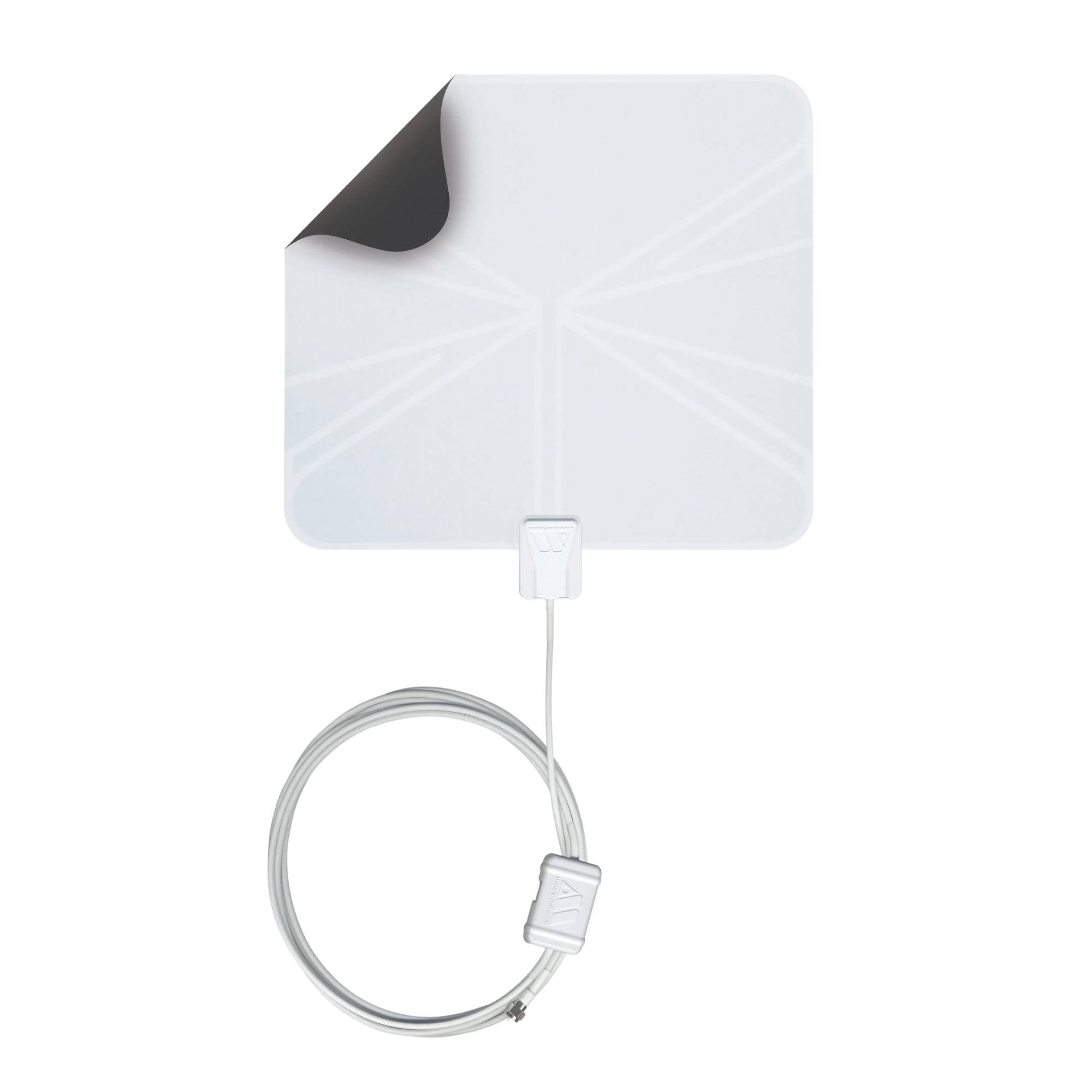
6. Winegard FlatWave FL5500A TV Antenna
A metro-focused indoor panel that weighs barely more than a phone.
Winegard builds this for urban and suburban homes, rating it at 60 miles for VHF and UHF pickup with an amplified signal. The panel is ultra-thin with a dual-color black-and-white finish, so it disappears against most walls without a rack of mounting hardware. At 5.44 ounces, it is the featherweight of this list — you can move it from room to room without thinking about it.
Setup is the easy part: it connects straight to most TVs through the coax jack with no tools, then you run a channel scan, and the Winegard app walks you through the rest. It handles NextGen TV broadcasts and pairs with most smart TVs and streaming devices. Owners find it works best high up in an upstairs window, picking up about 30 channels with a clean picture and little pixelation. Quality is the trait buyers praise most, and the channel count backs up the everyday performance.
The catch is that reception and station coverage draw split opinions — this is a panel that shines in a metro area with strong nearby signals and struggles when towers are far. Think of it as a city-and-suburb tool rather than a rural long-reach antenna. It carries 4.0+ stars across 6,000+ ratings, and for a renter who cannot mount anything on the roof, that is a fair balance of convenience and reach.
Built for: an apartment or upstairs room where the antenna lives in a window and nothing gets bolted to the roof.
Not for: a rural home 50 miles from the towers — the split reception feedback says nearby signals are where it shines.
7. Channel Master Omni+ 50 Omnidirectional Digital HDTV Antenna

A full-circle antenna that goes on a wall, mast, or camper with equal ease.
Channel Master rates the Omni+ 50 at 50 miles with 360-degree reception, so it picks up stations from all directions without turning. The package includes a mounting bracket that fits a wall, a mast pole, or an existing satellite mount — the flexibility of that bracket is what gets it onto a roof, into an attic, or strapped to an RV without extra parts. It works with all HDTVs and 4K TVs, and a 75-ohm impedance keeps it matched to standard coax.
Antenna quality is the trait it is praised for most, and the reception reports back it up. Owners note it picks up VHF-Low stations 6 and 2 well, a band cheap flat panels often miss. It delivers 50 channels on a good setup, and the omni-directionality earns steady praise because you never have to aim it. Installation gets called simple, and the compact size makes it easy to tuck away at 28.75 by 9 by 2 inches.
The one honest caveat is value: cost-effectiveness draws mixed feedback, so a buyer who only needs a small indoor panel might find the build richer than the job requires. But the wide 360-degree pickup and the multi-surface bracket mean it earns its keep for anyone whose towers are spread out. It holds 4.0+ stars across 400+ ratings, strong for a small-batch specialty antenna.
The smart buy: That includes-everything bracket is the reason to pick it — wall, mast, or satellite mount, one antenna covers every install type.
Fair warning: At 50 miles, it will not chase distant towers; this is a nearby-towers antenna, so check your map before choosing it.
Right choice for: the rooftop-then-RV owner who wants one antenna that handles 360-degree pickup and any mount type.
Skip the extra reach: if your stations are far out, step up to a longer-rated outdoor antenna.
8. Five Star Outdoor HDTV Antenna, 200 Mile Long Range

The over-the-top range claim, backed by a full multi-TV install kit.
Five Star rates this antenna at 200 miles for 1080p and 4K reception across VHF and UHF — the longest stated range in this lineup, and the one to treat with the most caution. The design uses extended receiving elements, longer and larger than typical antennas, to stabilize signal over distance. It is multidirectional, so it collects from more than one bearing, and it is ATSC 3.0 ready for NextGen broadcasts.
The package is the practical win: antenna, mounting bracket, J-pole, TV splitter, and instructions, giving you the hardware to feed several sets. It mounts on a roof, attic, chimney, eave, or mast, with or without a clear line of sight. It handles 1080p and 4K, a 75-ohm impedance keeps it coax-ready, and it measures 46 by 28 by 25 inches — a big outdoor unit, so size the mounting spot for it.
Owners find it easy to assemble and install, and the channel reports range widely. Customers note one pulling 82 channels and another getting 66 digital channels, so the count tracks tower distance. Owners repeatedly cite a clean picture and the money saved over a cable bill. The honest note is the 200-mile figure: treat it as an open-sky maximum and confirm your tower distances before you count on it. It holds 4.0+ stars across 900+ ratings.
What you get: A genuine multi-TV kit — splitter, J-pole, and bracket included — so one antenna can feed the whole house.
Read the range right: The 200-mile claim is the ceiling; actual reach depends on trees, hills, and building materials between you and the transmitters.
Pick it if: you are wiring up several TVs and want the bracket, splitter, and J-pole in the box.
Size the mount: 46 by 28 by 25 inches is a large fixture, so plan a sturdy roof or mast spot, not a windowsill.
9. Antennas Direct ClearStream 2V Outdoor TV Antenna

Double-loop elements plus a reflector for stations scattered left and right.
Antennas Direct built this around a 70-degree horizontal reception pattern — a wide beam that grabs channels even when your towers are not all in one spot. It pairs multi-directional UHF elements with Hi-VHF elements, the band where many local stations still live, and adds a signal reflector to focus incoming power and reject the interference that causes pixelation. It handles NEXTGEN TV, 4K, 8K UHD, and Full HD 1080p, with no internet needed to watch over-the-air TV.
The install package is complete: a 20-inch mast with a pivoting base, all-weather mounting hardware, and an adjustable mast clamp. That pivoting base lets you mount on a vertical or horizontal surface indoors, in an attic, or outdoors. It measures 18 inches high by 31.4 inches wide by 6.5 inches deep, and at 2 pounds it is light for a rooftop unit. A 75-ohm impedance keeps it coax-ready, and a manufacturer lifetime warranty backs the build.
Reviewers point out it working even from cinderblock homes, pulling in 50+ channels with signal strength improved by over 20% and clean HD pictures. Setup is called easy with the included hardware. The honest note is the reception math: distance to the towers and obstructions like trees and thick walls still govern how many channels reach a double-loop design. It holds 4.0+ stars across 5,000+ ratings, tying the top pick’s score with a very different design.
Where it leads: That 70-degree beam and Hi-VHF elements make it the sharper tool for stations spread across a wide arc, and the reflector helps fend off pixelation.
The follow-up question: No antenna pulls cable-only channels, so confirm your favorite networks broadcast free over the air in your market.
Worth it if: your towers are spread wide and you want UHF plus Hi-VHF coverage in a 2-pound rooftop package.
Think about mounting first: The 20-inch mast and pivoting base want a solid surface, so line up roof or attic space before you order.
Know the Specs
Maximum Range (Miles)
Range is the distance the maker claims the antenna can reach out to broadcast towers, and it assumes a clear line of sight. Trees, hills, and building materials shorten it, so treat any advertised figure as an open-sky best case. If your towers are 30 miles out, look for an antenna rated well beyond that to leave margin for obstructions and weather.
Directional vs Multidirectional
A directional antenna with a reflector aims at one bearing and rejects more interference, which suits homes where all stations sit in one direction. A multidirectional or omnidirectional design picks up from several directions at once, so it never needs aiming but often trades away some raw gain. Choose based on how your local towers are scattered on the map.
Amplifier and 4G LTE Filter
An amplifier boosts the signal right at the antenna head to make up for loss over a long coax run. A 4G LTE filter removes interference from nearby mobile-phone towers that can knock out channels. If your towers are close, an amplified antenna can overload the tuner and cost you stations, so amplification is not automatically better.
VHF, UHF, and NextGen TV
Local stations broadcast on VHF or UHF frequency bands, and a strong antenna should handle both. NextGen TV, formally ATSC 3.0, is a newer broadcast standard offering stronger signal, better picture and sound. An ATSC 3.0-ready antenna works today and is prepared for those broadcasts as they roll out in your area.
Common Questions
Will an HD TV antenna give me free local channels without a subscription?
How do I find out which direction my local TV towers are?
Does a longer-mileage antenna always get more channels?
Should I put my antenna in the attic or fully outside?
Do I need an amplified antenna?
Can I connect one antenna to several TVs at once?
Why does the picture freeze or pixelate on some channels?
Will an antenna work in an apartment or a rented house?
What is NextGen TV and do I need a special antenna?
How often should I run a channel scan after installing the antenna?
The Bottom Line
For most people cutting the cord, the top hd tv antenna winner is the GE Outdoor HD Digital TV Antenna (29884), because its 70-mile range, attic-or-roof flexibility, and included J mount cover the common suburban install with no extra parts. If your towers are nearby and you want nothing on the roof, the Channel Master FLATenna slips onto a window in minutes. And for feeding several TVs from one rooftop unit, the Five Star Outdoor HDTV Antenna brings the bracket, splitter, and J-pole in the box.
One last nudge worth acting on: the GE top pick’s 4.0+ star showing across 10,000+ ratings is the strongest combination of long-range reach and proven owner experience in this lineup, so it is the safe first look for anyone 30 to 70 miles from the towers.
How we choose
We do not accept paid placement. Every pick is matched to a real buyer and a real use-case; we do not hands-on test units.
Sources
Specifications: manufacturer listings and product documentation. Review insights: verified customer reviews, as of November 2026. Pricing: not shown on this page (it changes often); check the current price via the retailer link.
As an Amazon Associate, Tactical Gear Guy earns from qualifying purchases. This does not affect which products we feature.