Specs are compiled from manufacturer listings and verified buyer reviews and can change over time — please confirm the key details on the product page before buying.
Buying a cardio machine for the house is a big-ticket decision, and the honest answer is that most people only need one of two things: a low-impact full-body workout, or a walking/running platform they will actually keep using. Everything else — brand, screen, app — is a detail you can settle once the machine type is chosen. This guide breaks down eleven real machines across rowers, ellipticals, bikes, and treadmills so you can match the machine to your floor space, your joints, and your actual routine.
This guide is built by comparing the manufacturers’ published specifications and the patterns across verified customer reviews, so you get each pick’s real strengths and trade-offs instead of marketing spin.
The pieces that matter most are stride length, weight capacity, and how much room the frame eats up when it is not in use. Below you will find the machines that handle those three things best for the money, in a top cardio machines roundup built around real specs and owner feedback.
Top Picks
How To Choose A Cardio Machine For Your Home
The first real question is not which brand — it is which motion you will do three times a week without dreading it. A rower and an elliptical both take load off your knees, but they feel completely different to use. A treadmill is the easiest habit to keep because walking needs no learning curve, but it eats the most floor space and can be the loudest thing in the room.
Match the machine to your joints first
If running hurts, a rowing machine keeps you off your feet entirely and spreads the effort across your whole body. An elliptical keeps you upright and moves your feet in an oval path, which takes the hard landing out of each step. Recumbent bikes put you in a seat with a backrest, which suits longer, lower-effort sessions. None of these decide anything for you — they just narrow which of the eleven picks below fits your joints and your body.
Measure your floor before you measure your enthusiasm
Cardio machines are not small. A rower like the Concept2 needs space for a 96-inch length during use, and a treadmill can run 80 inches long before you add clearance behind it for getting on and off. Check the door widths on the path to the room too — a compact recumbent bike that rolls through a standard doorway is far easier to live with than a fixed frame that has to be walked around.
Stride length and deck size are the comfort specs
On an elliptical, stride length is the distance your foot travels per step, and a short stride forces tall users into a cramped, choppy motion. If you are over about six feet, look for a longer stride figure and a machine rated to your height. On a treadmill, deck length and width tell you how much running room you get — a 60-inch deck lets a tall runner land naturally, while a 55-inch deck is fine for walking and jogging.
Check the weight capacity against your heaviest user
Weight capacity is not just a safety number — it tells you how rigid the frame will feel at speed. A machine rated far above the rider’s weight tends to stay planted through hard intervals, while a frame pushed near its limit can rock or flex. If more than one person will use the machine, size it for the heaviest one and expect everyone else to get a stiffer ride.
Side-by-Side Comparison
| Model | Best For | Machine Type | Max User Weight | Footprint (D x W x H) | Amazon |
|---|---|---|---|---|---|
| Concept2 RowErg★ Best Overall | Full-body low-impact work | Air rower | 227 kg | 96″D x 24″W x 14″H | Amazon |
| YOSUDA EllipticalBest for Small Rooms | Small-space climbing cardio | 3-in-1 elliptical | 300 pounds | 38″D x 21″W x 62″H | Amazon |
| Wenoker Air BikeBest for HIIT | HIIT intervals | Air / fan bike | 350 pounds | 51″D x 22″W x 34″H | Amazon |
| Niceday Elliptical | Long stride on a budget | Front-drive elliptical | 400 pounds | 39.6″D x 24.4″W x 61″H | Amazon |
| Sunny Elite Recumbent Cross Trainer | Seated arm-and-leg work | Recumbent elliptical | 300 pounds | 71.7″D x 33.3″W x 50.8″H | Amazon |
| NordicTrack T Series T6.5s | Everyday walking and jogging | Folding treadmill | — | 55″L x 20″W deck | Amazon |
| Peloton Cross Training Bike | Class-led spin training | Indoor spin bike | 297 pounds | 54″D x 23″W x 61″H | Amazon |
| WaterRower S4 BLE | Quiet water-resistance rowing | Water rower | 330 pounds | 87.75″D x 22.25″W x 20″H | Amazon |
| 3G Cardio Elite RB X | Comfortable seated biking | Recumbent bike | 350 pounds | 49″L x 27″W x 43″H | Amazon |
| NordicTrack Commercial 1750 | Screened incline running | Folding treadmill | — | 60″L x 22″W deck | Amazon |
| 3G Cardio Elite Runner X | Marathon training at home | Non-folding treadmill | 400 pounds | 62″L x 22″W deck | Amazon |
Detailed Reviews
1. Concept2 RowErg Indoor Rowing Machine
Our pick — 4.5+★ from 13,000+ verified ratings; the strongest balance of quality and price.
The air rower that keeps earning its floor space, because the full-body stroke never stops working.
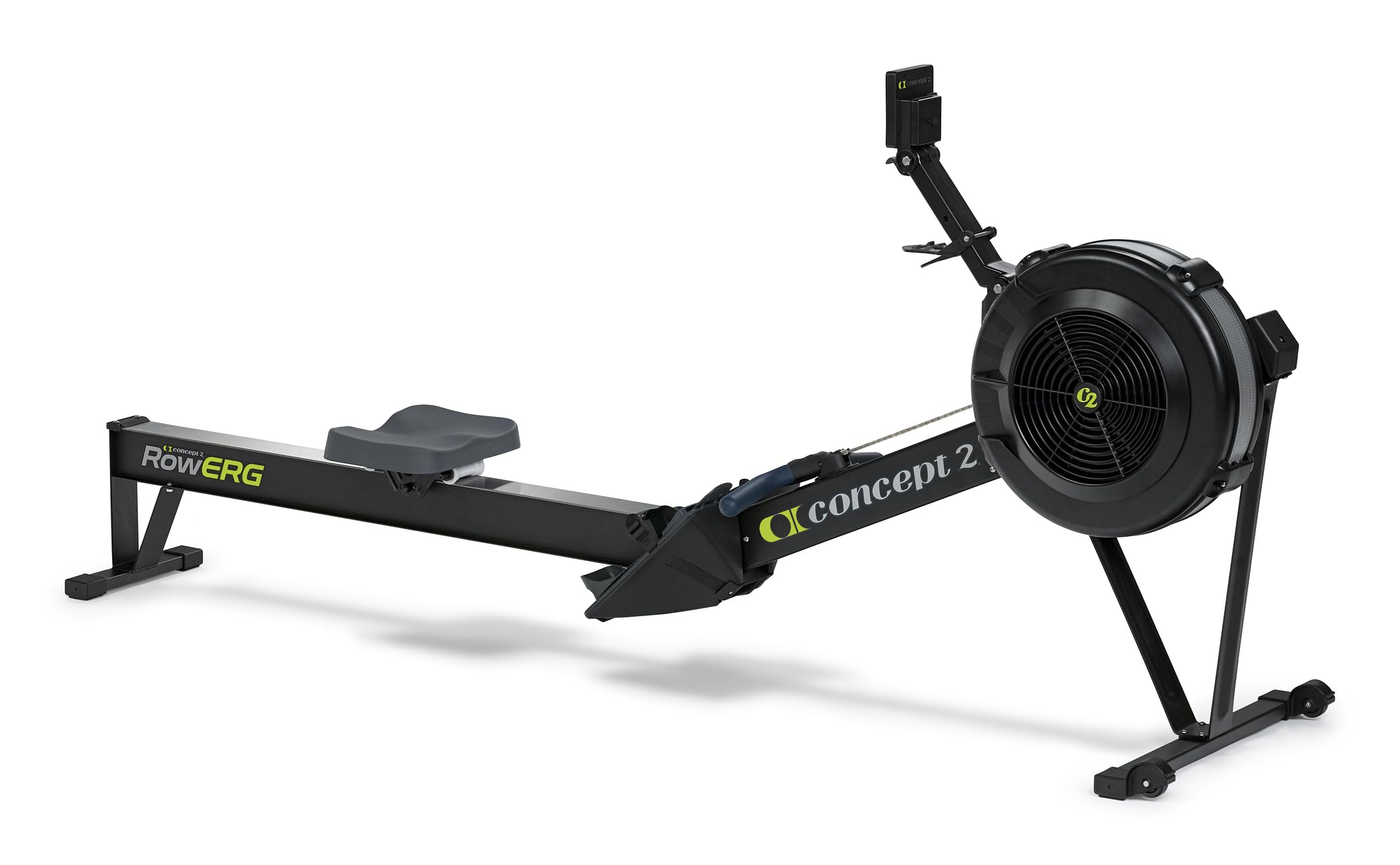
The Concept2 RowErg puts you through a full-body pull while your feet stay off the ground, which is the whole reason it holds the crowd favorite spot — 4.5+ stars across a huge base of 13,000+ owners. The rowing stroke moves your legs, back, and arms together, so you get a hard cardio session without the pounding a run gives your knees.
The Performance Monitor 5 is the brain here. It is a small LCD computer that shows your pace, distance, and calories, and it connects over Bluetooth and ANT+ (two short-range wireless standards) so you can pair a heart-rate strap or a phone app. It runs on two D cell batteries, and during a row it draws power from the spinning flywheel, so batteries stretch further than you would expect.
What wins people over is how little fuss it demands. It breaks into two pieces for storage, and caster wheels let you roll it aside. The 14-inch seat height is easy to mount, the footrests adjust, and the flywheel (the spinning wheel that creates resistance) keeps noise down so it fits in a shared house. For reference, the Concept2 weighs 57.3 pounds versus the 102-pound Wenoker Air Bike, and its 24-inch depth versus that bike’s 51-inch depth — so it tucks along a wall where a full-size air bike would not. One honest caveat: it needs roughly 9 by 4 feet of clear floor while you row, and the air flywheel makes a whooshing sound in use, so it is not silent. Against the WaterRower, the Concept2 holds a 227 kg (about 500-pound) rating while the WaterRower tops out at 330 pounds, so the upper weight ceiling favors Concept2.
Why it earns the top slot
- Full-body, low-impact stroke keeps load off your knees and hips.
- Splits in two with caster wheels, so a home gym can reclaim the floor.
- PM5 monitor pairs with Bluetooth and ANT+ for apps and heart-rate straps.
- 227 kg user capacity and a 5-year frame warranty back steady use.
Where it asks for room
- Wants about 9 x 4 feet of clear space while in use.
- Air resistance is not silent — expect a rhythmic whoosh.
- The monitor is a plain LCD, not a touchscreen.
Reach for this if: you want a joint-friendly full-body machine that stores out of the way and does not care which app you like.
Look elsewhere if: you need a built-in screen and guided classes on the machine itself.
2. YOSUDA Elliptical Exercise Machine
Three machines folded into one footprint, built for a corner and a short stride.
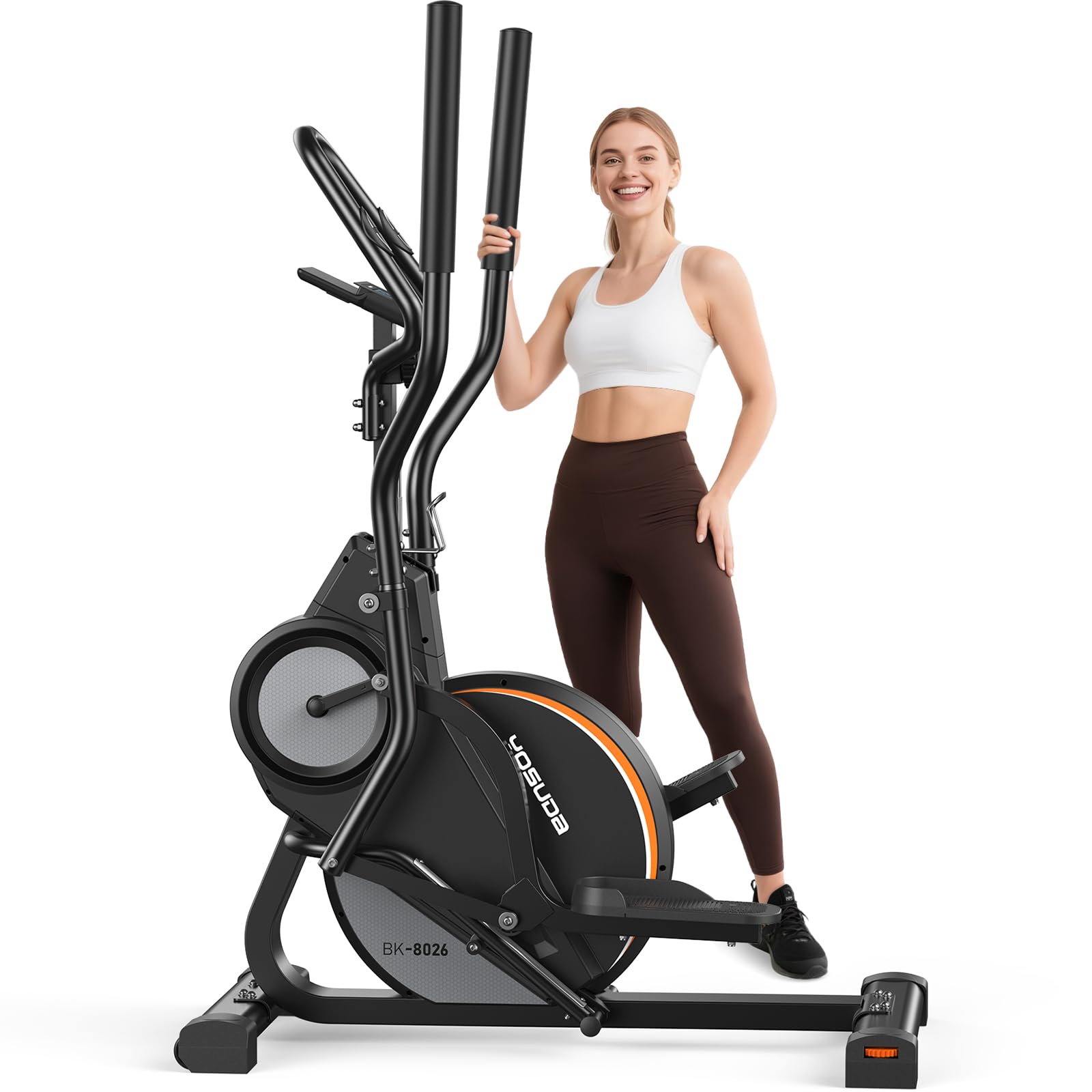
If floor space is the reason you have not bought cardio gear yet, this one answers it directly. The YOSUDA covers 5.38 square feet of floor, which is compact enough to sit in a living room corner or beside a balcony door. It blends three motions — elliptical, stepper, and climber — into one frame, so you get variety without buying three machines.
That steep inclined path mimics walking uphill, which shifts effort into your glutes, legs, and core rather than just your quads. You get 16 resistance levels to tune it, and an 18-pound heavy-duty flywheel (the weighted disc that keeps the motion smooth) gives the pedals steady momentum. A magnetic silent control system keeps the noise low for early-morning sessions.
It ships 90% pre-assembled, and the maker claims setup inside 30 minutes with the included tools and illustrated manual. The H-type support frame is rated to 300 pounds versus the 400-pound Niceday — so if you need the higher ceiling, size up. Bluetooth pairing with Kinomap and the Fed app adds guided sessions, and the digital monitor tracks calories, time, speed, distance, odometer, and pulse. Worth flagging: the 15.5-inch stride is on the short side, so a very tall user may feel the step is tight.
The space math: 5.38 square feet is the headline — front rollers let you push it aside between sessions, which is why it suits apartments and shared rooms.
Fair warning: the 300-pound rating is real but lower than heavier-duty ellipticals here, and the 15.5-inch stride rewards shorter legs more than long ones.
Fits you best when: your training room is tight and you want climbing resistance without a treadmill footprint.
Consider a longer stride if: you are tall and want a wide, sweeping step.
3. Wenoker Air-Resistance Exercise Bike
An air bike that punishes short sprints and rewards the arms that push with the legs.
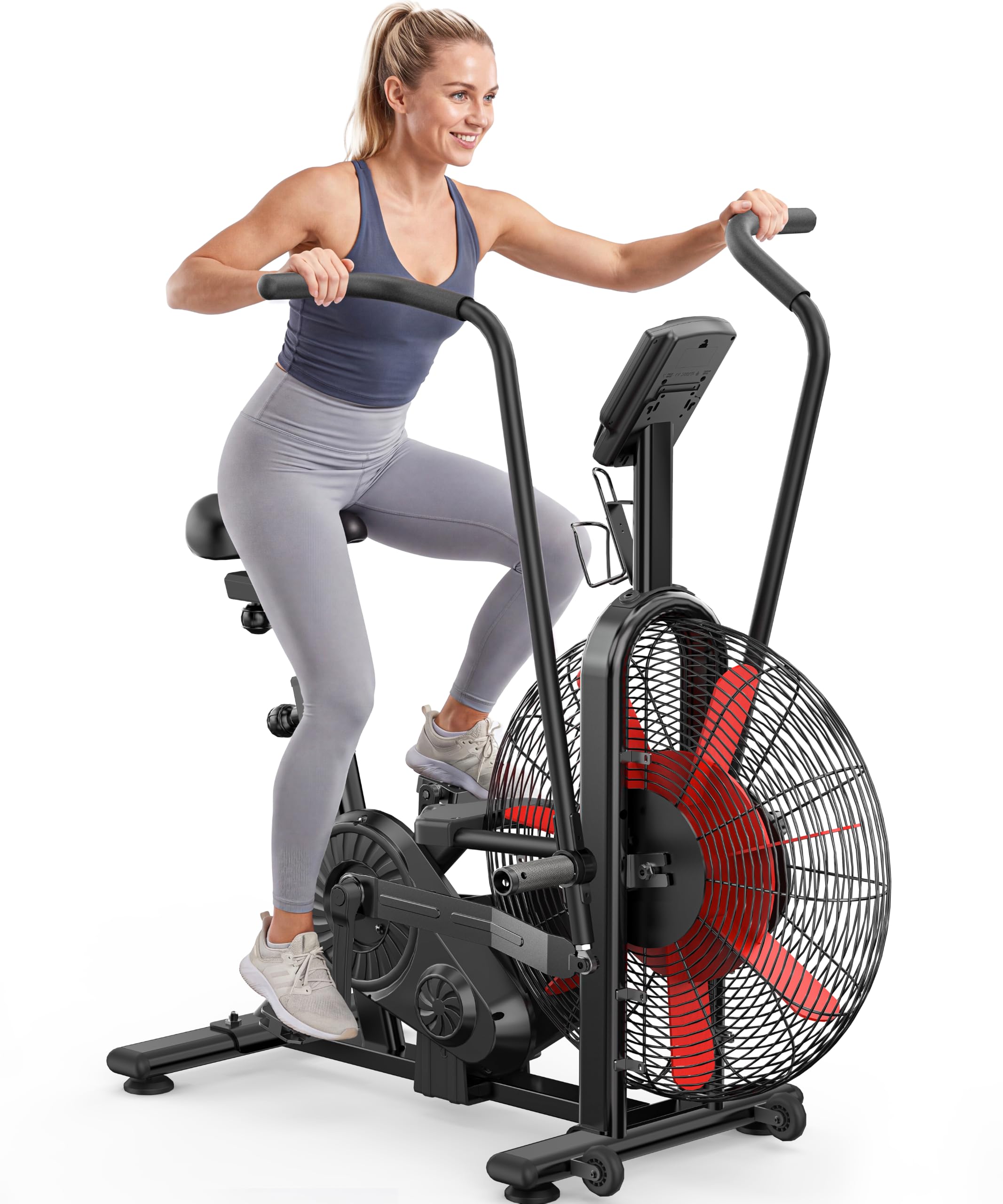
For interval training, the Wenoker pairs an air-resistance fan with dual-action handlebars and pedals, so your arms and legs drive the resistance together. Build effort goes up and the fan pushes back harder. It is rated to 350 pounds and passed dynamic load testing for hard riding, and the four-way adjustable seat with six height levels is meant to fit riders from 5’3″ to 7’2″.
Owner feedback lands strongly on performance — it is the thing buyers single out most, well ahead of assembly and build quality. The bike runs 102 pounds and 51 inches long, which is a committed footprint; the Concept2 rower at 57.3 pounds and 24 inches depth is the lighter, tighter machine if storage is your priority. It comes 90% pre-assembled, and the built-in monitor reports real-time data that the maker rates at over 98.7% accuracy. The wider, thicker padded seat and PVC leather cushioning help during longer sessions.
The recurring gripe is noise. Some owners hear an annoying metallic clicking, while others find it very quiet, so the honest read is that it is mostly quiet but not guaranteed silent. It carries a 2-year frame warranty and a 1-year accessory warranty. If loud clicking would bother you at 6 a.m., test it early and use the after-sales support.
Training angle: dual-action handles turn a sprint session into a whole-body push, which is exactly what HIIT riders want.
Honest snag: the 102-pound, 51-inch frame is a permanent resident unless you clear real floor space for it.
Made for: riders who want short, hard air-bike intervals and arm engagement.
Skip if: you need a machine you can fold and tuck into a closet.
4. Niceday Elliptical Exercise Machine
The 18-inch stride is the number to remember, and it carries a heavy rider with room to spare.
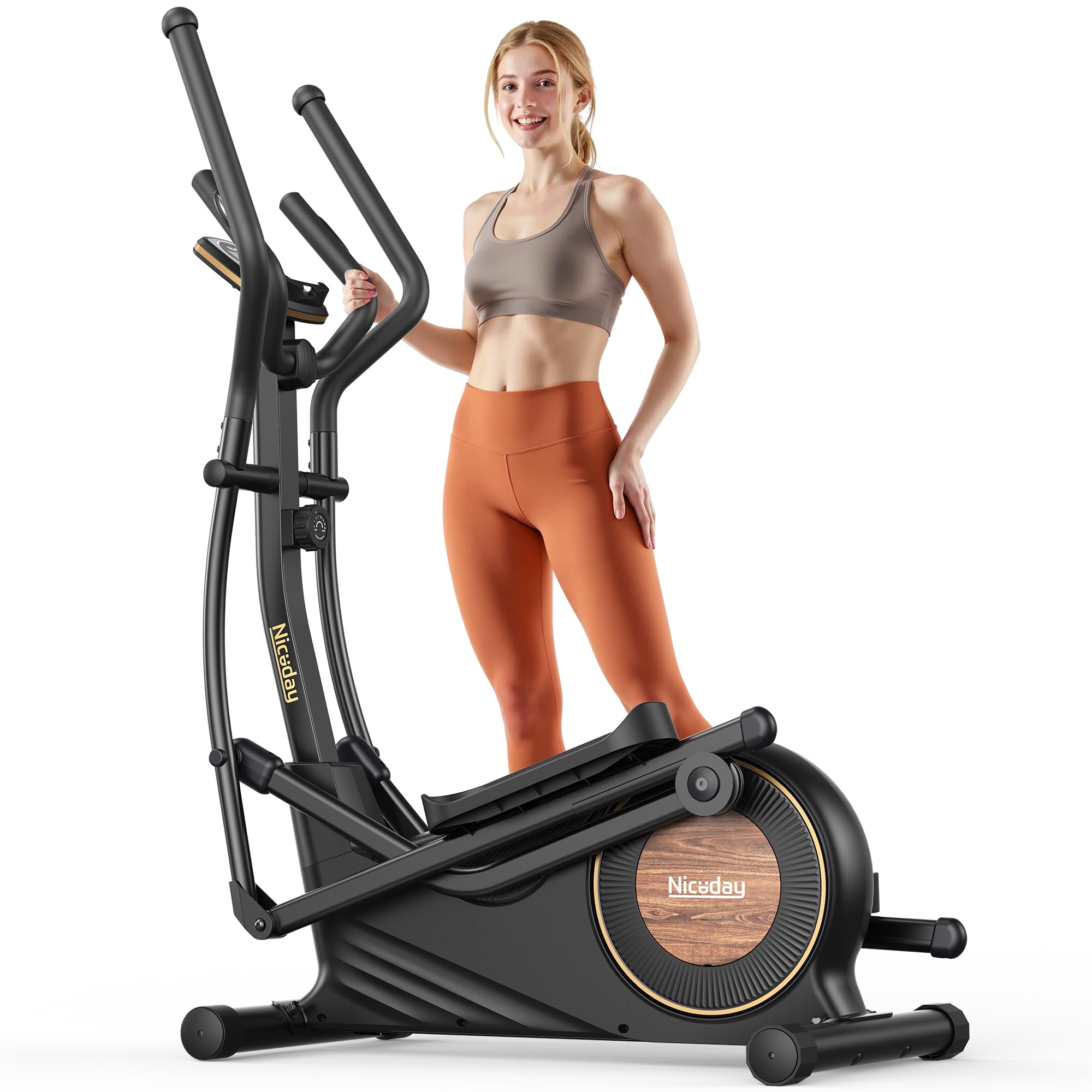
The Niceday’s headline is its 18-inch smooth stride, powered by a dual-axis linkage that saves space while still giving you a long, natural step. It fits users up to 6’3″, and that stride length is the difference between an elliptical that feels like a real stride and one that feels like a shuffle. The frame is rated to 400 pounds versus the YOSUDA’s 300 pounds — so it stays planted for heavier users.
Buyers praise how quiet it runs second only to overall quality, and the numbers back it: a magnetic control system and PU silent rollers (polyurethane wheels that cut friction and vibration) keep noise minimal, with the maker claiming under 20 dB — roughly quieter than a whisper. Sixteen resistance levels let you shift from easy recovery spins to hard efforts. The compact frame saves up to 40% floor space by the maker’s figure, and transport wheels make it easy to move.
A Bluetooth connection to Kinomap adds guided rides, and the digital monitor tracks six metrics: time, speed, distance, calories, and heart rate among them. Assembly is set up for about 30 minutes with included tools and video. The one thing to weigh: the single-axis front-drive design is a little less intuitive to first-timers than a seated bike — expect a short learning window before the motion feels natural.
What buyers keep praising
- An 18-inch stride gives tall users real room to step.
- 400-pound rating keeps the frame solid at speed.
- Quiet magnetic resistance works for early or late sessions.
- Compact footprint with transport wheels for easy repositioning.
What to plan around
- Front-drive motion takes a session or two to groove.
- The monitor is a basic unit, not a touchscreen hub.
Worth grabbing if: you want a long stride and a high capacity without a heavy frame.
Hold off if: you prefer a seated, back-supported ride over standing.
5. Sunny Health & Fitness Elite Recumbent Cross Trainer
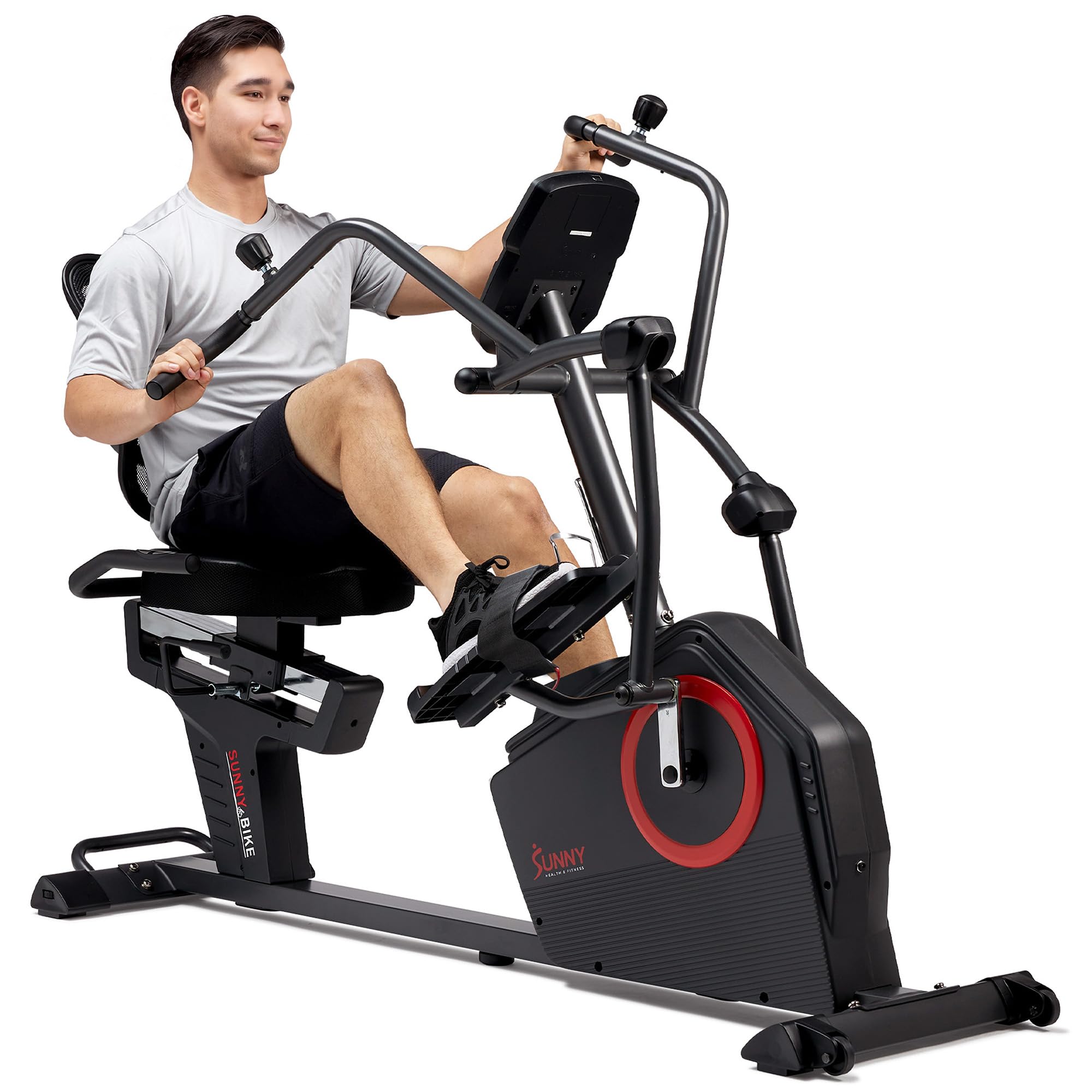
A seat, a backrest, and two moving handles — cardio that treats your knees gently.
This Sunny recumbent cross trainer blends two motions into one seated machine: a recumbent elliptical and an exercise bike. You can drive the moving handles and pedals together for full-body work, or use either alone to focus on your upper or lower body. That step-through frame and adjustable seat make getting on and off easy, especially for anyone with stiff hips or knees.
Buyers land squarely on quality and value here, and the seated format is why. Comfort is a recurring theme — it is described as easy on the knees and hips, which suits longer, lower-effort sessions and gentle rehab walks. The seat slides to fit roughly a 30.1″ to 39.6″ inseam, the cushioned seat pairs with a breathable mesh backrest, and the adjustable pedal straps keep your feet secure. The 300-pound capacity supports three people taking turns on the same frame.
Resistance changes from the console across 16 digitally controlled levels, so no bending down mid-session. You also get 24 workout programs, including Watt Control from 50 to 250 W and Heart Rate Control at 55%, 65%, 75%, and 85%. Bluetooth ties into the free SunnyFit app, with 2,000+ trainer-led workouts and 10,000+ scenic routes, and no subscription. The honest snag is assembly — some units arrive missing instructions, so save the video guide and give yourself an evening. The 300-pound ceiling is also lower than the 400-pound Niceday, so very heavy users should weigh that.
Who it treats well: anyone who wants to stay seated with back support and still work the arms.
The catch: the 71.7-inch length and mixed assembly experiences mean you need floor room and patience before day one.
Ideal for: riders who want a backrest, an easy step-through, and arm engagement in one frame.
Not the pick if: you want a hard standing climb or a compact fold.
6. NordicTrack T Series T6.5s Treadmill

Walk, jog, or climb up to ten percent, then fold it away when the room fills up.
The T6.5s is the treadmill to buy if you want a simple walking and jogging deck that does not demand a dedicated gym room. It runs at 0 to 10 MPH, so you can walk, jog, or build endurance, and the 0 to 10% incline range lets you raise the pitch to push harder and hit more muscle groups. The deck measures 55 inches long by 20 inches wide, which is comfortable for walking and jogging rather than long-stride sprints.
Quality is what buyers praise most here — it is the top aspect by a wide lead — and the folding frame is the everyday win. When the session ends, fold it and roll it away, with a foot bar for smooth assisted lowering. KeyFlex cushioning takes the hard landing out of each stride, which matters more the longer you walk. A 5-inch LCD shows live stats, and the 400-watt motor keeps the belt moving through longer sessions.
iFIT is the add-on story: pair a phone or tablet and an iFIT Train Membership open up 10,000+ workouts plus auto-adjusting speed and incline. It also syncs with Strava, Garmin, and Apple Health. The honest trade-off is that some assembly needs two people, and reviews on noise are mixed, so a shared wall may hear it. There is no built-in touchscreen, so your device does the display work.
The daily win: fold-and-roll storage plus a 55-by-20-inch deck turns a spare corner into a walking routine.
Plan for it: two-person assembly and no built-in screen, so bring a tablet.
Go with this if: walking and jogging at home is the goal and folding it away matters.
Pass if: you want a big built-in touchscreen and a long running deck.
7. Peloton Indoor Cross Training Bike
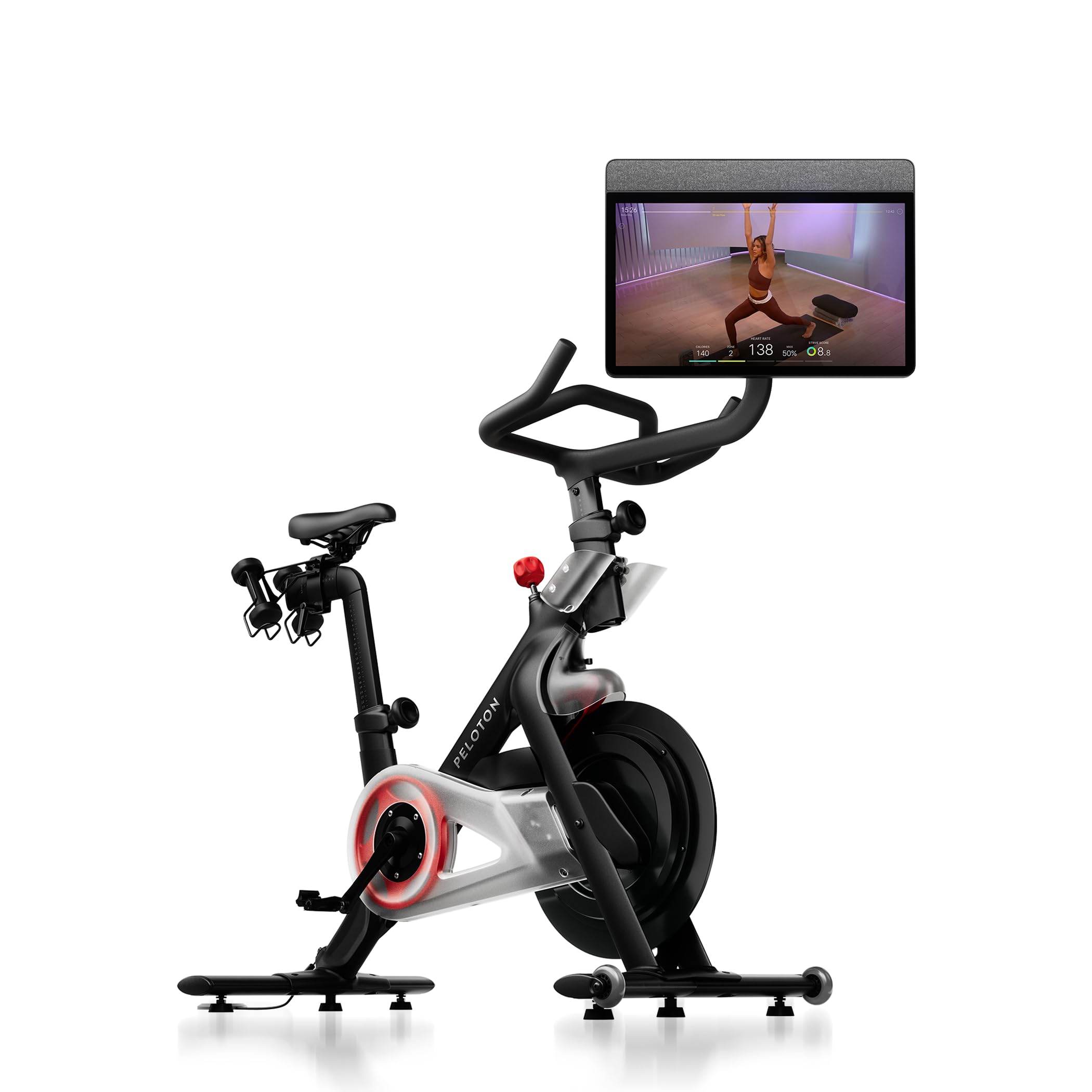
A 21.5-inch screen that swivels 360 degrees, so the bike becomes a whole studio.
If a guided class keeps you showing up, the Peloton is built around the screen rather than around silent specs. The 21.5-inch Full HD touchscreen rotates a full 360 degrees, so you can ride a spin class, then swing it to do yoga, strength, Pilates, or barre. That swing is the entire reason this bike earns its spot — the hardware is a bike, but the screen makes it an all-round training station.
Fit covers riders from 4’11” to 6’5″ up to 297 pounds, with adjustable seat and handlebar positions, a tilting screen, and a redesigned seat for comfort. Connectivity runs through Bluetooth 5.2 (a short-range wireless standard), USB-C charging, and front-facing speakers. The resistance knob lets you set ride intensity manually, and the frame measures 54 inches long by 23 wide by 61 tall.
The catch is that the classes need the All-Access Membership, listed at per month. Without it, you are on a very capable but quieter bike. The 297-pound capacity is also below the heavier riders here — the 3G Cardio recumbent handles 350 pounds. Owners describe it as genuinely high quality with a standout variety of classes, which is exactly the use case it is built for. Setup wants two strong people, because the frame weighs 178 pounds.
The screen advantage: the 21.5-inch swivel display is the differentiator, turning one bike into 15+ workout styles.
Budget the membership: classes are the point, and the monthly fee is part of the real cost.
Pick it if: instructor-led classes keep you consistent and you want one machine for many styles.
Look elsewhere if: you want zero subscriptions and a lighter frame to move.
8. WaterRower Water Rowing Machine

Water resistance you hear as a soft rush, wrapped in a handcrafted wooden frame.
Some people row for the workout; others row because the sound of moving water is what gets them on the machine. The WaterRower is built for the second group. Its WaterFlywheel creates resistance that rises with your effort, so a hard pull meets a heavy load and a soft one eases off. That responsive feel is the whole concept here.
The frame is the visual standout — hardwood from Appalachian forests, handcrafted, and made in the USA, which is why appearance trails only performance as what buyers praise most. It doubles as furniture, and it stores upright to save floor. The 87.75-inch length is long in use, but the upright storage makes up for it. It is rated to 330 pounds and built from commercial-grade components, the same ones the maker puts in over 100,000 machines in commercial gyms over the past 25 years.
Quiet operation is a genuine point of pride — the sound is water, not machinery, and reviews describe it as a soothing rush. The S4 BLE monitor tracks distance, and Bluetooth connects to the WaterRower ecosystem and CITYROW apps. Assembly is straightforward. The one place it asks more of you: emptying and refilling the tank is maintenance you will not skip, and keeping it clean protects the water sound you paid for.
Why it stands apart
- Water resistance rises with effort for a natural stroke.
- Handcrafted hardwood frame that looks like furniture.
- Stores upright and runs quiet enough for shared rooms.
- 330-pound capacity with commercial-grade components.
The trade-offs
- The tank holds water, so cleaning it is part of ownership.
- Long footprint in use at 87.75 inches deep.
Best suited to: rowers who want a beautiful, quiet, water-resistance machine that doubles as decor.
Weigh it against: tank upkeep and a longer footprint than an air rower.
9. 3G Cardio Elite RB X Recumbent Exercise Bike

A generously padded seat adjusts in 30 directions so a long ride stays comfortable.
Comfort is the reason this recumbent exists, and the seat proves it. The oversized cushioned seat tilts through 5 positions and slides forward or back through 25 more, which lets most riders between 5′ and 6’5″ find a position their back agrees with. The Airflow Mesh Flex backrest tilts to conform to your body and keeps your back cool, rated to a 350-pound capacity.
What wins buyers over here is comfort, second only to overall quality in the reviews, and the numbers follow. Quiet operation and build quality are close behind. The bike is compact at 49 inches long by 27 wide by 43 tall, and at 115 pounds it rolls through a standard doorway on built-in wheels. That compactness is the trick — it fits a small space without giving up a real seat.
Resistance runs through 16 magnetic levels with 12 preprogrammed and 3 heart-rate workouts, plus handheld sensors and an included wireless strap. FreeSync FTMS Bluetooth connects to third-party apps, and no membership is required — bring your own screen to the included tablet shelf. A narrow Q factor (the pedal-to-pedal spacing) keeps the ride ergonomic. The honest caveat is documentation — some units ship without assembly instructions, so plan to find a guide online before you start.
Comfort first: 5 tilt positions and 25 sliding positions are the whole pitch — a seat that fits almost any rider.
The honest catch: assembly instructions can be missing, so save a guide in advance.
Buy it for: long, comfortable seated rides with no app subscription required.
Try something else if: you want a standing climb or a guided-class screen built in.
10. NordicTrack Commercial 1750 Treadmill

A 16-inch pivoting screen and a deck that tilts from 12% incline down to -3% decline.
The Commercial 1750 is the treadmill for someone who wants terrain, not just flat walking. The incline range runs from a 12% climb down to a -3% decline, which means you can simulate uphill pushes and downhill recovery in the same session. Speeds run 0 to 12 MPH, and the deck measures a 60-inch length by 22-inch width — enough running room for a tall strider.
The 16-inch pivoting touchscreen is the standout hardware. It swings so you can watch while running, or follow off-treadmill yoga and strength classes beside the belt. RunFlex cushioning takes impact out of each stride, and a folding frame lets you fold and roll it away with a foot-bar assist. It syncs with Strava, Garmin Connect, and Apple Health, and SmartAdjust can auto-adapt speed and incline as you train.
Two facts sit honestly against the marketing. First, the full class and TV experience needs an iFIT Pro Membership, listed at a monthly fee, so the cost continues after purchase. Second, this machine carries the lowest owner rating of anything in this guide — 3.5+ stars across 200+ ratings — so the long-term reliability record is less established than the plainer T6.5s above, which holds a notably higher rating. It is a spec-rich treadmill; read the reviews before you commit to the subscription.
The hardware story: a 16-inch pivoting touchscreen and a 12% to -3% incline range give you the most terrain control here.
The honest read: a weaker owner rating than the cheaper T6.5s and a monthly fee for the best features.
For you if: screen-led incline training and streaming entertainment are what keep you moving.
Think twice if: you want the simplest, most proven treadmill in the lineup.
11. 3G Cardio Elite Runner X Treadmill

A 4.0 HP club-rated motor that reaches 12 MPH in eighteen seconds flat.
This is the machine for someone training for distance who wants gym hardware at home. The 4.0 HP high-torque motor is club-rated and drives the 386-pound frame, and it accelerates the belt from 0 to 12 MPH in 18 seconds — quick enough for interval and HIIT work. The oversized 22-inch by 62-inch running platform with Ortho Flex Shock Suspension underneath is built for a smooth, stable, quiet stride.
The build is the point, and buyers agree: quality is praised most, with sturdiness close behind. It is rated to a 400-pound max user weight, and the low 7.5-inch step-up deck height leaves clearance from most ceilings. The built-in programs include fitness tests, one-touch speed from 0.5 to 12 MPH, elevation up to 15%, and heart-rate control with the included wireless strap. There is no membership required here — connect a tablet for entertainment, and the built-in speakers and multi-speed fan round it out.
Weigh the value question honestly. Some buyers call it the best investment they have made, while others feel the price is steep for what it is — note, because it is the most expensive machine here and one of the few with a mixed value read. It is non-folding, so plan a permanent spot: 84 inches long, 35.5 wide, and 58 tall. If a marathon block and a big deck matter more than saving floor space, it earns its keep.
Where it shines
- 4.0 HP club-rated motor reaches 12 MPH in 18 seconds.
- 22-by-62-inch deck with Ortho Flex Suspension for long runs.
- 400-pound capacity and a low 7.5-inch step-up.
- No membership required — use your own tablet.
What it costs you
- Non-folding frame needs a permanent 84-inch spot.
- Value split among owners — some call it steep for the spec.
Choose this when: marathon training and a big, rigid deck are worth a permanent footprint.
Go lighter if: you need to fold the machine away between sessions.
Know the Specs
Stride Length And Deck Size
Stride length is how far your foot travels per step on an elliptical, and it decides comfort more than any other spec. A longer stride like the 18 inches on the Niceday feels natural for tall users, while a 15.5-inch stride suits shorter legs and tight spaces. On a treadmill, deck length and width do the same job — a 60-inch by 22-inch deck gives a runner room to land, while a 55-inch by 20-inch deck is meant for walking and jogging. Match the stride and deck figures to your height and your stride, not to the marketing.
Weight Capacity And Resistance Type
Weight capacity tells you how stiff the frame feels — a machine rated far above the rider stays planted during hard intervals. Resistance type changes the feel too. Air resistance rises with effort, so the harder you push, the harder it fights back, which suits HIIT. Magnetic resistance stays silky and quiet across its levels, which suits steady sessions and shared rooms. Water resistance gives a smooth, responsive stroke with a soft rushing sound. Pick the resistance to match how you like to train.
Common Questions
Is a rowing machine better than a treadmill for bad knees?
How much floor space does a home cardio machine really need?
Will a cardio machine fit through a standard doorway?
Do I need a subscription to use these cardio machines?
How quiet is an air bike compared with a magnetic elliptical?
What weight capacity do I need if two people share the machine?
Does an elliptical give a better workout than a rowing machine?
Can I row on carpet, or will the machine slip?
How long does assembly usually take on these machines?
Do I need extra clearance for an incline treadmill?
Is a recumbent bike easier on the back than an upright bike?
The Bottom Line
For most people buying a top cardio machines, the winner is the Concept2 RowErg because it gives you a full-body, low-impact workout, splits in two for storage, and pairs with the apps and straps you already own — and its enormous owner base backs up that consistency. If floor space is your blocker, grab the YOSUDA Elliptical for its 5.38-square-foot footprint. And for marathon-style distance work on a big, rigid deck, the 3G Cardio Elite Runner X is the one to reach for.
One last nudge: pick the machine whose motion you will repeat three times a week, not the one with the biggest screen. A rower, an elliptical, and a treadmill can all get you fit — the one you keep using is the one that actually works.
How we choose
We do not accept paid placement. Every pick is matched to a real buyer and a real use-case; we do not hands-on test units.
Sources
Specifications: manufacturer listings and product documentation. Review insights: verified customer reviews, as of November 2026. Pricing: not shown on this page (it changes often); check the current price via the retailer link.
As an Amazon Associate, Tactical Gear Guy earns from qualifying purchases. This does not affect which products we feature.