Specs are compiled from manufacturer listings and verified buyer reviews and can change over time — please confirm the key details on the product page before buying.
You want a carbon monoxide detector that actually wakes you at 2 a.m., not one that chirps for a new battery while you sleep through a real leak. The short answer: buy a battery-powered unit with an electrochemical sensor, an 85 dB alarm, and a listed safety certification, then mount it near your sleeping areas and furnace. Everything below is about picking the right one of those, not the prettiest plastic shell.
This guide is built by comparing the manufacturers’ published specifications and the patterns across verified customer reviews, so you get each pick’s real strengths and trade-offs instead of marketing spin.
Carbon monoxide is colorless and odorless, so the sensor and the alarm volume do all the work — everything else is convenience. Here is how each model earns its place among the top carbon monoxide detector choices.
Top Picks

How To Choose The Best Top Carbon Monoxide Detector
A CO alarm has one job, and it only gets one honest chance to do it. Skip the feature list and check four things in this order: the sensor type, the alarm loudness, the power source, and the certification on the box.
Start With the Sensor, Not the Screen
Look for an electrochemical sensor — a small cell inside the unit that reacts chemically when carbon monoxide touches it. Every pick below uses that type, so this is the floor, not a bonus. A unit with a screen but a vague sensor description is a unit you should put back on the shelf.
85 dB Is the Number to Memorize
An 85 dB alarm is roughly the volume of a garbage truck passing close by, and it is the level most listed CO alarms target. If a unit does not state its alarm volume, treat that as a missing spec. A quiet detector in a closed bedroom door is a decoration.
Battery, Plug-In, or Both
A battery-only unit goes anywhere without wiring and keeps working in an outage. A plug-in unit runs on 120V AC wall power but needs backup batteries to survive a blackout. Sealed ten-year lithium units remove the annual battery swap entirely, at the cost of replacing the whole alarm when the cell dies.
Where You Mount It Changes What You Buy
Put one near each sleeping area and one on every level of the home. If you rent or travel, a compact battery unit that slips into a suitcase earns its keep in hotel rooms and vacation rentals. If you want a plug-in with a rotating plug, confirm it fits your outlet orientation before ordering.
Side-by-Side Comparison
| Model | Best For | Power Source | Alarm Output | Warranty | Amazon |
|---|---|---|---|---|---|
| First Alert Battery Carbon Monoxide Alarm★ Best Overall | Whole-home basics on a budget | 9V battery | Audible | 5 Year Limited | Amazon |
| Kidde COB AA Battery DetectorBest for Travel | Travel and renters | 2 AA batteries | Audible + Visual, 85 dB | 10-Year Limited | Amazon |
| Heiman C1-S 10-Year CO DetectorBest for Landlords | Landlords and property managers | Lithium battery, 10-year average life | Audible/Visual, 85 dB | 7-Year | Amazon |
| Kidde KN-COB-B-LP Nighthawk | Long service life per unit | 3 AA batteries | Audible | Seven Year Limited | Amazon |
| First Alert FAT1039718 9V Alarm | Simple wall-mounted coverage | 9V battery | Audible, 85 dB | — | Amazon |
| SITERWELL Plug-In 10-Year Battery | Portable plug-in coverage | AC + CR123A battery | Audible | — | Amazon |
| First Alert CO710A Temp Display | Seeing CO levels and room temperature | Sealed 10-year lithium | Audible | — | Amazon |
Detailed Reviews
1. First Alert Battery Carbon Monoxide Alarm
Our pick — 4.5+★ from 22,000+ verified ratings; the strongest balance of quality and price.
The most-reviewed 9V CO alarm on this list, with 4.5+ stars across 22,000+ ratings.
This is the unit that already sits in more homes than any other pick on this page, and the crowd favorite holds 4.5+ stars across 22,000+ ratings. It runs on a single 9V battery, so it keeps watching during a power outage without any wiring. You mount it on the included bracket, and that is the entire installation.
What wins people over is the reliability of the core job — the quality and functionality of the sensing get far more agreement than anything else on the review pages. In a hallway it takes up only a modest strip of wall; the unit measures 1″D x 5″W x 3″H and weighs 7.2 ounces, so a single screw holds it without drama. That is a much smaller footprint than the 9V First Alert at number five, which runs 2″D x 5″W x 5″H and 7.36 ounces for a similar job.
The recurring gripe is battery life and long-term durability. Some units go through a cell faster than the packaging implies, and a few stop reporting after roughly six months of service. Size that honestly: with a 5-year limited warranty behind it, that is an occasional bad unit rather than the norm. Treat the battery as a yearly swap and keep the receipt.
What earned it the top slot
- 9V battery power keeps it detecting through an outage, with no outlet needed
- Mounting bracket and manual come in the box, so setup is screw-and-click
- Four-in-one packaging includes the alarm, bracket, manual, and battery
- 5-year limited warranty backs the unit itself
Where it asks for your attention
- Battery life is the most-mixed part of the picture — expect to swap cells yearly
- Durability is the weak spot; a small share of units quit early
- No digital CO readout, so you get an alarm, not a number
Reach for this if: you want one dependable alarm per level and you do not need a screen.
Look elsewhere if: you want to see actual CO levels in parts per million — the display models below do that.
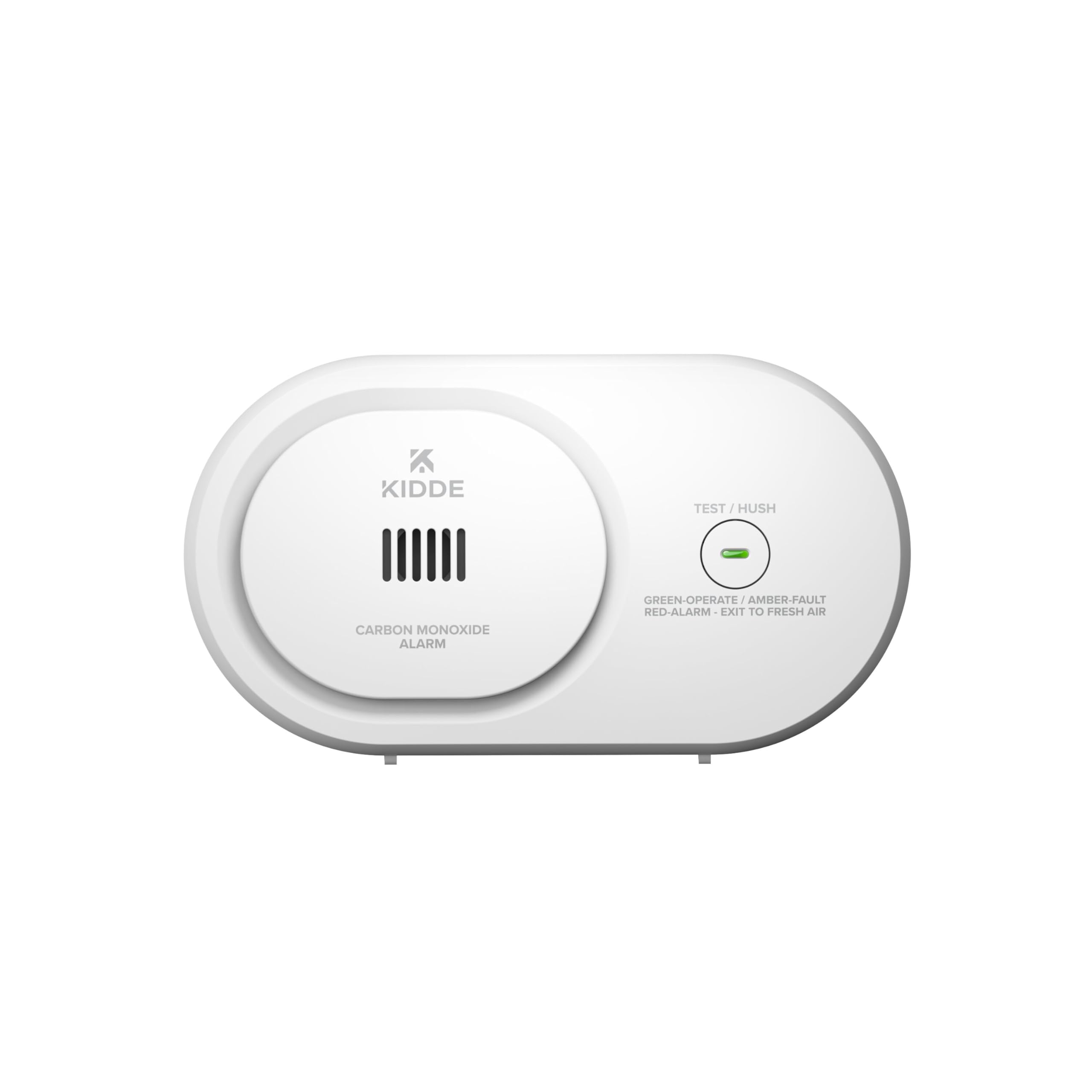
2. Kidde Carbon Monoxide Detector, AA Battery-Powered, COB
A five-ounce detector you can drop in a carry-on and trust in a rental kitchen.
The spec that decides this one is 5.92 ounces. That is light enough to live in a suitcase permanently, and it is why the COB works as a travel alarm rather than a fixed appliance. Two included AA batteries mean no outlet and no adapter, whether you are in a hotel room or a vacation rental with a suspicious gas stove.
The everyday job is covered too. A loud 85 dB alarm sounds when CO is present, and an LED warning light gives you a visual cue alongside the sound. The green indicator flash confirms it is working, which is the reassurance buyers keep coming back to — it “flashes green when working properly.” The Test/Hush button lets you check the unit or quiet a nuisance alarm without pulling it off the wall.
What buyers talk about most is that it simply functions as advertised, then ease of use right behind it. It meets UL 2034 5th Edition standards and is ETL Listed, and the alarm carries a 10-year limited warranty. The trade-off is thin: there is no display and no low-level readout, so you get a yes-or-no alarm rather than a number you can watch climb.
The portable case: 5.92 ounces, two AA batteries, and wall-or-tabletop mounting add up to the most flexible unit on this list for people who move between homes.
Worth knowing: no digital readout and no parts-per-million view — if you want to see levels, step up to the First Alert CO710A.
Suits you if: you split time between a house, a rental, and hotel rooms and want one alarm that travels.
Think twice if: you want a permanent plug-in unit wired to a bedside outlet.
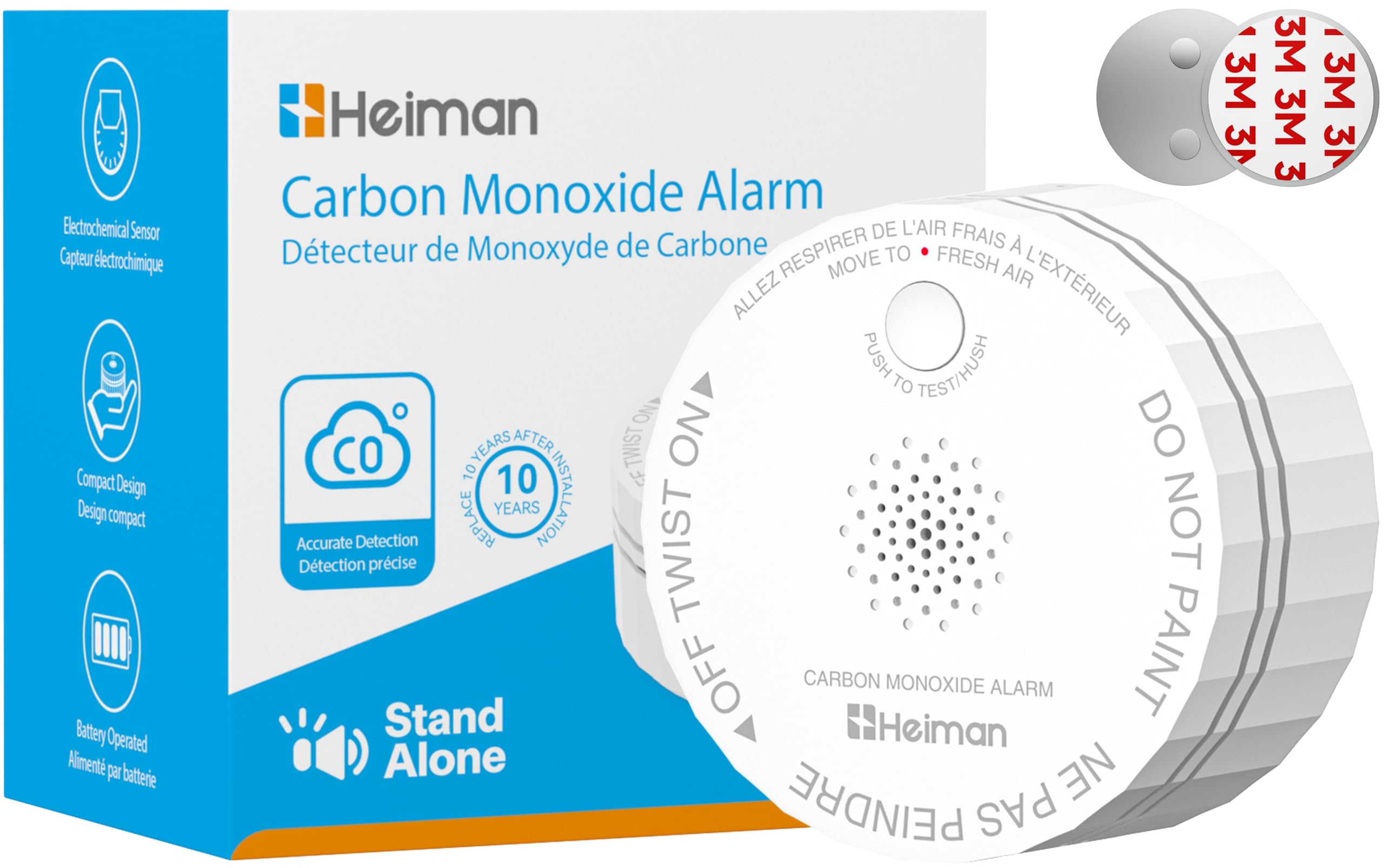
3. Heiman C1-S Carbon Monoxide Detectors
The smallest alarm on this page, built for people who have more than one property to cover.
Three and a third ounces of detector. At 3.68 ounces and 2.75″D x 1.45″W x 2.75″H, it is notably more compact than the First Alert FAT1039718 at 2″D x 5″W x 5″H. It slips onto a wall beside an existing smoke detector without crowding the ceiling.
Inside that small shell sits a Japan-made FIGARO electrochemical sensor, which is the part that actually tracks carbon monoxide build-up. It is UL 2034 5th Edition certified and CSFM Approved, and the housing is a UL94 V-0 rated flame-retardant ABS+PC blend. An 85 dB audio-visual alarm handles the warning, and a one-touch Test/Silence button covers checking and hushing. The included lithium battery is rated for a 10-year average life, so there is no annual battery crawl through a tenant’s hallway.
People praise the core function first, with compact size a close second — buyers like that it “mounts easily alongside a smoke detector.” The honest catch is the paperwork: the listing mentions a 7-year warranty in the specifications while the copy references a 10-year limited warranty, so confirm which applies to your unit before you rely on either. And with no display, you will not see a rising CO number, only the alarm when it hits.
Why landlords like it: 3.68 ounces, a 10-year-rated lithium battery, and a flame-retardant housing make multi-unit installation cheap in labor and headaches.
The fine print: warranty language reads two different ways in the listing — verify the term that applies to your order.
Built for: landlords, contractors, and property managers who need compliant coverage in several rooms at once.
Less ideal for: anyone who wants a screen showing CO in parts per million.
4. Kidde KN-COB-B-LP Nighthawk Carbon Monoxide Alarm

A seven-year warning that tells you it is time to replace the alarm, not just the battery.
Here is a spec most buyers overlook until it costs them: the end-of-life warning. This Nighthawk chirps at the seven-year mark to tell you the sensor itself is spent and the whole unit needs replacing. That is the piece of information a ten-year battery cannot give you if the sensing cell ages out first. Kidde also claims forty percent longer life than other CO alarms on the package.
Three included AAs carry it through outages, and the test-reset button checks operation and clears the alarm in one press. It meets the requirements of Underwriters Laboratories, and the unit is backed by a seven-year limited warranty that lines up with the end-of-life warning. Buyers come away satisfied with the core job — that it does its job effectively is the loudest theme on the review pages, with easy installation right behind it.
The battery side is more mixed than the rest. Some owners find the cells go and go, but that experience is not universal. Set a calendar reminder anyway, because a battery that “lasts forever” is not a spec you can build a safety plan around.
The standout detail: a seven-year end-of-life warning plus a seven-year limited warranty — a rare case where the alarm tells you when to retire it.
One more thing: the end-of-life chirp is not a battery chirp, so do not silence it and forget it.
Pick this if: you want a unit that announces its own retirement instead of quietly aging out.
Pass if: you would rather not think about a replacement deadline at all.
5. First Alert FAT1039718 Carbon Monoxide Alarm

No wiring, no screen, no menus — one button and a 9V cell.
A single test/silence button is the whole control scheme on the FAT1039718. For a guest room, a basement, or a rental where someone else will be operating it, that is the right design. It is battery-operated with a 9V cell, so it works almost anywhere on the wall without hunting for an outlet, and the electrochemical sensor inside is the same core technology First Alert uses up the line.
When CO levels rise, the alarm sounds at 85 dB — loud enough to push through a hallway and into a closed bedroom, which is the entire point. At 2″D x 5″W x 5″H and 7.36 ounces, it is noticeably chunkier than the 3.68-ounce Heiman C1-S at number three, though both do the same job. Expect the larger face to be visible on a hallway wall rather than hidden behind furniture.
Here is the one gap worth flagging before you order: the listing carries no published customer review summary, so you are buying on the spec sheet and First Alert’s track record, not on a crowd verdict. Nothing in the data suggests a defect. Read the manual and confirm your mounting spot before you commit.
Why it fits a simple job: 9V battery power, a 85 dB alarm, and one test/silence button make it the easiest unit here to hand off to someone else.
Keep in mind: no published review consensus and no feature beyond the basics — this is a coverage alarm, not a gadget.
Fits the bill for: spare rooms, basements, and rentals where simplicity beats features.
Worth reconsidering if: you want real-world owner feedback before committing — the reviewed picks above give you that.
6. Kidde COPD Carbon Monoxide Detector

A plug-in unit that packs a ten-year backup and a gentle breathing light into a suitcase-friendly shell.
The dual power design is the differentiator. It runs on AC power, but a backup CR123A battery carries the monitoring through an outage. That combination — no annual battery run plus outage coverage — is what makes it a simple device to leave plugged in and then take with you on a trip.
A green light means normal operation, yellow means a fault, and red means alarm, which is the clearest status language on this page. A one-touch silence function means you will not be jolted awake by a test chirp, and a gentle breathing light keeps the room’s status visible without a glare. The unit is compact and shippable in a backpack or handbag, so a rental kitchen or a hotel room with a gas heater gets the same protection as your bedroom at home.
What buyers talk about most is how little it asks of them — plug it in and it runs. Quality and function join that list. The catch is the battery side, which reads mixed rather than flawless. And with an audible alarm only and no digital readout, you get a warning, not a number.
Best detail: a green/yellow/red status system plus a one-touch silence button — the clearest at-a-glance state lights anywhere on the list.
The honest note: battery life is the mixed part of the picture, so plan the backup replacement sooner than the ten-year headline suggests.
Choose it if: you want plug-in convenience that also travels well.
Better to skip if: you want to see CO levels in numbers rather than a colored light.
7. Carbon Monoxide Detector 10-Year Battery

The one alarm here that tells you the highest CO level it has ever seen.
Peak level is the feature almost no one markets and everyone wants once they’ve had a scare. This unit stores the highest concentration of carbon monoxide it has measured, so you can check whether a spike happened while you were out. Check it after a furnace service or a cold snap to see whether CO spiked while you were out.
The backlit digital display flips between CO levels and ambient room temperature, which does double duty next to a thermostat. Power comes from a sealed ten-year lithium battery — no annual change-out, just a ten-year run before the whole alarm retires. The design is modern and compact enough for a tabletop or a wall mount.
The trade-off is exact and easy to size: a sealed ten-year battery means you replace the alarm, not the cell. There is no published customer review summary for this listing, and the sensor is electrochemical across the board, so you are buying on spec and First Alert’s parts quality. With no owner reviews to lean on, you are buying on the spec sheet and First Alert’s parts quality.
What makes it memorable: the peak-level memory plus a temperature display — two pieces of real data, not just a siren.
One honest limitation: the sealed battery cannot be swapped, so a ten-year-old alarm gets replaced wholesale.
Right for you if: you want to see what your CO levels have actually been, not just hear a noise in the night.
Look elsewhere if: you prefer a battery you can replace and keep the unit running.
Know the Specs
Electrochemical Sensor
This is the part that actually detects carbon monoxide. A small cell reacts chemically when CO touches it, and the reaction produces a tiny electrical signal the alarm reads. Every detector here uses that technology, so treat it as the baseline. What varies is the sensor brand — the Heiman C1-S uses a Japan-made FIGARO cell, which is the most specific sensor name on this page. A detector that does not name its sensor type at all is harder to judge.
85 dB Alarm
This is the loudness of the siren when CO is present — roughly the sound of a garbage truck rolling past your window. A unit rated at 85 dB targets a volume that can reach through a hallway and a bedroom door. The warning is an alarm, not a whisper, which is why placement matters as much as volume. Put the unit near where you sleep, not tucked in a closet.
10-Year Battery
A ten-year battery is a sealed power cell rated for roughly a decade of continuous monitoring. It removes the yearly cell swap, which is the most common reason an alarm goes dark. The flip side: when the cell dies, the whole alarm retires with it. Models with replaceable AA batteries ask more of you but let the unit keep going after each swap.
UL 2034 and ETL Listed
UL 2034 is the safety standard for carbon monoxide alarms, and ETL Listing is a third-party confirmation that a unit was tested to that standard. Look for either on the box or in the listing. Several picks here state 5th Edition compliance explicitly. If a detector shows neither, you cannot verify what it was tested against.
Low-Level CO Alerts
Most alarms warn at a higher CO concentration. A low-level alert turns on earlier — the Kidde COPDLG starts at 30-70ppm with a distinct light and sound pattern. Earlier warning gives you more time to open windows and call someone. It does not mean the unit is more sensitive to false alarms; it means it raises the flag sooner.
End-of-Life Warning
A CO sensor ages. An end-of-life warning is a chirp that tells you the sensing cell is spent and the whole alarm needs replacing — not just the battery. The Kidde Nighthawk uses a seven-year end-of-life warning, matched to a seven-year limited warranty. Ignore it and you keep a dead sensor on the wall. Replace it when it tells you.
Common Questions
How many CO detectors does a normal home need?
Will a plug-in detector work during a power outage?
What does 85 dB actually sound like?
Do I have to replace the whole alarm when the battery dies?
Is a carbon monoxide detector the same as a smoke detector?
What does 30-70ppm mean on a low-level CO alarm?
Why does my alarm chirp at random times?
Can I take a CO detector to a hotel or vacation rental?
Will a CO alarm also detect a natural gas leak?
How do I test a CO detector after installing it?
The Bottom Line
If you want the most-vetted choice in this category, the First Alert Battery Carbon Monoxide Alarm earns the top spot on the strength of its electrochemical sensor, 9V battery power, and four-in-one box that gives you a mount, a manual, and a battery in the same package. If you split time between homes and rentals, the Kidde COB at 5.92 ounces is the one to tuck in a bag. And if your home runs on gas, the Kidde COPDLG is the only pick here that watches for explosive gas as well as CO, with alerts starting at 30-70ppm.
How we choose
We do not accept paid placement. Every pick is matched to a real buyer and a real use-case; we do not hands-on test units.
Sources
Specifications: manufacturer listings and product documentation. Review insights: verified customer reviews, as of November 2026. Pricing: not shown on this page (it changes often); check the current price via the retailer link.
As an Amazon Associate, Tactical Gear Guy earns from qualifying purchases. This does not affect which products we feature.