Specs are compiled from manufacturer listings and verified buyer reviews and can change over time — please confirm the key details on the product page before buying.
A radar detector only earns its place on your windshield if it warns you early enough to actually lift off the throttle — and stays quiet the rest of the time. That is the whole game. Everything else, from colour screens to phone apps, is decoration. Below you will find the nine detectors worth considering, sorted by what they genuinely do well, so you can match one to how and where you drive instead of paying for features you will never touch.
This guide is built by comparing the manufacturers’ published specifications and the patterns across verified customer reviews, so you get each pick’s real strengths and trade-offs instead of marketing spin.
Some units here lean on GPS memory to silence repeated false alerts, others rely on raw antenna sensitivity to catch a signal from far away. The right answer depends on whether your daily commute is a city grid or an open highway. These are the top 10 radar detectors that hold up once the marketing pages are stripped away.
Top Picks
How To Choose The Best Radar Detector
Start with the one question that decides everything else: where do you actually drive? A detector tuned for wide-open interstate will drive you up the wall in a city full of automatic doors and blind-spot monitors. A city-friendly unit with aggressive filtering can feel numb on a lonely highway. Get that match right and the rest of the spec sheet falls into place.
Band coverage and what the police actually use
Detectors listen on X-band, K-band, Ka-band, and laser. K-band and Ka-band are the ones you will meet most often, and laser is a different animal — it is a narrow beam aimed at your car, so a laser alert often means you have already been measured. That is why front and rear laser detection matters: it widens the chance of catching scatter from a car ahead being targeted first.
Filtering is the feature you will notice daily
A noisy detector gets switched off within a week. Look for GPS-based autolearn, which remembers where a false alert happened on your route and mutes it on the next pass. Traffic Flow Signal Rejection does similar work for radar-based traffic monitoring systems. The more of this a unit has, the more you will trust the alerts that do get through.
Directional awareness and GPS camera alerts
Arrows that tell you whether a threat is ahead, behind, or beside you change how you react — you learn whether to slow down or just keep rolling. Separately, built-in GPS can flag fixed red light and speed cameras even when no radar signal is present, which is a completely different kind of warning and worth having if you drive unfamiliar towns.
Side-by-Side Comparison
| Model | Best For | Bands Supported | Display | Weight | Amazon |
|---|---|---|---|---|---|
| Escort Redline 360c★ Best Overall | Long-haul highway driving | X, K, Ka, Laser | OLED | 14.24 oz | Amazon |
| Whistler CR88Budget Champion | Budget 360° protection | X, K, Ka, Laser | OLED | 12.8 oz | Amazon |
| Cobra RAD 490iCompact Pick | Compact windshield fit | X, K, Ka | LED | 4.8 oz | Amazon |
| Whistler CR93 | Camera alerts, no subscription | X, K, Ka, Ku | OLED | 12 oz | Amazon |
| Cobra RAD 700i | Quiet daily commuting | X, K, Ka | OLED | 6.4 oz | Amazon |
| Escort MAX 3 | Balanced range and filtering | K, Ka, X, M, POP | OLED | 0.23 kg | Amazon |
| Uniden R4W | Extreme range on a budget-minded premium | Ka, K, X | OLED | — | Amazon |
| Uniden R8W | Directional arrows and dual antennas | 34.7 GHz, 24.125 GHz | OLED | — | Amazon |
| Valentine One V1 Gen 2 | Arrow purists and road trippers | X, K, Ka, Ku | LCD | — | Amazon |
Detailed Reviews
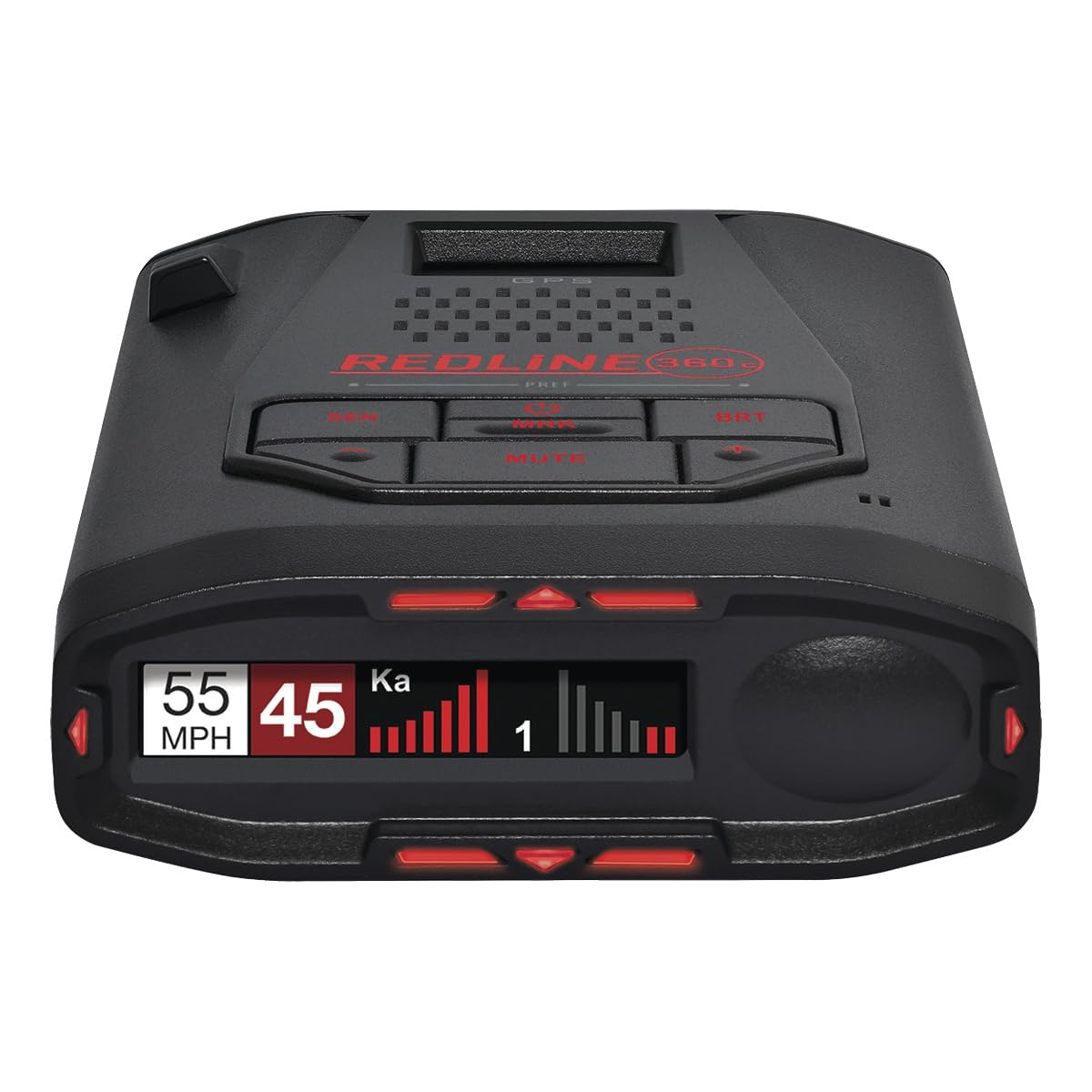
1. Escort Redline 360c Radar Detector
Our pick — 4.5+★ from 400+ verified ratings; the strongest balance of quality and price.
This is the detector for high-mileage highway drivers who need the longest possible warning window before a Ka-band hit.
The Redline 360c is built around range. Escort rates it at two times the range of the Redline EX and a processor that runs 25 times faster, which in plain terms means the alert lands further out and lands sooner. Mount it high, drive into open country, and the warning arrives with enough room to do something about it rather than just watch the situation develop.
Range alone would make it noisy, so the filtering stack carries equal weight. GPS Autolearn remembers where a false alert fired on a previous trip and mutes it next time, the IVT Filter is updateable, and the Drive Smarter network pools alerts from other drivers. It also hooks into Apple CarPlay and Android Auto, so alerts can sit on your vehicle’s display instead of a small screen on the glass. The one thing to know before you buy: this is a detection unit only, with no jammer function and no built-in camera database beyond what the connected services carry.
Buyers report it installs easily and delivers “a minimum one-mile plus detection range,” and the safety story runs through the reviews — plenty of saved-ticket accounts. Physically it is the heaviest pick here at 14.24 ounces, against the 4.8-ounce Cobra RAD 490i, so it is a chunk of hardware to hang off a suction cup. The wide 1.3-inch width is well under the Whistler CR93 at 3.12 inches, so it sits narrow on the glass and leaves your sightline alone.
Where it earns its price
- Extreme range with a processor rated 25 times faster than the Redline EX for quicker alerts
- GPS Autolearn plus an updateable IVT Filter that together cull repeat false alerts
- 360-degree directional awareness with GPS location accuracy within 2.5 meters
- Live shared alerts through the Drive Smarter community, viewable on CarPlay or Android Auto
What to weigh first
- 14.24 ounces is the heaviest unit in this lineup by a clear margin
- Detection only — no laser jamming function
- Premium-tier spend for a windshield detector
Made for: high-mileage highway drivers who want the longest possible warning window and will use the connected alert network.
Think twice if: you swap cars often or dislike a heavy unit on the windshield — the lighter picks below disappear on the glass.
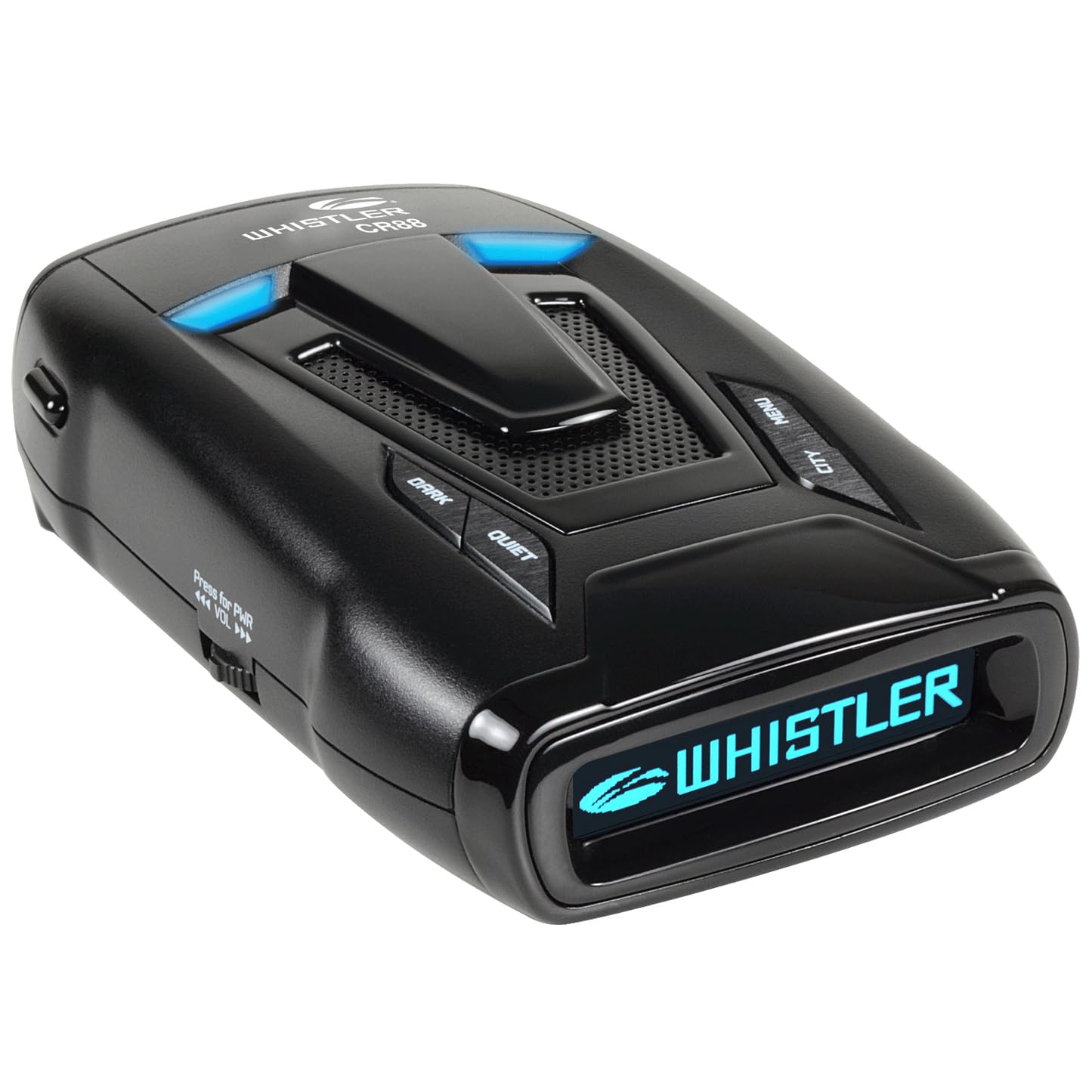
2. Whistler CR88 High Performance Laser Radar Detector
Three filter modes, Radar and Laser Signature ID, and a full text display at a starter budget.
If you are buying your first detector and want to learn how alerts behave before spending big, the CR88 covers the full spread of bands — X, K, super wide Ka, and laser — with 360 degrees of perimeter protection. It also picks up Laser Atlanta Stealth mode, Laser Ally, and LTI Truspeed S, which matters because laser is the band where early notice is hardest to get.
Where this one quietly punches above its tier is the display and filtering pair. Radar Signature ID and Laser Signature ID both flash up so you learn which band is talking to you, and Traffic Flow Signal Rejection with XK/Ka filter modes knocks down alerts from radar-based traffic monitoring systems. Voice alerts run in two languages. Physically it is a big unit — 7.62 inches long against the 4.25-inch Cobra RAD 490i, and 6 inches tall against 1.25 inches on the Cobra — so it eats windshield real estate and you should plan the mount placement before it arrives.
Full kit included: The box carries a 12V power cord, dash pad, direct wire kit, and windshield bracket kit, so you can hardwire it instead of looping a cable across the dash — a job most budget detectors leave you to solve yourself.
The trade-off to size: It is a bulky windshield presence, and the 4.0+ star rating on a modest review base reflects a smaller pool of owners than the big-name picks here.
Reach for this if: you want genuine band coverage and signature ID on a starter budget and have room on the glass.
Look elsewhere if: your windshield is already crowded or you want GPS memory filtering, which this unit does not list.
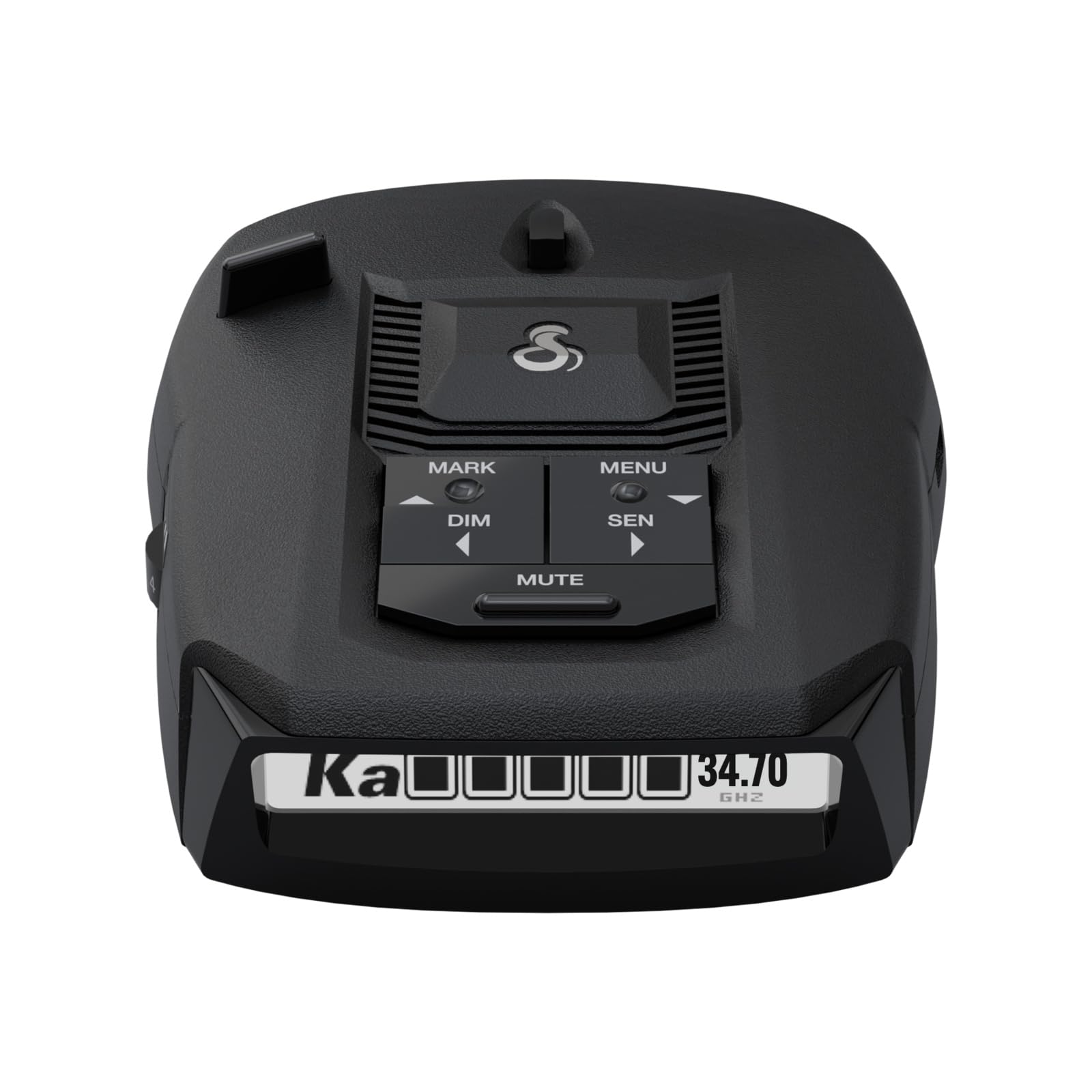
3. Cobra RAD 490i Radar Detector
At 4.8 ounces and 4.25 inches long, it is the lightest, smallest unit here — barely there on a crowded windshield.
Weight is the headline here, and the numbers make the case. The RAD 490i runs 4.8 ounces against the Escort Redline 360c at 14.24 ounces, and it measures 4.25 inches long against the Whistler CR88 at 7.62 inches. On a small windshield or a car you share with someone else, that difference is the whole purchase.
The engineering fits the small body. Cobra’s LaserEye technology reads laser from the front and the rear of the vehicle, the updateable IVT Filter and anti-falsing circuitry work against blind spot monitoring and collision avoidance systems, and Digital Signal Processing speeds up how fast an incoming signal becomes an alert. Adjustable sensitivity and filter modes let you decide how much chatter you tolerate — Extreme Mode drops the filters for maximum coverage when you are out of the city.
Ownership sentiment leans on build quality and value, and the recurring pattern is that alerts arrive well before the source is in sight. There is a split on signal quality that seems to track with how aggressive you set the filters. Setup runs through a USB-C power cord, a USB-C to cigarette lighter adapter, and an adhesive mount with static cling film, and firmware updates keep the software current over time.
What makes it liveable: The USB-C power standard and adhesive mount with a detachable, angle-adjustable bracket mean you can position it for visibility without committing to a permanent hardwire.
Honest catch: No GPS autolearn, so repeat false alerts on your regular commute stay manual — adjust the sensitivity modes instead.
Pick this one when: windshield space is tight or you want a detector light enough to leave mounted.
Pass if: automatic GPS-based muting of known false-alert locations is on your must-have list.
4. Whistler CR93 Radar Detector
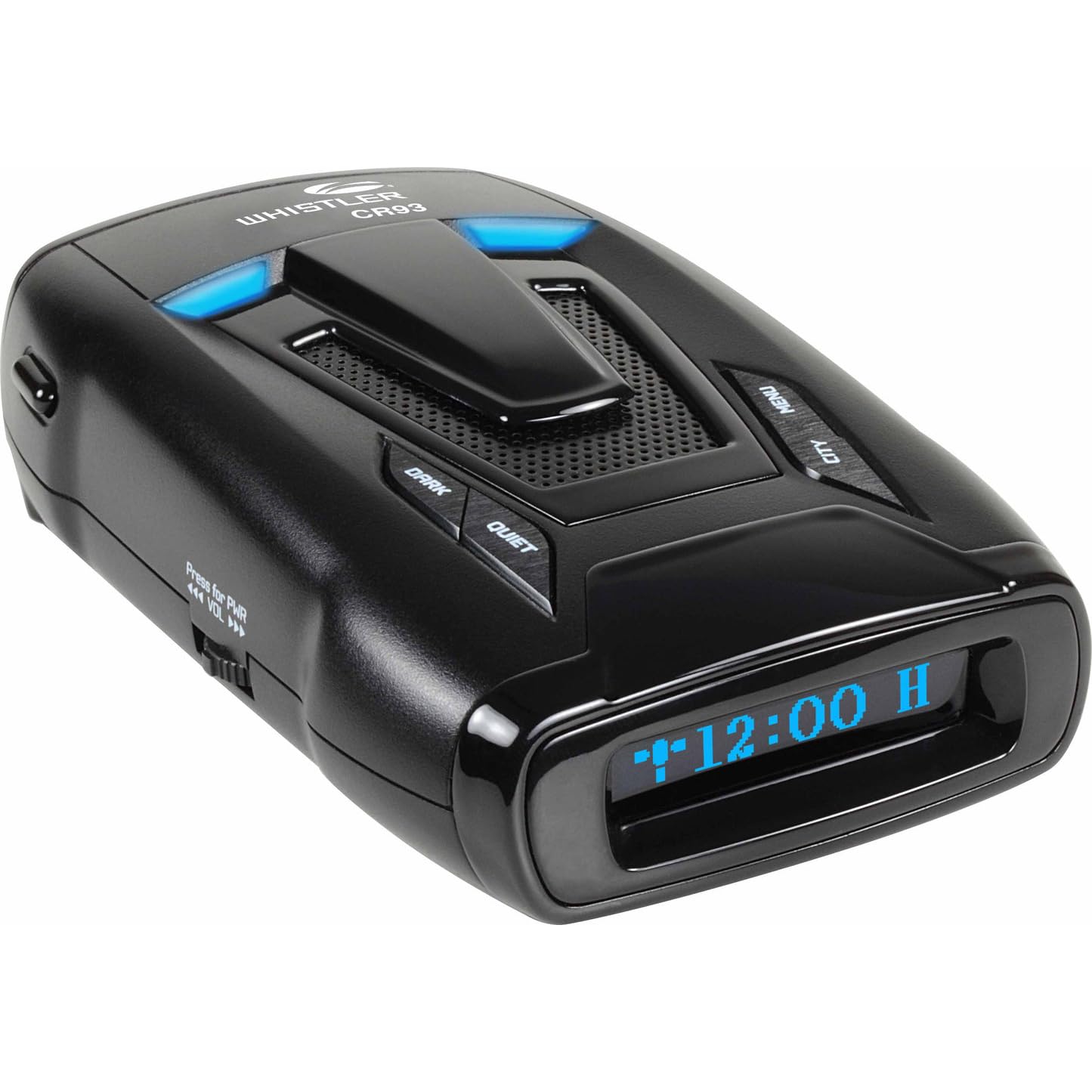
Built-in GPS flags red light and speed cameras with no app, account, or subscription.
Most camera alerts in this category arrive bundled with an app or a paid database. The CR93 builds GPS in and keeps it there, marking red light cameras, speed cameras, and known speed trap locations so you get a heads-up before the intersection rather than at it. Mount it, drive, no account, no ongoing cost.
That GPS chip does a second job most people do not expect. GPS-assisted city mode automatically rolls back sensitivity at lower speeds, which cuts the urban false alerts the XK/Ka filter and TFSR systems cannot fully handle on their own. It learns your route too, so familiar roads get quieter over time. Band coverage runs X, K, Ka, and Ku with POP mode, and the OLED screen plus spoken English or Spanish alerts keep your eyes where they belong.
Owners tend to land on quality and value, with range and the multiple city and highway modes coming up as the reasons it stays mounted. It is 12 ounces and measures 3.12 inches wide — wider than the Escort Redline 360c at 1.3 inches — so it takes a horizontal stretch of glass, though the 1.31-inch height keeps it low-profile in your sightline.
The sleeper feature: Selectable tone alerts let you tune the audio to something you will actually register instead of the same beep every unit ships with.
Worth knowing: The camera locations live in the unit’s own GPS database rather than a live crowd-sourced feed, so treat it as the built-in list rather than a real-time network.
Best fit for: drivers who rack up unfamiliar-town miles and want camera warnings without a subscription tail.
Less suited to: anyone chasing maximum raw detection distance — the range-focused picks sit further up this list.
5. Cobra RAD 700i Laser Radar Detector, Premium Detection Range

AutoLearn GPS memory mutes repeat false alerts on your regular route, so the commute gets quieter week by week.
Cobra’s answer to false-alert fatigue is AutoLearn Intelligence, a GPS-based layer that watches your regular routes and progressively mutes signals it has seen before in the same place. Pair that with the advanced filtering software and the detector gets quieter the longer you own it — the opposite of the suspicion that builds when a unit cries wolf every few miles.
The antenna platform and Digital Signal Processing handle the speed side: incoming laser signals get processed faster so the alert lands earlier. Front and rear detection runs through Cobra’s LaserEye protection across all radar types, and the 5-color OLED display can be matched to your interior lighting if you care how the cabin looks. CarPlay and Android Auto compatibility put route and alerts on the vehicle screen, and the Drive Smarter community feeds in live alerts from other drivers.
What wins people over is build quality, and value for money runs close behind. The accuracy story is genuinely split — the GPS learning reassures plenty of owners, while others still find the alert volume excessive. Physically it is a moderate 6.4 ounces and 1.25 inches tall, so it tucks under the mirror without drama.
The honest read on noise: AutoLearn only helps where you actually drive repeatedly. On constantly new roads, expect to lean on the manual filtering modes instead of the learning layer.
Worth it for: commuters on a fixed route who want the detector to quieten down over weeks rather than fight it daily.
Not the one if: you want a bare-bones alert box with zero connected features.
6. Escort MAX 3 Radar Detector

Variable Speed Sensitivity tightens filtering around town and opens up range on the highway, with an optional M2 dash cam pairing.
Variable Speed Sensitivity is the feature that sells the MAX 3 to daily drivers. It reads how fast you are going and dials sensitivity up or down to match — looser at highway pace where range counts, tighter around town where false alerts breed. Add AutoLearn GPS memory on top and the unit is doing two different jobs to keep the cabin quiet.
Detection range is Escort’s established strength, with rapid responses that buy you time to adjust. The filtering software sifts thousands of radar signals looking for the ones that are not threats, and the Defender Database feeds in red light and speed camera locations. Bands cover K, Ka, X, M, and POP. Bluetooth connectivity plus CarPlay and Android Auto compatibility extend it to your phone and vehicle display.
The feature that separates it from the pack is the M2 pairing: you can bolt on Escort’s M2 smart dash cam and run detection and recording as one windshield setup. Range and the mounting system draw the most praise, and the mount does go on easily. Accuracy is where opinions divide — GPS learning satisfies some owners completely while others still see more false alerts than they expected.
The pairing angle: If you were going to buy a dash cam anyway, running the M2 alongside this detector is a cleaner install than two separate brackets and two separate apps.
Size note: At 0.23 kg it is a mid-weight unit — heavier than the 6.4-ounce Cobra RAD 700i but a fraction of the 14.24-ounce Redline 360c.
Choose it for: mixed driving where speed limits change often and you want the detector adapting without you touching a setting.
Skip the upgrade path if: you have no interest in a dash cam — you are paying for a capability you will leave unused.
7. Uniden R4W Extreme Long-Range Laser/Radar Detector

Blackfin DSP delivers flagship-grade Ka-band range and GPS Auto Mute Memory for well under R8W money.
Uniden puts a Blackfin DSP — a digital signal processor, the chip that sorts incoming radar and laser signals — at the centre of the R4w, and the result is the long-range pickup the model is named for. Bands cover Ka, K, and X, alerts come through a multi-colour OLED display with voice, and the 12-volt DC power source keeps the install simple.
The clever part is what happens after the first week. Built-in GPS with Auto Mute Memory learns where false alerts fire along your routes and mutes them on repeat passes, so that retail door alarm stops interrupting you. Advanced K/Ka band filtering handles blind-spot monitoring and collision avoidance systems, and the R/TACH app pairs over Wi-Fi or Bluetooth for settings and firmware. Red light and speed camera locations are pre-loaded.
Long-range detection is the reason it gets recommended, and there is a real split on noise cancellation — the mute memory earns loyalty, while rapid beeping from miles out still irritates some owners. Setup and daily use are straightforward, and the R/TACH app keeps the firmware current without a cable.
What owners reward: Quality and reliability are the leading themes, and the pattern is a detector that keeps delivering the same early warning drive after drive.
The real catch: Range this long means the alert sometimes fires when the source is still well out of view — the mute memory is what makes that tolerable.
Go here if: you want flagship-grade range and GPS memory without paying flagship money.
Hold off if: you drive mostly in dense city traffic where maximum range becomes maximum noise.
8. Uniden R8W Radar Detector

Dual antennas and dual Blackfin processors feed directional arrows that show whether the threat is ahead, behind, or beside you.
Where the R4w hears a threat, the R8w places it. Dual antennas read radar from all four directions, dual Blackfin DSPs process both feeds, and the voice alerts call out direction, band type, and signal strength. That combination is the difference between slowing down and knowing whether you even need to.
Frequency support runs 34.7 GHz and 24.125 GHz, with built-in GPS and Auto Mute Memory repeating the trick from the R4w — remembered false alerts stay muted along your routes. Red light and speed camera locations ship pre-loaded and update free over firmware, and the R/TACH app handles voice-alert customisation over Wi-Fi and Bluetooth. A 1-year warranty covers the hardware.
Quality is the loudest theme in owner feedback and ease of use sits right behind it — the setup is closer to plug-and-play than the feature list suggests. Range and accuracy follow, particularly on rural roads where an early warning has nowhere to hide. Reliability and value carry more mixed sentiment, and the honest read is that this is a lot of detector for the money rather than a bargain-bin find.
Where it beats the R4w: The directional arrows give you threat location on top of the range, which is the difference between knowing something is out there and knowing where.
Consider the size: It measures 4.9 inches long by 3.5 inches wide by 1.5 inches tall, a larger footprint than the 4.5-inch R4w, so check your mirror area first.
Built for: drivers on unfamiliar highways who want to know the direction of a threat, not just that one exists.
Overkill if: you drive short, familiar routes where the R4w already covers you.
9. Valentine One V1 Gen 2 Radar Detector

A dedicated rear antenna and an arrow that points — no screen gimmicks, no app-first design.
Valentine’s approach is unusual in this lineup: instead of one antenna working to infer direction, the V1 Gen 2 carries a dedicated rear radar antenna alongside the front, so the directional indicator is reporting from two real listening points. Add 360-degree laser protection and the arrows mean something a single-antenna unit can only approximate.
Band coverage runs X, K, Ka, and Super Wideband Ka, plus Ku band — the one band in this comparison that the Cobra and Uniden picks do not list. A smartphone or tablet pairs for configuration. The footprint is compact at 4.6 inches long by 3.8 inches wide by 1 inch tall, and the LCD display keeps the readout simple rather than colour-coded.
Owners describe it as the detector they stop second-guessing, with the arrows for front, back, and side called out as the feature that changes how you read the road. Accuracy and range follow close behind in what people value. The settings menu is the one spot that draws complaints — it takes time to learn, and this is not a unit that walks you through it.
The case for it: Direction from a real rear antenna beats direction inferred from signal strength, and the Ku band coverage is meaningful if you drive where it is used.
Right for: drivers who want pure directional awareness and will take the time to learn the settings.
Wrong for: anyone expecting a guided setup or a colour OLED interface.
Know the Specs
Band Coverage Explained
X, K, and Ka are the three main radar bands, and each behaves differently in the real world. K-band is the one most often confused with blind-spot monitors and automatic doors, which is why filter quality matters as much as sensitivity. Ka-band is the most common enforcement band on open highways. Laser sits apart entirely — a narrow beam, not a broad sweep, so a laser alert usually arrives very close to the moment of measurement. Ku band appears on some units and not others, so check the band list against where you drive.
GPS Memory and False-Alert Filtering
GPS memory is where the daily quality of life lives. The detector notes the location of a false alert — a store door, a traffic sign — and mutes that same spot on later passes. Autolearn does this automatically; some units require you to mark it. Traffic Flow Signal Rejection and IVT filtering target the sensors cars carry themselves, from blind spot monitors to collision avoidance systems. A detector with strong filtering and modest range often beats a long-range unit with none, because you will actually leave the quiet one switched on.
Directional Arrows and What They Tell You
Arrows report whether a threat is ahead, behind, or beside you. Single-antenna units infer direction from signal strength, which works until reflections confuse the reading. Dual-antenna designs, like those with a dedicated rear antenna, measure from two points and give a truer answer. In practice the difference shows up when a signal follows you rather than approaches — you keep driving instead of braking for a threat that is already behind.
Display, Mounting, and Power
OLED screens stay readable in direct sun and use less power than older LCD types, though both appear here. Weight and dimensions matter more than buyers expect: a heavy unit flexes the mount and takes up mirror space, while a light one disappears. Most units run off a 12-volt DC cord, and how you route that cable — hardwire kit or cigarette lighter adapter — decides whether the install looks clean or looks like an afterthought.
Common Questions
Will a radar detector pick up laser in time to react?
Does GPS autolearn actually reduce false alerts over time?
What is the difference between a single antenna and dual antennas?
Do I need Wi-Fi and Bluetooth on a radar detector?
Can a radar detector warn me about red light and speed cameras?
How much does unit weight matter on a windshield mount?
What does POP mode detection mean?
Is a more expensive detector always better at avoiding tickets?
Can I hardwire a radar detector instead of using the cigarette lighter?
Will a radar detector detect police from behind?
The Bottom Line
For most drivers, the top 10 radar detectors winner is the Escort Redline 360c because it pairs extreme range with GPS Autolearn and the Drive Smarter network, so the alerts you get are both early and worth acting on. It carries the highest rating in this lineup at 4.5+ stars from a large, active owner base. If you want directional arrows and dual antennas behind your alerts, the Uniden R8W is the step up. And for a compact daily driver that disappears on the glass, the Cobra RAD 490i at 4.8 ounces is the sensible reach.
How we choose
We do not accept paid placement. Every pick is matched to a real buyer and a real use-case; we do not hands-on test units.
Sources
Specifications: manufacturer listings and product documentation. Review insights: verified customer reviews, as of November 2026. Pricing: not shown on this page (it changes often); check the current price via the retailer link.
As an Amazon Associate, Tactical Gear Guy earns from qualifying purchases. This does not affect which products we feature.