Specs are compiled from manufacturer listings and verified buyer reviews and can change over time — please confirm the key details on the product page before buying.
The bike that actually gets your toddler gliding is the one whose seat height matches their inseam today, not the one with the flashiest lights. Every pick below is a pedal-free balance bike — no chain, no pedals, nothing to trip on — so your child learns to steer and coast on their own two feet. What matters most is fit (seat height vs. leg length), weight (a five-pound bike your child can lift by themselves beats a heavy one you carry back to the car), and whether the wheels are foam or air-filled.
This guide is built by comparing the manufacturers’ published specifications and the patterns across verified customer reviews, so you get each pick’s real strengths and trade-offs instead of marketing spin.
Below you’ll find the fit ranges, wheel types, and frame materials that decide which bike suits a one-year-old versus a four-year-old. By the end, you’ll know exactly which toddler push bike belongs in your hallway.
Top Picks
How To Choose The Best Toddler Push Bike
You are not shopping for a scaled-down bicycle. A balance bike has no pedals and no drivetrain, which means the only thing your toddler does is sit, push, and coast. That makes three numbers do almost all the work: your child’s inseam, the bike’s seat height range, and the bike’s weight.
Measure the inseam before you read any listing
Have your toddler stand with feet flat and measure from the floor to the crotch. That number is your filter. A bike whose lowest seat height sits above your child’s inseam will leave them on tiptoes, which defeats the whole point of a push bike. Compare it to the seat range in the listing — for example, a bike with a 9–17 inch seat range covers a wide spread of leg lengths, while a 13–17.3 inch range is built for the taller end.
Lighter bikes get ridden more
A bike your toddler can’t lift tends to stay in the garage. Weight is quoted in pounds or kilograms, and the spread here is wide — from 3.6 pounds on the lightest model up to 12.7 pounds on the heaviest. Aluminum and nylon frames keep the number down; steel frames push it up but usually take more abuse.
Foam tires versus air tires
Foam rubber tires are flat-free, which means you never patch a tube on a Saturday morning. Air-filled rubber tires ride smoother over grass and gravel but need occasional inflation. Neither is wrong — pick based on whether your riding happens on pavement or uneven ground.
Side-by-Side Comparison
| Model | Best For | Seat Height Range | Bike Weight | Tire Type | Amazon |
|---|---|---|---|---|---|
| Strider 12 Sport 2-in-1★ Best Overall | Youngest riders, rocking to rolling | 9–17 in. | 12.7 lb | Foam rubber | Amazon |
| Gotrax KS12Best Lights | Lights and fun on a budget | Adjustable (ages 2–5) | 8.6 lb | 12″ EVA | Amazon |
| Liberry Baby Balance BikeBest for New Walkers | New walkers, 12–24 months | 9.7–11 in. | 5 lb | EVA | Amazon |
| SEREED Baby Balance Bike | One-year-olds, indoor play | Not listed | 3.6 lb | EVA | Amazon |
| Babelio Baby Balance Bike | Early walkers who need grip | 9.3–10.67 in. | 6.6 lb | TPE off-road | Amazon |
| Toddler Balance Bike (Youthkkee) | Budget first bike, ages 1–3 | Adjustable | 3.23 kg | Puncture-resistant | Amazon |
| Birtech 12 Inch | Older toddlers, ages 2–5 | 13–17.3 in. | 6.4 lb | 12″ air rubber | Amazon |
| Retrospec Cub | Pavement and grass, 18 mo–3 yr | 11–14.5 in. | 10 lb | Airless puncture-proof | Amazon |
| Strider 12 Pro | Lightest premium option, ages 1–5 | 11–17 in. | 5.6 lb | Foam rubber | Amazon |
Detailed Reviews
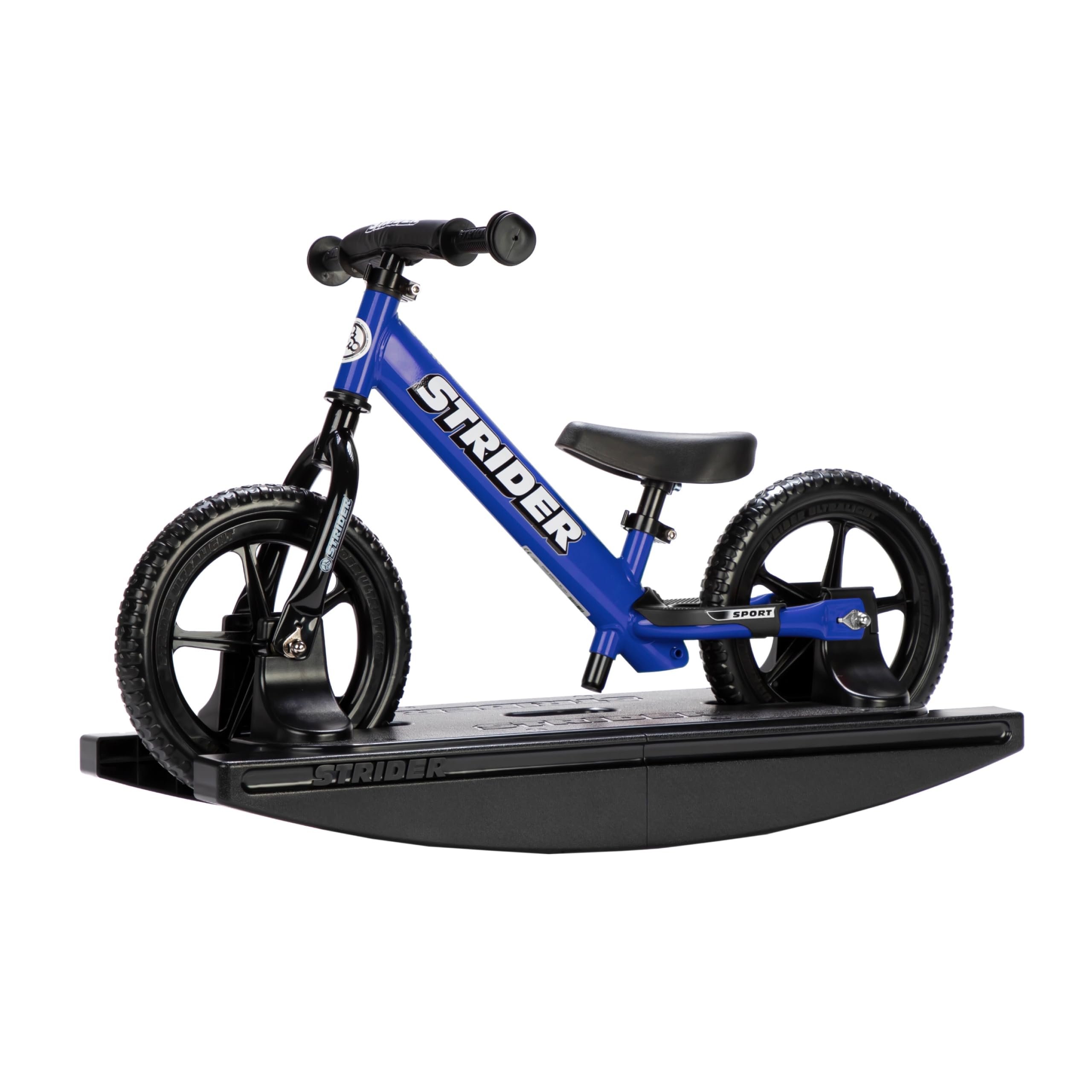
1. Strider 12 Sport Rocking Bike
Our pick — 4.5+★ from 850+ verified ratings; the strongest balance of quality and price.
The only bike here that starts as a rocker and turns into a real balance bike.
For a six-month-old who can barely sit up, the detachable rocking base is the opening move. Bolt it on and the bike becomes a stationary rocker; once your child has the hang of self-propelling, you lift the base off with no tools and it is a two-wheel balance bike. That conversion is why this earns the top slot — it is the only pick on this list that covers the pre-walking stage, and it stretches all the way to age four.
The fit is genuinely adjustable. Seat height runs from 9 to 17 inches to suit a 10–18 inch inseam, and the handlebars move from 18 to 22 inches, so the same bike follows your child from short-legged wobbling to confident gliding. The tires are flat-free foam rubber, so a thorn on the driveway ends the ride only in the sense that you go inside for a snack. A safety pad covers the front for the inevitable bumps.
The price also lands at the premium end, which is the trade-off the rocking base buys you. Unbolt it in the wrong order and you will be squinting at the manual, so do the first conversion with a coffee and ten minutes to spare.
Why it takes the crown
- Two bikes in one: rocking base for pre-walkers, balance bike for toddlers
- 9–17 in. seat range and 18–22 in. handlebars grow with the child
- Flat-free foam rubber tires mean no flats, ever
- No-tool conversion from rocker to rider
What to weigh first
- 12.7 pounds is heavy for a toddler to carry independently
- Priced at the top of the range — the rocking base is what you pay for
- Needs the manual open on the first base removal
Reach for this if: your child is somewhere between sitting up and turning four, and you want one bike to carry them through every stage.
Look elsewhere if: you need something a toddler can carry up the porch steps without help.
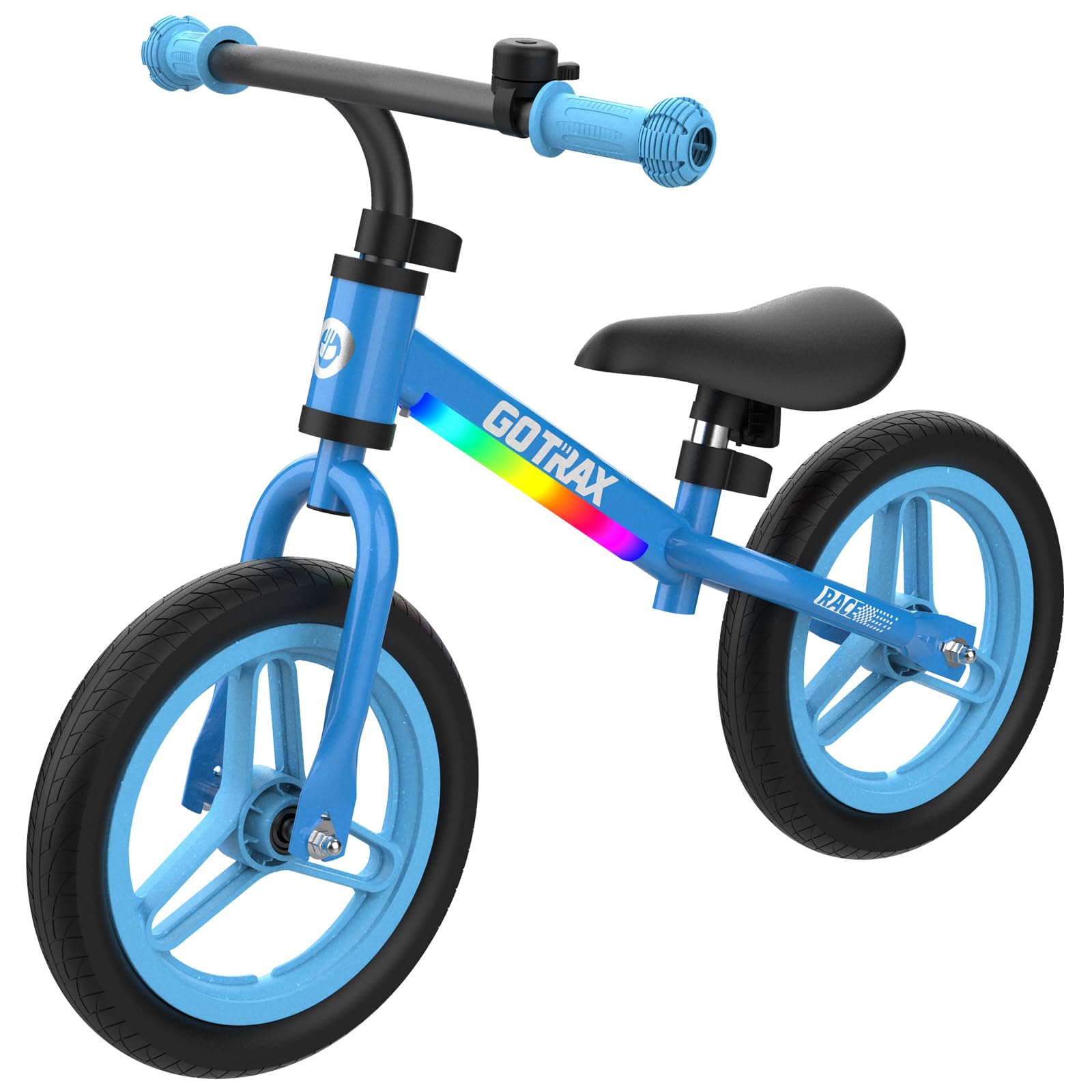
2. Gotrax Toddler Balance Bike
Flip a switch and the wheels glow — the bike that pulls kids off the couch.
The headline here is the switchable LED lighting. One flip and the colorful lights come alive, and they serve two jobs at once: they make the bike feel like a toy worth riding, and they make your toddler easier to spot when the afternoon light fades. Turn them off when you want the attention to go elsewhere. A bell, an ergonomic seat, and silicone grips round out the cockpit.
The 12-inch EVA wheels are dense foam that rolls over sidewalk, grass, and gravel without ever going flat, and reviewers report the iron frame holding up with no durability complaints. The frame is iron and the whole bike weighs 8.6 pounds while carrying riders up to 50 kg, so it is built for the long haul of toddlerhood.
The one place it will age out is size. The seat and handlebar adjust to cover ages 2 to 5, but parents of taller four-year-olds do find it runs small for the top of that range — if your child is already stretching toward the upper band, look at the Birtech below instead. Assembly is a few minutes with the included tools, and the maker backs it for a year.
The confident call: a solid, lit-up first bike that suits a two-year-old who needs a reason to love riding.
The single caveat: taller four-year-olds will outgrow the fit before they outgrow the fun.
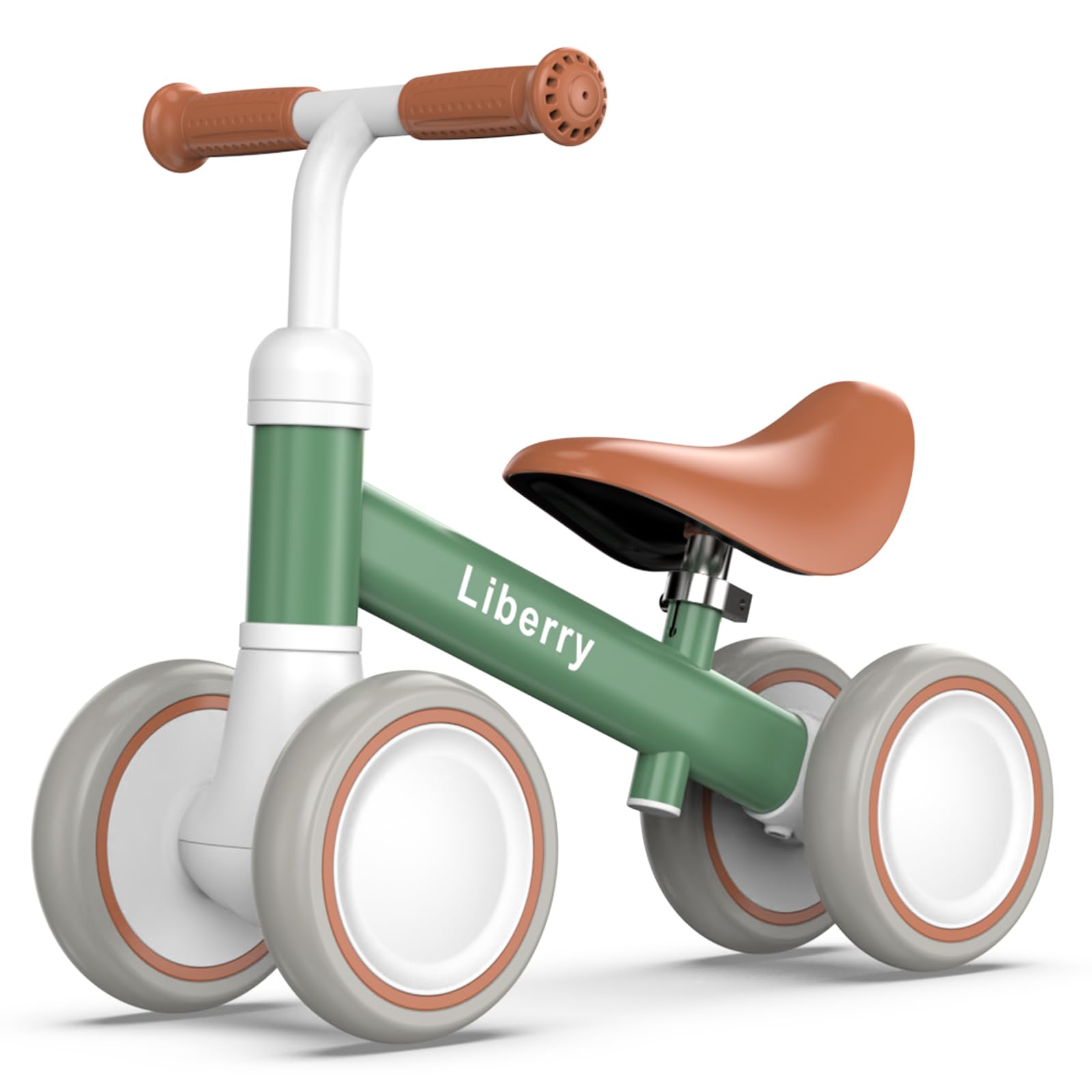
3. Liberry Baby Balance Bike
Four wheels that refuse to tip, in a package your toddler can carry one-handed.
Where a two-wheel balance bike asks for balance, this one hands it to your child first. Four wheels keep the seat level as they climb on and push, so the learning curve is basically zero. Enclosed wheels mean no pinched toes while scooting along, and the strengthened steel frame carries riders up to 55 pounds.
Weight is where it genuinely separates from the pack. At 5 pounds it is 12.7 pounds lighter than the Strider 2-in-1 — a 2.5x difference — which means your toddler can drag it around the yard themselves, and you can tuck it under one arm on the way to the park. The PU (polyurethane, a firm foam-like material) seat adjusts from 9.7 to 11 inches to grow with the child, and the rubber handlebars hold up better than foam grips that tear.
The green finish is the most-praised feature, drawing glowing comments on appearance across more than 60 mentions. The EVA tires cut noise and keep it quiet on hardwood, which matters if your downstairs neighbours or your own sleeping baby are within earshot. It suits a 12–24 month old best; once your child is past that window and ready to coast, move on.
The real standout: a four-wheel, 5-pound bike your one-year-old can carry — no balance required, no flats to patch.
Factor this in: built for 12–24 months, so it is a starter bike, not one that follows them to age four.
Suits you best if: your child is a new walker who needs the most stable possible first ride.
Move on if: you want a bike that lasts from toddlerhood to preschool.
4. SEREED Baby Balance Bike

The one a first-birthday baby can actually push around, no pedals or help required.
Recommended for 12–24 months, this bike is aimed at the toddler who has just started walking. The colorful wheels glow as they spin — no batteries, just motion — so the reward for pushing is immediate and visual. The frame is aluminum, which is why it tips the scale at just 3.6 pounds: the lightest bike on this list by a wide margin.
Safety is engineered in rather than talked about. The wheels are fully widened and closed, so toes stay out of the way, and steering is limited to 135 degrees to reduce the chance of a sideways tip. There are no sharp parts. Assembly takes no tools and about a minute, which means the birthday-morning unboxing is not a project.
What earns it the age-appropriateness label rather than a generic “for toddlers” tag is that the fit suits the smallest riders — and the fussiness goes the other way too. A handful of owners find the assembly instructions thinner than they would like, so watch a quick video if the manual leaves you guessing. The seat is soft and the 55-pound rating covers siblings.
What earns it a place
- 3.6 pounds — the lightest bike on this list
- No-tool, one-minute assembly for birthday-morning setup
- 135° steering limit and fully closed wheels to reduce tip-overs and pinches
- Motion-powered glowing wheels, no batteries needed
Where it stops short
- Built for 12–24 months, so it is a short-lived stage bike
- A few owners find the assembly instructions thin
Pick this one: for a first birthday gift where indoor-floor riding and easy carrying matter most.
Pass on it: if your child is already two-and-a-half and ready to graduate.
5. Babelio Baby Balance Bike

An off-road-tread balance bike that holds its grip on grass as well as pavement.
The tires are the story. The off-road tread is made from durable TPE (a rubbery, grippy plastic), and the non-slip, wear-resistant surface gives your child a steadier ride on uneven ground than a smooth wheel would. Grip is what everyone raves about — a firm hold the child will not easily wiggle out of. The four-wheel design keeps it level as they learn.
The fit range is unusually wide for this style: 10 to 36 months, with a 9.3–10.67 inch adjustable seat and a three-level adjustable handlebar that raises and lowers. That means the same bike can serve a very early walker and still fit a two-year-old. Assembly is tool-light, and the maker backs it with a lifetime after-sales warranty.
The honest limit is the low seat ceiling. At 10.67 inches at maximum, it tops out sooner than the taller two-wheel bikes here — a tall three-year-old will want to move up. The 6.6-pound weight sits in the middle of this group, so it is not the bike to hand a small toddler for carrying.
Wins on: three-level handlebar and a 9.3–10.67 in. seat that grow with a 10–36 month old, plus TPE off-road tread.
Know before you buy: the seat ceiling of 10.67 in. means it will be outgrown before the child is ready for a full-size bike.
Best matched to: a child from around ten months to two-and-a-half who rides on grass as much as pavement.
Not the fit for: a tall preschooler who needs a higher seat.
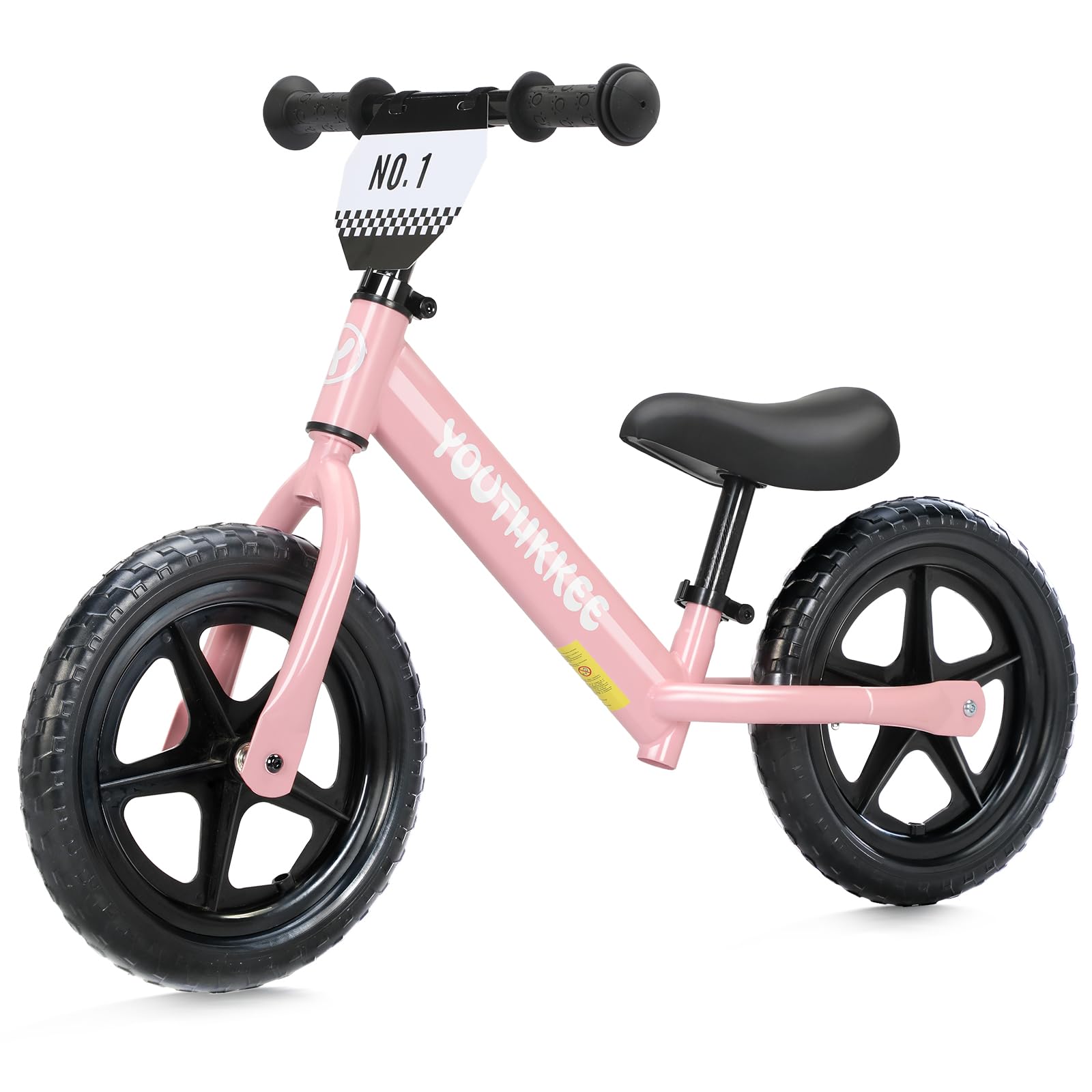
6. Toddler Balance Bike, Tool-Free Adjustable, Gift for 1-3
The no-fuss first bike for the family who wants to start small.
This is the entry point. The pedal-free design and low centre of gravity are aimed squarely at the 1–3 age band, and the adjustable seat and handlebars mean the same bike fits a short toddler and a taller three-year-old. Tool-free adjustment matters here — you can raise the saddle as your child sprouts without hunting for an allen key.
The frame is aluminum, which helps keep the bike light (quoted at 3.23 kg), and the padded seat plus non-slip handlebar grips are aimed at comfort during longer rides. Puncture-resistant tires mean no flat to deal with. Rounded edges on the frame are there to soften the occasional bump.
Durability is the honest variable. It is a heavier-use bike at a budget position, and while most owners find it holds up, a minority report the wear showing sooner than they’d like after about a month of steady use. Treat it as a starter bike, not a hand-me-down, and it will do the job it is built for.
The value read: a light aluminum frame, tool-free adjustment, and a seat that grows with a 1–3 year old at the entry point of the price range.
The trade-off: durability across many months of heavy use is the mixed part of the picture, so it is best seen as a starter rather than a long-term keeper.
The right call when: you want a light, adjustable first bike without committing to premium spending.
Look up the list if: you plan for the bike to survive two kids and years of use.
7. Birtech 12 Inch Balance Bike Air Rubber Tires with Footrest

For the four-year-old who has graduated from a smooth-wheel starter.
Twelve inches of inflatable rubber, with a deep anti-slip tread that soaks up shock on uneven ground — that is the reason this bike is aimed at the 4–5 crowd rather than early walkers. It rolls over concrete, grass, playground surfaces, and even indoor wood flooring. The seat runs from 13 to 17.3 inches for an 11–16 inch inseam, and a quick-release aluminum clamp lets you raise it without tools.
The frame is a one-piece molded nylon fiberglass shell with no welded joints, and the whole bike is light at 6.4 pounds. A race-style aluminum handlebar allows full 360-degree rotation. A U-shaped footrest wrapped on both sides lets a coasting child rest their feet — a small thing that makes longer glides comfortable.
Do know the recurring quirk: the handlebars can work loose and need re-tightening. It is a fixable annoyance rather than a defect that breaks the bike, but expect to check the clamp every few rides. Setup is close to done before it arrives — the frame is about 90% pre-installed.
Where the money goes
- 12-inch inflatable rubber tires with deep tread for shock absorption
- 13–17.3 in. seat with tool-free quick-release clamp
- 6.4 lb one-piece molded frame with no welded joints
- U-shaped footrest on both sides for coasting
Keep an eye on
- Handlebars can loosen and need periodic re-tightening
- The 13 in. minimum seat excludes very young toddlers
Ideal match: a preschooler aged four or five who rides on real terrain and benefits from air-filled grip.
Keep looking if: your rider is still two and cannot reach a 13-inch seat.
8. Retrospec Cub Toddler Balance Bike

The all-terrain workhorse that glides across pavement, grass, and dirt without a flat.
Airless, puncture-proof tires are the reason this bike is the low-maintenance choice. On pavement, grass, and dirt paths it rolls smooth and stable, and a nail on the bike path has nothing to deflate. The frame is alloy steel, which is why it weighs 10 pounds — middle of the pack in this group, but not the bike your toddler will carry one-handed.
Reviewers describe the airless tires as solid and long-wearing, holding up season after season. The seat adjusts from 11 to 14.5 inches, and the quick-release handlebars raise without tools as the child grows, so the same bike carries a two-year-old through to three-plus. Rounded edges, non-slip grips, and a low centre of gravity keep it stable on turns.
The catch is age. It is aimed at 18 months to 3 years, so a child approaching four will have outgrown it — that is when you graduate to the Birtech or Strider 12 Pro. For the 18-month to three-year window, though, it is hard to find a more complete package of durability, adjustability, and fun.
Standout feature: airless puncture-proof tires that ride across pavement and dirt without a flat to deal with.
The window to know: built for 18 months to 3 years, so a taller four-year-old will ride it out.
Made for: a young toddler who will ride across mixed ground and needs a bike that never quits.
Step up to a bigger frame if: your child is already turning four.
9. Strider 12 Pro Balance Bike
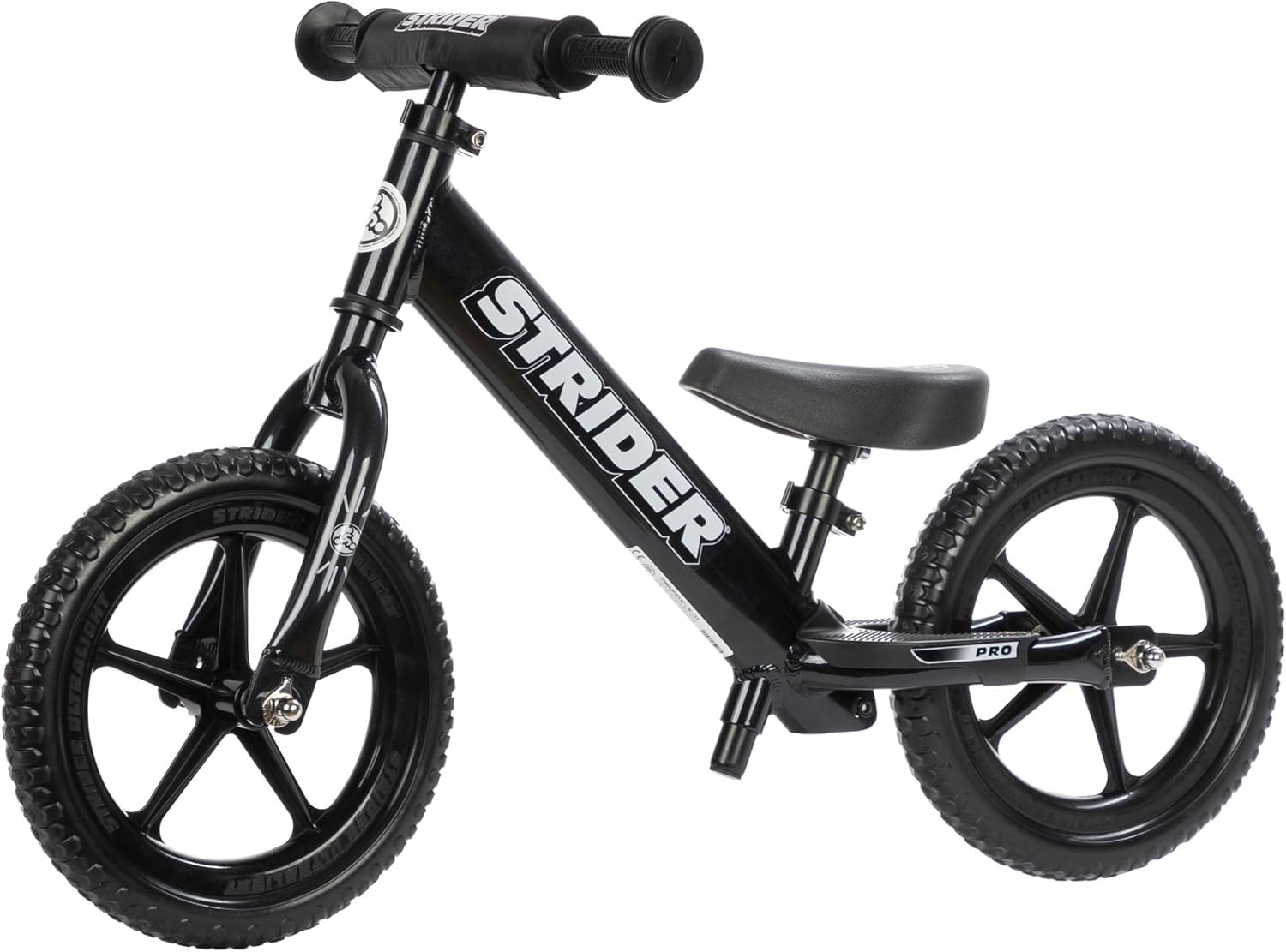
A 5.6-pound aluminum frame that your child can pick up and ride without asking for help.
The word that matters most with this bike is aluminum. That frame is why it weighs just 5.6 pounds, and the whole point of a balance bike is the child handling it themselves. A light bike gets lifted over curbs and ridden more often. The foam rubber tires stay flat-free, and the mini grips give small hands a proper hold.
Fit is generous. The seat adjusts from 11 to 17 inches for a 12–18 inch inseam, and the handlebars move from 18 to 22 inches, so a child from one to five years keeps the same frame. Standing footrests let a coasting child balance with feet up — a step toward riding without training wheels. Tools come in the box, so assembly is a quick job.
Reviewers call the aluminum frame sturdy and well-built, and many describe it as a great first bike. The trade-off is the premium position and the mixed value question — a fair number of owners consider it overpriced for what is essentially a frame and two wheels. If you plan for two children to share it, the frame justifies itself; for one short stage of childhood, the lighter-framed budget picks do similar work.
What you’re paying for: a 5.6 lb aluminum frame, flat-free foam tires, and standing footrests — the lightest premium option here.
Weigh the spend: the value conversation is the mixed part — worth it if two kids will share it, less so for a single short stage.
Choose it when: lightness and a frame that lasts from age one to five are your top priorities.
Think twice if: you are buying for one child and want the most economical route.
Know the Specs
Seat Height Range (the fit spec that matters)
Seat height is measured from the ground to the top of the saddle, and it must sit at or just below your child’s inseam for their feet to reach the ground. A bike whose range starts at 9 inches suits a very short toddler; one that starts at 13 inches needs a taller child. Look at both ends — the low end decides when they can start, the high end decides how long the bike lasts.
Bike Weight (the spec that decides who carries it)
A balance bike is meant to be picked up, dragged, and lifted by a toddler. Weight quoted in pounds or kilograms tells you who can do that — a 3.6-pound bike a one-year-old can shove around, a 12.7-pound bike you will be carrying. Aluminum and nylon frames keep the number low; steel frames push it up but are typically sturdier.
Foam Tires vs. Air Rubber Tires
Foam rubber and EVA (a dense foam) tires never go flat, so they need no inflation and no patching. Inflatable air rubber tires ride smoother over grass and gravel but require occasional air. Neither is better in isolation — the surface your child rides most should decide it.
Steering Limit and Enclosed Wheels
A steering limit (often around 135 degrees) stops the handlebars turning far enough to tip the bike sideways. Enclosed or widened wheels keep toes out of the spokes and away from the ground. Both are safety features aimed at the youngest riders who are still learning to steer.
Common Questions
How do I know which size balance bike fits my toddler?
Are foam tires or air tires better for a toddler push bike?
At what age should a child start on a balance bike?
Do balance bikes need pedals or training wheels?
Is a heavy balance bike a problem for a toddler?
How long does a toddler balance bike last before it is outgrown?
Can a balance bike be used indoors?
What is a steering limit and why does it matter?
Are balance bike handlebars and seats adjustable?
Should a one-year-old ride a two-wheel or four-wheel balance bike?
The Bottom Line
For most families, the toddler push bike that covers the longest stretch is the Strider 12 Sport 2-in-1 — the rocking base handles the pre-walker stage and the same frame carries a four-year-old, so you buy once instead of twice. If you want the lightest bike a small toddler can carry themselves, reach for the SEREED at 3.6 pounds. And if your child is already four and riding real terrain, the air-tire Birtech is built for the job. The Strider 2-in-1 is the crowd favourite, rated 4.5+ stars across 800+ ratings.
How we choose
We do not accept paid placement. Every pick is matched to a real buyer and a real use-case; we do not hands-on test units.
Sources
Specifications: manufacturer listings and product documentation. Review insights: verified customer reviews, as of November 2026. Pricing: not shown on this page (it changes often); check the current price via the retailer link.
As an Amazon Associate, Tactical Gear Guy earns from qualifying purchases. This does not affect which products we feature.