Specs are compiled from manufacturer listings and verified buyer reviews and can change over time — please confirm the key details on the product page before buying.
Most truck owners check tire pressure with whatever gauge is rattling in the door pocket, then wonder why the steer tire reads different every time. The gauge is the whole problem. A cheap one loses accuracy fast, a short one can’t reach an inner dual, and a dial you can’t read in daylight is useless when you actually need it. This guide sorts nine gauges by what they genuinely do well — reach, accuracy, brightness, and how they hold up to real work — so you can pick the one that fits your truck’s PSI range and valve stems.
This guide is built by comparing the manufacturers’ published specifications and the patterns across verified customer reviews, so you get each pick’s real strengths and trade-offs instead of marketing spin.
You’ll see digital gauges with locking readings, pencil gauges built for dual wheels, and shop-grade brass tools that shrug off a gravel lot. Each pick below is matched to a specific truck job, from inner duals to night checks. Here is the practical shortlist of the best tire gauge for trucks.
Top Picks


How To Choose The Best Tire Gauge for Trucks
Truck tires run at pressures that would pop a passenger-car gauge off the chart. So check the top of the PSI range first. A gauge that tops out at 120 PSI leaves no headroom on a heavy rig. One rated to 250 PSI reads your steer and drive tires without straining. After range, three things matter: how far the chuck reaches, how accurate the reading stays, and whether you can see the numbers without squinting.
Match the PSI range to your tire, not the marketing
Look for the maximum pressure printed on the gauge and compare it to your actual tire placard. A dual-wheel semi tractor and a light pickup sit at very different pressures. Gauges in this group range from a 120 PSI ceiling up to 250 PSI. If your tires run anywhere near the top of a gauge’s range, step up to a higher-rated unit so the needle or bar sits comfortably inside the scale.
Reach decides whether you fight the inner dual
An inner dual valve stem hides behind the outer wheel, often at a shallow angle. A straight chuck can’t seat there cleanly. That’s why dual-head designs exist: one straight foot and one angled foot let you press onto a valve from either direction. Extension length matters too — a longer gauge body and tube reach past the outer wheel so your knuckles clear the rim.
Accuracy is a spec, so read the spec
Digital gauges state their error margin. The ETENWOLF T600, for example, is calibrated to a ±0.5% of full-scale figure with a 0.1 PSI display resolution. Analog gauges usually quote a pressure band and a step size instead, like readings in 2 PSI increments. Tighter resolution helps when you’re fine-tuning a tire to an exact placard number. A coarser step is fine for a fast daily check.
Daylight, dark garages, and gloved hands
You’ll check tires in the worst light and with cold fingers. A backlit LCD or an LED-lit dial solves the dark-garage problem. A large dial face helps at arm’s length. And on a digital unit, a reading that locks on screen until you reset it means you don’t have to memorize a number while pulling the chuck off the stem. Backlighting, a large dial face, and a locking reading separate a gauge you’ll actually use from one that stays in the toolbox.
Side-by-Side Comparison
| Model | Best For | Max Pressure | Gauge Type | Chuck Style | Amazon |
|---|---|---|---|---|---|
| ETENWOLF T600★ Best Overall | All-round digital pick | 250 PSI | Digital, backlit | 360° rotating angled chuck | Amazon |
| LUMITECO 2-PackBest Value | Dual wheels on a budget | 150 PSI | Pencil, slide bar | Straight + 30° reverse dual head | Amazon |
| Milton S-927Pocket Pick | Pocket-sized daily check | 120 PSI | Pencil, slide bar | Dual head | Amazon |
| Number-one 230 PSI Digital | Nighttime checks | 230 PSI | Digital, LCD + flashlight | Bi-directional dual head, 360° rotatable | Amazon |
| Jon MFB 150 PSI (23-402-SF) | Reaching deep valve stems | 150 PSI | Analog, dual scale | Extended straight + dual head | Amazon |
| Jon MFB Semi Truck 2-Pack (23-402) | Spare-gauge kit | 150 PSI | Analog, dual scale | Angled dual head air chuck | Amazon |
| Rhino USA Digital 250 PSI | Big glowing dial | 250 PSI | Digital, 2 inch glow dial | Solid brass 360° swivel, braided hose | Amazon |
| Milton 986BLK | Shop-grade durability | 160 PSI | Analog, stamped nylon bar | Dual foot straight lock-on | Amazon |
| TireMinder Digital RV/Truck | Precision fine-tuning | 150 PSI | Digital, backlit + flashlight | Interchangeable straight and 45° heads | Amazon |
Detailed Reviews
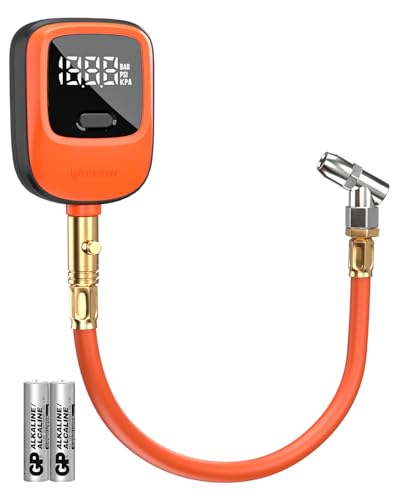
1. ETENWOLF T600 Digital Tire Pressure Gauge 250 PSI
Our pick — 4.5+★ from 350+ verified ratings; the strongest balance of quality and price.
A 250 PSI ceiling, a locking backlit readout, and one button for everything.
Here’s the number that settles most arguments: a 0–250 PSI range. That upper limit covers heavy truck tires with room left over, so the sensor never sits near the end of its scale. It also spits out readings to a 0.1 PSI resolution, which is finer than the placard you’re aiming for anyway. The accuracy claim is ±0.5% of full scale, and ETENWOLF says each unit is manually calibrated to ANSI B40.7 Grade 2A. In plain terms, that’s a documentation-backed tolerance rather than a vague “high precision” sticker.
Reaching the valve is where this one quietly earns its keep. The flexible rubber hose ends in a 360-degree rotating angled chuck, so an inner dual or a recessed stem angles toward you instead of fighting you. The reading holds on the display after you pull off the chuck — you look at the number after the work is done, not while you’re hunched over. If a tire comes up overpressure, the built-in air bleeder lets you dump air while the gauge stays seated and watch the number fall. Size is the honest trade-off against the tiny pencil gauges: at 1.77 x 5.51 x 7.48 inches it’s the biggest body in this group, and the Milton S-927 measures 0.59 x 1.18 x 6.02 inches by comparison. It weighs 2.4 ounces versus 1.6 ounces for the S-927, so this is a glovebox-to-toolbag tool rather than a keychain one.
What wins people over is the overall build quality, with accuracy a close second in owner feedback. Owners point out how easily it reads on dual wheels and deep stems, and the display stays legible in bright sun. Two AA batteries are included separately in the package and need installing before the first check. The 2-year product support backs it up. And a note so nobody is disappointed: this is a checker and bleeder, not an inflator — it won’t add air.
What earns the top spot
- 250 PSI range with 0.1 PSI resolution — room to spare on heavy truck tires
- 360-degree rotating chuck plus flexible hose makes dual-wheel valves easy to seat
- Reading locks on screen until you reset, so no number memorizing
- Rated from -14°F to 140°F, so cold-morning checks read the same as summer ones
- Backlit display stays readable in direct sunlight and in dark garages
Where it asks a little of you
- Larger and heavier than a pencil gauge — a toolbag item, not a pocket one
- Needs its two AA batteries installed before first use
- Checks and bleeds air only; it does not inflate
Reach for this if: you run duals or deep-seated stems and want one digital gauge that covers a full truck tire range with a documented accuracy spec.
Think twice if: you want something that lives in a shirt pocket — this is the biggest gauge here.
2. LUMITECO 2-Pack Dual Head Tire Pressure Gauge 10-150 PSI
Two 12-inch pencil gauges, no batteries, one for the cab and one for the shop.
You get a pair of gauges here instead of one — a 2 Count pack against the single-count ETENWOLF T600. For a fleet driver or a two-truck household that’s an obvious practical win: keep one in the door pocket, stow the other with the tools. The 12-inch pencil body carries a straight foot chuck plus a 30-degree reverse chuck, so an angled inner dual valve is reachable from either foot. It reads from 10 to 150 PSI, or 1 to 10 Bar, in 2 PSI steps on a dual-sided measurement stick.
Construction is where this one punches above its entry-level slot. The chuck is zinc alloy over a solid brass core, and the black matte steel body has a hanging ring at the top. No battery means no dead-gauge morning — pull it out and it works. Four spare valve stem caps ride along in the box too, which is the kind of extra you notice a month later when a cap goes missing. Functionality leads what people talk about with these, with build quality right behind it, and the recurring theme is how well they work on trucks and travel trailers.
The catch is the reading style. There’s no display and no lock, so you read the slide bar while it’s still pressed on the valve, then push the plate back down after. A 2 PSI step also rules out the fine 0.1 PSI tuning the digital gauges offer. If you’re chasing an exact placard figure on a light truck, the ETENWOLF’s backlit display is the more precise tool. If a quick, dependable check on a big rig is the job, this pair does it without fuss.
Best for the tool roll: a driver who wants a rugged, battery-free gauge in two places at once and doesn’t need decimal-level readings.
The honest limit: slide-bar pencil design with 2 PSI increments — accurate enough for daily checks, not for precision tuning.
Who it suits: anyone who’d rather have two dependable analog gauges than one digital.
Who should pass: precision-focused owners who want a locked, decimal readout.
3. Milton S-927 Dual Head Truck Tire Gauge
The brass-and-nylon classic that disappears into a pocket and still reads a dual.
At 1.6 ounces and 0.59 x 1.18 x 6.02 inches, this is the slimmest gauge in the roundup — a genuine pocket carry that won’t bulge a work jacket. The body is brass and nylon, built in the USA, and the dual head handles both straight and angled valve angles. It reads from 20 to 120 PSI in 2 PSI increments and shows kilopascal and pounds per square inch on the scale.
The dual head is the reason it belongs on a truck list. Press the straight side onto an outer wheel, flip it for an inner dual, and the head still finds the stem. It’s the kind of tool that lives in the door and gets used without ceremony. Build quality carries the reputation here, with how it functions a close second, and it fits cleanly on new valve stems.
The honest caveat is at the top end. That 120 PSI ceiling is tighter than most of this group, so a heavy truck running high pressures sits near the limit — the 150 PSI and 250 PSI gauges give more headroom. Owner feedback on accuracy is split: plenty find it dead-on, while some report readings that drift from other gauges. Value gets a similar mixed read. Treat it as a superb little daily-check tool for tires comfortably inside 120 PSI, and step up if your rig runs hotter.
A proven pocket tool: tiny, USA-made, and ready to check a dual at a moment’s notice.
Watch the ceiling: 120 PSI max and a mixed accuracy record mean it’s best on tires well inside its range.
Buy it for: the pocket-sized convenience of a USA-made brass gauge on moderate-pressure tires.
Look elsewhere if: your tires run near or above 120 PSI.
4. Number-one 230 PSI Digital Tire Pressure Gauge

A built-in LED light and lit display for the checks you do after dark.
Plenty of pressure checks happen at a truck stop at night, and this gauge is built around that. It pairs an LCD backlight with a built-in LED flashlight, so the valve stem and the number both light up. One button cycles four units, and the range runs 0 to 230 PSI — wide enough for a loaded semi with margin. It reads in 0.5 increments for a fast, clean figure.
The head does the reach work. It’s a bi-directional push-pull dual head with a metal connecting rod that rotates a full 360 degrees, which suits valves that sit at odd angles on inner and outer wheels. The swivel helps on trailers and RVs where the stem points somewhere inconvenient. Power saving is baked in too: two AAA batteries come installed, and the gauge shuts off on its own within 30 seconds of inactivity, or you can hold the power button for 5 seconds. Accuracy is the headline in owner feedback, with how it functions close behind, and the light gets singled out for easy reading.
Durability is where this one needs an honest word. Some buyers report it failing after about four months of steady use, so treat it as a light-duty gauge rather than a shop-grade beater. The ABS body backs that up — it’s comfortable in the hand but not armored. Keep it clean, store it dry, and it’s a sharp little gauge for the frequent night check.
Why it earns a spot
- Built-in LED flashlight plus backlit LCD for dark-lot checks
- 0–230 PSI range covers heavy truck tires
- 360-degree rotatable dual head works on both inner and outer wheels
- Auto shut-off in 30 seconds saves the batteries
The trade-off to weigh
- Some units fail after roughly four months of use, so handle it gently
- ABS body is comfortable but not built for rough shop use
Pick this for: routine nighttime pressure checks where seeing the stem is half the battle.
Not for: heavy daily shop duty where a brass-bodied analog tool will outlast it.
5. Jon MFB 150 PSI Semi Truck Tire Pressure Gauge (23-402-SF)

An extended straight gauge built to spare knees and reach stubborn duallies.
This one is aimed straight at the driver who’s tired of crouching. The extended straight gauge body is long enough to reach deep valve stems on trucks, duallies, and big tires without folding yourself around the wheel. It reads 10 to 150 PSI, plus 69 to 1034 kPa on the same scale, so you get both units in one glance. The head is industrial zinc alloy with brass ends, thick seals, and a solid brass core.
There’s a dual-head chuck on hand for the awkward stems, which makes it useful across a fleet — the maker lists it for RV, van, SUV, dually, and motorcycle duty. The scale is sized to read easily at arm’s length, which matters when you’re standing back from a wheel. Accuracy drives the positive feedback on this gauge, with its functionality right behind, and owners describe tracking pressure across their vehicles without trouble. It ships as a 2 Count pack too, so a working truck and a backup rig both get covered.
The 150 PSI ceiling is the thing to check against your tire placard. That covers most semi and dually pressures but leaves less headroom than a 250 PSI digital. The analog scale also asks you to read the needle while seated rather than locking a number.
Built for the tall tire: the extended body adds reach where a short gauge forces a crouch.
Mind the top: a 150 PSI analog scale with no locking readout.
Good match for: drivers with stiff knees who want reach and dual-head flexibility over a digital display.
Weigh the alternative: a 250 PSI digital if your pressures run high or you want a locked figure.
6. Jon MFB Semi Truck Tire Pressure Gauges 10-150 PSI (23-402)

A pair of commercial-duty analog gauges with an angled dual-head chuck.
Two gauges, one pack. The 23-402 comes as a 2 Count set with an angled dual-head air chuck for valve stems that sit at difficult angles on trucks and tires. The head is industrial zinc alloy with brass ends, thick seals, and a solid brass core — the same materials story as its long-reach sibling. The scale covers 10 to 150 PSI and 69 to 1034 kPa, readable in one look.
The angled chuck is the practical hook. It lets you press onto a stem at an angle rather than square, which helps on crowded duals and tight wheel wells. The maker lists it for RVs, vans, SUVs, and bikes as well as trucks, so it earns its place across a mixed fleet. Quality leads owner feedback here, with accuracy right behind, and the general read is a dependable commercial-grade tool. It also carries a 6-month warranty.
If you’ve already got one good gauge on the truck, having a second stashed in the toolbox or the shop drawer is the reason to pick this pack. The trade-offs are the same as any analog: a 150 PSI ceiling and a stepped scale instead of a digital lock. For keeping a spare gauge in the truck and another in the shop drawer, that’s exactly right.
The spare-kit angle: two commercial gauges so a truck and a toolbox each get one.
Same analog limits: 150 PSI max, stepped scale, no backlight.
Choose it if: you want a second dependable analog gauge on hand without hunting for a single.
skip it if: one gauge is plenty and you’d rather spend on a higher-PSI digital.
7. Rhino USA Digital Tire Pressure Gauge 250 PSI

A 2-inch LED-lit dial on a braided steel hose, built for low-light reach.
The showpiece here is the readout: a large 2-inch LED backlit dial that stays legible when the light is bad. It tops out at 250 PSI, so heavy truck tires sit well inside the scale. The braided steel hose flexes to reach valve stems on large-offset wheels and reverse-mount rims — the awkward spots where a rigid gauge gives up. A solid brass 360-degree swivel head and a heavy-duty air bleeder valve round out the chuck end.
Rhino USA sells it as a mechanic-minded tool, with an ANSI B40.7 accuracy spec on the label. The braided hose is the real differentiator over a rigid-body digital like the ETENWOLF T600 — it lets you reach and hold a seal at an angle the rubber hose can’t always match. The reading holds until you press the relief valve, so you check the number after you’re clear of the wheel. Quality and accuracy lead what owners praise, with functionality close behind, and the glow dial earns its share of the credit.
Two honest notes. Value draws a mixed read — some owners call it worth it, others find it priced high for the job. There’s also split opinion on whether it’s actually made in the USA, despite the American-owned branding. Neither changes what the tool does. At 10 ounces it’s a solid hand-filling gauge, not a pocket one, and the flex hose plus big dial are exactly why.
The case for the big dial
- 2-inch LED backlit dial is easy to read at a glance in poor light
- 250 PSI range with an ANSI B40.7 accuracy spec
- Braided steel hose reaches large-offset and reverse-mount rims
- Reading holds until the relief valve is pressed
What to keep in mind
- 10 ounces makes it a hand tool, not a pocket carry
- Value and country-of-origin claims draw mixed owner views
Worth it for: drivers who want a big, bright, hose-reach gauge and will use it often.
Second-guess it if: you want a compact gauge or you’re stretching a tight tool budget.
8. Milton Dual Foot Straight Lock-on Chuck Service Gauge (986BLK)

A smooth brass tube, a lock-on chuck, and a non-slip poly grip make this gauge ready for the shop floor.
This gauge is built like a shop tool, because that’s what it is. The body is heavy-duty brass with smooth tube construction, coated in a black poly finish for a non-slip grip in any weather or shop condition. Milton builds it in the USA and positions it against standard aluminum gauges that corrode and dent. The 13-inch body reaches down a large vehicle wheel, and the scale reads 10 to 160 PSI and 80 to 1100 kPa on a stamped nylon bar.
The chuck is the feature that separates it from a plain pencil gauge. It’s a dual foot straight lock-on chuck with a 30-degree foot, so it grabs a recessed valve stem at either angle and holds a seal without leaking while you read. The lock-on action means the gauge stays put on the stem while your hands are free — a genuine help on a big rig. The stamped bar reads precision in both units, and the brass construction is the durability story: it shrugs off drops and grime that would crack a plastic body.
There are a couple of things to plan around. The 160 PSI ceiling covers most truck pressures but leaves less headroom than a 250 PSI digital, and there’s no backlight, so it’s a daylight tool. Milton also lists no warranty on this model. For a busy shop or a driver who values a brass tool that takes abuse over a glowing readout, that’s a fair trade — the lock-on chuck and the smooth brass tube are why it’s here.
Buy once, use hard: smooth brass and a lock-on dual foot chuck handle heavy, repeated use.
Plan for it: 160 PSI max, no light, and no listed warranty.
Get it for: shop-grade durability and a lock-on chuck that holds a seal while your hands are busy.
Not the fit if: you want a backlit digital readout or a small pocket gauge.
9. TireMinder High Precision Digital Truck and RV Gauge

A ±1 PSI tolerance and a 5-year warranty on an all-metal digital body.
For the driver who wants to nail the exact placard number, the spec here is the draw: ±1 PSI precision across a 10 to 150 PSI range. That’s a tight tolerance stated in plain PSI, so you know how close the reading should land. It’s an all-metal body with a “No Sweat” custom grip, a front-facing flashlight, and a green LED backlight for low-light checks. Two heads come in the box — a straight one and a 45-degree one — so you swap to whichever fits the stem in front of you.
Power comes from replaceable AAA batteries, included with the gauge, and a protective pouch rides along. The backlight and flashlight together make this one of the easier gauges to read at night on a trailer or a semi. It’s built for cars and semis both, reading exact figures on a lit display. Quality leads owner feedback by a wide margin, with functionality and accuracy following, and owners lean on it for both passenger and heavy vehicles.
The power button is the one spot that draws mixed views — a few find it easy to switch on by accident in a bag. On a gauge this precise that’s a minor annoyance, not a dealbreaker, but it’s worth knowing. The 16-ounce weight and metal build also make it a toolbag resident rather than a pocket gauge. For an exacting check backed by a long warranty, the ±1 PSI promise is the whole argument.
Where precision pays off: ±1 PSI across 10–150 PSI, backed by a 5-year warranty and two interchangeable heads.
The small snag: the power button can switch on accidentally in a bag.
Best for: an exacting owner who wants a tight PSI tolerance and a long warranty over a budget tool.
Look elsewhere if: you want a featherweight pocket gauge or tend to toss gear loose in a bag.
Know the Specs
Max PSI rating
This is the highest pressure a gauge is built to measure, and it should sit comfortably above your tire pressure. A digital unit like the ETENWOLF T600 goes to 250 PSI, while a pencil gauge like the Milton S-927 stops at 120 PSI. Choose a ceiling with headroom so the sensor or needle isn’t pushed to its limit on every check.
Accuracy and resolution
Accuracy is how close the reading is to the true pressure; resolution is the smallest step it can show. The ETENWOLF quotes ±0.5% of full scale with 0.1 PSI resolution, while the TireMinder states ±1 PSI. Analog gauges often step in 2 PSI increments. Tighter numbers help when you’re matching an exact placard figure.
Chuck style and reach
The chuck is the head that presses onto the valve stem. A straight foot works on open stems; an angled or dual head handles inner duals and recessed valves. Lock-on chucks hold a seal hands-free, and braided or rubber hoses add reach on large-offset wheels. Match the chuck to the stems your truck actually has.
Display and power
Digital gauges show a number on an LCD, often backlit for dark garages, and many hold the reading until reset. Analog gauges use a slide bar or dial you read while seated. Some digitals run on AAA or AA batteries — replaceable cells mean no recharging, while an auto shut-off such as the 30-second timer protects battery life. No battery means a pencil gauge always works.
Common Questions
What PSI range do I need for truck tires?
Can a dual-head gauge reach inner dual wheels?
Is a digital gauge more accurate than a pencil gauge?
Do tire gauges need batteries?
What is a lock-on chuck and do I need one?
How accurate should a truck tire gauge be?
Can I use a truck gauge on my car or ATV tires?
Do these gauges inflate tires or only check pressure?
How do I read a pencil gauge in cold weather?
Why does my gauge give a different reading each time?
The Bottom Line
For most truck owners, the tire gauge for trucks that balances it all is the ETENWOLF T600 — a 250 PSI range, a ±0.5% accuracy spec, a locking backlit readout, and a 360-degree chuck that finds inner duals. If you’d rather have two battery-free gauges ready to grab, the LUMITECO 2-Pack does the job. And for exacting owners who want the tightest stated tolerance plus a 5-year warranty, the TireMinder is the one to reach for. Match the chuck to your stems and the PSI range to your placard, and every check reads true.
How we choose
We do not accept paid placement. Every pick is matched to a real buyer and a real use-case; we do not hands-on test units.
Sources
Specifications: manufacturer listings and product documentation. Review insights: verified customer reviews, as of November 2026. Pricing: not shown on this page (it changes often); check the current price via the retailer link.
As an Amazon Associate, Tactical Gear Guy earns from qualifying purchases. This does not affect which products we feature.