Specs are compiled from manufacturer listings and verified buyer reviews and can change over time — please confirm the key details on the product page before buying.
If your desk is shallow or your shelf is tight, a thin Micro-ATX case can still fit a full-length graphics card. A thin Micro-ATX case is a chassis built around a narrow footprint — often well under eight inches of width — that still holds a standard Micro-ATX motherboard. But “thin” can mean a narrow width or a shallow depth, and confusing the two costs you GPU length or cooler height.
This guide is built by comparing the manufacturers’ published specifications and the patterns across verified customer reviews, so you get each pick’s real strengths and trade-offs instead of marketing spin.
Some of these chassis run past 17 inches deep while barely clearing seven wide, and that depth is what buys you radiator room. Below you will find the narrowest cases that still swallow a full-length card, laid out so you can match one to your actual hardware list. Every pick here earns its place in this thin micro-atx case roundup on hardware clearance first, not on how it photographs.
Top Picks


How To Choose The Best Thin Micro-ATX Case
A thin case is a trade: you give up width and get back depth, height, or both. The mistake most first-time builders make is shopping by volume in litres, which says almost nothing about GPU or cooler clearance. Litres tell you almost nothing about whether your specific graphics card and cooler will fit.
Start with three numbers from your own parts list — GPU length, radiator size, and cooler height — then match them to the case specs.
Graphics card length is the number that decides your build
A thin chassis has no room to angle a long card in, so clearance is measured straight and enforced hard. The range in this category is wide: one narrow tower here tops out at 340mm while the Lian Li A3-mATX reaches 415mm. Measure your card’s length from the bracket to the tip and leave a little slack for the power connectors at the end. A card that fits but leaves its power plugs jammed against a panel will force a rebuild.
Radiator size shapes the case more than the motherboard does
Micro-ATX boards are all roughly the same footprint, so the board rarely limits you. Liquid cooling does. A 240mm AIO (an all-in-one sealed water loop with two 120mm fans on the radiator) fits most of these chassis. A 360mm AIO — three fans in a row — needs either a very deep case or a side-mount arrangement, which is why the Lian Li A3-mATX stretches to 17.44 inches front-to-back. If you plan to run air cooling only, you can choose a much smaller case and save the desk space.
Watch cooler height limits that shift with your drive count
In ultra-narrow towers, the CPU cooler and the hard drive cage fight for the same air. The mATX/Mini ITX Mini Tower here advertises 73mm of cooler height with no drive installed, dropping to 45mm once you mount a 25mm 3.5-inch drive. That is a real filter: a tall tower air cooler simply will not go in once you add spinning storage. Decide your storage plan before you decide your cooler.
Power supply position changes your cable story
Cases that mount the PSU at the front — like the Lian Li A3-mATX and the JONSBO D32 PRO — free up floor space and shorten the run to the board, but they eat into the depth you thought you had. Bottom-mounted designs leave the main chamber cleaner but push cables toward the rear. Check what length PSU the case accepts: the JONSBO D32 PRO takes up to 200mm, and the Lian Li B4-mATX caps ATX units at 140mm.
Side-by-Side Comparison
| Model | Best For | Max GPU | Max Radiator | Max CPU Cooler | Amazon |
|---|---|---|---|---|---|
| Lian Li A3-mATX Wood Black Mesh★ Best Overall | Wood-accented compact builds | 415mm | 360mm | — | Amazon |
| darkFlash DB330MGlass Showcase | Glass-showcase builds on a budget | — | 240mm | — | Amazon |
| T.F.SKYWINDINTL mATX/Mini ITX Mini TowerTrue Slim | HTPC and shelf builds | — | — | 73mm (no drive) | Amazon |
| Thermaltake View 170 TG ARGB | Dual-glass display builds | 340mm | 280mm | — | Amazon |
| ASUS Prime AP201 | Airflow-first mesh builds | 338mm | 360mm | — | Amazon |
| Lian Li A3-mATX Black Mesh | Big liquid cooling, plain panel | 415mm | 360mm | — | Amazon |
| JONSBO D32 PRO | BTF and back-connect boards | 365mm | 240mm | 170mm / 164mm | Amazon |
| JONSBO Z20 | Portable LAN and travel builds | 363mm | 240mm | 164mm / 163mm | Amazon |
Detailed Reviews
1. Lian Li A3-mATX PC Case
Our pick — 4.5+★ from 500+ verified ratings; the strongest balance of quality and price.
A walnut accent panel on a case that still swallows a 415mm graphics card.
The reason this one takes the top spot is a number pair that should not coexist: 26.3L of volume and 415mm of graphics card clearance. Most narrow chassis force you to choose between a small footprint and a long card. This one holds a full-length card, a 360mm radiator, and up to 10 fans, all in a body that measures 7.63 inches wide and 12 inches tall. Four expansion slots and four internal bays round out the layout.
What wins people over is the look. A walnut front panel backed by steel mesh gives you a case that reads like furniture rather than a gaming rig, and the mesh is doing real work behind it. Owners describe putting a 360mm AIO and a 7900 XTX in together with no fit fights, which is exactly the build this chassis was drawn for. The side and top steel mesh panels keep a high-TDP card fed, and the modular structure means you can pull panels and reposition the PSU between front and side mounting.
The catch is cable management, and it is the one place this case asks for patience rather than rewarding it. Cables are meant to tuck into the main chamber with tie points instead of a separate rear channel, so a first build here takes planning. Also note the listing is explicit that no fans are included — budget for those separately. Everything else about the chassis is a deliberate, well-resolved compromise.
What the layout gets right
- Fits a 415mm graphics card and a 360mm radiator in a 26.3L body
- Walnut front panel with steel mesh behind it for real intake
- Accepts ATX, SFX, and SFX-L power supplies with front or side mounting
- Room for up to 10 x 120mm fans
What to plan around
- No fans included, so add cooling to your parts list
- Cable routing lives in the main chamber with no rear chamber to hide in
The build this rewards: an mATX gaming rig with a long card and a 360mm AIO, sitting in a living room where the wood front earns its keep.
What costs you time: the cable runs, which need laying out before you tighten anything down.
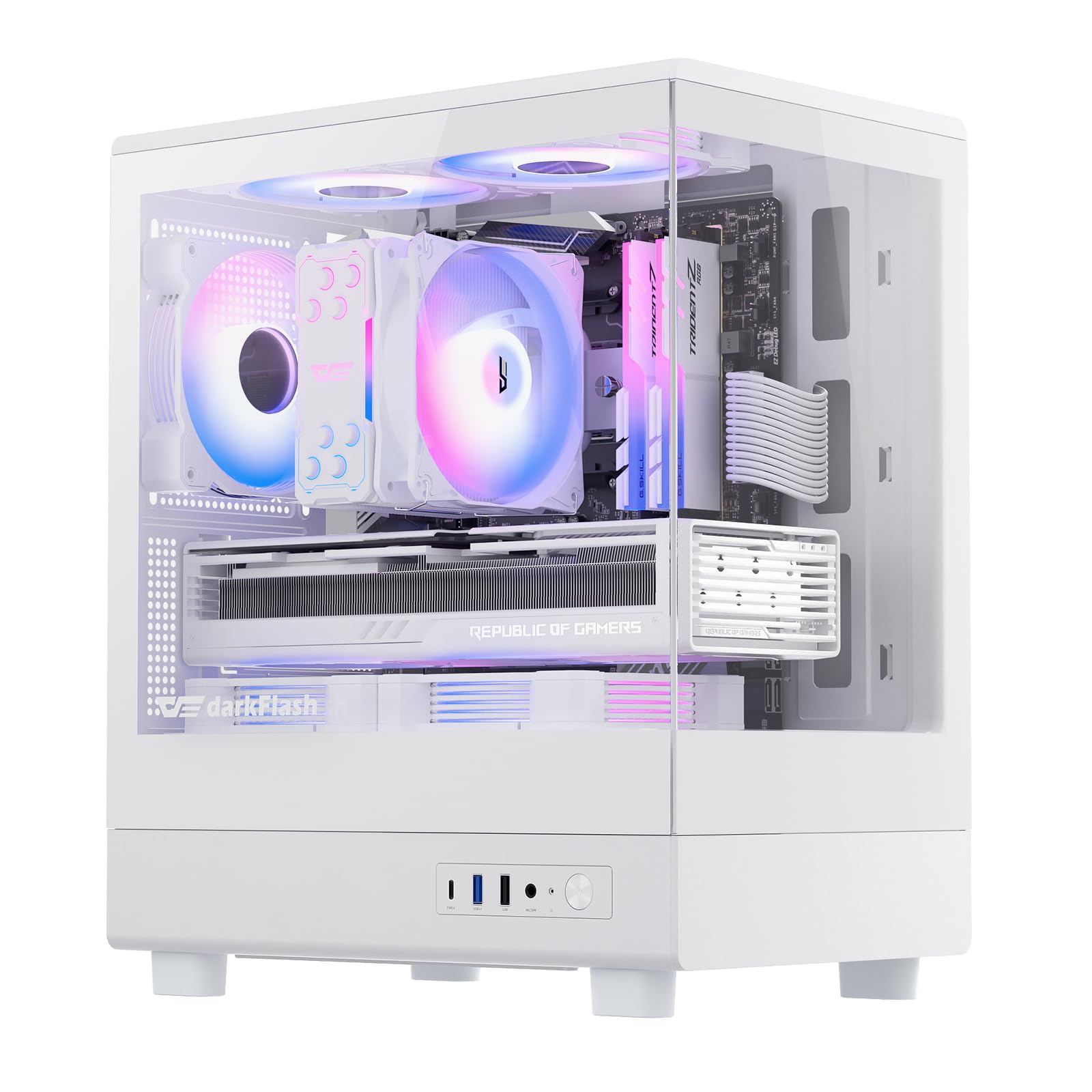
2. darkFlash Micro ATX PC Case (DB330M) White
Three fans and a wrap of glass, with the RGB hub you will need to add yourself.
If your build is the point — an RGB-heavy mATX setup you want to actually look at — this is the value play. The 270° panoramic tempered glass panel wraps the front and side so the whole interior is on display, and three PWM ARGB fans come pre-installed. It carries a Type-C port and USB 3.0 on the front IO panel, and it takes a 240mm AIO up top. At 13.11 inches wide it is one of the broader cases in this roundup, so treat it as a showcase that happens to be compact rather than a true space-saver.
Buyers report fitting an ASUS mATX board, a 5060 GPU, and a 240 AIO without trouble, and one common comparison is to O11 Dynamic-style cases. The airflow design is worth understanding: two fan positions sit above the power supply, and the PSU-adjacent fan pushes air toward the graphics card, creating a vertical duct instead of the usual front-to-back sweep. Magnetic dust filters sit on the top panel and the side.
Here is the honest catch, and it is printed right on the listing: the RGB hub controller is not included. If you want to drive the fan lighting, you will be adding a controller or leaning on your motherboard’s headers. The single internal bay is also worth flagging — one 3.5-inch spot only, so a multi-drive build needs a different chassis.
Where the money went: the glass, the trio of PWM ARGB fans, and a Type-C front port — in that order.
Where it will bite: one internal 3.5-inch bay total, and the RGB controller sits outside the box.
Choose it if: you are building a display piece and want fans in the box on day one.
Pass if: you need more than one hard drive bay or the case must stay narrow.
3. mATX/Mini ITX PC Case Mini Tower 0.8mm SPCC
At 3.62 inches wide it is the narrowest thing here — and the most limited.
The width number is the whole story: 3.62 inches, against the darkFlash’s 13.11 inches. If your goal is a case that slides into a wall cabinet, sits beside a receiver, or disappears behind a monitor, nothing else on this list comes close. The 0.8mm SPCC steel body (a common cold-rolled steel sheet) is stiff for the price, and the shell is built around mATX 244×244mm and Mini-ITX 170×170mm boards.
The trade is cooler clearance, and it is severe. With no drive installed you get 73mm for a CPU cooler. Add a 25mm 3.5-inch drive and that drops to 45mm. A 20mm drive gives you 50mm, a 15mm 2.5-inch drive gives 55mm, and slimmer drives claw back a few more millimetres. Those figures rule out nearly every tower air cooler, so plan on a low-profile cooler from the start. Storage is one 3.5-inch or two 2.5-inch drives, and the power supply is a Flex unit rather than a standard ATX box.
Buyers are largely positive on the quality of the shell, and more divided on fit — which tracks with a chassis this tight. Measure your board, your cooler, and your PSU before ordering, because there is no slack to work with once it arrives. It is a specialist answer to a specific space problem, not a general-purpose case.
The narrowest option here: 3.62 inches wide, 1.4 kg, and short enough for a shelf or a home theatre rack.
The limit you must accept: 73mm of cooler height with no drive, 45mm once a 25mm 3.5-inch drive goes in.
Right for: a HTPC or small desk build using a low-profile cooler and a Flex power supply.
Wrong for: anyone planning a tower cooler, a full ATX PSU, or a liquid loop.
4. Thermaltake View 170 TG ARGB Black Micro-ATX Case
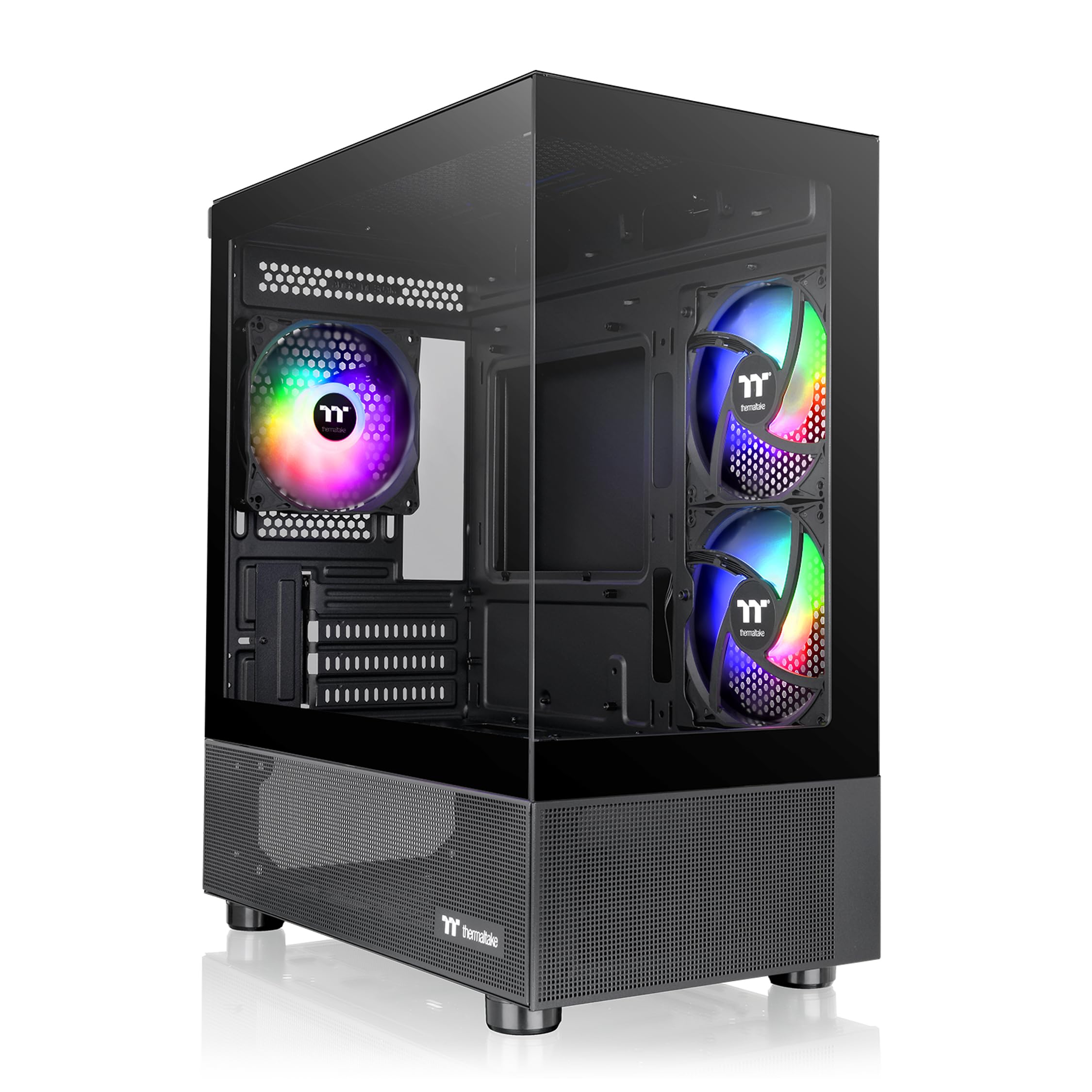
Pillarless glass on two sides, three ARGB fans inside, and a 340mm card limit.
The pillarless front and side glass design is what you are paying for here, and it is genuinely different from the single-panel cases around it. No corner strut interrupts the view, so a build with a lit fan array reads as one continuous window. Three 120mm ARGB fans are included, which keeps the build cost honest, and the chassis takes up to a 280mm radiator at the top.
Graphics cards cap out at 340mm. That is shorter than the 415mm the Lian Li A3-mATX allows, so measure before you commit to a triple-fan flagship. It carries dual USB 3.0 and HD audio on the front, three internal bays, and a three-year warranty. Owners mention it takes a 280mm radiator comfortably, and the glass does its job of showing off the internals.
Build quality is the split opinion across this case’s feedback — the panels and cooling read as solid, while the fan performance and overall fit draw a more divided reaction. At 17.24 inches tall it is the tallest case on this list, so check your shelf height too. Tall, glassy, and lit — but not the one to pick if you want a card over 340mm.
Why the glass wins
- Pillarless dual tempered glass with no corner strut breaking the view
- Three 120mm ARGB fans already installed
- 280mm radiator support at the top
- Three-year warranty and a dual USB 3.0 front panel
The limits that matter
- 340mm graphics card ceiling rules out the longest cards
- 17.24 inches tall, so measure the space above your desk
Fits best: a mid-length card and a 280mm AIO in a build meant to be seen from two angles.
Look elsewhere if: your card runs past 340mm or your shelf is tight vertically.
5. ASUS Prime AP201 Micro-ATX PC Case

More than 57,000 holes of mesh, and a side panel that pops off without a screwdriver.
The mesh is the pitch and it is a real one: over 57,000 precision-machined 1.5mm holes across the quasi-filter panels. That is not decoration — it is intake area, and it is why this case handles the heat a high-performance card throws. It holds a 360mm radiator and up to six fans, and supports ATX power supplies up to 180mm long inside a 33L footprint.
The layout is the quiet advantage. An extended motherboard tray with strategically placed cutouts and a 32mm gap gives you somewhere to actually put the cables, which is more than several slimmer cases here can offer. Graphics cards go to 338mm. The side panels use a clip mechanism that resists accidental knocks, so you can open the case up without hunting for a tool. Four internal bays cover storage.
The recurring note is that this case is bigger than its litres suggest — the size feedback splits, and 18.11 inches of depth is the reason. It also lands at 12.7 pounds, the heaviest here, so it is a desktop case rather than something you move weekly. If your goal is a genuinely narrow body, the 8.07-inch width is fine but the depth is not.
Where it earns the pick: mesh front and top panels with more than 57,000 holes, plus a 32mm cable gap and tool-free clips.
The honest trade: 18.11 inches deep and 12.7 pounds — compact in litres, not in desk footprint.
Pick it for: a hot-running card and a 360mm AIO where thermals beat size on your priority list.
Think twice if: the case has to be short front-to-back, not just narrow.
6. Lian Li A3-mATX PC Case, Black Mesh (A3X.US)

The same 415mm clearance as the top pick, minus the walnut front.
This is the black-panel version of the same 26.3L platform, and the hardware numbers match: 415mm graphics cards, 360mm radiators, up to 10 x 120mm fans, and four expansion slots. If the wood front of the top pick means nothing to you, this is the same chassis without the cosmetic premium. Steel mesh side and top panels do the intake work for a high-TDP card.
The PSU story is flexible in the same way — ATX, SFX, and SFX-L units are all supported with front or side mounting, so you can shift clearance around your card and radiator. It measures 17.44 inches deep, 7.64 wide, and 12.05 tall, and weighs 11 pounds. Three internal bays handle storage. Buyers describe it as easy to build in and good value for the hardware it accommodates.
As with its wood-front sibling, no fans are included, so the total build cost is higher than the chassis alone suggests. And like the top pick, the main-chamber cable routing rewards planning over improvisation.
The value angle: identical 415mm GPU and 360mm radiator headroom to the wood-front pick, in plain black steel.
Same catch, same answer: no fans in the box, so add a set to your list.
Suits: anyone who wants the 415mm clearance but prefers a plain black panel over wood.
Skip if: you need fans bundled or a rear cable chamber.
7. JONSBO D32 PRO Micro-ATX PC Case

Two motherboard mounting modes, so a back-connect board finally has a home.
The A/B mode is the differentiator. Mode A takes a standard mATX board; Mode B switches the layout to accept a back-connect or BTF board, where the power and front-panel headers sit on the back of the motherboard instead of the front edge. That single feature is why this case exists, and almost nothing else in this roundup offers it. The 24L body takes graphics cards to 365mm and an ATX, SFX, or SFX-L power supply — though 16A plugs are excluded.
Cooling is capped at a 240mm AIO on the top. CPU air cooler clearance shifts by mode and by CPU brand: 170mm for Intel or 169mm for AMD in A mode, dropping to 164mm for Intel or 163mm for AMD in B mode. An adjustable cover hides the motherboard cabling behind the tempered side glass, and the PCI-E slot area has a detachable opening so a large card slides in without a fight. Front IO gives you two USB 3.2 Gen 1 Type-A ports, one USB 3.2 Gen 2 Type-C, plus audio and mic.
Cable management is the polarised topic here — a neat layout for some, exposed wires for others depending on how much time goes into it. The detachable PCI-E opening and the cover are there to help, but they do not route for you. Note the 240mm AIO ceiling before you commit to a bigger radiator.
Where it leads
- A/B modes let one chassis take standard or back-connect mATX boards
- 365mm GPU clearance with a detachable PCI-E opening for easy install
- 163mm to 170mm of CPU cooler room depending on mode and CPU brand
- USB 3.2 Gen 2 Type-C on the front panel
Where it stops short
- 240mm is the largest AIO it takes
- Power supplies with 16A plugs will not fit
Built for: a BTF or back-connect mATX board and a build where clean front-side visuals matter.
Look past it if: you need a 360mm radiator or run a 16A-plug PSU.
8. JONSBO/JONSPLUS Z20 Black Micro-ATX Mini Tower

The only case here with a handle — carry it to a LAN and back without a bag.
Roughly 20L of volume with a detachable carrying handle on top is a combination nothing else on this list offers. If the case travels — a weekly LAN, a friend’s place, a tournament — that handle turns a two-handed awkward lift into a one-hand carry. The body is built from 2mm integrated bent steel panels, with a large area of square openings for airflow and a magnetic dust filter covering the panels.
Hardware room is generous for the size: graphics cards go to 363mm depending on the rest of your configuration, a 240mm AIO fits up to 60mm thick, and CPU air coolers clear up to 164mm for Intel or 163mm for AMD. It runs ATX, SFX, or SFX-L power supplies with multiple mounting positions, plus SFX side mounting. Fan mounts cover the top and bottom at 2 x 120mm or 2 x 140mm, with a single 120mm or 92mm at the rear. Front IO includes one USB 3.2 Gen 1 Type-A, one USB 3.2 Gen 2 Type-C, and audio and mic.
The fit and internal space both draw mixed reactions, which is expected once you pack this much hardware into 20L — clearances depend heavily on your own part choices, and the listing itself points you to its compatibility image before ordering. Four expansion slots and room for two 2.5-inch SSDs plus one 3.5-inch HDD, or three SSDs, cover a realistic build.
The one distinguishing feature: a detachable handle on a 20L chassis, built to be moved.
The planning you owe it: fit depends on your exact GPU, cooler, and PSU combination.
Reach for it if: your rig travels and you want a 363mm-capable case you can actually pick up.
Leave it if: the machine never moves and you would rather have a bigger radiator.
Know the Specs
GPU Clearance (measured in millimetres)
This is the straight-line distance from the rear expansion slot bracket to the far inside wall. Because a narrow case cannot accept a card at an angle, you need the card to fit on the first attempt. Cards here range from a 340mm ceiling on the Thermaltake View 170 to 415mm on the Lian Li A3-mATX. Measure from the bracket to the tip of the card, then add a little room for the power connectors at the far end — those plugs need clearance too.
Radiator Support (240mm vs 360mm)
A 240mm AIO carries two 120mm fans on its radiator; a 360mm carries three, and a 280mm carries two 140mm fans. Most thin mATX cases cap at 240mm, which is enough for a mid-range chip. Stepping to 360mm usually forces a deeper body or a side-mounted arrangement, and the total thickness of the radiator plus fans is its own limit — the Lian Li B4-mATX restricts its 360 and 280 builds to 52mm total on SFX power supplies.
CPU Cooler Height
Measured from the surface of the CPU to the inside of the side panel. A tower air cooler commonly needs well over 100mm, so tight cases publish a hard ceiling — the T.F.SKYWINDINTL tower allows 73mm with no drive and 45mm once a 25mm 3.5-inch drive is installed. Add the drive first in your planning, because that is where the number moves.
Power Supply Form Factor
ATX is the full-size standard box and usually the cheapest. SFX and SFX-L are smaller and open up more clearance in tight builds. A Flex unit is smaller again and appears in ultra-slim towers like the T.F.SKYWINDINTL. Check both the form factor and the maximum length the case permits — the JONSBO D32 PRO takes up to 200mm, while the Lian Li B4-mATX caps ATX units at 140mm.
Common Questions
Will a standard Micro-ATX motherboard fit in every case here?
How do I measure my graphics card for a thin case?
Can I fit a 360mm radiator in a narrow Micro-ATX case?
Does a thin case cool worse than a full-width tower?
Why does the CPU cooler height limit change when I add a hard drive?
Is SFX better than ATX in a small form factor build?
How do I pick between a mesh case and a glass case?
What does back-connect or BTF motherboard support actually mean?
Can a 20L case take a full-length graphics card?
Do these cases come with fans included?
The Bottom Line
The shortlist narrows fast once you know your card length. The Lian Li A3-mATX in Wood Black Mesh is the pick that satisfies the widest range of builds — 415mm of graphics card clearance, a 360mm radiator, up to 10 fans, and a walnut panel that makes a compact machine look deliberate. It ties the highest rating in this roundup at 4.5+ stars, and its 415mm GPU and 360mm radiator ceilings are what earn the top spot.
For a glass display build, the Thermaltake View 170 brings three ARGB fans and a 280mm radiator, though your card must stay under 340mm. If you are building around a back-connect board, the JONSBO D32 PRO is the only chassis here that switches modes to accept one, and its 365mm card ceiling keeps most modern GPUs in play.
And when the machine has to leave the house, the JONSBO Z20 is the one to reach for — a detachable handle on a roughly 20L body that still clears a 363mm card and a 240mm AIO. The Lian Li A3-mATX, with 415mm of GPU clearance and 360mm radiator support, remains the safest place to start your shortlist.
How we choose
We do not accept paid placement. Every pick is matched to a real buyer and a real use-case; we do not hands-on test units.
Sources
Specifications: manufacturer listings and product documentation. Review insights: verified customer reviews, as of November 2026. Pricing: not shown on this page (it changes often); check the current price via the retailer link.
As an Amazon Associate, Tactical Gear Guy earns from qualifying purchases. This does not affect which products we feature.