Specs are compiled from manufacturer listings and verified buyer reviews and can change over time — please confirm the key details on the product page before buying.
The short answer: buy a thermostat that shows up natively in your Apple Home app and matches the heating system in your walls. Those two boxes decide everything else. A HomeKit badge means nothing if the unit can’t drive electric baseboard heat, and a beautiful touchscreen is useless if it only talks to Alexa. This guide sorts nineteen real options by which system they actually control and how cleanly they drop into Apple Home.
This guide is built by comparing the manufacturers’ published specifications and the patterns across verified customer reviews, so you get each pick’s real strengths and trade-offs instead of marketing spin.
You’ll see which units need a C-wire, which run on line voltage, and which bring extra sensors into the Apple Home app. Below is my honest read on the best thermostat for Apple Home, sorted by the system and setup each one genuinely fits. That shortlist is the best thermostat for Apple Home you can buy with clear eyes about wiring and compatibility.
Top Picks


How To Choose The Best Thermostat for Apple Home
Check your heating system before you shop, because the thermostat has to match it. Most smart thermostats are built for low-voltage systems — a furnace, a boiler, a central air conditioner, or a heat pump that runs on roughly 24 volts and usually needs a C-wire (a fifth wire that supplies steady power to the screen). Electric baseboard and in-wall convector heaters run on line voltage instead, at 120V or 240V, and need a different class of thermostat entirely. Get that wrong and no amount of HomeKit support will help you.
HomeKit native versus Matter bridge
There are two ways a thermostat lands in your Apple Home app. The first is built-in HomeKit support, where the manufacturer ships Apple’s protocol on the device itself. The second is Matter, a shared smart-home standard that lets a device join Apple Home, Google Home, and Alexa without a brand-specific bridge. Both show up in the Home app, but Matter devices typically run local commands rather than routing through a cloud server, which matters on the day a company changes its backend.
Wiring, C-wires, and line voltage
A unit that needs a C-wire but doesn’t find one usually ships a power adapter kit to fake it — ecobee includes one in the box, and Honeywell Home prints a voucher for a free adapter. Line-voltage units for baseboard heat are a different job: they work directly with the high-voltage wires behind the heater and often need four wires including a neutral. If you’re not comfortable at the breaker panel, budget for an electrician.
What the sensors really buy you
A room sensor is a small battery-powered puck you place in a bedroom or office. It reports the temperature where you actually sit, so the thermostat stops averaging the hallway. Occupancy sensing then decides whether to heat or cool based on whether someone is there. For a home with hot and cold rooms, a sensor or two often makes a bigger difference than the thermostat’s own display.
Side-by-Side Comparison
| Model | Best For | Apple Home Route | System Type | Notable Spec | Amazon |
|---|---|---|---|---|---|
| ecobee Smart Thermostat Enhanced★ Best Overall | All-round pick for most homes | HomeKit built-in | Low-voltage (90% of HVAC) | PEK kit included for no C-wire | Amazon |
| Emerson Sensi ST55 + Wall PlateBest Value | Budget-friendly basic smart control | HomeKit via app | Low-voltage, C-wire required | Built-in level for install | Amazon |
| Mysa Smart Thermostat LITEBaseboard Specialist | Electric baseboard heat | HomeKit built-in | Line voltage, 120V/240V | Up to 3,800W at 240V | Amazon |
| Sensi Smart Thermostat 1F87U-42WF | Simple reliable low-voltage control | HomeKit (C-wire required) | Low-voltage, C-wire required | 7-day flexible scheduling | Amazon |
| Aqara Smart Thermostat W200 | Deep Apple Home automation | Matter + Thread built-in | Low-voltage (about 85%) | 4-inch touchscreen, mmWave radar | Amazon |
| Mysa Mini-Split Controller | Mini-split heat pumps and AC | HomeKit built-in | Replaces mini-split remote | No subscription, free app | Amazon |
| Honeywell Lyric T6 Pro | Multi-stage heat pump systems | HomeKit built-in | Up to 2H/1C heat pump | UWP mounting system | Amazon |
| LUX TQX Matter Thermostat | Native Matter with room sensor | Matter over Wi-Fi | Low-voltage, Power Bridge included | Room sensor + mmWave occupancy | Amazon |
| Honeywell Home X8S | Big display and doorbell view | Matter certified + Apple Home | Up to 3H/2C heat pump | 5-inch customizable display | Amazon |
| ecobee Smart Thermostat Premium | Built-in Siri and air quality | HomeKit built-in + Siri | Low-voltage (95% of HVAC) | SmartSensor + air quality monitor | Amazon |
| Google Nest Learning 4th Gen | Learning comfort with Matter | Matter compatible | Most 24V systems | 60% larger display | Amazon |
Detailed Reviews
1. ecobee Smart Thermostat Enhanced
Our pick — 4.0+★ from 3,500+ verified ratings; the strongest balance of quality and price.
The do-everything default that talks to Siri, keeps its promises on install, and covers most homes.
The ecobee Enhanced is the safest first smart thermostat for an Apple Home setup because it asks almost nothing of you. It arrives with the Power Extender Kit — a small adapter that lets the thermostat run in a home with no C-wire — plus a trim plate to cover the old wall marks. Those two parts are why ecobee claims compatibility with 90% of HVAC systems. For a house with a standard furnace and air conditioner, you plug it into the existing low-voltage wires and you’re finished.
What wins people over is how reliably it simply works: the heating and cooling respond, the schedule holds, and the app mirrors the wall unit. Installation gets just as much love, because the wire labels and step-by-step guide turn a confusing job into a half-hour task for anyone who can follow instructions. Built-in occupancy sensing also means it can preheat or precool before you walk in, and it adjusts for humidity as well as temperature.
The catch is in the details of your own system. It works with Alexa and Siri, but heat pump compatibility is where things get mixed — some owners find their particular pump doesn’t behave the way the thermostat expects. Temperature control is generally solid, though the AC-overcooling behavior draws gripes. At 1.1 pounds and roughly four inches square, it sits flat and unobtrusive on the wall. If you have a straightforward low-voltage setup, this is the one to beat; if you have a heat pump you don’t fully understand, run the compatibility checker before you buy.
What it gets right
- Power Extender Kit and trim plate are in the box, so no C-wire isn’t a roadblock
- Works with HomeKit, Alexa, Google Assistant, and SmartThings from one app
- Built-in occupancy sensing preheats or precools before you arrive
- A 3-year warranty backs the hardware
Where it can stumble
- Heat pump compatibility is inconsistent across systems
- Some owners see the AC overcool past the set point
Buy it if: you have a standard low-voltage furnace/AC setup and want the least fussy path into HomeKit.
Pause if: you’re on a heat pump and haven’t verified your model against the compatibility checker.
2. Emerson Sensi ST55 + Wall Plate
The budget-friendly way in — a plain black-and-white LED screen, a level, and not much else to go wrong.
If your goal is HomeKit control without paying for a colour touchscreen you’ll never use, the Sensi ST55 is exactly that. It’s a compact white unit with an LED display and a touch pad, and it bundles a white wall plate that covers the marks and holes left behind by whatever thermostat was there before. The plate is designed for the ST55 and the 1F87U-42WF only — it doesn’t fit the Sensi Touch models.
Functionality carries this one, and ease of use is right behind it. The built-in level helps you get the base square on the wall, and the app walks through step-by-step instructions, so most installs finish in 30 minutes or less. Geofencing, 7-day flexible scheduling, and remote access are all there through the free app, and it’s ENERGY STAR certified with a manufacturer claim of about 23% savings on HVAC energy. In a house where the thermostat sits in a hallway and nobody ever touches it, that’s plenty.
The honest limit is the wiring rule: this one requires a C-wire for heat-only, cool-only, and heat pump systems. Unlike the ecobee above, it doesn’t ship an adapter to fake one. That’s a fit question rather than a flaw — check your low-voltage terminals before you order. For a basic forced-air home that already has the fifth wire, it delivers Apple Home control and remote scheduling for very little.
Where the money goes: into functionality and connectivity rather than a display — a plain LED readout, a working app, and geofencing that earns its keep on an empty house.
Reach for this if: your system already has a C-wire and you just want reliable HomeKit control on a basic wall unit.
Look elsewhere if: you’d need to add wiring, in which case a kit-included model saves you the hassle.
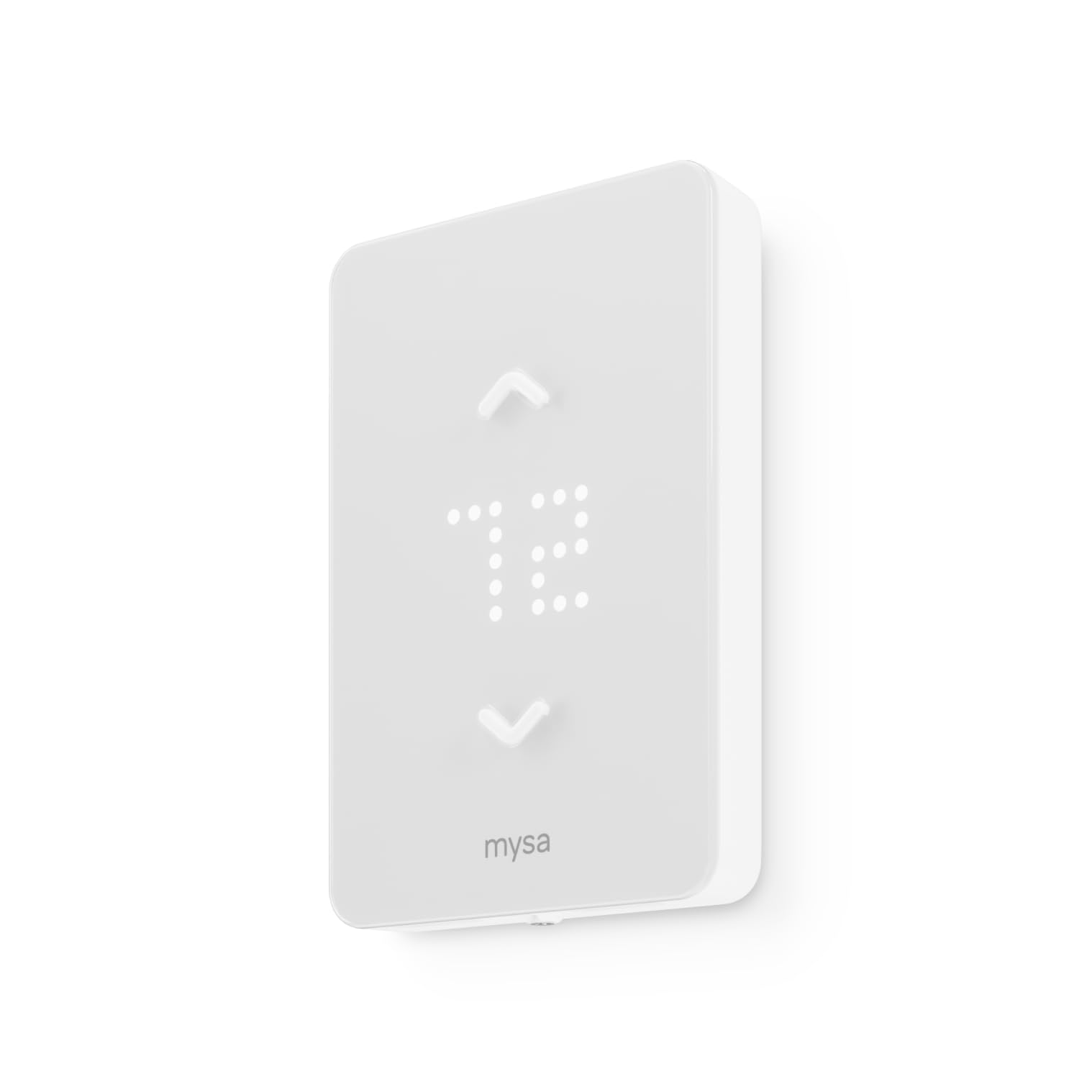
3. Mysa Smart Thermostat LITE
For electric baseboard heaters, this is the thermostat that actually speaks the right voltage — and it’s a chunky 2.48 inches deep, versus the ecobee Enhanced’s 0.94 inches.
Electric baseboard heat is the odd one out in the smart thermostat world. Most units on this list run on low-voltage wiring and won’t touch a 240V baseboard circuit at all; the Mysa LITE is built for it. It handles electric baseboard, fan-forced, wall, convector, and radiant ceiling heat, at up to 1,900W on 120V or 3,800W on 240V. It’s a single-pole thermostat that replaces many single-pole and double-pole units, though local codes vary and you should confirm yours.
The setup is the honest sticking point. This needs four wires, including a neutral or a second live wire, and it won’t work on a two-wire switch loop or on 24V furnaces and heat pumps. Run Mysa’s compatibility checker before you order; the guided app install walks through each wire once you’re sure. From there it’s straightforward and entirely subscription-free — scheduling, remote control, voice control, geofencing, and a monthly runtime email are all included in the free app. HomeKit, Alexa, and Google are all supported natively.
Effectiveness is what owners talk about most, and the appearance gets its share of praise too. Its 5-year warranty is the longest on this list. What’s mixed is compatibility — some homes find the four-wire requirement rules them out. If you have baseboard heat and a neutral wire behind the unit, this is easily the best thermostat for Apple Home in the category.
The voltage story: 120V and 240V handling is the whole reason this exists, and up to 3,800W at 240V covers a serious baseboard run.
The wiring reality: four wires or nothing — no neutral means no install, so verify before you order.
Pair it with: electric baseboard, convector, or radiant ceiling heat and a neutral wire at the wall.
Don’t force it: on a 24V furnace or heat pump, or a two-wire switch loop, this unit simply won’t run.
4. Sensi Smart Thermostat 1F87U-42WF
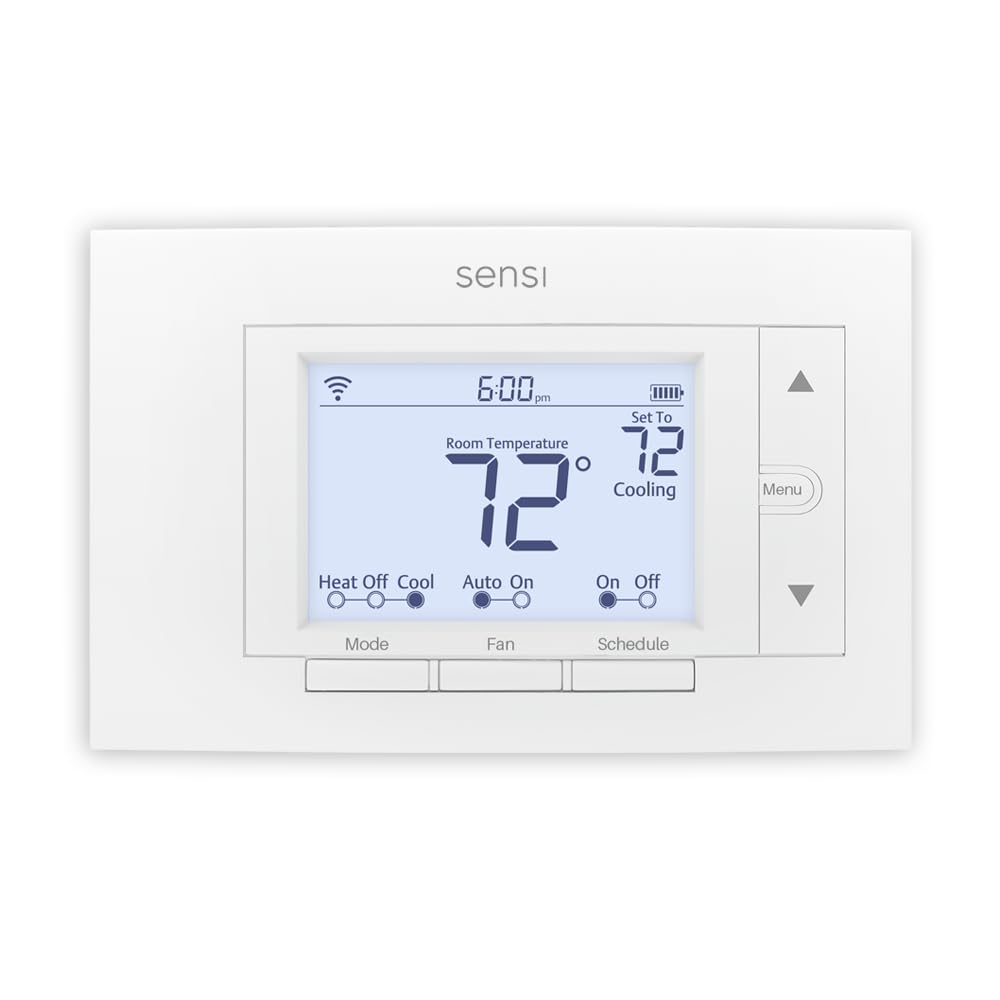
The button-operated workhorse that reviewers keep calling reliable, with HomeKit on board for Apple homes.
Sensi’s 1F87U-42WF takes a different tack from the touchscreen crowd: simple physical buttons, a digital display, and no extra hardware to configure. It carries HomeKit support alongside Alexa, Google Assistant, SmartThings, and Vera, so Apple Home owners can route it through the same app as everything else. What people value most here is quality and reliability — this is a thermostat that quietly does its job season after season, and smart alerts warn you when temperature or humidity heads somewhere extreme.
Customizability is the sleeper feature. Owners set different temperatures for different times of day, control the whole thing from their phone, and adjust schedules while away so a pet stays comfortable. It’s ENERGY STAR certified with a claimed savings of about 23% on HVAC energy, and the app’s video tutorials get most people through install in 30 minutes or less. You can also find utility rebates through Sensi’s rebate finder.
HomeKit specifically requires a C-wire here, which is the one thing to confirm before buying. Connectivity overall earns mixed marks from owners — a few find the app link fussier than expected, though most report it holding fine. At 1 inch deep with a 5.88-inch width, it’s a wide, low-profile wall unit. For a heat-and-cool home that already has the fifth wire and a buyer who doesn’t want to learn a new interface, this is a quietly smart pick.
Simple done well: buttons over touchscreens, a digital readout, and a reliability record that owners bring up again and again.
Best fit for: an Apple Home setup in a home with an existing C-wire and a preference for button control.
The one snag: no C-wire means no HomeKit here — confirm your terminals first.
5. Aqara Smart Thermostat W200
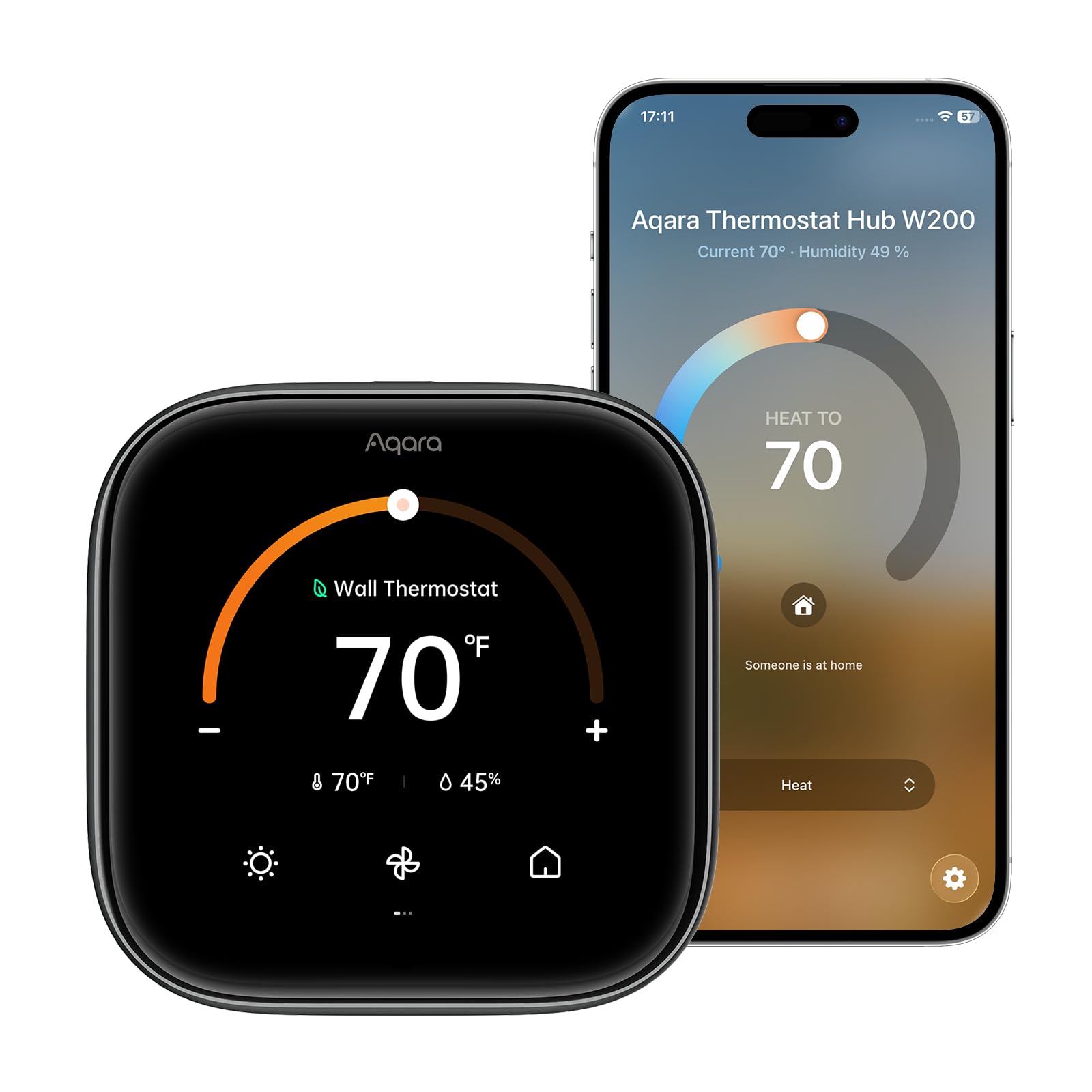
A 4-inch curved touchscreen that doubles as a Matter hub and a video-doorbell viewer for Apple Home.
If your Apple Home setup is the whole point, the W200 is the most Apple-native unit on this list. It runs Matter 1.4 directly, which means it connects to Apple Home, Google Home, Alexa, and SmartThings locally instead of through a cloud service — faster response and one less company to trust. Apple’s Adaptive Temperature uses your iPhone to move the set point between home, sleep, away, and extended away states, so you skip schedule programming entirely. That needs a home hub (Apple TV or HomePod) and an iPhone or Apple Watch on version 26 or later.
The hardware goes well beyond a thermostat. Built in are a Zigbee hub, a Matter controller, and a Thread border router, so the unit ties Aqara sensors to Apple Home and extends your Thread network at the same time. An mmWave radar sensor detects real human presence rather than just motion, so the screen lights as you approach and the heat can ease off when a room empties. The 4-inch full-colour touchscreen with waterfall corners is the nicest display in this group by a clear margin. Dual-band Wi-Fi covers 2.4 and 5GHz.
Installation is broadly easy, and HomeKit integration ranks second among what owners love. It fits about 85% of HVAC systems, including furnaces, air conditioners, heat pumps, boilers, and PTAC units. No C-wire? Add the Aqara C-Wire Adapter, sold separately — unlike the ecobee Enhanced, that adapter isn’t in the box. Temperature control draws some mixed remarks, where the Adaptive Temperature feature is praised but the result isn’t always the temperature people expected. As a smart panel that happens to heat your house, few things compete.
Why Apple homes gravitate here
- Matter 1.4 runs locally, so commands don’t wait on a cloud server
- Adaptive Temperature uses your iPhone states instead of manual schedules
- Doubles as a Zigbee hub, Matter controller, and Thread border router
- mmWave radar detects presence, not just motion
What to weigh first
- Adaptive Temperature needs a hub and devices on version 26 or later
- C-Wire Adapter is sold separately
- Some find the resulting temperature not always on target
Choose it for: a HomePod- or Apple TV-led home where you’ll use Adaptive Temperature and want Thread coverage.
Skip if: you want a no-adapter install and don’t have a C-wire — you’ll be buying the adapter separately.
6. Mysa Mini-Split Controller

Not a wall thermostat at all — a smart replacement for the handheld remote your mini-split came with.
Mini-split heat pumps and ductless AC units usually don’t play nice with standard thermostats; instead of a wall box, they respond to an infrared remote. Mysa’s controller takes that remote’s place, so you get scheduling, geofencing, and voice control for a ductless system that had none. It talks to HomeKit, Alexa, and Google Home, and the free app keeps every feature open up with no subscription. Wall mount or tabletop stand, both in the box.
The convenience is the pitch: monitor and adjust your mini-split from your phone, set schedules that follow your routines, and get Climate+ and filter-cleaning alerts. It’s engineered in Canada for North American climate conditions and designed for 2.4GHz Wi-Fi networks, though it also works on combined 2.4/5GHz and mesh networks. Setup uses step-by-step video guidance, and support helps if a remote pairing gets stubborn. At 280 g it’s light enough that the wall mount holds it comfortably.
Set expectations honestly though: a newer product with a smaller review base will always have thinner consensus, and the controller depends on line-of-sight infrared or its adapter matching your specific mini-split brand. Check the compatibility list for your unit before you commit. For a ductless heat pump or AC with a lost remote or a serial frustration with the stock app, though, this fills a real gap that almost nothing else on this list does.
The gap it fills: mini-splits and ductless units that ignore wall thermostats get scheduling, geofencing, and HomeKit through one small controller.
Worth it when: you own a ductless mini-split or AC and want it in HomeKit without a subscription.
Think twice if: your mini-split brand isn’t on the compatibility list, or you’d rather have a wall-mounted display.
7. Honeywell Lyric T6 Pro

Built for houses with staging to spare — up to two heat and two cool stages on a conventional system.
The T6 Pro is the pick for a home with a more elaborate HVAC setup than a single-stage furnace. It handles up to 2 heat/1 cool on a heat pump or 2 heat/2 cool on conventional systems, plus optional wired indoor and outdoor sensors, and it’s ENERGY STAR certified. The large touchscreen makes on-wall scheduling workable without the app, and the Lyric app covers the phone side. It also integrates with Apple HomeKit and Amazon Alexa for single-app control.
Functionality and reliability share top billing here, and installation lands right behind them — the UWP mounting system is standard across the T Series, so swapping an older Honeywell is a matter of reusing the plate. Geofencing, 7-day scheduling, and 5-2 or 5-1-1 programming give you the flexibility a working household needs. The bundle adds a large wall plate and a cleaning cloth, which handles the cosmetic cleanup after the old unit comes off.
What’s mixed is ease of use and the app experience — plenty of people find it straightforward, and some find the interface busier than expected. The wall unit lets you do almost everything without opening a phone, which is either liberating or a step back depending on your habits. At 1.09 inches deep and 4.06 inches square, it’s a tidy fit for a hallway wall. If your system has multiple stages and you already live in Honeywell hardware, this slots in without drama.
Staging headroom: 2H/1C heat pump or 2H/2C conventional means it drives setups that simpler units can’t address.
The trade-off: a busier on-device interface that some owners prefer to skip in favor of the app.
Good match when: you have a staged conventional system or heat pump and want HomeKit without replacing the wall plate.
Look past it if: your system is single-stage and you’d rather have a cleaner, simpler app-driven experience.
8. LUX TQX Matter Smart Thermostat

Matter-first, sensor-included, and built to learn your routine without you touching a schedule.
The TQX from LUX makes its case on two fronts: native Matter over Wi-Fi and an included wireless room sensor. Matter means it joins Apple Home, Google Home, Alexa, SmartThings, and Home Assistant through the app you already use — no separate LUX login and no proprietary app to install. The 1.1-inch deep, 3.5-inch square black unit is small on the wall, and it arrives with a trim plate and a Lux Power Bridge that stands in for a missing C-wire, so a no-C-wire house isn’t shut out.
The QSZ room sensor reports temperature, humidity, and occupancy from wherever you place it, and you can pair up to five of them to give the thermostat a whole-home picture. A built-in mmWave occupancy sensor handles the rest — comfort follows the people in the house rather than the hallway reading. Automatic schedule learning then adapts to your routine over time, so the schedule forms itself without programming sessions.
The plain caveat is that this is the newest, least-reviewed unit here, so the long-term record is still being written. People who want plug-and-play confidence may prefer a model with more history. What you get in return is a genuinely open Matter thermostat with room sensing and humidity awareness included in the box, which is more than most competitors hand you at any tier. For a renter or a tinkerer rebuilding an Apple Home setup from scratch, that openness is the point.
The open-platform bet: Matter over Wi-Fi plus an included room sensor means no lock-in and room-by-room readings on day one.
Reach for it if: you run Apple Home alongside other platforms and want a Matter thermostat with an occupancy sensor in the box.
Hold off if: you want a long track record behind the hardware rather than a fresh Matter-first design.
9. Honeywell Home X8S

The 5-inch screen that wants to be the smartest display on your hallway wall, doorbell feed and all.
Where most thermostats give you a modest readout, the X8S gives you a 5-inch customizable display you can colour-match to your room. It’s Matter certified for interoperability and also lists Apple Home alongside Amazon Alexa and Google Assistant, so it lands in the Home app through the standard route. The reason to look at it isn’t the thermostat alone, though — it’s the doorbell camera view. Pair it with a First Alert VX1 or Ring streaming doorbell (sold separately) and you can see and speak to visitors straight from the wall.
It does more than hold a temperature: it manages humidity and ventilation for indoor air quality, so your rooms stay comfortable and fresh. Its occupancy and presence detection adjusts settings when you’re home and backs off when you leave. It’s ENERGY STAR certified, which also makes it eligible for energy programs and rebates. System support reaches up to 3 heat/2 cool heat pump with electric backup or 2 heat/2 cool conventional — but note that it does not work with electric baseboard heat at 120-240V, so the Mysa LITE above is still the correct answer there.
Connectivity is the honest wobble. The remote-control features work well and the breadth of automation options keeps owners happy, but reports of Alexa compatibility issues surface enough to mention; Apple Home users are less likely to hit that particular snag. A C-wire is required, and Honeywell prints a voucher for a free C-Wire Adapter by mail if your system lacks one. At 0.96 inches deep and 15.2 ounces, it’s a slim, solid-feeling wall unit. If your hallway is where the family gathers around a screen, this is that screen.
A display first, thermostat second: a 5-inch customizable screen, doorbell camera view, and air-quality control make it the visual centrepiece of the wall.
The caveat to plan for: C-wire required, and no support for electric baseboard heat.
Pick it when: you want a big, customizable display and doorbell viewing in a conventional or heat-pump home with a C-wire.
Not for you if: you’re on electric baseboard heat or you rely heavily on Alexa
10. ecobee Smart Thermostat Premium
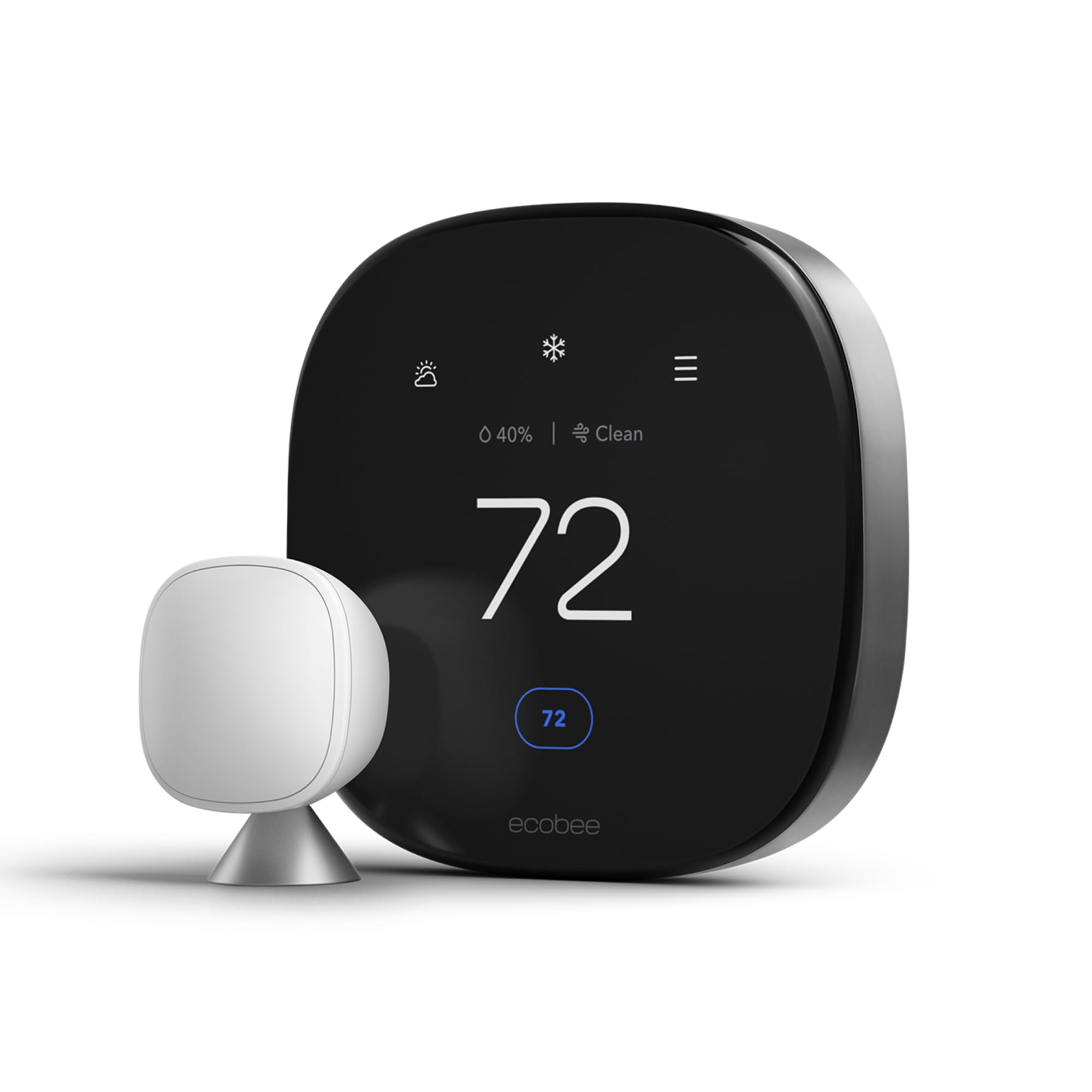
The one with Siri living inside the wall — plus an air quality monitor and a bundled room sensor.
The Premium steps up from the ecobee Enhanced in three visible ways: a built-in smart speaker with Siri or Alexa, a built-in air quality monitor, and an included SmartSensor in the box. That speaker means you can control your home by voice from the hallway without a HomePod in earshot, and you can stream Spotify or podcasts through it too. It also listens for smoke alarm sounds and alerts you when they trigger — though that security feature needs an ecobee Smart Security subscription. Siri needs an Apple home hub to enable.
The included SmartSensor is the practical win: it detects which rooms you’re actually using and adjusts temperature there rather than relying on a single hallway reading. Combined with the built-in radar occupancy sensor, the thermostat preheats or precools before you arrive. It’s ENERGY STAR certified, and ecobee claims savings of up to 26%. It covers 95% of HVAC systems, and the included Power Extender Kit and trim plate handle a no-C-wire install. The three-year warranty is the same confidence the Enhanced carries.
Where owners divide is on settings depth and connectivity. The feature set is deep enough that some find the volume of options intimidating, and a portion report connectivity struggles with HomeKit even though most get it working. At 1.3 pounds and 2.9 inches deep it’s a substantial wall presence. If you want Siri on the thermostat itself and air quality alerts, this earns the upgrade; if you don’t, the Enhanced does the same heating job for less.
Why the upgrade lands
- Siri and Alexa built in, plus a speaker for music and podcasts
- Air quality monitor with alerts and filter-change reminders
- SmartSensor and Power Extender Kit included in the box
- Covers 95% of HVAC systems per the manufacturer
What some buyers hit
- Deep settings menu that a few find intimidating
- HomeKit connectivity reports are mixed
- You pay substantially more than the Enhanced for the extras
Worth the step up if: you want Siri on the wall, air quality tracking, and a room sensor bundled in.
Save the difference if: you mainly want reliable heating control and don’t need a speaker or air sensor.
11. Google Nest Learning Thermostat (4th Gen)

The most recognizable circle in home heating, now with a 60% larger display and a bundled temperature sensor.
Nest’s fourth-generation Learning Thermostat is the crowd favorite of the whole category, and its appeal is largely visual plus smart. The display is 60% larger than the previous generation, with Dynamic Farsight that shows the time or weather from across the room and adjusts brightness automatically. In Polished Silver, it’s the one people point at when they walk in. It’s Matter compatible, and works with Alexa, Siri, or Google Assistant speakers, so an Apple Home household can still reach it by voice.
The comfort story is about learning rather than programming. It watches how outside temperature affects the inside of your house — sun through the windows warming a room, for instance — and pauses the system when it can. New Adaptive Eco uses outside temperature to find an energy-saving set point while you’re away, then brings things back to comfort within an hour of your return. It asks permission before making schedule changes, so you confirm savings with a tap rather than discovering them later. The bundled Nest Temperature Sensor lets you set a target temperature for a specific room at a certain time.
Compatibility is broad: most 24V systems, including gas, electric, oil, forced air, heat pump, and radiant, and no C-wire required for install in most homes. What’s mixed is reliability and app experience — some report failures or Nest app frustration while others find it works smoothly with their smart systems. At 161.8 g it’s a light, wall-friendly circle. If the look matters as much as the function and you’re comfortable in Google’s ecosystem with Matter as the bridge to Apple Home, this is the showpiece.
The learning layer: adaptive eco, outside-temperature awareness, and permission-based schedule changes make it feel less like a thermostat and more like a comfort assistant.
The app question: reliability divides opinion — some owners rave, some hit Nest app friction.
Made for: buyers who want a designer circle on the wall and don’t mind routing Apple Home through Matter.
Pair with care if: you want a pure native HomeKit path with no Google app in the loop.
Know the Specs
C-wire and line voltage
A C-wire is the fifth low-voltage wire that supplies steady power to a thermostat’s screen and Wi-Fi radio. Most smart thermostats assume one is present; if it isn’t, some ship a workaround. The ecobee Enhanced includes a Power Extender Kit, and Honeywell Home includes a voucher for a free C-Wire Adapter with the X8S. Line voltage is completely different — baseboard heaters run at 120V or 240V, and a low-voltage thermostat will not control them. The Mysa LITE handles that job directly, up to 3,800W at 240V.
Matter, Thread, and local control
Matter is a shared smart-home standard that lets a thermostat join Apple Home, Google Home, Alexa, and SmartThings without a brand-specific app or bridge. Thread is a low-power wireless mesh that Matter devices can use instead of Wi-Fi, and a Thread border router extends that network through your home. The Aqara W200 packs a Thread border router and Matter controller inside the thermostat itself. The practical payoff is speed and resilience: a local Matter command responds faster than a cloud round-trip and keeps working if a manufacturer changes its backend.
Occupancy and room sensors
Occupancy sensing looks for whether a person is present and adjusts comfort or savings accordingly. The Aqara W200 and LUX TQX use mmWave radar, which detects real human presence rather than just motion. A room sensor is different — it’s a small wireless puck placed in a bedroom or office that reports temperature, and often humidity and occupancy, back to the thermostat. The ecobee Premium includes a SmartSensor, the LUX TQX includes a QSZ sensor, and the ecobee Enhanced accepts SmartSensors sold separately.
Stage counts and system match
Stage count describes how many heating and cooling outputs a thermostat can drive. A single-stage furnace has one heat output; a heat pump may have two heating stages and one cooling stage. The Honeywell Lyric T6 Pro supports up to 2 heat/1 cool on a heat pump, and the Honeywell X8S reaches up to 3 heat/2 cool heat pump with electric backup or 2 heat/2 cool conventional. Match the stage count to your equipment before buying; a thermostat with fewer stages than your system needs will leave comfort on the table.
Common Questions
Will a HomeKit thermostat work with electric baseboard heaters?
Do I need a C-wire for a thermostat in Apple Home?
Is Matter better than built-in HomeKit for a thermostat?
Can the Aqara W200 work without an Apple home hub?
Will a smart thermostat control a mini-split heat pump?
How long does installation take on these thermostats?
What is a room sensor and do I need one?
Do these thermostats need a subscription for scheduling or remote control?
How many heating and cooling stages can these thermostats handle?
Can I control these thermostats with Siri on my phone or Apple Watch?
The Bottom Line
The thermostat that earns the top spot is the ecobee Smart Thermostat Enhanced, because it asks the least of your walls and delivers the most reliably into Apple Home. The Power Extender Kit and trim plate are in the box, so a missing C-wire won’t stop you, and it covers 90% of HVAC systems while sitting flat at 0.94 inches deep. For a standard furnace-and-AC home, it’s the pick that stays out of your way.
Electric baseboard heat changes the answer entirely — reach for the Mysa Smart Thermostat LITE and check for a neutral wire behind the unit first. And if you want Apple’s own Adaptive Temperature and a Thread border router (a hub that relays your smart-home network) in the wall, the Aqara W200 is the most Apple-native unit on the list, provided you have a home hub and an iPhone or Apple Watch on version 26 or later.
One last nudge before you buy: the compatibility checker is the single most valuable five minutes of this whole process. Every thermostat here is solid hardware, but none can fix a mismatch with the system behind your wall.
How we choose
We do not accept paid placement. Every pick is matched to a real buyer and a real use-case; we do not hands-on test units.
Sources
Specifications: manufacturer listings and product documentation. Review insights: verified customer reviews, as of November 2026. Pricing: not shown on this page (it changes often); check the current price via the retailer link.
As an Amazon Associate, Tactical Gear Guy earns from qualifying purchases. This does not affect which products we feature.