Specs are compiled from manufacturer listings and verified buyer reviews and can change over time — please confirm the key details on the product page before buying.
If you want one answer fast: buy the tent whose stove jack sits where your pipe actually exits, in a fabric that holds heat instead of sweating it out. The rest is fit and floor space. A stove jack is a fire-resistant opening cut into the tent roof or wall so a wood stove pipe can pass through without torching the fabric. Get that hole in the wrong spot and your winter camp turns into a smoky, drippy mess.
This guide is built by comparing the manufacturers’ published specifications and the patterns across verified customer reviews, so you get each pick’s real strengths and trade-offs instead of marketing spin.
Canvas, nylon, and air-beam shells all behave differently once a stove is lit and the temperature drops. Below you’ll see which shell holds warmth, which packs small enough to carry, and which setup you can actually pitch alone in the dark. The picks that follow are the tent with stove jack options most worth your money.
Top Picks


How To Choose The Best Tent with Stove Jack
Most people buy a hot tent by sleeper count and end up cold. The number on the box rarely matches the space you get once a cot and a stove are inside. Start with the three specs that change your night: jack placement, shell fabric, and floor area.
Where the stove jack sits
A roof jack gives you the straightest pipe run and the best draft, which means less smoke backing into the tent. A side-wall jack lets you run the pipe out at an angle when a tree branch or a low tarp is in the way. Some shelters give you both, so you pick the exit that fits the site. Check that the jack is cut from fire-resistant material before you trust it with a lit stove.
Canvas versus synthetic shells
Cotton canvas is heavy and breathes, so it holds warmth and lets moisture escape instead of condensing on the walls. Ripstop nylon and polyester pack far smaller and dry faster but shed heat quickly and can bead up with condensation in a hard freeze. If you drive to camp, canvas is the warmer call. If you carry the tent on your back, synthetic wins on weight.
Floor area and standing room
Look at the actual floor area in square feet, not the sleeper rating. A stove eats floor space, and so does a cot. Peak height decides whether you can stand to dress — a low teepee forces you to crawl around the stove, which is exactly when you bump a hot pipe.
Side-by-Side Comparison
| Model | Best For | Floor Area | Shell Fabric | Form Factor | Amazon |
|---|---|---|---|---|---|
| WHITEDUCK Regatta Canvas Bell Tent★ Best Overall | Cold-weather glamping with a stove | 132.67 sq ft | Cotton Canvas | Teepee | Amazon |
| OneTigris TEGIMEN Hammock Hot TentBest for Hammocks | Hammock hangers in winter | 82.5 sq ft | 70D Nylon | Hammock shelter | Amazon |
| POMOLY Chalet 70 ProPackable Cabin | Two-person backpacking | 54 sq ft | 70D Ripstop Polyester | Cabin | Amazon |
| OneTigris Rock Fortress Tipi | Group basecamp, car camping | 60.84 sq ft | Nylon | Teepee | Amazon |
| TIMBER RIDGE Inflatable 6 Person | Fast no-pole setup | 68 sq ft | 210D Oxford | Inflatable Cabin | Amazon |
| Naturehike Massif | Roadside four-season base | 89.13 sq ft | 30D Polyester / 70D Nylon | Cabin | Amazon |
| WaldZimmer Canvas Bell Tent | Group canvas shelter, four seasons | 12.57 square meters | Polycotton canvas | Bell | Amazon |
| Night Cat 8-Person Instant Cabin | Family base with sleeping room | 112 sq ft | Polyester | Cabin | Amazon |
| Naturehike Dune | All-weather family camping | 132.05 sq ft | 75D 210T Polyester | Tunnel | Amazon |
| Kodiak Canvas Cabin Lodge | Long-term canvas basecamp | 144 sq ft | 100% Cotton Duck Canvas | Cabin | Amazon |
| Coody Premium Inflatable Canvas | Luxury air-beam hot tenting | 10 sq m (107 sq ft) | 210 GSM TC Cotton Canvas | Inflatable Cabin | Amazon |
Detailed Reviews
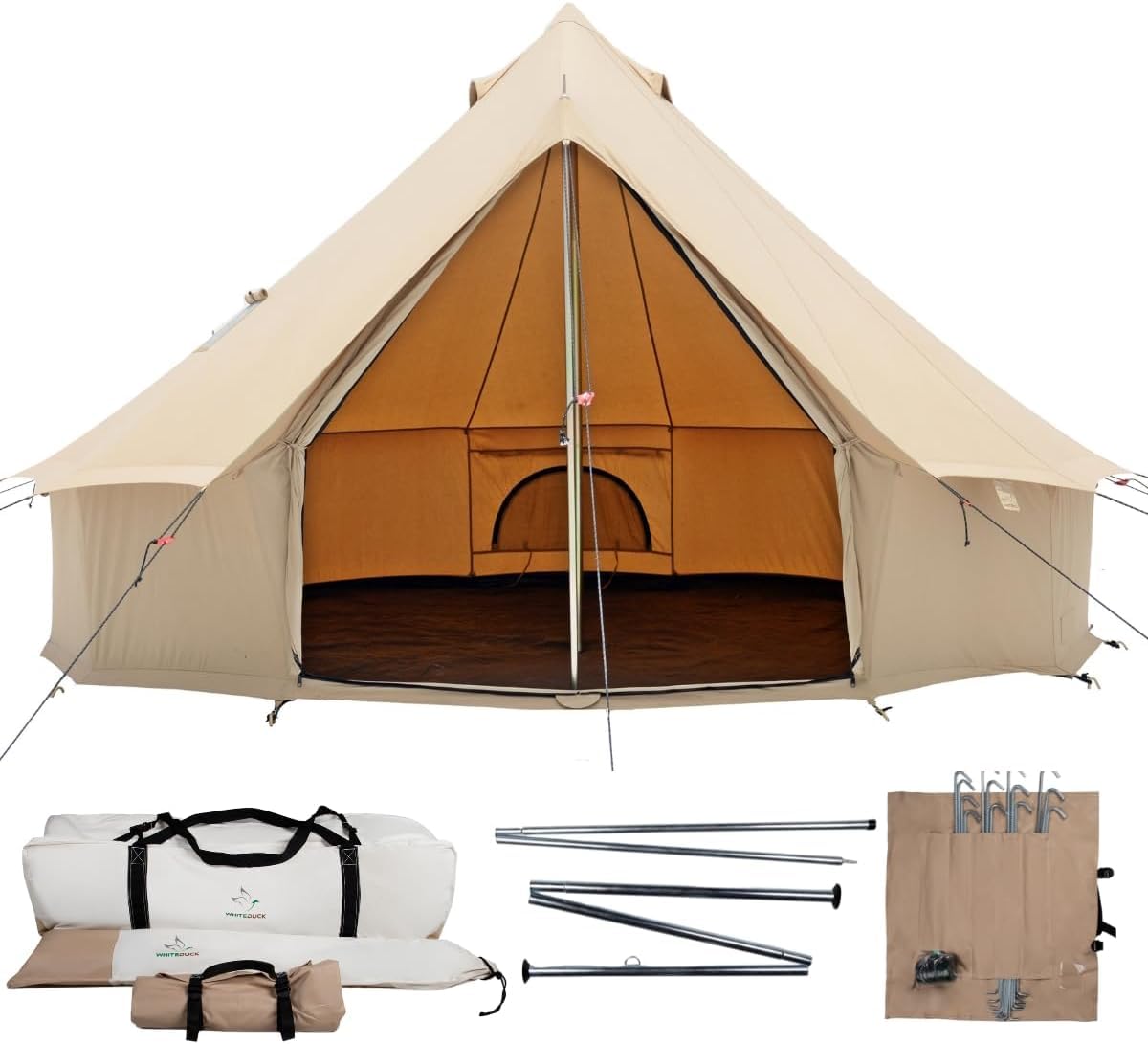
1. WHITEDUCK Regatta Canvas Bell Tent
Our pick — 4.5+★ from 750+ verified ratings; the strongest balance of quality and price.
Breathable canvas that fights back against wind, rain, and a lit stove pipe.
The warmth here comes from the shell itself — breathable performance cotton canvas, finished with a PFC-free water-resistant treatment and a stove jack lined in fire-retardant material. That combination means you can run a wood stove on a cold night and still get airflow instead of a wall of condensation. It’s also sold in a flame-retardant version for four-season use with a wood stove, if your plans lean hard into winter.
The floor area is 132.67 square feet, against 54 square feet on the POMOLY Chalet 70 — roughly 2.5 times the footprint, which is why this one swallows a cot, a stove, and a chair without a shuffle. Walls stand at 2’7″, higher than average bell-tent walls, so you get real walk-around room instead of a crouch zone.
What wins people over is the build. Owners repeatedly praise the triple-stitched seams, and the waterproofing holds through storms without leaking into the sleeping area. Setup runs about 10 minutes per the maker, and the box includes the sewn-in groundsheet, stove jack, mesh windows, roof vents, poles, tool kit, and a weatherproof bag — no surprise add-ons.
What earns the top spot
- 132.67 sq ft of floor with 2’7″ walls for genuine stand-up space
- Breathable cotton canvas holds warmth and cuts condensation
- Fire-retardant stove jack plus a complete kit in the bag
- 2-layered doors and windows, plus an electrical cable outlet
What to weigh first
- Canvas this heavy is a car-camping tent, not a pack tent
- Heat retention gets the weakest marks of any praise category here
Buy this if: you drive to camp, want a warm four-season shell, and need room to stand and move around a stove.
Think twice if: you plan to carry your shelter any distance — the canvas build is the price of that warmth.
2. OneTigris TEGIMEN Hammock Hot Tent with Stove Jack
The only pick here built around a hammock instead of a ground pad.
Two stove jacks — one on the roof, one on the side wall — let you choose your pipe angle based on how the trees fall. That single design choice solves the most common hammock-camping headache: a pipe that has to exit sideways under a tarp. The shell is 70D ripstop nylon with a 3000mm waterproof rating, a measurement that says the fabric resists a heavy column of water before it pushes through.
Floor length runs 12.5 feet against 4.9 feet on the POMOLY Chalet 70 — a spread that leaves room for a Haven XL hammock plus a cot with space to spare. Floor width is 6.6 feet. A wind-proof sod skirt traps heat at ground level, and the YKK zippers keep a winter draft out.
The honest catch is setup. Durability feedback is similarly mixed, with some reporting the material melting near the stove and others praising it through winter ice storms. Treat the stove clearance with real respect and this shelter rewards you.
Where the value sits: quality is the thing owners praise most, and the 4.0+ star showing reflects a shelter that does its one job — hanging warm over frozen ground — better than a ground tent can.
Reach for this if: you sleep in a hammock year-round and want stove heat without an underquilt.
Look elsewhere if: you want a fold-out-and-go pitch with written instructions in the bag.
3. POMOLY Chalet 70 Pro Camping Hot Tent Cabin
A backpacking cabin that guards the floor from stove sparks.
Fire safety under the stove is the standout spec: a built-in fireproof ground sheet made from silicone and fiberglass cloth, plus an ember mat that keeps sparks and hot ash off your floor and the grass beneath. The 70D plaid ripstop polyester shell carries a 2500mm waterproof rating, and two 7001 aluminum alloy main poles with 8 tie-down points do the structural work.
Interior dimensions are 8.2 × 6.56 × 4.9 ft, which lands at 54 square feet of floor — the smallest footprint in this group. That’s the opposite end from the WHITEDUCK’s 132.67 square feet, so pack light and sleep one, or sleep two close. Side rain curtains on both opposing doors let you crack the tent open in weather and still stay dry inside.
Quality is the loudest positive in owner feedback, with setup speed close behind. Ventilation is where it draws the most divided response — some find airflow fine, others report condensation building up. If you run a stove hard in a hard freeze, plan on cracking the doors.
Small footprint, real trade: this is the most carry-friendly option here, and the fireproof floor plus ember mat make it the smartest choice for a backpacker running a small stove.
Suits: one or two hikers who carry their shelter and want stove heat with floor protection built in.
Does not suit: anyone wanting to spread out — 54 square feet fills fast once a stove goes in.
4. OneTigris Rock Fortress Hot Tent with Stove Jack
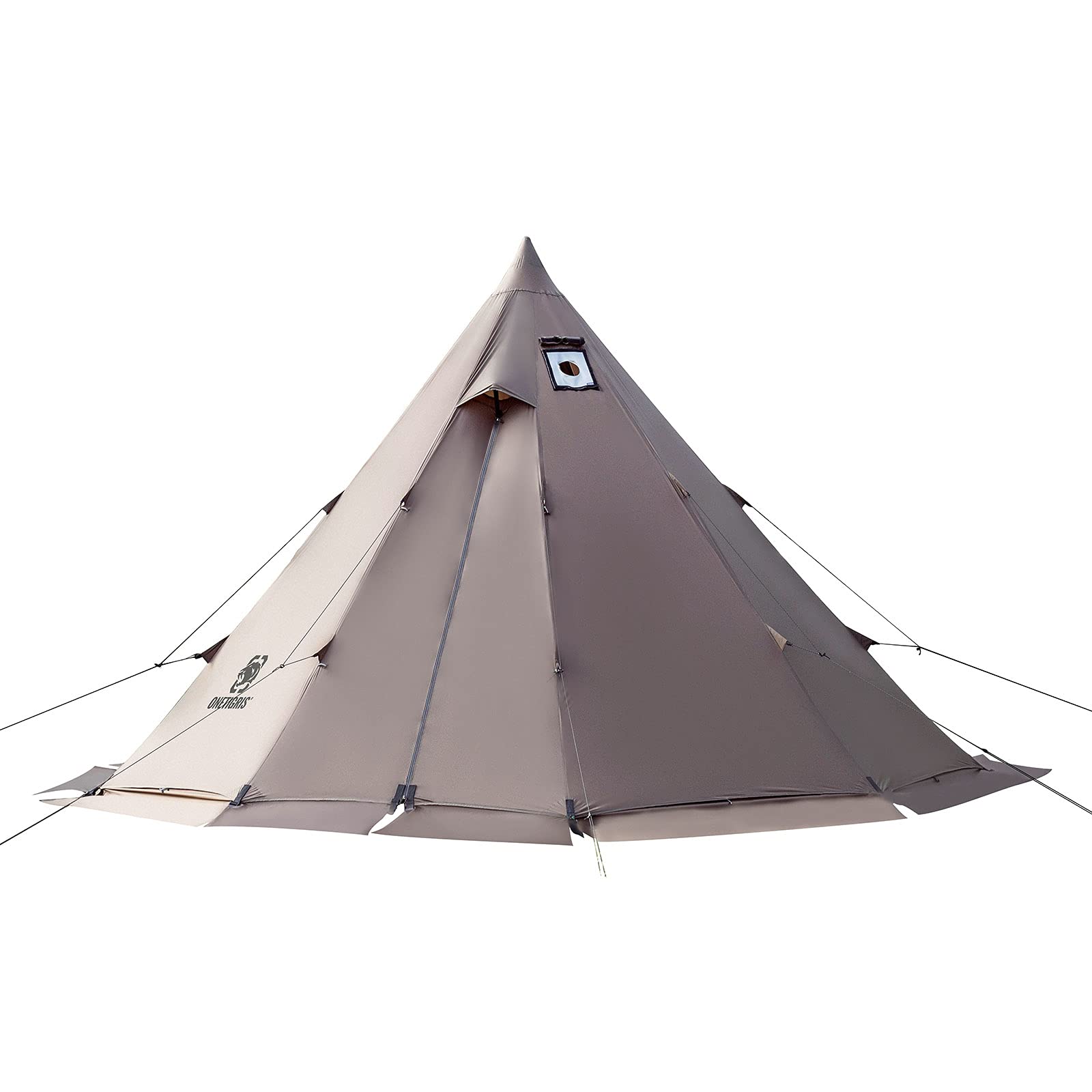
Twelve feet of teepee diameter for a stove and a crowd of cots.
Bottom diameter runs 12.4 ft with 7.8 ft of height, which means you can stand upright inside a tipi — rare in this shape. Floor length is 148.8 inches, the longest in the group and a 3.2x spread over the WHITEDUCK Regatta’s 46 inches. The maker rates it up to six people, and a stove plus a couple of cots fits without a fight.
A wind-proof snow skirt traps heat at the base and folds away when you want summer airflow, so this shelter works both as a winter hot tent and a warm-weather shade. Weather resistance is the most consistent result in this set — every review that mentions it reports the tent standing up to strong winds and heavy rain. Warmth comes through the same way: it heats fast and holds.
Durability draws the most divided response, with the top seam named as the weak point by a few. Size splits opinions too — plenty of room for two adults with cots and gear, tighter than some expect. Set it on clean ground and the shell rewards you.
Why it holds this slot
- 12.4 ft diameter and 7.8 ft height for stand-up tipi room
- Snow skirt keeps heat in and folds for summer ventilation
- Reviews on wind and rain come back unanimous
- Packs down with a 24-peg, 10-guy-line setup kit
The honest caveat
- Top seam is the failure point a few buyers hit
- Big footprint for the floor area it gives you
Pick it for: family or hunting basecamp where you want stand-up room around a stove.
Leave it if: you need to carry your shelter — a teepee this size is a drive-in tent.
5. TIMBER RIDGE Inflatable Tent 6 Person Hot Tent
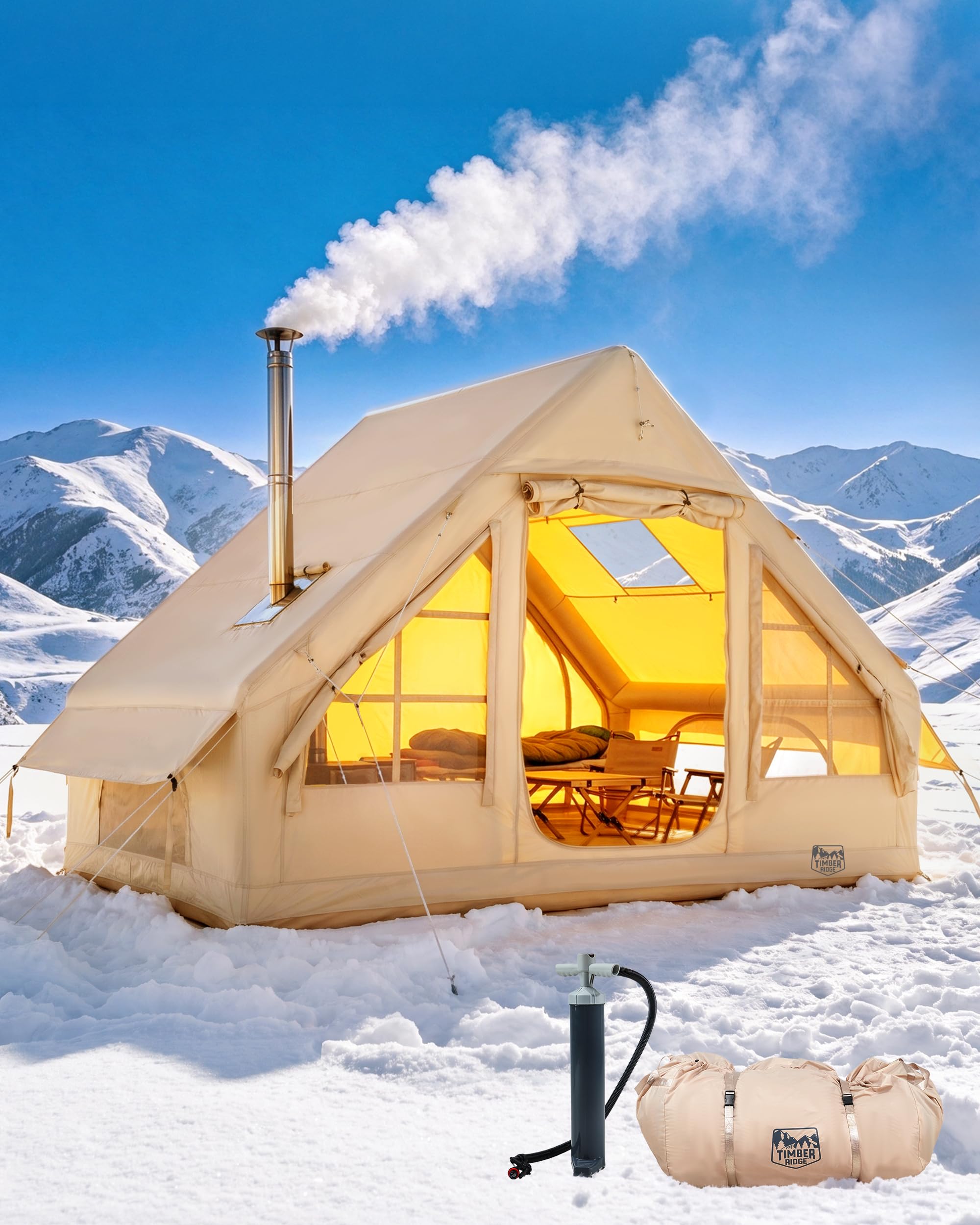
No poles. Connect the pump, and the cabin stands up in about five minutes.
This is the one pick with zero pole work. Connect the included pump, and the reinforced air beams hold pressure overnight while a pressure release valve bleeds off over-inflation on hot days. Puncture-resistant fabric handles repeat trips. Setup in the maker’s terms is about five minutes, freeing one or two people to actually enjoy the evening.
The shell is 210D Oxford with a 3000mm waterproof coating and UPF 50+ UV protection, rated to 5-6 wind resistance. Floor space is 9.8 ft by 6.9 ft at 6.5 ft peak height — 68 square feet, enough to seat six or fit a queen air mattress with stand-up room. It packs into a 17-inch bag for the truck bed.
A cut-to-fit stove jack accepts most heater pipes for four-season camping, and 360-degree mesh with a roof skylight lets you vent heat and condensation when the stove is roaring. Sturdiness is the mixed note — some find the air frame solid enough to stand in, others find it less rigid than a pole tent. The porch screen also lacks a floor, which matters if you plan to set gear there.
The setup-speed win: quality is what buyers praise most, and an inflatable cabin with a skylight and a stove jack in 68 square feet is a strong tailgate and family-camp answer.
Go for it when: you want a winter-capable cabin up fast, with no poles to thread in the cold.
Pass when: you want the rigidity of a pole frame — air beams flex more than steel or aluminum.
6. Naturehike Massif Hot Tent with Stove Jack

A double-wall cabin with a hall out front and two windows to clear the air.
Ventilation here is engineered, not an afterthought. Two ventilation windows and a breathable mesh inner tent push moisture out, and the maker calls it out specifically as a way to reduce condensation. The tent fly is 30D lightweight polyester with a silicone coating, the inner is 70D nylon, and the 7001 aluminum alloy cross frame holds up in wind. Waterproofing is rated at 3000mm.
Floor area is 89.13 square feet, with a room, a hall, and a vestibule out front for gear and boots. It’s a two-person design that carries a snow skirt to seal out wind and snow. Without the stove lit, it still works as a four-season tent with both doors propped open for air.
Size and setup both land on the positive side of owner feedback, and the reinforcement at stress points earns praise. The honest note is weather: the skirts keep the sleeping area dry, but a few report wind pushing moisture in. Peg the wind ropes out properly and this shelter does its job.
Built for damp cold: this is the shelter to pick when condensation is your real enemy — mesh inner, two windows, and a vestibule that keeps wet gear out of your sleeping space.
Fits: two campers who want a room-plus-vestibule layout and air movement with the stove on.
Skip if: you want a single-wall teepee for standing room — this is a cabin with a lower profile.
7. WaldZimmer Canvas Bell Tent

A canvas bell with a floor you can pull out and a chimney hole pre-cut.
The removable floor is the feature most other tents here don’t give you. A heavy-duty waterproof PVC groundsheet rated at 500gsm unclips, so you can set up over a group and leave the grass underneath. The shell is polycotton canvas that breathes and insulates; the maker is honest that it has no PU coating and shouldn’t sit in long rain.
The 4m diameter model takes 4-5 people, with a top height of 8.2 ft and a 5 ft door so you walk in without stooping. A 2 ft side wall frees up the floor corners. Four double-layer windows, a double-layer door, and four roof vents handle airflow, and a pre-cut chimney opening lets the stove run on snowy days.
Durability on the center pole is the strength buyers call out — it stays stable in wind. Water is the divided note: some report no leaks, while a few find water pooling around the perimeter. A plastic waterproof cap on the door pole keeps rain out of the metal hole.
The canvas room you can party in: Buyers praise the well-made stitching and rock-steady center pole, and the removable floor plus pre-cut chimney hole make this the social-occasion canvas pick.
Choose this for: a yard or festival base where you want canvas warmth and a floor you can strip out.
Choose differently if: you need it to shrug off days of steady rain — this canvas breathes by design.
8. Night Cat 8-Person Instant Cabin Tent with Stove Jack
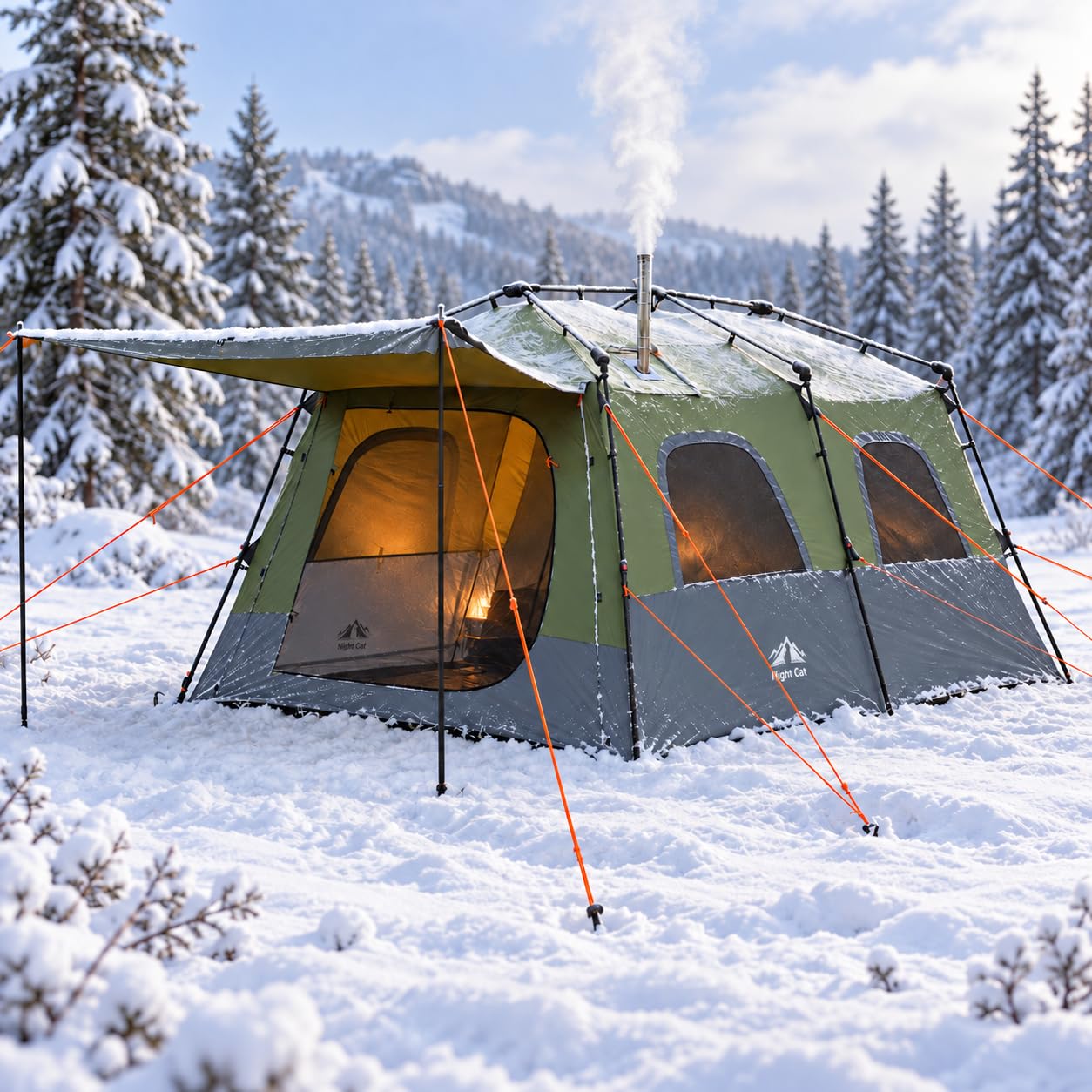
A sealed sleeping room up front and a stove-ready living room behind it.
The layout is what sells it: a fully enclosed inner tent that sleeps 4, plus a spacious front vestibule for gear, cooking, or up to 4 more sleepers. The stove jack sits in that vestibule, so the stove lives in the living space and the sleeping area stays separate and sealed. The overall layout runs 14 ft by 8 ft with an 80-inch peak, landing at 112 square feet of floor.
The inner tent floor is waterproof with sealed seams. The vestibule uses a removable groundsheet, which keeps setup flexible — and during rain, gear meant to stay dry belongs inside the enclosed inner tent. Dual-layer mesh windows and triangular vents keep air moving and condensation down.
Two people can put it up in roughly five minutes per the maker’s listing. Fire-retardant fabric around the stove area adds a layer of protection. Barely into its review life, the early word is good on quality and setup — but treat this as a newer model with a shorter track record than the canvas veterans here.
The family split-room idea: a separate sleeping room and a stove room under one roof is the reason to pick it, and setup speed makes it a realistic weekend tent.
It’s the one for: families who want a stove-lit living room separate from the sleeping space.
Don’t pick it for: hardcore winter — the vestibule groundsheet comes out, so rain handling needs gear care.
9. Naturehike Dune Hot Tent with Stove Jack
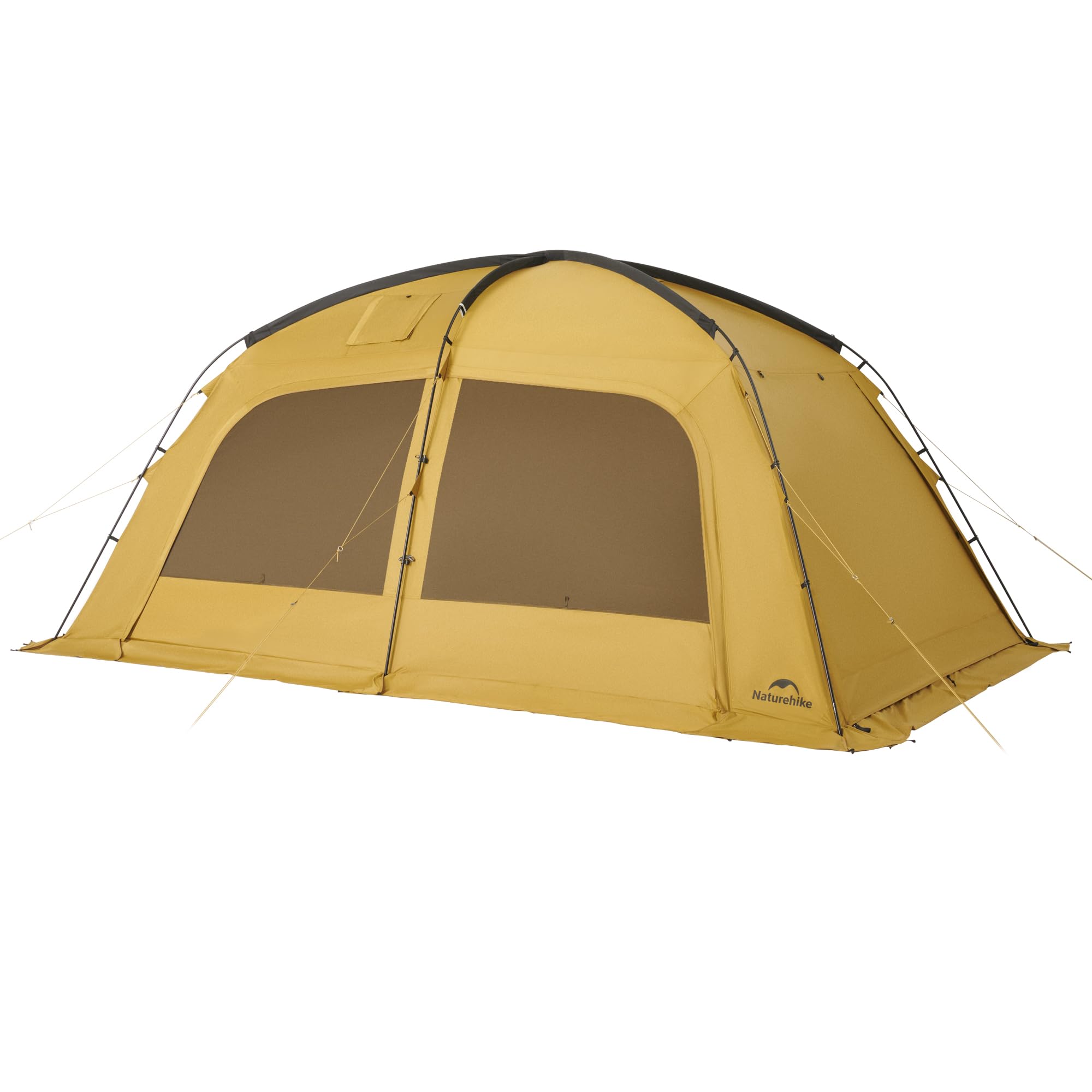
Four setup modes, six mesh doors, and a waterproof rating that tops the chart.
The Dune’s headline number is its waterproofing: PU10000mm+ on a 75D 210T polyester shell with a UPF50+ silver coating. That rating is the highest in this group, and it means the fabric resists a much taller column of water before any gets through — the sort of shell you want under a heavy snow load that melts by afternoon. Setup modes run four ways, from fully enclosed overnight to full mesh ventilation to canopy shade.
Floor area is 132.05 square feet across a 14.5 ft by 9.1 ft layout, with a 6.8 ft height. Six mesh doors open the tent up, and each panel takes a zippered TPU curtain sold separately for weather-resistant views. The fiberglass stove jack resists yellowing and blackening, and its double-layer heat-resistant webbing fits various pipe diameters and is user-replaceable.
Durability is the confident note — buyers report the shell holding up in strong winds and snow loads, with well-stitched seams and quality zippers. Heat retention in the inner tent also draws praise. Add the optional canopy and the shaded area grows to 380 square feet, though that canopy is a separate purchase.
What makes it the versatile pick
- PU10000mm+ waterproof shell, the strongest rating in this lineup
- User-replaceable fiberglass stove jack with heat-resistant webbing
- Six mesh doors with optional TPU panels for weather-resistant views
- 132.05 sq ft that fits a queen air mattress and pets
Where it costs you
- TPU view panels are sold separately, not in the box
- The 380 sq ft expanded shade needs the canopy add-on
It is the call for: year-round family camping where rain and snow load are the real worry.
Look at the Dune’s cheaper cousin if: you want a cabin shell without the multi-mode canopy system.
10. Kodiak Canvas Cabin Lodge Stove-Ready Tent
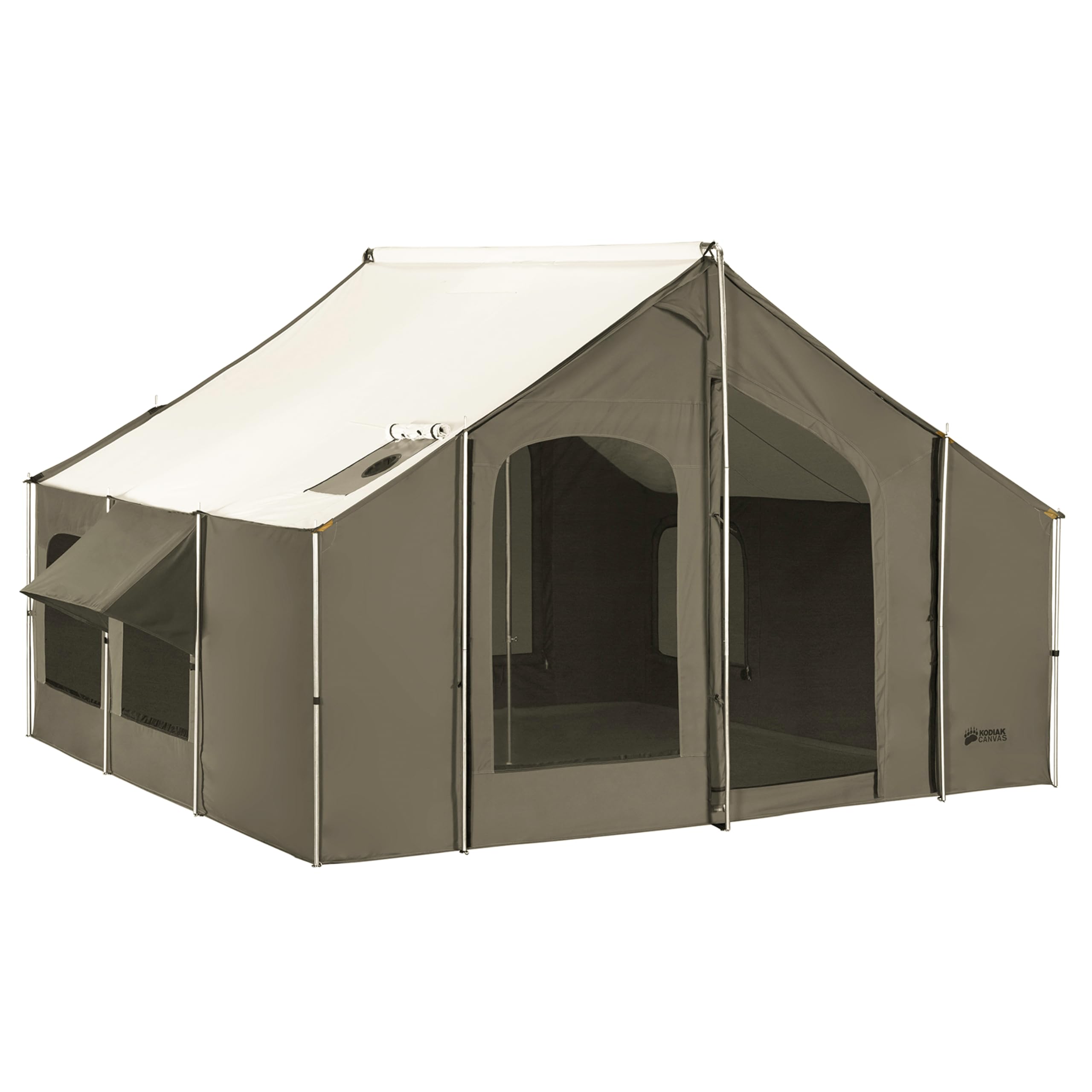
Vertical canvas walls, a steel frame, and a 5-inch jack built for a real stove.
This is the most traditional build on the list. A 12×12 ft cabin with 7.5 ft peak ceiling and vertical walls gives you stand-up, walk-around comfort, and floor area of 144 square feet — the largest footprint here. Hydra-Shield 100% cotton duck canvas is durable, watertight, and breathable, with a 13.5 oz vinyl sewn-in floor and welded seams underneath you.
The 5-inch stove jack fits a wood-burning stove sold separately, and the maker rates the tent for up to 8 people — or 4 when the stove is in use. Six large windows with no-see-um mesh and two vents open even in rain, so airflow doesn’t require a dry spell. A galvanized 1-inch steel tubing frame carries the wind and snow load, backed by stainless steel wire stake loops and 12-inch steel rod stakes.
Setup takes two adults, and the build quality is the entire story here — the shell gets described as outstanding, exceeding expectations, with sturdiness and durability both landing clean. Set it once at a basecamp and leave it standing.
The long-haul canvas answer: cotton duck that breathes, a steel frame that shrugs off snow, and 144 square feet of vertical-walled room make this the tent you keep for years.
Made for: a permanent or seasonal basecamp where weight and pack size don’t matter.
Not made for: one-person trips — it needs two adults and a vehicle to move it.
11. Coody Premium Inflatable Canvas Tent with Stove Jack
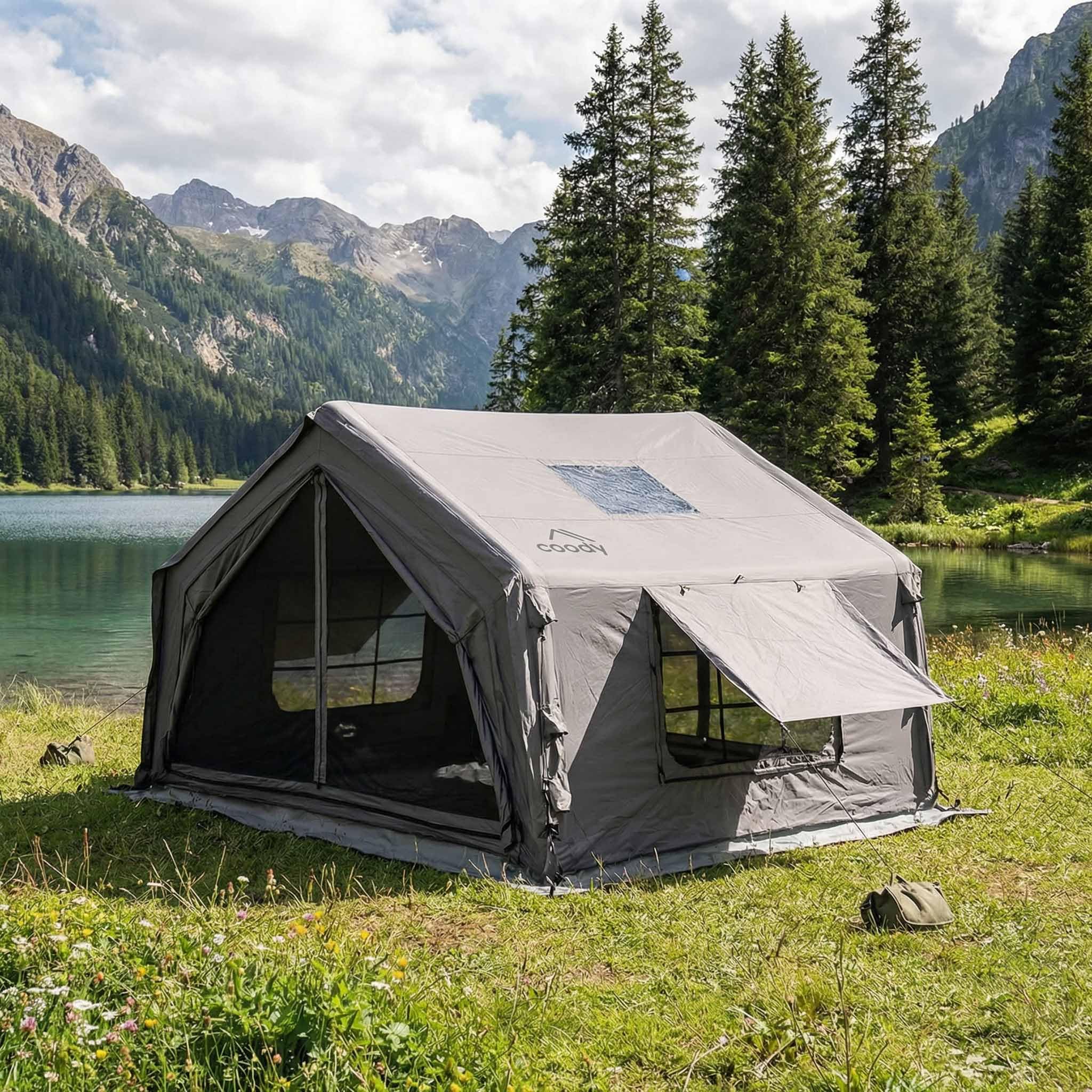
Breathable canvas wrapped around an air frame — six minutes to a standing cabin.
The shell is 210 gsm TC cotton canvas, a 65% polyester and 35% cotton blend that lets air move and helps regulate humidity inside. That’s the real difference from a synthetic shell: canvas breathes, so condensation has somewhere to go. The reinforced inflatable air beam frame sets up in about six minutes with the included hand pump, and the PVC air tubes hold a stable structure in wind and rain.
Interior area is 10 square meters (107 square feet) in a square cabin layout, rated for 2-4 people in sleeping bags. Full interior height is 2.04 m (80 inches), so most adults stand up straight. A 420D Oxford rainfly with PU3000 waterproof coating covers the top, and a stove jack accepts a wood stove for four-season use.
The maker rates this for camping above 0°C (32°F), so it’s a cold-weather tent but not an extreme-arctic one. Quality draws the strongest reaction in owner feedback, with setup speed close behind. It’s the priciest pick here, and it earns that with canvas fabric on an air frame rather than nylon on poles.
Where the premium lands: breathable cotton canvas is the whole pitch — no condensation drip, an 80-inch ceiling, and an air frame you inflate rather than thread.
The one for you if: you want canvas breathability without wrestling poles in the cold, and you camp down to freezing.
Not for you if: you push deep into sub-zero trips — the maker’s own rating tops out at 32°F.
Know the Specs
The stove jack and pipe angle
A stove jack is a fire-resistant port cut into the tent fabric so a stove pipe can exit. A roof jack gives a straight vertical pipe and strong draft, while a side-wall jack lets the pipe angle out when a branch or tarp blocks the top. The OneTigris TEGIMEN gives you both, which is why it works for hammock hangers. Always check the jack is cut from fire-resistant material and match the pipe diameter before you light anything.
Waterproof rating in millimeters
The rating measures how tall a column of water the fabric withstands before it pushes through. A 3000mm shell (like the OneTigris TEGIMEN and TIMBER RIDGE) handles steady rain, while a PU10000mm+ shell like the Naturehike Dune resists a much heavier column — useful when snow melts on the roof. Higher isn’t always better for a hot tent, though, because breathability keeps condensation down and heavy coatings can trap moisture.
Floor area versus sleeper count
The box count is optimistic. A stove and a cot each eat floor space, so look at the square footage instead. The Kodiak Canvas Cabin Lodge gives 144 square feet, the POMOLY Chalet 70 just 54 — same category, very different nights. For a stove, assume one person plus gear per comfortable berth, and check peak height if you want to stand while tending the fire.
Shell fabric and heat retention
Canvas is heavy, breathes, and holds warmth, which makes it the pick for drive-in winter camp. Ripstop nylon and polyester pack small and dry fast but shed heat quickly. On an air-beam tent, the frame replaces poles and saves setup time, while a pole frame trades that speed for rigidity. Match the shell to how you travel, not to how the tent looks on the box.
Common Questions
Can I run a wood stove inside a tent safely?
What size stove pipe fits the Kodiak Canvas Cabin Lodge jack?
Is a canvas tent better than nylon for a hot tent?
How long does setup take on an inflatable hot tent?
Will a stove jack leak rain when the stove is out?
Can I use a hot tent in summer without the stove?
How many people actually fit in a 4-person hot tent with a stove?
Does a stove jack work with a stove pipe angled out a side wall?
What is the coldest weather a hot tent can handle?
Can two people pitch a large canvas hot tent without help?
Should I use a floorless hot tent for a stove?
The Bottom Line
For most buyers, the tent with stove jack winner is the WHITEDUCK Regatta Canvas Bell Tent because breathable cotton canvas holds warmth, the fire-retardant jack runs a wood stove, and 132.67 square feet of floor with 2’7″ walls lets you stand and move around a lit stove. If you want stove heat over frozen ground without an underquilt, grab the OneTigris TEGIMEN — its twin jacks solve the hammock pipe-angle problem. And for a family base that separates the sleeping room from the stove room, the Night Cat 8-Person Instant Cabin is the one to reach for.
Here’s the nudge worth acting on: the Naturehike Dune carries a PU10000mm+ waterproof shell — the strongest rating in this whole lineup — on a 132.05 square-foot floor with a user-replaceable stove jack. If rain and melting snow are what keep you home, that’s the spec that ends the argument.
Whatever you pick, buy only after you’ve matched your stove pipe to the jack and your pipe angle to the site. Warmth comes from a clean draft and a breathable shell, and a misplaced jack turns a good night into a smoky one.
How we choose
We do not accept paid placement. Every pick is matched to a real buyer and a real use-case; we do not hands-on test units.
Sources
Specifications: manufacturer listings and product documentation. Review insights: verified customer reviews, as of November 2026. Pricing: not shown on this page (it changes often); check the current price via the retailer link.
As an Amazon Associate, Tactical Gear Guy earns from qualifying purchases. This does not affect which products we feature.