Specs are compiled from manufacturer listings and verified buyer reviews and can change over time — please confirm the key details on the product page before buying.
Buying a telephoto lens is really a mount question first and a glass question second. The best telephoto camera lens for you is the one that fits your camera body, reaches the distance you actually shoot at, and stays light enough that you will carry it on the walk. Get the mount wrong and no amount of optical quality saves you. Get the reach wrong and every bird, athlete, or aircraft stays a smudge in the corner of the frame.
This guide is built by comparing the manufacturers’ published specifications and the patterns across verified customer reviews, so you get each pick’s real strengths and trade-offs instead of marketing spin.
Below you will find eleven lenses sorted by what they are genuinely good at, from a 750 g walk-around zoom to a 200-600mm super telephoto built for field work. Every pick lists its mount, its reach, and the honest trade-off, so you can match one to your camera before you spend anything. The right telephoto camera lens turns distant subjects into frame-filling photographs.
Top Picks


How To Choose The Best Telephoto Camera Lens
Start with the camera you already own. Every lens here locks onto one specific mount, and that single fact narrows your list faster than any spec sheet. A Canon RF body takes RF glass only, a Nikon Z body takes Z glass, and Fujifilm bodies take X-mount lenses. Sony E-mount is the widest net, because both Sony and third-party makers like Tamron and Sigma build for it.
Once the mount is settled, the two numbers that decide your daily experience are focal length and maximum aperture. Focal length is the reach, written in millimeters. Aperture is the size of the opening the light passes through, written as an f-number, and a smaller f-number means a bigger opening that gathers more light and blurs backgrounds harder.
Match the reach to the distance you actually shoot
If your subjects sit in the 10 to 30 meter band, a 70-200mm or 100-400mm covers nearly everything. Step out to a wetland or a stadium and you want the long end to start at 200mm or beyond. The Sony FE 200-600mm and the two Fujinon zooms push past 400mm for a reason: birds and distant athletes simply need that stretch.
Crop-sensor bodies change the math in your favor. A 70-350mm lens on a Sony APS-C body frames like a 105-525mm, and a Fujinon 150-600mm frames like 229-914mm. You get more reach from a shorter, lighter tube, which is why crop-sensor shooters often get away with smaller glass.
Weigh aperture against weight before you commit
A constant f/2.8 zoom is the wedding and indoor-sports favorite, because it keeps the shutter speed up as the light drops. The price is mass: the Sigma 70-200mm f/2.8 sits at 1345 g. An f/5.6-6.3 zoom like the Canon RF 100-400mm weighs 750 g and costs far less reach-for-reach, but it struggles in dim light and leans hard on stabilization.
Decide how much stabilization you need
Optical stabilization means a group of elements inside the lens shifts to cancel your hand shake. Long lenses amplify every tremor, so at 400mm and beyond stabilization stops being a bonus and starts being a requirement. Nikon quotes up to 5.5 stops of compensation on the NIKKOR Z 100-400mm, and Fujifilm builds a 5-stop system into the XF100-400mm.
Check teleconverter support if you plan to grow
A teleconverter is a small magnifier that fits between lens and body and multiplies your reach. Only some lenses accept one. The Nikon NIKKOR Z 100-400mm takes the 1.4x and 2x Z converters, pushing 400mm out to 560mm or 800mm. If you think you will want more reach later, buy a lens that already lists converter compatibility.
Side-by-Side Comparison
| Model | Best For | Focal Length | Max Aperture | Weight | Amazon |
|---|---|---|---|---|---|
| Canon RF 100-400mm F5.6-8 IS USM★ Best Overall | Wildlife and aviation on a Canon R body | 100-400mm | f/5.6-8 | 750 g | Amazon |
| Sony E 70-350mm f/4.5-6.3 G OSSCompact Pick | Compact super-telephoto on Sony APS-C | 70-350mm (105-525mm equiv.) | f/4.5-6.3 | 22 oz | Amazon |
| Tamron 70-180mm F/2.8 Di III VC VXD G2Most Versatile | Fast f/2.8 portraits and indoor sport on Sony | 70-180mm | f/2.8 | 30.2 oz | Amazon |
| Tamron 18-300mm F/3.5-6.3 Di III-A VC VXD | One-lens travel kit on Sony E APS-C | 18-300mm | f/3.5-6.3 | 1.4 lb | Amazon |
| Canon EF-S 55-250mm f/4.0-5.6 IS II | First telephoto on a Canon APS-C DSLR | 55-250mm | f/4.0-5.6 | 1.3 lb | Amazon |
| Sigma 70-200mm F2.8 DG DN OS for Sony | Constant f/2.8 on Sony E or L-mount | 70-200mm | f/2.8 | 1345 g | Amazon |
| Nikon AF-S NIKKOR 70-200mm f/2.8E FL ED VR | Nikon DSLR event and sports work | 70-200mm | f/2.8 | 3.2 lb | Amazon |
| Sony FE 200-600mm f/5.6-6.3 G OSS | Birding and long-range wildlife on Sony | 200-600mm | f/5.6-6.3 | 4.7 lb | Amazon |
| Fujinon XF100-400mm F4.5-5.6 R LM OIS WR | Weather-sealed reach on Fujifilm X | 100-400mm (152-609mm equiv.) | f/4.5-5.6 | — | Amazon |
| Fujinon XF150-600mm F5.6-8 R LM OIS WR | Maximum Fujifilm reach for birding | 150-600mm (229-914mm equiv.) | f/5.6-8 | 1605 g (3.53 lb) | Amazon |
| Nikon NIKKOR Z 100-400mm VR S | Teleconverter-ready reach on Nikon Z | 100-400mm (150-600mm on DX) | f/4.5-5.6 | 3.2 lb | Amazon |
Detailed Reviews
1. Canon RF 100-400mm F5.6-8 IS USM
Our pick — 4.5+★ from 750+ verified ratings; the strongest balance of quality and price.
The walk-around telephoto that reaches 400mm and still lets you hike all afternoon.
Canon nailed the balance here. You get 100-400mm of reach in a body that weighs 750 g, and that combination is why it tops this list. Four hundred millimeters is enough to fill a frame with a heron or a passing jet, and the optical image stabilization — a moving lens group that fights your hand shake — is what makes hand-holding at that length realistic rather than a tripod-only exercise.
It only mounts on Canon RF bodies, so a Canon R-series mirrorless camera is a prerequisite. Mounted there, the lens autofocuses, and the wide-to-tele zoom means you can pull back to 100mm for a habitat shot and push to 400mm on the subject without swapping glass. Compare that to the Tamron 18-300mm, which spans 18-300 millimetres for all-in-one convenience but stops well short on the long end. If distant detail is the whole point, the Canon’s 400mm long end beats the Tamron’s 300mm.
The honest catch is light. The maximum aperture narrows to f/8 at 400mm, which is a small opening, so overcast mornings and shaded woodland force you onto higher ISO settings or slower shutter speeds. Stabilization helps with the latter, not the former. This is a fair-weather and daylight reach lens, and it is brilliant at exactly that.
What it gets right
- 100-400mm of reach in a 750 g body, light enough for long walks
- Optical image stabilization keeps hand-held 400mm frames sharp
- Autofocus and zoom in one tube, so no mid-shoot lens changes
Where it asks for patience
- f/5.6-8 aperture wants daylight; dim scenes push your ISO up
- RF mount only, so Canon DSLR and other-brand bodies are out
Point it at: Canon R shooters chasing wildlife, action, and aviation in good light who refuse to lug a heavy barrel.
Leave it on the shelf if: most of your shooting happens indoors or after dusk, where the f/8 long end bites.
2. Sony E 70-350mm f/4.5-6.3 G OSS
Twenty-two ounces that frames like a 525mm lens on a Sony crop body.
For an APS-C Sony body, this is the reach-to-weight ratio to beat. The 70-350mm range gives you a 5x super-telephoto that frames like 105-525mm in full-frame terms, so a distant subject fills the frame without a monster barrel. It weighs 22 oz, and that number is the whole argument: you can carry it on a full day of hiking and forget it is on the strap.
Sharpness holds across the frame, corner to corner, which is what the G badge on the barrel is promising. The XD linear motor drives autofocus quickly and quietly, so tracking a moving subject feels immediate rather than laggy. Optical SteadyShot — Sony’s in-lens stabilization — backs up the hand-held shooting that this focal length demands.
The trade-off is that this is APS-C glass. On a full-frame Sony body it will not cover the sensor, so it belongs on cameras like the a6000-series. Compared with the full-frame Sony FE 200-600mm, you give up the extreme long end and the internal zoom, and you gain a lens you will actually carry. For most crop-sensor shooters, trading the 200-600mm’s extreme long end for a lens you will actually carry is the right call.
The resolution story: corner-to-corner G-lens sharpness across the whole 70-350mm range, so you are not stopping down to rescue the edges.
The practical footnote: buy it for an E-mount APS-C body, because it is built for that sensor size and not for full-frame coverage.
Reach for this if: you shoot a Sony APS-C camera and want serious reach without a heavy bag.
Look elsewhere if: you are on full frame or need to go past roughly 525mm equivalent.
3. Tamron 70-180mm F/2.8 Di III VC VXD G2
Constant f/2.8 through the whole zoom, in a tube that stays under two pounds.
The aperture is the headline. A constant f/2.8 across 70-180mm means the same wide opening whether you are at the short or long end, so your exposure does not shift as you zoom and your backgrounds blur hard at any focal length. That matters for portraits, indoor sport, and any dim venue where you cannot add light. Tamron’s VC stabilization works alongside your camera’s sensor-shift system, and the VXD motor tracks moving subjects quickly.
Close focusing is unusually tight for this class. The minimum object distance is 0.3m (11.8in) at 70mm and 0.85m (33.5in) at 180mm, so you can pull in on a detail at the short end instead of backing off. At 1.9 pounds it undercuts the Sigma 70-200mm f/2.8 at 1345 g, which is the difference between a lens you take to a shoot and one you leave in the car.
Here is the catch worth weighing. It stops at 180mm, not 200mm, so you give up a sliver of reach versus the Sigma and Nikon 70-200mm options. For portraits and event work that gap rarely matters. For field sports at the far touchline, it can. The moisture-resistant construction and fluorine coating on the front element mean rain and fingerprints wipe away cleanly, which softens the sacrifice.
Value read: constant f/2.8 glass with stabilization, close focus, and a zoom lock switch, without the mass of the f/2.8 alternatives.
Best matched to: Sony full-frame shooters doing portraits, weddings, or indoor action who want f/2.8 speed in a lighter barrel.
Think twice if: your work lives at the long end and 20mm of extra reach decides the shot.
4. Tamron 18-300mm F/3.5-6.3 Di III-A VC VXD

Wide landscape to 300mm of telephoto, without changing a lens all day.
This is the one-lens answer for travel. Tamron builds it as the world’s first 16.6x all-in-one zoom for APS-C mirrorless, and the 18-300mm span means you cover a street scene and a distant mountain in the same outing. It is a compact 4.9 x 2.9 inches and weighs 21.9 ounces, so it slips into a small bag and stays there.
The VXD linear motor is the part that surprises people. It focuses fast and precisely, and the lens holds resolving power from center to corners across the range. A moisture-resistant build and a fluorine coating on the front element mean a drizzle or a dusty trail does not end the day. Owners talk about it as a semi-macro option too, because it focuses close enough to pull detail out of small subjects.
Where it gives ground is aperture. At the long end it narrows to f/6.3, so a shaded subject needs stabilization or a steady rest. Compared with a dedicated telephoto like the Sony 70-350mm, the extreme long end simply is not there. But the 18-300mm spans 18-300 millimetres in one tube, and the compromise is a reasonable toll for carrying one lens instead of three.
Why travelers like it
- 16.6x zoom covers wide landscape through 300mm telephoto
- VXD motor gives fast, precise autofocus and close focusing
- Moisture-resistant build with fluorine-coated front element
Where the compromise lands
- f/6.3 at the long end wants steady light or a rest
- APS-C Sony E mount only, so full-frame bodies are out
Ideal for: Sony APS-C travelers who want one lens for every scene and refuse to swap glass on the trail.
Not the pick if: you shoot distant birds and need past 300mm, where the dedicated super-telephotos take over.
5. Canon EF-S 55-250mm f/4.0-5.6 IS II

The first telephoto most Canon crop-body owners should own.
Nothing here costs less to get you into real telephoto reach. The 55-250mm range on a Canon APS-C body covers portraits, backyard wildlife, and school sports, and the lens weighs 1.3 pounds. That is the lightest tube on this list, and for a beginner it means the camera still hangs comfortably on a neck strap.
The optics are honest work for the class. The design uses 12 elements in 10 groups, including a UD glass element, which is the low-dispersion glass that reins in color fringing. Optical stabilization and autofocus both work as intended, and the small size pairs well with a starter body. Users report it working with the EOS 860D, so it slots into a Canon APS-C kit without drama.
Read the mount warning carefully. This is EF-S glass and it will not fit a full-frame DSLR, so it belongs on crop bodies only. The micro-motor focus is accurate but not fast or silent the way the newer linear motors are, and f/5.6 at the long end keeps you in daylight territory. For the novice who wants to learn telephoto technique before spending on serious glass, that is a fair trade.
Starter verdict: 12 elements in 10 groups with a UD element, stabilization, and autofocus at 1.3 pounds — the cheapest honest entry into Canon telephoto reach.
The caveat to note: EF-S glass and crop-body only, with a micro-motor focus that trails the newer linear motors on speed.
Right for you if: you own a Canon APS-C DSLR and want to try telephoto without stretching the budget.
Step past it if: you shoot full frame or fast action, which this mount and motor cannot serve.
6. Sigma 70-200mm F2.8 DG DN OS for Sony

Sports-line weather sealing wrapped around a constant f/2.8 zoom.
If your work happens outdoors and the forecast is unreliable, this is built for it. Sigma gives the 70-200mm a dust- and splash-resistant structure and the superior weather resistance of its Sports line, so a wet touchline or a misty morning does not send you running for cover. The f/2.8 aperture stays constant through the zoom, and the High-response Linear Actuator handles autofocus.
It covers 70-200 millimeters and autofocuses quickly enough that tracking a moving athlete stays reliable, with the kind of hit rate that keeps a sports shooter confident. Build quality feels solid in the hand. Owners describe it as tack-sharp with quick focus, and the feedback on its tracking during sports events is what you would hope for at this level.
The mass is the real conversation. At 1345 g it is a committed purchase, and the weight is the most-discussed gripe in the feedback. The offset is that the lens itself carries optical stabilization, so a heavy rig stays steady in the field. Compared with the Tamron 70-180mm at 1.9 pounds, you gain a full 200mm long end and the tank-like sealing, and you pay for it in shoulder fatigue by day’s end.
Field read: constant f/2.8, HLA autofocus, and drizzle-ready sealing — the outdoor sports and event workhorse for Sony E and L-mount bodies.
Pick it up when: you shoot outdoor sport or events and need weather sealing plus 200mm at f/2.8.
Weigh it first if: 1345 g on the strap all day is a deal you cannot make.
7. Nikon AF-S NIKKOR 70-200mm f/2.8E FL ED VR

The FX-format fixed f/2.8 zoom that Nikon DSLR shooters build a kit around.
For Nikon DSLR owners, this is a career lens. It holds f/2.8 across 70-200mm on an FX/35mm sensor, with a nine-blade diaphragm that keeps out-of-focus highlights round rather than polygonal. Focusing is fast enough that it lives in sports arenas and event halls, and the build is meant for years of use. It is 3.2 pounds, and that mass is the price of the constant aperture and the sealing.
Sharpness holds through the range, which is the whole point of the design. Owners talk about the FL and ED glass keeping detail crisp at both 70mm and 200mm, and the vibration reduction makes hand-held work at the long end more forgiving. The minimum focus distance sits at 3.6 feet (1.1 meter), so you can move in reasonably close on a subject when the shot calls for it.
Two things decide whether it fits you. First, it is a DSLR lens — it belongs on Nikon FX and DX bodies, not on the Z mirrorless line, which needs Z-mount glass such as the NIKKOR Z 100-400mm. Second, at 3.2 pounds it is over twice the weight of the Canon EF-S 55-250mm at 1.3 pounds, so a lighter body pairing will feel top-heavy. Neither is a flaw; both are mount-and-mass realities you should weigh before buying.
What sells it
- Constant f/2.8 through 70-200mm on FX/35mm bodies
- Nine-blade diaphragm for clean background blur
- Fast focus suited to arenas and event work
What to plan around
- 3.2 pounds is heavy for all-day carry
- DSLR mount only, so Z-body owners need a different lens
Built for: Nikon DSLR shooters who want one fixed-aperture zoom that handles portraits, sport, and events.
Not for: Nikon Z mirrorless owners, who need Z-mount glass instead.
8. Sony FE 200-600mm f/5.6-6.3 G OSS

Six hundred millimeters of reach that never changes length as you zoom.
Birds, big game, and distant action live beyond most lenses. This lens starts where others stop, covering 200-600mm so a subject across a field still fills your frame. The internal zoom keeps the barrel the same length as you crank through the range, which matters when you are balancing the rig on a monopod and do not want the balance shifting mid-shot.
Sony fills the optical path with serious glass. Five ED (extra-low dispersion) elements reduce flare and ghosting, an aspherical element cuts spherical aberration, and Nano AR coating fights reflections. A Direct Drive Supersonic Wave Motor focuses fast and quietly, and optical stabilization backs up hand-held work. The result is crisp resolution through the whole zoom range, which is exactly what bird photography demands.
The honest bill is weight. At 4.7 pounds, this is the heaviest lens in the full-frame Sony lineup here, and the mass is the trade for that reach. It costs more reach-for-reach than the Sony 70-350mm, but that lens stops around 525mm equivalent on crop. For a close, sharp bird frame at long range on Sony full frame, the 200-600mm’s reach is what delivers it.
The reach verdict: 200-600mm with internal zoom and Nano AR coating — a wildlife specialist’s lens first and a general zoom last.
The weight bill: 4.7 pounds means a monopod and a serious strap are part of the kit.
Your lens if: you shoot birds and long-range wildlife on Sony full frame and want maximum reach.
Only if the plan includes support: a monopod or tripod realistically belongs with this 4.7-pound barrel.
9. Fujinon XF100-400mm F4.5-5.6 R LM OIS WR
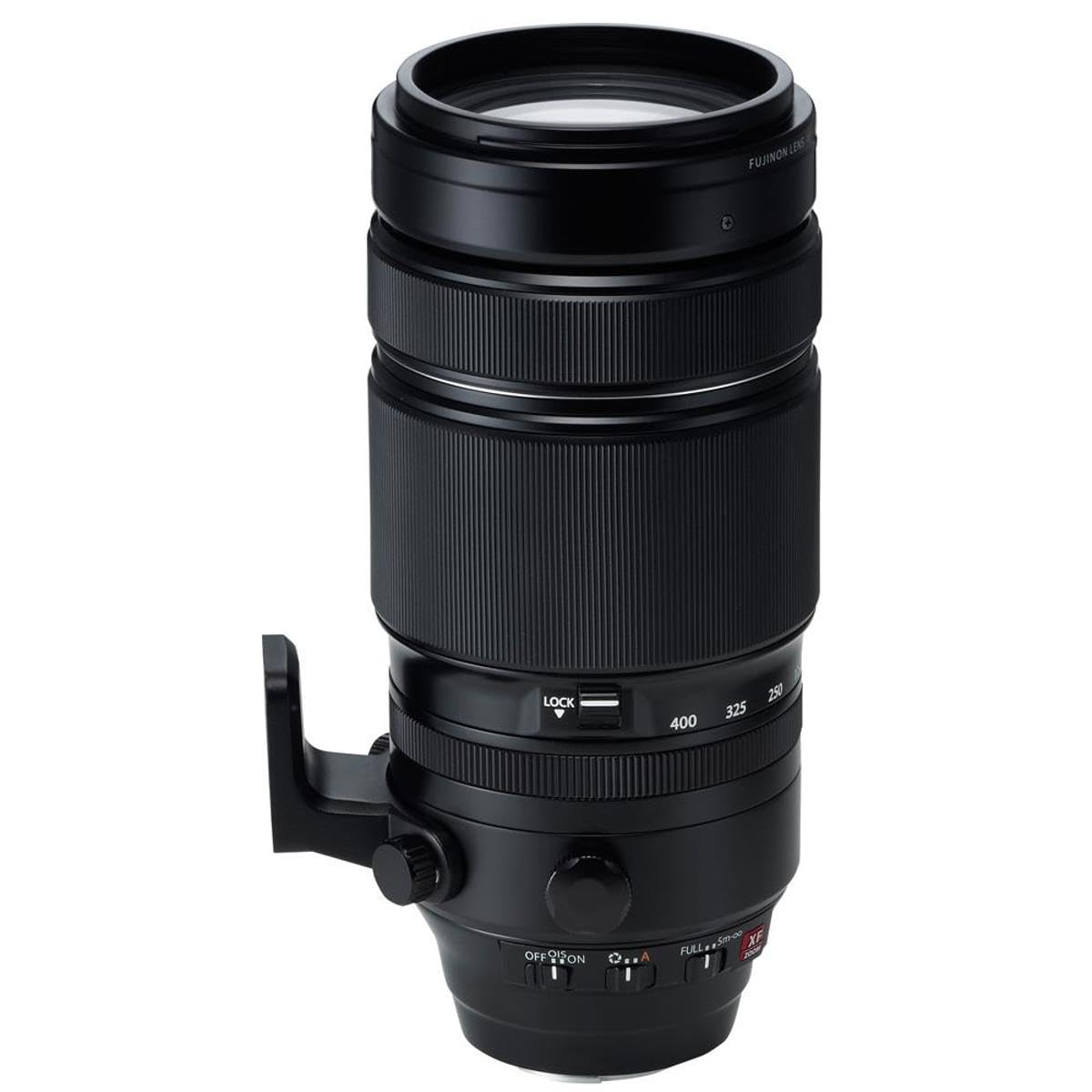
A sealed, five-stop telephoto built to keep shooting when the weather turns.
Fuji shooters get a lens designed for the outdoors. It uses 21 elements in 14 groups, including 5 extra-low-dispersion elements and one super extra-low-dispersion element, which is the recipe for sharp prints with controlled color fringing. The 100-400mm range frames like 152-609mm in full-frame terms, so you cover distant subjects on an X body without an enormous barrel.
The stabilization is the standout, a 5-stop system rated to hold steady at long focal lengths. The lens is water and dust resistant and rated to operate in temperatures as low as 14 degrees F (-10 degrees C), so a cold, damp morning on the marsh is workable. A removable tripod mount lets you swap between hand-held and supported shooting, and the front filter thread takes 77mm filters.
The recurring note in owner feedback is the heft. It is described as heavy against the lighter Fujinon pair, and the size is a matter of taste — some find it compact, some do not. That said, at 100-400mm with a 5-stop stabilizer and full weather sealing, the mass is the price of the capability. Five extra-low-dispersion elements and one super ED element are what you are paying for, and the heft is their cost.
Go for it if: you shoot Fujifilm X and work outdoors in rain, cold, or dusty conditions.
Handle it before you commit: the weather-sealed glass earns the weight, but lighter Fujinon options exist if you carry all day.
10. Fujinon XF150-600mm F5.6-8 R LM OIS WR

Nine hundred fourteen millimeters of equivalent reach, built for birds.
Fujifilm’s long-reach specialist covers 150-600mm, which frames like 229-914mm on an X body, so a bird on a far branch is suddenly close. Add a 1.4x teleconverter and it reaches 320-1,280mm; add the 2x and it reaches 457-1,824mm, though the aperture narrows to f/8-11 and f/11-16 respectively. That is a lot of reach in one tube, and it stays reasonable at 1605 g (3.53 lb).
The optical build is designed for detail. There are 24 elements in 17 groups, including 4 Super ED and 3 ED elements, which handles color control over the long zoom range. Users praise its autofocus speed and describe it as excellent for birding and wildlife, with one noting it stays sharp up to 500mm and another getting shots of eagles over 100 yards away. It is a genuine long-reach tool.
The honest limit is the aperture. At the long end it sits at f/8, and with converters it gets slower, so early mornings and dusk need stabilization and a steady rest. Compared with the shorter XF100-400mm, you swap a brighter aperture and lighter barrel for real reach. If your subjects keep their distance, that is the right trade. If you shoot in low light, the 100-400mm may serve you better.
Reach math: 150-600mm frames like 229-914mm, and converters push it well past 1,000mm equivalent.
The trade: f/5.6-8 wants good light, and 1605 g is a commitment at the long end.
Choose this: for Fujifilm birding and wildlife at distance, where equivalent reach past 900mm is the goal.
Not for you: if the bulk and the f/8 long end are more than your light or your shoulders allow.
11. Nikon NIKKOR Z 100-400mm VR S

The Nikon Z zoom that starts at 400mm and keeps growing with converters.
Start with the reach and how it grows. On an FX-format Z camera the lens covers 100-400mm, and on a DX-format body it frames 150-600mm when mounted, so a crop sensor gets more stretch from the same glass. Add the 1.4x Z converter and it reaches 560mm; add the 2x and it reaches 800mm. It accepts both without losing focus points. That growth path is the reason to choose it.
Stabilization is rated up to 5.5 stops of compensation, achieved in Normal mode when mounted on a full-frame sensor and zoomed to the long end, so hand-held work at 400mm is viable. Two high-speed STM stepping motors move in near silence, which helps with close focusing and edge-to-edge sharpness, and the fluorine coating on the front element wipes clean after a wet outing. Users report it working well in cold and wet conditions and handling birds-in-flight subjects capably.
What it asks of you is weight and mount. At 3.2 pounds it is a serious barrel on the body, and it is built for the Nikon Z series, so DSLR shooters need the F-mount option. The 100-400mm range is versatile but does not match the pure reach of the 200-600mm super-telephotos. For a Z shooter who wants one sealed zoom that can grow with converters, the trade is right.
The case for it
- 1.4x and 2x converter support pushes reach to 560mm or 800mm
- Up to 5.5 stops of vibration reduction for hand-held shooting
- Silent STM motors and fluorine-coated front element
The case against
- 3.2 pounds is heavy for a full-day carry
- Z-mount only, so DSLR bodies need a different lens
The one to buy if: you shoot Nikon Z and want sealed reach that grows to 800mm with converters.
Look away if: you need pure long-range reach from the start, where a 200-600mm starts ahead.
Know the Specs
Focal Length and Reach
Focal length is the number in millimeters, and it describes how much the lens magnifies distant subjects. A 70-200mm covers portraits and nearby action, while a 200-600mm pulls far-away birds and athletes into the frame. The bigger the first number, the wider the view; the bigger the second, the further your subject can be and still fill the sensor.
Maximum Aperture and Light
Aperture is the size of the opening, written as an f-number like f/2.8 or f/6.3. A smaller number means a wider opening that lets in more light and blurs the background harder. Constant f/2.8 zooms stay bright through the range, while a sliding f/5.6-6.3 narrows as you zoom, which can force higher ISO settings in dim light.
Lens Mount Compatibility
The mount is the physical fitting that connects lens to body, and each brand and format has its own. Canon RF lenses fit RF bodies only, Nikon Z lenses fit Z bodies only, and Fujinon X lenses fit Fujifilm X bodies. Sony E mount is the widest net, because Sony, Tamron, and Sigma all build for it. Always check the mount beforeanything else.
Image Stabilization and Hand Holding
Optical stabilization is a group of elements inside the lens that shifts to cancel your hand shake. At 200mm and beyond, every tremor is magnified, so stabilization turns shaky frames into sharp ones at slower shutter speeds. Fujifilm rates the XF100-400mm at 5 stops, and Nikon rates the NIKKOR Z 100-400mm at up to 5.5 stops of compensation. It helps with motion, but not with a subject that is itself moving.
Teleconverters and Reach Growth
A teleconverter is a small magnifier that fits between lens and body and multiplies focal length. Only lenses built to accept one will mount it, and it always costs you light because the aperture narrows. The Nikon NIKKOR Z 100-400mm takes the 1.4x and 2x Z converters, reaching 560mm or 800mm, and the Fujinon XF150-600mm reaches 320-1,280mm or 457-1,824mm with its converters.
Weight and Carry Reality
Long glass gets heavy fast, and weight decides whether the lens leaves the house. A 750 g lens like the Canon RF 100-400mm rides on a strap all day; a 4.7 pound super-telephoto like the Sony FE 200-600mm expects a monopod. Match the mass to how you actually shoot: a 750 g zoom rides a neck strap, while a 4.7 lb super-telephoto wants a monopod.
Weather Sealing and Build
Sealing means the barrel resists moisture and dust, which matters for field work in rain or grit. The Sigma 70-200mm carries a dust- and splash-resistant structure, the Fujinon XF100-400mm is water and dust resistant and rated down to 14 degrees F, and the Nikon NIKKOR Z 100-400mm adds a fluorine coating that wipes clean. For outdoor shooters, sealing is the difference between shooting through a drizzle and packing up at the first drop.
Common Questions
Will a Canon EF-S 55-250mm fit my full-frame Canon DSLR?
What is the difference between a 70-200mm and a 200-600mm lens?
Can I use a teleconverter on every telephoto lens?
Does an f/2.8 lens beat an f/5.6-6.3 lens for indoor sports?
How much reach does a crop-sensor body add to a telephoto lens?
Do I need image stabilization at 400mm?
Is a 100-400mm lens good for wildlife photography?
Will a Fujinon X lens fit a Sony E-mount camera?
What is internal zoom and why does it matter?
Which telephoto lens is the lightest to carry all day?
The Bottom Line
For most shooters, the telephoto camera lens winner is the Canon RF 100-400mm F5.6-8 IS USM because it pairs 100-400mm of reach with a 750 g body and optical stabilization, which keeps it on your camera all day instead of in the bag. If you want a constant f/2.8 opening for portraits and dim venues, the Tamron 70-180mm F/2.8 Di III VC VXD G2 delivers it in a barrel that stays under two pounds. And when the subject will simply not come close, the Sony FE 200-600mm f/5.6-6.3 G OSS carries you out past 500mm with an internal zoom that holds its balance.
One final nudge before you buy: settle the mount first, then the reach, then the aperture, because every pick here is a strong lens that only works when it fits the body you actually own. The Canon RF 100-400mm’s 4.5+ star owner rating confirms that 400mm of reach at 750 g is the combination most buyers end up valuing most.
How we choose
We do not accept paid placement. Every pick is matched to a real buyer and a real use-case; we do not hands-on test units.
Sources
Specifications: manufacturer listings and product documentation. Review insights: verified customer reviews, as of November 2026. Pricing: not shown on this page (it changes often); check the current price via the retailer link.
As an Amazon Associate, Tactical Gear Guy earns from qualifying purchases. This does not affect which products we feature.