Specs are compiled from manufacturer listings and verified buyer reviews and can change over time — please confirm the key details on the product page before buying.
If your small office phone system drops calls, echoes on speakerphone, or needs a manual to transfer a caller, the fix is not more features. The fix is matching the right line count and handset style to how your team actually works. A two-person shop with a reception desk needs a corded base plus one cordless handset. A five-desk office with a front counter needs multi-line conferencing and internal extension dialing. Match the line count and handset style to your desk count, and the rest of the spec sheet matters far less.
This guide is built by comparing the manufacturers’ published specifications and the patterns across verified customer reviews, so you get each pick’s real strengths and trade-offs instead of marketing spin.
Below you will find nine real systems sorted by how they handle line count, handset range, and setup complexity, with the honest trade-offs spelled out for each one. My goal is to match you to a small office phone system by line count and handset style, not by the longest feature list.
Top Picks


How To Choose The Best Telephone Systems for Small Office
The single decision that filters this whole category is whether your office already has a VoIP provider (a service that sends calls over your internet connection) or a traditional phone line coming out of the wall. A VoIP desk phone will not work without a PBX or hosted service behind it. A landline system plugs into the jack and rings. Choose the wrong one and the phone either will not register or will not ring, no matter how many features it lists.
Line count versus SIP account count
A line is a phone number your office answers. A SIP account is the login credential the phone uses to register with your VoIP provider. One phone can hold several SIP accounts while supporting even more lines. If your team shares two numbers but needs four people on handsets, you need a system with enough handsets first and enough lines second.
Corded base or all-cordless
A corded base station stays powered and reachable during a power outage if your line carries power. Cordless handsets give you range — the AT&T TL86103 lists up to 1,000 feet of coverage — but they need charging cradles and battery replacements over time. Most small offices do best with one corded desk unit at reception and cordless handsets for everyone who walks around.
Expansion headroom
Buy for the desk count you will have in two years, not today. Several systems here expand to ten or more handsets, which means you add a handset instead of replacing the whole base when you hire. Check the compatible handset model number before you commit — some bases only accept specific add-on units.
Answering, paging, and internal dialing
An auto-attendant answers and routes calls without a receptionist. Intercom and paging let one desk reach another without tying up an outside line. These are the features that separate a business phone from a home phone, so decide which ones your front desk will actually use before you compare spec sheets.
Side-by-Side Comparison
| Model | Best For | Lines | SIP Accounts | Connection | Amazon |
|---|---|---|---|---|---|
| Grandstream GXP2135★ Best Overall | Budget VoIP desk phone | 8 | 4 | Gigabit Ethernet with PoE | Amazon |
| Grandstream GXP2170Most Lines | Busy reception desk | 12 | 6 | Dual Gigabit with PoE | Amazon |
| VTech CM18445Easiest Landline | Four-line landline office | 4 | — | Landline corded base + DECT | Amazon |
| AT&T TL86103 | Home office with cell pairing | 2 | — | Landline + Bluetooth cell | Amazon |
| Yealink W73P | Warehouse and roaming staff | Up to 10 handsets | 10 | DECT cordless VoIP | Amazon |
| VTech IS8251-3 | Three-handset home office | Virtual 2-line | — | Landline + Bluetooth cell | Amazon |
| Yealink SIP-T54W | Manager with heavy call load | — | — | Bluetooth + Wi-Fi | Amazon |
| Panasonic KX-TGW420B | Growing four-line office | 4 | — | Landline corded base + DECT | Amazon |
| AT&T TL88102 | Multi-handset coverage | 2 | — | DECT 6.0 landline | Amazon |
Detailed Reviews
1. Grandstream GXP2135 IP Phone | 8 Lines, 4 SIP Accounts
Our pick — 4.5+★ from 250+ verified ratings; the strongest balance of quality and price.
Eight lines and four SIP logins on a desk phone that punches well past its tier.
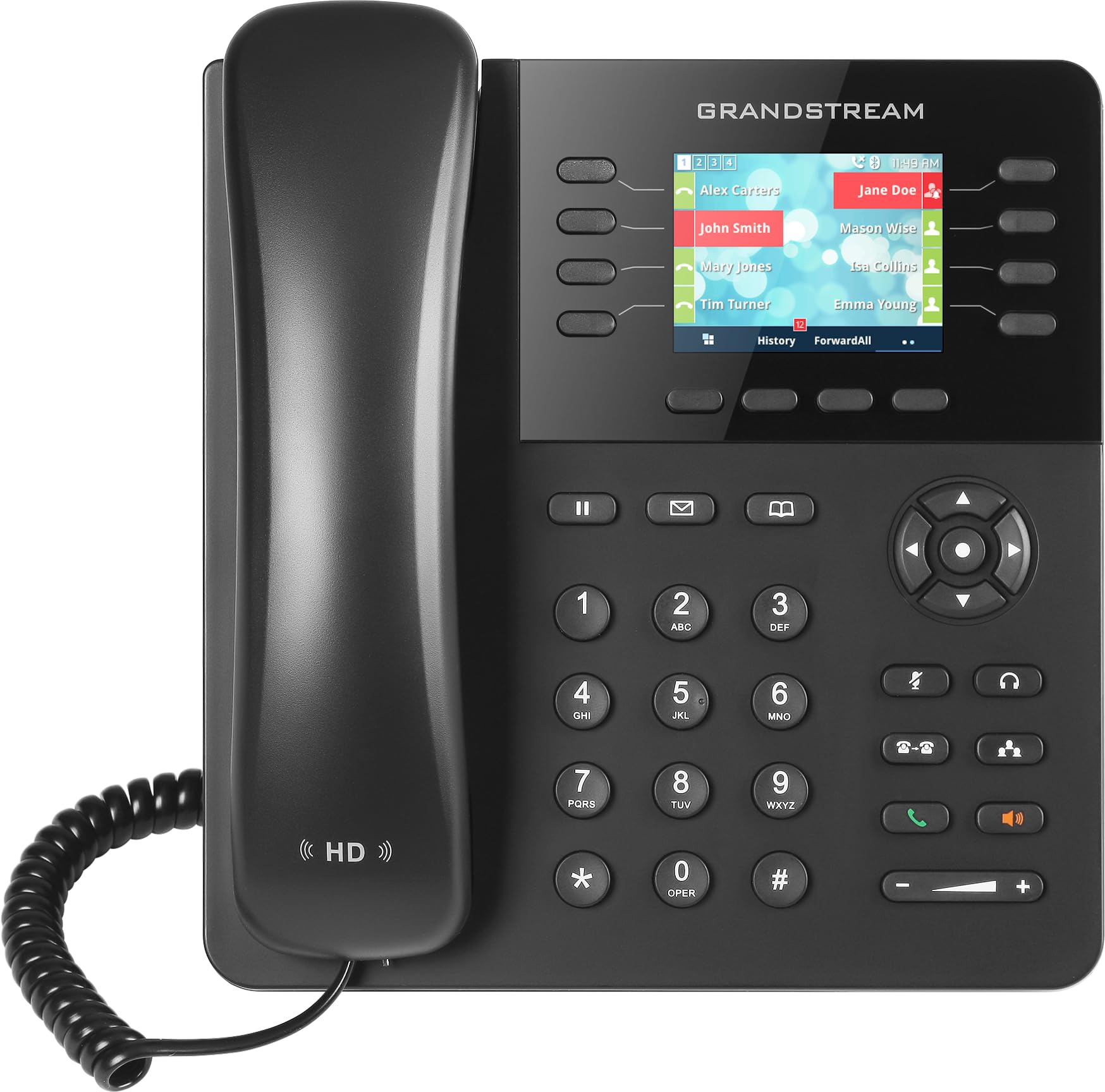
For a small office that already runs a VoIP provider, this desk phone covers the most ground without asking you to think hard. It handles 8 lines and 4 SIP accounts (SIP is the standard your VoIP provider uses to connect calls). That means four separate registrations can live on one phone while staff answer across eight lines. The 32 digitally programmable BLF/speed-dial keys (BLF means busy lamp field — a light that shows if a colleague is on a call) are the real estate that matters at a front desk. Each key lights up to show whether a colleague is on a call, so you can see who is free before you transfer.
Under the hood sits a 2.8-inch color display. Dual switched auto-sensing Gigabit Ethernet ports give you gigabit speed on both the wall side and the desk side, so a PC can chain through the phone. Built-in PoE (Power over Ethernet — the network cable carries both data and electricity, so no wall adapter is needed) keeps your desk free of one more plug. Built-in Bluetooth lets you pair a headset or sync contact books and calendars from a mobile device. The full-duplex speakerphone means both people can talk at once without one side getting cut off.
What keeps this at the top is its reliability record: reviewers report these units staying in service for years. The phone-quality and functionality notes in the review pages are overwhelmingly positive. One common thread is how long these units stay in service. An occasional screen fade after a year of use is the recurring gripe, and it is the kind of thing that shows up on a single unit rather than an entire batch. Setup through the web dashboard is quick; doing it on the handset itself takes more patience. If you need six SIP accounts rather than four, size up to the GXP2170 below.
Where it earns its keep
- 8 lines and 4 SIP accounts cover a multi-desk office on one device
- 32 programmable BLF keys give the front desk live extension status at a glance
- Dual Gigabit ports with built-in PoE cut cable clutter at each desk
- Bluetooth syncing for headsets, contact books, and calendar data
Where it asks for patience
- On-phone menus are slower than the web dashboard for setting up features
- The 2.8-inch screen is small and takes getting used to for reading caller details
- The ringer options are limited, which shows up as a recurring nit
Reach for this one if: your office already has a SIP provider and you want a do-everything desk phone without paying premium-tier rates — the pick the crowd settles on, holding 4.5+ stars across 280+ ratings.
Look elsewhere if: you need six SIP accounts instead of four, or a bigger screen for reading caller information across a busy reception desk.
2. Grandstream GXP2170 IP Phone | 12 Lines, 6 SIP Accounts
Twelve lines and 48 on-screen keys — the reception desk phone that tracks an entire floor.
Where the GXP2135 stops at eight lines, this one carries 12 lines and 6 SIP accounts — 12 lines versus 2 on the AT&T TL86103, a gap you feel the moment your team has more than two numbers. The 48 on-screen digitally customizable BLF/speed-dial keys outnumber the GXP2135’s 32 by 50%, so a switchboard operator can watch more extensions light up on one panel. Expand it with up to four GXP2200EXT modules and you reach up to 160 contacts on physical keys.
The screen is the other tell: a 4.3-inch (480×272) color LCD that shows caller details and key labels clearly enough to read from across a desk. Dual Gigabit ports and integrated PoE mean one cable does data and power. Five-way voice conferencing handles a client call with three internal colleagues and no separate bridge. Alloy steel in the enclosure gives it a solid feel in the hand that plastic desk phones do not have.
The honest wrinkle is setup and long-term stability. Most buyers get it running quickly against a FreePBX server or Grandstream UCM appliance (both are phone-system software that manages your calls). But there is a steady undercurrent of units that freeze and need a reboot after a few weeks, and a few cases where the microphone drops out over time. The recurring gripes are worth knowing rather than fearing — 4.0+ stars across 430+ ratings says the vast majority are happy. If you are handling the IT for a ten-desk office and need the biggest key panel on the market, this is the phone you build the front desk around.
Why the key count matters: 48 programmable keys plus four expansion modules (add-on key panels) means a receptionist can route calls across an entire floor without touching a menu. No cordless system here gives you that many live extension lights on one panel.
The trade-off to know: expect a learning curve on first configuration, and keep the reboot ritual in your back pocket for occasional freeze-ups.
Built for: an office with a dedicated receptionist who needs line and extension visibility across 12 lines and dozens of colleagues on one key panel.
Not the fit for: a two-person shop — the line count and key array are more than you will ever program, and a simpler desk phone will cost less and confuse fewer people.
3. VTech CM18445 Main Console
Four landline lines, internal extension dialing, and a three-way conference — no VoIP account required.
If your office has phone jacks in the wall and you want a key system without adding a PBX, this is the straightforward answer. It handles 4 lines and adds extension dialing, paging, intercom, and an auto-attendant — the full set of features that turns four desk phones into a small phone network. Setup is the part owners single out most: the box arrives and the system comes up working, with a straightforward interface for assigning a different extension to each handset.
At 2 pounds and 13 x 10 x 0.1 inches in the listing, the console is light enough to sit on any desk without needing reinforcement. It takes add-on CM18245 handsets, so a growing office adds extensions without replacing the base. Three-way conferencing covers a quick client-and-colleague call, and the digital answering system picks up when nobody is at the desk.
Here is the catch that matters most for a business: this is a landline system, and it does not work with business telephone provider services — you need a residential-style line for it to ring. The sound quality on the console receiver is also a recurring mixed report, with the person on the other end sometimes struggling to hear. The dial tone and mute behavior draw split reactions, but the silence on mute is a feature many actually prefer. For a small office with wall jacks that wants extension dialing, paging, and an auto-attendant without configuring VoIP, this is the practical pick.
The best match: an office with existing landline jacks that wants extension dialing, paging, and an auto-attendant without touching VoIP configuration.
Think twice if: you are on a business telephone provider service — this system needs a residential line to function.
4. AT&T TL86103 2-Line Corded/Cordless Phone System

Pair two cell phones and two landlines on one system — the hybrid desk for a hybrid schedule.
A small office without a full phone setup can get surprisingly far with this. It connects up to 2 cell phones and 2 landlines simultaneously over a Bluetooth link, and the base is built to download up to 6,000 cellular phonebook entries so a call from a client pops up by name. With up to 1,000 feet of coverage, one cordless handset walks the whole floor and then some. That range number is the straightforwardly bigger one on this list.
The corded base has a backlit display, speakerphone, and a big-button keypad, and its line-power mode keeps the corded handset working during a power outage as long as the line carries power. Two USB ports on the base charge two phones at once — one fewer cable to lose. The digital answering system runs two separate mailboxes at up to 22 minutes of recording each, which is a clean way to keep client messages apart from everything else.
What needs sizing honestly is the long-run story. The cordless handset batteries are the weak link — a fair share of units are reported to quit making calls within a couple of years, and handset button layout draws occasional gripes. Sound quality splits too: the landline and cell link earn praise, while speaker calls can pick up static. At 2 lines, this is also the smallest system on the list, so a four-desk office should look at the VTech CM18445 instead. For a one-room office that wants two cell phones and two landlines answered from one desk, this is the hybrid to get.
What makes it different: the Bluetooth cell link turns a mobile line into a desk phone with a real handset — no more taking sales calls on a smartphone held between your ear and shoulder.
The limit to plan for: cordless battery packs are the wear item here, so budget for replacing them rather than replacing the whole system.
Pick this up if: a home office, a side business, or a small front desk needs a landline and a cell phone answering calls from the same base station.
skip it if: your office runs more than two landlines — you will run out of line capacity before you run out of desks.
5. Yealink W73P DECT Cordless IP Phone System

A cordless VoIP handset that holds ten SIP accounts and runs 35 hours per charge.
This is the phone for the office where people do not sit still. The W73P base station registers up to 10 DECT cordless handsets (DECT is a wireless standard for voice) and up to 10 SIP accounts. That is 10 SIP accounts versus 4 on the Grandstream GXP2135, which is enough to give every desk and every shared number its own registration. The single handset charges in a cradle and delivers up to 35-hour talk time and up to 400-hour standby time in ideal conditions. So a warehouse walker can go a full shift and more without a charge top-up.
Range is the headline. DECT 6.0 cordless signal carries through shelving and walls, and the phone is reported to hold a clear connection deep into a warehouse filled with metal racking. The 1.8-inch 128 x 160 TFT color screen is small but the interface is built for quick dialing rather than reading menus. Opus audio and the noise reduction plus FNR (Flexible Noise Reduction — a processing layer that cuts background noise from a busy room) keep the voice side clean. Up to 20 simultaneous calls means the base station can carry the whole office’s concurrent traffic, not just one conversation at a time.
This is a niche pick and it knows it. It requires a SIP provider and a base station, so it will not plug into a wall jack and just work — think RingCentral, 3CX, Zoom Phone, or the like. The handset count is generous but the base takes only one handset in the box, so a multi-desk office buys additional W73H units. For a small team on a hosted VoIP platform whose staff walk the floor all day, the 35-hour handset battery justifies the base-station setup.
The reasons to pick it
- 10 SIP accounts and 10 DECT handsets on a single base station
- 35-hour talk time and 400-hour standby in ideal conditions
- Opus audio, noise reduction, and FNR processing for clean speech
- Handles up to 20 simultaneous calls across the office
What you give up
- Requires a VoIP provider and base-station configuration
- Ships with one handset, so extra desks need additional W73H units
- The 1.8-inch display is small for reading detailed caller information
The right call for: a hosted-VoIP office where people walk the floor, the stockroom, or the shop instead of sitting at a desk.
Wrong call if: you want a phone that plugs into a phone jack — this one needs a SIP platform behind it.
6. VTech IS8251-3 Cordless Phone
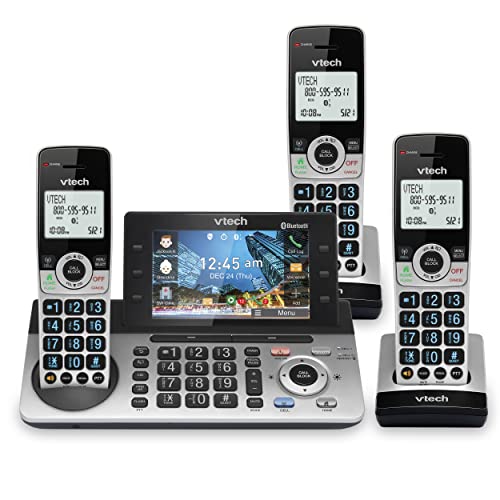
Three handsets, a 5-inch color base display, and robo-call blocking that works from the first ring.
The screen is the whole pitch here: a 5-inch color base LCD that shows a caller’s picture, name, and push-to-dial number in big icons. For the office manager juggling calls at a counter, that is a real upgrade over a 2-inch display. The base runs a virtual 2-line setup that merges a landline with either two cell phones or one cell phone and a Bluetooth headset — so one desk handles the landline plus two mobile lines without juggling handsets. Three cordless handsets are in the box, each with its own charging cradle, so the whole office is up the moment you unpack it.
Programmable short-cut keys jump straight to the functions you use most, one-touch callback pulls a number from a message or the call history, and a timer function helps with tasks split across the day. The Smart Call Blocker stops robocalls on the landline before the first ring — no setup ritual, no allow-list building. The digital answering system records up to 40 minutes of messages and shows caller info for each one in the 5-inch display, so you scan the list and decide who to call back first. Three-way conferencing covers small client calls.
What needs naming is the business-phone fit. The ringtone is loud and does not lower much, which is great for a home but potentially annoying in a shared office. And the unit moves to voicemail after three rings even when it is set to six, which is a quirk a few buyers flag. Echo on speaker calls and hard-to-delete messages show up in the mixed reports. For a home-based business or a converted-home office where the phone is on a desk and there are only two or three people, those are small costs against real call-screening value.
Where the size shows up: the 5-inch base display is the feature most buyers single out — caller photos and names visible across the room, not squinted at with a handset pressed to your ear.
The genuine caveat: this is a home-office system dressed for business, so a loud ringtone and a fixed voicemail ring count are the two things to accept going in.
Good fit for: a home-based business or small converted-home office that wants a large caller-ID display, three handsets, and robo-call blocking without any VoIP setup.
Not for: an open-plan office that needs quiet rings and configurable voicemail timing — this one is loud and fixed.
7. Yealink SIP-T54W Landline Phone, Classic Gray

A manager’s desk phone that walks onto Wi-Fi and Bluetooth — no Ethernet drop required.
The unusual part is what it leaves out: this phone has built-in Wi-Fi and Bluetooth, so it can register on a VoIP system without a network cable running across the office. For a manager or a small-office owner whose desk is not near a wall jack, that is a real shortcut. It is built for moderate call loads — the ergonomic design with adjustable display angles the phone toward the user, and Bluetooth pairs a wireless headset or the phone’s own mobile link. A 3-way conference covers a quick three-person check-in.
On the software side, owners get good results with hosted platforms. Nextiva and Zoom VoIP both show up in the working reports, and the phone answers a Zoom call with the same setup effort as a standard desktop phone. Sound quality on the handset reads clean. The phone is certified to CE, FC, and RoHS standards (the compliance marks for Europe, the US, and hazardous-substance limits). That is the check you want before ordering a batch for an office rollout.
The one to plan around: this phone does not ship with a power cord in every package. Power over Ethernet — a network cable that carries electricity — removes the need for one, but if your switch does not supply it, you will need to source a power supply. Accessory gaps and intermittent network failures are the more candid complaints in circulation, but the bulk of reports have it working reliably once connected. Configuring it against a hosted provider is quick; getting a password-reset flow on a used or re-provisioned unit is the part that occasionally snags.
Go here if: your desk lacks an Ethernet run and you want a VoIP phone that connects over Wi-Fi to a hosted provider like Nextiva or Zoom.
Confirm first: that your network switch supplies PoE or that a power adapter is included, or you will be buying the power side separately.
8. Panasonic KX-TGW420B 4-Line Corded Base Office Phone System

A four-line corded base with a digital receptionist and room to add nine more desks.
The growth story is the reason to look. This base handles 4 lines and expands wirelessly to up to 9 additional corded desk units or cordless handsets — the compatible KX-TGWA40B corded phone and KX-TGWA41B cordless handset — for a total of 10 phones on one system. No cabling between desks, so you grow one station at a time as you hire. The built-in Digital Receptionist answers incoming calls and routes them to the right extension, which covers a small office that cannot justify a full-time receptionist.
DECT 6.0 signal keeps call clarity across separate rooms and out into an adjoining area, which is the standard for business cordless phones and the reason it holds up in a walled office. The feature set goes deeper than the line count suggests: 30 speed-dial numbers, 6-way conferencing, 2-way recording, intercom, music on hold, and a digital answering system with up to 200 minutes of message storage. The 200-minute mailbox is a serious storage figure — that is weeks of missed calls kept on the device, not hours.
The honest picture here is the least settled on this list, and buyers should know it. Reports on button reliability are mixed, with a few base units ending up with unresponsive buttons after a short stretch of use, and the redial and conference flows take some figuring out. The ring volume runs quiet, so a phone in an adjoining room can be hard to hear. None of these are universal, but for an office that lives on the phone, expect a learning period and plan for a service check if a base fails. For a four-line office that wants the most expandable landline system of the set, the desk-count math makes a strong case.
what separates it
- 4-line base expands to 10 phones without new cabling
- Digital Receptionist answers and routes calls hands-free
- 6-way conferencing plus 2-way recording for client calls
- 200-minute digital answering mailbox holds weeks of messages
The honest limits
- Redial and conference flows are buried in sub-menus
- Ring volume is low enough to miss from another room
- Some reports of buttons failing on the base over time
The case for it: a growing four-line office that wants a digital receptionist and room to add nine more desks on one system.
The case against: a phone-heavy team that needs rock-solid buttons and loud rings — this base trades some of that for expansion room.
9. AT&T TL88102 Landline Telephone

Two landlines and four handsets that cover the house, the shop floor, and the yard.
The bundle is the point: one TL88102 base plus 3 additional handsets means 4 total units, each with its own charging cradle, spread across a building in one purchase. Two landlines let a caller ring in while another call is already on the line — no busy signal, no “I’ll call you back”. The DECT 6.0 cordless link keeps signal through walls, so a shop with a front desk and a back room gets full coverage without stringing wire.
Setup is straightforward. The menus follow the standard AT&T layout and the phones ring throughout. The 4-way conferencing beats the other landline picks on this list, which gives a small business the ability to put three callbacks on one line without a bridge service. Four AAA batteries power the handsets, so plan on replacing them over the life of the system rather than charging a proprietary pack.
What has to be said: sound quality is the recurring mixed report. The speakerphone picks up static, and one common complaint is that the sound thins out on long calls. Call quality in general has improved but does not match the cleaner VoIP desk sets above. Some units have had charging bases stop working. For an office that lives on conference calls, a VoIP desk phone is the better investment. For a small business with two lines and staff in multiple rooms — a shop, a home-based office, a counter plus a back office — the four-handset coverage in one box is hard to match with any other landline system here.
Worth grabbing if: you need four handsets and two landlines covering a whole building in one purchase, with 4-way conferencing built in.
Look past it if: clear speakerphone audio is the priority — the tinny reports on speaker calls are the system’s clear weak spot.
Know the Specs
Lines vs. SIP Accounts
A line is a phone number your office answers. A SIP account is the credential the phone uses to log in to a VoIP service. One phone can hold multiple SIP accounts while handling even more lines. If your office shares two phone numbers but has four desks answering calls, you want a phone rated for four SIP accounts first and two lines second. The Grandstream GXP2170 carries 12 lines and 6 SIP accounts; the Grandstream GXP2135 carries 8 lines and 4 SIP accounts. For a landline system like the VTech CM18445, only line count applies — the base connects to wall jacks, not SIP registrations.
DECT 6.0 and Cordless Range
DECT 6.0 is the cordless standard most business phones use — a dedicated radio band that stays clear of Wi-Fi and Bluetooth interference. Range depends on walls, shelving, and floor construction, so treat listed coverage as the best case. The AT&T TL86103 lists up to 1,000 feet of coverage, which is enough to walk a whole building. The Yealink W73P is reported holding a clear connection deep into a warehouse full of metal racking, which is the environment where most cordless phones fail. Look for DECT 6.0 on the spec sheet and a handset count that matches your desk count.
PoE and Power Over Ethernet
PoE means the network cable carries both data and electricity, so the phone runs without a wall adapter. On a VoIP desk phone, that single cable is a real install shortcut. The Grandstream GXP2135 and GXP2170 both build PoE in. The Yealink SIP-T54W does not ship with a power cord in every package, so check your switch supports PoE before assuming you are set. If your network switch does not supply PoE, budget for a power adapter or an injector.
Answering System and Mailbox Capacity
Recording time tells you how many missed calls the system can hold. Small offices that close for a weekend should look at the upper end. The Panasonic KX-TGW420B holds up to 200 minutes of messages — hours of calls kept on the device. The AT&T TL86103 splits recording across two mailboxes at up to 22 minutes each, so client and personal messages stay separated. The VTech IS8251-3 records up to 40 minutes. Match the mailbox depth to how often someone clears messages; a two-day gap is enough to fill a shallow mailbox.
Common Questions
Will a VoIP desk phone work with my current phone service?
How many handsets can I add to the Panasonic KX-TGW420B?
Is the VTech CM18445 compatible with business phone providers?
How long does the Yealink W73P battery last on a charge?
What do BLF keys do on a desk phone?
Can I connect my cell phone to the AT&T TL86103?
Will the Yealink SIP-T54W work without a power cord?
How much recording time does the Panasonic KX-TGW420B answering system hold?
Do these phone systems work during a power outage?
What is the difference between the Grandstream GXP2135 and GXP2170?
The Bottom Line
For most small offices on a VoIP service, the telephone systems for small office winner is the Grandstream GXP2135 because it covers 8 lines and 4 SIP accounts on one device, adds 32 programmable BLF keys for the front desk, and runs on a single PoE cable. It is the crowd favorite at 4.5+ stars across 280+ ratings, even though the GXP2170 above carries more total reviews at 430+.
If your receptionist needs a bigger key panel and 12 lines instead of 8, reach for the Grandstream GXP2170. And for an office with wall jacks that wants extension dialing and no VoIP setup, the VTech CM18445 is the one to reach for.
How we choose
We do not accept paid placement. Every pick is matched to a real buyer and a real use-case; we do not hands-on test units.
Sources
Specifications: manufacturer listings and product documentation. Review insights: verified customer reviews, as of November 2026. Pricing: not shown on this page (it changes often); check the current price via the retailer link.
As an Amazon Associate, Tactical Gear Guy earns from qualifying purchases. This does not affect which products we feature.