Specs are compiled from manufacturer listings and verified buyer reviews and can change over time — please confirm the key details on the product page before buying.
Well water carries grit, iron, and dissolved minerals that chew through a conventional tank heater’s lining and pile up inside its burner. A unit with scale control and a sediment pre-filter handles that load; a bare-bones model clogs within a season. This breakdown covers ten tankless heaters that tolerate the sediment and hard water a private well throws at them, plus the one model that suits your household size, fuel type, and electrical panel.
This guide is built by comparing the manufacturers’ published specifications and the patterns across verified customer reviews, so you get each pick’s real strengths and trade-offs instead of marketing spin.
You’ll see how flow rate, fuel type, and scale-control features decide which unit survives your well — and which wiring or venting project each one demands before it ever heats a drop. Read on for the full rundown of the tankless water heater for well water.
Top Picks
How To Choose The Best Tankless Water Heater For Well Water
A well changes the buying math. Your water arrives with grit, iron, and calcium that city water never carries, and a tankless heater pushes all of it through a copper heat exchanger in a thin stream. Pick a unit rated to pass that sediment load and shed scale, and the heat exchanger lasts. Pick a bare-bones model with no scale control and you’ll be flushing it far more often.
Match the flow rate to your well and your fixtures
Flow rate is measured in GPM (gallons per minute — how much hot water the unit can push while it heats). A 5.55 GPM electric unit like the Westinghouse covers a couple of fixtures at once. A 10 GPM or 11 GPM gas model runs three or four showers together. Your well pump’s recovery rate caps what you can actually draw, so size the heater to what the well can deliver, not just to the fixtures.
Gas or electric, and what each install demands
Electric tankless units need no venting, which simplifies a basement or closet install. The catch is electrical service — the Stiebel Eltron Tempra 24 Trend calls for a minimum recommended electric service of 150 A. Gas units need venting but pull far less current, and models like the A. O. Smith ATI-510CX3 use a direct vent system that can terminate vertically or horizontally.
Scale control is the well-water feature that matters
Hard water leaves mineral deposits on a heat exchanger, and that film kills efficiency before it kills the unit. Look for built-in scale prevention — the A. O. Smith carries X3 Scale Prevention — or a simplified flush routine like the Quick Flush feature on the Rinnai models. A sediment pre-filter ahead of the heater is cheap insurance that keeps grit out of the exchanger entirely.
Groundwater temperature sets your real hot-water capacity
Flow ratings are quoted at a specific temperature rise. Deep-well water can arrive cold, so a unit rated at 8.4 GPM at 35°F rise delivers less once it has to lift your incoming water further. Check your incoming groundwater temperature before you trust a GPM number at face value.
Side-by-Side Comparison
| Model | Best For | Flow Rate | Fuel / Power | Weight | Amazon |
|---|---|---|---|---|---|
| Stiebel Eltron Tempra 24 Trend★ Best Overall | Quiet whole-home electric | 0.03 gpm | 24 kW / 240V electric | 16.1 lb | Amazon |
| Westinghouse 24kW WiFiBest Value | Smart-home small home | 5.56 gpm | 24000 W / 240V electric | 17 lb | Amazon |
| CAMPLUX Propane 199000 BTUBest for Cold Climates | Off-grid cabins and cold climates | 6.86 gpm | 170000 BTU/hr propane | 37.5 lb | Amazon |
| GASLAND Gasmart E CE686NG | Big household on natural gas | 7.6 gpm | 199000 BTU natural gas | 37.5 lb | Amazon |
| Rheem RTEX-24 | Proven long-run electric | 5.9 gpm | 24 kW / 240V electric | 17.8 lb | Amazon |
| Stiebel Eltron Tempra Plus 29 | Heavy-demand electric homes | — | 29 kW electric | — | Amazon |
| A. O. Smith ATI-510CX3 | Hard well water, no descaling worry | 10 gpm | 199000 BTU NG or propane | 26.76 kg | Amazon |
| Rheem RTGH 8.4 GPM | Large family, low gas bills | 8.4 gpm | 157000 BTU natural gas | 59.9 lb | Amazon |
| Rinnai RX199iN | Indoor or outdoor flexibility | 11 gpm | 199000 BTU NG or propane | 55 lb | Amazon |
| Rinnai RXP199iN | Whole-home recirculation | 11 gpm | 199000 BTU NG or propane | 58 lb | Amazon |
Detailed Reviews
1. Stiebel Eltron Tempra 24 Trend
Our pick — 4.5+★ from 90+ verified ratings; the strongest balance of quality and price.
The quiet operator that heats on demand and asks for no vent at all.
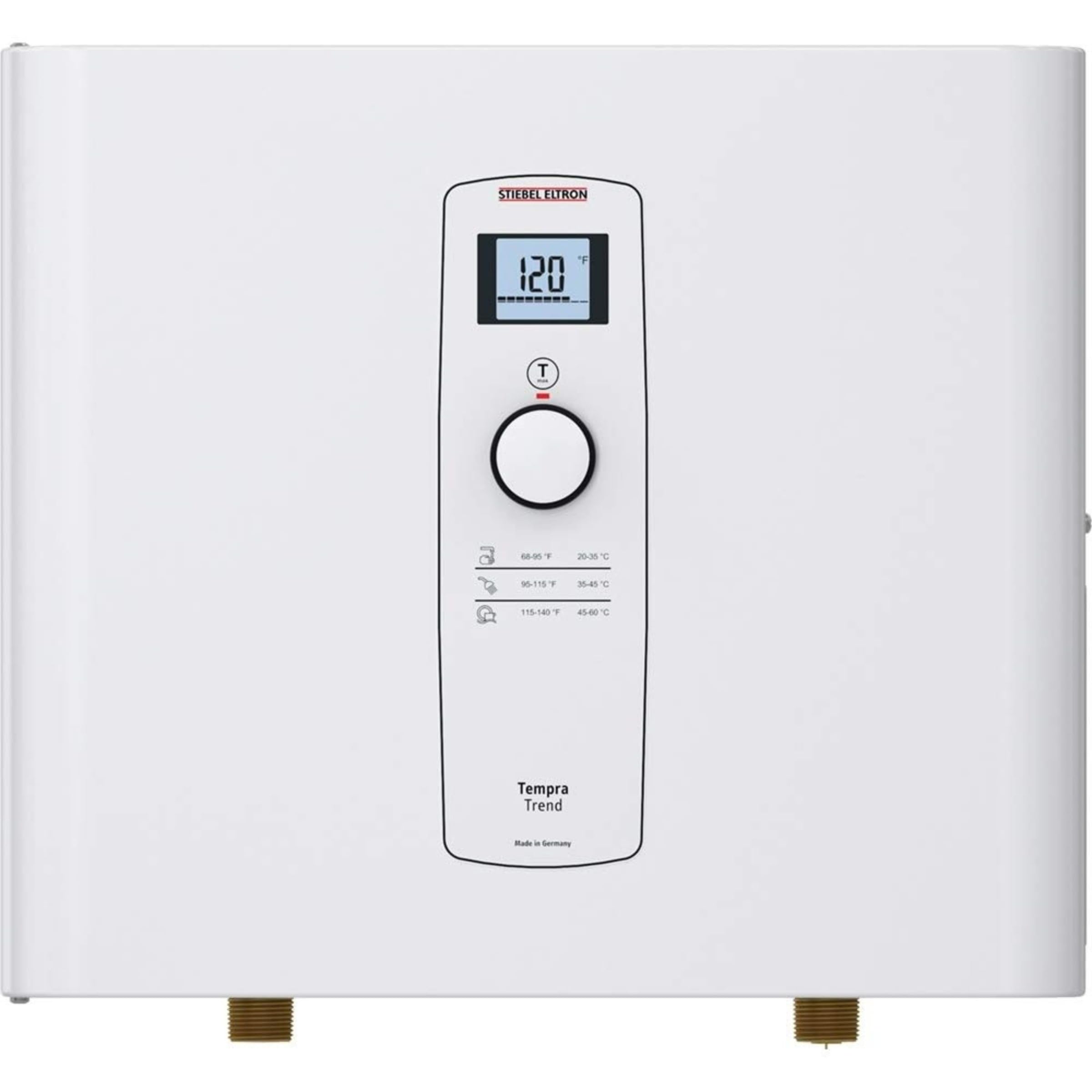
Settle into the Stiebel Eltron’s defining trait first: it runs with zero venting and it produces no noise while it heats. One electronic switch brings the unit on, the digital display reads out your set temperature, and the interior solid copper heating system carries the load. For a basement or closet install where you have no flue to run, that quiet no-tank setup is exactly the relief a well-water household wants after living with a rumbling tank.
What lifts it above the pack for most buyers is simple reliability. The Tempra 24 Trend has earned a reputation among owners as a long-term performer that just keeps delivering unlimited hot water — the kind of repeat loyalty that tells you the engineering holds up. It’s the crowd favorite here at 4.5+ stars across 90+ ratings, and the 7-Year Leakage and 3-Year Parts Warranties back the confidence.
Here’s the catch a well-water buyer must weigh. The manufacturer specifies this 24kW, 240V model needs a minimum recommended electric service of 150 A, and it references 2x50A breakers with a 100A draw. That’s a serious electrical project, not a plug-in swap. It also weighs 16.1 pounds — the lightest and most manageable of the whole-house units here, which makes the wall-mounting itself easy.
Where It Wins Out
- No venting required, so a closet or basement install stays simple
- Silent, noise-free operation while it heats
- Output range of 68° to 140°F gives you fine control
- 7-Year Leakage and 3-Year Parts Warranties included
- Built to handle a home’s worth of supply on demand, not a trickle
Where It asks More
- Prefers a minimum recommended electric service of 150 A — confirm your panel first
- Head-to-head on flow, its 0.03 gpm spec compares against the GASLAND’s 7.6 gpm
- Temperature can waver briefly the first day before settling
Land on this one: A well-fed home that wants silent, ventless, whole-house hot water with strong warranty coverage behind it.
Verify first: Your electrical panel must support a 150 A recommended service — otherwise this install stalls.
2. Westinghouse 24kW Tankless Water Heater
WiFi control, a flush wall mount, and a start flow low enough to catch trickle demand.
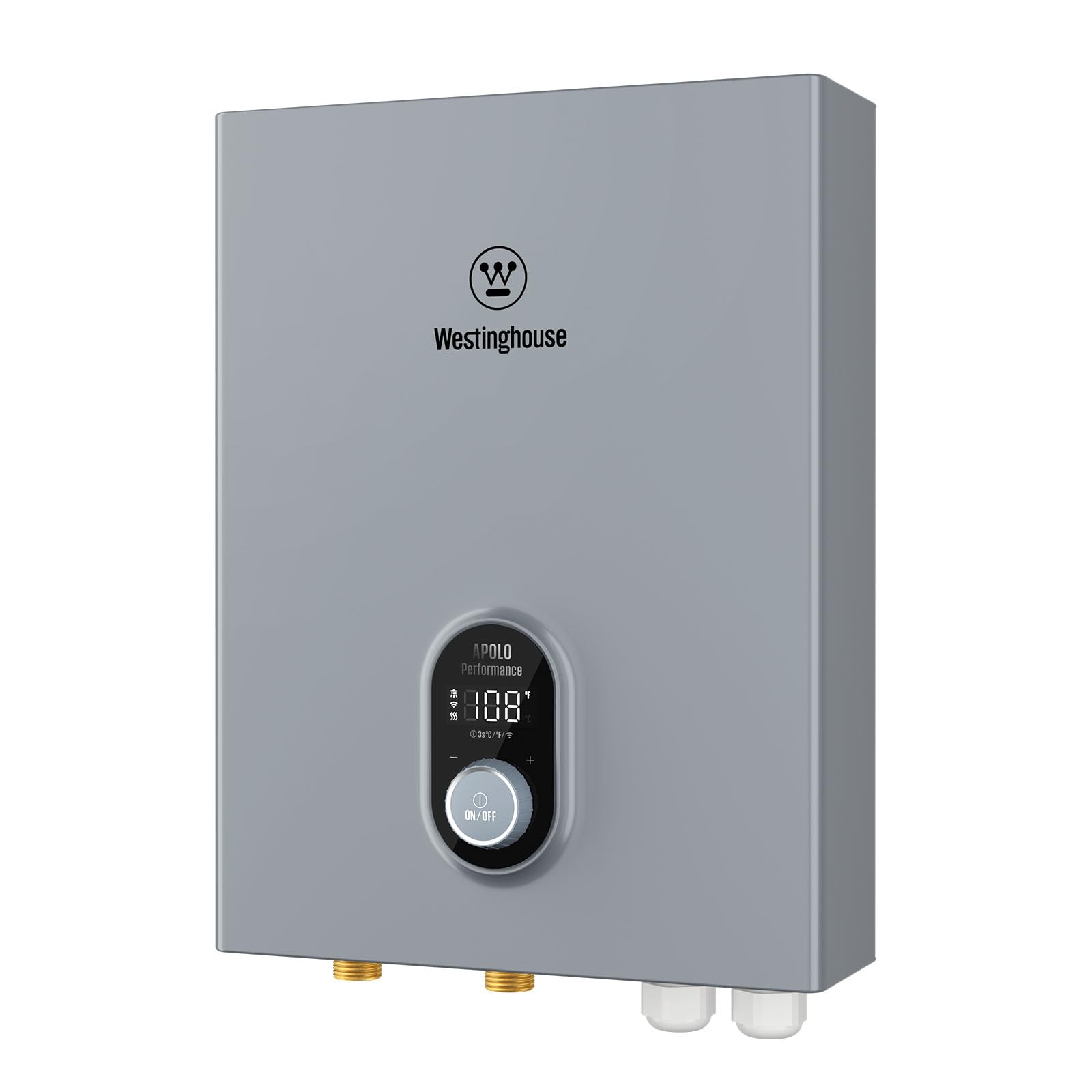
This one draws you in with smart-home convenience: you can dial the temperature and watch usage from an app or by voice through Alexa or Google Home. The starting flow rate is only 0.79 GPM, which means it kicks on for small draws a sluggish unit might miss — handy when sediment-heavy well water comes through slowly at first. It pushes up to 5.55 GPM.
The buyers who leave happy describe it as working exactly as advertised and delivering hot water quickly, often for a small bathroom or outbuilding. Its 5.56 gpm flow lines up well against the Rheem RTEX-24’s 5.9 gpm for similar service. The 17-pound body mounts flush at 4.3 inches deep — noticeably slimmer than the CAMPLUX’s 7.3-inch-deep cabinet, so it tucks into tight wall space.
The honest hurdle is electrical. This 24kW 240V unit needs a 100A breaker setup, and its own listing warns that you make that check before buying — one buyer found out the hard way and never opened the box. For anyone already wired for a big load, it’s an easy, space-saving performer.
Smart-home payoff: Voice and app control make temperature adjustments from another room painless, and the 0.79 GPM start flow means less waiting for hot water on a low draw.
The electrical prerequisite: Plan for a 100A breaker configuration and 3 x 8 AWG wire before installation — confirm your panel supports it, because that’s the real gate on this unit.
Ideal if: You want app and voice control plus a slim flush mount and your panel is already built for 100A.
Think twice if: Your electrical service can’t carry the breaker load — this is a wiring project, not a swap.
3. CAMPLUX Tankless Water Heater Gas Propane Indoor
Built-in freeze protection that keeps a propane heater alive through a hard winter.
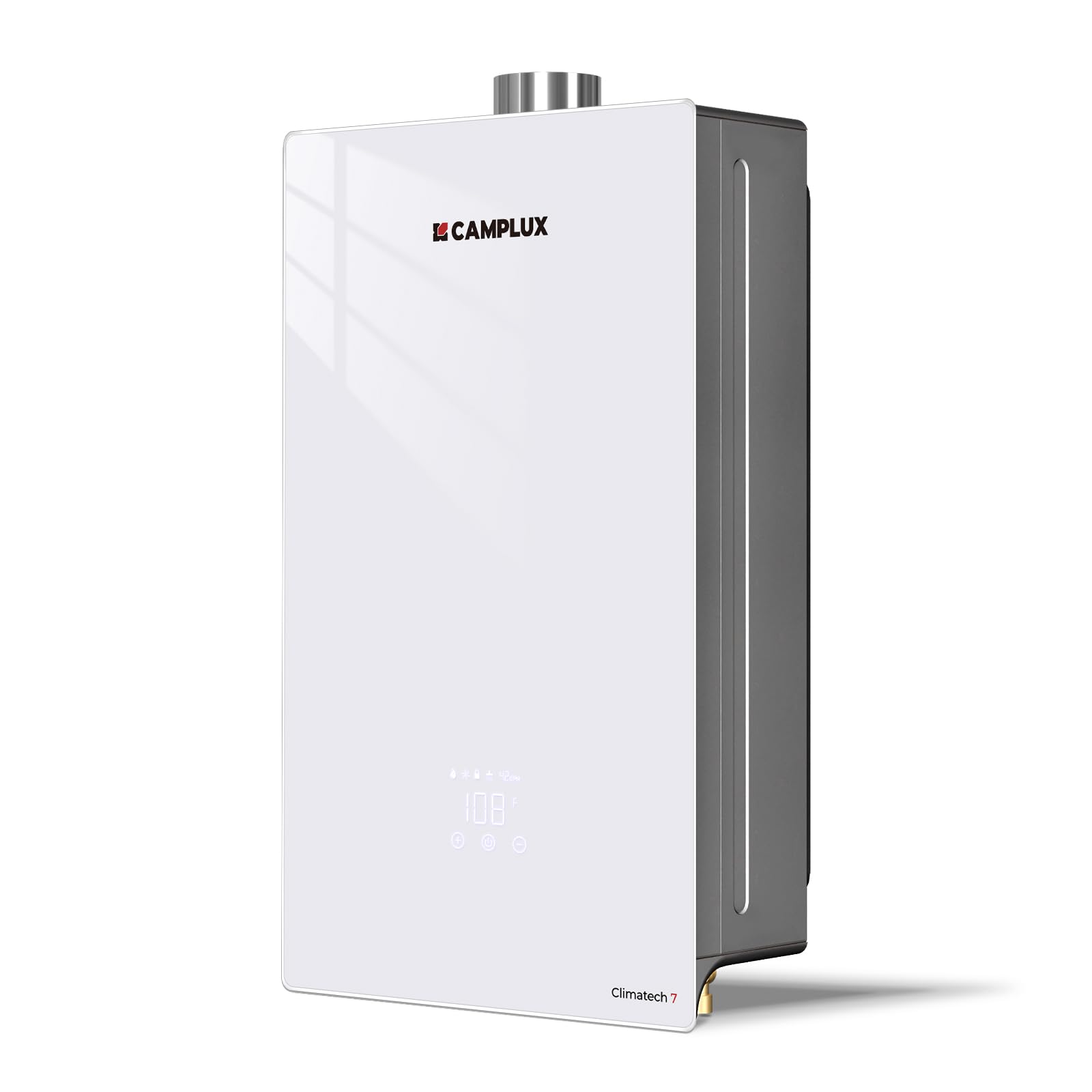
If your well sits on a property that drops below freezing, the CAMPLUX was designed with you in mind. It carries built-in -20°F freeze protection with an automatic drain assist, plus an oxygen-free copper heat exchanger that improves heat transfer. It runs on propane with a rated flow of 6.86 gpm and heat output up to 170,000 BTU.
Functionality is the trait owners talk about most here — it earns 4.5+ stars and an easy-install reputation, with the pre-drilled mounting panel and 3/4″ NPT water and propane ports keeping the plumbing straightforward. The dual undercarriage blowers run at 45dB, quieter than a humming refrigerator, and maintain a 16:1 air-fuel ratio for complete combustion. It measures 7.3 inches deep.
The buyer’s honest note: this is a propane machine that wants annual descaling and winterization below 20°F with the included quick-drain valve, and its altitude compensation tops out at 2,000 ft — mountain cabins above that need a consult first. It’s also the heaviest class of unit at 37.5 pounds, so plan a two-person mount.
Cold-weather edge: The -20°F freeze protection with automatic drain assist and the 45dB blower operation make this a fit for cabins and basements that see real winters.
Maintenance reality: Annual descaling is required for longevity on a propane unit, and you winterize below 20°F — build those into your well-water routine.
Reach for this if: Your well feeds a cold-climate home or cabin where freeze protection matters more than anything else.
Look elsewhere if: You’re above 2,000 ft elevation or don’t want to commit to annual descaling.
4. GASLAND Gasmart E CE686NG
A natural-gas heater that out-flows the electric competition by a wide margin.
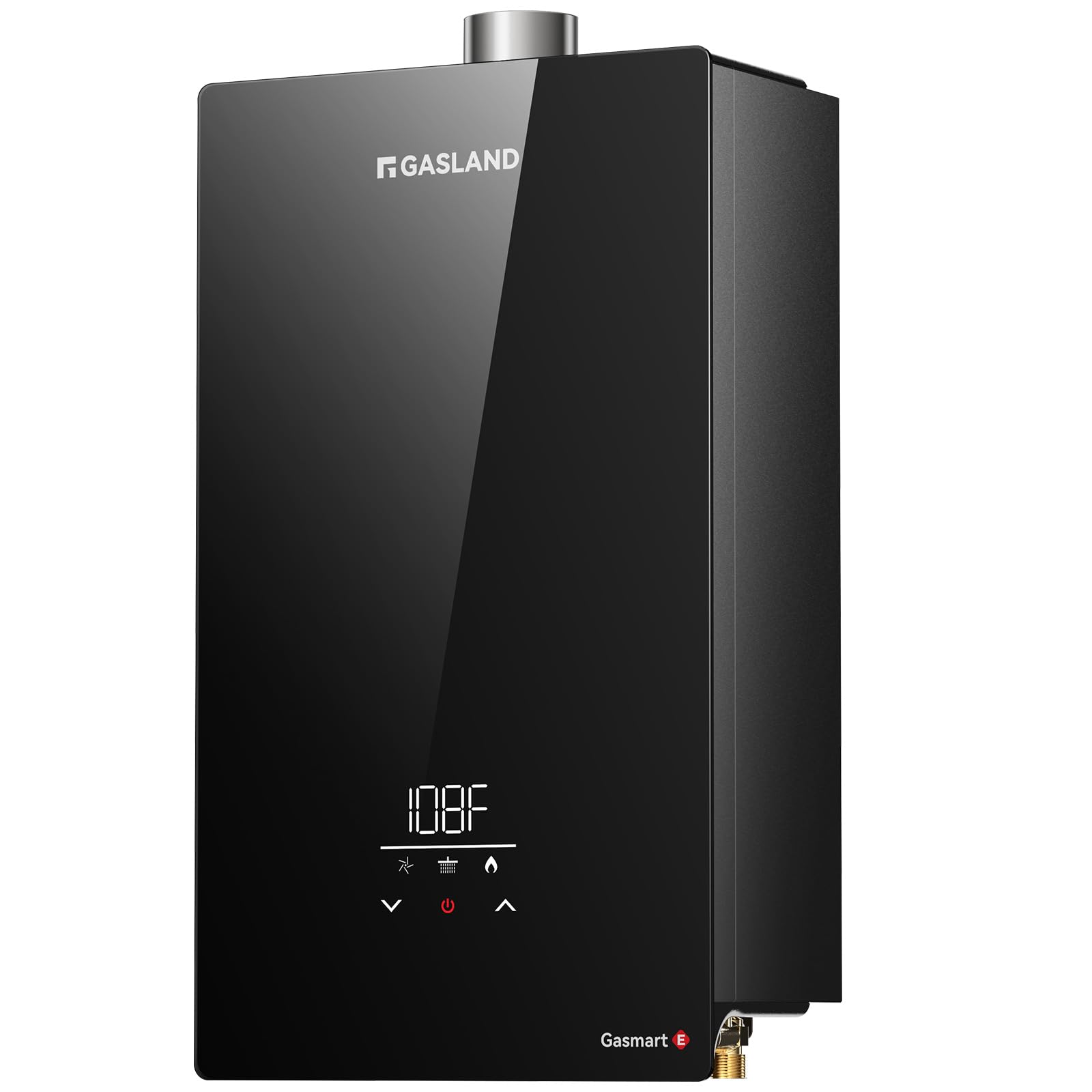
On raw capacity this GASLAND makes a strong case. It pushes up to 7.6 GPM with 199,000 BTU of natural-gas heat — against the Westinghouse’s 5.56 gpm electric output, that’s a bigger stream for simultaneous fixtures. Its 150 psi maximum pressure also tops the Westinghouse’s 120 psi, giving more headroom in a healthy well system. The UEF (Uniform Energy Factor, a standardized efficiency score) of 0.8 is quoted as more efficient than a 50-gallon tank heater’s 0.6.
Performance is the thing buyers notice — this is a workhorse that heats water quickly and delivers a steady flow, the kind of all-around competence that earns repeat recommendations. It’s built for year-round use with overheat protection, flame-out protection, and freeze protection, and it’s CSA certified.
The recurring gripe is installation clarity — some find the instructions thin and end up calling the manufacturer, who does answer. At 37.5 pounds and 7.28 inches deep, it’s a heavier, deeper cabinet than the electrics, so clear your wall space. For a natural-gas household that needs real multi-fixture flow, that trade-off is worth it.
Why It Delivers the Water
- 7.6 GPM and 199,000 BTU for running several fixtures at once
- UEF of 0.8 documented against a 0.6 tank baseline for efficiency
- 150 psi max pressure handles strong well-system supply
- CSA certified with freeze, overheat, and flame-out protection
Budget In These
- Installation instructions divide buyers — some need manufacturer support
- Heavier at 37.5 pounds and deeper at 7.28 inches than the electric models
- Natural gas only, so propane homes need the convertible options instead
The right call for: A natural-gas well-water home that needs serious multi-outlet flow and would rather pay for support than fuss with instructions.
Not your pick if: You’re on propane or want a featherweight electric wall mount.
5. Rheem RTEX-24 24kW 240V Electric Tankless Water Heater, Gray

The electric veteran with fine-grained temperature control and a huge following.
The most striking spec on the Rheem RTEX-24 is the digital thermostat — it adjusts in 1-degree increments from 80°F to 140°F. For a well-water household, that 1-degree precision lets you set the output to your exact shower temperature instead of guessing at cold-water mixing. It pushes up to 5.9 GPM, requires no venting, and sits just 3.5 inches deep while freeing up floor space — the listing notes it’s 90% smaller than a traditional tank heater.
The volume of owner experience behind this unit is its real strength, and the pattern that runs through it is satisfied, easy-to-install performance that keeps up with demand. One long-time owner sums up the loyalty this unit breeds, and the installer-friendly design clearly earns its reputation.
The trade-off is power draw. Operating the RTEX-24 takes three 40-amp double-pole breakers and a recommended minimum 200-amp household service — the heaviest electrical ask on this whole list. Some owners also note a short wait for water to reach a distant faucet. If your panel is already heavy-duty, it’s a precise and reliable choice.
Control that matters on a well: The 1-degree increments from 80°F to 140°F let you set an exact output, so sediment sway in incoming water doesn’t force a shower-temperature gamble.
Panel capacity is the gate: The three 40-amp breakers and recommended 200-amp service mean this install lives or dies on your electrical panel, not on the heater itself.
Choose it if: You have a heavy-amp panel and want pinpoint digital temperature control with a no-vent install.
Skip the headache if: Your electrical service falls short of the three-breaker, 200-amp recommendation — you’d be rewiring first.
6. Stiebel Eltron Tempra Plus 29
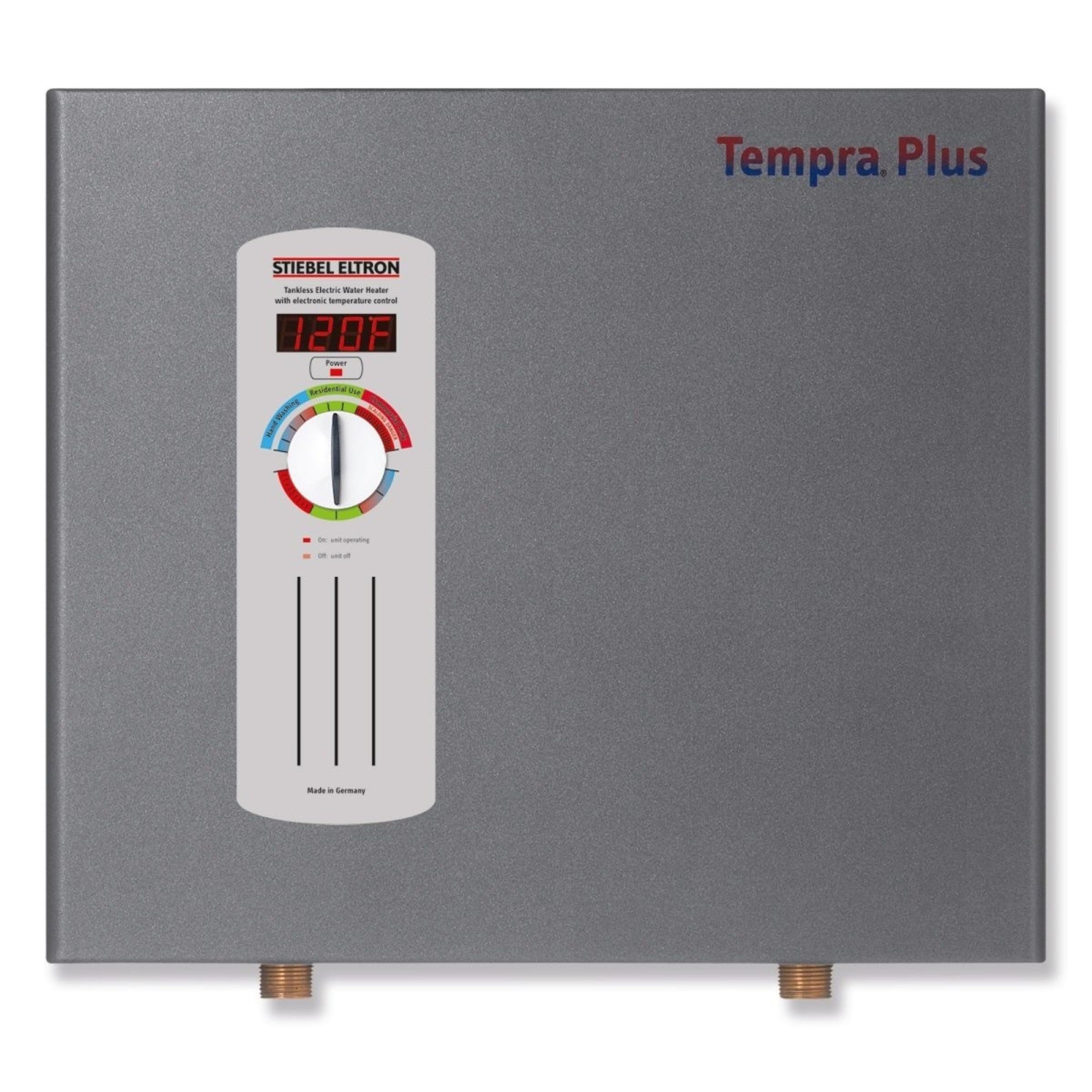
The step-up Stiebel for homes that push more hot water than a 24kW unit can carry.
At 29kW and 98,350.75 BTU, this Tempra Plus moves up a tier from the Tempra 24 Trend — more heating muscle for a bigger household. Its two signature features are Self-Modulating Power Technology and Advanced Flow Control, both aimed at keeping output steady when your well supply and fixture demand change at the same time. It runs on stainless steel internals and needs no venting, so the install stays clean.
Owners describe it as a formidable performer that heats the water and holds it — the kind of consistency you want when well water arrives cold. It carries a manufacturer warranty of 7 years leakage and 3 years parts, matching the Tempra 24’s coverage.
The honest limit is warm-up: this unit takes a while to engage and heat up before it settles into steady performance. Its other spec that must be checked is electrical — a 29kW draw needs a substantial service. If your home is already wired for high demand, the extra kW buys you more simultaneous hot water.
More muscle where it counts: The 29kW output and Advanced Flow Control mean more simultaneous hot water and steadier temperature than the smaller Tempra 24 Trend, which matters in a busy home.
Patience at the tap: This unit takes a while to heat up before it’s in full swing, so your first fixture of the day waits a beat — the reward is steady output after that.
Fits best: A larger electric household that needs more than 24kW and values flow-controlled consistency.
Don’t choose it if: You want instant heat — this one takes a while to engage, and it demands serious electrical service.
7. A. O. Smith ATI-510CX3
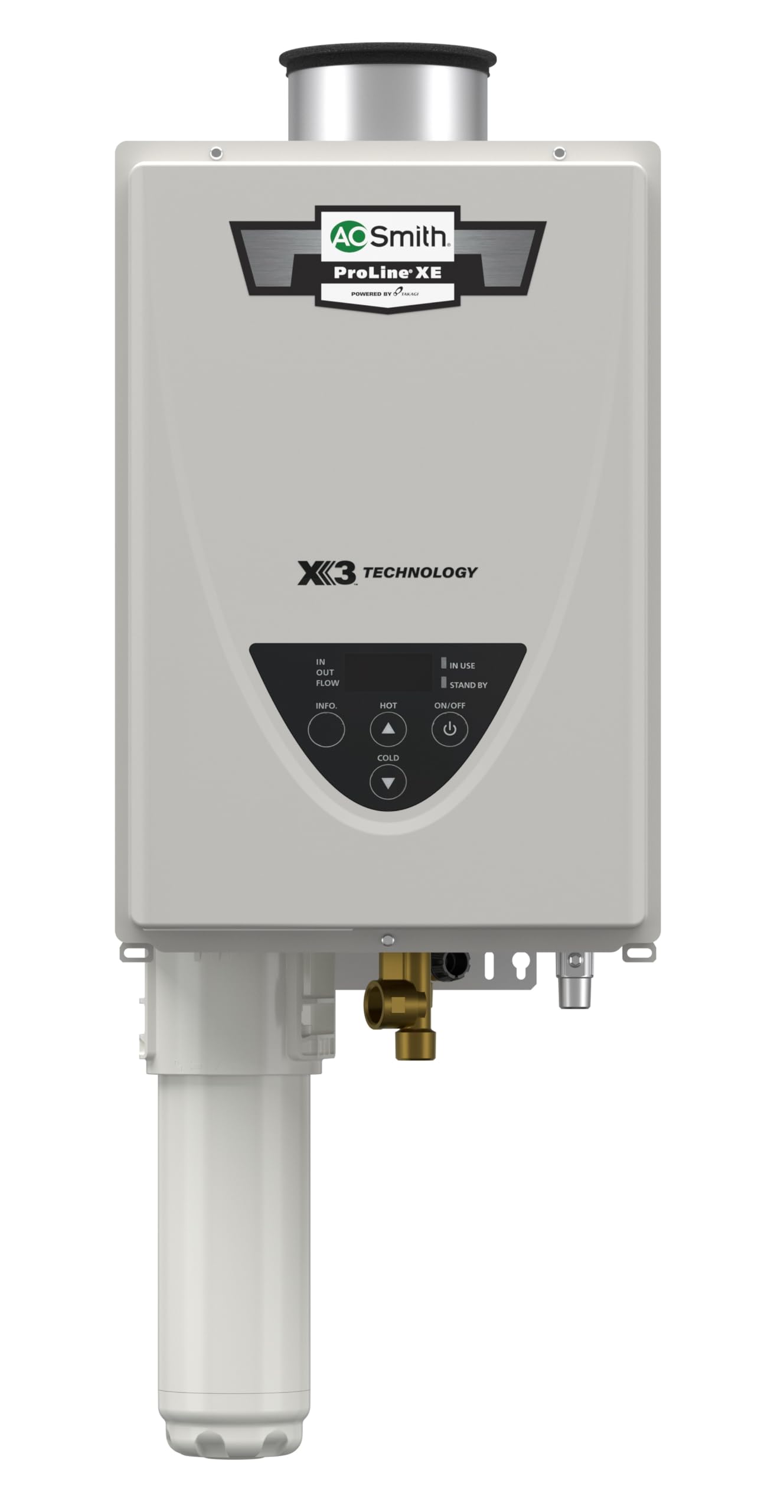
Built-in scale prevention turns the worst part of well water into a managed nuisance.
For a well-water buyer, the headline here is X3 Scale Prevention, which targets the mineral buildup that shortens a heat exchanger’s life. Add a continuous flow rate up to 10.0 GPM and a commercial-grade copper heat exchanger that the maker describes as 25x better than stainless steel at heat transfer, and you have a machine engineered to move a lot of hard well water while resisting the film that slows it down.
It’s a 199,000 BTU indoor unit, convertible from natural gas to propane, with a quoted UEF of up to 0.81. The APNC35 direct vent system can terminate vertically or horizontally, which gives you install flexibility in a basement or utility room. Safety is covered by exhaust and water temperature controls, an overheat cut-off fuse, and an air-fuel ratio sensor, all backed by a 15-year limited warranty on the heat exchanger.
The trade-off is a big, heavy unit — it weighs 26.76 kg and stands 36.13 inches tall — and it’s a premium pick aimed at 3-plus-bath homes. For a large household fighting hard water, those are acceptable costs for the scale protection built in.
The Well-Water Advantage
- X3 Scale Prevention tackles mineral buildup at the source
- 10.0 GPM flow runs a 3-plus-bath home at once
- Converts from natural gas to propane for fuel flexibility
- 15-year limited warranty on the heat exchanger
What You’ll Have to Handle
- Heavy at 26.76 kg and tall at 36.13 inches — plan the install space
- Premium positioning makes it a bigger upfront commitment
- Convertible fuel type still requires the right vent termination
Best-fit household: A large, hard-water well home that wants built-in scale control without adding a treatment rig.
Weigh carefully if: You have a tight utility closet — the 36.13-inch height and heavy body need room.
8. Rheem RTGH Series 8.4 GPM Natural Gas Tankless Water Heater
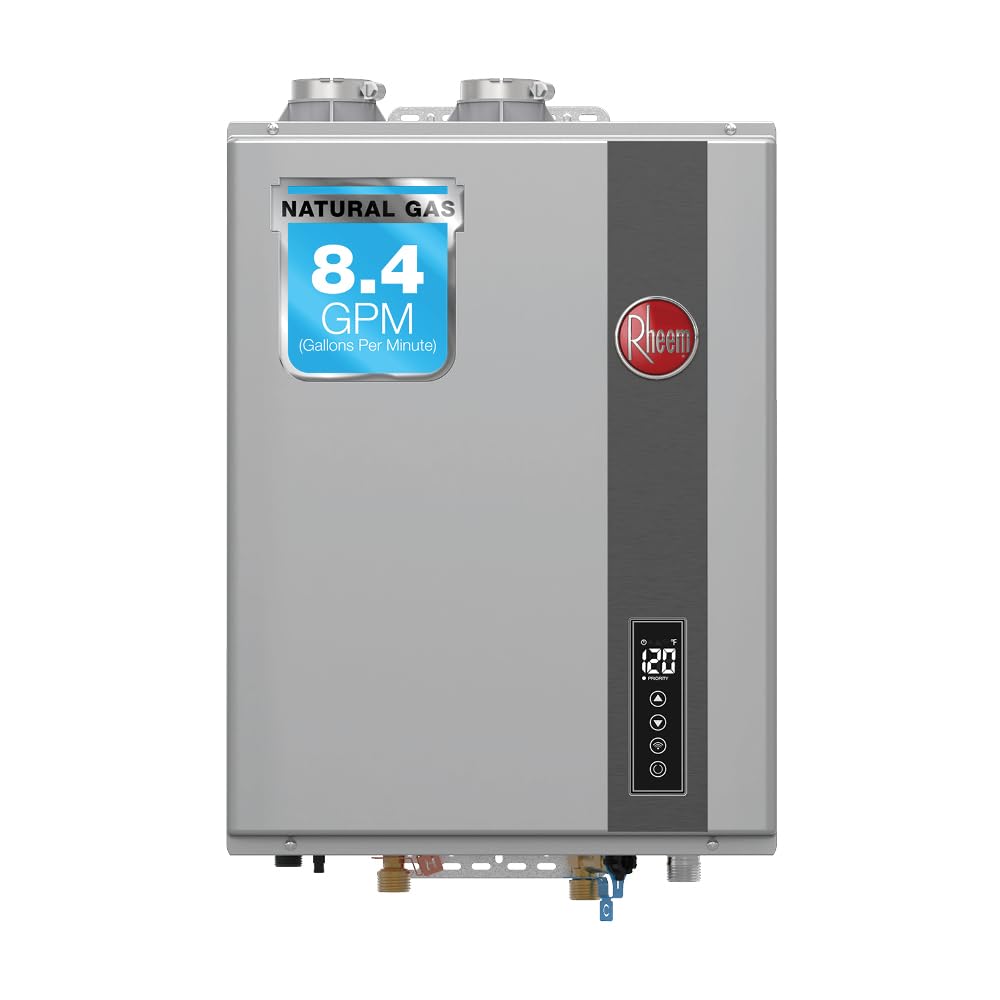
A condensing gas heater tuned to stretch every therm across a large family.
The number that earns this Rheem its spot is UEF 0.93 — a condensing efficiency score that the listing frames as using up to 34% less energy than a standard 50-gallon electric tank. It delivers 8.4 GPM at a 35°F rise, which the maker sizes for 3-4 simultaneous showers, making it a natural for a big family on a well. The precision temperature control holds within ±1°F, and it includes built-in freeze protection.
Owners find it effective and dependable, the kind of unit that winterizes each year and fires right back up in the spring. Once the hot water reaches the tap it’s described as never-ending — a real fit for half-hour-shower households.
Two honest notes. It’s a challenge to install with a lot of parts, so professional installation is the recommended path. And at 59.9 pounds it’s the heaviest unit on this list, needing a solid wall and a two-person lift. For a large gas household chasing lower bills, the UEF 0.93 condensing efficiency pays that premium back over time.
Efficiency that adds up: UEF 0.93 and the ±1°F precision control make this a strong pick for a big household watching gas costs.
Installation and weight: Lots of parts make it a pro-install job, and 59.9 pounds plus 9.8 inches depth need a sturdy mounting plan.
Suits you if: You run a large natural-gas household that wants condensing efficiency and steady, frost-protected output.
Pause if: You plan a solo weekend install — the many parts and heavy body make pro help the smart route.
9. Rinnai RX199iN Condensing Smart Sense Tankless Water Heater

One model that mounts indoors or out, and switches between gas and propane.
Rinnai’s Smart Sense gas control lets this unit run on either propane or natural gas, and the Versa Vent design means it installs indoors or outdoors (with the RX-OVC vent cap required outside). For a well property where the mechanical space is awkward, that flexibility is a genuine convenience. It delivers up to 11.1 GPM — the maker sizes that to 7 fixtures at once — and carries a super-high UEF of 0.98.
What wins people over on this unit is performance and reliability: water heats fast, and running out of hot water stops being a thing, even in a busy house with several people competing for the shower. It’s also praised as cost-effective over the long haul and straightforward to self-install by handy owners.
The well-water-friendly detail is the Quick Flush feature, which simplifies the periodic flushing a hard-water heater needs. The honest notes are noise — some find it loud, some find it quiet depending on placement — and the professional-install recommendation. It’s rated 4.5+ stars and carries a limited 15-year heat exchanger warranty.
Why It’s a Well-Site Favorite
- Quick Flush simplifies the descaling maintenance hard water demands
- UEF 0.98 efficiency with up to 11.1 GPM for 7 fixtures
- Indoor or outdoor install and NG or propane flexibility
- 15-year limited heat exchanger warranty
Before You Commit
- Noise varies with placement — some find it loud, others quiet
- Rinnai recommends professional installation
- WiFi control needs a separate Controlr module, not included
Made for: A well home that wants one flexible unit for indoor or outdoor mounting and either gas type, with easy flushing.
Reconsider if: You need app control — that requires the extra Controlr module — or you’re sensitive to heater noise in a living space.
10. Rinnai RXP199iN Condensing Smart Sense Tankless Water Heater
Recirculation that learns your routine and puts hot water closer to the tap.
This RXP199iN adds Smart-Circ Intelligent Recirculation to the Rinnai formula — an internal pump that learns your water usage patterns, then schedules pump and recirculation around them. For a well-water home where the heater sits far from the bathrooms, that recirculation cuts the wait for hot water at distant fixtures. It matches the RX199iN’s 11.1 GPM and UEF 0.98 efficiency, and it installs indoors or out on either gas type.
Quality is the aspect owners talk about most: it heats fast and its distribution stays consistent throughout the house, with temperature that doesn’t swing like an older unit. It’s rated 4.0+ stars and carries the same limited 15-year heat exchanger, 5-year parts, and 5-year labor warranty (registered within 90 days).
The trade-off to weigh honestly is reliability perception — some buyers report a unit that didn’t work at all, so the professional-install recommendation and warranty registration aren’t optional extras here. At 58 pounds and with built-in recirculation, it’s the most comfort-focused, highest-commitment choice in this group.
Comfort where it counts: Smart-Circ recirculation and the 11.1 GPM, UEF 0.98 spec make this the pick for large homes that want instant-feeling hot water everywhere.
The reliability caveat: A 5-year labor warranty is strong, but it requires registration within 90 days — and professional installation and registration are the responsible path given the mixed reliability feedback.
Built for: A large, spread-out well home that values recirculation-driven instant hot water over upfront simplicity.
Steer clear if: You want a set-and-forget install — this rewards proper professional setup and warranty registration.
Know the Specs
Flow Rate (GPM)
GPM stands for gallons per minute — how much hot water the unit can push at once. A 5.55 GPM electric heater suits a couple of fixtures; a 10 GPM or 11 GPM gas unit runs several showers together. On a well, match GPM to what your pump can actually recover, so the heater doesn’t outrun your water supply.
UEF (Uniform Energy Factor)
UEF is a standardized efficiency score — higher means less energy to heat the same water. A condensing gas unit can reach 0.93 or 0.98, while a 50-gallon tank typically scores around 0.6. That gap shows up on your gas bill over a heating season, which is why condensing models cost more upfront.
Gas vs. Electric Service
Electric tankless units skip venting, but they draw heavy current — some need three 40-amp breakers and a recommended 200-amp service panel. Gas units need a vent but far less electricity. Check your electrical panel before you fall for an electric model’s clean install.
Scale Prevention and Descaling
Hard well water leaves mineral film on a heat exchanger, which cuts efficiency. Built-in scale prevention like X3, or a simplified flush like Rinnai’s Quick Flush, makes upkeep easier. Annual descaling keeps a well-fed heater’s heat exchanger clear, so budget the time and descaler cost into ownership.
Common Questions
Can a tankless water heater handle well water with sediment?
Do I need a filter before my tankless heater on a well?
Is a gas or electric tankless heater better for a well-water home?
How do I know what GPM I need for my well?
Will hard well water shorten the life of a tankless heater?
How often should I descale a tankless heater on a well?
What electrical service does an electric tankless heater need?
Can a tankless heater run on both natural gas and propane?
Why does my well-water tankless heater take a while to heat up?
Do tankless water heaters require venting?
The Bottom Line
The tankless water heater for well water winner for most buyers is the Stiebel Eltron Tempra 24 Trend because it pairs silent, ventless whole-house output with a 7-year leakage warranty — just confirm your panelreaches the recommended 150 A service. If hard water is your main worry, the A. O. Smith ATI-510CX3 builds X3 Scale Prevention right in and runs 10 GPM. And for a spread-out home that wants hot water close to every tap, the Rinnai RXP199iN adds Smart-Circ recirculation on top of the 11.1 GPM output.
One nudge worth repeating: the Stiebel Eltron’s light 16.1-pound body and ventless design make the install itself easy — the real gate is your electrical panel, so check it before you commit, then let the quiet reliability of a well-proven heater do the rest. Whether your well water runs hard or cold, one of these ten tankless units will keep hot water flowing without a tank to rust out.
How we choose
We do not accept paid placement. Every pick is matched to a real buyer and a real use-case; we do not hands-on test units.
Sources
Specifications: manufacturer listings and product documentation. Review insights: verified customer reviews, as of November 2026. Pricing: not shown on this page (it changes often); check the current price via the retailer link.
As an Amazon Associate, Tactical Gear Guy earns from qualifying purchases. This does not affect which products we feature.