Specs are compiled from manufacturer listings and verified buyer reviews and can change over time — please confirm the key details on the product page before buying.
A tankless electric water heater will not save you a cent if your breaker panel cannot feed it. That is the single fact that decides whether the unit in your cart is a great purchase or an expensive wall ornament. These heaters pull serious current, they need dedicated breakers and thick copper wire, and the flow rate printed on the box only holds true under specific conditions. So before you compare heat output, get honest about your electrical service and how many taps you run at once.
This guide is built by comparing the manufacturers’ published specifications and the patterns across verified customer reviews, so you get each pick’s real strengths and trade-offs instead of marketing spin.
Below you will find units sized for a single sink, units built for a whole house, and everything in between, each one matched to a specific electrical setup. One pick here carries 4.5+ stars across 300+ ratings. My goal is simple: match the heater to your panel and your faucet count so you buy the right one the first time with these tankless electric hot water heaters.
Top Picks
How To Choose The Best Tankless Electric Hot Water Heaters
Start with your electrical panel, not the heater. Every electric tankless unit here is hardwired, meaning it connects directly into your home’s wiring with no plug, and each one demands its own breaker and its own set of copper conductors. If your panel has no spare slots for the breaker count listed on a model, that model is not an option for you no matter how good the reviews are.
Match the heater to how many taps run at once
A single under-sink unit handles one faucet, which suits a bathroom vanity, a bar sink, or a salon station. A whole-house model with a higher flow rate can feed a shower and a kitchen tap together. The mistake most first-time buyers make is buying for the sink they have now and then discovering the shower needs its own heater. Count the fixtures you want running simultaneously, then buy for that number.
Understand temperature rise before you trust a flow figure
The flow rate on the box is usually quoted at a specific temperature rise — the number of degrees the unit lifts the incoming water. Colder incoming water in winter means the same heater gives you less hot water at the same flow, or the same flow at a lower temperature. If you live where groundwater runs cold, plan for a single-fixture setup even on a heater rated for two.
Check the certified safety listings
Look for an ETL or UL listing on the product page. Those marks mean an independent lab has tested the electrical and safety design. Also look for overheat protection and dry-fire protection, which shut the element down when no water is flowing.
Side-by-Side Comparison
| Model | Best For | Flow Rate | Heat Output | Breaker / Wiring | Amazon |
|---|---|---|---|---|---|
| TNKLS WTRHTR11.8KW TITAN★ Best Overall | Whole-home value pick | 10 gpm | 11.8 KW | — | Amazon |
| ThermoMate 6kW for Sink WashingBest for Sinks | Under-sink point of use | 1.07 gpm | 6000 watts | 30A breaker, 10AWG | Amazon |
| ThermoMate 8kW 240VTwo-Tap Workhorse | Two faucets on one unit | 1.9 gpm | 8000 watts | 40A double pole, 8AWG | Amazon |
| Fogatti 11kw 240V | Shower plus sink | 2.6 gpm | 11 KW | 1x50A breaker, 8AWG | Amazon |
| 14kW Tankless Water Heater Electric 240V | Kitchen and bath together | 3.3 gpm | 131 °F max | 1x60A breaker | Amazon |
| EcoSmart ECO 8 | Cabin or cottage retrofit | 2 gpm | 8 KW | 40A | Amazon |
| CAMPLUX 27kW 240V | Whole-house shower demand | — | 27 KW | 3 x 8AWG | Amazon |
| Electrolux 18kW | Two bathrooms with app control | 4.2 gpm | 18 KW | 2 circuits, each 40A double pole | Amazon |
| Westinghouse 24kW | Smart whole-home upgrade | 5.56 gpm | 24000 watts | 3 x 40A, 3 x 8AWG | Amazon |
| Rheem RTEX-24 | High-demand family homes | 5.9 gpm | 24 KW | 3 x 40A double pole, #8 AWG | Amazon |
| Stiebel Eltron Tempra 29 Plus | Premium precision and efficiency | 3 gpm | 28800 watts | 3 x 40A breakers, 8 gauge | Amazon |
Detailed Reviews
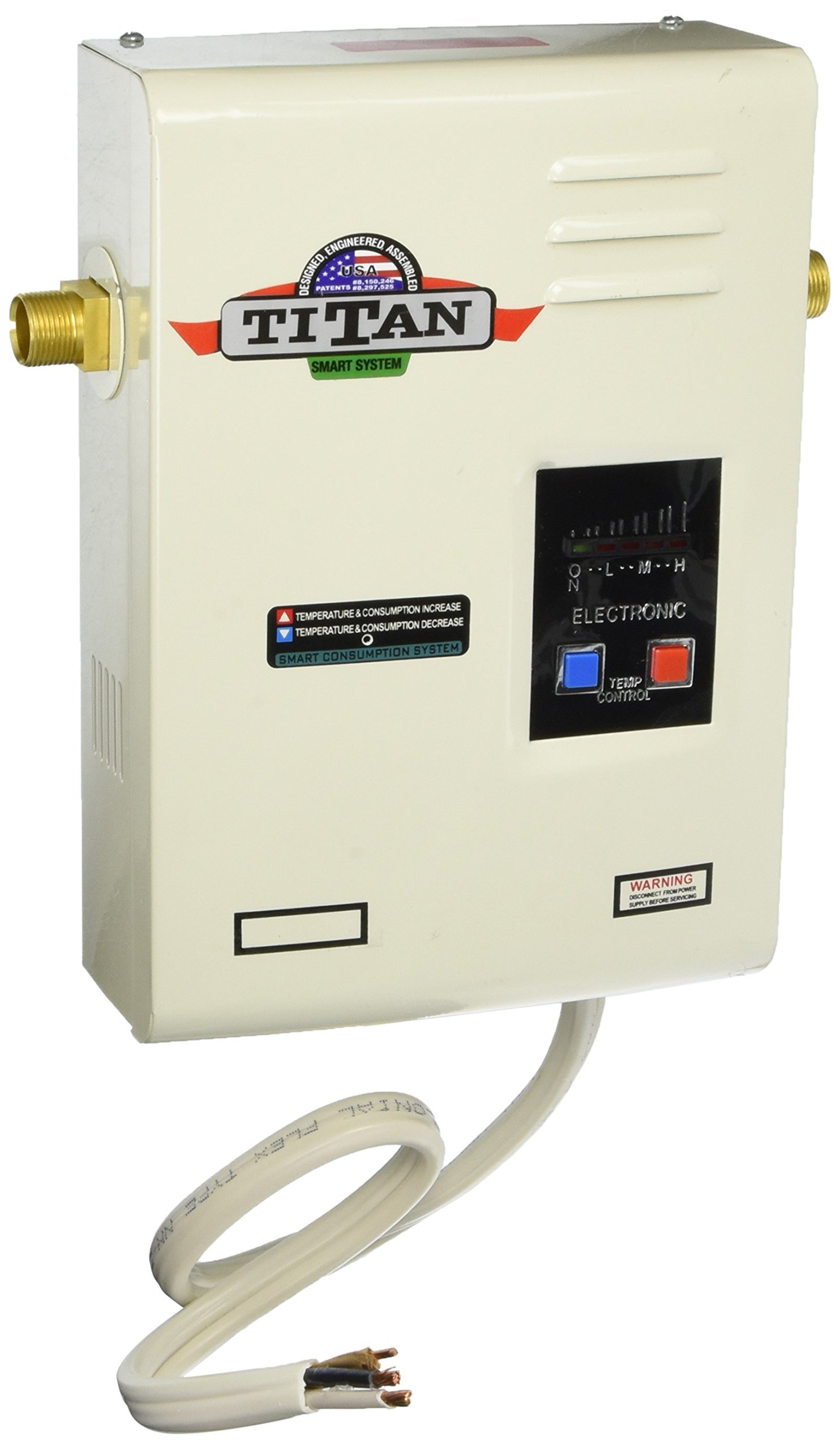
1. TNKLS WTRHTR11.8KW TITAN
Our pick — 4.5+★ from 300+ verified ratings; the strongest balance of quality and price.
Ten gallons a minute of hot water from a unit you can hold in one hand.
The headline here is a flow rate of 10 gpm — that is gallons per minute, the volume of hot water the unit can pass through as it heats. Compare that with the ThermoMate 6kW sink unit at 1.07 gpm and the gap is 9.3x. In practice this is the pick that can supply a shower and a running faucet together without the temperature diving, which is exactly what most buyers are chasing when they move off a storage tank.
The physical size is the quiet surprise. The unit is just 2.75 inches deep and weighs 6.4 pounds, so it mounts on a wall or tucks into a closet without eating floor space, and the connections are already in position on many replacements. Owners describe the swap as roughly a 15-minute job on a like-for-like replacement, and the heat arrives on demand rather than after a wait. It is made by Niagara Industries, caries UL compliance and ETL lead-free certification, and the housing is titanium.
Buyers care most about two things: the flow number and how fast hot water arrives. The recurring theme in reviews is instant heat from a box that looks too small to deliver it. The honest catch is durability, where reports are mixed. Most units run for years, and one buyer notes a first unit that lasted a decade. But some buyers report a unit failing early, and one reports a company that did not stand behind the product. Buy for the flow and the footprint, but keep your receipt and read the warranty terms before you commit.
Where It Wins
- A 10 gpm flow rate — the highest on this list, well clear of every point-of-use unit here.
- Only 2.75 inches deep and 6.4 pounds, so it goes where a tank never could.
- Instant heat with no standby loss, and the low-water use shows up in monthly bills.
- UL compliant and ETL lead-free certified.
Where It Needs Care
- Durability reports split — some units run a decade, others fail inside a year.
- Not every failure gets covered, so confirm the warranty path up front.
- Whole-home flow still depends on your service panel feeding it properly.
Buy this one if: you want the strongest flow figure here and you are replacing an existing unit on the same footprint.
Think twice if: long-term reliability cover matters more to you than raw flow rate.
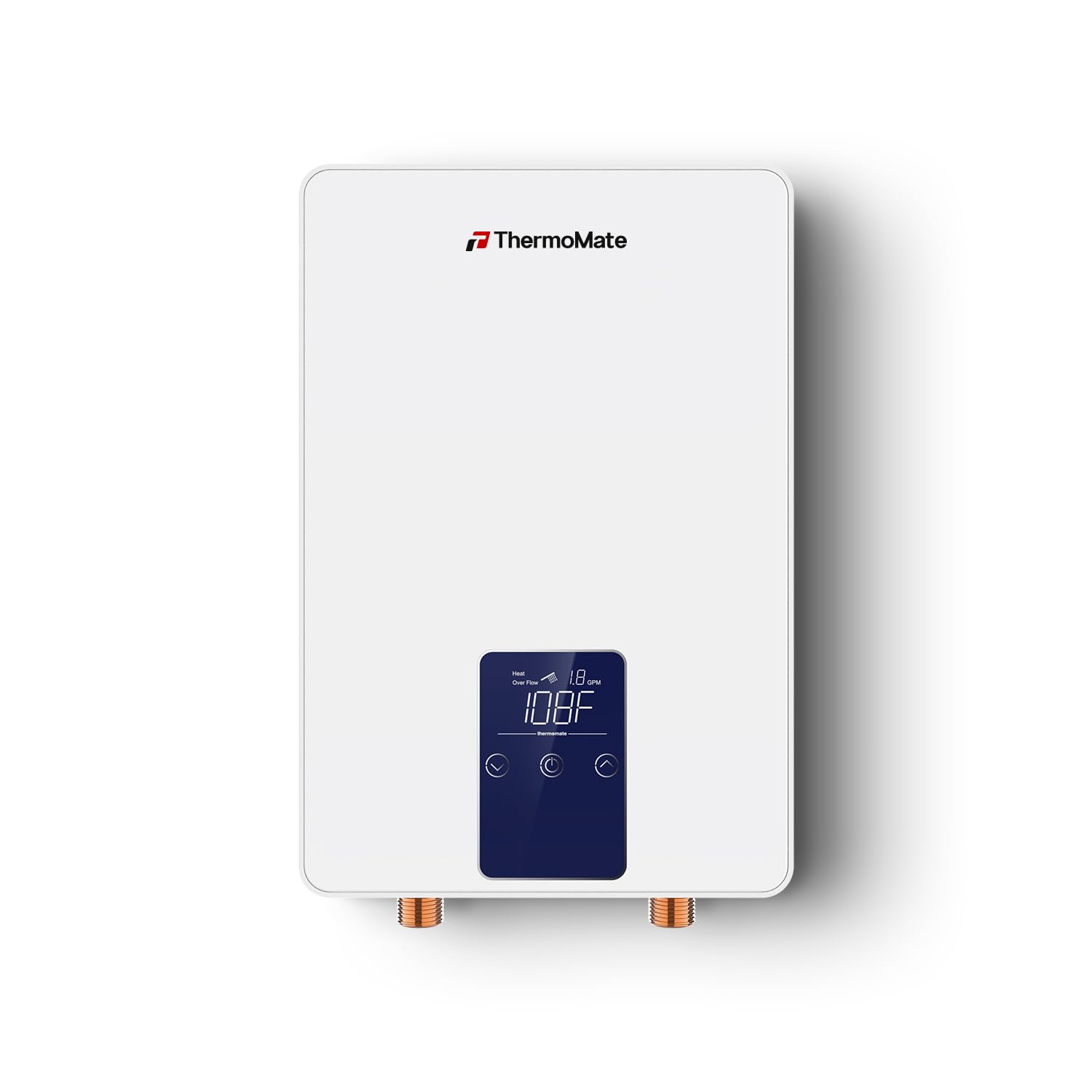
2. ThermoMate 6kW Tankless Water Heater
Built for the one faucet where waiting for hot water gets old.
This is a point-of-use heater, which means it serves a single fixture rather than a whole house. It delivers 1.07 gpm at a 35°F temperature rise, runs on 240 volts, and pulls 25 amps through a 30-amp circuit with 10AWG wire. That modest electrical ask is the reason it fits homes where a whole-house unit would need a panel upgrade. Slip it under a bathroom vanity, a bar counter, a salon station, or a hotel reception and the sink gets hot water in seconds.
Where this design earns trust is the interior. The heating element is cast aluminum and sits separated from the water line, which is the approach that limits scale, corrosion, and mineral buildup on the element itself, and the water tube is SUS 304 stainless steel. The touch panel lets you dial temperature in 1° increments from 85°F to 131°F, and the rated maximum pressure is 150 psi. There is also an IP25 waterproof rating, which means it resists dripping water but is not built for submersion, and standard 1/2″ NPT fittings simplify the plumbing connection.
The recurring note in the review pages is that it simply works once the wiring is right, and buyers describe the install as straightforward when the 240-volt feed is already there. The one thing to know going in is the maintenance expectation — this heater is designed to be serviced annually, so if you are the type who never touches a unit after install, factor that in. It is a compact 10.96″ x 7.4″ x 2.52″, small enough to disappear under a cabinet.
Straight read: the right heater for a single sink where a big unit cannot reach and the panel cannot spare three breakers. The 30-amp requirement keeps the electrical work realistic for most homes.
Plan for: yearly maintenance and a hardwired 240-volt connection, since there is no plug on this one.
Fits your project if: you have one stubborn faucet and a spare 30-amp slot.
Keep looking if: you need two taps hot at once — this unit serves a single point.
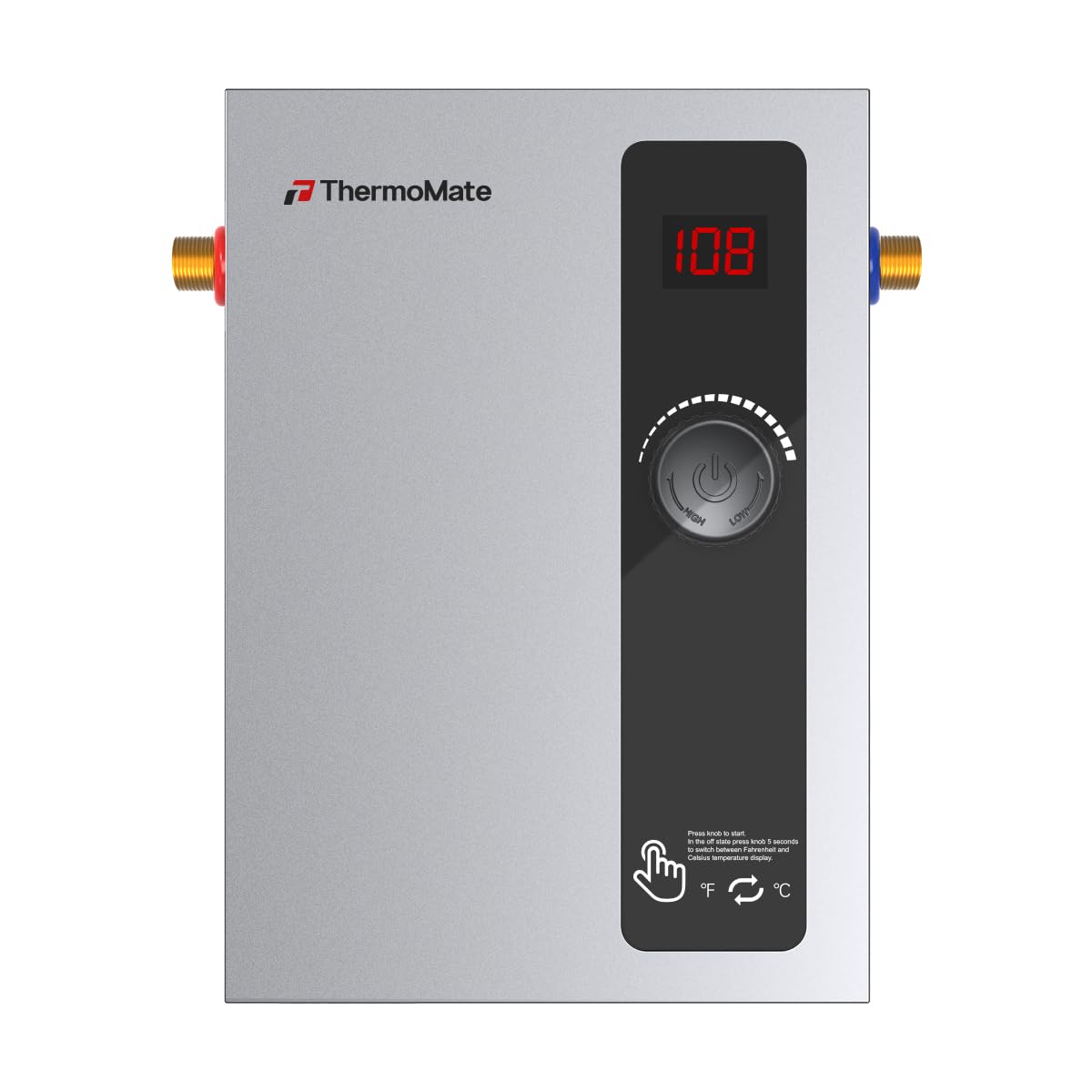
3. ThermoMate 8kW Tankless Water Heater
One heater, two faucets, and a break-even point that comes fast.
Step up from the sink unit above and the numbers shift in useful ways. This model carries 8000 watts of heat output against that unit’s 6000 watts, and its 1.56 gallons of capacity is 56% more. Those two figures are what let it support up to two faucets under the right conditions. It runs on a double-pole 40-amp breaker with 8AWG wire, which is a bigger electrical ask than the 30-amp sink version but still within reach of many homes.
The heating chamber is cast aluminum with the element held away from the water line, the same design idea that keeps scale and corrosion off the element and helps extend the unit’s lifespan. Self-modulating control continuously reads the water temperature and flow, then feeds the element only the energy needed, and ThermoMate cites up to 60% lower water heating cost than a tank. Maximum temperature is 131°F, working pressure tops out at 150 psi, and the side-mounted water connections are 1/2 NPT. It is ETL certified with overheat protection and an auto-stop when no water is detected.
Sizing is where buyers get caught. The unit is rated for 2 faucets, but that rating assumes typical incoming water and reasonable flow. If you are drawing a hot shower on a cold morning while someone runs the kitchen tap, expect to manage expectations on temperature. The honest framing is that it is a strong two-fixture heater in mild conditions and a one-fixture heater in deep winter.
What You Gain
- 8000 watts versus 6000 on the sink-only model, with 1.56 gallons of capacity.
- Cast aluminum chamber with element separated from the water line to slow scale.
- Self-modulating control and 99% heating efficiency.
- ETL certified with overheat and dry-run protection.
What to Budget For
- Needs a dedicated 40-amp double-pole breaker and 8AWG wire.
- Two-fixture support drops if the incoming water runs very cold.
Worth it when: a bath and a kitchen tap share duty and your panel has a 40-amp slot open.
Not the pick when: you need three fixtures hot at once in cold weather.
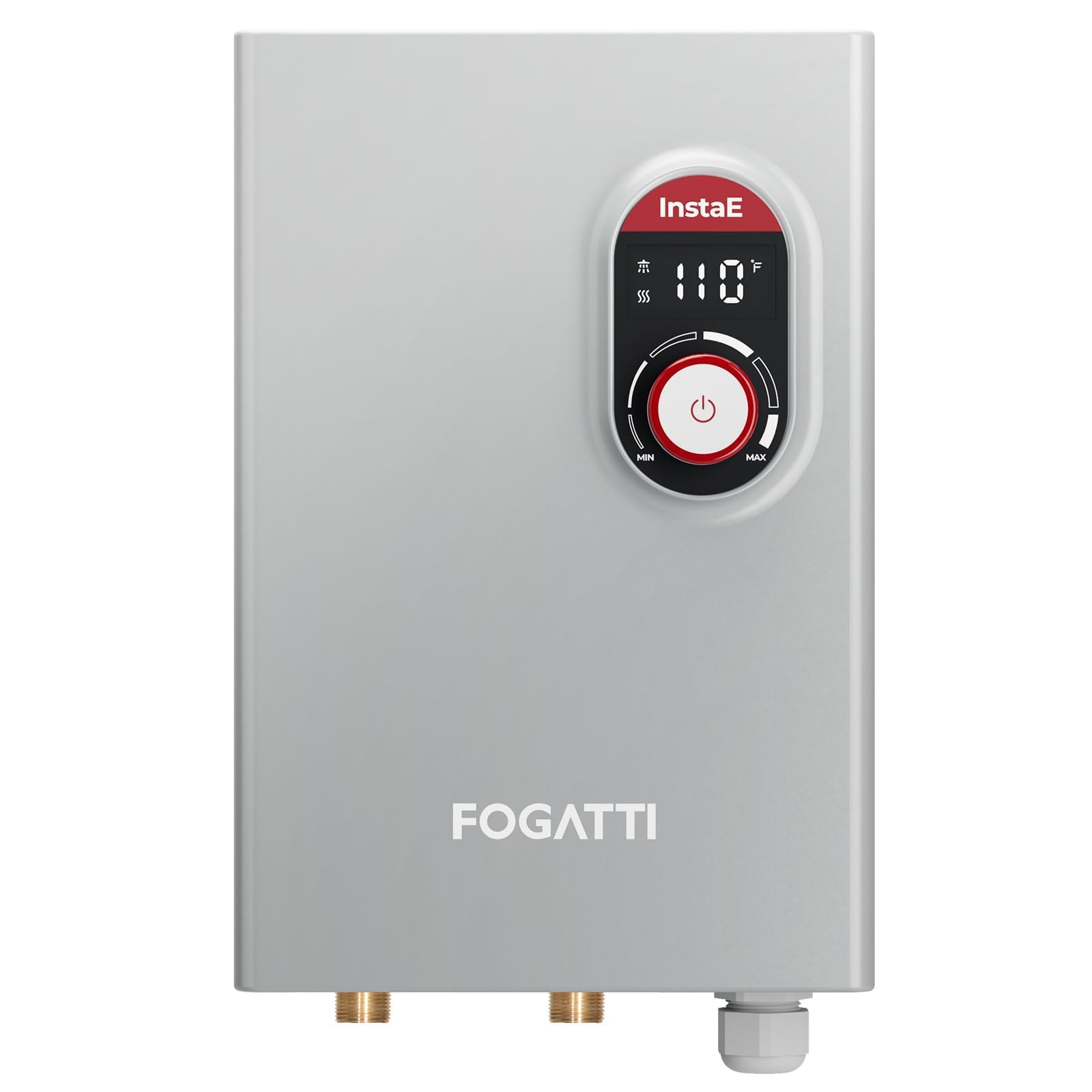
4. Fogatti 11kw Tankless Water Heater
A cabin-sized heater that holds temperature to within a single degree.
The control system is the reason to look at this one. A smart chip adjusts 20,000 times per second to hold output at ±1°F of your setting, and the LED display with knob control spans 86°F to 140°F. That level of stability matters in a tiny house or a guest cabin where the plumbing run is short and every degree shows up instantly at the tap. It delivers max 2.6 GPM at 77°F inlet and 110°F outlet, and needs 0.5 GPM flowing to activate.
Electrically, it is a single 240-volt dedicated circuit with one 50-amp breaker and a set of 8AWG wire plus 1/2″ NPT connections. That means no 120-volt option and no 15 or 20-amp feed — check your panel capacity before ordering and bring in an electrician if you are unsure. The housing is iron, it is ETL certified with overheat and leak protection, and the compact 14.3 x 9.6 x 3.5-inch body mounts on a wall in confined spaces, with the maker listing a 3-second heating response.
What gets mentioned most with this unit is how it functions in real rooms — running two showers and a sink while still coming up to temperature quickly on only 60 amps of draw. The catch is temperature control in the cold months. Buyers here in a two-point setup get stable heat under mild conditions, but the same water getting cold mid-shower shows up when incoming water is colder and the demand is higher. Treat the two-point rating as a fair-weather figure and run it single-point in winter.
Practical verdict: the tightest temperature control on this list, and a genuinely compact body for a cabin, apartment, or small rental.
Set expectations: the two-point use is conditional — colder inlet water means single-point only for stable temperature.
Choose it for: small dwellings where precise temperature and a small footprint beat fixture count.
Look past it if: you need simultaneous fixtures in cold climates.
5. 14kW Tankless Water Heater
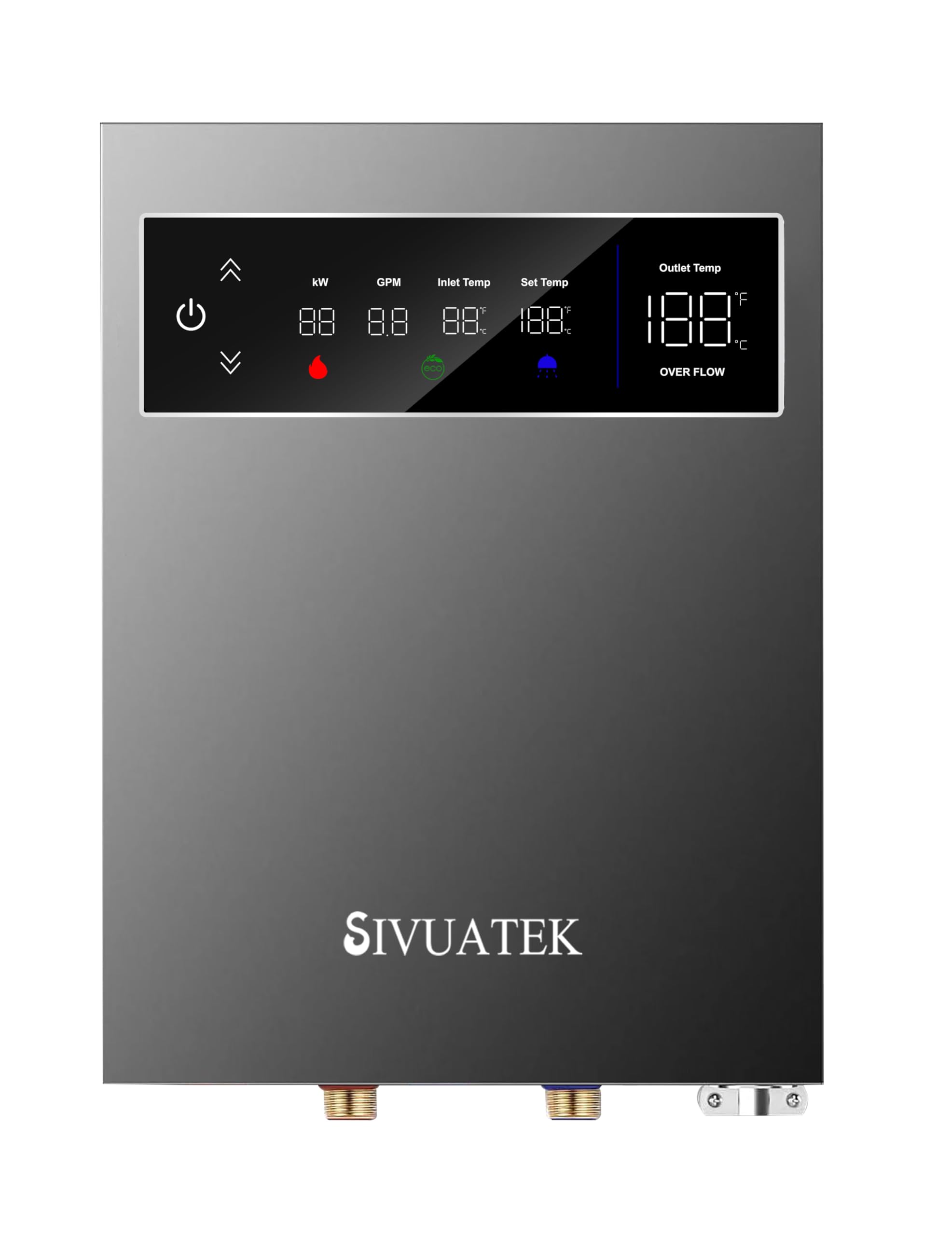
A 60-amp setup sized for a kitchen tap and a shower running at the same time.
Three numbers define this heater. It delivers a 3.3 gpm flow rate, it is rated at up to 99.8% thermal efficiency, and it runs on a single 60-amp breaker. That last figure is the practical one — one breaker slot rather than the three that whole-house giants like the Rheem RTEX-24 demand. It is rated for one to two simultaneous usage points such as a kitchen and a bathroom, with an LED display that sets temperature from 86°F to 131°F in precise 1°F increments.
The build uses water-electricity separation to keep scale off the element, plus leakage protection, overheating protection, and auto shut-off. The display reports inlet and outlet temperature along with flow and kW, which turns troubleshooting into reading a screen instead of guessing. Wiring is simpler than many competitors because you do not have to disassemble the housing to reach the terminals, and the unit is 15.87 inches deep with standard 1/2″ NPT connections. The body is aluminum, brass, and metal, and it holds steady output through water pressure swings.
Where it shines in daily use is the consistent shower — buyers describe steady temperature and easy setup, and the space-saving shape earns real praise for tucking away out of sight. The honest wrinkle is twofold. It is not truly instant: a bathroom ten feet away can take around 15 to 20 seconds to run hot, because the water has to travel. And temperature control draws mixed reports, with some showers fluctuating between cold and hot. Both are real, and both are manageable if you size expectations to a two-fixture unit rather than a whole-house monster.
Strong Points
- 3.3 gpm at up to 99.8% thermal efficiency — strong output for one 60-amp circuit.
- No standby loss, and the maker cites up to 50% lower water heating costs than a tank.
- LED readout shows inlet/outlet temp, GPM, and kW for easy diagnostics.
- Housing need not be opened for wiring, speeding installation.
Honest Limits
- Not instant — a nearby tap can take 15 to 20 seconds to heat.
- Some showers show temperature fluctuation under heavy demand.
- One 60-amp breaker is a real demand on your panel.
Right call for: a one-bathroom home or small build that wants the kitchen and shower on a single 60-amp circuit.
Reconsider if: you expect truly instant heat at a distant tap or run multiple fixtures hard.
6. EcoSmart ECO 8 Tankless Water Heater, Electric, 8-kW

A cottage and camper specialist that gets moved off-season.
At 4.8 pounds with a 2 gpm flow rate, this is the lightest heater on the whole list and the obvious one to pull off the wall when the season ends. Owners run it in beach cottages, bonus rooms, and campers — one wired it with a 4-prong 40-amp RV-style plug so it could be dismounted easily during the off-season. It is rated at 8 kW of heat output with 99.8% efficiency and 2 gallons of capacity, in a compact 8″W x 11.5″H housing that fits where tanks will not.
The trade-off of a small heater shows up in the heating. It is not fast — water can take a while to come hot at the tap, and one camper owner noted the wait feels like wasted water while the heating catches up. The flow matters too; at 2 gpm it suits a single fixture and struggles if you expect a full shower at a brisk rate. On the plus side it is easy to wire, budget-friendly, and owners consistently value being able to set an exact temperature of their choosing.
If you are fitting out a seasonal spot, this is a sensible, low-risk starting point that many owners treat as a permanent fixture. Keep in mind the warranty path — registration has been reported to call for a licensed installer, so if you plan to wire it yourself, read the fine print before you cut into the drywall.
Honest take: the cabin and camper pick, and the lightest option here by a wide margin, but heating speed and flow are modest by design.
Worth knowing: warranty registration may want a licensed installer, so plan the install accordingly.
Suits you if: you want an easy-to-wire seasonal unit for one fixture and are fine with a short warm-up.
Pass on it if: you want hand-washing hot water the moment you turn the tap.
7. CAMPLUX Electric Tankless Water Heater 27kW 240V

Twenty-seven kilowatts aimed squarely at a whole-house shower.
For buyers who need to feed a shower rather than a sink, this one leads with a 27 KW heat output and a 3-second response time, with a minimum activation flow of just 0.66 GPM. It is up to 99.8% efficient and self-modulating, which auto-adjusts the energy used based on the water temperature and flow at that moment. That efficiency matters because it saves the maintenance overhead of a water softening system by keeping scale off the heating elements, separated from the water pipe.
The install requirements are substantial and worth stating plainly: three 8AWG conductors, a 3/4″ NPT water connection, and a digital display showing current water temperature with a small red light indicating heating. Output runs between 80°F and 140°F, working pressure tops out at 150 psi, and the box measures 17.12″ x 13.12″ x 3.12″. Camplux backs it with 2-year parts, 3-year leak-free, and 3-year tech support.
What people notice is that it simply works, and the installation is quicker than expected — one buyer had it running in an hour with few plastic parts to worry about. The catch arrives with the cold. In summer it keeps pace, but several note that in winter it struggles to keep water hot, and one report has the unit capping around 123°F when they wanted 140°F. Treat the flow and temperature figures as figures under good incoming conditions, and size to your coldest months.
What It Delivers
- 27 KW of heat output with a 3-second response and 0.66 GPM activation.
- Self-modulating control at up to 99.8% efficiency.
- Heating elements separated from the water pipe to limit scale buildup.
- 2-year parts, 3-year leak-free, 3-year tech support.
The Catch to Weigh
- Cold-inlet performance drops — winter can leave water short of the 140°F mark.
- Needs serious electrical capacity, including three 8AWG conductors.
Good fit when: a shower is the main job and you have the panel capacity to back a 27 KW unit.
Not ideal for: buyers in cold climates who need full temperature in winter.
8. Electrolux 18kW Tankless Water Heater
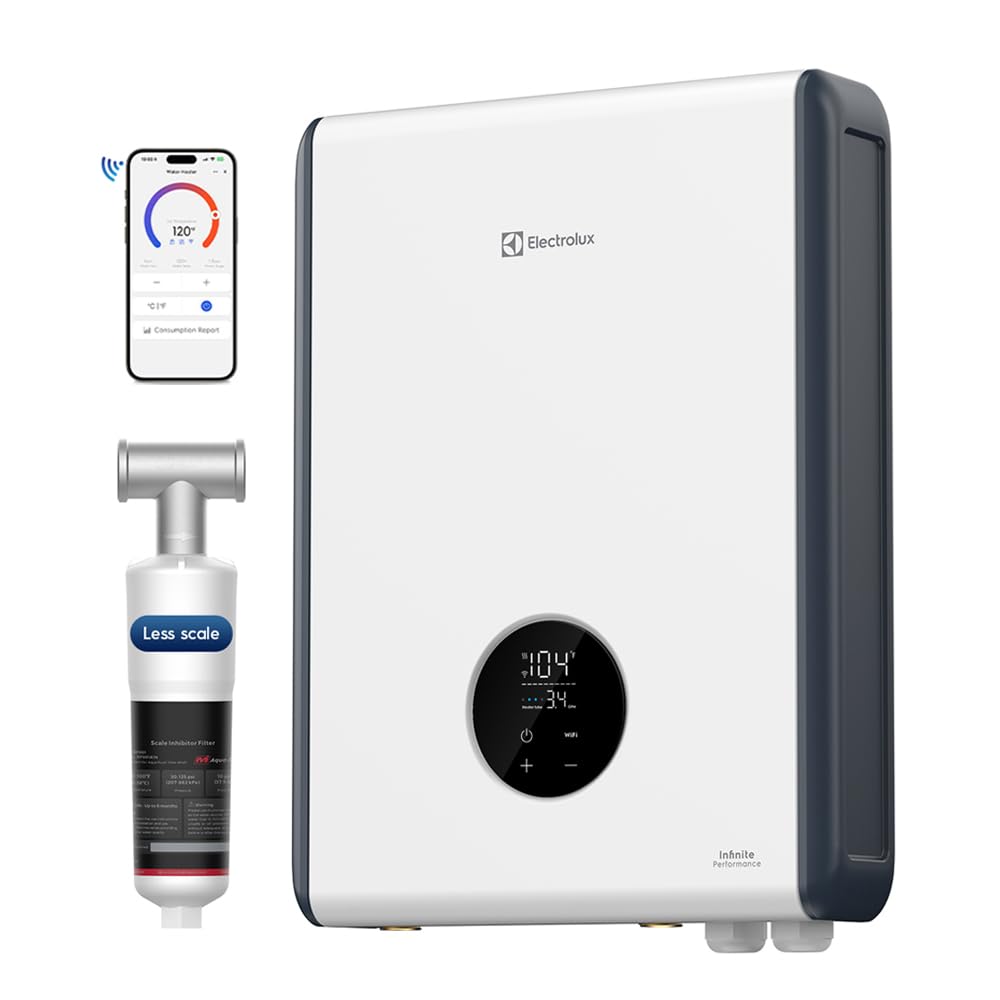
Two bathrooms, one app, and a scale inhibitor built in.
At 18 KW with a 4.2 gpm flow rate, this heater is sized for multi-point use such as one bathroom plus one kitchen. The differentiator is the controls: it connects over WiFi so you can adjust and monitor settings from the app, and it works with Alexa for voice commands. That means you can raise the temperature before you step into the shower without walking to the unit. It comes with a scale inhibitor included, which helps reduce scale formation in the water line — a real advantage if you live on hard water.
You get steady heat because the heating chamber is copper and senses water flow, so it heats on demand. The unit is rated to hold temperature within 1°F, so your shower stays even. Built-in safety covers dry-fire (running with no water) and overheat protection. Read the electrical requirements twice: the company recommends a 150-amp or larger household service. It also needs two separate 240-volt circuits, each on its own 40-amp double-pole breaker, with two sets of 8AWG copper conductors plus ground. That is a serious electrical ask. The unit weighs 15.4 pounds, runs to 140°F, and comes with at least a one-year warranty for the whole machine.
This is the premium-priced pick for a modern smart home, and the app control plus scale inhibitor are the reasons to pay for it over a plainer unit. The one caution is documentation — with two circuits and a 150-amp service recommendation, less experienced buyers should have the electrical plan reviewed before committing.
The value case: app and Alexa control plus a built-in scale inhibitor, in a unit sized for a bathroom and a kitchen together.
Plan for: two separate 40-amp double-pole circuits and a 150-amp or larger household service.
Reach for it if: you want app control and hard-water protection in a two-bathroom home with the panel to support it.
Hold off if: your service panel is smaller or you cannot run two dedicated circuits.
9. Westinghouse 24kW Tankless Water Heater
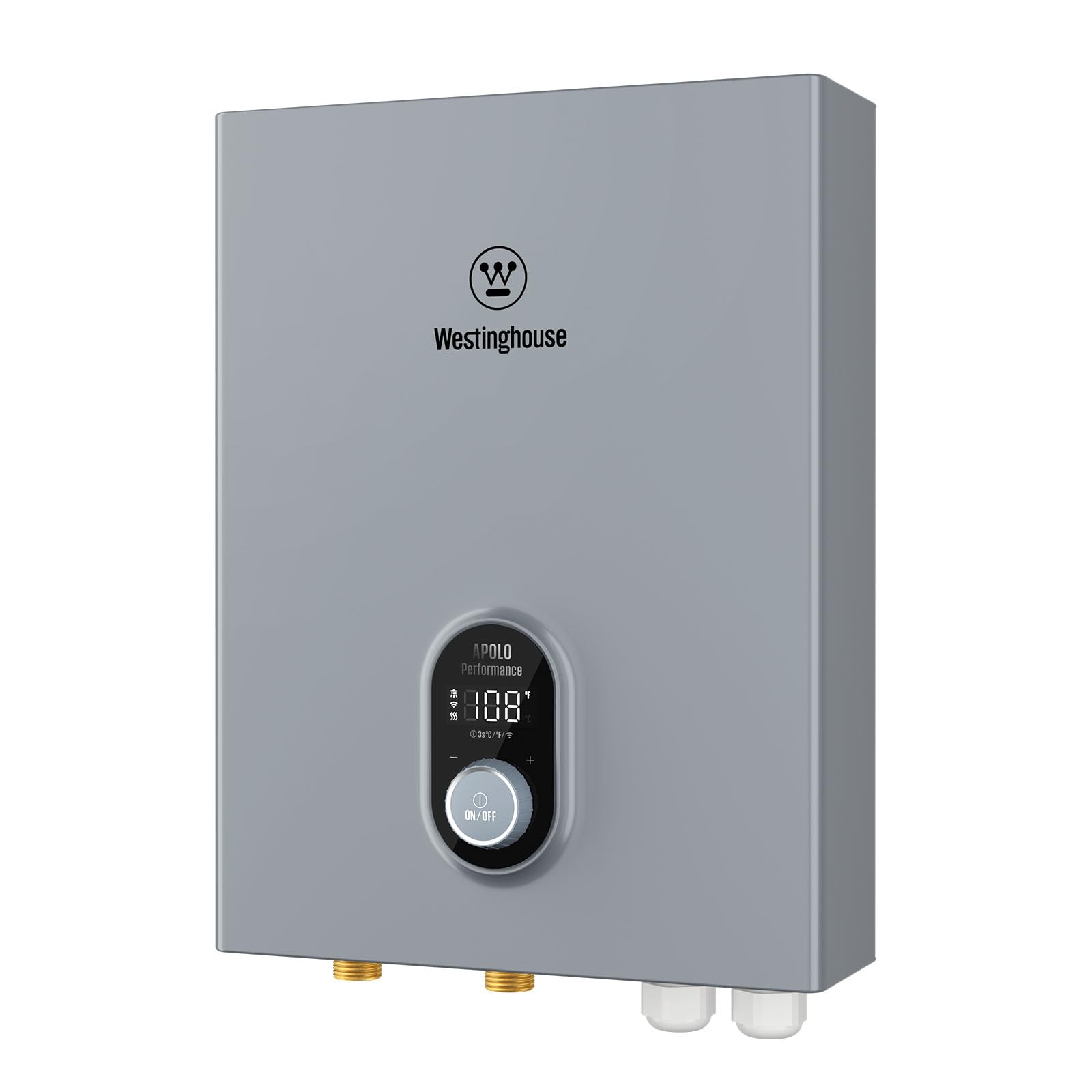
Whole-house output with voice control and a 0.79 GPM start.
You get a lot of hot water without a heavy draw to trigger the heat, thanks to a 5.56 gpm flow rate and a 0.79 GPM starting flow. It is ETL certified (a safety testing standard), rated at 24000 watts of heat output, and designed as a whole-home unit for two to three bathrooms. WiFi lets you adjust temperature and monitor usage from an app, and it works with Alexa and Google Home for voice control.
The electrical setup is the make-or-break detail: 100 amps of current, three 40-amp double-pole breakers, and three sets of 8AWG wire, with 3/4-inch NPT connections at the bottom. The body measures 17″ H x 13″ W x 4.3″ D, mounts flush to the wall, and takes up no floor space, with a maximum pressure of 120 psi. It is designed to serve a bathroom, kitchen, or office restroom continuously.
What buyers confirm is that it does what it says — hot water delivered fast, consistently, without surprises once installed. The caveat is the electrical demand catching people off guard. One buyer described shopping hard for it, then realizing the amp requirement exceeded what their home could offer, and never even opening the box. That is the exact check to do first: three 40-amp breakers and 100 amps is not something every panel can spare.
Why It Stands Out
- 5.56 gpm flow with a low 0.79 GPM activation for a whole-home unit.
- WiFi app control plus Alexa and Google Home voice commands.
- Flush wall mount at 4.3 inches deep, savings floor space.
- ETL certified for two to three bathrooms.
Do This First
- Draws 100 amps — three 40-amp double-pole breakers and three sets of 8AWG wire.
- Many older panels simply cannot spare that, so verify capacity before ordering.
Pick it when: you want whole-house flow and smart controls and your panel can feed three 40-amp breakers.
Skip it when: your electrical service cannot support 100 amps of dedicated load.
10. Rheem RTEX-24 24kW 240V Electric Tankless Water Heater, Gray

The flow king for multi-fixture homes, with a breaker count to match.
A family can run several fixtures in sequence without stepping into cold water, because the 5.9 gpm flow rate is the highest of the whole-house group. It matches the Westinghouse top figure and clears the Electrolux 4.2 gpm by a wide margin, which is why this model suits larger households. It is a 24 KW unit with digital thermostatic controls set in 1-degree increments from 80°F to 140°F. It complies with the maker’s recommendations for three 40-amp double-pole breakers on three sets of #8 AWG copper wire and a 200-amp household panel.
Build-wise, this is the unit that packs the most into a small footprint: 17.63″W x 18.25″H at 3.5 inches deep and 17.8 pounds, freeing floor space that a tank would claim. The maker notes it is no venting required compared with a gas tankless heater, so the install avoids that entire step, and it is backed by a 5-year leak and 1-year parts warranty. Space saving and unlimited supply are what buyers keep coming back to.
The honest note is the heating-demand trade-off. It gives plenty of hot water, but it takes a lot of electrical power to do so, and some buyers find it less efficient per gallon than they hoped. There is also a mixed reliability signal — most units run well for years, but at least one account describes a coil failing inside the first year with a replacement that did not cover the melted housing. That is a small share of the field; treat it as the reason to ensure the warranty terms are clear before install, not as a reason to write off the model.
The verdict: if your panel can carry three 40-amp breakers and your household runs multiple fixtures, the 5.9 gpm output and 1-degree control justify the wiring work.
The real cost: high electrical demand, and a few durability comments suggest confirming the warranty path first.
Made for you if: you have a 200-amp service and want the top flow figure for a busy household.
Choose another if: your service panel cannot support three double-pole breakers.
11. Stiebel Eltron Tempra 29 Plus Tankless Water Heater
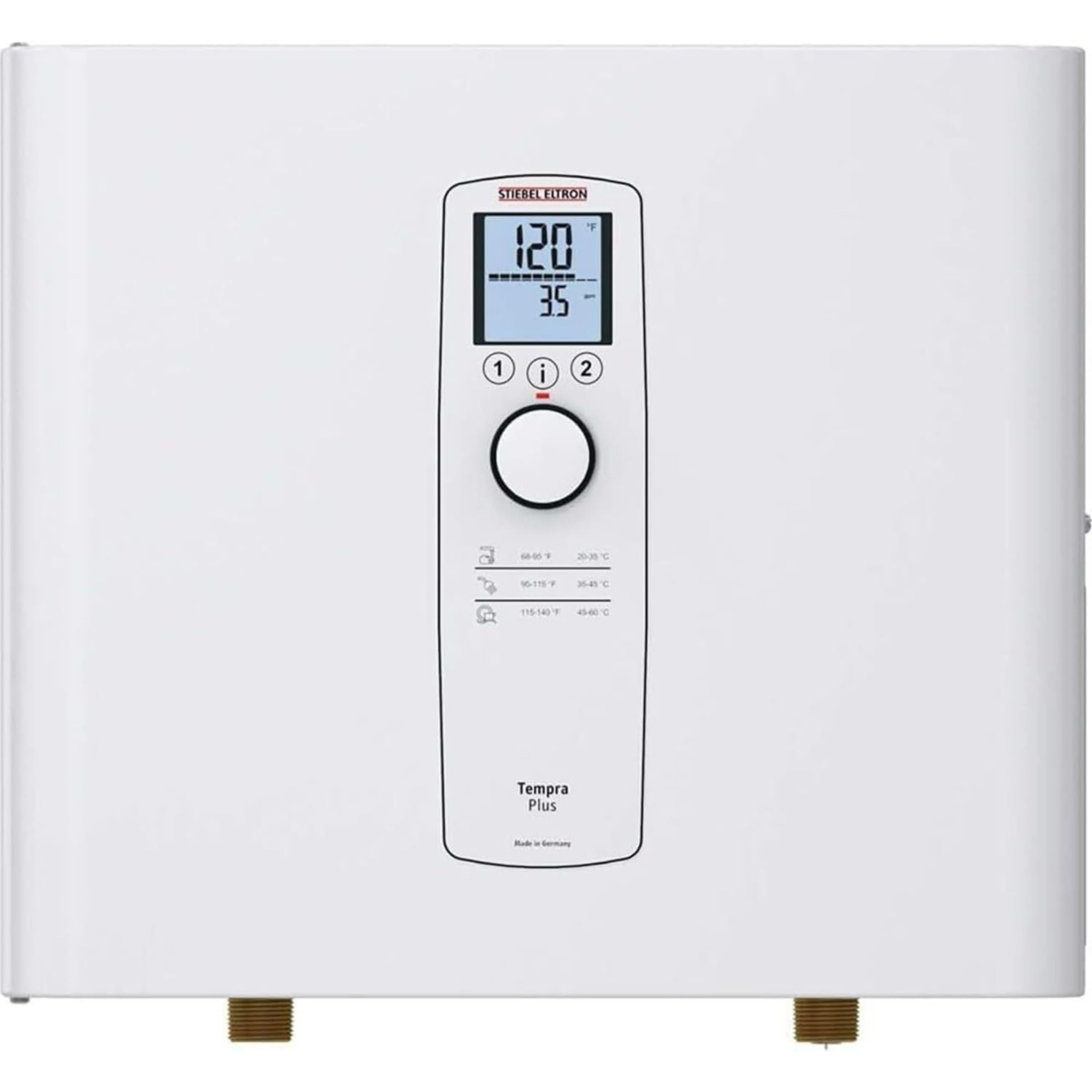
German-engineered power with two memory presets and a flow caveat.
This is the top of the electrical pyramid here: 28800 watts at 240 volts, 19 pounds, and a 3 gpm flow rate with an Advanced Flow Control system. It is made in Germany, offers two temperature memory presets so you can jump between settings without dialing, and is rated for up to 34% energy savings in whole-home use. The trade-off of that efficiency is the service demand: three separate 40-amp breakers, 8-gauge copper wire, and a 200-amp minimum household panel are required.
Owners mention continuous hot water and no trouble in normal use. One buyer reports about ten years of service for a little under eight hundred dollars. Performance is what carries it, and the copper construction points to a build meant to last.
Know the flow behavior before you order. This unit has a much lower flow than a whole-house tank, because it is designed for a specific mix of fixtures. It needs roughly 0.8 GPM per minute of throughput or it simply will not turn on. That trips up buyers who assume the highest wattage means feeding everything. Run it within its fixture count and it works well. Push it past the flow tolerance or try a single low-flow tap and it may not activate at all.
Where the Money Goes
- 28800 watts at 240 volts with Advanced Flow Control and two presets.
- Made in Germany, copper construction, up to 34% energy savings in whole-home use.
- Continuous, unlimited hot water that owners describe as trouble-free.
The Flow Catch
- Needs about 0.8 GPM flowing or it will not switch on.
- Three 40-amp breakers plus an 8-gauge feed at 200 amps total is a heavy demand.
- The lower flow suits set fixture combinations, not free-flowing multi-use.
Worth the outlay if:
Cross it off if: you need to feed low-flow taps or cannot supply three dedicated breakers.
Know the Specs
Flow rate in GPM
GPM stands for gallons per minute — how much hot water the unit can push through as it heats. A single sink unit in this list runs around 1.07 gpm, while a whole-house model can reach 5.9 gpm. More flow means more taps can run at once, but it also demands more heating power and a bigger electrical feed. Buy to the number of fixtures you actually run together, not the number you might run someday.
Temperature rise
Temperature rise is the gap in degrees Fahrenheit between the cold water coming in and the hot water going out — often quoted at a specific rise like 35°F. The same unit gives you less hot water when incoming water is colder, which is why winter showers expose undersized heaters. If your groundwater runs cold, choose a higher output or plan for single-fixture use in the colder months.
Breaker size and wire gauge
Every electric tankless heater is hardwired, so the breaker count and wire gauge decide whether it can run in your home at all. Small point-of-use units use a single 30-amp breaker and 10AWG wire, mid units use a 40-amp double-pole breaker with 8AWG, and whole-house behemoths need three 40-amp double-pole breakers with #8 AWG copper. Check your panel for open slots before you buy.
Self-modulating heating
Self-modulating means the heater reads water temperature and flow continuously and feeds the element only the energy needed at that moment. That is what delivers the efficiency figures you see, often in the 99% range, and it is why customers note lower bills compared with a tank that reheats stored water around the clock. It also helps hold a steadier output temperature as flow changes.
Common Questions
Can I install an electric tankless water heater myself?
What size breaker do I need for a tankless electric water heater?
Will a tankless electric water heater work with a small electrical panel?
How do I know if a unit is big enough for my shower?
Do tankless electric heaters work in cold climates?
How long does a tankless electric water heater last?
Do I need to change the wire gauge when switching from a tank heater?
Do these units save money on my electric bill?
Is WiFi control worth having on a water heater?
What temperature range do these units reach?
The Bottom Line
For most households, the tankless electric hot water heaters winner is the TNKLS WTRHTR11.8KW TITAN. Its 10 gpm flow rate is the highest here, and it slips into the smallest space on the list at 2.75 inches deep. If you want whole-house capacity with app and voice control, grab the Electrolux 18kW and its built-in scale inhibitor. For a single stubborn sink, reach for the ThermoMate 6kW. Whichever you choose, verify your breaker capacity first. No rating adds a spare breaker slot to your panel.
How we choose
We do not accept paid placement. Every pick is matched to a real buyer and a real use-case; we do not hands-on test units.
Sources
Specifications: manufacturer listings and product documentation. Review insights: verified customer reviews, as of November 2026. Pricing: not shown on this page (it changes often); check the current price via the retailer link.
As an Amazon Associate, Tactical Gear Guy earns from qualifying purchases. This does not affect which products we feature.