Specs are compiled from manufacturer listings and verified buyer reviews and can change over time — please confirm the key details on the product page before buying.
If you have ever worn a cheap plastic poncho in a real downpour, you already know the problem: it flaps like a trash bag, it soaks through at the shoulders, and it is shredded by the time you reach the tree line. What you need instead is a tactical rain poncho — a hooded, rugged rain shell that covers you and your pack, packs down small, and can double as a shelter or ground sheet when you stop moving. The nine picks below all clear that bar. The Hazard 4 PonchoVilla takes the top spot because its softshell fabric moves quietly and carries a 10,000 mm waterproof rating (a measure of how much water pressure the fabric holds back before it leaks — 10,000 mm handles steady, wind-driven rain).
This guide is built by comparing the manufacturers’ published specifications and the patterns across verified customer reviews, so you get each pick’s real strengths and trade-offs instead of marketing spin.
Below you will find a plain-English breakdown of waterproof ratings, fabric types, packability, and how each poncho behaves as a shelter — plus the honest fit and durability notes that decide whether a poncho works for your body and your kit. Every pick here is a genuine hooded rain poncho built for field use, and the right one for you depends on how much pack coverage and quiet you need. Here is the honest shortlist of the tactical rain poncho picks worth your kit budget.
Top Picks


How To Choose The Best Tactical Rain Poncho
A tactical poncho is not a fashion raincoat. It is a piece of field kit that has to do three jobs at once: keep you and your rucksack dry while you are moving, stay quiet enough not to give you away, and convert into a shelter when you stop. Most buyers get burned by treating it like a disposable emergency poncho and buying the thinnest thing on the shelf. The sections below cover the specs that actually decide whether a poncho survives a season in the field.
Waterproof Rating and Seam Taping
The waterproof rating is written in millimeters, and it measures how tall a column of water the fabric can hold back before moisture pushes through. A 3,000 mm rating like the onewind handles ordinary steady rain; a 10,000 mm rating like the Hazard 4 handles harder, wind-driven weather. Equally important is seam taping — the taped strips that seal the stitched seams, which is where most ponchos leak first. A high rating with untaped seams will still wet you out at the shoulders.
Fabric: Ripstop, Silnylon, and Softshell
Ripstop nylon uses a grid of thicker threads so a small tear stops at the grid line instead of running down the panel. Silnylon (silicone-treated nylon) is lighter and packs smaller but tends to be the noisiest. Softshell fabric — a stretchy, woven material rather than a slick coating — moves with your body and stays quiet, which is why hunters and range users pay more for it. If noise matters where you operate, softshell or ripstop beats a crinkly plastic shell every time.
Coverage, Hood Fit, and Wearing It Over a Pack
The hood opening is the most common complaint across the whole category. A snug hood will not fit over a helmet or a ball cap, and a short poncho will not cover a loaded rucksack. Look for an adult length that drapes past your pack and a hood with adjustable drawcords or a neckline zipper, so you can open it up when you are wearing headgear. Side snaps and press studs also let you form sleeves or close the sides against wind.
Turning It Into a Shelter
Grommets (the metal-rimmed holes along the hem) are what let you peg a poncho out as a tarp, ground sheet, or emergency shelter. Copper or heavy-duty metal grommets hold up better than thin plastic ones. Corner eyelets plus a few feet of cord give you a quick lean-to when the weather turns. If shelter use is part of your plan, count the grommets before you buy.
Side-by-Side Comparison
| Model | Best For | Waterproof Rating | Fabric | Weight | Amazon |
|---|---|---|---|---|---|
| HAZARD 4 PonchoVilla★ Best Overall | All-around field use | 10,000 mm | Softshell (86% poly / 14% spandex) | — | Amazon |
| LOOGU Ripstop PonchoBudget Champion | Budget tarp + poncho | — | 210T ripstop nylon, PVC coated | — | Amazon |
| WINWAY Military Style PonchoBest for Hunting | Quiet hunting cover | — | 210T polyester, PU coated | 0.67 lb | Amazon |
| Fousam Camo Poncho | All-day rain coverage | — | Ripstop polyester | 12 oz | Amazon |
| Urby Plus Size Poncho | Larger frames | 100% waterproof backing | Rip-resistant polyester | 14.4 oz | Amazon |
| onewind Silnylon Poncho | Backpacking light | 3,000 mm | 1.1oz Silnylon ripstop | 235 g / 8.3 oz | Amazon |
| Rothco G.I. Rip-Stop Poncho | Classic G.I. look | — | Rip-stop nylon | — | Amazon |
| MFH US Poncho Ripstop | Two-poncho basha | 100% waterproof | Ripstop material | — | Amazon |
| Hazard 4 Poncho Villa MK2 (Coyote) | Modular gear rigs | 10,000 mm | Softshell | 2.29 lb | Amazon |
Detailed Reviews
1. HAZARD 4 PonchoVilla Tactical Poncho
Our pick — 4.5+★ from 300+ verified ratings; the strongest balance of quality and price.
The softshell poncho that moves like fabric, not like a plastic bag in the wind.
The thing that wins people over here is quality of build. The PonchoVilla is cut from an 86% polyester, 14% spandex softshell — a stretchy woven fabric rather than a slick coated shell — so it flexes with your shoulders instead of crinkling. Fully seam-taped construction and a 10,000 mm waterproof rating give you a shell that stands up to hard, sideways rain and blocks wind at the same time. It drapes over your torso, upper legs, and gear, so you can keep moving without fighting the fabric.
Packability and multi-function are where it earns its place in a kit. It stuffs into its own front pocket for fast storage, and the perimeter grommets (the metal-ringed holes along the hem) let you peg it out as a shelter or lay it down as a ground cover. MOLLE panels and loop fields — the webbing rows and velcro patches used to mount tactical gear — let you add pouches or IDs. The hood has adjustable cinchers, the sides have snaps, and it will take an optional fleece liner sold separately for colder weather.
The honest trade-off is water resistance at the edges of a storm. Some field users find it keeps them bone dry, while others report it stops being waterproof — so treat the fabric’s DWR finish as something you renew over time, and do not expect plastic-poncho levels of invincibility. Value is the other split opinion; this is a premium-tier softshell and it is priced like one. Compared with the cheaper ripstop options here, you are paying for the quiet fabric and the modular panels, not for a thicker coat.
What earns it the top slot
- 10,000 mm waterproof rating with fully taped seams blocks wind-driven rain
- Quiet, stretchy softshell fabric that moves with you instead of crinkling
- MOLLE panels and loop fields for mounting pouches and gear
- Stuffs into its own front pocket and converts to a shelter via perimeter grommets
Where it asks more of you
- Waterproofing confidence splits between owners — re-treat the coating over time
- Premium-tier cost for a softshell rather than a simple ripstop shell
Go for it if: you want one quiet, modular poncho that dresses over a pack and a vest without a crinkle of noise, and can become a shelter in seconds.
Think again if: you want the cheapest possible rain cover or expect a softshell to shrug off a soaking exactly like a plastic tarp.
2. LOOGU Rain Poncho Waterproof Hooded Rain Coat
A camo tarp-and-poncho combo that stretches a small budget into a whole shelter kit.
For entry-level money you get a 210T ripstop nylon shell with an inner PVC coating — the ripstop grid keeps a snag from running into a full tear, and the coating is the water barrier. The adult sizing is 55 x 41 inches (length x width), big enough to drape over a loaded hunting backpack with room left over. It comes with a storage bag that closes for rain protection or opens flat to boost coverage as a tarp.
The multi-purpose angle is real. Spread it out and it becomes a bigger shelter, a tent, a ground sheet, or a sleeping bag cover. The green, tree, and woodland camo versions add a neckline zipper, which solves the classic problem of a head opening that is too small for some wearers. Owners rate the water resistance and value highly, and consistently call the 55 x 41 inch cut genuinely large.
Two things to know before you commit. Fit splits down the middle — some find it perfect, others find the head opening tight — so the zippered colorways are the safer bet if you wear a cap. Durability also divides opinion: some call it heavy duty and long-lasting, others report it rips easily, so keep it away from sharp brush and branches. Compared with the softshell Hazard 4 above, this is a much simpler coated shell — cheaper, but noisier and without the modular panels.
Where the value sits: a large-dimension ripstop shell that converts into a ground sheet or tarp, with a neckline zipper on the camo versions to fix the tight-hood problem.
Reach for this if: you want one budget poncho that also works as a tarp and ground sheet on a hunting or camping trip.
Look elsewhere if: you need a softshell-quiet shell or plan to push through heavy brush, where a coated ripstop can snag.
3. WINWAY Military Style Poncho Multi Use Rip-Stop
At 0.67 lb, this is the poncho you forget is in the bottom of your pack until the sky opens.
Weighing just 0.67 lb, the WINWAY folds into its carry bag and tucks into a rucksack without eating space — exactly what you want in a piece of kit you carry “just in case.” The shell is a 100% polyester 210T ripstop with two layers of polyurethane (PU) coating, which is the water-blocking layer. The 210T fabric is chosen to keep noise down, so it does not rustle like a plastic emergency poncho when you shift position in a blind.
It is built for more than rain. The omni-protect hooded cut covers you and your gear during long airsoft events, fishing trips, hiking, and camping. Lay it out and it doubles as a survival shelter, waterproof floor, water-collection sheet, privacy screen, or sun canopy. The camo pattern gives strong concealment for hunting and tactical work, and owners consistently call it a military-grade essential that keeps them dry through the rainy season.
The catch is durability at the seams of hard use. Some find it fairly durable while others report it is not very durable and easy to rip, so this is a light-and-packable pick rather than a bombproof one. Fit splits too — some say it fits like a champ, others find it too small to go over headgear. Compared with the LOOGU above, it is lighter and quieter but similar in the ripstop-nylon family.
The weight-versus-ruggedness call: you get a 0.67 lb, noise-reduced 210T shell that packs tiny and covers you and your gear — the trade is that thin fabric demands care around thorns and sharp kit.
Pick this if: you want the lightest quiet camo cover for hunting, airsoft, or a bug-out bag.
skip it if: you need to wear it over a helmet or want a shell you can abuse without worrying about a tear.
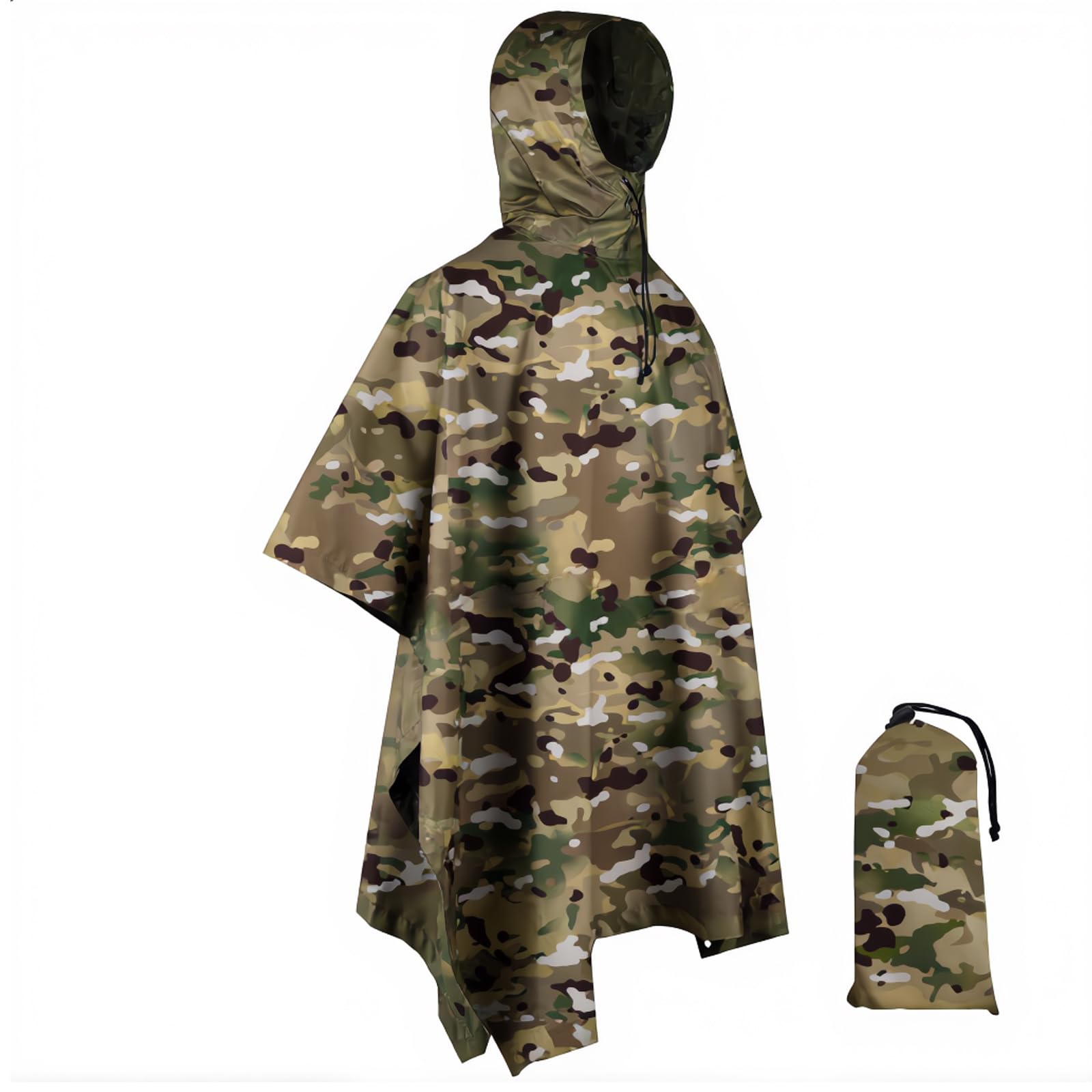
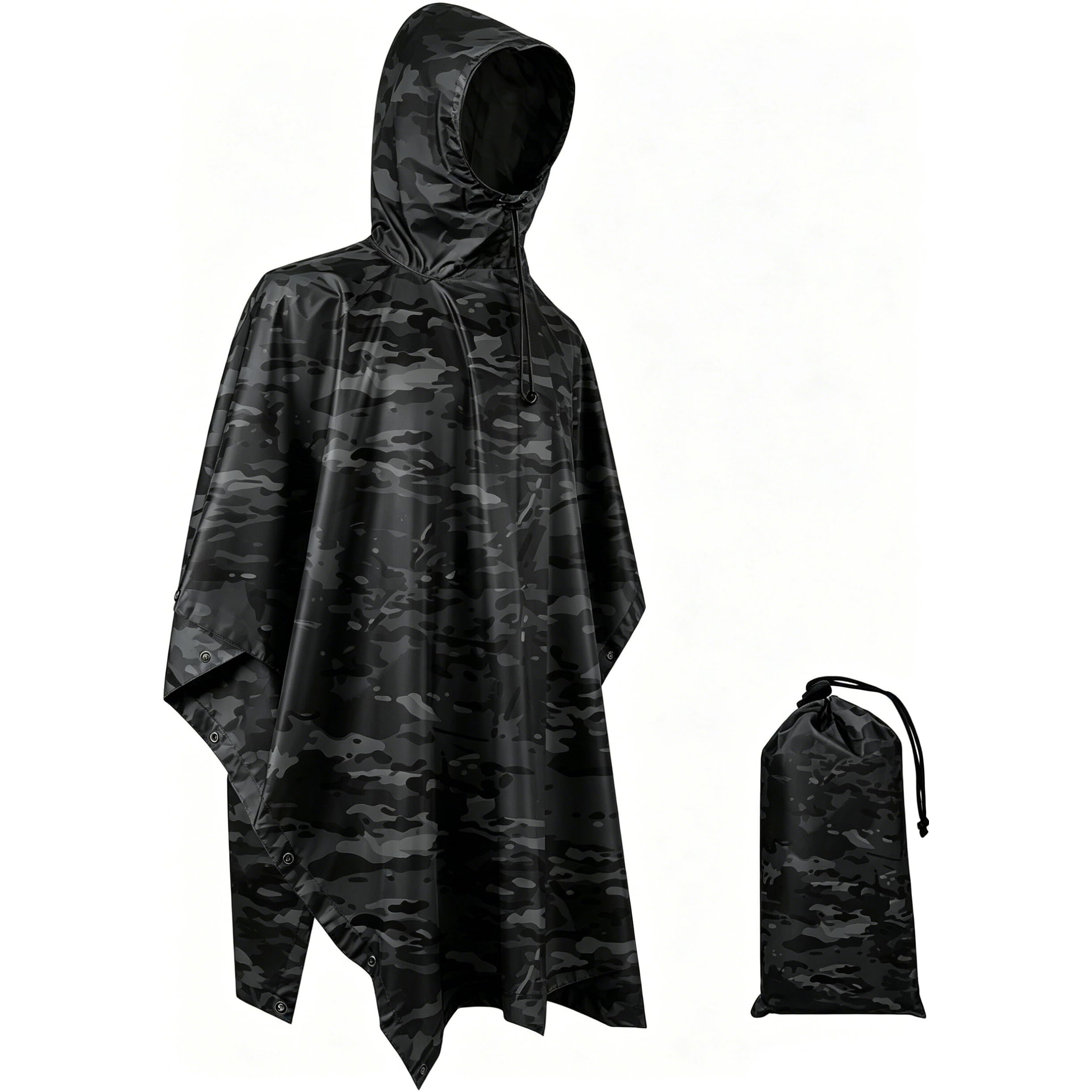
4. Fousam Camo Rain Poncho, Multi Use Waterproof Rain Coat
Built to hang in through an all-day soaker, with hardware that outlasts cheap plastic snaps.
This one is aimed at the hunter or hiker who gets rained on from dawn to dusk. The shell is a tear-resistant ripstop polyester, waterproof and breathable, cut long at 41 inches (82 inches fully extended) so it reaches past your pack and keeps your legs drier on wet days. At 41 x 55 inches it spreads wide enough to serve as a temporary shelter or awning. It weighs 12 ounces and folds into a compact carrying bag for any pack or go-bag.
The hardware is a step above the budget crowd: six heavy-duty copper grommets let you tie it off to trees or stakes as an emergency tent, and the metal buttons are more durable than the plastic ones on cheaper ponchos. Adjustable drawstrings let you mold the hood to your head size, and side snap buttons let you cinch the cut to your body. Buyers report it keeps them dry through all-day rainstorms, and the camo pattern draws steady praise.
Two fit caveats to weigh. The hood runs small for some wearers and the whole poncho can run a bit small, so check your size against the 41-inch length. The snaps are the recurring weak point — a few report them breaking off early — so go easy when you pop the sides open. Still, the six copper grommets and metal buttons make this a sturdier shelter-conversion kit than the WINWAY above.
Shelter hardware done right: six copper grommets and metal buttons make tying this out as a tent or awning a reliable job, not a fight with flimsy fasteners.
Best for: the hunter or camper who wants a long, breathable camo shell that turns into a proper shelter.
Watch out for: a snug hood and side snaps that need gentle handling — not the poncho for a very tall frame.
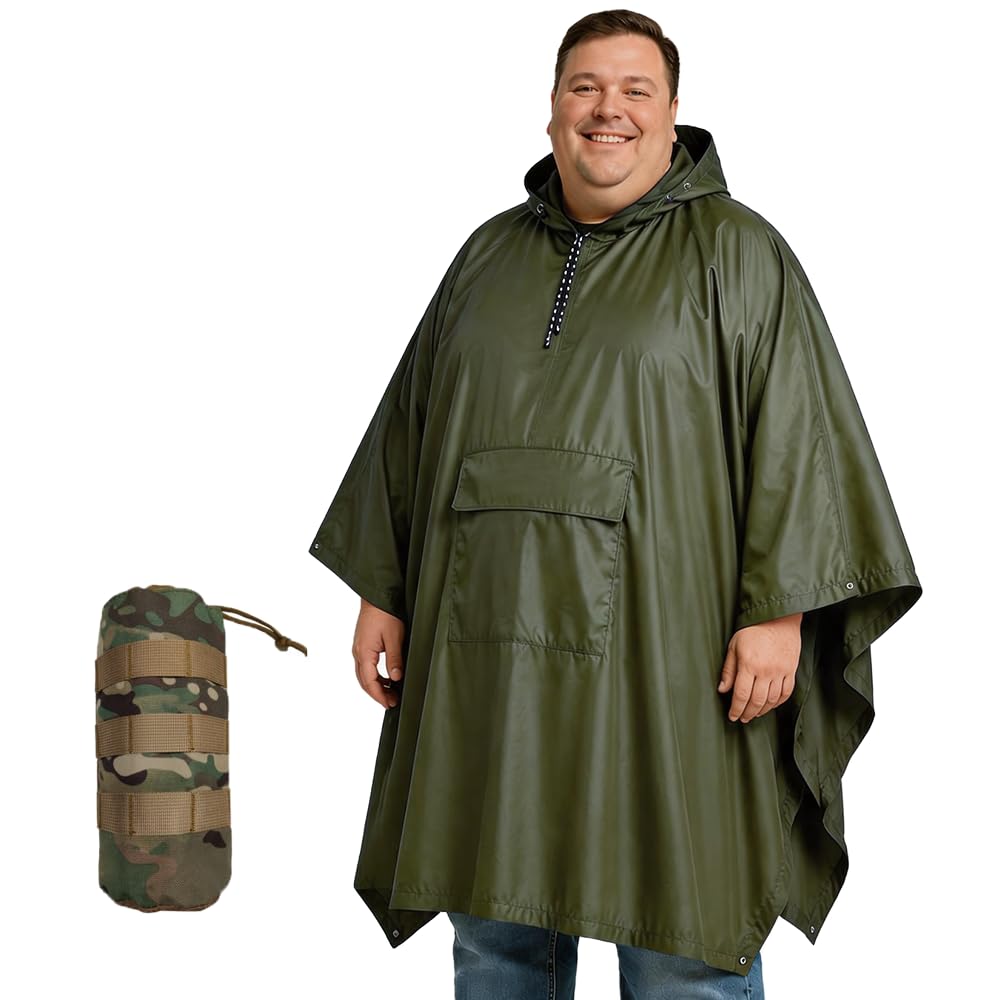
5. Urby Plus Size Adult Rain Poncho with Hood
A genuinely large cut for broad shoulders, with a hood you can size to your own head.
The plus-size sizing is the headline here, and it is the reason this poncho exists. It is a rip-resistant polyester shell sealed with a waterproof backing that the maker calls 100% waterproof. The adjustable snap-button hood can be cinched to your head circumference, so it does not ride up or swallow your face. Button closures open on each side for easy on and off over gear.
It is a two-job piece of kit. Worn, it keeps you dry; laid flat, it becomes a camping tarp, and four corner grommets let you rig it as an emergency shelter or drape it over your goods. It folds into a tactical carry bag and takes up little space when stowed, at 14.4 ounces packed. Owners praise the water resistance and coverage of the rip-resistant polyester, and call the material sturdily built.
Here is the honest limit: “plus size” does not mean “fits everyone tall.” Some report it is too small for a 6’2″ frame and does not suit very tall wearers, while others find it right for a large person. Durability splits as well, with most praising the material and a few flagging weak points. Compare it with the Fousam above and you get a slightly heavier shell with a more adjustable hood rather than more grommets.
The real benefit: side button closures plus an adjustable hood make this the easiest poncho here to throw on over bulky layers without a wrestling match.
Choose it if: you wear a broad build and want an adjustable hood and easy side openings.
Pass if: you are very tall — the length is generous in width but tall wearers report it comes up short.
6. onewind Hooded Rain Poncho, Waterproof Silnylon Shelter

Eight-point-three ounces of silnylon that covers you and your rucksack and doubles as a tarp.
For backpackers watching every gram, the numbers matter. It is made from 1.1oz Silnylon ripstop with a PU coating for a 3,000 mm waterproof rating — silnylon being a silicone-treated nylon that is light and strong. It weighs 235 g / 8.3 oz and folds to a compact 2.8″ x 7.1″ into a matching stuff sack, so it disappears into a pack. The 89 x 56 inch cut covers both you and your backpack, with a hood to shield your head and neck.
Versatility is the other strength. Off your back, it converts into a tarp, groundsheet, backpack rain cover, or survival shelter in seconds. Cord adjusters and side fasteners let you tune the fit, and the loose arm holes and bottom let air circulate so you do not steam up inside. Owners consistently call out the 8.3 oz carry and soda-can packed size, yet the 89 x 56 inch cut still works as a tarp. It keeps rain off you and your gear through real rainstorms.
The trade-offs are fit and toughness. The fit runs tight for some and could be bigger, while the tie closures and Velcro strips divide opinion on how well they stay put. Durability splits too, with some finding it tough and others reporting a rip over time. Set against the cheaper ripstop picks above, this is a lighter silnylon build that packs smaller but is not the most reinforced shell in the lineup.
Packability that changes your loadout: at 8.3 oz and packing to a soda-can bundle, this is the one that lives in your pack all season without you noticing the weight.
Made for: backpackers and through-hikers who want a light silnylon shell that also serves as a tarp and groundsheet.
Not ideal for: a broad-shouldered wearer who needs a roomy cut, since the fit runs tight for some.
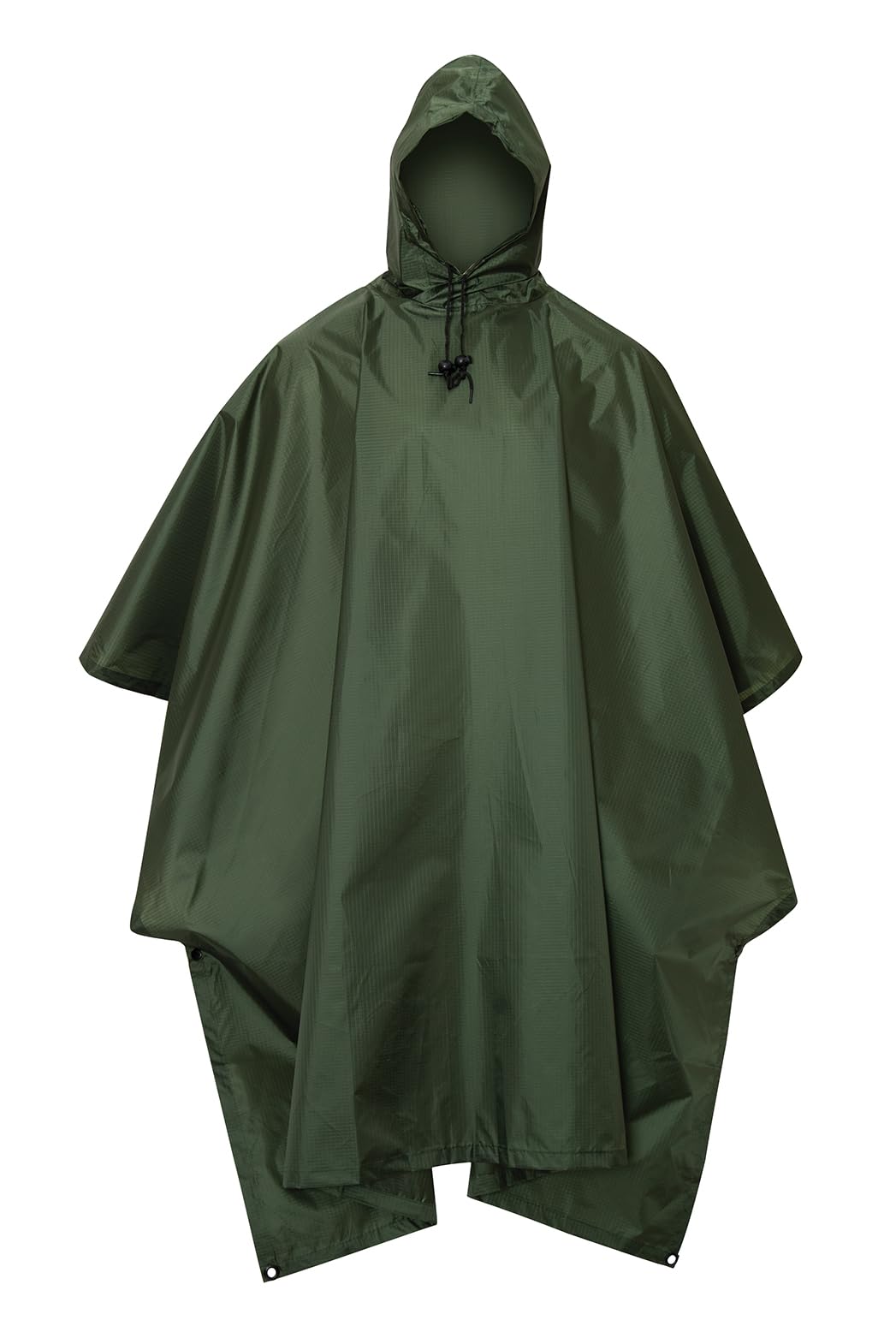
7. Rothco G.I. Type Military Rip-Stop Poncho
The military-style rip-stop shell that collectors and re-enactors reach for out of habit.
This is the poncho people buy when they want the familiar G.I. silhouette — a rip-stop nylon shell in a military cut. Owners find the rip-stop nylon durable, with the grid keeping a snag from tearing the whole panel on a first push through brush. It is lightweight enough to carry and functional as a straight rain cover. The design goal is simple: throw it on and keep the rain off your body.
Fit is the make-or-break here. Some owners with larger frames find it drapes nicely and keeps the rain off, so it works for a tall build. But the fit is the most contentious point overall — a substantial share find the hoodie and hood run snug, and the hood is reported as too snug against the head. Water resistance also splits, with some finding it sufficient to keep rain off the body and others reporting wet spots at the back and where the seams meet the head and shoulders.
The quality read is genuinely mixed across the board, and that is worth saying plainly: this is not the most consistent shell in the lineup, and its camo can look faded toward white in some units. Where it holds up best is as a lightweight, familiar-shaped cover for casual use. Against the Fousam above, it offers the classic look but less dependable waterproofing and a tighter hood.
The honest read: a lightweight rip-stop shell with the classic G.I. character, best treated as a fair-weather field cover rather than a hard-rain fortress.
Right for: buyers who want the traditional G.I. look and a lightweight rip-stop shell for lighter rain.
Not the one for: heavy, prolonged downpours or anyone who needs a roomy hood to fit over headgear.
8. MFH US Poncho Ripstop

The one you can snap to a second poncho and turn into a proper two-person basha.
The standout capability here is modular shelter building. Press-stud poppers along the sides let you snap two MFH ponchos together into a basha — a larger tarp-style shelter — which is something the single-poncho picks cannot do. The shell is a 100% waterproof ripstop that dries fast and is built to be extremely durable at a light carry weight.
Field use is flexible in several directions. Eyelets on the hem let you peg it out as a shelter or ground sheet. The poppers also let you form “sleeves” so you can still work equipment with your hands while the poncho is on, and the same snaps turn it into a sleeping bag cover. In a vehicle or on a pack, those same fasteners keep it compact and quick to deploy.
One limitation to be straight about: this listing carries no customer review text, so the durability and waterproofing claims come from the manufacturer specification rather than owner feedback. That makes it a reasonable pick for a buyer who specifically wants the two-poncho basha option, and less of a sure thing if you want a large body of real-world experience to lean on. It sits in the premium tier on cost, above the budget ripstop picks here.
What only it does: side press studs snap two ponchos into a basha or form working sleeves, a modular trick none of the single-shell picks here offer.
Worth it if: you want to build a two-poncho basha shelter and value fast-drying ripstop that can double as a sleeping bag cover.
Hold off if: you prefer a pick backed by a body of owner reviews, since this listing carries none.
9. Hazard 4 Poncho Villa MK2 Soft Shell Poncho, Coyote

The MK2 version of the top pick, in coyote, built to clip onto a full tactical rig.
This is the same PonchoVilla family as the overall winner, in the coyote colorway and the MK2 build. It carries a 10,000 mm waterproof rating with fully taped seams to hold back rain, snow, and wet terrain. The quick-deploy design throws on over gear in seconds — you do not have to strip your pack or vest when the weather shifts. Laser-cut MOLLE panels and loop fields let you attach pouches, IDs, and accessories to the poncho itself.
Compact packability rounds out the kit. It folds into its own pocket for a small carry size that fits in a pack, kit, or vehicle. The softshell shell stretches and moves with you rather than crinkling. Owners describe the softshell MK2 as well-made and versatile, and single out the fold-into-its-own-pocket design. Those who love it find it fits even when crammed over layers.
The caveats are size and cost. Fit splits — some find it comfortable even when crammed, while others find it too small. The water resistance divides as well: some report it keeps them dry in heavy downpours, others say water soaks through the fabric. Durability has a few reports of stitching coming undone and seam tape peeling. Stitching is the thing to inspect when it arrives. Against the PonchoVilla above, you are getting the same 10,000 mm shell in a different colorway, so pick on availability and fit rather than capability.
Why it suits a full rig
- 10,000 mm waterproof rating with fully taped seams for rain, snow, and wet ground
- Laser-cut MOLLE panels and loop fields mount pouches and accessories
- Quick-deploy over a pack or vest without removing gear
- Folds into its own pocket for pack, kit, or vehicle storage
What to check on arrival
- Fit runs small for some wearers over bulky layers
- Water resistance and stitching divide opinion — inspect seam tape out of the bag
Suits you if: you run a MOLLE-heavy rig and want a softshell poncho that deploys over it in seconds.
Look past it if: you want a generous cut or need proven heavy-downpour waterproofing — some owners get soaked.
Know the Specs
Waterproof Rating in Millimeters
The rating measures how much water pressure a fabric holds back before moisture pushes through. The Hazard 4 models carry 10,000 mm, which handles harder, wind-driven rain, while the onewind carries 3,000 mm for steady rain. A high rating only works if the seams are taped — those are the stitched lines where water sneaks in first. Underwind-driven conditions, seam taping matters as much as the rating number.
Ripstop, Silnylon, and Softshell
Ripstop nylon weaves a reinforcing grid so a tear stops at the line instead of running. Silnylon is silicone-treated nylon that packs lightest but tends to be noisier. Softshell is a stretchy woven fabric that stays quiet and moves with you, which is why field and range users pay more for it. Your choice trades weight and pack size against noise and ruggedness — no fabric wins all three.
Grommets, Snaps, and Shelter Conversion
Grommets are the metal-rimmed holes along the hem that let you peg a poncho out as a tarp, ground sheet, or shelter. Copper and heavy-duty metal outlast thin plastic. Snap buttons on the sides let you cinch the cut, form sleeves, or join two ponchos together. If shelter use is in your plan, count the grommets and check whether the snaps are metal before you buy.
Weight and Packed Size
Weight is what you feel on your back all day. The WINWAY reports 0.67 lb and packs into a carry bag, while the onewind reports 235 g / 8.3 oz and folds to 2.8″ x 7.1″. The lighter and smaller the bundle, the more likely it stays in your pack instead of being left behind. Heavier softshell ponchos like the HAZARD 4 add durability and modular panels at the cost of bulk.
Common Questions
Will a tactical poncho fit over my backpack?
What does a 3,000 mm or 10,000 mm waterproof rating actually mean?
Can a poncho really work as an emergency shelter or tarp?
Is silnylon quieter than ripstop nylon for hunting?
Why do so many ponchos have a hood that is too small?
How do I stop a ripstop poncho from leaking at the seams?
Can two ponchos be joined into a bigger shelter?
Is a softshell poncho worth more than a ripstop one?
How do I store a wet tactical poncho so it does not mold?
What is the difference between ripstop and silnylon for a rain poncho?
The Bottom Line
The crowd favorite is the HAZARD 4 PonchoVilla — 4.5+ stars across 300+ ratings — because its 10,000 mm taped-seam softshell stays quiet over a pack and a vest, folds into its own pocket, and converts to a shelter through its perimeter grommets. If light weight is your priority, the onewind Silnylon Poncho packs to a soda-can bundle at 235 g / 8.3 oz for backpackers who count grams. And for the tightest kit budget with maximum multi-use, the LOOGU Rain Poncho stretches a large 55 x 41 inch cut into a poncho, tarp, and ground sheet with a neckline zipper on its camo versions. One honest nudge: whichever you pick, check the hood opening and seam tape first — those two details decide whether a poncho keeps you dry in a real storm.
How we choose
We do not accept paid placement. Every pick is matched to a real buyer and a real use-case; we do not hands-on test units.
Sources
Specifications: manufacturer listings and product documentation. Review insights: verified customer reviews, as of November 2026. Pricing: not shown on this page (it changes often); check the current price via the retailer link.
As an Amazon Associate, Tactical Gear Guy earns from qualifying purchases. This does not affect which products we feature.