Specs are compiled from manufacturer listings and verified buyer reviews and can change over time — please confirm the key details on the product page before buying.
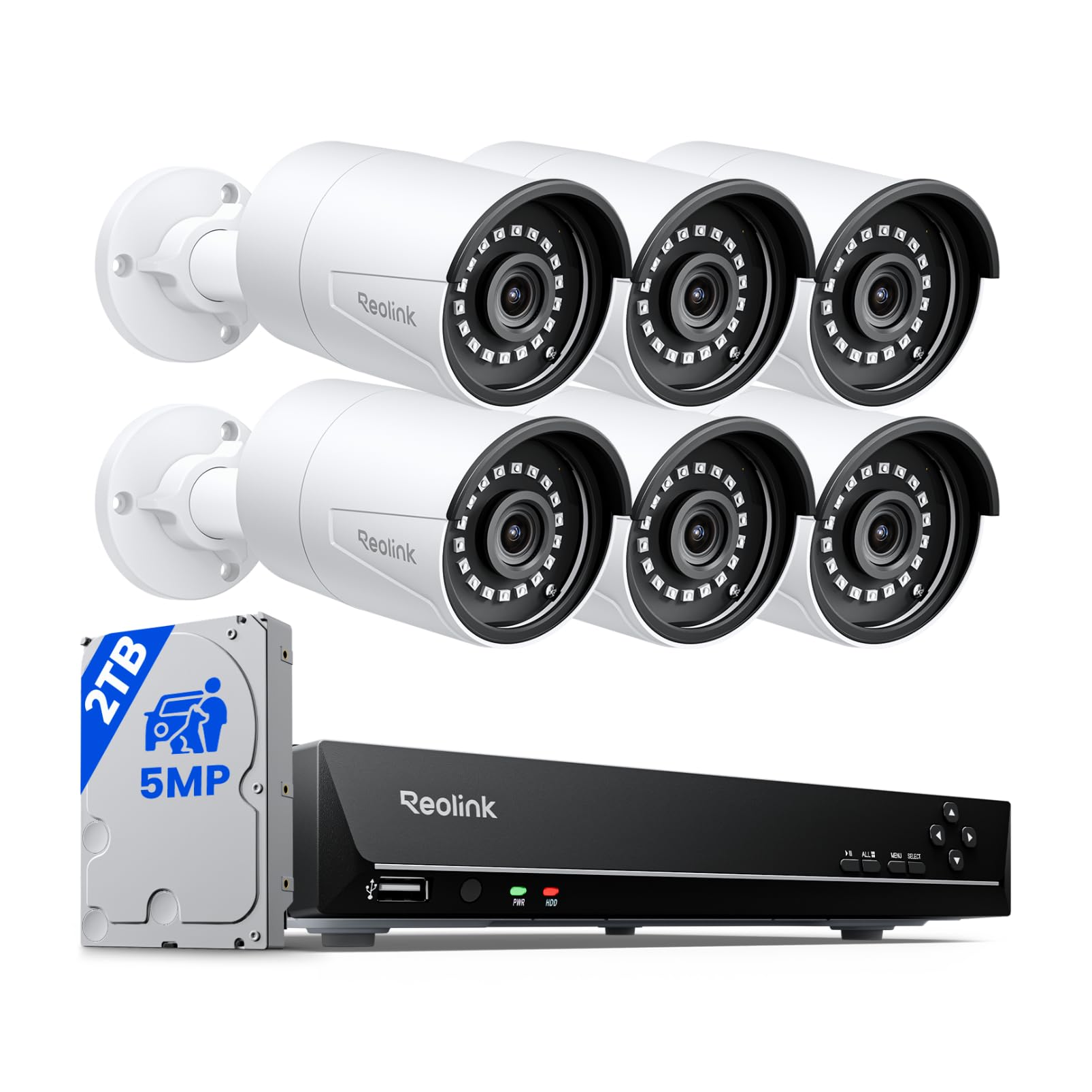
If you want the short answer: buy a wired PoE kit with a recorder that already has a hard drive inside. PoE (Power over Ethernet) means one cable carries both power and video to each camera. That setup keeps recording through a power cut, a dead router, and a bad WiFi week. Wireless solar cameras are easier to install, but they trade that reliability for convenience. The best overall pick here is the REOLINK 8CH 5MP kit — six cameras, a 2TB recorder, and one cable per camera that carries both power and video.
This guide is built by comparing the manufacturers’ published specifications and the patterns across verified customer reviews, so you get each pick’s real strengths and trade-offs instead of marketing spin.
Below you will find eleven systems split by how they are wired, what they record, and whether they charge you every month. That way you can match a system to your wiring, storage needs, and whether you’ll pay a monthly fee. Every pick here is a currently sold home system with a live Amazon listing. This breakdown of the best surveillance system for home focuses on two things that actually matter: footage you can read, and a recorder that keeps running.
Top Picks

How To Choose The Best Surveillance System for Home
Most buyers get this wrong by shopping for camera count first. What actually decides whether you are happy two years from now is how the cameras get power, where the video is stored, and whether the app keeps working without a subscription. Get those three right and the megapixel count matters far less than the spec sheet suggests.
Decide between wired PoE and wireless first
A PoE camera (Power over Ethernet — a single network cable that carries both electricity and video) draws power straight from the recorder. That means no battery to swap and no signal to drop when your neighbor’s microwave kicks on. The catch is real: you have to run cable, which often means a ladder and a drill. Wireless solar cameras skip the cable entirely and recharge from daylight, which suits renters and anyone mounting on a shed or gate post far from an outlet.
Check whether a hard drive is included
A system listed as “no hard drive included” records nothing until you buy and fit one. Look for a stated capacity like 1TB, 2TB, or 3TB in the listing, because that number sets how far back you can scroll. A 10TB-capable recorder sounds generous until you realize the drive itself is a separate purchase. If you want to unbox and go, buy a kit that lists a drive capacity like 1TB or 2TB in the box.
Read the night vision distance, not just the resolution
Every camera claims “clear night vision.” What matters is the stated infrared range in feet, because that is the distance at which the image is still usable. A camera rated to 100ft will light up a driveway; a camera with no stated infrared range gives you no way to judge its reach. Pair that with the lens field of view — a wider angle sees more of the yard but puts fewer pixels on a face.
Know what the subscription actually gates
Some kits record locally to a hub or recorder with no monthly bill at all. Others give you a trial period, then hold back video history, AI detection, or emergency features until you pay. Read the listing for the words “no monthly fee” or “paid plan required after trial” — that single line decides whether you pay monthly for years, which outweighs any resolution or lens spec.
Side-by-Side Comparison
| Model | Best For | Cameras | Storage | Resolution | Amazon |
|---|---|---|---|---|---|
| REOLINK RLK8-410B6-5MP★ Best Overall | Whole-house wired coverage | 6 | 2TB HDD | 5MP | Amazon |
| ANNKE 8CH 3K LiteBudget Starter | Tight-budget first system | 4 | None included (10TB max) | 2MP | Amazon |
| Arlo Pro 2K HDR (6th Gen)Most Flexible | Renters and wire-free placement | 4 | Cloud plan (trial) | 2K HDR | Amazon |
| eufy eufyCam C37 | Pan-and-tilt tracking | 4 | 64GB local (1TB max) | 2K | Amazon |
| Hiseeu 8-Cam Solar Kit | Off-grid and no-internet sites | 8 | 1TB HDD | 4MP | Amazon |
| Hiseeu 4K PoE PTZ 6-Cam | Tracking a long driveway | 6 | 3TB HDD | 5MP PTZ | Amazon |
| aosu D1 Max 4-Cam | Sharp 4K without wiring | 4 | 32GB local (1TB max) | 4K | Amazon |
| Night Owl 12-Ch DVR | Many cameras on one recorder | 8 | 1TB HDD | 2K | Amazon |
| ANNKE 16CH 5MP PoE | Business-scale coverage | 8 | 2TB HDD | 5MP (3K) | Amazon |
| REOLINK RLK8-800B6 | Maximum image detail | 6 | 2TB HDD | 4K / 8MP | Amazon |
| eufy eufyCam S4 | Large properties, zero blind spots | 4 | 16GB local hub | 4K + 2K PTZ | Amazon |
Detailed Reviews
1. REOLINK 8CH 5MP RLK8-410B6-5MP
Our pick — 4.5+★ from 600+ verified ratings; the strongest balance of quality and price.
Six cameras, one cable each, and a recorder that already has storage inside — the least fussy way to cover a whole house with six cameras on one cable each.
This is the kit to buy if you want a wired system that works the day it arrives. The recorder ships with a 2TB hard drive already fitted, so there is no separate drive to hunt down and no “no HDD included” asterisk waiting for you at checkout. Each of the six cameras connects to the recorder with a single network cable that carries both power and video — that is what PoE (Power over Ethernet) means, and it is why you never climb a ladder to change a battery. Installation is genuinely plug-and-play for the basics; the camera powers up and appears in the app.
Picture quality holds up well past the point where cheaper kits go soft — the 5MP sensor reads plates and faces at a distance rather than turning them into blobs. Night vision reaches a stated 100ft off 18 infrared LEDs, so a driveway or a long side yard stays lit in black and white after dark. The recorder covers 24/7 continuous recording, and a built-in mic on each camera picks up ambient sound. You also get smart detection that separates people, animals, and vehicles, so a cat crossing the lawn does not wake your phone. The 2-year warranty and lifetime tech support round out the package.
What wins people over is the picture. It is the most-praised thing about this kit by a wide margin, and the near-second place goes to exactly that sharpness at range. Ease of setup lands right behind — most owners describe getting the basics running quickly. The recurring gripe is reliability over the long haul: a share of buyers report a camera dropping out or the recorder failing after months of service. Treat that as a real durability caveat and keep the warranty paperwork, rather than as a reason to pass. Unlike the ANNKE 8CH 3K Lite below, which ships with no drive and tops out at 10TB of expandable storage, this Reolink arrives with 2TB already inside.
Where it earns its keep
- 2TB hard drive included, so recording starts on day one
- Six 5MP cameras on single-cable PoE — no batteries, ever
- Night vision rated to 100ft from 18 infrared LEDs
- Smart detection sorts people, animals, and vehicles
What to weigh first
- You must run cable to all six cameras
- Long-term durability splits opinion — some units fail within months
- Wired-only placement, so no moving a camera on a whim
Made for: a homeowner who can drill and wants six cameras recording around the clock with zero monthly bill.
Think twice if: you rent or cannot run cable — go wireless instead.
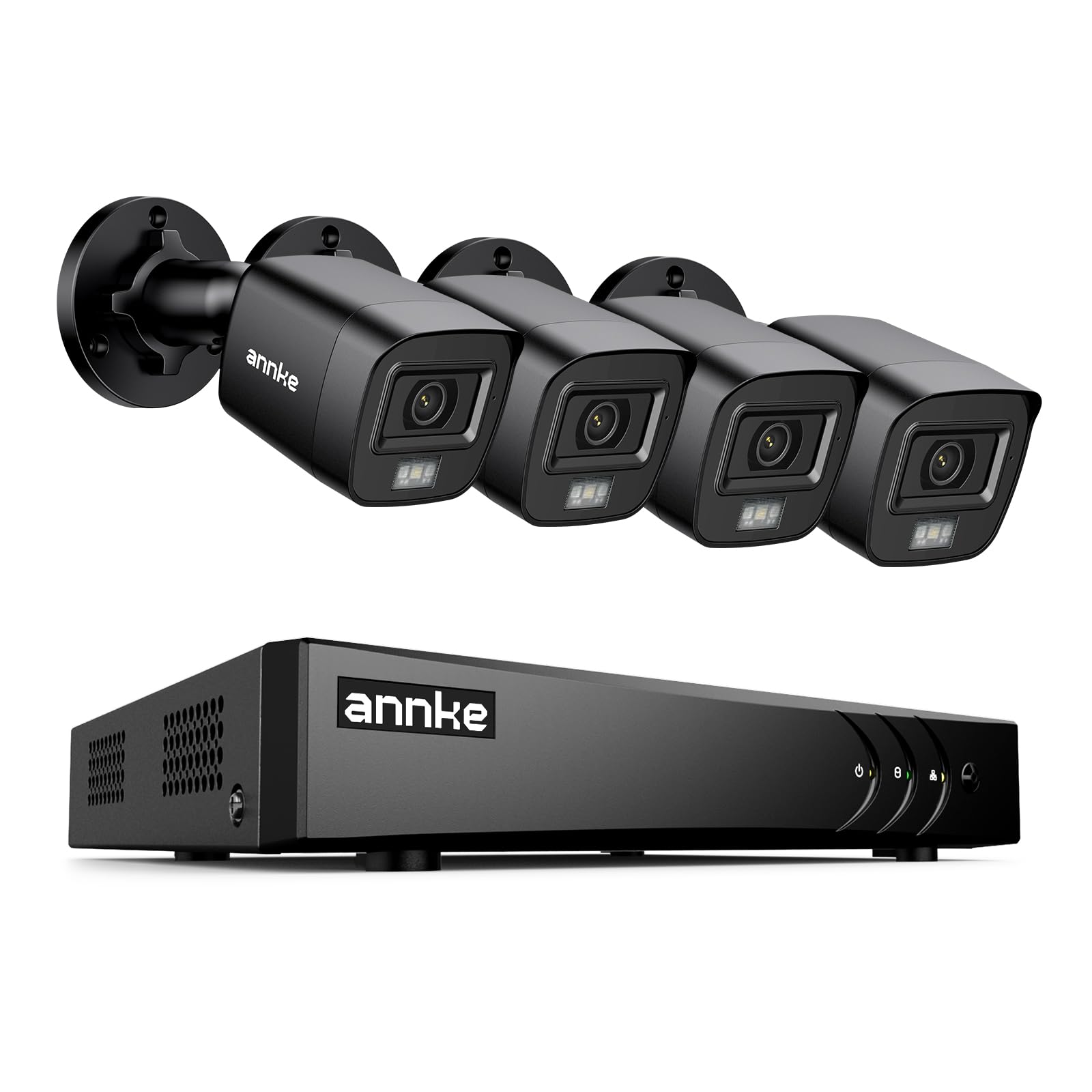
2. ANNKE 8CH 3K Lite 4 x 2MP
The cheapest honest way in — with a hard drive you have to buy yourself.
Four cameras, a DVR, and a headline number that looks too low to be a real system: those four cameras record at 2MP, or 1920×1080, which is plain 1080p. That is not the crispest footage on this list, but at normal viewing distances it still shows you a person, a vehicle, and what they were carrying. The DVR itself records and live-views in 3K Lite with H.265 Pro+ compression, which is an encoding trick that packs more footage into less drive space.
Here is the catch you must plan around: there is no hard drive in the box. The DVR (digital video recorder) supports one drive up to 10TB, which is the largest ceiling in this guide by a wide margin. The Reolink above arrives with 2TB already installed, but tops out far lower. Installation is tool-free for the drive, so adding one is quick. The cameras are rated IP67, meaning dust-tight and able to survive rain, and they are specified to run from -40°F to 140°F. AI motion detection runs on all eight channels and can tell a person or a vehicle from a swaying branch.
Frame rate is 24 fps (frames per second), a touch under the Reolink 5MP kit’s 25 fps. Both are smooth enough to read motion clearly, and the gap will not show in day-to-day use. Buy this if you are comfortable adding a drive and want a low-cost 1080p foundation you can expand later. Pick something else if you want sharp detail at long range or a system that records the minute you plug it in.
Best value in the guide: a 1080p four-camera kit with a 10TB storage ceiling — but budget for a drive on top of the kit itself.
The smart buy if: you have a spare drive or don’t mind buying one and want four weatherproof cameras for the least money.
Not your system if: you expect video in the box on day one.
3. Arlo Pro Wireless Security Camera 2K HDR (6th Gen) – 4-Cam
Clip a camera to any fence post and it starts watching — no cable, no electrician, no drill.
The 160° field of view is the number that does the work here. A wide 160° panoramic lens means one camera covers a corner of the yard that a narrower lens would need two to reach. Add 2K HDR video — high dynamic range, which keeps a bright sky and a shadowed porch readable in the same frame — and you get a usable picture in tricky light. Color night vision and an integrated spotlight keep faces visible after dark, and 12x zoom lets you push in on a face or a plate once you spot it.
Each camera runs on a rechargeable, swappable battery rated at 22 watt-hours. Swappable is the key word: you swap in a fresh cell and keep recording rather than waiting hours for a charge. Placement is completely wire-free, so renters and anyone mounting to a shed or a tree can move cameras whenever they want. Setup is quick and the app handles the rest. The system also speaks to Alexa, Apple Home, and Google Home, and connects over dual-band WiFi so it can grab the stronger signal.
Two honest catches. First, the advanced features — 60-day video history, AI detection, emergency response — need a paid plan after the trial ends; live streaming and basic alerts work without one. Second, battery life splits opinion sharply: some owners get comfortable runtime, others find it needs frequent recharging. That is the trade for going wire-free, and it is the one thing to weigh before buying.
The honest read: brilliant placement flexibility and a wide 160° view, with a subscription and a charging routine as the price of cutting the cord.
Reach for this if: you rent, move cameras around, and want wide-angle 2K without drilling a single hole.
Look elsewhere if: you refuse a recurring cloud bill or hate recharging batteries.
4. eufy Security eufyCam C37 4-Cam Kit
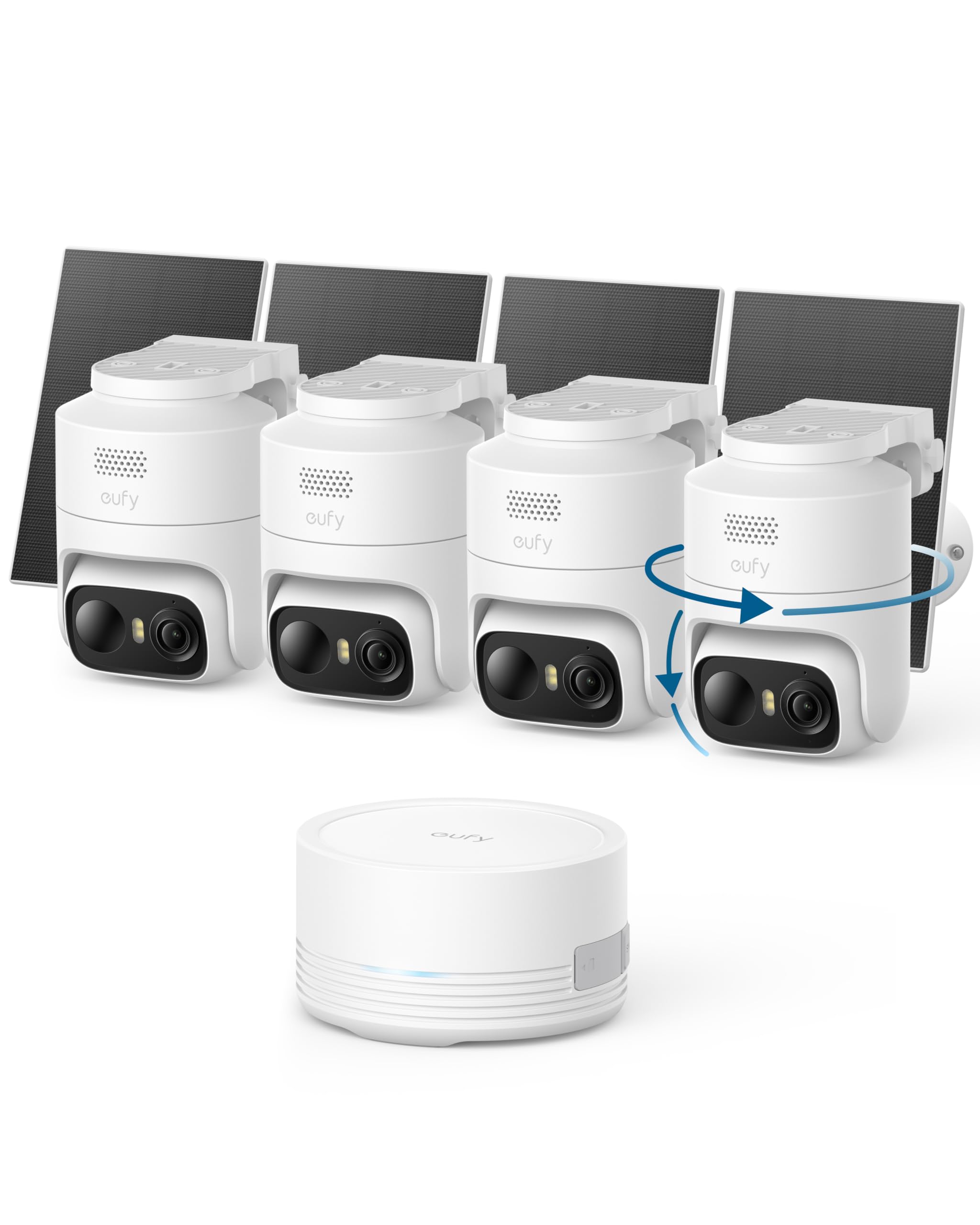
One camera that turns its head and follows the car down the driveway.
A single camera covering 360° is the pitch, and the pan-and-tilt head delivers it: auto-tracking keeps a moving subject centered instead of letting it walk out of frame. Each of the four cameras carries 2K resolution, which the maker says is 77% more pixels than standard 1080p — enough to read a license plate or a jacket color in the spotlight-lit color night vision. The spotlight is what makes that color view possible in total darkness.
Power is handled by four detachable 3W solar panels, one per camera. Detachable matters because you can angle the panel at the sun independently of where the camera points, so you never trade a good view for a good charge. Footage stays local on the HomeBase Mini’s 64GB of built-in storage, expandable to 1TB via microSD, with no monthly fees attached. The hub also open up human, vehicle, and pet recognition plus cross-camera tracking, and it can hold up to 10 cameras in one app. One compatibility note to check before you buy: this camera needs HomeBase 3 version 3.7.8.4 or newer, or HomeBase Mini version 4.0.5.6 or newer, and it does not work with HomeBase 2 or HomeKit.
Setup is the thing everyone raves about — the software is simple and the cameras mount fast. Reliability is the honest counterweight, with a meaningful share of owners reporting a camera that quit after a few days or trouble with the web portal. Connectivity is split too. It is a strong fit if tracking is what you need; a plain fixed-lens kit is simpler if it is not.
What makes it different
- 360° pan-and-tilt with auto-tracking on every camera
- Detachable 3W solar panel per camera for independent aiming
- 64GB local storage on the hub, expandable to 1TB, no fees
- Tracks and centers subjects instead of losing them at the frame edge
Before you commit
- Needs HomeBase 3 or HomeBase Mini at the stated firmware version
- Not compatible with HomeBase 2 or HomeKit
- A portion of units reportedly stop working early
Built for: a yard where things move — cars, delivery vans, kids — and you want the camera to follow them.
Skip if: you already run older eufy hardware that isn’t on the required firmware.
5. Hiseeu Solar 8 Cam-Kit 1TB HDD
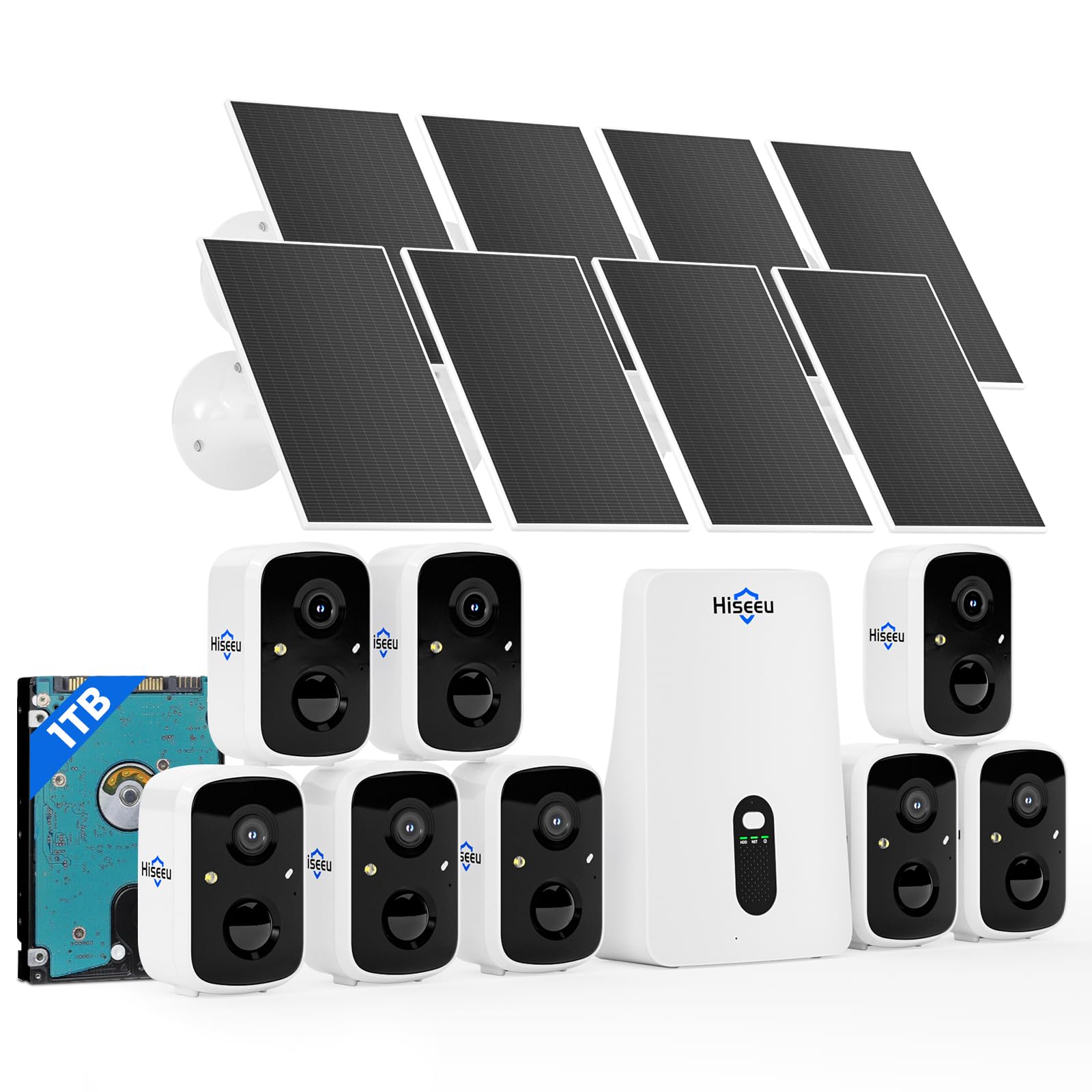
Eight solar cameras for a barn, a gate, or a cabin where the WiFi barely reaches.
The base station ships with a 1TB hard drive inside, and Hiseeu rates that as 36+ months of recorded video. That is the number that sells this kit: local storage with no subscription, and a recorder that expands to a 256GB SD card or an 8TB hard drive if you need more. It is also scalable from one camera to ten, which matters on a large property where you add coverage in stages.
The standout trick is offline operation. Connect the base station to a TV or monitor over HDMI and the system keeps recording and showing live view with no internet connection at all. That makes it a genuinely useful pick for a rural home, a workshop, or a cabin. The eight cameras are solar-powered and 100% wireless, and Hiseeu says four hours of direct sunlight a day keeps them running year-round. They carry an IP66 water-resistance rating, so rain is not a concern. Each camera records at 4MP with color night vision and a 135° wide lens, and two-way talk lets you speak through the app.
What owners praise most is the overall build and quality of the system, with easy setup close behind — the mounting is a five-minute job of three holes and a bracket adjust. The honest caveat is that AI human and vehicle detection sits behind a paid cloud plan, so on the free local setup you lean on the PIR motion sensor instead. Reliability and pairing are the other split opinions to know about.
Where it shines: a no-internet, no-subscription install on a property far from a router — 1TB of local storage included and room to grow to ten cameras.
This is your kit if: the cameras go somewhere cable and WiFi both fail, like a barn, a gate, or a vacation cabin.
Pass on it if: you want AI person-detection without paying for a cloud plan.
6. Hiseeu 4K PoE 6pcs 5MP PTZ

Cameras that swivel 300° and lock onto a person walking across the lot.
A fixed camera sees one slice of the world. These PTZ cameras — pan, tilt, zoom — sweep 300° side to side and 90° up and down, which covers a wide lot with fewer units and fewer blind zones. The auto human tracking is the hook: when someone steps into the surveillance area, the camera follows them. It needs a preset point set on the local NVR to work, so budget a few minutes of setup time.
Storage is generous from the start — a 3TB hard drive for 7/24/365 recording, with regular and motion-triggered record modes. Smart playback lets you jump to a specific period instead of scrubbing through days of footage. The NVR has eight built-in PoE ports and can grow to 16 channels with an added PoE switch, taking up to 16 cameras at 4K. Two-way audio runs with no fees, so you can tell a courier where to leave a package straight from the app, and there is an intruder alarm light that triggers alongside push alerts. It works with or without internet: local TV monitoring needs no connection, and remote app access just needs the recorder linked to your router.
Installation is the part that goes right — this is the easiest setup on the list according to how owners talk about it. The tracking feature earns real praise for how cleanly it follows people and animals without tripping on a passing cat. Reliability is the honest caution, with a share of systems losing cameras unexpectedly. Picture and sound quality together are the second most-praised thing here, so you are not sacrificing clarity for the moving parts.
Why it moves to the front
- 300° pan and 90° tilt cover wide areas with fewer cameras
- 3TB HDD pre-installed for 24/7/365 recording
- Auto human tracking follows subjects across the lot
- Expandable from 8 to 16 channels at 4K
Know this going in
- Auto-tracking needs a preset point configured on the NVR
- Some systems reportedly lose individual cameras
- Wired PoE means running cable to each camera
Pick it for: a long driveway or a big lot where you need the camera to turn and follow, with 3TB of recording to back it up.
Don’t pick it for: a small yard where fixed cameras already cover everything.
7. aosu D1 Max 4-Cam Kit 4K Solar
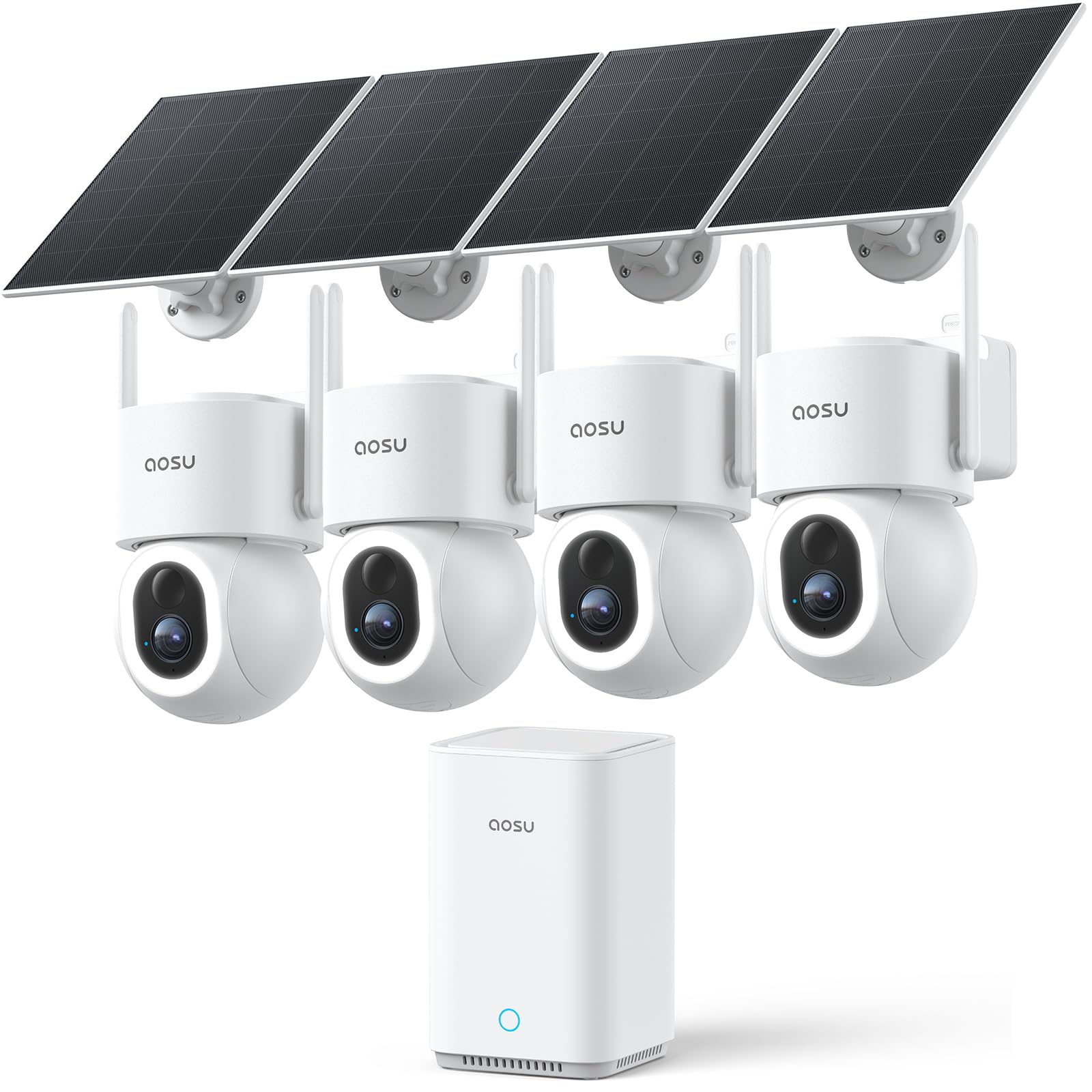
The wireless kit that reads a license plate from the street — 4K, no cable, no monthly bill.
4K Ultra HD at 8MP is the headline, and it earns it: aosu says you can read faces and plates from up to 33ft (10m) away. Add 6× digital zoom and full-color night vision from built-in spotlights, and the footage stays useful after dark rather than turning to gray mush. Infrared mode is there too when you want a discreet black-and-white view instead of a floodlight.
This kit makes a real case against the wired systems for anyone who hates cable. Footage stores locally on the aosuBase’s included 32GB, expandable to 1TB, so there is no subscription required and nothing leaves your house. The detached solar panel lets you aim the panel at the sun separately from where the camera points. Setup is the easiest thing on this whole list according to owner experience — almost everyone calls it quick and painless. AI detection runs on-device to sort people from vehicles, and Smart Vehicle Guard watches a parked car and alerts you if someone moves nearby.
Coverage is smart, too: the 4-camera kit is built for a standard single-family home across front, back, side yards, and driveway, and the PTZ heads pan and tilt to follow people and vehicles. Cross-camera tracking hands a moving subject from one camera to the next into one continuous timeline. The honest trade-off is battery life, which draws split opinions — solar keeps some cameras charged easily while others drain fast and never reach full. Performance reliability is also mixed. For wireless 4K clarity, though, it leads the wire-free pack.
The 4K pitch, delivered: faces and plates readable to 33ft, local 32GB with no fees, and setup so easy nearly everyone says so.
Ideal when: you want genuine 4K detail but will not run a single cable.
Consider another if: you live somewhere with little sun and cannot rely on the solar panels to keep the 5200mAh batteries topped up.
8. Night Owl 12-Ch 8 2K Cams 1TB HDD

A 12-channel recorder with eight 2K cameras — room to add four more later without swapping the box.
The channel count is the reason to look at this one. A 12-channel DVR with eight 2K cameras means you can add up to four more cameras down the road on the same recorder, instead of buying a new system when your coverage needs grow. It ships with a 1TB hard drive already installed, so it records from the moment you power it up, and there are no monthly fees according to Night Owl. The company is US-owned and operated, which some buyers weigh when choosing where their footage lives.
Video quality is the standout in owner experience — a very clear view is how most describe it, and the 30 fps frame rate is the highest on this list, so motion stays smooth rather than smearing. Installation draws warm words too, with the DVR described as easy to set up and operate. Two-way audio is on board, and the system suits indoor or outdoor mounting.
Connectivity is where this kit needs care. Wired and wireless are both listed, but owner experience with getting things connected is the least positive aspect of the whole package for some — Bluetooth pairing trouble and app setup snags come up. Reliability and value also split opinion, and a share of owners mention one of the eight cameras failing to come up. It is a strong pick if you want a big channel headroom and clear video; just set aside patience for the initial app hookup.
Big-recorder thinking: 12 channels and 1TB of storage for a home that plans to grow its coverage, with the smoothest 30 fps video in this lineup.
Worth it for: planned expansion — eight cameras now, four more anytime, all on one no-fee recorder.
Second-guess it if: you want a setup that connects painlessly in five minutes.
9. ANNKE 16 Channel 5MP PoE 2TB HDD
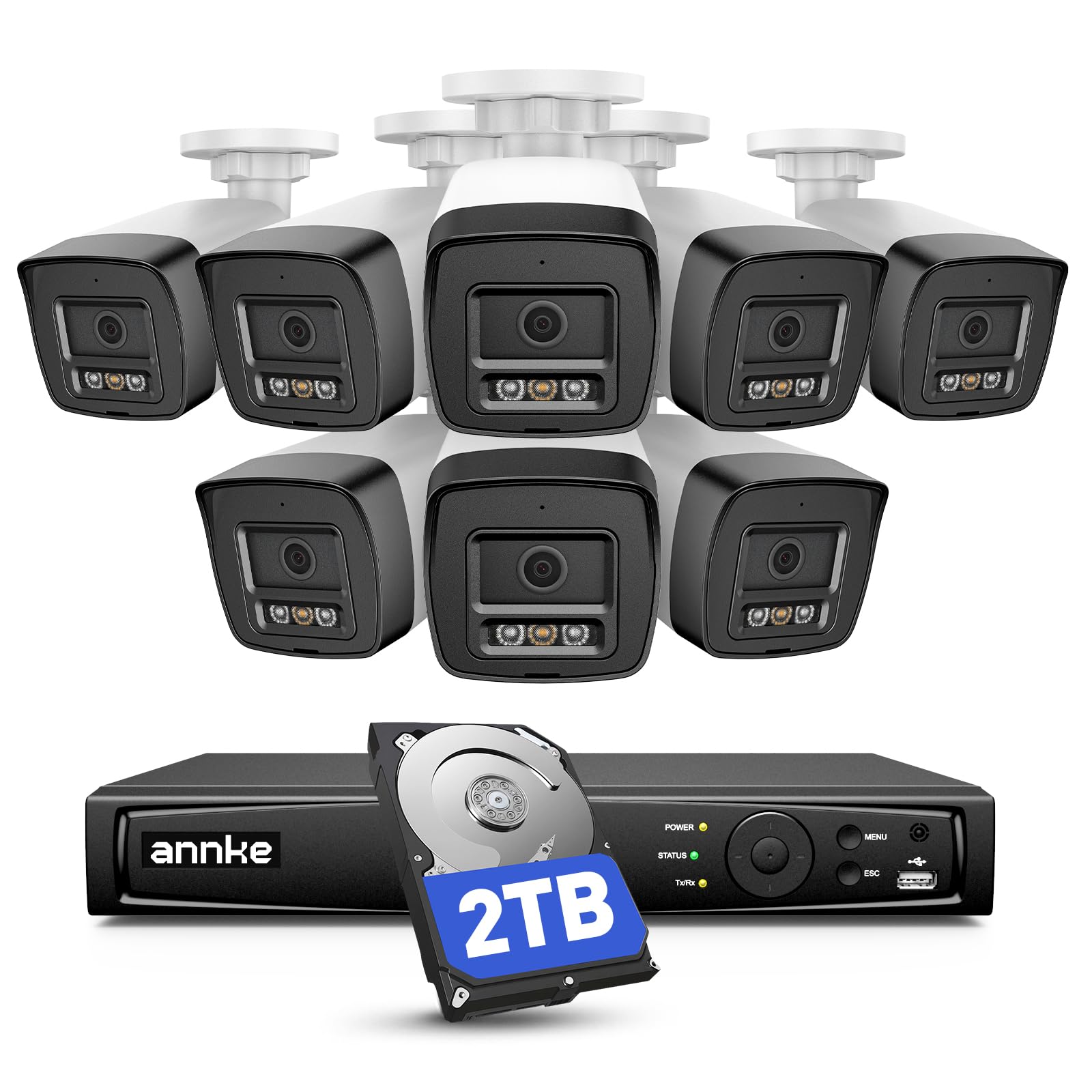
Cameras that shout back in your own voice — plus 120dB WDR for brutal backlight.
The feature nobody else here has: you can record a custom warning in your own voice, so an intruder hears a real person rather than a siren tone. Backup deterrence comes from ultra-bright red and blue LEDs and a high-decibel siren. If you want a system that announces itself, this is the one; just enable that custom-voice feature before you need it.
The cameras record 5MP at 3072×1728 and 20 fps in a 16:9 frame, which fits modern monitors better than the older 4:3 shape. The 120dB wide dynamic range (WDR) is a big deal for a door or driveway pointed at the sky — it holds detail in both the bright and shadowed parts of the same shot. Night vision is rated up to 100ft, and the 2.8mm lens gives a 123° diagonal view, wider than a 4mm lens would. AI detection covers people and vehicles, and two-way audio plus the free ANNKE Vision app handle talking and playback with no hidden fees. The 16 channel NVR ships with 2TB installed and eight 5MP cameras, with IP67 ratings on the cams.
Owners describe this system as reliable — cameras working well with no issues reported across the whole setup — and easy to install, with crisp day-and-night vision. It is the most reliable-feeling wired system in this guide. Two real notes: the desktop software is clunky for some, even though the phone app is well liked, and cable compatibility has drawn complaints about bad wires and lost connections. Check your cable runs before mounting.
what separates it
- Custom voice warnings in your own voice plus a loud siren
- 120dB WDR keeps backlit doorways readable
- 16 channels with 2TB HDD and eight 5MP cameras
- IP67 cameras rated to -22°F / 140°F
The fine print
- Desktop software is clunky for some owners
- Cable issues — bad wires and dropped connections — come up
- Wired install to eight cameras is real work
Meant for: a home or small business that wants active deterrence — voice warning, siren, lights — not just silent recording.
Look elsewhere if: you are not comfortable running and testing eight cable runs.
10. REOLINK 8CH 4K/8MP RLK8-800B6
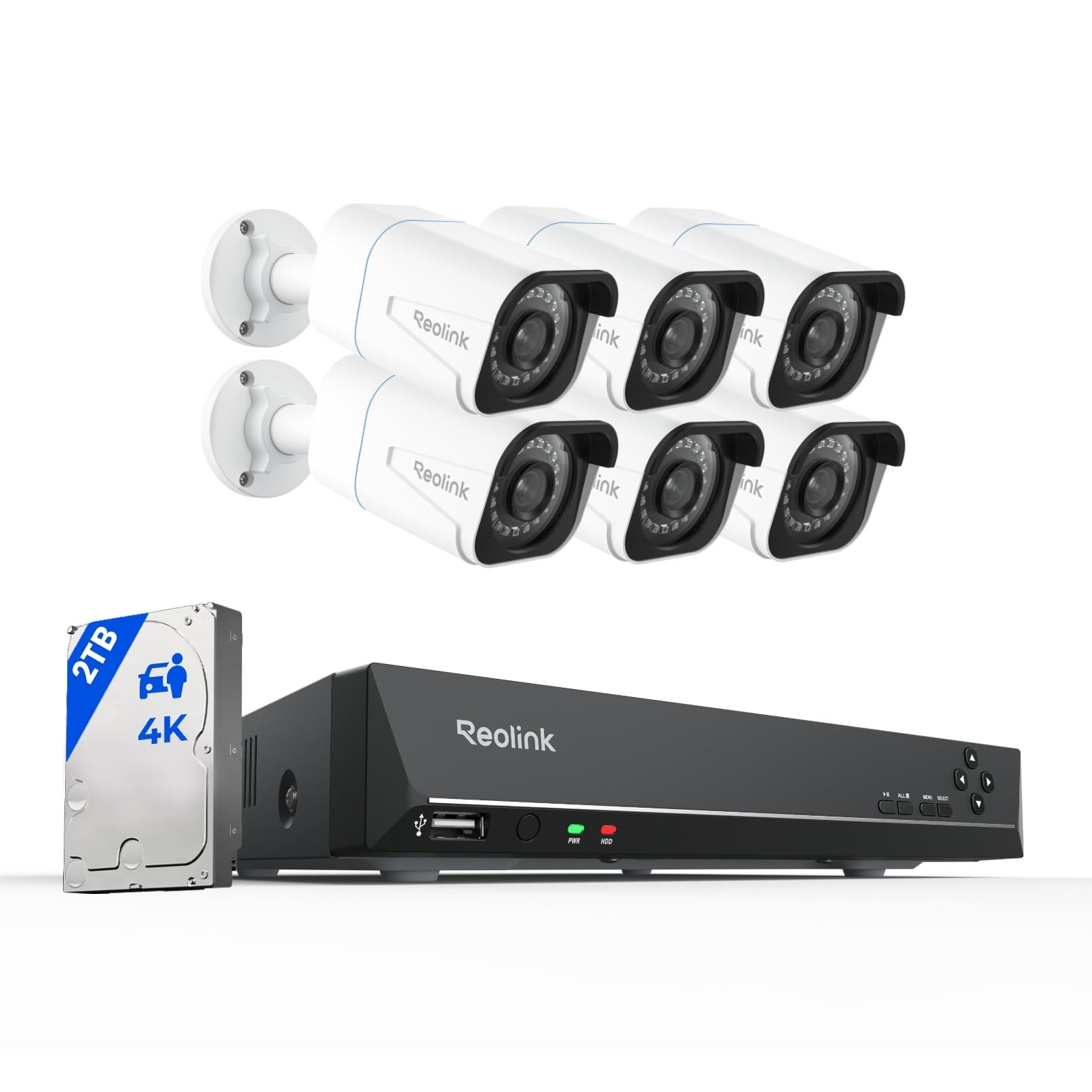
Six 4K cameras on PoE — the most detail on this list, and the highest ceiling on cable reach.
Resolution is the whole argument here: 4K Ultra HD at 3840×2160 per camera, which puts far more pixels on a face than any 5MP kit above. Night vision is rated to 100ft from 18 infrared LEDs, and 3D-DNR (noise reduction that cleans up grain in dim shots) helps keep the image clear. The PoE cable run reaches up to 300ft per camera, which is the longest stated reach in this guide and enough to cover a long fence line from one recorder.
Storage is a pre-installed 2TB drive, expandable to an external 8TB for backup and to 16TB total (2×8TB). Smart detection sorts people, vehicles, and animals, and installation is three steps: plug in, add the recorder to the free Reolink app, and live-view locally or remotely. Wired PoE also means a lossless signal, which is a real advantage in a crowded WiFi neighborhood.
Picture quality at 4K is the most-praised thing about this kit, and the app is universally well liked. But this is also the pick with the sharpest split on image quality complaints — a share of owners hit night-vision and image problems that the 5MP version above largely avoids. Reliability splits opinion too, with cameras failing in some cases. Go 4K if detail is king; go 5MP if you want the steadier track record.
Detail without compromise: 3840×2160 on six cameras with 300ft cable reach — just know the 4K sensors are harder to get perfectly reliable.
Choose it for: the sharpest plate-and-face reads on PoE, with cable runs long enough for a big property.
Weigh the other one first if: you would rather trade a little sharpness for steadier reliability.
11. eufy Security eufyCam S4 4-Cam Kit
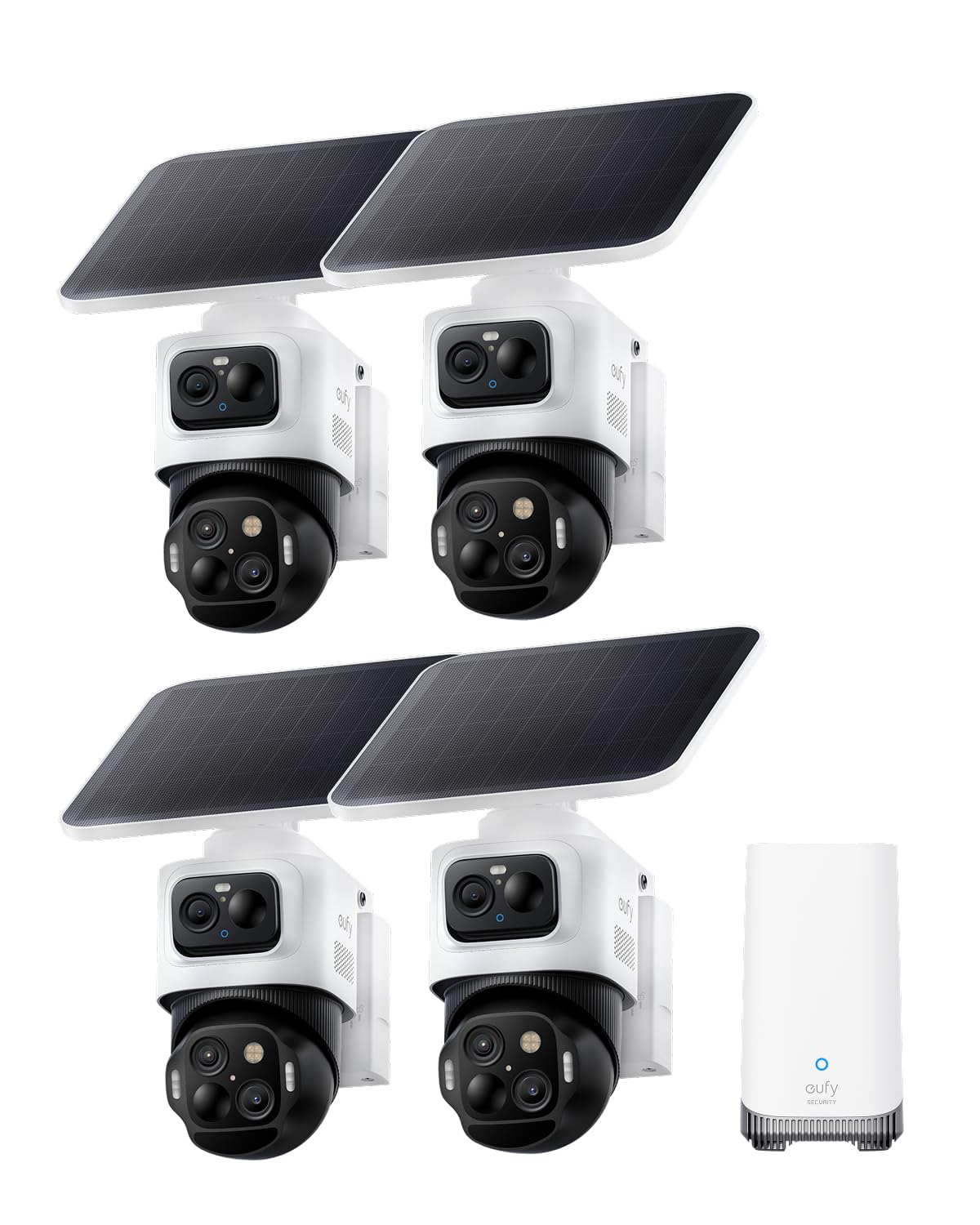
Two cameras in one body — a 4K wide shot and a 2K zoom that tracks, stitched together across the whole property.
Each camera in this four-pack is really two cameras. An upper 4K bullet lens covers a 130° wide view while a lower 2K PTZ lens locks on, tracks, and zooms — so you get the whole scene and the crucial close-up at the same time. AI tracks subjects and zooms in for detail up to 164 ft away. Link the cameras through the HomeBase S380 and they hand a moving target from one to the next, stitching the walk across your property into one continuous, timestamped video.
Power comes from an ultra-large 5.5W solar panel on each camera, and eufy says just 1 hour of direct sunlight daily keeps a camera running year-round. The 44.3 watt-hour battery backs that up. Footage stores locally on the HomeBase S380’s 16GB built-in drive, expandable with any 2.5″ drive, with no subscription. The hub’s BionicMind AI learns familiar faces to cut false alerts, and the system scales from these four cameras up to 16 devices. Radar and PIR sensors trigger red and blue warning lights and a 105 dB siren when a threat enters a set zone.
This is the most ambitious system here, and the price of that ambition shows up in the owner experience: functionality, value, motion tracking, battery life, and connectivity all split opinion. Some cameras perform beautifully; others work inconsistently or drain fast. It is the right pick if you want maximum coverage from few cameras on a large property — and the wrong one if you want a simple, settled setup.
Maximum coverage, maximum moving parts: a triple-lens camera plus cross-camera handoff is genuinely clever — and the most temperamental system on this list.
For the buyer who wants it all: large properties, close-up detail, and cross-zone tracking with no monthly fee.
Be sure you want the complexity: this is a system to tune, not a plug-in-and-forget one.
Know the Specs
PoE vs wireless power
PoE (Power over Ethernet) sends electricity and video down one network cable from the recorder, so a camera never needs a battery or a wall outlet. That is why wired kits keep recording through a power blip and a dead router, and why they never ask you to recharge anything. Wireless cameras run on a battery charged by solar or a cable, and they talk to the hub over WiFi. They install in minutes but depend on a strong signal and, eventually, on sunlight or a charging routine.
Resolution and megapixels
A megapixel (MP)is a million pixels of image sensor, so 2MP is plain 1080p, 5MP sits between, and 4K is 8MP. More pixels mean a face or a plate stays readable at a longer distance and survives zooming in later. But pixels are only half the story — a 2MP camera with a good lens and strong night vision can beat a higher-rated one that goes soft in the dark.
Local storage vs cloud plans
Local storage means a hard drive in the recorder or hub holds your footage, and there is no recurring fee. Cloud plans move video off-site and open up extras like longer history or AI detection, usually after a trial. Read the listing closely: a kit that says “no hard drive included” needs one bought and fitted, and a line like “paid plan required after trial” tells you the free tier is limited.
Night vision range and WDR
The infrared distance in feet is the range at which the camera can still see after dark — 100ft is a good driveway figure. WDR (wide dynamic range, measured in decibels) balances a scene with a bright sky and a dark porch in the same frame; a higher dB figure holds more detail in both. Both matter more than a marketing “HD” label.
Common Questions
Do I need internet for a home surveillance system to record?
Is a wired PoE system better than a wireless one for home security?
How much recording time do I get from a 1TB or 2TB hard drive?
What does “no hard drive included” actually mean on a kit like the ANNKE 8CH 3K Lite?
How far can a PoE camera be from the recorder?
Do these systems charge a monthly fee?
Will a 4K camera really read a license plate better than a 1080p one?
What IP rating do I need for an outdoor camera?
Can I add more cameras to these systems later?
Do solar cameras need direct sunlight every day?
The Bottom Line
For most houses, the surveillance system for home winner is the REOLINK 8CH 5MP kit, because it pairs six cameras with a 2TB drive already inside and a single cable per camera that never needs a battery. If you want maximum image detail and can run cable, grab the REOLINK 4K RLK8-800B6 with its 3840×2160 view and 300ft cable reach. And for a wire-free 4K setup that reads a plate at the street, the aosu D1 Max is the one to reach for.
Still unsure between wired and wireless? Run one cable to the hardest-to-reach corner first and let that decide the rest — it is the single choice that shapes every other one.
How we choose
We do not accept paid placement. Every pick is matched to a real buyer and a real use-case; we do not hands-on test units.
Sources
Specifications: manufacturer listings and product documentation. Review insights: verified customer reviews, as of November 2026. Pricing: not shown on this page (it changes often); check the current price via the retailer link.
As an Amazon Associate, Tactical Gear Guy earns from qualifying purchases. This does not affect which products we feature.