Specs are compiled from manufacturer listings and verified buyer reviews and can change over time — please confirm the key details on the product page before buying.
You want the floor to move when the explosion hits, not a polite thud that makes you check the volume. That is the whole job of a surround sound subwoofer, and it is also where most buyers get lost. The short answer: match the driver size and the low-frequency reach to your room, not to the biggest wattage number on the box.
This guide is built by comparing the manufacturers’ published specifications and the patterns across verified customer reviews, so you get each pick’s real strengths and trade-offs instead of marketing spin.
Every unit here runs its own built-in amplifier, so a single cable from your receiver is all it takes. Below, the picks are split by what your room actually needs, from a compact 8-inch sealed box to a 12-inch ported monster that pressurizes a whole great room. This is the honest, spec-by-spec rundown of the best surround sound subwoofer for your setup.
Top Picks


How To Choose The Best Surround Sound Subwoofer
The mistake most people make is buying the biggest box their budget allows and then wondering why their living room sounds muddy. A subwoofer is not a volume contest. It is a matchmaking job between the driver, the cabinet, your room size, and the speakers already sitting in your front stage.
Driver size tells you what a sub can move, not how loud it gets
A bigger driver moves more air, which is why a 12-inch model like the Polk Monitor XT12 can push bass further down than an 8-inch like the Edifier T5s. Air movement is what you feel in your chest during a low-frequency scene. More surface area gives you that physical punch without driving the amp to its limit.
The low-frequency number is the one that decides movie night
Frequency response is the lowest note a subwoofer can reach, written in hertz (Hz, or cycles per second). Human ears stop hearing around 20Hz and start feeling below that. A sub that reaches 28Hz like the Dayton Audio Classic CS1000 reaches deeper into the rumble region than one that stops at 35Hz like the Edifier T5s.
Sealed versus ported changes the character of the bass
A sealed cabinet traps air so the bass stops and starts quickly, which suits music and tight dialogue. A ported cabinet uses an opening to tune the air inside, giving you more output low down for movie effects. Ported boxes are usually physically bigger, so measure your floor space before you commit.
Your receiver and inputs matter as much as the amp
Look for an LFE input (the dedicated low-frequency-effects channel your AV receiver sends bass down) plus line-level RCA and speaker-level inputs for flexibility. The Polk MXT12, Dayton CS1000, and Rockville Rock Shaker all offer that trio. If your receiver only has one subwoofer output, a single RCA cable is all you need to run.
Side-by-Side Comparison
| Model | Best For | Driver Size | Amplifier Power | Low-Frequency Reach | Amazon |
|---|---|---|---|---|---|
| Klipsch Synergy Sub-120★ Best Overall | Overall home theater punch | 12 inches | 200W continuous | — | Amazon |
| Polk Monitor XT12Deepest Punch | Deep, punchy movie bass | 12 inches | 100W Class A/B | 24Hz | Amazon |
| Klipsch SPL-120Raw Output | Raw output for big rooms | 12 inches | 600W | — | Amazon |
| Dayton Audio Classic CS1000 | Clean, tight music and film | 10 inches | 180W | 28Hz | Amazon |
| Rockville Rock Shaker 12 | Budget-minded room-filling bass | 12 inches | 800W peak | — | Amazon |
| Edifier T5s | Compact desktop and small-room setup | 8 inches | 70W RMS | 35Hz | Amazon |
| SVS SB-1000 Pro | Sealed precision with app control | 12 inches | 325W RMS | — | Amazon |
| KEF Kube 10 MIE | Compact high-end music bass | 10 inches | 300W RMS | 24Hz | Amazon |
| Sonos Sub 4 | Wireless Sonos soundbar pairing | 5 inches | — | — | Amazon |
| REL T/5x | Stereo music and HiFi blending | 8 inches | 125W Class A/B | 33Hz | Amazon |
| SVS PB-1000 Pro | Max low-end output for large rooms | 12 inches | 325W RMS | — | Amazon |
Detailed Reviews
1. Klipsch Synergy Black Label Sub-120
Our pick — 4.5+★ from 800+ verified ratings; the strongest balance of quality and price.
A 12-inch front-firing driver with 200W continuous power, built to pressurize a living room with movie effects.
Klipsch pairs a 12-inch spun-copper front-firing driver with 200 watts of continuous power and 400 watts of dynamic power, which is the headroom that lets an explosion hit and then recover instead of flattening out. Front-firing matters in a real room because you can aim the woofer into open space rather than into a wall or the back of a cabinet. The grille is removable and flexible, so the look changes if your decor does.
Owners say it shakes the house at 45% power, so the volume dial has plenty left before it hits its ceiling. As owners put it, it shakes the house at 45% power, which tells you the volume dial has plenty left in reserve before you ever reach its ceiling. Its 4.5+ star rating across 800+ owners is the largest verified review pool in this lineup.
The obvious follow-up question is placement. At 21.3 inches tall and 17.7 inches wide, this is not a hide-it-behind-the-sofa box — it wants to be seen and heard.
Where the Sub-120 wins
- 200W continuous with 400W dynamic headroom keeps big effects clean
- Front-firing 12-inch driver lets you aim bass into the room
- Compatible with almost any AV receiver from the start
- Removable grille and contemporary finish blend with most decor
Worth knowing before you buy
- Connection wires are not included, so plan on a subwoofer cable
- Corner placement is recommended, which eats floor space
Go for it if: you want the most proven all-round home theater sub and have a corner to spare.
Measure first: that 21.3-inch height needs real floor clearance.
2. Polk Audio Monitor XT12
The long-throw 12-incher that reaches down to 24Hz and still punches its weight in an action scene.
Polk builds the MXT12 around a long-throw, high-excursion 12-inch Dynamically Balanced Woofer, and pairs it with a 100W Class A/B amplifier. The number that matters for movie night is the 24Hz reach, because that is the deep rumble region most subs simply cannot touch. A rigid, critically braced MDF cabinet plus a removable precision-fit grille keeps resonance out of the sound.
On driver size, this is the bigger box next to the Edifier T5s — 12 inches against 8 inches — and that extra surface area is why the Polk digs deeper and moves more air. Buyers repeatedly report it performs like a sub costing three to four times its price. The low-end impact in action scenes is exactly what the extra excursion was engineered for.
Here is the trade-off: a Class A/B amp at 100W asks more of the cabinet than a lighter Class D design would, and the bracework is what keeps it clean. You also get serious flexibility — line-level RCA, an LFE input, and nickel-plated 5-way binding posts, plus Dolby Atmos and DTS:X receiver compatibility. Set the variable crossover between 80Hz and 160Hz and it blends into almost any front stage.
Why it earns its place: 24Hz reach from a braced MDF box with LFE, RCA, and binding-post inputs gives you both depth and wiring options.
The honest catch: the Class A/B amplifier runs warmer and heavier than a Class D design, so give it breathing room.
Pick this one if: deep, physical movie bass matters more to you than a trim footprint.
Consider the Edifier instead: if you are working with a small shelf.
3. Klipsch SPL-120
A 12-inch long-throw cerametallic woofer built to hit a 118dB ceiling without falling apart.
If your room is large and you want the walls to carry the note, start here. The SPL-120 uses a 12-inch long-throw cerametallic woofer, runs 600 watts, and is rated to a maximum acoustic output of 118dB (decibels, the scale we use to measure how loud a sound is). That is a lot of clean loudness on tap. The enclosure is MDF, and the ebony finish is scratch resistant, so it holds up to a busy living room.
What keeps this pick honest is the bass boost, low-pass crossover, and phase control on board — you can dial the sub into your room instead of hoping it fits. Owners describe bass that travels through walls, and the sound quality is what carries this box. The optional Klipsch WA-2 accessory adds wireless connection, so you are not stuck running a cable across the room.
Two things to plan around. The wireless ability is an add-on, not built in, so factor that in if cable routing is a problem. And with this much output, a small room will need the volume eased down until it settles — 118dB potential and a tight closet are not a friendly pairing.
What a big room gets
- 600W and 118dB max output for serious pressurization
- 12-inch long-throw cerametallic woofer for deep, controlled excursion
- Bass boost, low-pass crossover, and phase control built in
- Scratch-resistant ebony finish on an MDF cabinet
The fine print
- Wireless needs the optional Klipsch WA-2 accessory
- Overkill for a small bedroom or tight listening nook
Made for: a dedicated movie room that wants maximum clean output.
Think twice if: your space is compact and you want subtle low-end support.
4. Dayton Audio Classic CS1000
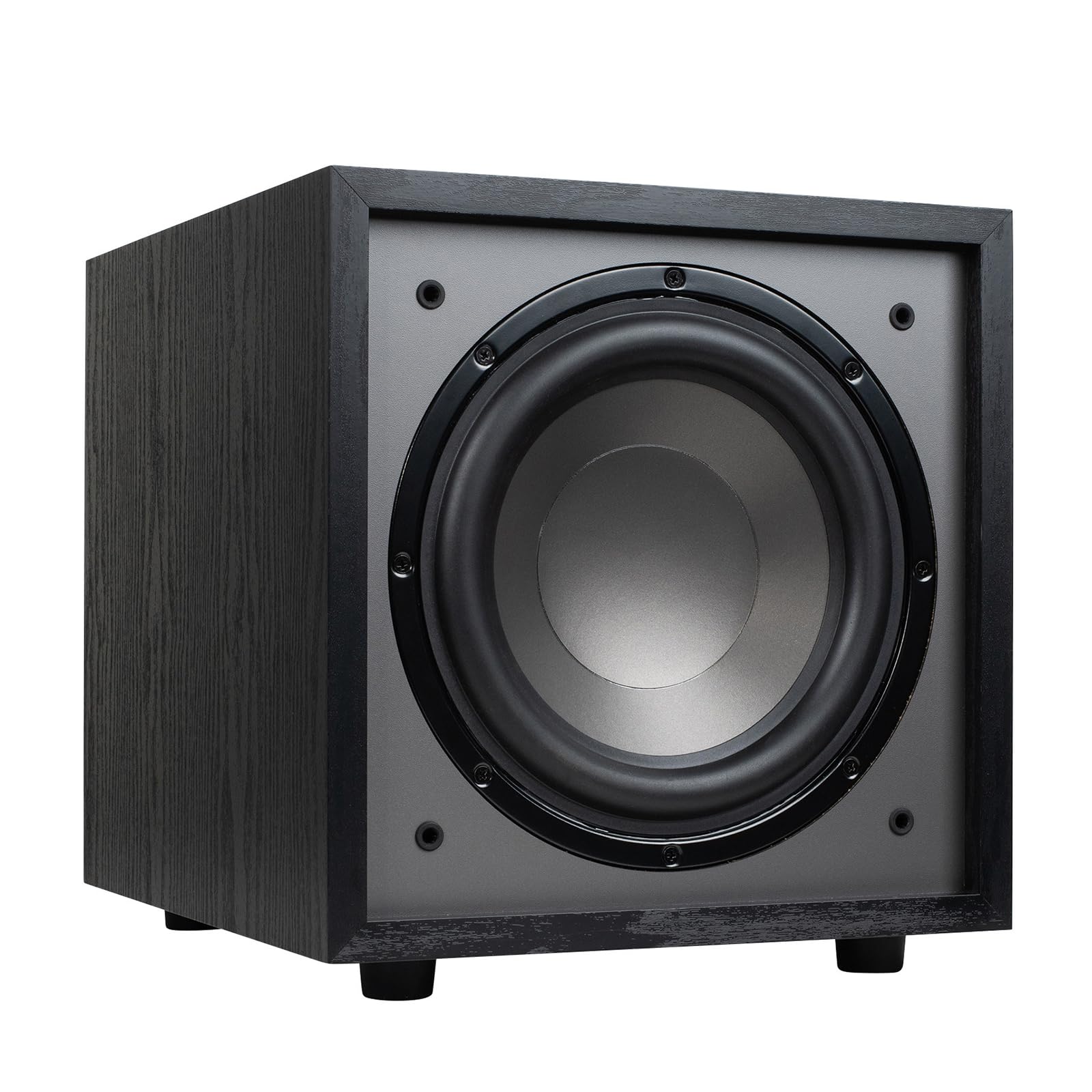
A 10-inch sealed-style box tuned for accuracy over boom, with a 28Hz floor that surprises people.
Dayton takes a different route to bass — a 180W Class-D amplifier pushing a 10-inch driver inside a rigid, braced cabinet, tuned to deliver tight, accurate low end without boominess or distortion. Class-D is the efficient amplifier type, so it runs cooler and lighter than the Class A/B design in the Polk. The reach is rated at 28Hz, which is deeper than the Edifier T5s at 35Hz and shallower than the Polk’s 24Hz.
The front panel is swappable: a black grille ships in the box, and a gray one is sold separately, so the look follows your room. Connectivity is generous for the tier — stereo RCA, LFE, and speaker-level inputs, plus auto-on and simple push-button controls. For a sub that needs to blend with whatever speakers you already own, that flexibility matters.
Clean and tight bass is what people keep returning to with this one, and the adjustability gets credit too. The maker backs it with a 5-year warranty and builds it in the USA, which is a strong statement at this level. The trade-off is headroom: 10 inches and 180W give you accuracy, not the chest-thump a 12-inch Klipsch brings to a large room.
The accuracy argument: 28Hz reach and a braced, low-resonance cabinet make this the pick for music-first listening and dialogue clarity.
Where it stops short: a 10-inch driver will not pressurize a big open-plan room the way a 12-inch can.
Your match if: you want clean, musical bass and value a long warranty.
Not your box if: your priority is maximum output for explosions.
5. Rockville Rock Shaker 12

A 12-inch MDF box that promises room-filling bass and mostly delivers, with one number worth questioning.
Rockville builds the Rock Shaker 12 around an MDF cabinet and a 12-inch driver, with a built-in Class D amplifier and a 50Hz to 150Hz adjustable crossover so you can dial the handoff to your main speakers. RCA and speaker-level inputs mean it slots into receivers, amps, and home audio rigs without special cables. There is a phase switch and a volume dial up front for quick tweaks.
Sound quality is what owners talk about, and it holds up as musical down in the low register rather than turning to mush. It will rattle windows and make the house shake when you push it. The honest caveat is the power rating: some note it doesn’t deliver the claimed 800 watts, so treat that peak number as marketing rather than a spec you can bank on.
Durability gets mixed reports, with a few long-term owners reporting units that did not hold up over months of use. That does not make it a bad sub — it makes it a value-first pick you should buy with eyes open. If you want a 12-inch driver and room-shaking effects on a tight budget, it delivers — just expect the 800W figure to be peak, not sustained.
What stands out
- 12-inch driver in an MDF cabinet at an entry-level tier
- Adjustable 50Hz–150Hz crossover for blending with your speakers
- RCA and speaker-level inputs plus a phase switch
- Bass that stays musical in the low range
Set your expectations
- The 800W figure is peak power, and owners question it
- Long-term durability draws mixed reports
Right call if: you want a big driver on a small budget and can accept the real-output reality.
Look elsewhere if: you need a sub to last years of heavy use.
6. Edifier T5s

The space-saver: an 8-inch woofer and 18mm MDF cabinet that disappears into a room but still reaches 35Hz.
For a desk setup, a small apartment, or a bedroom theater, the T5s is the one that actually fits. It runs a 70W RMS Class-D amplifier behind an 8-inch long-throw woofer, and the 18mm MDF cabinet with a front-firing driver and right-firing acoustic port keeps resonance down. Frequency response goes down to 35Hz, which is shallower than the 28Hz Dayton and 24Hz Polk, but plenty for a small or medium room.
Buyers report it completely fills a great room at 50% on both volume and gain, so it has more in the tank than its size suggests. What people praise most is the sound quality it brings to a desktop or bookshelf system, with value and build quality close behind. The auto-standby kicks in after 15 minutes of inactivity to save power.
The one thing to check before you buy is how your source connects. If your speakers have a sub out, a single RCA cable handles it. If they do not, the T5s can run in series through its Signal In and Signal Out, but your main speaker then needs a line-in connection and Bluetooth, USB, or optical will not work on that path. Compatibility is the mixed note in an otherwise strong pick.
The fit it fills: an 8-inch driver in an 18mm MDF cabinet with a 30Hz–160Hz low-pass filter and 0°/180° phase selector, sized to tuck away in a small room.
The catch to check: series connection needs a line-in on your main speaker, and it rules out wireless sources.
Best fit for: a small-to-medium room or desktop rig where footprint beats raw output.
Skip the series route: if your main speaker only takes Bluetooth, USB, or optical.
7. SVS SB-1000 Pro
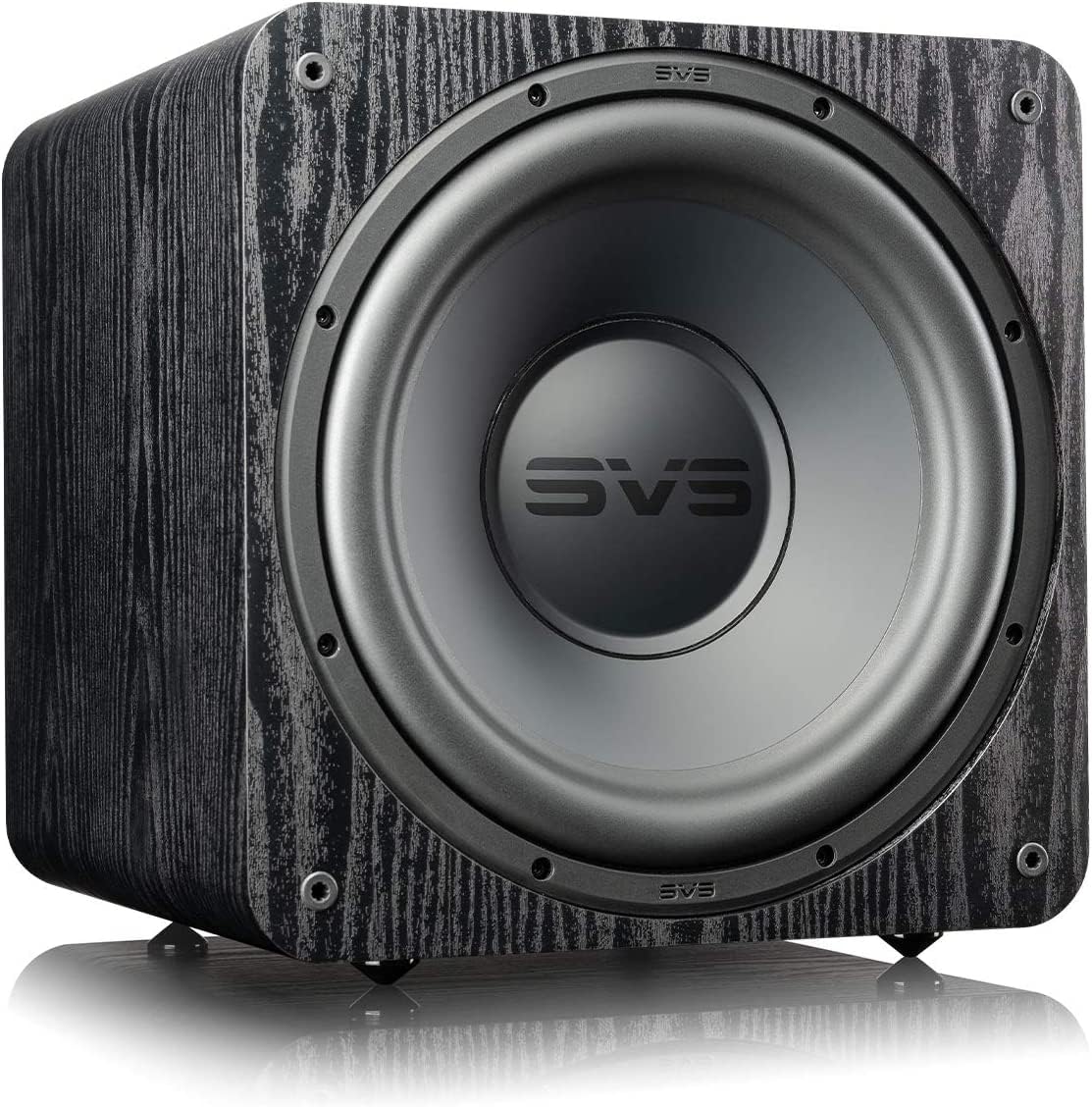
Sealed-box precision with a phone app that retunes the bass from your seat.
This is the pickup where you dial in bass from your chair instead of crawling behind the couch. The Sledge STA-325D amplifier delivers 325 Watts RMS and 820-plus Watts Peak, driving a high-excursion 12-inch driver with a dual ferrite magnet motor. A 50MHz Analog Devices Audio DSP handles in-room tuning, so the sub corrects for where it actually sits. The cabinet is sealed, extra-thick MDF with internal bracing, which is why the bass stays controlled instead of smearing.
Sealed cabinets like this one trade some low-end output for accuracy, and that is the whole design intent here. Owners describe it filling large rooms with booming bass and blending cleanly with tower speakers, which is the hallmark of a sealed design that stops on a dime. The compact MDF box also fits in more places than a ported alternative would.
The app is the standout feature: volume, custom presets, and fine tuning all live on your phone, so you can compare settings without leaving your seat. Bluetooth range is listed at 10 meters. The one thing to weigh is that a sealed 12-inch gives you precision and speed, not the deepest possible rumble — the ported PB-1000 Pro chases that instead.
The case for the SB-1000 Pro
- 325W RMS and 820+W peak from the Sledge STA-325D amplifier
- Sealed, braced MDF cabinet keeps bass tight and controlled
- Smartphone app controls volume, presets, and tuning
- 12-inch high-excursion driver with dual ferrite magnet motor
The other side
- Sealed design gives up some low-end output to the ported SVS model
- The app is central to setup, so budget a few minutes with your phone
Choose this if: you want precise, tunable bass and prefer a compact sealed box.
Head for the PB-1000 Pro if: your goal is maximum rumble, not control.
8. KEF Kube 10 MIE

A 10-inch sealed box that reaches 24Hz and hides in a corner while it does it.
KEF’s Kube 10 MIE is the compact high-end answer: a 10-inch front-firing driver in a sealed cabinet, a 300W RMS Class D amplifier, and a frequency response down to 24Hz. That reach matches the Polk MXT12’s 24Hz from a much smaller enclosure, which is the whole point of the Music Integrity Engine — KEF’s digital signal processing that squeezes detailed bass out of a sealed box. At 15.4kg and roughly 370mm on each side, it tucks into more rooms than a floor-standing ported sub.
Three room EQ settings let you match the bass to where you place it, and KEF’s Smart Connect app tune the sub automatically for mono or stereo input. RCA and speaker-level inputs handle the wiring, and an optional KEF KW1 adapter adds a wireless connection. Build quality is the aspect owners mention most, with sound performance right alongside it.
What those specs promise is controlled, distortion-free bass that complements music as much as movies — the sealed cabinet keeps it nimble.
Why music lovers lean here: 24Hz reach from a sealed 10-inch box with a 300W Class D amp and three room EQ settings.
The honest catch: a compact sealed 10-inch will not move the air a 12-inch ported cabinet does.
Built for: a refined stereo-plus-movie setup where the sub must stay out of sight.
Know going in: this rewards precision over brute output.
9. Sonos Sub 4

If you already own a Sonos soundbar, this is the sub that slots in over Wi-Fi with zero cables to the TV.
Sonos builds the Sub 4 around dual Sonos-engineered drivers and a force-canceling architecture, which places the drivers so their vibrations cancel each other out — that is why distortion, buzz, and rattle are largely removed from the equation. Pair it with a Sonos Arc Ultra, Arc, or Beam and it takes over the low end for movies, games, and music. Setup is one power cable and the Sonos app, so there is no RCA run across the room.
The flexibility is real: stand it upright or lay it on its side and slide it under the sofa, and the matte finish matches the rest of the Sonos lineup. Owners mention it makes kitchen cabinets rattle and improves bass in larger rooms, and the Wi-Fi connection keeps it stable away from the TV. Pair two with an Arc Ultra or Arc for extra immersion.
Two honest limits. The driver is listed at 5 inches, so the raw air movement is smaller than the big Klipsch and Polk boxes — the design leans on force-canceling and DSP rather than surface area. And the value question is the mixed note, because it only makes sense inside the Sonos ecosystem; on a standard AV receiver it has nothing to plug into.
Why Sonos owners love it
- Force-canceling architecture reduces distortion, buzz, and rattle
- Wi-Fi pairing with Arc Ultra, Arc, or Beam over the Sonos app
- Runs on a single power cable with flexible placement
- Stand it upright or lay it under the sofa
Before you commit
- Only makes sense inside the Sonos ecosystem
- Smaller 5-inch drivers rely on clever design over raw air movement
Made for: a household already running a Sonos soundbar who wants cable-free bass.
Wrong turn if: you are on a standard AV receiver setup.
10. REL T/5x

A sealed, down-firing 8-inch box built to melt into a stereo system, not shout over it.
REL aimed the T/5x squarely at mid-tier speakers — lower-end 3-way towers or quality bookshelf models — and it is a different animal from the movie-first subs here. The sealed design uses a down-firing 8-inch driver and a 125-watt Class A/B amplifier, reaching down to 33Hz at -6dB. It is built for spaces up to 400 square feet, and a stereo pair opens up larger listening rooms.
You get two ways to hook it up, so one sub can serve both your music and your movies. For music, run the included high-level speaker wire (a cable that taps the signal straight off your amplifier) from your amp. That is how REL subs blend the low end into the character of your main speakers. For movies, switch to the single RCA cable (the standard round plug) into your subwoofer output. Both cables can stay wired at once, so a stereo rig and a theater share one sub.
The high-level cable ships in the box, along with a Neutrik connector and a 10-meter run, so you are not hunting for a special lead. The catch is scale: an 8-inch driver with 125 watts is tuned for blend and texture, not for pressurizing an open-plan great room. The high-gloss white finish is also a statement piece, so make sure it matches the room.
Where it shines: high-level and RCA inputs wired at once, a sealed 125W Class A/B amp, and a down-firing 8-inch driver tuned to 33Hz for stereo blending.
The honest limit: an 8-inch sealed box will not energize a large open room.
The right match for: a music-first two-channel setup that also handles movie night.
Look bigger if: your room runs north of 400 square feet and you want it to shake.
11. SVS PB-1000 Pro

The ported sibling to the SB-1000 Pro, built to move more air and rattle more of the house.
The PB-1000 Pro shares its electronics with the sealed SB-1000 Pro — the same Sledge STA-325D amplifier at 325 Watts RMS and 820-plus Watts Peak, the same 12-inch high-excursion driver. The difference is the cabinet. This one is ported with an acoustically tuned dual-port design that allows maximum airflow without distortion, which boosts both the quantity and the quality of output at every drive level. That extra airflow is why a ported box feels bigger in the room.
The 50MHz Analog Devices DSP and the smartphone app carry over, so you still control volume, presets, and frequency response from your phone. Customers note a clear delineation between bass notes rather than a wall of boom, which is the sign of a port that is tuned well. The low-frequency response is where this design is meant to stand out.
The trade-off is size and placement. A ported cabinet is physically bigger than the sealed SB-1000 Pro, so measure the spot before you buy, and leave the port some breathing room. If your room is large and you want the deepest, most physical low end in this lineup, this is the box that delivers it.
Why it tops the output chart
- Dual-port cabinet boosts bass quantity and quality at all levels
- 325W RMS and 820+W peak from the Sledge STA-325D
- Smartphone app for volume, presets, and frequency response
- 12-inch high-excursion driver for deep, articulate output
What you give up
- Ported cabinet is larger than the sealed SB-1000 Pro
- Needs clearance so the ports can breathe
Your pick if: you have the floor space and want the biggest, deepest low end here.
Go sealed instead if: a compact box and tighter control matter more than rumble.
Know the Specs
Driver size in inches
Driver size is the diameter of the woofer cone, and it decides how much air the sub can move. A 12-inch driver moves noticeably more air than an 8-inch one, which is why the Polk MXT12 and Klipsch SPL-120 pressurize rooms that the Edifier T5s cannot. Match it to your space: a large living room wants 12 inches, while a desk or bedroom does fine with 8. Surface area is the physical ceiling on output, so pick the size for your room before you chase wattage numbers.
Watts and what they mean
Watts measure amplifier power, and you will see two kinds: RMS (continuous power the amp can sustain) and peak (a short burst). The Edifier T5s runs 70W RMS while the SVS models run 325W RMS, and that gap is why the bigger amps hold their composure at high volume. Peak figures like the Rock Shaker’s 800W are marketing-tuned bursts, so weigh the RMS number more heavily when you compare.
Frequency response and hertz
Frequency response is the lowest note a sub can reproduce, written in hertz. Lower is better for movie rumble: 24Hz (Polk, KEF) reaches deeper than 28Hz (Dayton) which reaches deeper than 35Hz (Edifier). Human hearing bottoms out around 20Hz, so anything in the 24Hz–35Hz band is a meaningful difference you can feel during action scenes.
Sealed versus ported cabinets
A sealed cabinet traps air, giving you quicker, tighter bass — that is why the SVS SB-1000 Pro and KEF Kube use one. A ported cabinet uses tuned openings to reinforce low frequencies, delivering more output for the size — the SVS PB-1000 Pro and Edifier T5s lean on this. Neither is better; sealed suits music, ported suits rumble, and your room decides which you want.
Crossover and LFE inputs
A crossover is the frequency where the sub hands off to your main speakers, usually adjustable from 50Hz up to about 160Hz depending on the model. Set it near the low end of your speakers’ range so bass does not double up. LFE is the dedicated bass channel your AV receiver sends movie effects down, and using that input lets the receiver manage the bass for you.
Wired versus wireless connection
Most subs connect with a single RCA cable, but a few go a step further. The Sonos Sub 4 pairs over Wi-Fi with a Sonos soundbar, and the Klipsch SPL-120 can go wireless with an optional accessory. Wireless frees your placement, but it also ties you to one ecosystem, so decide whether flexibility or simplicity matters more.
Common Questions
Will a 12-inch subwoofer overwhelm a small bedroom?
What is the difference between a sealed and ported subwoofer?
Do I need an LFE input on my subwoofer?
How do I set the crossover on a surround sound subwoofer?
Can I use a home theater subwoofer with a stereo amplifier?
Where should I place my subwoofer in the room?
How much amplifier power do I actually need for movies?
Can I connect a subwoofer wirelessly?
Will a subwoofer improve my dialogue clarity?
Do I need to buy a cable separately with these subwoofers?
Can I run two subwoofers in one surround system?
The Bottom Line
For most rooms, the surround sound subwoofer to buy is the Klipsch Synergy Sub-120. Its 12-inch front-firing driver (the cone that pushes the bass into the room) and 200W continuous, 400W dynamic amplifier (the power it delivers in short bursts) turn a normal living room into a theater floor. It also has the largest verified owner base here, at 4.5+ stars across 800+ reviews. If deeper, more physical movie bass is your priority and you have a corner to spare, the Polk Monitor XT12 reaches 24Hz (a very low bass note you feel more than hear) in a braced MDF cabinet (dense engineered wood that resists rattle). For a compact apartment or desk rig, the Edifier T5s tucks into an 18mm MDF box and still reaches 35Hz.
The Klipsch backs that up with 4.5+ stars across 800+ owners, the deepest review pool here. Measure your floor space, decide if you want sealed precision or ported rumble (a sealed box is tighter, a ported box moves more air), and pick the driver size your room can actually use.
How we choose
We do not accept paid placement. Every pick is matched to a real buyer and a real use-case; we do not hands-on test units.
Sources
Specifications: manufacturer listings and product documentation. Review insights: verified customer reviews, as of November 2026. Pricing: not shown on this page (it changes often); check the current price via the retailer link.
As an Amazon Associate, Tactical Gear Guy earns from qualifying purchases. This does not affect which products we feature.