Specs are compiled from manufacturer listings and verified buyer reviews and can change over time — please confirm the key details on the product page before buying.
You keep reaching for the remote because the talking scenes are the ones you can’t hear. That is the classic center-channel problem, and it is fixable. A dedicated center speaker sits directly under your screen and carries almost all the dialogue in a movie mix. The right one turns muffled mumbling into clean, anchored dialogue while explosions stay in the left and right speakers. This guide covers the ten center speakers worth your attention and tells you which one fits your room, your receiver, and your ears.
This guide is built by comparing the manufacturers’ published specifications and the patterns across verified customer reviews, so you get each pick’s real strengths and trade-offs instead of marketing spin.
Below you’ll find a plain-English breakdown of driver sizes, horn designs, and cabinet ports, plus a direct read on which cabinet suits a small apartment and which one belongs in a dedicated room. The short answer to your search for the Best Surround Sound Center Speaker sits right at the top of the list.
Top Picks


How To Choose The Best Surround Sound Center Speaker
The center speaker is the one channel your ears lock onto for every line of dialogue, so it deserves more thought than the pair of tower speakers flanking it. Get it right and you stop reaching for the remote during quiet scenes. Get it wrong and every quiet scene turns into a volume-knob fight. The four choices below decide most of that outcome.
Driver size and how many woofers you actually need
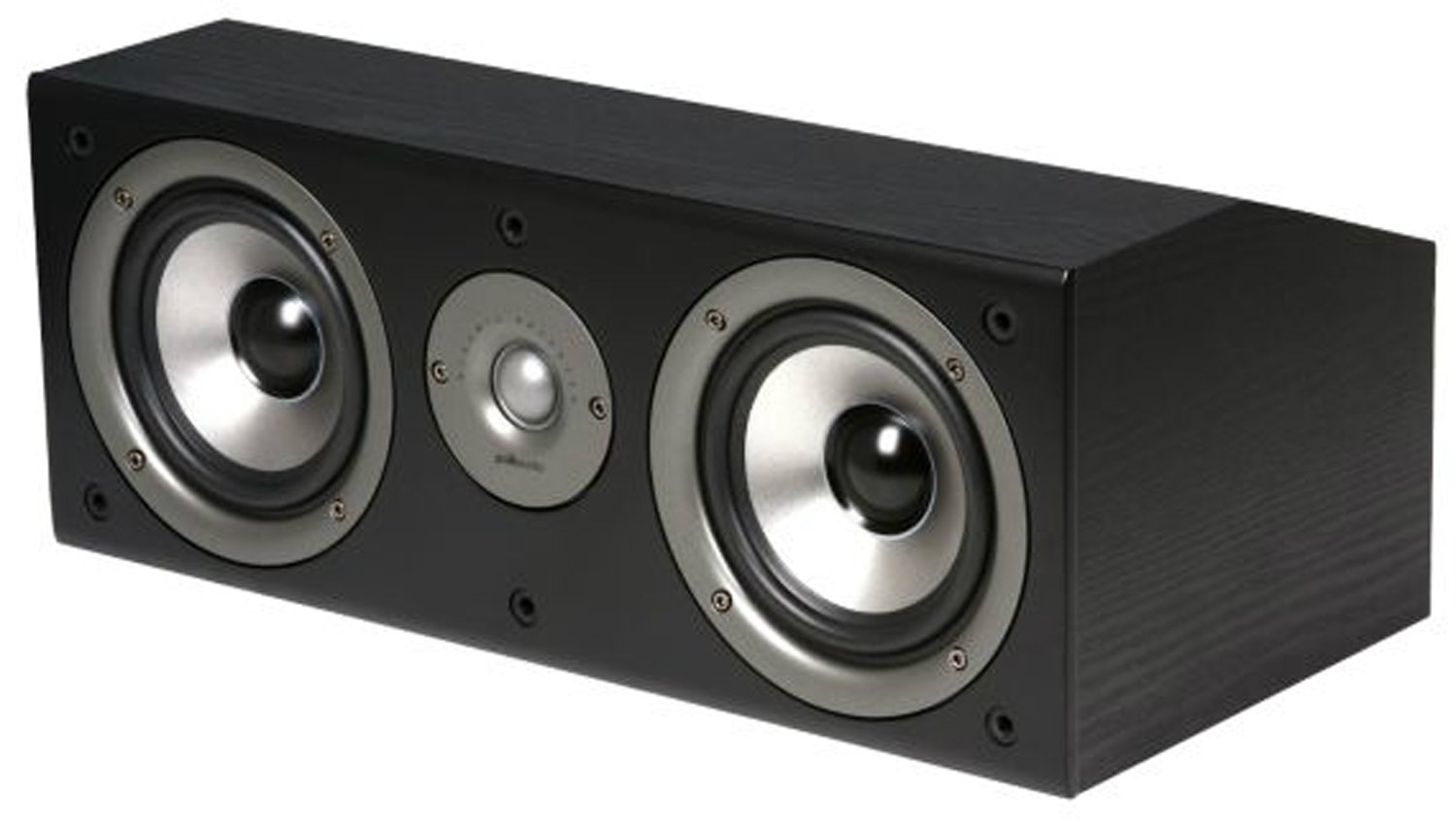
A center speaker’s woofers (the round cones that move air for lower notes) determine how much body male voices and deep effects carry. Two 5.25-inch woofers, as on the Klipsch RP-504C and the Polk CS1, give you more cone area than a single larger driver and keep the cabinet wide enough to sit under a TV. Bigger 6.5-inch drivers move more air but need a taller cabinet, which can block your screen or crowd the shelf below it.
Horn-loaded versus dome tweeters
The tweeter handles the high frequencies, which is where speech consonants live and where clarity is won or lost. A horn-loaded tweeter, like the Tractrix horn on the Klipsch models, controls how sound spreads across the room so dialogue stays locked to the screen for viewers off to the side. A soft-dome or silk-dome tweeter, like the ones on the ELAC and Micca, spreads sound more gently and often sounds softer on bright soundtracks.
Matching the center to your existing speakers
Your center speaker should share a tonal family with your front left and right speakers, or voices will jump in character as actors move across the screen. If you already own Polk Monitor towers, stay in the Polk family. If you run Klipsch Reference Premiere fronts, the RP-500C blends in without a seam. Mismatched brands can still work, but be prepared for a slight shift in voice tone.
Where it will physically sit
Measure the gap under your TV before anything else. A compact cabinet slips into an AV console, a ported cabinet needs a little breathing room behind it, and a reversible design lets you flip the speaker to aim sound up at your ears from a low shelf. Front-firing ports, as on the ELAC Debut C5.2, let you push the speaker closer to a wall or tuck it into a bookshelf without muddying the bass.
Side-by-Side Comparison
| Model | Best For | Woofer Size | Design Layout | Tweeter Type | Amazon |
|---|---|---|---|---|---|
| Klipsch RP-504C★ Best Overall | Reference-grade dialogue with punch | 5.25 inches | Horn-loaded 2-way | Titanium vented | Amazon |
| Micca MB42X-CBudget Champion | Tight spaces and tight budgets | Carbon fiber woofer | 2-way ported | Silk dome | Amazon |
| Polk Audio CS1Most Versatile | Reversible placement below ear level | 5.25 inches | 2-way rear ported | 1-inch dome | Amazon |
| Polk Monitor XT30 | Console and shelf installs | 5.25 inches | 2-way compact | 1-inch dome | Amazon |
| ELAC Debut 2.0 C5.2 | Wall-adjacent placements | 5.25 inches | 2-way bass reflex | Cloth dome | Amazon |
| Klipsch RP-500C | Matching Reference Premiere fronts | 5.25 inches | Horn-loaded 2-way | Titanium LTS vented | Amazon |
| JBL Stage 2 245C | Wide rooms needing extra cone area | 4.5 inches | 2-way quad woofer | Anodized aluminum | Amazon |
| SVS Prime Center | True 3-way clarity on a receiver | 5.25 inches | 3-way rear ported | 1-inch aluminum dome | Amazon |
| SVS Ultra Evolution | Dedicated rooms and transparency | 6.5 inches | 3-way vertical array | Diamond carbon aluminum | Amazon |
| KEF Q6 Meta | LCR flexibility and wide dispersion | 6.5 inches | 3-way Uni-Q | 12th-gen Uni-Q array | Amazon |
Detailed Reviews
1. Klipsch RP-504C Center Channel Speaker
Our pick — 4.5+★ from 950+ verified ratings; the strongest balance of quality and price.
The horn-loaded heavyweight that makes every whispered line land clean.
The Klipsch RP-504C is the pick for anyone who is tired of subtitles. It pairs dual 5.25-inch Cerametallic woofers (light, stiff cones that hold their shape while moving air) with a 1-inch titanium vented tweeter behind a 90° x 90° Tractrix horn — the flared guide that spreads high frequencies evenly across the room. That horn is the reason dialogue stays pinned to the screen rather than smearing toward the side walls. If your couch sits off-center, this is the layout that keeps conversation intelligible.
Klipsch also does real engineering inside the horn. A compressed molded silicon face fits against the horn to damp the ringing that can make horns sound harsh. Computer-modeled phase plugs act as a mechanical filter that smooths the frequency response while shielding the tweeter from damage. Titanium is chosen for the diaphragm because it is light but rigid, and Klipsch’s Linear Travel Suspension keeps the diaphragm moving like a piston to cut distortion. In plain terms, loud action scenes stay composed instead of turning gritty.
Setup is straightforward but deserves a note. The rear Tractrix port needs a little room behind the cabinet to breathe, so push it right against the wall and you lose some of the low-end control the design is built around. Voices, action, and dialog come through clearly in the reviews, and the consensus is that the value and looks back up the performance. A pair of nice speakers and a receiver with real power will do it justice — this cabinet rewards quality upstream. If you want Klipsch’s horn sound but space is tight, the RP-500C below trims the footprint.
What makes it the top pick
- The 90° x 90° Tractrix horn spreads dialogue evenly for seats off to the side.
- Dual 5.25-inch Cerametallic woofers drive low notes with easy headroom.
- The titanium vented tweeter is tuned to keep high frequencies smooth, not sharp.
- The ebony finish matches the rest of the Reference Premiere line.
The honest caveats
- The rear port wants clearance behind the cabinet — tuck it flush to the wall and bass tightens up.
- Horn-based clarity exposes a weak receiver far more than a soft-dome speaker would.
Go for it if: you want movie dialogue that stays centered on the screen from every seat in the room, and you have a receiver with real power behind it.
Think again if: your console leaves barely any gap behind the speaker — the rear Tractrix port needs room to work.
2. Micca MB42X-C Center Channel Speaker
The smallest speaker on this list that still makes dialogue sound easy.
Start with the footprint, because that is why most people find the Micca. It is a compact 2-way cabinet built to disappear into a console or a shelf, so it fits under a TV where the bigger center speakers physically cannot go. Inside is a balanced woven carbon fiber woofer for punchy, transient bass and a silk dome tweeter for smooth treble and accurate imaging — meaning voices stay placed where the actor is standing on screen.
The engineers put real work into the crossover, the circuitry that hands off frequencies between woofer and tweeter. Micca uses an 18dB crossover tuned for an open, balanced, dynamic sound, and the ported enclosure extends bass response with low distortion. In practical terms, you get a fuller low end than the cabinet size suggests, which helps male voices and deep effects feel grounded rather than thin. What owners keep coming back to is simply how good it sounds for the size, and how it handles dialogue at lower volumes — a genuine help for late-night viewing when you cannot crank the level.
The obvious catch is scale. This is a small passive cabinet, so it will not fill a large dedicated theater room with the authority of the Klipsch RP-504C above. In an apartment living room or a bedroom setup, though, that is exactly the point. It pairs naturally with Micca bookshelf speakers if you want a matched set, and the carbon fiber woofers dress it up to look pricier than it is. A smart starting point for a first real surround system.
Where it earns its place: a compact cabinet with an 18dB crossover and a silk dome tweeter that keeps dialogue readable at low volume — ideal for late-night watching and small rooms.
The part to weigh: it is a small passive speaker, so a large theater room will want more cone area and cabinet volume than this can offer.
Made for: first-time surround builders, dorm and apartment setups, and anyone whose console has limited shelf height.
Look elsewhere if: you are outfitting a big room where the center channel has to carry serious volume.
3. Polk Audio CS1 Series II Center Channel Speaker, Black
Flip it upside down and the sound aims straight at your ears.
Most center speakers assume you can mount them at ear level, which almost nobody can with a TV in the way. The Polk CS1 solves that with a reversible cabinet: turn it upside down and the drivers aim the sound upward, directing dialogue right at your listening position from a low shelf. That single trick is why this speaker earns a spot. Inside it pairs two 5.25-inch Dynamic Balance woofers with a 1-inch tweeter for detailed highs and accurate reproduction, and a rear port adds powerful, deep bass.
Owners get more than placement flexibility. The speaker handles maximum volume without distortion, which matters when an action score swells and you still need to catch the line underneath it. It also timbre-matches neatly with Polk’s own family — pair it with Monitor 60 or 70 towers in a larger room, Monitor 40 bookshelf speakers in a smaller one, or combine the whole set for a matched surround system. Voices hold their character as they pan across the front stage, which is the whole goal of sticking with one brand family.
The file notes that size draws mixed feelings, with a few finding the cabinet larger than expected, so check your shelf clearance before ordering. Otherwise this is a dependable, well-liked center channel that earns its keep through flexibility rather than brute force. If you want the reversible-placement trick, nothing else here offers it.
The placement trick: a reversible cabinet that aims sound up from below ear level, plus dual 5.25-inch Dynamic Balance woofers for clear high-frequency detail.
Measure first: the cabinet runs larger than some buyers expect, so confirm your console’s shelf height rather than assuming it will slide in.
Right choice when: your TV sits high and your center speaker has to live on a low shelf or inside a console.
Skip the flip if: you already have a shelf at proper ear height — the reversible advantage is wasted and the larger cabinet may crowd you.
4. Polk Audio Monitor XT30 Center Channel Speaker

A space-saving center that lets you hear the dialogue without cranking the volume.
If your media console is shallow and your patience for menu-diving is thin, the XT30 is built for you. It packs a 1-inch tweeter and two 5.25-inch Dynamically Balanced woofers into a compact cabinet sized for AV consoles, bookshelves, speaker stands, and tabletops. The dynamic-balance driver design keeps the cones moving cleanly, so mid-range bass comes through smooth instead of boomy. The result is a clear, hi-res soundstage without a giant box dominating the room.
What sells this speaker to most buyers is the dialogue. It lets you hear what characters are saying without pushing the surround system to punishing levels — exactly the fix for the “why is everyone whispering” problem. Polk also timbre-matches the XT30 to the rest of the Monitor XT line, so you can add MXT60 tower pair, MXT90 height modules, and an MXT12 sub later and the whole system will blend. Build quality also gets noticed: the cabinet looks like a deliberate design choice rather than a budget afterthought.
Shop smart on one point. This is a compact cabinet, so a very large room will feel its size limits sooner than the bigger Klipsch models. In a normal living room, though, it is a strong blend of clear dialogue, easy placement, and matched-system potential.
The case for the XT30
- Compact enough to drop into most AV consoles and on shelves.
- Clear dialogue without maxing out your surround system.
- Timbre-matched to Polk’s MXT line so you can expand later.
What to keep in mind
- Compact size means less output for a very large room.
- You need a receiver or amplifier to drive it — passive only.
Pair it with: a console-based living room setup where the TV already fills the wall and shelf space is precious.
Hold off if: your room is large enough that you need the deeper bass of a full-size center cabinet.
5. ELAC Debut 2.0 C5.2 Center Channel Speaker
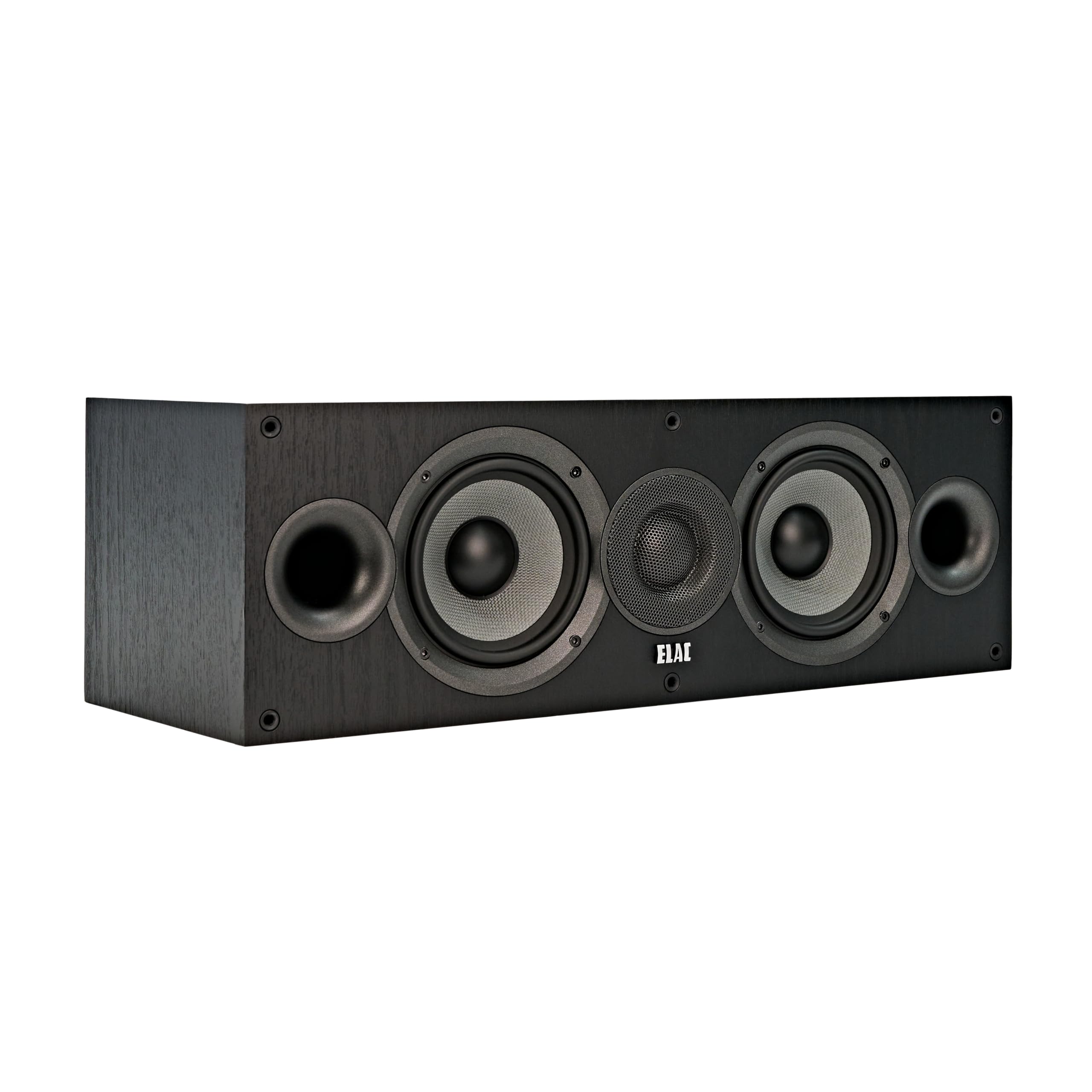
A cloth dome tweeter rated to 35,000 Hz that pulls air and detail out of the top end.
Here is the number that sets this cabinet apart: a cloth dome tweeter with a wide-roll surround that takes response up to 35,000 Hz. That extends far above the range of human hearing, and the payoff is air and detail in the top end that makes strings, rain, and whispers feel present. A waveguide controls directivity and cuts the diffraction that plagues ordinary box cabinets, so dialogue lands where it should. Dual 5.25-inch woven aramid fiber woofers handle the lower half with stiff, well-damped cones.
The cabinet itself shows the same care. Thick MDF walls are internally braced to reduce vibration, and the front-firing ports mean you can push the speaker against a wall or slide it into a bookshelf without ruining the sound — something the rear-ported Klipsch models above cannot claim. ELAC also tuned sensitivity and impedance so the speaker asks less power from your AV receiver, which means a modest receiver still gets dynamic impact. Owners consistently point to clearer TV dialogue and a fuller viewing experience as the reason they are glad they bought it.
The trade-off worth flagging is size. Some buyers feel the C5.2 runs larger than they pictured, so measure your shelf before you commit. It also does its best work with a receiver that can feed it properly, which is fair for a speaker built to resolve fine detail. For a wall-adjacent or bookshelf install, few cabinets here are this accommodating.
The standout spec: a soft-dome tweeter with response up to 35,000 Hz and a waveguide that tames diffraction — sound that stays airy and detailed in the treble.
Measure the shelf: the cabinet is larger than some expect, and rear clearance is not the issue — the front-firing ports are forgiving — but shelf width can be.
Best matched with: a bookshelf or wall-adjacent placement and a receiver that values high-frequency detail.
Consider the size: if your console shelf is shallow or narrow, check the cabinet dimensions before ordering.
6. Klipsch RP-500C Center Channel Speaker
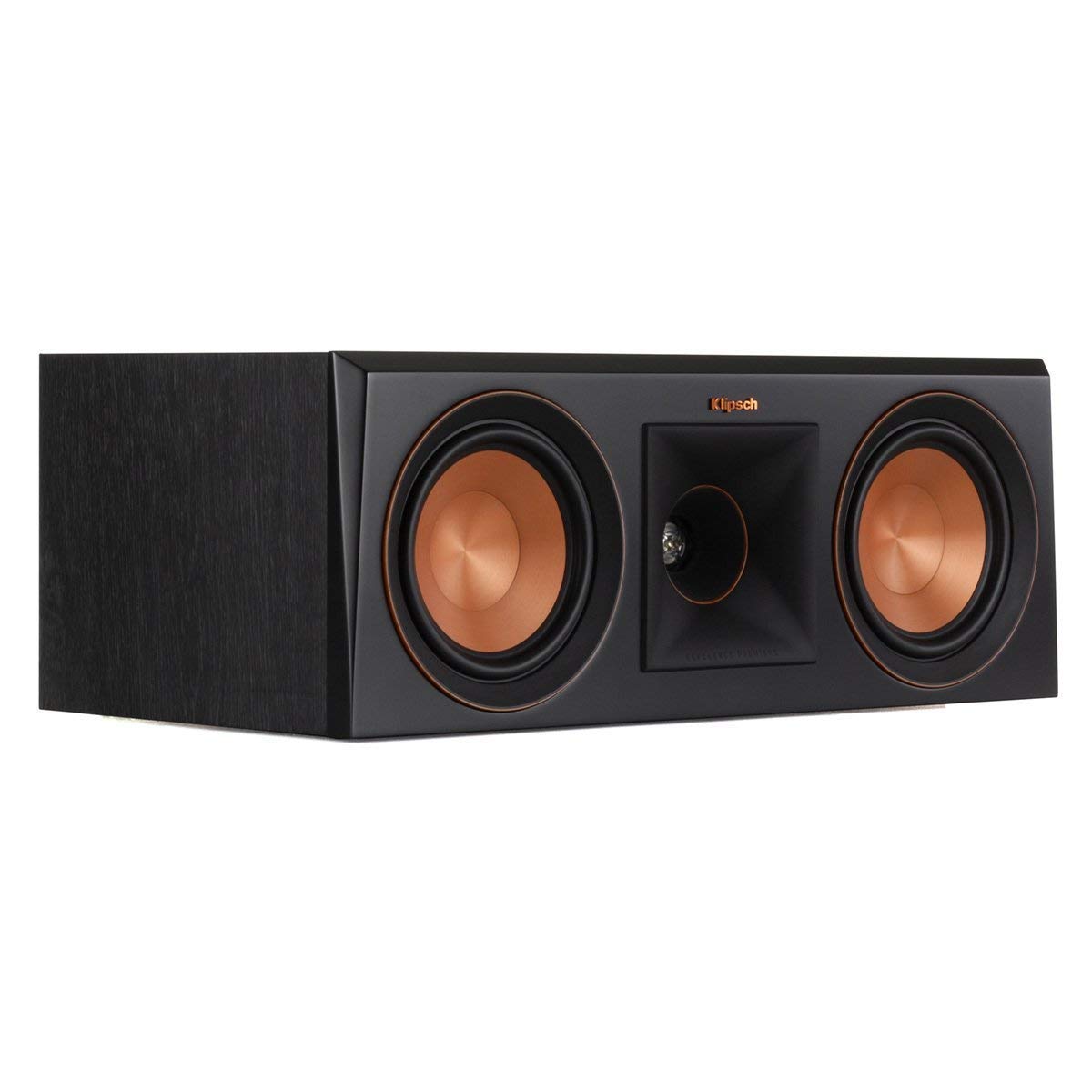
Same horn family as the top pick, in a cabinet that fits tighter spaces.
The RP-500C is the trimmer sibling of the RP-504C, and it keeps the same reference-grade ingredient list. A 1-inch titanium LTS vented tweeter sits behind a hybrid Tractrix horn, matching the dispersion control that keeps dialogue locked to the screen. Two 5.25-inch spun copper Cerametallic woofers bring the low-mid body, and a rear-firing Tractrix port adds bass without the cabinet growing taller. If your fronts are Reference Premiere towers, this is the center that blends without a seam.
Sound-wise, this cabinet delivers crisp, clear output with improved clarity across the volume range. It adds punch and bass to the center stage, and it is comfortable handling dialogue, music, and sound effects in the same scene — the exact juggling act a center channel faces in every movie. Its scratch-resistant ebony and walnut finishes hold up to daily life, and the strong, flexible removable magnetic grille means you can run it bare or covered without fighting clips.
One thing to plan around: some buyers find the cabinet larger than they pictured. That is not a sound complaint, just a space one, so verify your shelf opening. Otherwise this gives you the Klipsch horn sound with more placement flexibility than its bigger brother — for a matched Reference Premiere system, it is the obvious finishing piece.
The blend partner: a matched Reference Premiere front stage where horn dispersion and copper woofers need to feel like one speaker across the screen.
Space check needed: the cabinet is chunkier than some buyers expect, so confirm the shelf opening first.
7. JBL Stage 2 245C Center Channel Loudspeaker

Four small woofers where most centers use two — a wider front stage for big rooms.
Count the cones on this one. The JBL Stage 2 245C runs four 4.5-inch Polycellulose ribbed cone woofers across the front, where most cabinets here use two. More, smaller cones spread across a wide baffle give you a broad front stage that suits a room where the couch is far from the screen. Up top, a 1-inch anodized aluminum tweeter sits in JBL’s next-generation HDI horn, a design that controls how sound spreads so off-axis listeners still get clean dialogue. Dual rear-firing tuned ports add bass depth.
The espresso finish is a departure from the usual black, giving it a warmer look against wood furniture. It is a passive speaker, so it needs a receiver or amplifier to drive it, and it slots naturally into a home theater or TV setup. Depth, clarity, and consistency are the goals here, and the quad-woofer layout is the mechanism that delivers them across a wide listening area.
The honest note is reach. This cabinet is newer to the market with far fewer buyers weighing in so far, so the long-term story is still being written — but the design itself is sound engineering, not a gamble. If your seating runs wider than the screen, the quad-woofer approach makes practical sense.
The quad layout: four 4.5-inch Polycellulose woofers and an HDI horn spread dialogue across a wide front wall — the pick for long couches and side seating.
Newer to the market: it has far fewer buyer reports than the established options here, so weigh the proven track records of the Polk and Klipsch cabinets alongside it.
For wide rooms: a large front wall and a seating arrangement that spreads out past the screen edges.
Wait if: you want a long, well-documented ownership record before you commit.
8. SVS Prime Center Speaker – Premium Black Ash

A true 3-way crossover that hands vocals their own dedicated midrange driver.
The SVS Prime Center takes a different engineering route from the 2-way cabinets here. It uses a true 3-way crossover, which splits the sound into three bands — low, mid, high — each handled by a dedicated driver. That separation is why vocals and dialogue stay composed even when the soundtrack gets crowded. A 1-inch aluminum dome tweeter plays cleanly at high volume, and the dual 5.25-inch woofers sit in cast ABS-fiberglass composite baskets for precise component alignment and an inert frame without added resonances.
The SVS SoundMatch 3-way crossover, tuned for accurate frequency response, keeps transitions between drivers silky-smooth and imaging pinpoint. In practice, that means a voice moving across the screen stays anchored instead of sliding. The cabinet is rear-ported for enhanced bass and tuned for dual woofers. What buyers key in on is the sound distribution — it holds up well beyond the 90° axis, so viewers sitting off to the sides still get coherent audio. The black ash finish also dresses it up nicely.
Weigh one practical point: the 3-way layout is more revealing of a weak receiver than a simple 2-way, so give it clean power. Do that and you get a center speaker that handles the dialogue-and-effects juggling act with real poise. It is the balance for someone who wants 3-way clarity without jumping to the flagship price tier.
Why 3-way matters here
- Dedicated drivers for low, mid, and high keep vocals separate from effects.
- Sound stays coherent well beyond the 90° axis for off-center seats.
- The cast composite baskets and 1-inch aluminum tweeter aid clean high-volume playback.
Set it up right
- Rear porting wants breathing room behind the cabinet.
- The detailed 3-way tweeter exposes a cheap receiver more than a soft-dome would.
A match for: a receiver with real headroom and a front stage that deserves genuine 3-way separation.
Not the one if: you plan to run it near a wall with no clearance or drive it from a thin amplifier.
9. SVS Ultra Evolution Center Channel Speaker

A vertical tweeter-midrange array that keeps each voice locked to its spot on screen.
This is the step up for a dedicated room. The Ultra Evolution arranges its tweeter and midrange in a vertical array, which creates even on- and off-axis response and blending for clear vocals — the physical reason dialogue stays glued to the actor rather than smearing sideways. A 6.5-inch driver joins the array for weight and body, and the whole assembly is built on precision-cast aluminum-alloy baskets that keep components aligned and pull heat away. The result is transparency and dynamics that a compact 2-way simply cannot match.
The tweeter is the showcase. A hyper-rigid diamond carbon coating sits on an aircraft-grade aluminum dome to deliver linearity and quick transient response — meaning sharp sounds like door slams and gunshots snap into place without smearing. FEA-tune cabinet construction, bracing, and acoustic insulation eliminate structural resonances so the cabinet stays quiet and the drivers do all the talking. Owners gravitate to how it makes mediocre streaming dialogue sound noticeably better, and to the fact that it is a really solid true 3-way center. The 8-ohm impedance makes it friendly to a wide range of receivers.
The catch is scale — a 6.5-inch driver and a vertical array mean a big cabinet, so it needs a proper stand or a deep console shelf. It also costs real money, which is fair for this build. If you have the room, it is a serious anchor for a high-end surround rig.
The engineering payoff: a vertical tweeter-midrange array with a 6.5-inch driver and diamond carbon coating on aluminum — transparency and dynamics that reveal detail in every source.
The room it demands: a 6.5-inch driver and vertical array make for a large cabinet, so budget for a stand or a deep shelf as well as the speaker.
Built for the dedicated room: a serious system where the center channel is the star of a high-end front stage.
Check your space: the big cabinet and premium build mean you need both the shelf and the budget to support it.
10. KEF Q6 Meta Center Channel Speaker
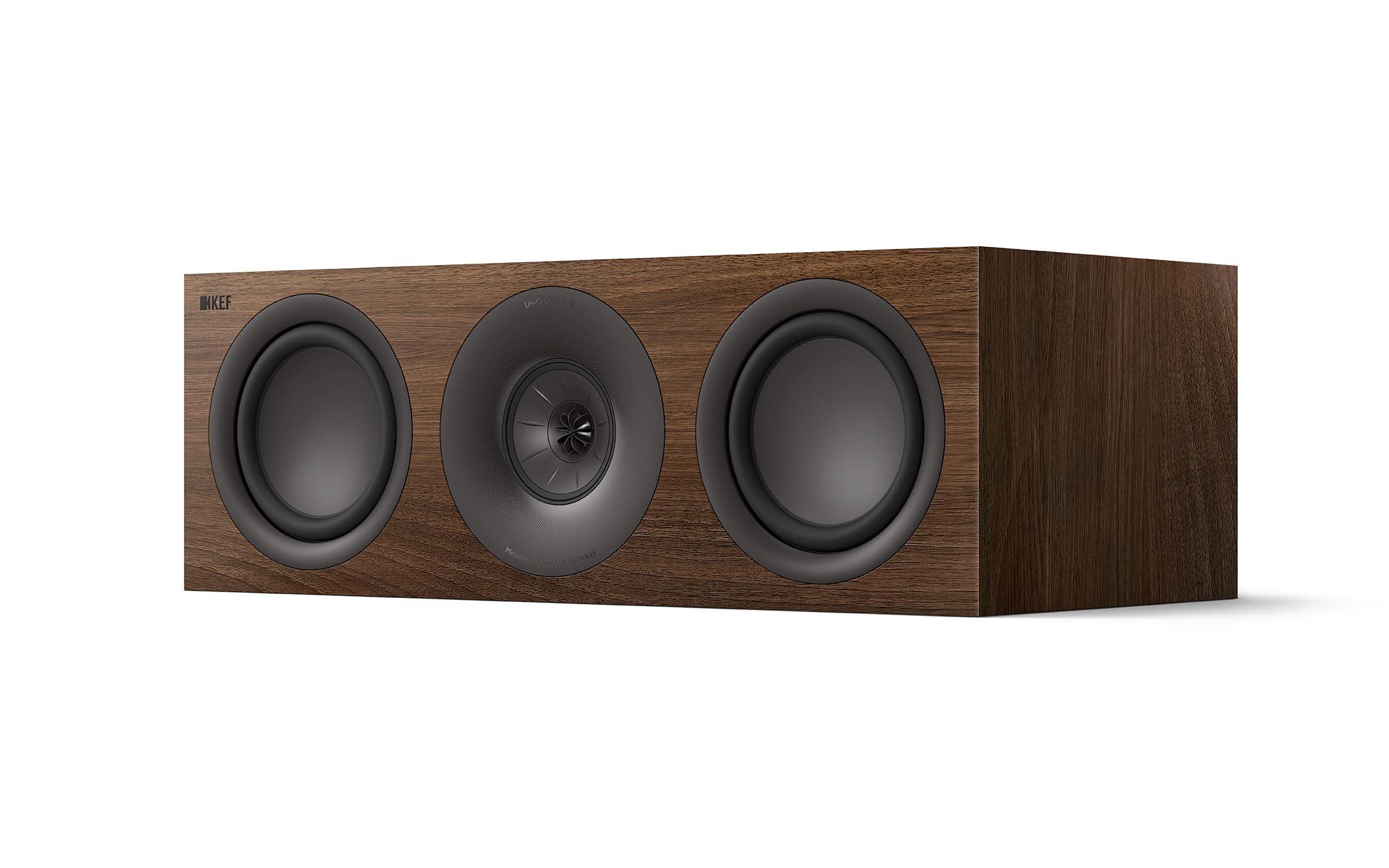
A 12th-generation Uni-Q array that disperses dialogue evenly to every seat in the room.
KEF’s approach is different from everyone else here. Instead of separate drivers, its 12th-generation Uni-Q array combines the high and mid frequency drivers into a single point source, so sound disperses more evenly around the room. That means more people can hear clear, detailed audio from wherever they sit — not just the person in the middle of the couch. Around it, a 3-way design separates frequencies for detail, and two 165 mm hybrid aluminum bass drivers deliver punchy, controlled low end.
The other signature feature is MAT, a metamaterial absorption technology that KEF says absorbs 99% of unwanted sound from behind the driver. The point is less distortion and cleaner, more natural audio, so you hear more of the dialogue and detail you actually want. The cabinet is genuinely flexible — use it as your center speaker in a surround system or as a left, center, or right speaker in an LCR setup, and it integrates with other KEF Q Series speakers so you can build the system around your room. The walnut finish gives it a furniture-grade look.
Bear in mind this is a premium cabinet at the top of the list, and the 6.5-inch drivers make it a full-size speaker. It is also a passive design that needs a receiver. For a room where several people watch together from different angles, the Uni-Q dispersion is a genuine advantage over a standard 2-way — a fair premium for even coverage.
Ideal if: you watch with a full room of people at different angles and want every seat to hear clear dialogue — the Uni-Q point source delivers even coverage across the room.
Only if the budget stretches: it is a full-size passive cabinet, so plan for a receiver and shelf space alongside it.
Know the Specs
Driver size and cone area
Woofer size is usually listed in inches, and it tells you how much air a center speaker’s cones can move. Dual 5.25-inch woofers, as on the Klipsch RP-504C, Polk CS1, and XT30, give you more total cone area than a single driver and keep the cabinet wide enough for under-TV duty. Larger 6.5-inch drivers, as on the SVS Ultra Evolution and KEF Q6 Meta, move more air and add weight to voices, but they need a taller or deeper cabinet — so measure before you commit.
2-way versus 3-way designs
A 2-way design splits the audio into two bands (a woofer for low and mid, a tweeter for high). A 3-way, like the SVS Prime Center and Ultra Evolution, adds a dedicated midrange driver so the crossover hands off each frequency band to a separate component. In plain terms, 3-way layouts tend to keep dialogue clearer when a soundtrack gets busy, because the midrange is not sharing a driver with bass duties.
Horn versus dome tweeters
The tweeter reproduces the highs where speech consonants live. Horn-loaded tweeters, like the Tractrix designs on the Klipsch cabinets, control sound spread so dialogue stays tied to the screen for off-axis viewers. Soft-dome and silk-dome tweeters, like the ELAC C5.2 and Micca, spread sound more gently and often sound softer on bright tracks. Neither is better in the abstract — it depends on your room and taste.
Ports and placement
A port is a tuned opening that extends bass response. Rear-ported cabinets, like the Klipsch models and Polk CS1, need a little breathing room behind them. Front-firing ports, like those on the ELAC C5.2, let you push the speaker closer to a wall or tuck it into a bookshelf without ruining the sound. If your console is tight against the wall, front porting is the friendlier choice.
Common Questions
Will a center channel speaker work if I do not have matching left and right speakers?
Do I need an amplifier or receiver to run a passive center channel speaker?
Which center speaker is best for hearing dialogue clearly at low volume?
How much clearance does a rear-ported center speaker need behind it?
Can I place a center channel speaker below ear level?
Is a 3-way center speaker better than a 2-way for movies?
How do I match a center speaker to tower speakers I already own?
Will a large center speaker fit under my TV or inside my console?
What does the tweeter type actually change in everyday listening?
Can a center channel speaker be used as a left or right speaker too?
The Bottom Line
For most people building a surround system, the strongest all-round center is the Klipsch RP-504C. Its 90° x 90° Tractrix horn keeps dialogue pinned to the screen from any seat, and its dual 5.25-inch Cerametallic woofers give voices real body. If your console shelf is short or your budget is tight, the Micca MB42X-C fits where the big cabinets cannot and still handles dialogue at low volume. Want your center speaker to aim up from a low shelf? Reach for the Polk CS1 and flip it over.
For a dedicated room, the SVS Ultra Evolution brings a vertical tweeter-midrange array and a 6.5-inch driver that reveal detail a compact 2-way cannot. And if several people watch from different angles, the KEF Q6 Meta spreads dialogue evenly around the room with its Uni-Q point source. Whichever cabinet you choose, the Klipsch RP-504C backs up its horn-and-woofer design with 4.5+ stars across 900+ ratings.
How we choose
We do not accept paid placement. Every pick is matched to a real buyer and a real use-case; we do not hands-on test units.
Sources
Specifications: manufacturer listings and product documentation. Review insights: verified customer reviews. Pricing: not shown on this page (it changes often); check the current price via the retailer link.
As an Amazon Associate, Tactical Gear Guy earns from qualifying purchases. This does not affect which products we feature.