Specs are compiled from manufacturer listings and verified buyer reviews and can change over time — please confirm the key details on the product page before buying.
You want one cable that reaches from your media rack to the projector across the room and still delivers a clean picture. For a run of roughly 25 feet or longer, an active or fiber-optic cable (one with a built-in chip that boosts the signal) does the job that ordinary copper quietly fails at. The short answer: the KabelDirekt 50ft is the safest all-round buy for most people. Choose a fiber pick when you need 8K or 4K at high frame rates down a long wall run.
This guide is built by comparing the manufacturers’ published specifications and the patterns across verified customer reviews, so you get each pick’s real strengths and trade-offs instead of marketing spin.
A long HDMI run behaves nothing like the short cable in the box. The gap between a clean signal and a blank screen usually depends on how the cable carries data over distance. Below are the picks that hold up, explained in plain terms so you choose the right super long hdmi cable the first time.
Top Picks


How To Choose The Best Super Long HDMI Cable
A long cable is not just a short cable with more wire in it. Past roughly 25 feet, a plain copper HDMI lead starts to lose the signal, and that shows up as flickering, dropouts, or no picture at all. The fix is either a heavier shielded copper design or an active fiber cable that converts the signal to light for the trip. Knowing which one your setup needs is the whole decision.
Copper or fiber — which one survives your run
Fiber-optic cables carry the signal as light, so they don’t pick up electrical noise from power cables or Wi-Fi routers sitting nearby. That makes them the better fit for a long in-wall run past a breaker box or a crowded AV rack. Copper cables are simpler and often cheaper, and a well-shielded one like the KabelDirekt handles a 50ft run at 4K 60Hz without trouble. If your run crosses a lot of electrical clutter, lean fiber.
Match the bandwidth to your resolution and frame rate
Bandwidth, measured in gigabits per second (Gbps), is the size of the pipe the picture travels through. A 4K 60Hz setup is happy with 18Gbps. If you want 8K, or 4K at 120Hz for a PS5 or Xbox Series X, you need the 48Gbps that HDMI 2.1 cables provide. Buy for the display you plan to own, not just the one you have now — the cable is the cheapest link to upgrade correctly once.
The directional trap almost everyone hits
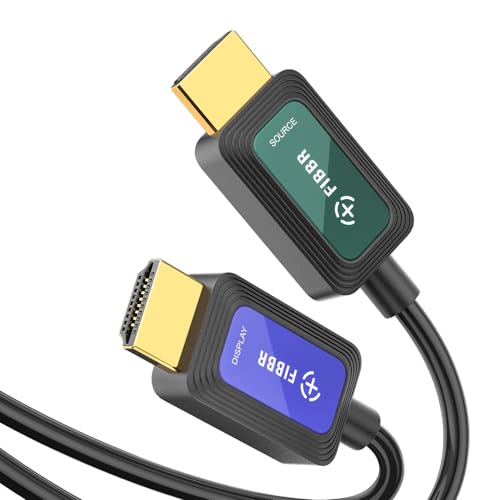
Active fiber cables are one-way. One end is marked SOURCE (your console, PC, or streaming box) and the other DISPLAY (your TV or projector). Plug them in backwards and you get a blank screen, not a warning. Before you buy, check the labeling and confirm which end goes where — some cables even print the direction on the connector housing, which saves a lot of head-scratching during install.
In-wall rating and audio return on very long runs
If the cable is going inside a wall, look for a CL2 or CL3 rating, which marks it as safe for permanent in-wall installation. Several picks here carry that rating. The other catch is audio return: on the longest fiber cables, ARC and eARC (the channel that sends TV audio back to your soundbar or receiver) often stops working past a certain length. If you need soundbar audio return, keep that run short or plan a separate audio path.
Side-by-Side Comparison
| Model | Best For | Length | Max Resolution | Bandwidth | Amazon |
|---|---|---|---|---|---|
| KabelDirekt 4K 50ft★ Best Overall | All-round value | 50 ft | 4K@60Hz | 18 Gbps | Amazon |
| RUBMUD Fiber Optic 50ftTop Performer | 8K gaming | 50 ft | 8K@60Hz / 4K@120Hz | 48 Gbps | Amazon |
| FIBBR Fiber Optic 50ftBest for In-Wall | In-wall AV installs | 50 ft | 8K@60Hz / 4K@120Hz | 48 Gbps | Amazon |
| KIMTABO 4K 100ft | Very long runs | 100 ft | 4K@60Hz | 18 Gbps | Amazon |
| Fibopitcal 8K 50ft | Home theater | 50 ft | 8K@60Hz / 4K@120Hz | 48 Gbps | Amazon |
| Cable Matters 8K 25ft | Certified reliability | 25 ft | 8K@60Hz / 4K@240Hz | 48 Gbps | Amazon |
| OREI 4K 100ft | Long HDR runs | 100 ft | 4K@60Hz | 18 Gbps | Amazon |
| BlueRigger 4K 50ft | In-wall on a budget | 50 ft | 4K@30Hz | 18 Gbps | Amazon |
| Monoprice 4K 50ft | Dense installs | 50 ft | 4K@60Hz | 18 Gbps | Amazon |
Detailed Reviews
1. KabelDirekt 4K HDMI Cable 50ft
Our pick — 4.5+★ from 112,500+ verified ratings; the strongest balance of quality and price.
A 50ft copper run that holds a 4K picture without the usual flicker.
Most people installing a projector or a wall-mounted TV across a room don’t need 8K. They need a cable that reliably carries 4K at 60Hz from the source to the screen without turning the picture into confetti. That is exactly what this KabelDirekt 50ft does, and it does it at 18Gbps — the bandwidth HDMI 2.0 needs — with a frequency of 60Hz matching the standard 4K 60Hz signal.
The engineering underneath is worth understanding. German Flexcore combines multi-layer metal shielding with flexible conductors, which means the cable resists interference from nearby power lines while still bending around tight corners. A tight bend radius matters in real installs — you’re often routing behind a wall plate where a stiff cable would kink and lose the signal. Add HDR, 7.1 surround, ARC, and Ethernet, and you cover almost every home theater setup.
The cable has a 36-month manufacturer warranty and is individually machine-tested before it ships — a detail that shows up in how few buyers report outright failures. It covers the whole device list, from PS5 and Xbox to projectors and streaming boxes. Buyers consistently praise the build: substantial shielding, connectors that seat firmly, and a picture that stays stable over the full 50ft run. The honest catch is that this is a 4K 60Hz cable, not an 8K or high-refresh-rate one — if you’re running a PS5 at 120Hz or planning an 8K display, you’ll want the 48Gbps fiber picks below instead. For everyone else chasing a dependable 4K run, this is the safe call.
Where it cleans up
- Multi-layer shielding keeps the picture stable over the full 50ft run
- 36-month warranty and machine-tested build give real confidence
- Supports HDR, 7.1 surround, ARC, and Ethernet in one cable
Where it stops short
- Capped at 4K 60Hz — no 8K or 4K high-refresh-rate support
- 18Gbps bandwidth leaves no headroom for next-gen displays
Best fit for: anyone wiring a 4K TV, projector, or console across a room and wanting a cable that just works.
Look elsewhere if: you’re chasing 8K or high frame rates — the fiber options beat it on bandwidth.
2. Fiber Optic HDMI Cable 50ft, 8K Long HDMI 2.1 Cable, 48Gbps
The budget-friendly way into 8K fiber — if your display plays nice with it.
Here is where the bandwidth gap opens up wide. This fiber cable runs at 48Gbps, against the KabelDirekt’s 18Gbps — 2.7 times the data pipe. That 48Gbps headroom is what carries 8K@60Hz and 4K@120Hz down a full 50 feet. For a PS5 or Xbox Series X owner who wants smooth 120Hz gameplay on a big screen across the room, that’s the spec that matters.
Fiber construction brings its own advantages beyond bandwidth. The signal travels as light, so it ignores electrical interference from power cables and Wi-Fi routers, and it stays lossless over long distances in a way copper simply can’t. It’s also slimmer and more flexible than copper, with gold-plated connectors and a zinc alloy housing rated for 20,000+ bending cycles. It’s directional, though — SOURCE end into your console or PC, DISPLAY end into the TV, and backwards means no picture.
What wins people over is that it just works across a wide spread of gear — function and picture quality both earn strong marks, and 4K at high refresh rates is a common success story. There’s a real caveat worth knowing before you buy: the maker states lab testing found compatibility problems with LG OLED and LCD displays, and some buyers hit signal-loss and short-lived durability issues. It’s a great fit for Samsung, Sony, and projector setups; check your TV first if it’s an LG.
The value play: 48Gbps and 8K support at a lower entry point than most fiber 2.1 cables — hard to argue with for a console-driven setup.
Check before checkout: the LG OLED compatibility note and the mixed durability feedback are the two things to weigh honestly.
Reach for this if: you own a non-LG display and want 8K/120Hz headroom without spending premium money.
Think twice if: your TV is an LG OLED — the maker’s own note flags compatibility trouble.
3. FIBBR Fiber Optic HDMI 2.1 Cable 50 ft
At 3.2 ounces, it threads through a wall cavity like a shoelace.
If the cable is going behind drywall, weight and flexibility stop being trivia and start deciding whether the install takes twenty minutes or two hours. This FIBBR comes in at 3.2 ounces and a round profile, and its makers state it runs 50% thinner and lighter than copper cables. That’s the difference between threading conduit in minutes and wrestling a stiff copper snake the whole way.
The fiber core here uses YOFC technology, which converts the electrical signal to light so the picture survives long distances without degradation, freezing, or dropouts. It’s immune to EMI and RFI interference, which matters when the cable shares a wall with Romex or runs alongside power lines. On bandwidth it’s fully HDMI 2.1: 48Gbps, 8K@60Hz, 4K@120Hz, Dynamic HDR, eARC, VRR, ALLM, and Dolby Vision, backward compatible with 2.0 and 1.4.
Signal quality is what wins people over most, and it holds up in the field — clean 4K at 120Hz with steady connectivity between monitor and TV. Two things to know before you commit. It’s directional, so SOURCE and DISPLAY ends must be right. And FIBBR states 66ft and longer versions drop ARC/eARC, and this one may not support HDCP 2.2 or 4K@120Hz on some LG OLED models. If you’re running a long in-wall AV install and your display is compatible, this is a smart buy.
Why installers like it
- 3.2 oz weight and round shape make wall and conduit routing easy
- 48Gbps handles 8K@60Hz and 4K@120Hz with VRR and ALLM
- Fiber core ignores electrical interference in crowded walls
Set-up flags
- Directional — wrong end in the wrong port means no signal
- Maker notes possible LG OLED HDCP/120Hz compatibility limits
Ideal for: DIY in-wall runs and custom AV installs where cable weight and interference are real concerns.
Not the pick for: LG OLED owners who need guaranteed HDCP 2.2 at 4K@120Hz.
4. KIMTABO 4K HDMI Cable 100 ft Fiber Optic
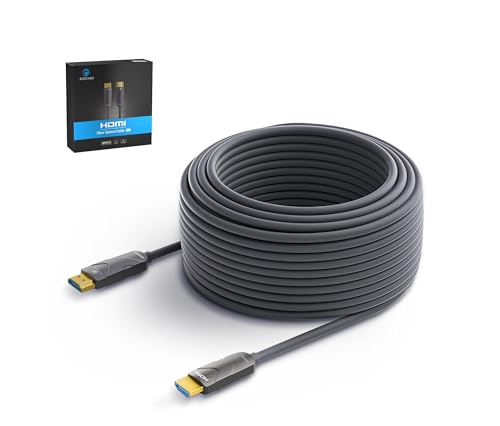
A full hundred feet of 4K at 60Hz from a cable barely wider than a pencil.
Some rooms are simply too big for 50ft. When your projector sits at the back of a long basement or your PC tower is one room over, you need the extra distance. This KIMTABO reaches 100 feet and still carries 4K@60Hz at 4096×2160, with support for 18Gbps bandwidth, HDCP 2.2, HDR10, and ARC. It’s a 4K 60Hz cable, not an 8K one, but at this length that’s a fair trade.
The engineering fit for long runs is what matters. The fiber core transmits video with no attenuation and no interference, and the whole cable measures just 4.8mm in diameter with a zinc shell. That slimness is what lets it snake through walls, ceilings, and tight conduit across a big space. Inside, a German chipset drives an OM3 fiber core, and the maker claims compatibility with 95% of devices on the market. Gold-plated connectors and a fully-molded design keep the connection solid.
How honest is it? Reliability draws mixed feedback — some units run flawlessly for a long stretch, while others stop working after a while. Build quality and length earn solid praise, and buyers appreciate that it’s long enough for their layout. The recurring gripe is signal strength on some setups, which is the reality of pushing 4K over a hundred feet through fiber. If you need serious distance and can test it in your setup early, it’s a sensible buy.
Why it earns a spot: 100ft of 4K 60Hz in a 4.8mm body is genuinely useful for basement projector runs and detached gear setups.
The honest limit: reliability is a mixed bag and signal strength is the most common complaint — plug it in and confirm a stable picture during the return window.
Worth it for: very long projector or room-to-room runs where 50ft won’t reach.
Skip if: you need guaranteed long-term reliability without testing first.
5. Fibopitcal 8K Fiber Optic HDMI Cable 50 ft, 48Gbps

Fifty feet of 8K with eARC and VRR, built to feed a receiver-fed theater room.
If your gear chain runs source to AV receiver to projector, the cable in the middle needs to pass high-bandwidth video and reference-grade audio without flinching. This Fibopitcal does 48Gbps with 8K@60Hz, 4K@120Hz, HDR, VRR, ALLM, and eARC for Dolby Atmos and DTS:X. It also stays at 3.2 ounces, so it routes through tight spaces behind the rack.
The fiber build is the reason it works over this distance. Fibopitcal rates it for 1000ft+ lossless runs, with no copper oxidation and 360° bendability for conduit routing. It ignores EMI/RFI noise from power cables, speakers, and Wi-Fi routers — the typical clutter in a wall rack. The makers even point out it’s directional, with SOURCE and DISPLAY clearly marked, and note that at 60ft and longer the ARC/eARC path drops off due to signal limits at extended distance.
Quality and compatibility are the two things buyers consistently value here — it plays nicely with plenty of 4K and 8K displays, and a Samsung-plus-Yamaha setup is a common working example. Durability is the mixed note: a few report units failing after months of use. There’s also the LG OLED compatibility notice for HDCP 2.2 and 8K/4K@120Hz formats. For a theater room full of high-bandwidth formats, this is a strong, well-priced fiber pick.
What makes it theater-ready
- 48Gbps handles 8K@60Hz and 4K@120Hz with VRR and ALLM
- eARC delivers Dolby Atmos and DTS:X to your receiver
- Fiber core stays clean next to power and Wi-Fi interference
Points to weigh
- Some units fail after a few months of use, per buyer reports
- Maker flags possible LG OLED HDCP 2.2 and high-bandwidth issues
Built for: receiver-dish, cablemunching theater setups that need 8K video and eARC audio in one run.
Look past it if: you need guaranteed long-term durability above all else.
6. Cable Matters Long 8K HDMI Cable 25ft
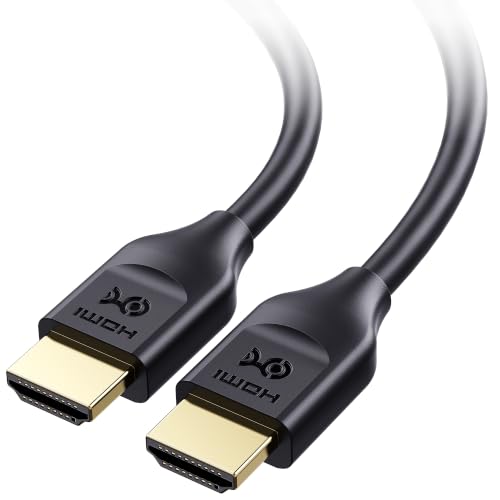
The certified 8K shortlist pick — 25 feet is still a long run, just not a wall-crossing one.
This is the one pick in the group that carries official Certified Ultra High Speed HDMI status, which means it’s been independently tested to meet the HDMI 2.1 spec. That matters if you’d rather not gamble on a brand you haven’t heard of. It runs 48Gbps, supports 8K@60Hz and 4K@240Hz, and is fully compatible with eARC, Dolby Atmos, and DTS:X 7.1/5.1.
At 25 feet it’s more of a same-room or same-wall run than a full-house install. If your TV and console are on opposite sides of a living room, that’s plenty. If you’re fishing through a ceiling to a projector, you’ll want a 50ft or 100ft option from this list. The cable weighs 0.61 kg, so it’s got real heft — the kind of weight that comes from heavy shielding rather than a bare fiber strand. It supports 4:4:4 RGB, 12-bit color, and Dolby Vision, and works with PS5, Xbox Series X/S, Apple TV, Roku Ultra, and NVIDIA RTX 3080/3090.
Reliability is what earns it this spot — it delivers real high-speed performance and pairs cleanly with current-gen consoles. The place to be careful is high bit-depth at 60Hz: some owners mention success at 4K 144Hz but trouble with 4K 10-bit at 60Hz. If your chain needs that specific format, this may not deliver it. For most 4K/8K gaming and streaming setups at 25 feet, though, it’s a dependable certified pick.
The right call when: you want certified HDMI 2.1 confidence at a 25ft reach with a current-gen console.
Keep looking if: your wall run exceeds 25ft, or you specifically need 4K 10-bit at 60Hz.
7. OREI 4K Fiber Optic HDMI 2.0b Cable 100ft – 18Gbps, HDR, ARC
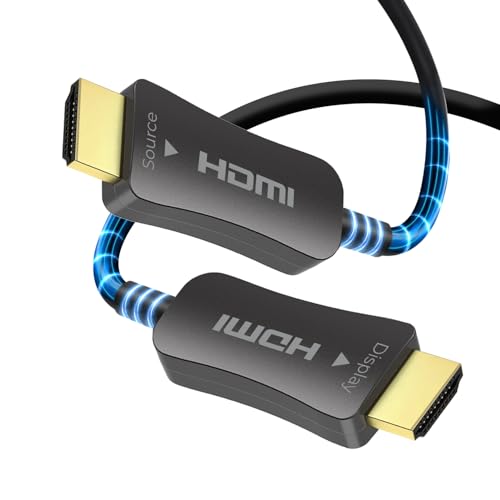
A hundred feet of 4K HDR with a five-year warranty behind it.
When a cable is going into a wall, durability stops being a nice-to-have and becomes the whole justification for the purchase. This OREI runs 100 feet at 18Gbps carrying full HDMI 2.0 4K@60Hz, and backs it with a five-year warranty — long enough that a failure in year three still gets replaced. That’s the kind of security a plastered-in wall run is worth.
It supports CEC, EDID, HDCP 2.2, HDR, ARC, and 1536KHz sample rates, with 32 uncompressed audio channels and 4K@60Hz 8-bit 4:4:4. The maker points out you don’t need an HDMI extender — the fiber core carries the signal the full distance, saving you an extra box and the power brick that comes with it. The cable is about 4.8mm in diameter, so it slips through tight spaces and walls without a wrestling match.
What wins people over is that it simply keeps working over the full 100ft run, and it’s often compared to pricier boutique cable brands. Functionality and quality both get strong marks, and customers note it’s reliable when even Wi-Fi drops out. The honest trade-off is that this is an HDMI 2.0b cable, not a 2.1 one — no 8K, no 4K@120Hz. For anyone doing a long 4K HDR install with a projector or big flat panel, that’s typically fine and the warranty makes it a smart buy.
The warranty is the headline: five years of coverage on a 100ft fiber run is unusual in this class and takes the sting out of an in-wall failure.
Where it stops: HDMI 2.0b caps the picture at 4K 60Hz — no 8K or high-refresh-rate formats.
Pick it for: long 4K HDR projector and display installs where the cable disappears into a wall for good.
Skip it for: PS5 or Xbox Series X at 4K 120Hz — this one is a 4K 60Hz cable.
8. BlueRigger 4K HDMI Cable 50 FT, 4K 30Hz, CL3 Rated

The sturdy copper workhorse — CL3-rated, 50 feet, and built to be forgotten inside a wall.
Not every long run needs fiber. If you’re wiring a soundbar to a TV or feeding a 4K 30Hz display through a wall, a well-made copper cable with the right rating does the job cleanly. This BlueRigger runs 50 feet at 18Gbps, handles Ultra HD 4K 30Hz, HDR, HDCP 2.2, eARC, 3D, and Ethernet, and is CL3-rated for safe permanent in-wall and ceiling installation. That rating is the one spec that actually gets you past an electrician’s inspection.
Solid copper conductors and 24K gold-plated connectors are rated for over 25,000 bends — enough to outlast the drywall it hides behind. It’s an ARC cable too, which for soundbar owners is exactly the connection you want. Universal compatibility covers Apple TV, Roku, PS5, Xbox, Switch, PC, Blu-ray, and projectors, and it’s backward compatible with older HDMI standards.
The build quality is what wins people over — beefy connectors and sturdy construction that seat firmly and stay put. It’s been handed plenty of use across 3D home theater, Apple TV, and projectors like the Epson Home Cinema 8350, and reviewers point out it holds up well for streaming and online gaming. The main thing to know: this is a 4K 30Hz cable, so if you need 60Hz, 4K high-refresh, or 8K, it won’t keep up. For a budget-friendly in-wall soundbar or 4K 30Hz run, it’s the sensible choice.
Best when: you need a CL3 in-wall 50ft run for a soundbar, 4K 30Hz display, or projector on a budget.
Not for: 4K 60Hz or high-frame-rate gaming, which needs the 18Gbps-plus 60Hz picks.
9. Monoprice 4K High Speed HDMI Cable – 4K@60Hz, Active, 50ft

An active fiber run in a 24-gauge body, rated for in-wall installs.
This is the cable for an installer who knows the spec sheet matters as much as the picture. It carries up to 4K@60Hz at 18Gbps with YCbCr 4:4:4 chroma sampling — full color resolution rather than the compressed chroma some cables quietly fall back to. It’s CL2 in-wall rated and active, which means it’s designed from the ground up for a permanent 50ft run behind the wall.
The active fiber design handles the distance without the degradation that hits passive copper, and a 24-gauge conductor gives it real presence. Compatibility covers TVs, monitors, projectors, receivers, and laptops. One honest note: 4K support and signal quality draw mixed marks on this one — it does full 4K at 60Hz, though some shoppers say signal-quality quirks over the run. Durability also gets a mixed read.
Functionality and quality are the strengths, and it shines in a long-run setup where the cable is meant to stay put for years. It’s a premium-tier pick, so it’s the right choice only when the CL2 rating and active fiber design are what your install actually demands. If your budget and setup are simpler, one of the copper or fiber picks above will cover you for less.
Where it justifies the tier: CL2 in-wall rating, active fiber design, and full 4:4:4 color make it a genuinely install-grade cable.
The real caveat: 4K support and signal quality come in mixed, and durability is not a strong point — test it thoroughly before you hide it in a wall.
Right for: permanent in-wall 4K 60Hz installs where the CL2 rating and active fiber design are non-negotiable.
Think again if: you can use a simpler, better-reviewed cable for a lighter-duty run.
Know the Specs
Bandwidth in Gbps
Bandwidth is how much data the cable can carry per second, and it’s the number that decides which resolutions and frame rates survive a long run. An 18Gbps cable handles 4K at 60Hz. A 48Gbps HDMI 2.1 cable adds headroom for 8K or 4K at high refresh rates like 120Hz. If your cable’s bandwidth falls short of what your console or display pushes, you’ll see flicker or a blank screen. Match the bandwidth to your gear before you run the cable.
Active vs passive and directional ends
Passive cables carry the signal directly, which works fine over short lengths but fades over long runs. Active cables, especially fiber-optic ones, use a chip or light conversion to boost the signal, which is how they stay clean at 50ft and beyond. Active fiber cables are directional: one end is labeled SOURCE for your player or console, the other DISPLAY for your TV or projector. Plug them in backwards and you get no picture. Check the labeling before installing.
Common Questions
Will a 50ft HDMI cable work with my PS5 or Xbox Series X at 4K 120Hz?
Why does my long HDMI cable give a black screen?
Do I need a fiber optic HDMI cable or is copper fine?
Can I use a long HDMI cable inside a wall?
Why doesn’t ARC or eARC work on very long fiber cables?
Is a 4K 30Hz cable good enough for a projector?
Will these cables work with an LG OLED TV?
How do I know a long cable is carrying the full 4:4:4 color?
Can I run two devices through one long HDMI cable?
What is the difference between HDMI 2.0 and HDMI 2.1 on a long cable?
The Bottom Line
For most people wiring a 4K display across a room, the super long hdmi cable worth buying is the KabelDirekt 50ft. It carries 4K 60Hz (4K resolution at 60 frames per second) cleanly over 18Gbps (gigabits per second, the cable’s data rate), so fast motion stays smooth. Its Flexcore shielding holds up in real installs, and a 36-month warranty backs it. If you want 8K and 4K at high frame rates, reach for the Fibopitcal 50ft at 48Gbps with eARC (the audio return channel that sends TV sound back to your receiver) for a theater room. For a long 4K HDR projector run inside a wall, the OREI 100ft carries a five-year warranty, which makes the in-wall risk far easier to swallow.
How we choose
We do not accept paid placement. Every pick is matched to a real buyer and a real use-case; we do not hands-on test units.
Sources
Specifications: manufacturer listings and product documentation. Review insights: verified customer reviews, as of November 2026. Pricing: not shown on this page (it changes often); check the current price via the retailer link.
As an Amazon Associate, Tactical Gear Guy earns from qualifying purchases. This does not affect which products we feature.