Specs are compiled from manufacturer listings and verified buyer reviews and can change over time — please confirm the key details on the product page before buying.
Your trunk is full and your back seat carries people, not speaker boxes, yet you still want real bass in the car. That is the whole reason the under-seat subwoofer exists — a powered box slim enough to slide beneath a seat and deep enough to add the low end your factory stereo never had. This guide covers nine of them, sorted by what each one actually does well. One note before you shop: this list uses flexible, human-like matching for the under-seat / slim low-profile form factor designed to mount beneath a vehicle seat, so not every pick is the exact number you searched — the nearest same-type size or wattage serves the same purpose, and you should know that upfront.
This guide is built by comparing the manufacturers’ published specifications and the patterns across verified customer reviews, so you get each pick’s real strengths and trade-offs instead of marketing spin.
Every pick below is judged on three things: whether it truly fits beneath a seat, how much clean low end it produces from its built-in amplifier, and how much wiring work it asks of you on install day. Here is how to pick the right subwoofer under the seat without buying twice.
Top Picks

How To Choose The Best Subwoofer Under the Seat
Before you ask “how loud,” ask “will this box physically slide under my seat.” Measure the gap between your seat rail and the floor first, because a sub you cannot fit is a sub you cannot hear. Once fitment is settled, the rest is about power, wiring, and how much control you get over the bass you are adding.
Measure your mounting gap before you shop
The box height is the number that decides your install. A very slim box can tuck into tighter footwells and under more seat positions than a taller one. Some of these units are as slim as 2.75″ to 3″ tall, which is the difference between sliding under a low seat rail and not clearing it at all. Treat the height figure on each spec sheet as your hard limit.
Match the amplifier to your car’s electrical system
Every unit here has a built-in amplifier, so you are not buying a separate amp and wiring it to a bare speaker. That saves you a lot of install work. The trade-off is current draw: a bigger amp pulls more power, and one of these subs is specifically built for electric vehicles with a listed maximum current draw low enough to keep range anxiety out of the picture. If your car is an EV, that specification matters more than raw wattage.
Know your radio’s output before you buy
High-level inputs accept the speaker wire from a factory head unit — the kind with no RCA outputs. Low-level inputs use RCA cables and want an aftermarket radio with preamp outputs. Most picks here offer both, which is what makes them usable in a stock vehicle. Check the input type on your radio first, then confirm the sub supports it.
Side-by-Side Comparison
| Model | Best For | Driver Size | Power Rating | Footprint | Amazon |
|---|---|---|---|---|---|
| BOSS Audio BASS10★ Best Overall | Tight-space trucks | 10 inches | Amplified (PWM) | 14” x 12.3” x 3.3” | Amazon |
| Pyle PLBX8ABest Value | Lowest-profile budget fit | 8 inches | 600 watts max | 12.8” x 9.5” x 3” | Amazon |
| Pioneer TS-WX010ASmallest Footprint | Smallest footwell | 6.58 inches | 160W max | 4.63” x 9” x 2.75” | Amazon |
| Blaupunkt GTHS131PRO | DSP-tuned bass | 10 inches | 350 Watts | 15L x 11W x 3H inches | Amazon |
| Pioneer TS-WX140DA | Electric vehicles | 8 inches | 250W max / 170W Class-D | 8″ x 5-1/4″ sealed | Amazon |
| Alpine PWE-S8 | Deep extension | 8 inches | 240W peak / 120W RMS | 8″ high-excursion cone | Amazon |
| JBL BassPro SL | Stock-radio simplicity | 8 inches | 250W peak / 125W RMS | 8-inch enclosure | Amazon |
| KICKER 46HS10 | All-aluminum durability | 10 inches | Compact powered | 10-inch Hideaway | Amazon |
| JBL Bass Pro SL2 | Small footprint upgrades | 8 inches | Powered (amp built-in) | 8-inch underseat | Amazon |
Detailed Reviews
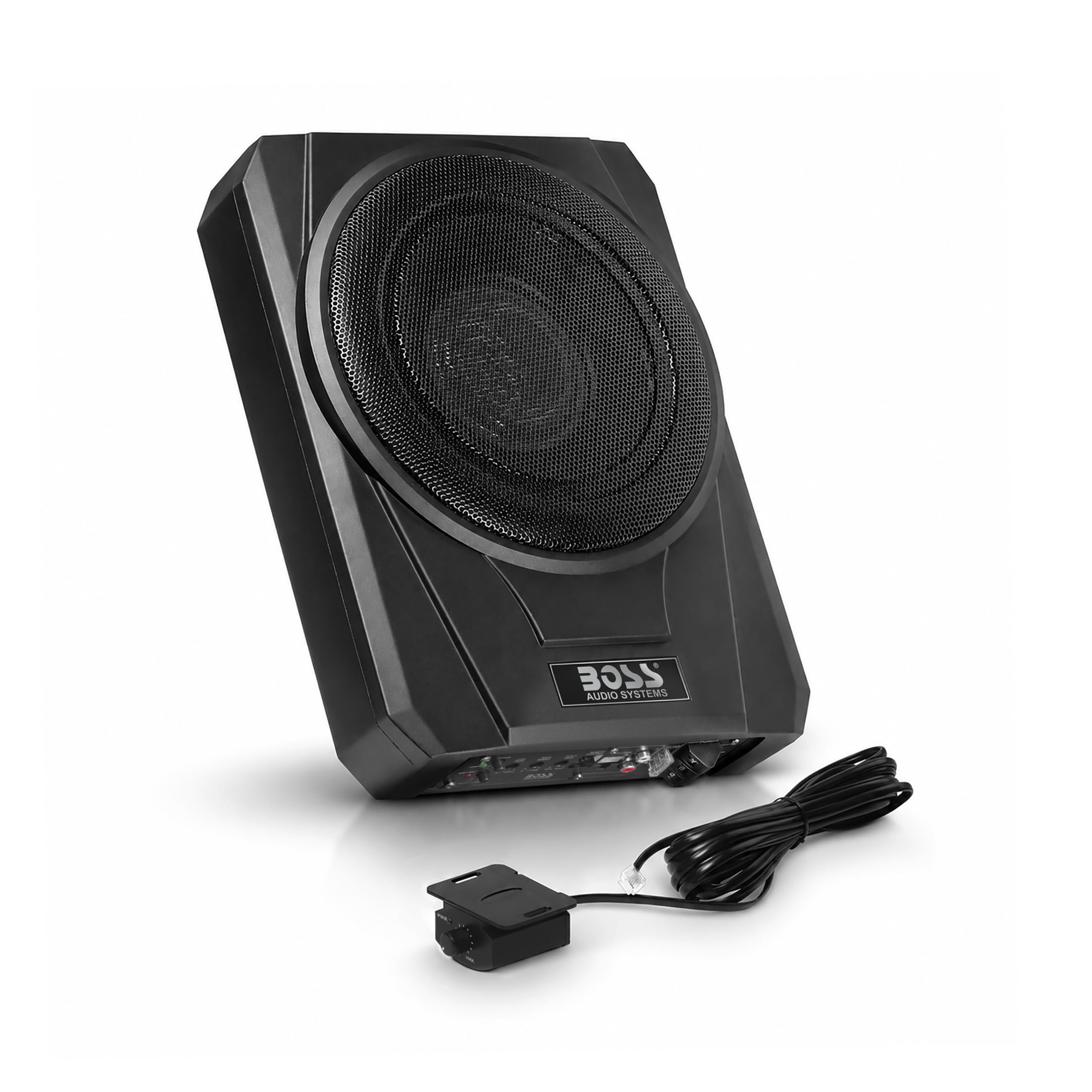
1. BOSS Audio Systems BASS10 Subwoofer
A ten-inch driver squeezed into a 3.3-inch-tall box — that is the trick here.
If your truck bed is doing the job of a trunk and your back seat has people in it, the BASS10 is the pick that solves the space problem without giving up cone size. It packs an amplifier and a 10-inch driver into one all-in-one unit measuring 14” x 12.3” x 3.3”, so you get the bigger cone without a separate amp taking up room. The aluminum cone and rubber surround handle daily driving, and the pulse-width-modulated power supply is there to keep output voltage and current steady — in plain terms, it is built to run efficiently rather than waste current. BOSS backs it with 3 years parts and labor.
The sound itself wins people over — buyers report usable low-end fill in vehicles like a Tacoma Double Cab, with gains above 30Hz (30 cycles per second, the deep bass range). It also carries strong marks on overall quality, value, and reliability. The tuning controls are what make it flexible: a variable low-pass filter strips out the high notes so your sub only plays low bass, a variable bass boost lets you dial the low end up or down, and phase control helps the new bass blend with your door speakers instead of fighting them. High-level inputs let you tap the factory radio’s speaker wires; low-level RCA inputs work if you run an aftermarket head unit. Compare that footprint to the Pioneer TS-WX010A at just 4.63” x 9” x 2.75” — BOSS gives you a much larger cone and box in exchange for more floor space, so measure your rail gap first.
What earns it the top spot
- A 10-inch driver in a 3.3-inch-tall enclosure — bass that slides under a truck back seat.
- Variable low-pass filter and bass boost let you tune the low end to your ears.
- Both high-level and RCA inputs cover factory and aftermarket radios.
- Thermal, short, and overload protection circuits plus 3 years parts and labor.
Worth knowing before you buy
- At 14” x 12.3” it needs real floor space, not a tiny gap.
- The noise-level feedback is mixed — some installs need extra deadening to stay quiet.
Made for: truck and SUV owners whose seats hide real space and who want a 10-inch cone doing the work.
Think twice if: your under-seat gap is tighter than 3.3 inches tall — look at the slim Pioneer instead.
2. Pyle PLBX8A Subwoofer
A three-inch-tall box rated at 600 watts — the budget pick that clears tight rails.
Height is the whole story with the PLBX8A. The enclosure stands just 3 inches tall across a 12.8” x 9.5” x 3” footprint, so it slides under the seat in cars where taller boxes will not go. The 8-inch driver is fed by a built-in amplifier rated at a maximum of 600 watts — noticeably more on paper than the 350 Watts the Blaupunkt GTHS131PRO lists. The integrated amp also carries low-pass crossovers, input sensitivity adjustable from 0.12V to 3.5V (volts, the strength of the signal your radio sends) so the sub matches whatever signal your radio sends, and a remote level-control module you can mount up front to change bass without touching the radio.
The sound is what sells it. It reaches lower than the 6-inch door speakers most economy cars ship with, and the 12.8” x 9.5” x 3” box slides under a passenger seat like a factory option. You get both high-level speaker inputs for a stock radio and RCA low-level inputs for an aftermarket one, and the box includes mounting hardware and the remote cable. The caution is durability — that is the one aspect with a genuinely negative read across feedback, so treat the install as permanent rather than something you pull in and out, and secure it to the floor properly with the supplied hardware.
Where the value sits: maximum rated power of 600 watts plus a 3-inch profile plus a remote bass knob is a lot of function for an entry-level outlay, and the sound-quality feedback is the strongest signal in its favor.
The honest caveat: reliability and durability feedback runs mixed to negative — this is a fit-it-once-and-leave-it unit, not a piece you move between vehicles.
Good match for: first-time bass upgraders with a shallow gap and a stock radio.
Skip the hassle of: relocating this box often — mount it once, tighten it down, and let it sit.
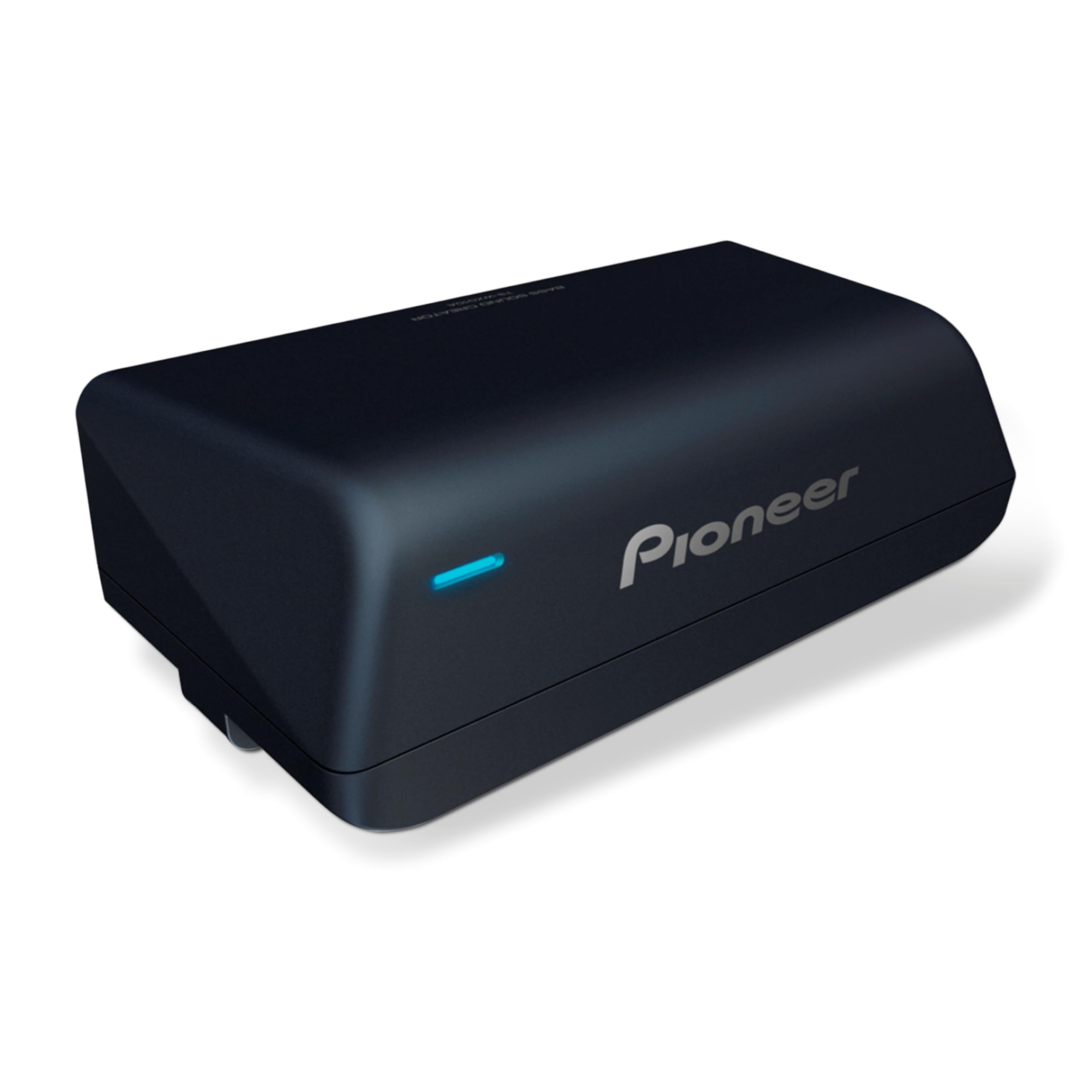
3. PIONEER TS-WX010A Subwoofer
The sub you buy when the gap under your seat is measured in fractions of an inch.
At 4.63” x 9” x 2.75”, this is the most compact pick on the list, and the 2.75-inch height is what lets it tuck into spaces where bigger boxes simply will not clear a seat rail. It measures barely a third of the BOSS BASS10’s dimensions — 14” x 12.3” x 3.3” against this unit’s 4.63” x 9” x 2.75” — so if the BOSS will not fit, this is the one to check. The driver is listed at 6.58 inches (52% smaller than the Blaupunkt’s 10-inch cone), powered by a built-in amplifier rated at a maximum of 160W. The low-pass crossover is adjustable from 50Hz to 125Hz, so you can shape exactly where the bass hands off to your door speakers.
Installation is the standout practical feature. The box connects to a factory stereo without drama, and owners pair it with upgraded tweeters without any conflict — a good sign it blends with the rest of a system rather than dominating it. The all-in-one design means no external amplifier to mount and wire. The one note is that a 2.75-inch box with a 6.58-inch driver is built for filling in the bass your factory speakers lack, not for rattling windows — treat it as the space-saving solution it is, and it delivers exactly that. There is no separate bass knob in the box, so tuning happens at the crossover and bass boost.
The fit-first argument: 2.75 inches of height is the smallest number on this list, and that is the spec that decides whether the sub exists in your car at all.
What to accept going in: 160W max and a 6.58-inch driver mean modest output — it fixes a bass gap rather than transforming the soundstage.
Reach for this if: your seat rail clearance has already ruled out taller boxes.
Leave it on the shelf if: you want wall-shaking output, because 160W is not that job.
4. BLAUPUNKT GTHS131PRO Subwoofer

A tuned 10-inch underseat box with specs a car-audio tinkerer will actually read.
The GTHS131PRO publishes real numbers instead of adjectives. A 10-inch driver runs on 350 Watts output with a frequency response from 50 to 150Hz — that is 52% larger cone area than the Pioneer TS-WX010A’s 6.58-inch driver, so it moves noticeably more air. The enclosure is everything a tinkerer wants on the label: signal-to-noise ratio of 91 dB, phase adjustment from 0 to 180°, bass boost from 0 to 12dB, a 2Ω impedance, and a 15A fuse running at 14.4V nominal. The box measures 15L x 11W x 3H inches, so it stays in the slim underseat class while holding a cone that a compact box would have to sacrifice.
For buyers chasing a specific tonal balance rather than just more bass, that tuning range is valuable — phase and boost adjustment together let you blend the sub with your front stage instead of having bass arrive as a separate layer. The built-in amplifier keeps install simple, and the sound rounds out a music selection nicely. It is a smaller-record product than the household-name picks around it, which shows up in the sensitivity-to-feedback ratio, but the feedback that does exist is uniformly favorable on sound and value.
Standout engineering
- 10-inch cone on 350 Watts — real displacement in a 3-inch-tall enclosure.
- Phase, boost, and crossover controls for tuning to your car’s cabin.
- Built-in amplifier simplifies the whole install.
Limits to plan around
- Needs a 15A fuse and 14.4V system — check your car’s accessory circuit.
- Fewer real-world users than the bigger brands, so less install lore to lean on.
Best fit for: owners who tune their own system and want phase and boost knobs on the box.
Second thoughts if: you want plug-and-play without reading a spec sheet — the factory-simple JBL below is easier.
5. Pioneer TS-WX140DA Subwoofer

Built with a 4.3-amp maximum current draw so an EV driver can add bass without watching the range gauge.
Most subwoofers are designed around a gas car’s generous electrical headroom. This one is designed around an EV’s tight budget. The built-in amplifier is a high-efficiency 170-watt Class-D unit with a maximum current draw of only 4.3 amps — in plain terms, adding bass will not noticeably shorten your driving range. The driver is an 8-inch (20 centimeter) unit in a sealed enclosure with a max power rating of 250W, and it comes with a 10A ATO fuse on the power wire.
The tuning here is more customizable than most. Three selectable listening modes — Deep, Dynamic, and Natural — change the bass character without requiring you to crawl under the car and fiddle with a knob. Sensitivity ratings of 95 dB (Deep), 100 dB (Dynamic), and 98 dB (Natural) mean the sub produces clean volume even from a modest signal. A wired digital bass control with a 16.25-foot cable runs up to the dash so you can adjust on the fly. Between the three modes and the up-front controller, this is the most finely adjustable sub in the group — a bit like the Blaupunkt’s tuning flexibility but with pre-set character curves instead of manual phase adjustment.
The EV case: a 4.3-amp maximum current draw is a spec almost no other sub here publishes, and it is what makes this unit a battery-friendly choice rather than a range-killer.
Honest note: at 170W the output is modest compared to the 250W max rating on the box, and value feedback is mixed — some drivers find it a lot to pay for the output.
Pick it for: EV drivers who care more about range than raw volume.
Reconsider if: you are in a gas car with a big alternator — you can usually get more bass per unit of outlay elsewhere.
6. Alpine PWE-S8 Subwoofer

Frequency response reaching down to 32 Hz — that is the spec that separates this from the compact crowd.
Most underseat subs reach down to 50Hz (50 cycles per second) and stop. The PWE-S8’s frequency response extends from 32 to 150Hz, which means it reaches genuinely low frequencies in the sub-bass zone rather than starting at 50Hz and working up. The 8-inch high-excursion cone is driven by a built-in Class D amplifier (a small, efficient amp design) with 240 watts peak and 120 watts RMS (RMS is the sustained power it handles continuously). It goes both under a seat and behind a seat, so a smaller pickup truck — the 2015 GMC Canyon being a specific fit — has the option of using that behind-seat space when the actual floor gap is tight.
It also ranks near the top of the group on overall quality-to-feedback. With far more users behind it than the compact Pioneer TS-WX010A, it stands as one of the two most-bought products on this list, and the practical confidence matches: drivers install it themselves under a rear seat without major hassle. There is no tuning dial for bass boost, so the mixing happens at the head unit or through a separate remote — which is a fair trade for a sub that produces the deepest low-end of the pick set. Just accept that a below-50Hz extension means the whole car shakes when you turn it up.
The spec that sells it: a 32Hz low-frequency extension at 120W RMS with a Class-D amp is a strong combination that translates into felt bass, not heard bass.
The honest trade-off: no bass-boost knob on the unit means tuning happens at the head unit or with an optional remote — the Alpine is not a tinkerer’s platform.
Choose this if: you want the deepest, cleanest low extension from an 8-inch driver.
Find something else if: you need a bass knob on the sub itself — the JBL below includes that.
7. JBL BassPro SL Subwoofer

Wired for the driver who does not want to pull the head unit — speaker-level inputs and auto-on handle it.
If you are keeping your factory radio, this sub is designed for exactly that scenario. It takes speaker-level (high-level) inputs with an audio-sense auto-on circuit — which means the sub senses music playing and turns itself on, with no separate trigger wire to route. No RCA converter is needed, and that removes the single biggest head-scratcher for a first-time install. The 8-inch driver runs through an efficient Class D amplifier at 250 watts peak and 125 watts RMS, a soft-start turn-on prevents a pop at power-up, and an optional wired bass remote gives you dash-side control.
Where this one earns its spot is the all-around balance. It reads strong on sound quality, build, and fit, and its noise-control feedback stands out — owners mention no idle hiss or turn-on pop. Drivers fit it under a seat without fuss. On raw output it sits behind the Alpine’s 32Hz extension, but that is a deliberate trade: this design favors clean integration with a stock system over maximum low-frequency depth. One of the optional extras is the bass remote — a nice touch but not included as standard.
Why the factory crowd likes it
- Speaker-level inputs with auto-on sensing — no RCA converter, no trigger wire.
- 8-inch driver on 125W RMS through a Class D amp for clean, controlled bass.
- Soft-start turn-on and strong noise control keep the install clean.
Fine print
- The wired bass remote is optional, not included — budget the extra if you want dash control.
- It trades bottom-end extension for integration, so it does not dig as deep as the Alpine.
Best suited to: drivers keeping their stock radio who want the simplest possible install.
Not the pick if: your system is already aftermarket with RCA outputs — you are paying for features you may not need.
8. KICKER 46HS10 Hideaway Compact Powered Subwoofer, 10-Inch

A 10-inch powered sub inside an all-aluminum frame, with a quick-connect plug that makes pulling it out painless.
The Hideaway HS10 is the 10-inch driver in this lineup that takes frame construction seriously — the entire enclosure is aluminum, which is a different level of durability than a plastic box. Even with the bigger cone, it is only two millimeters taller than its little brother the HS8, so you do not sacrifice fit for driver size. The included remote lets you change the amount of bass without touching the radio volume, an adjustable low-pass crossover dials in where the bass stops, and variable +6dB bass boost adds extra punch when you want it. There is a phase switch and two auto turn-on options — DC-offset or signal sensing — so it can power up automatically in most factory setups.
For install convenience, the quick-connect Molex plug and harness bundles power, signal, and remote turn-on into one connector, and the unit accepts both high- and low-level inputs. That makes it a strong fit for the driver who might move the sub between vehicles or pull it out for cargo space. It also has the highest feedback volume of any 10-inch in the group, so the under-seat install pattern is well documented. Value and reliability feedback sits in mixed territory, which is worth knowing going in.
Build angle: the all-aluminum frame is a real physical difference from the plastic enclosures elsewhere on the list, and it pairs with a quick-connect harness designed for easy removal.
The honest caution: durability feedback leans negative for some owners, so inspect the unit on arrival and secure it well — an aluminum frame protects the driver, not necessarily everything inside it.
Good for: drivers who value the 10-inch cone, aluminum frame, and removable harness together.
Look elsewhere if: you want proven long-term reliability above all — the feedback here is more split.
9. JBL Bass Pro SL2 8″ Underseat Subwoofer Boombox

The SL2 takes over from the SL with the same small footprint and a remote in the box.
This is the follow-up to the BassPro SL above, and it keeps the same 8-inch driver and powered, amp-built-in format in a small-frame enclosure. Where the SL focused on stock-radio simplicity, the SL2’s story is about enhancing factory speakers without taking up storage or floor space. The built-in amp means no separate hardware to mount, and the remote control comes in the box for dash-side bass adjustment. It slots in behind or beneath a seat in most vehicles.
Sound-wise, it is built to lift an existing system rather than replace it — the feedback consistently points to the factory speakers sounding fuller with the sub in line. The small footprint is a recurring strength, and installation is described as straightforward. What keeps it from ranking higher is the value conversation: the feedback on whether it is worth the outlay is split, and functionality feedback is mixed as well. That does not make it a poor sub — it makes it one where you should be clear about what you are paying for: JBL’s tuning and the small frame, not the biggest bass output for the outlay.
Where it earns its place: a compact 8-inch sub with a built-in amp and remote in the box, sized to lift factory speakers without sacrificing cargo room.
The value question: this is a premium-tier product whose cost-to-output ratio is not as sharp as the mid-range picks — buy it if you specifically want JBL’s compact tuning, not if you want the most bass per dollar.
Right call for: drivers already set on JBL sound who want a compact, remote-equipped upgrade.
Better to hold off if: you are chasing raw output for the money — the Alpine PWE-S8 and BOSS BASS10 deliver more low-end punch in their formats.
Know the Specs
Watts and RMS figures
A wattage number on an under-seat sub tells you how much power the built-in amplifier can push to the driver. Max power is the peak figure the amplifier will hit briefly; RMS is the continuous power it can sustain. Where a product lists both — like the Alpine’s 240 watts peak and 120 watts RMS — the RMS number is the one that describes long-term sound volume. An amplifier rated higher than another is not guaranteed to sound louder, because efficiency and driver size also shape output.
Driver size and frequency response
The driver is the cone that moves air — the component that physically creates bass. A larger driver can move more air, which is why the 10-inch options often carry more low-end weight than an 8-inch. Frequency response, measured in Hz, is the range of pitches the subwoofer can reproduce. A response reaching down to 32Hz reaches the deep sub-bass zone; one starting at 50Hz focuses on the upper bass range. Either can transform a factory system — what matters is matching the response to the music and cabin acoustics you have.
High-level versus low-level inputs
High-level inputs use the speaker-level wires already in your car — this is the path for a factory head unit with no RCA outputs. Low-level inputs use RCA cables and want an aftermarket radio with preamp outputs. Most of the picks here offer both, which is what makes them installable in a stock or modified vehicle. Check your radio’s output before you buy, then confirm the sub supports it.
Low-pass filter and bass boost
A low-pass filter lets only the low frequencies pass through to the subwoofer, keeping the high notes on your door speakers so the sound does not muddy. A bass boost knob adds extra low-end emphasis within a defined range — it does not create bass that is not there, it amplifies the existing low end. Phase control adjusts the timing of the bass output so it blends with the rest of the system instead of cancelling it. These controls are what let a sub work with your car’s existing speakers rather than against them.
Common Questions
Will an under-seat subwoofer fit under my factory seat?
Can I install one of these with my stock factory radio?
How much power can my car’s electrical system handle?
Is 8-inch better than 10-inch for an under-seat subwoofer?
Do I need a separate amplifier with these subwoofers?
Will an under-seat subwoofer add bass without drowning out my door speakers?
What does the 4.3-amp current draw figure mean for my electric vehicle?
How do I change the bass level from the driver’s seat?
Can I move an under-seat subwoofer between cars?
Will a 10-inch underseat subwoofer sound noticeably fuller than an 8-inch?
The Bottom Line
For most drivers, the subwoofer under the seat winner is the BOSS Audio BASS10 because it packs a 10-inch driver into a 3.3-inch-tall box and offers variable crossover, bass boost, phase control, and both high-level and RCA inputs. On paper its power rating alone can be beat — the Pyle rates 600 watts against the BOSS’s amplified-only labelling — but the BOSS has the larger cone and the most consistently praised sound quality. If your seat gap is tight, grab the Pioneer TS-WX010A, which is only 2.75 inches tall. And if you drive an EV and watch your range, the Pioneer TS-WX140DA with its 4.3-amp maximum current draw is the right choice.
How we choose
We do not accept paid placement. Every pick is matched to a real buyer and a real use-case; we do not hands-on test units.
Sources
Specifications: manufacturer listings and product documentation. Review insights: verified customer reviews, as of November 2026. Pricing: not shown on this page (it changes often); check the current price via the retailer link.
As an Amazon Associate, Tactical Gear Guy earns from qualifying purchases. This does not affect which products we feature.