Specs are compiled from manufacturer listings and verified buyer reviews and can change over time — please confirm the key details on the product page before buying.
If you ride through real winter, the tire that keeps you upright is the one with metal studs biting into the ice, and all four picks below have them. Tread depth, width, and pressure only tune how well those studs work. A standard knobby tire has nothing that grips glare ice, and when the front wheel lets go, you are down before you can react. Below are the studded tires that prevent that slide, sorted by the riding you actually do.
This guide is built by comparing the manufacturers’ published specifications and the patterns across verified customer reviews, so you get each pick’s real strengths and trade-offs instead of marketing spin.
You will see the exact sizes, weights, and mounting behavior that separate a smooth commute from a wrestling match in the garage. Here is the practical breakdown of the best studded bike tires, written for riders who would rather stay off the pavement than off the bike.
Top Picks

How To Choose The Best Studded Bike Tires
Start with the size code stamped on the side of your current tire. A number like 42-622 means the tire is 42 millimeters wide and fits a rim with a 622 millimeter bead seat diameter. If your new tire does not match that code, it will not seat on your rim, no matter how good the studs are.
Match the tire to the bike you actually ride
A hybrid or cyclocross bike takes a narrower studded tire that rolls fast on cleared roads. A mountain bike wants a wider casing with a taller tread block for packed snow. A fat bike needs the wide casing, full stop — a narrow tire on a fat rim will not work.
Studs work harder at low pressure
Drop the pressure and the tire casing flexes, pushing more stud heads into the ice instead of holding them up in the air. At high pressure you trade ice grip for a quieter, faster roll on dry pavement. That is the dial you will be turning all winter.
Expect some noise and some slip in the corners
Metal studs on bare asphalt sound like a pocket of gravel under your wheel. They also grip beautifully straight-line and let go sooner in a hard lean. Neither is a defect — it is how studded tires behave, and knowing it up front stops it feeling like a problem.
Side-by-Side Comparison
| Model | Best For | Rated Width | Diameter | Weight | Amazon |
|---|---|---|---|---|---|
| Schwalbe Marathon Winter Plus 42-622★ Best Overall | Hybrid and cyclocross commuting | 40 mm | 70 cm | 2 lb | Amazon |
| Schwalbe Winter 700Cx30C | Road bike winter riding | 1.2 in | 62.2 cm | 16 oz | Amazon |
| Cicli Bonin Schwalbe Ice Spiker Pro Hs379 | Mountain bike ice and hardpack | 5.7 cm | 70 cm | 1070 g | Amazon |
| Vee Tires Snowshoe XL Studded | Fat bikes in deep snow and sand | 4.8 in | 26 in | 3.8 lb | Amazon |
Detailed Reviews
1. Schwalbe Marathon Winter Plus 42-622
Our pick — 4.5+★ from 250+ verified ratings; the strongest balance of quality and price.
The winter commuter that pairs real studs with a puncture layer built to survive glass-strewn bike lanes.
For the rider who pedals to work on a hybrid or cyclocross bike all winter, this is the pick that covers the most ground. It carries a SmartGuard layer — a thick protective belt under the tread that shields the tube from road debris — so you get ice grip without taking a flat every third ride. That combination is rare in this category, where most studded tires are thin racing casings.
The tire is rated at 40 millimeters wide and 70 centimeters in diameter, light enough at 2 pounds to feel like a normal commuter tire once you are rolling. Schwalbe’s own guidance is the useful part: the studs bite hardest on ice at the minimum pressure, and at max pressure the noise drops away on cleared roads. That means one tire handles both the icy side street and the dry main road, as long as you are willing to swap pressure now and then.
Weight is where it separates from the fat-bike route entirely — at 2 pounds it is a fraction of the Vee Snowshoe XL’s 3.8 pounds, and it is narrower than that tire’s 4.8 inches by a wide margin. Think of it as the tire you ride to work on, not the tire you float over a snowfield on.
What Sells It
- SmartGuard puncture belt under the tread, so winter road debris is less likely to end your ride
- Stud grip that adapts with pressure — soft for ice, firm for quiet dry-road rolling
- 2 pounds keeps it feeling like a commuter tire rather than a tractor tire
- Fits hybrid and cyclocross bikes, the two bikes most winter commuters actually own
Where It Asks Something Of You
- Stuck at one pressure, you give up either ice bite or dry-road quiet — the dial needs turning
- Narrower than any fat-bike casing, so it is not the answer for deep snow
Reach for this: if you commute on a hybrid or cyclocross bike and want studs plus flat protection in one tire.
Think twice: if your winter riding means plowing through unplowed snow rather than crossing ice patches.
2. Schwalbe Winter 700Cx30C

A 700C studded tire that turns a road bike into something you can trust on black ice.
Road bikes are the hardest sell for winter rubber, because anything wide enough to hold studs usually ruins the ride. This one keeps the profile narrow at 1.2 inches and 62.2 centimeters in diameter, so it still rolls like a road tire on cleared asphalt. The Kevlar Guard belt adds a puncture barrier under the tread, and the Reflex sidewall throws light back at drivers in low winter sun.
Where it really earns its place is the tubeless-style pressure window: 50 to 95 PSI gives you room to soften the casing for stud contact on ice, then pump it back up for the dry commute home. The stud quality is the standout — the consensus on the review pages is that it compares favorably to the studs on car winter tires. That is the kind of bite that stops a thin road casing from skating.
The honest catch is mounting. Wire bead tires in this width fight back, and getting one onto a tight road rim takes real hand strength and tire levers. Ride quality on bare pavement also has a gravel-rattle texture to it, because those studs are standing between you and the road. If you can live with both, the ice performance is excellent.
Fit check before you order: the 700C size and 1.2 inch width suit road bikes and any frame set up for a narrow tire, but they will not fit a hybrid or mountain bike frame set up for wider rubber.
The trade you accept: ice grip and road speed in one tire, paid for with a stiff sidewall that is genuinely hard to install and a noisy roll on dry tarmac.
Suits you if: you ride a road bike through winter and want a narrow studded tire that still rolls fast on cleared roads.
Look elsewhere if: you want a tire you can pop on and off the rim with your hands alone.
3. Schwalbe Ice Spiker Pro Hs379

The mountain bike specialist that trades a little rolling speed for a lot of studded bite on hardpack.
Mountain bikers get the wider casing here — 5.7 centimeters and 29 x 2.25 inches, coded 57-622 on the sidewall. That width gives the studs a broad platform, which is exactly what you want when the trail is frozen into rutted hardpack rather than sheet ice. The nylon casing carries a 1070 gram weight, heavy enough to feel planted but not so heavy that climbing becomes a chore.
It only comes in one flavor, so sizing is a simple yes-or-no check: match 57-622 to your rim and you are done. That same diameter of 70 centimeters is matched by the Marathon Winter Plus above, so if you already know that size fits your frame, this one slots in the same space.
The thing to understand about this tire is who it is for. It is a mountain bike tire first — the kind you point down a frozen fire road — and its grip and reliability are built around that use. It is not a commuter tire and it will not roll like one on a paved bike path.
Why it earns the shelf space: a 5.7 centimeter casing with ETRTO 57-622 sizing gives mountain bikers studs across a broad, planted footprint — the spec that matters most when the trail is frozen solid.
The one question to answer first: does 57-622 match your rim and does your frame clear a 5.7 centimeter casing? Both need a yes before this tire is the right buy.
Right for you: mountain bikers riding frozen trails and ice-covered fire roads who want a broad studded platform.
Not your tire: if you need a narrow commuter profile or a wide fat-bike casing — this sits squarely in the mountain bike lane.
4. Vee Tires Snowshoe XL Studded Fat Bike Tire, 26″ x 4.8″
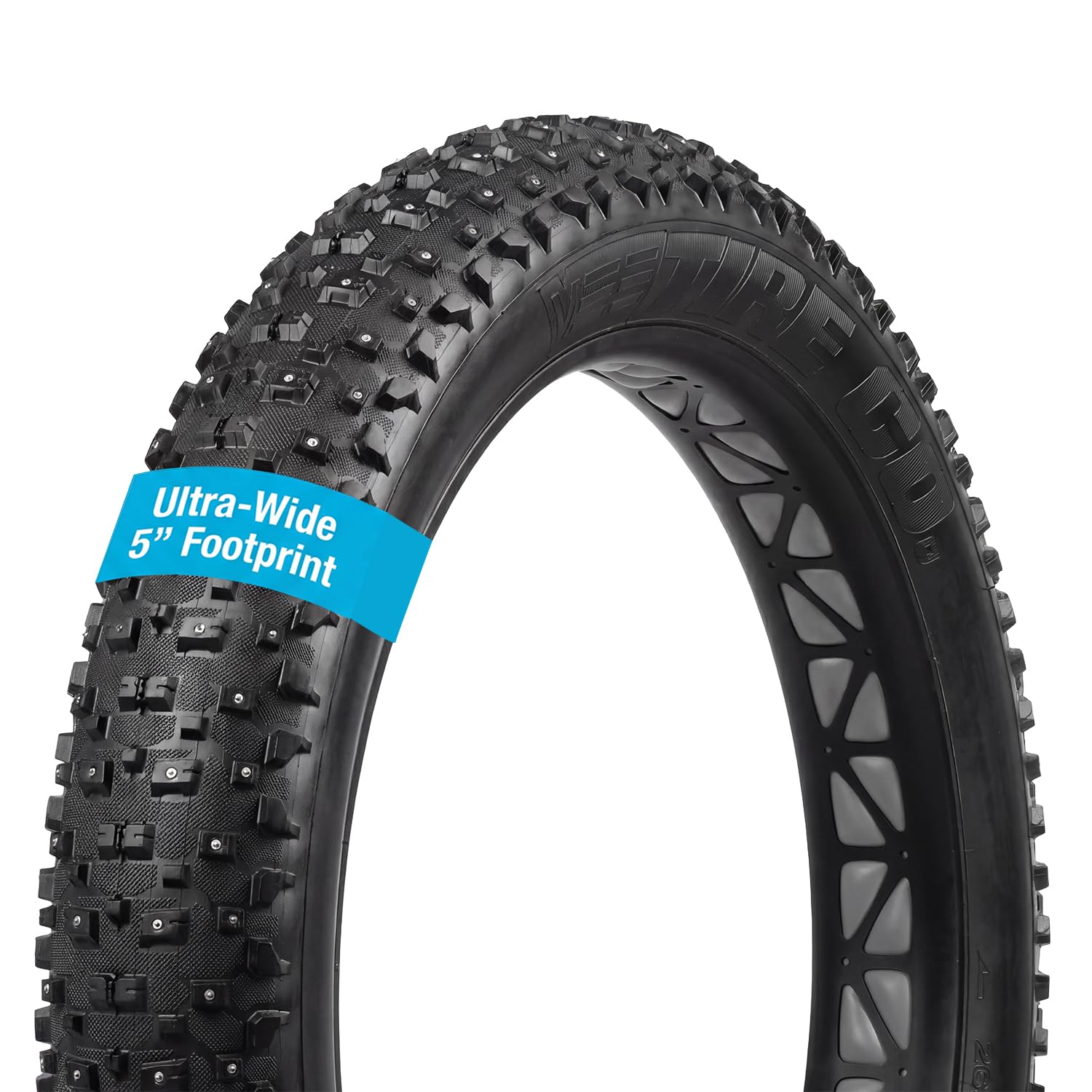
A 4.8 inch studded fat tire for riders who want flotation over snow and ice grip underneath.
This tire is built for one job: keeping a fat bike upright and floating across winter terrain. The width is the headline — 4.8 inches, which is far wider than the 1.2 inch Schwalbe Winter road tire and dwarfs the 40 millimeter Marathon Winter Plus casing. In the real world that width is what lets you ride on top of packed snow instead of cutting through it, and a folding bead plus tubeless-ready construction makes it easier to set up without a tube inside.
The owners are clear on where it works: on ice it keeps them upright, and on hard-pack snow and dirt it performs better than they expected for the money. The silica compound and ultra-wide profile suit snow and sand specifically, which is the whole point of a fat bike in winter. The consensus is that the tread blocks provide traction in every direction and resist sliding out to the side the way some rival studded fat tires do.
Here is the honest limit. The outer knobs carry studs across the center but not on the outside, so a hard lean in snow can wash the front end out before you expect it. Cornering is the weakest part of the package, and a few riders find that frustrating enough to want a different tire. Ride it predictably and it rewards you; push it into aggressive turns and it will remind you what it is designed for.
Why Fat Bikers Pick It
- 4.8 inch width gives real flotation over packed snow and sand
- Studs across the center hold the line on ice and hardpack
- Folding bead and tubeless-ready build simplify setup
- Silica compound tuned for cold-weather riding
What You Agree To
- No studs on the outer knobs, so hard cornering leans can wash out
- A 3.8 pound tire that you feel on every climb and every acceleration
Best match for: fat bike owners who ride snow, sand, and icy trails and want maximum flotation with center studs.
Wrong tool if: you ride a road, hybrid, or mountain bike — this 26 inch fat casing will not fit those frames.
Know the Specs
The Size Code (42-622, 57-622)
A code like 42-622 tells you two things at once. The first number is the tire’s width in millimeters. The second is the bead seat diameter in millimeters — the diameter of the rim it will sit on. Match both numbers to your existing tire and the new one fits. Get the second number wrong and no amount of stud quality will help you.
Pressure and Stud Contact
Studs only grip when they press into the ice. High pressure keeps the casing stiff and lifts the stud heads slightly away from the surface. Lower pressure lets the tire flex so the studs dig in. The trade-off is noise and rolling speed on bare asphalt. That is why a studded tire feels different depending on how you inflate it.
Common Questions
Will a 42-622 tire fit the rim currently holding a 700×40 tire?
Do studded bike tires actually grip on black ice?
How much pressure should I run in a studded tire on ice?
Are studded tires loud on dry pavement?
Can I run a studded tire on only the front wheel?
Will a 26 inch fat bike tire fit a standard mountain bike?
How wide is too wide for a winter commuter tire?
Do studs fall out over time?
Is the Ice Spiker Pro better than the Marathon Winter Plus for commuting?
What does tubeless ready mean on a fat bike tire?
The Bottom Line
For most riders the winner is the Schwalbe Marathon Winter Plus, because it pairs real metal studs with a SmartGuard puncture layer at a 2 pound weight that still feels like a commuter tire. If your winter riding happens on a road bike, grab the Schwalbe Winter 700Cx30C for its narrow 1.2 inch profile and 50 to 95 PSI range. And for fat bikes on deep snow, the Vee Snowshoe XL is the one to reach for, with its 4.8 inch casing built for flotation. Buy the tire that matches your bike’s size code first and your winter conditions second — that order saves more grief than any spec.
How we choose
We do not accept paid placement. Every pick is matched to a real buyer and a real use-case; we do not hands-on test units.
Sources
Specifications: manufacturer listings and product documentation. Review insights: verified customer reviews, as of November 2026. Pricing: not shown on this page (it changes often); check the current price via the retailer link.
As an Amazon Associate, Tactical Gear Guy earns from qualifying purchases. This does not affect which products we feature.