Specs are compiled from manufacturer listings and verified buyer reviews and can change over time — please confirm the key details on the product page before buying.
You already know the feeling — the nut is rounded, the stud is seized, and you are standing there with a torch and a drill bit you really don’t want to use. A stud removal tool grips the damaged fastener from the outside instead of trying to cut a new thread into it. This guide breaks down nine real options by drive size, stud range, and how well each one holds under load, so you can pick the right one for the job in front of you.
This guide is built by comparing the manufacturers’ published specifications and the patterns across verified customer reviews, so you get each pick’s real strengths and trade-offs instead of marketing spin.
Some tools here are socket sets you drive with a 3/8-inch ratchet; others are single cam-action units that clamp down with a knurled roller. The difference in stud range and drive size decides which job each one is actually good for, and it is the reason this stud removal tool breakdown leads with the plumbing details.
Top Picks


How To Choose A Stud Removal Tool
Start by measuring the diameter of the rounded or seized fastener, then match it to a tool’s stated stud range. A tool that grips a smooth 5/64-inch stud will not clamp a seized 3/4-inch lug nut, and the reverse is just as true. Match the stud range first, then worry about steel grade and finish.
Match the stud range before anything else
A socket-style set is sized in both SAE and metric steps, so a 1/4-inch to 7/16-inch set covers small-and-mid fasteners you find on exhaust manifolds and body panels. A single cam-action unit built for 1/4-inch to 3/4-inch handles the fatter seized studs where a socket set would run out of sizes. Buy the range that covers the fastener sizes on your own vehicle, not the widest spread on the shelf.
Think about drive size and torque
The drive is the square hole where your ratchet, breaker bar, or impact gun snaps in. A 3/8-inch drive socket is lighter and easier to swing in tight engine bays, while a 1/2-inch drive takes a longer breaker bar and more force without shearing. On stubborn studs, a 1/2-inch drive set delivers bigger torque to the fastener — and the tool has to be built for that load.
Read the steel, not the label
Chrome molybdenum steel (often written Cr-Mo) is the material that resists twisting and cracking under extraction load. Large multi-piece socket sets just list their material; single-piece cam-action tools often skip the grade entirely. Where the listing names Cr-Mo, that is a real clue on the tool’s ability to survive a stuck fastener without splitting.
Side-by-Side Comparison
| Model | Best For | Pieces / Stud Range | Drive Size | Material | Amazon |
|---|---|---|---|---|---|
| Topec Deep Bolt Extractor Set 28PCS★ Best Overall | Deep and shallow extraction in one kit | 28 pieces (13 deep + 13 standard) | 3/8-inch square drive | Chrome molybdenum steel | Amazon |
| DUNDOO 15 Pieces Screw Extractor SetBest Small-Fastener Kit | Small broken screws and drain plugs | 15 pieces (1/8-inch to 1/2-inch) | 3/8-inch hex | Chromium molybdenum steel | Amazon |
| Lisle 71200 Stud Remover | Rusted studs with a steady breaker bar | 0.75-inch jaw capacity | 1/2-inch square drive | — | Amazon |
| YEKEPRO 16PCS Deep Impact Set | Impact-gun extraction on deep fasteners | 16 pieces (SAE + metric) | 3/8-inch square + hex base | Chrome molybdenum steel | Amazon |
| ABN 8-Piece Stud Extractor Set | Small SAE and metric studs in a case | 8 sockets (1/4-inch to 7/16-inch, 6–12mm) | 3/8-inch and 1/2-inch | Metal | Amazon |
| GEARWRENCH 41760D 8-Piece Set | Professional daily use with lifetime backing | 8 sockets (SAE + metric) | 3/8-inch and 1/2-inch | Alloy steel | Amazon |
| Mayhew Tools 29894 | Very small 5/64-inch to 9/32-inch studs | 5/64-inch to 9/32-inch | 1/4-inch drive | Heat-treated alloy steel | Amazon |
Detailed Reviews
1. Deep Bolt Extractor Set 28PCS, 3/8″ Drive Stud Remover kit
Our pick — 4.5+★ from 450+ verified ratings; the strongest balance of quality and price.
Twenty-eight pieces covering deep and shallow holes, so the awkward jobs don’t stall you.
The Topec set is the widest kit here — 28 pieces split into 13 extended bolt extractors and 13 regular ones, plus a 3/8-inch drive and a punch pin. If a stud sits down inside a recessed housing, the deep extractors reach it without you needing a second trip to the store. That breadth is the practical reason this one tops the list for a home mechanic who wants one box to cover most jobs.
Each extractor is cut from high-hardness chrome molybdenum steel with a sandblasted finish, and the sizes are laser-etched onto the sockets. The hex and Torx drive setup also lets it work with hand tools, pneumatic tools, and power tools, so you’re not locked to one driver.
The honest catch is steel fatigue on the biggest sizes. Buyers report that the 11/16 size broke in half during first use — a warning worth hearing, and a sign to back off the torque on a fully seized fastener instead of leaning on it. Treat the largest sockets as load-limited, use heat and penetrating oil first, and the set does the job. This is the tool for someone who wants a broad arsenal in one case and accepts that the extreme end has a limit.
What earns the top spot
- 28 pieces including 13 deep extractors, so recessed studs get reached
- High-hardness chrome molybdenum steel with laser-etched sizes
- Works with hand, pneumatic, and power tools via the 3/8-inch drive and hex adapters
- Quality is what owners rave about most — the fit and finish on the sockets hold up
The trade-off to weigh
- At 2 pounds it’s the heaviest set here — 1.3 pounds heavier than the Lisle 71200
- The largest sockets have a working limit; the 11/16 broke on a hard first job
Reach for this if: you want one kit covering deep, shallow, small, and mid-size fasteners for auto maintenance and home repair.
Look elsewhere if: you’re only working a single very stubborn large nut — a dedicated cam-action tool takes a longer bar with less risk.
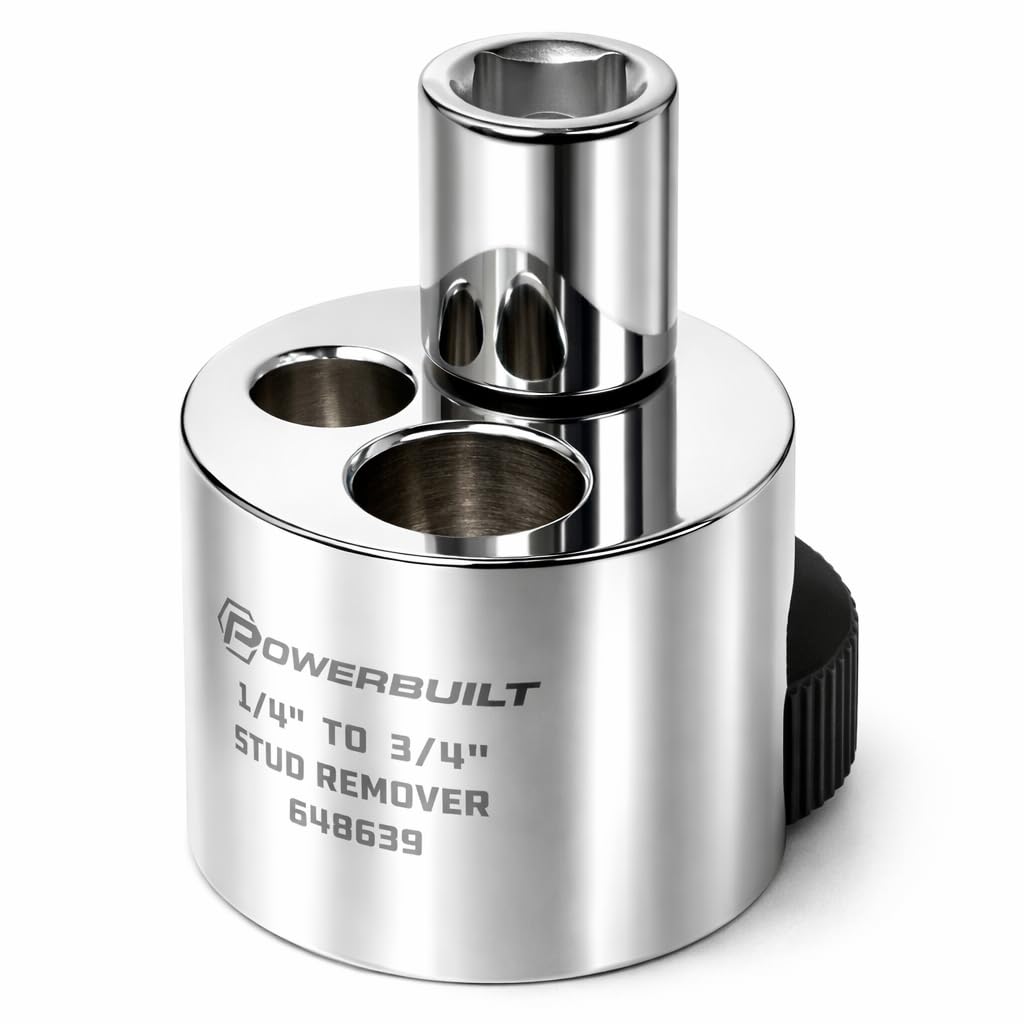
2. Powerbuilt Stud Extractor Tool 648639
One hand-sized body that clamps 1/4-inch to 3/4-inch studs — no socket hunt required.
The Powerbuilt 648639 is the simplest tool here. A knurled roller with self-adjusting cam action tightens onto the stud as you turn, and the built-in firm hold is designed to spare the thread and surface. It spans 1/4-inch to 3/4-inch in diameter, so the same single tool grabs a range that would take a dozen sockets to cover. It’s the pick for a seized, rounded, or rusted stud where you just want the fastest possible grip.
Drive it with a 1/2-inch drive ratchet or breaker bar — that’s the 1/2-inch square hole in the body. The length comes in at 2 inches, making the Powerbuilt 0.5 inches shorter than the Lisle 71200 (2.5 inches), so it tucks closer to the block in tight bay work.
Grip and durability are the two things to understand before buying. Some batches grip hard on smooth studs; others suffer a hardened roller that lets the stud slip. If the cam isn’t biting, back the roller off and re-seat it cleanly rather than forcing it. A steady pull on the breaker bar grips better than a sudden slam. Seat the roller cleanly and add heat first, and the cam bites instead of slipping on a rusted stud.
Single-tool value: One 2-inch body covers 1/4-inch through 3/4-inch studs — functionally the widest coverage per dollar in this list — and works from a 1/2-inch breaker bar for maximum bite.
What can go wrong: When the knurled roller doesn’t bite the stud cleanly, the tool slips instead of turning it. Re-seat the tool and add heat before leaning harder.
The no-socket answer: Grab one when a single rounded or seized nut is your problem and you don’t want a full set.
Not for the deep stuff: If the stud sits inside a recessed hole, the deep sockets on the Topec or YEKEPRO reach where this can’t.
3. DUNDOO 15 Pieces Screw Extractor Set
Fifteen sockets from 1/8-inch to 1/2-inch that bite down on stripped screws before the head is gone.
This DUNDOO set compresses the range into 15 sockets — 1/8″, 5/32″, 3/16″, 7/32″, 1/4″, 9/32″, 5/16″, 11/32″, 3/8″, 13/32″, 7/16″, 15/32″, 1/2″, plus a 3/8″-1/4″ hex adapter and a 3/8″-1/2″ impact adapter. That compares with the 28 pieces on the Topec, so you’re trading socket count for smaller, easier-to-access sizes. If your problem is a stripped oil drain plug or a rounded bolt head in a cramped spot, this is exactly the working range.
Each socket is a left-hand spiral with a high-density pattern designed to bite faster. The steel is heat-treated chromium molybdenum, and every size is engraved on the socket for quick identification. The 3/8-inch hex shank and the dual adapters let it run on hand tools or a power driver, so the same set works for a driveway repair or a bench job.
The left-hand spiral bites on the first turn, and the engraved sizes make picking the right socket quick. The honest caveat is durability. Several owners mention units breaking immediately during use, and value is mixed among owners. Treat the smallest sockets with a steady hand rather than an impact gun, and this set stays a strong small-fastener pick. It’s the kit when the job’s about screws and drain plugs, not heavy 3/4-inch studs.
Fastener-first design: A left-hand spiral that bites faster and an engraved size on every socket — good for a stripped oil drain plug or a rounded bolt head in a tight engine bay.
Hold back on power tools: Customers note units breaking immediately during use. Save the impact for the YEKEPRO or the Topec set, and use this one on hand tools.
Goes to work on: stripped screws, drain plugs, and small-to-mid fasteners that a deep socket set can’t reach.
Not the choice for: heavy 3/4-inch studs — that range belongs to the Powerbuilt.
4. Lisle 71200 Stud Remover

A 1.3-pound socket-style remover with a 0.75-inch jaw — the fast snap-on answer.
The Lisle 71200 is built around speed of use: it snaps onto your 1/2-inch square drive, you push it over the stud, and you turn. The jaw capacity tops out at 0.75 inches, so it handles fatter studs you find on suspension and exhaust. It weighs 1.3 pounds — 0.7 pounds lighter than the Topec 28-piece set — which matters when you’re holding a breaker bar overhead or in a cramped bay.
The polished finish and box-end, fixed-square head make it a clean tool to work with, and it comes in a package sized 5.25 inches wide by 6.13 inches high by 2.5 inches deep, so it stays put in the bottom of a tray. Unlike a multi-piece socket set, there’s nothing to sort through — grab it and go.
Grip and durability are the friction points. It handles rusted studs well when it bites, but on a slick, seized fastener it can let go. If the jaw slips, clean the stud, add heat and penetrant, and re-seat before forcing it. The 1/2-inch drive gives you leverage, so the risk is a sheared stud rather than a stuck one — back off if you feel it strain. It’s a value-minded pick that rewards patience.
For the quick grab: A lightweight 1.3-pound body that snaps straight onto your existing 1/2-inch ratchet for fast, one-handed work.
Mind the jaw limit: 0.75-inch is the ceiling — a 3/4-inch stud needs the Powerbuilt range to be safe.
5. 16PCS 3/8″ Drive Deep Impact Bolt Extractor Set

A 16-piece deep impact set built for the gun, not the hand — bites harder the more it turns.
The YEKEPRO T38316 runs 16 deep-well sockets with a reverse spiral flute: an uneven internal wall that tightens its grip the more you rotate. It’s built to handle the ugly stuff — damaged, frozen, rusted, rounded-off bolts, spark plugs, nuts, and screws. If you work a wheel-lock removal or a corroded exhaust nut, this is the set that’s made for the job.
The dual-sized design covers both SAE and Metric fasteners, and it offers both a square drive and a hex base so you can run it from an impact gun, ratchet, wrench, or pliers. The chrome molybdenum alloy steel is rated to meet or exceed ANSI standards, and a gray oxide coating fights corrosion. That’s a serious build spec at this tier — the kind you want if the tool gets tossed around a shop.
Buyers praise the reverse spiral flute, which bites harder the more torque you apply. It works, it’s easy to use, and the right size for the day is already in the box. Durability is the honest caveat — some units reportedly break after removing just a couple of nuts. Keep the impact gun on lower settings for the tightest fasteners to extend life. It’s also 4.71 pounds, 2.71 pounds heavier than the Topec 28-piece — so this is a bench-and-bay set, not a pocket tool.
Built for the gun
- Reverse spiral flute bites harder the more torque you apply
- 16 deep sockets covering SAE and Metric fasteners
- Square drive and hex base work with impact gun, ratchet, wrench, or pliers
- Chrome molybdenum steel meets or exceeds ANSI standards
Where it needs care
- At 4.71 pounds, it’s the heaviest set here — plan for bench and bay work
- Durability is mixed; a couple of units reportedly broke after removing two nuts
Best when the impact gun is out: A deep-reach socket set for wheel locks, exhaust nuts, and anything frozen solid.
Skip if weight matters: 4.71 pounds is a lot of steel to hold overhead; the Lisle 71200 is the lighter grab instead.
6. ABN Stud Extractor Set 8-Piece

Eight sockets, one blow-molded case, and a reach that keeps every size where you left it.
The ABN 8-piece kit fits studs from 1/4-inch to 7/16-inch (6mm to 12mm), and the sockets are split across 3/8-inch and 1/2-inch drives. It leans on smooth internal paws that push into the fastener — so no threads are needed to grab a smooth, broken, rusted, or stripped stud. If a body-mount or manifold stud is the problem and it’s in that small-and-mid range, this is the set that covers it.
Storage is a real strength: the heavy-duty 8.6-by-4.6-by-2-inch plastic case is blow-molded with a latch, and each compartment carries a permanently etched size. That’s the sort of kit that lives in the truck bed or shop cart without losing a socket. At 1.19 pounds it’s lighter than the Topec 28-piece set by 0.19 pounds — you’ll barely notice it in a toolbag.
The etched sizes and latched case keep the right socket in hand on a truck-bed or shop-cart job. It works across a wide range of fasteners, and the size is printed where you can read it. The honest limit is durability on hard jobs: some units reportedly break immediately under load. Use the correct socket size, add heat, and avoid overloading the tool on a fully seized stud. For a modest 8-piece kit with real organization, it earns its keep in a truck or farm box.
For the kit-in-a-case shopper: 8 sockets from 1/4-inch to 7/16-inch with SAE and metric sizes stored in a clearly etched case.
Watch the load: Durability is mixed under hard extraction — heat first, and don’t force a seized stud with brute torque.
7. GEARWRENCH 8 Piece Stud Removal Set | SAE & Metric | 41760D

The only set here with a standard limited lifetime warranty backing the steel.
The GEARWRENCH 41760D gives you eight sockets — 1/2-inch drive sockets in 10mm, 12mm, 3/8″, and 7/16″, and 3/8-inch drive sockets in 6mm, 8mm, 5/16″, and 1/4″. It is the direct answer for a pro who wants both SAE and metric in one blow-molded case without hunting through five drawers. The sockets are alloy steel with a polished chrome finish, built to reach studs in difficult work areas.
The standing point is coverage for the working tech. Owners point to successes on hard jobs like a sheared exhaust manifold stud on a Ford 5.4L — exactly the kind of awkward, half-broken fastener that makes a stud extractor worth owning. The blow-molded case keeps the sockets together for the next job.
The thing to know before you buy is that the eight-piece range stops at 12mm and 7/16-inch. If your stud is larger than that, this set doesn’t have it. And at 37.68 centimeters in package length, it’s a proper case, not a pocket set. But the standard limited lifetime warranty is the real differentiator — if a socket fails, the maker stands behind it. For a tech who does this daily, that’s the buy.
Built for daily pro use: Alloy steel, 3/8-inch and 1/2-inch drives, and a standard limited lifetime warranty — the set a working shop can lean on without fear of a one-shot tool.
The small-print limit: Eight sockets stopping at 12mm and 7/16-inch won’t cover larger studs — buy a bigger-range tool if your job runs larger.
Worth it for: A professional or dedicated home mechanic who wants SAE-and-metric coverage with a lifetime warranty behind it.
Look bigger if: Your typical stud runs over 12mm — the Powerbuilt or Topec sets extend the reach.
8. Mayhew Tools 29894 Stud Extractor, Chrome Finish, 1/4″ Drive

A 1.76-ounce extractor for the tiny 5/64-inch to 9/32-inch studs big tools can’t touch.
The Mayhew 29894 is the specialist here — it runs on a 1/4-inch drive and fits studs from 5/64 to 9/32 inches in diameter. That’s a surprisingly narrow range, and exactly right for small seized and broken fasteners where a 1/2-inch tool is overkill. The heat-treated alloy steel is finished in chrome for additional rust protection, and the whole tool weighs just 1.76 ounces — you can tell it’s meant for precision work.
Reviewers point out that paired with a 20-inch breaker bar, it frees fasteners that resisted other approaches. That pairing is key: the small 1/4-inch drive means you supply the torque through bar length, not socket width. The piece is small enough to fit places where bigger extractors just won’t go.
The fit-vs-force question is the one to weigh before buying. Some units grab and hold; others, on a stubborn fastener, break or fail to grip properly. Use a steady, leverage-driven pull instead of a sudden slam, and if the tool doesn’t bite on the first try, clean the stud and re-seat. For very small seized hardware that big tools can’t handle, this is the one to reach for.
For tiny seized fasteners: The 5/64-inch to 9/32-inch range and 1.76-ounce body make this the precision pick when bigger tools can’t reach.
Handle with care: Grip and durability are mixed on hard jobs — use a longer breaker bar with a steady pull, not a sudden slam.
Know the Specs
Drive Size (3/8-inch vs 1/2-inch)
The drive size is the square socket slot your ratchet, breaker bar, or impact gun snaps into. A 3/8-inch drive takes shorter, lighter tools and is easier to swing in tight engine bays. A 1/2-inch drive accepts a longer breaker bar with more leverage on a stubborn stud. When you’re deciding between two tools, a 1/2-inch drive unit like the Lisle 71200 or the GEARWRENCH set lets you put more force into the fastener — at the cost of a bigger tool in tight spaces.
Stud Range and Cam-Action Grip
Stud range is the spread of stud diameters a tool grips, usually listed in inches or millimeters. A single cam-action unit like the Powerbuilt covers 1/4-inch to 3/4-inch; a socket set like the ABN 8-piece covers 1/4-inch to 7/16-inch. Cam action means a knurled roller automatically tightens onto the stud as you turn. That’s the entire grip mechanism on single-piece tools, so the quality of that roller is what decides whether the tool bites or slips.
Common Questions
Will a stud removal tool work on a rounded bolt head?
What drive size do I need for a seized exhaust manifold stud?
Can these tools remove a stripped oil drain plug?
What’s the difference between a socket-style extractor and a cam-action tool?
Does a stud extractor need to match my thread pitch?
Can I use these extractors with an impact gun?
What size stud remover do I need for 1/4-inch studs?
Are these stud removal tools made of strong enough steel?
Will a small extractor reach a stud in a tight, recessed spot?
What should I do if the tool slips on a rounded stud?
The Bottom Line
For most buyers, the stud removal tool winner is the Topec 28-piece deep bolt extractor set, because it covers deep and shallow recesses in one case with 28 pieces, chrome molybdenum steel, and laser-etched sizing. If your job is one hand-sized tool that clamps a seized 1/4-inch to 3/4-inch stud, the Powerbuilt 648639 is that pick. And if you’re in the field daily and want the backing of a standard limited lifetime warranty, the GEARWRENCH 41760D makes the most sense — eight alloy-steel sockets that stand behind the work.
How we choose
We do not accept paid placement. Every pick is matched to a real buyer and a real use-case; we do not hands-on test units.
Sources
Specifications: manufacturer listings and product documentation. Review insights: verified customer reviews, as of November 2026. Pricing: not shown on this page (it changes often); check the current price via the retailer link.
As an Amazon Associate, Tactical Gear Guy earns from qualifying purchases. This does not affect which products we feature.