Specs are compiled from manufacturer listings and verified buyer reviews and can change over time — please confirm the key details on the product page before buying.
You want to hang a shelf or a TV, and the wall has one thing you cannot see: a live cable running right where the drill bit is headed. That is the whole reason a stud finder with wire detection exists. The short answer is that the Zircon StudSensor A100 gets the most out of a modest tool — it finds stud edges up to 3/4 in. deep, reaches 1 1/2 in. in deep mode, and flags live unshielded AC wiring up to 2 in. deep. Even a basic finder with a wire warning light earns its price the first time it keeps the bit out of a live cable.
This guide is built by comparing the manufacturers’ published specifications and the patterns across verified customer reviews, so you get each pick’s real strengths and trade-offs instead of marketing spin.
Below you’ll find nine wall scanners split into what they actually do best, from a nine-sensor panel that maps a whole stud at once to a radar unit that reads concrete and water pipes. Every one of them carries live AC wire detection, because that is the feature that earns the tool a spot in your bag. These are the pick worth carrying for a stud finder with wire detection.
Top Picks

How To Choose The Best Stud Finder with Wire Detection
The wrong assumption most beginners carry is that the wire alert is a safety switch. It is not. Wire detection on these tools reads live, unshielded AC cable — meaning a cable carrying current with no metal conduit around it. A dead wire, a shielded cable, or a pipe full of water needs a different mode or a different tool entirely.
Match the depth mode to your wall, not to the price
Standard scan depth on most of these units sits at 3/4 in., which covers ordinary drywall over wood studs. Deep mode pushes to 1 1/2 in. so you can read through thicker surfaces. Wire detection typically reaches 2 in. If your wall is lath, plaster, or tile-over-board, the deeper mode is not optional — it is the only way you will get a usable reading.
More sensors means you see the stud, not just the edge
Conventional electronic finders use one or two sensors, which is why they give you a single edge line and make you guess the rest. A multi-sensor panel lights up the full width of the stud at once, so you can see the center and both edges in one pass. Seeing the full stud width in one pass is what separates a confident mark from three re-scans of the same spot.
Calibration is where accuracy lives or dies
Almost every model here calibrates by sitting flat against the wall and holding the power button until a beep. The rule that matters: calibrate on an empty patch, never over a stud or a cable. A tool calibrated over a stud will read that stud as “nothing” for the rest of the scan. Models that skip calibration entirely remove that failure point.
Side-by-Side Comparison
| Model | Best For | Wire Detection Depth | Stud Depth | Sensors | Amazon |
|---|---|---|---|---|---|
| Zircon StudSensor A100★ Best Overall | First-timer DIY drilling | Up to 2 in. | 3/4 in. / 1 1/2 in. | — | Amazon |
| HANMATEK SF1 5-in-1Most Versatile | Whole-home scanning | 2 in. (50mm) | 0.8 in. / 1.5 in. | — | Amazon |
| Franklin Sensors ProSensor M50Featherweight Pick | Lightweight one-hand scanning | — | 1.5 in. (always on) | 5 | Amazon |
| HART Professional 9-Sensor | Seeing center plus both edges | — | — | 9 | Amazon |
| FNIRSI WD-01 6-in-1 | Marking holes without a pencil | 2 in. | 0.75 in. / 1.5 in. | — | Amazon |
| Premium Wall Scanner | Sensitivity tuning per material | 2 in. | 1.5 in. | — | Amazon |
| Zircon MultiScanner A200 | Metal studs and wall frames | WireWarning alert | 3/4 in. / 1 1/2 in. | — | Amazon |
| Bosch D-tect 120 | Concrete and plastic pipe | Radar, live and non-live cables | All materials | — | Amazon |
Detailed Reviews
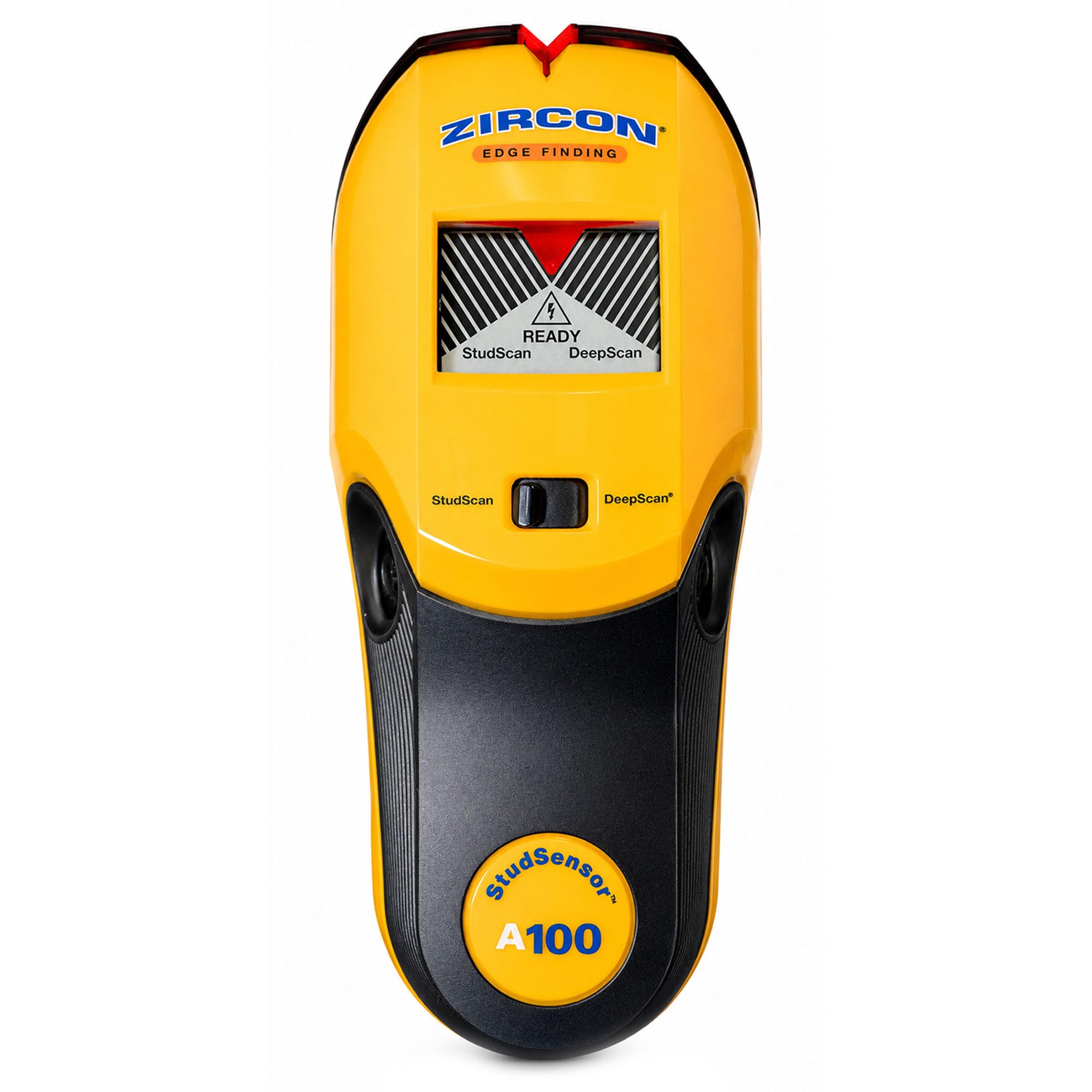
1. Zircon StudSensor A100 Stud Finder with Live Wire Detection
Our pick — 4.0+★ from 900+ verified ratings; the strongest balance of quality and price.
The starter finder that tells you where the edge is and where the cable runs.
You are standing in front of a bare wall with a bracket in one hand. The A100’s job is small and clear: find the edge, and warn you about the wire. Standard StudScan mode reads wood and metal stud edges up to 3/4 in. deep, which is exactly what a drywall-and-2×4 house demands. Flip to DeepScan and it reaches 1 1/2 in., so thicker wall surfaces still give up their studs.
The wire alert is the part that earns it the top spot. WireWarning Detection flags live, unshielded AC wiring up to 2 in. deep, and it stays live in both scan modes rather than switching off when you move to deep. That means you are not choosing between “find the stud” and “avoid the cable” — you get both readings in one pass. The LCD screen, audio tone, and SpotLite pointer do the showing; the pointer projects a line onto the wall so you mark the exact spot instead of eyeballing it.
The catch is that it takes one fresh 9V alkaline battery, and that battery is not in the box. The other honest note is calibration discipline. It wants the unit flat against the wall with a single beep to confirm before you slide, and starting the scan over a stud rather than an empty patch throws the reading off. Get that right and the edge readings hold up.
What it does well
- Wire detection runs in both StudScan and DeepScan, so no mode swaps to stay safe
- SpotLite pointer marks the wall for you instead of leaving you to guess the spot
- Two depth modes cover standard drywall at 3/4 in. and thicker surfaces at 1 1/2 in.
Where it asks more of you
- No 9V battery included, so it is a paperweight until you buy one
- Calibration must happen on a clean patch or the scan drifts
- Accuracy is the least settled part of owner feedback — slow, repeated passes help
Reach for this if: you want one dependable edge-finder with a live wire alert for TV mounts and shelf brackets, and you already keep 9V batteries around.
Look elsewhere if: you need to map the full width of a stud in a single sweep — a multi-sensor panel does that better.
2. HANMATEK SF1 Wall Scanner, 5-in-1 Stud Finder
Five separate modes on one panel, so the wall gives up studs, metal, and wiring.
Most finders give you studs and a wire light. The SF1 gives you five distinct scan functions and lets you pick the one the wall deserves. Stud scan exact mode locates center and edges down to 0.8 in. (20mm), deep mode reaches 1.5 in. (38mm), and the AC Wires scan reaches 2 in. (50mm) — that last one is your wire detection, and it is a dedicated mode rather than a passing warning light.
The metal modes go further than a typical finder. Ferrous metal scan reads iron to 4.7 in. (12cm), and non-ferrous scan reads copper to 4 in. (10cm). That matters for anyone hunting rebar or a hidden pipe rather than a timber stud. The display shows signal strength, depth, mode, and battery level together, so you are not pressing buttons blind. Three colour lights do the verdict: green means nothing, orange means edge, red backlight means center.
What wins people over is straight performance — the panel that reads through stucco and roofing shingles, which are awkward surfaces for a simple edge finder. The honest caveat is calibration. The auto-calibration must be done with no nails, AC wires, or metal nearby, or the reading skews. The other fair note: depth readings can wander on dense walls, and the manual rewards a slow, patient slide over a fast sweep.
Rugged enough to carry: the IP66 rating means it shrugs off dust and water spray, which suits a bag tossed in a truck bed.
On the mixed side: accuracy is the least consistent part of the feedback, so treat any reading near a cable as a starting point and confirm with a second pass.
Built for: the owner with a mixed list — studs today, a buried pipe or rebar tomorrow — who wants every scan mode sitting on one screen.
Not the one if: you only ever hang pictures on drywall and want a single-button tool with nothing to calibrate.
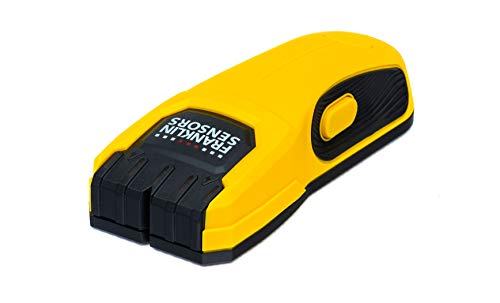
3. Franklin Sensors ProSensor M50 5-Sensor Stud Finder
Five sensors, no calibration step, and a scan you can start right on top of a stud.
Here is the direct contrast with the Zircon above. The A100 makes you find a clean patch and calibrate before it will read anything useful. The M50 skips that entirely — press and hold the button and start scanning anywhere, even directly over a stud. For a one-handed job on a ladder, that difference is the whole purchase.
Five sensors do the work instead of the usual one or two, and the LED display shows the full width of the stud rather than a single edge line. Deep scan is always on at up to 1.5 in., and it picks up both wood and metal studs without a mode change. Live wire detection is included for drilling confidence. At 4.8 ounces it is the one you can hold overhead for a full ceiling run without your arm complaining.
That weight gap is worth naming: the FNIRSI WD-01 in this list weighs 9.3 ounces, and the M50 comes in at 4.8 ounces — less than half, so it hangs far lighter off a raised arm. What buyers like most is the accuracy of the edge and center readings, and the wiring indicator lands as a genuine bonus. The recurring gripe centers on the battery door and the button — the cover can loosen and lose contact, and a jammed button has left units dead. A small AA-powered panel like this also will not take rechargeable cells.
The ergonomic read: it sits comfortably in the palm and the single-button sweep is the kind of thing you learn in ten seconds, not ten minutes.
The repeated friction: button and battery-door complaints recur, so press firmly, seat the cover fully, and check it before each job.
Worth picking if: you work alone and need a light, calibration-free panel that maps a whole stud in one pass.
Hold off if: you want a full set of metal and pipe scan modes, which this one does not offer.
4. HART Professional Stud Finder with 9 Sensors
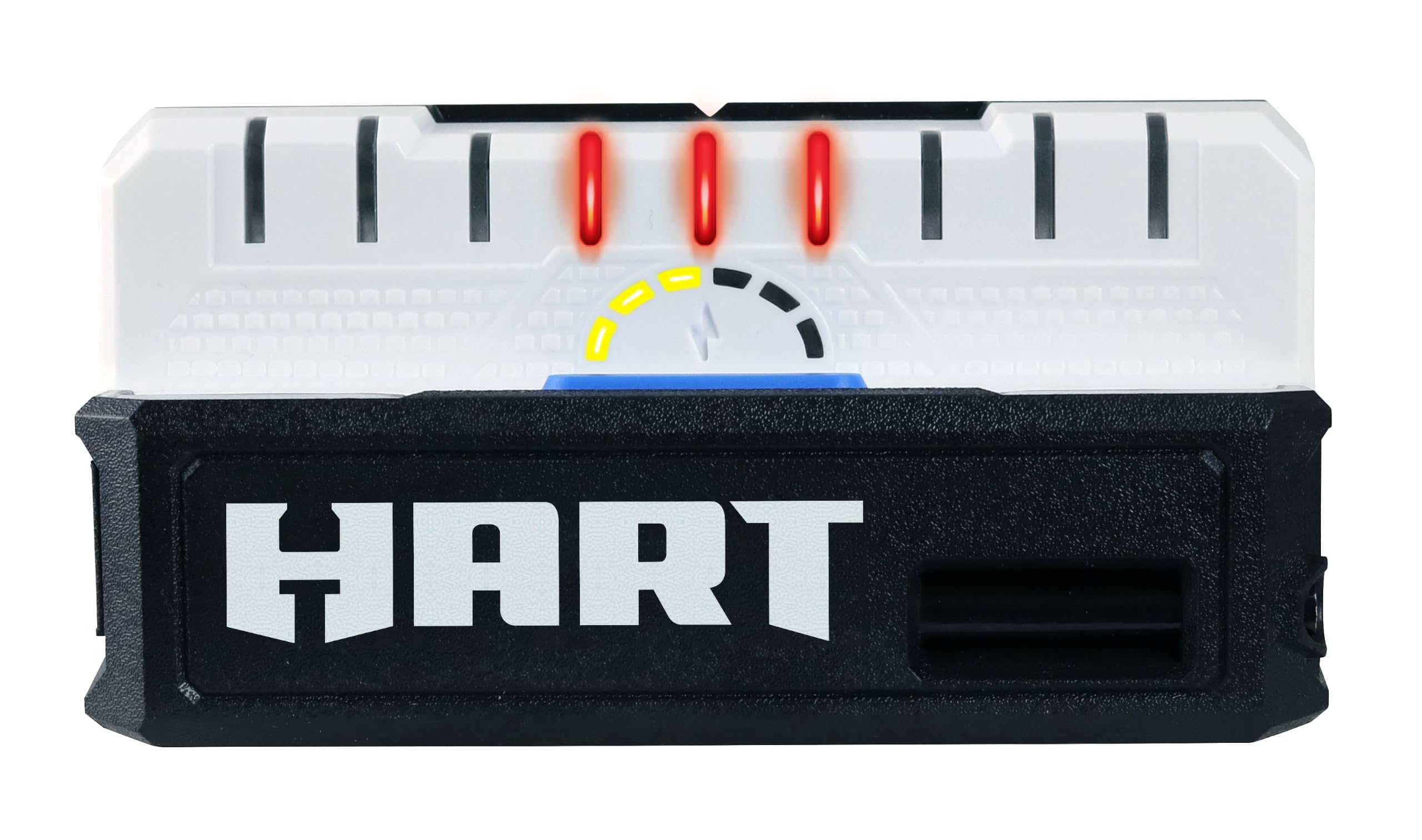
Nine sensors turn the wall into a map that shows center and both edges at once.
Nine sensors stacked side by side is the entire pitch here. A conventional finder has one or two, and it gives you a single line to interpret. The HART panel lights the center and edges of the stud simultaneously, so you see the whole beam on the wall rather than inferring it from one reading. The display tells you when you are in the middle, and which side you drifted to.
There is no calibration step. Press and hold the button and start scanning anywhere — including right over a stud — and the unit adjusts for varying depths, materials, and textures on its own. Live Wire Detection is included for the wire-warning job, and a Pencil Caddy clips to the body so your marking tool is not the thing you go hunting for. Power comes from AAA batteries, which are not included, and rechargeable cells are not supported.
The real limit is depth judgment: on a deep stud stack the true center is harder to pin down, so run a second confirming pass. It can pick up studs set further back and make the true center harder to pin down on a deep wall, so a second confirming pass is worth the ten seconds. Stud tracking is the mixed part of owner feedback; the build, ease of use, and overall function come through clean. Buyers who hang curtain rails and mount brackets on ordinary drywall describe the workflow as hold, slide, read, done.
The strong suit: function and build quality — the adjustable sensing and full-width display make standard drywall work feel almost automatic.
Where to be careful: a deep stud stack can pull a reading, so verify before the drill bit goes in and skip the rechargeable AAAs.
Made for: someone who wants the most sensor coverage they can get and likes seeing both edges the moment the panel touches the wall.
Then again: this model’s wire detection is a bonus feature, so if avoiding cable is your primary job, a dedicated AC mode on the HANMATEK or FNIRSI serves you better.
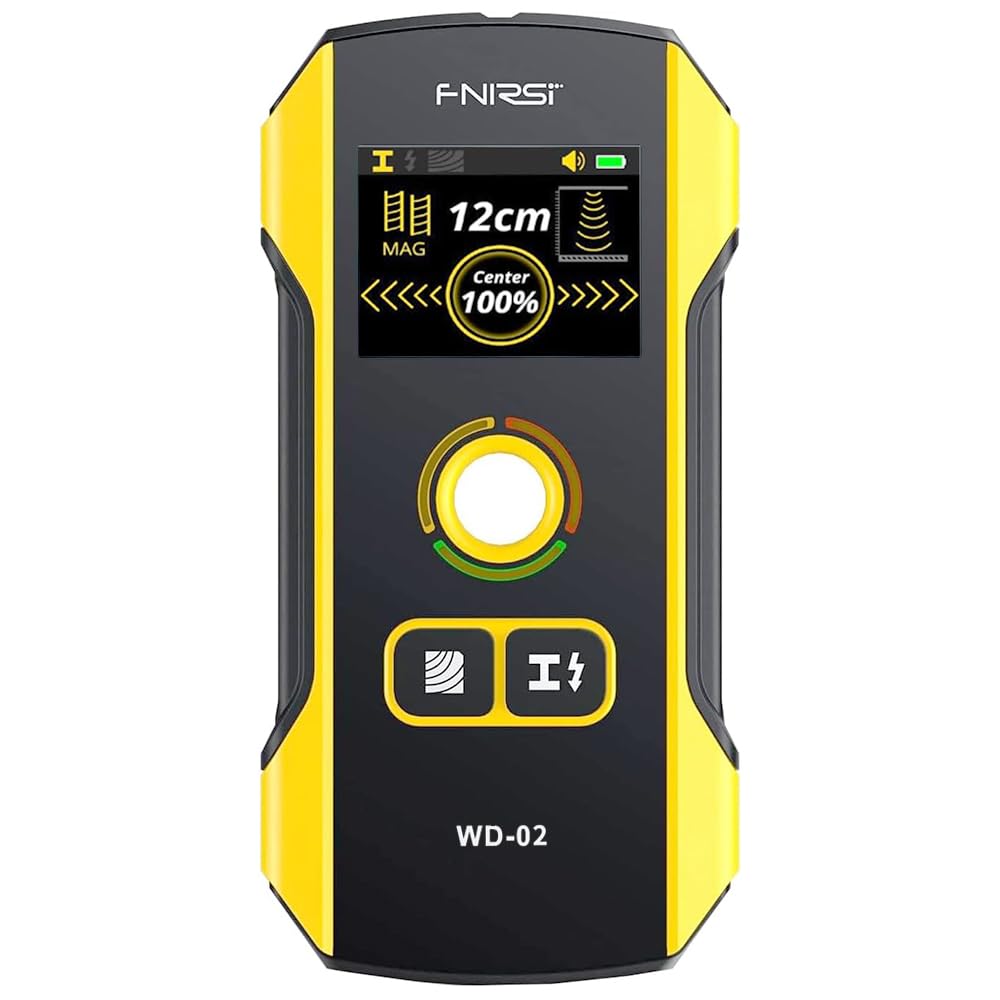
5. FNIRSI WD-01 6-in-1 Rechargeable Wall Scanner

A built-in marking hole so the spot you find is the spot you drill.
The positioning hole is the small feature that changes the whole workflow. Locate an edge or center, mark through the hole with a pencil, and you have a dot exactly where the sensor read — no taping, no estimating the offset from a pointer. For anyone installing a TV mount in one try, that is the detail you end up using on every job.
The 6-in-1 set of modes is broad. Exact scan finds wood and metal stud center and edges to 0.75 in., depth scan reaches 1.5 in., non-ferrous metal scan reads copper to 3.9 in., ferrous metal reads iron to 4.7 in., AC scan reads live unshielded wire to 2 in., and a separate copper wire scan reaches 1.6 in. The LCD and audible alarm confirm the hit, and it recharges instead of eating batteries — which also explains why it weighs 9.3 ounces, heavier than the 4.8-ounce Franklin M50 in the same list.
The trade-off sits in reliability at the edges. Readings can be inconsistent on a wall with hidden clutter, and some users report it cannot find pipes or power even when they know the wire is there. The instructions are translated and can be unclear on first read. The build feels solid in the hand and the marking hole is the feature owners call out most warmly.
Charging beats battery shopping: a rechargeable lithium-ion cell inside means no drawer full of dead 9V blocks, and a full scan charge is always ready when you pick it up.
The honest limit: treat AC and pipe detection as a warning signal rather than a definitive map, and confirm pipe and wire locations with a second method.
Great fit for: a project with lots of marks to make — TV mount, shelves, and curtain hardware — where the positioning hole saves a step each time.
Think twice if: your walls are crowded with hidden plumbing and you expect a primary wire and pipe locator.
6. Premium Wall Scanner with Visible Positioning Hole
Three modes, three sensitivity levels each — tune the scanner to a tricky wall.
Adjustable sensitivity is the reason to choose this over a one-button panel. Three dedicated detection modes cover studs, metals, and live wires, and each mode carries three sensitivity levels. On a painted wall with a thick skim coat, dropping a level or two cuts down on phantom readings. On plain drywall, you leave it high and move on.
The depth figures are stated plainly: up to 1.5 inches for wood studs, 4.7 inches for metal, and 2 inches for live AC wiring. A bright TFT LCD reports real-time position plus an audible alarm, and the positioning hole lets you mark the exact center and edges without guessing. It recharges with an included lithium-polymer battery, so there is no battery drawer to raid. Auto-calibration works across drywall, plaster, wood, and painted walls.
The honest part is that this is the model where the outcome depends most on tuning. In the wrong sensitivity band you get a late signal — the alert can stay quiet longer than you would like before it lights. Set correctly on a clean patch, it delivers clear wire reads behind drywall, and the text on the bright screen is easy to interpret at arm’s length. The unit is compact and carries an 8.1-ounce body.
The control you get: three modes and three sensitivity levels per mode give you enough granularity to dial in for lath, plaster, or a painted surface.
The catch: tuning demands patience — the alert latches later than expected, so start slow at a mid-level and adjust as you go.
Best suited to: someone scanning a variety of wall surfaces who wants to adjust sensitivity rather than settle for one fixed level.
Reconsider if: you want a scan you can trust immediately from the start with no adjustments.
7. Zircon MultiScanner A200 Stud Finder
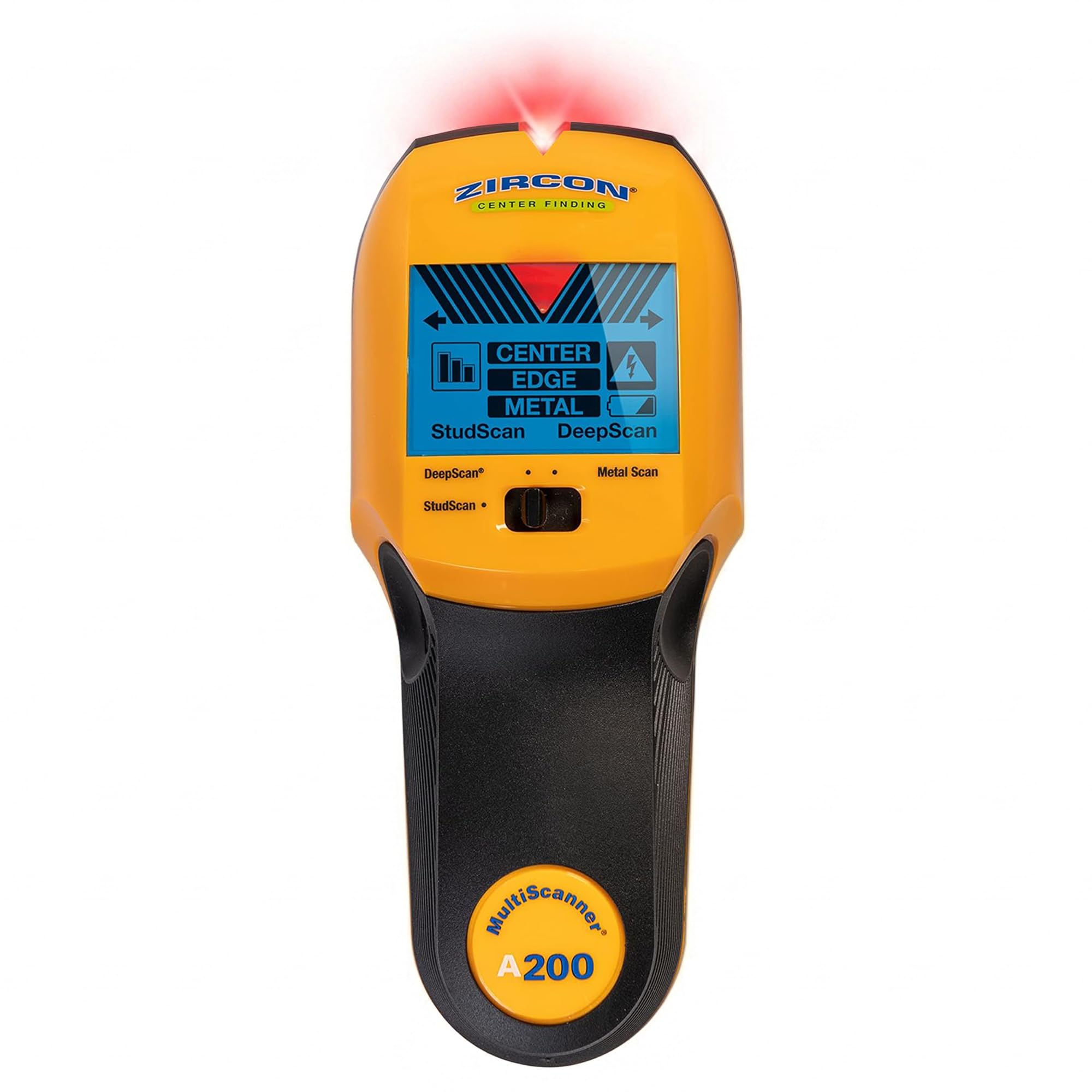
A three-mode scanner built to find metal studs and frames, not just timber.
Most finders treat metal as an afterthought. The A200 gives it a dedicated mode. Metal Scan locates metal behind walls before drilling, which matters in commercial drywall where the studs themselves are steel. StudScan finds wood or metal stud edges and centers to 3/4 in. deep, and DeepScan reaches 1 1/2 in. for thicker wall surfaces.
Wire detection arrives as WireWarning, which alerts to hot electrical wires behind the wall, and the LCD display, audio tone, and SpotLite pointer work together to make the stud edge and center easier to mark. Calibration is deliberate: press and hold the power button, wait 1 to 2 seconds for the short beep, and hold still until it finishes before sliding. The case carries an IP54 rating and it runs on a 9V alkaline battery, again not included.
What owners praise most is how quickly the controls make sense — the pointer guidance and simple workflow are the parts that land. The honest split is on accuracy, which is the loudest thread in the feedback. Some report entirely reliable stud finds, others find the readings drift on some surfaces. The practical answer is patience: a slow, deliberate slide on a calibrated patch is what gets the tool to perform.
Where it clicks: the SpotLite pointer and the metal mode combine to make steel-stud walls and metal frames far easier to read than a timber-only finder.
Fair warning: the calibration pause is not optional — sliding before the second beep is what produces most of the disappointing results.
Reach for this if: your work includes metal studs, steel frames, or commercial drywall, and you want wire warnings on the same panel.
skip it if: you mostly scan wood-stud walls and would rather not spend the calibration window every time you pick it up.
8. Bosch D-tect 120 Wallscanner Radar Scanner

Radar that reads concrete, plastic pipe, and cables — the one for walls the others give up on.
Every other tool on this list is an electronic stud finder with a wire warning. The D-tect 120 is a radar scanner. Bosch’s patented radar technology detects all object types in one pass: live and non-live cables, water-filled plastic pipes, and both magnetic and non-magnetic metal. That range is why it is the pick for a concrete wall or a floor where a stud finder has nothing to say.
Three detection settings tune it to the wall — drywall, concrete, or universal mode when you do not know what the wall is made of. Spot View delivers immediate results even when there is little or no space to slide the scanner, so a crowded corner is not a dead end. Center Finder uses arrows and a signal strength indicator to guide you toward the object and shows when you have hit the center. It is IP54 rated and runs from either a 12 V Li-ion battery or standard AA batteries with the included adapter.
The honest limit is size: at 2.3 pounds this is a professional radar unit built for repeat site work, not a drawer gadget for one picture hook. The range and radar capability come with a learning curve and a body your arm notices on a long ceiling scan. For a wall where a standard finder reports nothing but you know there is a pipe and a cable in there, this is the tool that answers the question.
The radar advantage: all-material, all-object detection covers pipes, cables, and metal where an edge finder goes silent.
What you live with: a 2.3-pound body and a three-mode learning curve — worth it on site, overkill for a single picture hook.
The right tool when: your walls are concrete, or you need to locate water-filled plastic pipe and non-live cable that no stud finder can see.
Not the tool for: a quick home fix — the size and cost only pay off when you scan against a real job.
Know the Specs
Wire detection depth
This is how deep the tool can sense live, unshielded AC cable behind the surface — 2 in. is a common reach, which covers most residential drywall and the cable running behind it. The key word is live. A wire that is off, or one inside metal conduit, is often invisible to a wire warning. Always confirm with a second pass before you drill.
Scan depth and modes
Standard scan reaches 3/4 in. to 0.8 in., which handles typical drywall over wood studs. Deep mode pushes to 1.5 in. for thicker surfaces. On lath or plaster, the deeper setting is the only one that reads. A separate metal mode adds detection of steel studs and hidden metal, often at greater depth than the stud scan.
Sensor count
A single-sensor finder reports one edge line; more sensors let the panel show the full width of the stud at once. Five sensors is enough to see the center and both edges, and nine gives even finer resolution. More sensors make the tool easier to read, but they do not replace good calibration.
Calibration and power
Most models calibrate by sitting flat on an empty patch and holding the power button until a beep. Calibrating over a stud or cable produces false readings for the rest of the scan. On power, a 9V or AAA model needs a fresh battery before it works, while rechargeable models carry an included lithium cell. A dead or weak battery throws off the scan.
Common Questions
Will a stud finder with wire detection find a cable that is switched off?
What is the difference between stud scan and deep scan?
Can a wire warning tell me how deep the cable is?
Why does my stud finder give false readings over the same spot?
Do these stud finders work on plaster and lath walls?
Is a multi-sensor stud finder more accurate than a single-sensor one?
Can a stud finder detect water pipes or just studs and wires?
Does the battery type affect scan accuracy?
How do I mark the exact spot the scanner finds?
Is a cheap stud finder good enough for mounting a TV?
The Bottom Line
The stud finder with wire detection winner for most walls is the Zircon StudSensor A100, because it puts two reliable depth modes and a live wire warning in one straightforward tool at the entry-level tier. If you want to see the whole stud at once, grab the HART Professional with its nine sensors. And for a concrete wall or a water-filled plastic pipe that a standard finder cannot see, the Bosch D-tect 120 is the one to reach for.
The short version: calibrate on an empty patch, slide slowly, and confirm the reading before the bit goes in. The A100 holds the top spot because it does the two jobs that matter — find the stud edge, flag live cable — with two depth modes and no menu to learn.
How we choose
We do not accept paid placement. Every pick is matched to a real buyer and a real use-case; we do not hands-on test units.
Sources
Specifications: manufacturer listings and product documentation. Review insights: verified customer reviews, as of November 2026. Pricing: not shown on this page (it changes often); check the current price via the retailer link.
As an Amazon Associate, Tactical Gear Guy earns from qualifying purchases. This does not affect which products we feature.