Specs are compiled from manufacturer listings and verified buyer reviews and can change over time — please confirm the key details on the product page before buying.
Most people buy a structured media enclosure, cut the hole, mount it, and then discover their Wi-Fi has dropped a bar in the living room. That is the problem worth solving first: a metal box in the wall can choke a router signal, while a plastic one lets it through. The right box also has to fit between 16-inch studs, hold your modem and switch without crowding, and close with a door that still opens when the drywall is thicker than expected.
This guide is built by comparing the manufacturers’ published specifications and the patterns across verified customer reviews, so you get each pick’s real strengths and trade-offs instead of marketing spin.
The short version: steel gives you a stronger box, plastic gives you better wireless reach, and the size you pick decides how much gear you can ever add. Below you will find the best Structured Media Enclosure for your wall, your gear, and the signal you refuse to lose.
Top Picks


How To Choose The Best Structured Media Enclosure
You are installing the box that all your low-voltage cabling disappears into: coax, ethernet, phone, and security wire. Choose wrong and you will fight it every time you add a device. Choose right and the box disappears behind a flush cover and holds every coax, ethernet, and security run for years.
Steel or plastic — and what that does to your Wi-Fi
Steel enclosures are rigid and hold their shape, which matters if the box hangs between studs and you need the cover to sit square. The trade-off is that a metal shell can block the radio waves your router sends out. Plastic enclosures made from ABS or polypropylene are Wi-Fi-transparent, so a router mounted inside keeps its reach into the room. If your router lives inside the box, lean plastic.
Match the size to your studs and your gear
Most of these boxes are built to sit between 16-inch center studs, so the width is partly fixed by your wall. What changes is height and depth. A 14-inch box handles a modem, a switch, and a splitter; a 20-inch or 28-inch box leaves room for a router, a soundbar, or shelves. Depth matters just as much, because a cover that adds only a little clearance may not fit a power strip or a bulky adapter.
Knockouts, module grids, and covers
Knockouts are the pre-scored holes you push out to run cable through, and having more of them in different sizes makes routing easier. A universal module grid means you can snap in shelves, brackets, and splitter mounts from the major brands instead of one. The cover is the last decision: a flanged screw-on cover hides rough drywall edges, while a hinged vented door gives you access and airflow for gear that runs warm.
Side-by-Side Comparison
| Model | Best For | Material | Height | Depth | Amazon |
|---|---|---|---|---|---|
| Leviton 47605-140★ Best Overall | All-round steel pick | Alloy Steel | 15.62 in | 3.68 in | Amazon |
| VEVOR 20-Inch RecessedMost Room Inside | Big steel box for AV gear | Cold-rolled Steel | 20.91 in | 3.74 in | Amazon |
| Legrand OnQ EN1400Flush-Mount Favorite | Flush steel rough-in | 20 Gauge CRS | 17.25 in | 5.5 in | Amazon |
| ICC ICRESDP14E | Lightweight plastic starter | Plastic | 14.96 in | 4.87 in | Amazon |
| Benner-Nawman 14144-MMH | Universal module fit | Zinc-coated Steel | 14 in | 4 in | Amazon |
| Benner-Nawman BN14304F | Wi-Fi-friendly tall box | Polypropylene | 28 in interior | 4 in | Amazon |
| Legrand OnQ ENP2050-NA | Large Wi-Fi-transparent box | ABS | 22.2 in | 5.5 in | Amazon |
| Leviton 49605-28P | Vented wireless center | Plastic | 28 in | 1.25 in extra | Amazon |
| On-Q EN2850 | Large steel with locking door | Cold Rolled Steel | 28 in | 5.2 in | Amazon |
Detailed Reviews
1. Leviton 14″ SMC Structured Media Enclosure
Our pick — 4.5+★ from 650+ verified ratings; the strongest balance of quality and price.
The 14-inch steel box that quietly holds an entire home’s worth of wiring.
If you want a 14-inch steel box that drops between 16-inch studs and closes flush, this is the one. It measures 15.62 inches wide and 15.62 inches tall on the outside, with a 3.68-inch depth, and it is built from alloy steel with a powder-coated white finish. That steel shell is the reason it stays square when you screw it to a stud — and the reason a router should not live inside it.
What wins people over here is build quality, which is the thing praise centers on most in owner feedback. The box feels solid rather than flimsy, and the cover closes flush. It carries more knockouts than most boxes this size — including two 2-inch knockouts on top — so coax, ethernet, and power runs each get their own hole. There is also a cutout in the base for mounting single and double gang J boxes and power modules, which means you can add a receptacle without drilling your own opening.
The catch is installation, the one area where feedback turns mixed. Positive tabs on the sidewalls stop the box dropping through the stud bay, which helps a lot, but it still mounts as a custom fit rather than a snap-in, so measure twice. At 6.3 pounds it is a two-hand job while you hold it level. Unlike the ICC box further down, which weighs 2.8 pounds, this one feels like a permanent fixture — that is the trade you are making.
What earns its keep
- Two 2-inch knockouts on top plus multiple smaller ones for clean cable entry
- Base cutout accepts single and double gang J boxes and power modules
- Positive sidewall tabs hold the box in the stud bay before you screw it down
- Surface mount or recessed — your call on the wall
Where it asks more of you
- Alloy steel shell can blunt a router’s wireless reach if you mount the router inside
- 6.3 pounds and a custom fit make it a slower install than a snap-in box
Reach for this if: you are running structured wiring into a 16-inch stud bay and want a rigid steel box with a flush cover.
Look elsewhere if: your router will sit inside the enclosure — the plastic Legrand or Leviton wireless boxes push signal out instead of trapping it.
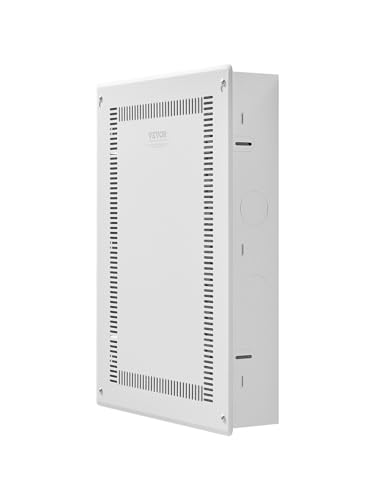
2. VEVOR 20-Inch Recessed Structured Media Enclosure with Cover
A tall steel cabinet that swallows a router, a switch, and a streaming player.
Twenty inches of height changes what you can keep behind the wall. The VEVOR box measures 20.91 inches tall, 15.08 inches wide, and 3.74 inches deep, which is roughly five inches more height than the 14-inch Leviton. That extra space is the whole pitch: 20.91 inches of height holds a router, a switch, and a streamer like a Roku or Apple TV with room to spare.
The knockout count is where this box outdoes its size class. You get three 2.36-inch knockouts on top, four 1.97-inch openings, and six 1.57-inch openings, plus two reserved knockouts for outlet boxes. The cold-rolled steel body is meant to help heat escape rather than trap it, which matters once you pack amplifiers and receivers in there.
Ten pounds of steel is a fair bit to hold overhead while you line up the screws — it is 10.1 pounds to be exact, against the ICC’s 2.8 plastic build. The detachable cover also does double duty: it hides an imperfect drywall cut, so a slightly ragged opening still looks finished.
Space-to-cost read: for a home theater wall where a receiver and a soundbar both need a home, this is the most floor-to-ceiling room you will find in a steel body.
The weight tax: 10.1 pounds means a second pair of hands is worth arranging before you lift it into the bay.
Built for: media walls and home theater builds where the box has to hold several pieces of equipment, not just a modem.
Not for: a quick one-device retrofit — the weight and size make it more work than you need.
3. Legrand – OnQ 14 Inch In-Wall 20-Gauge Media Box, EN1400
The box that sits flush with drywall and hides the cut you were worried about.
Sitting flush is the reason this one gets picked for finished rooms. The flanged screw-on cover is designed to cover the drywall opening, so the edge you cut disappears behind a clean white face. Drywall depth indicators on the cover help you set it to the right plane, and mounting tabs position it for a standard flush install.
This is the deepest box on the list at 5.5 inches, which is 49 percent more depth than the 3.68-inch Leviton. That headroom is what lets you fit a power strip or a chunky adapter without the cover fighting back. The 20-gauge cold-rolled steel body is a step up in rigidity from thinner sheet, and it is made in the USA with a 1-year warranty behind it.
It also brings a small nicety most boxes skip: a literature pouch inside the cover for dealer notes. The quibble is the screw-on cover itself — it is slower to remove than a hinged door when you need to get back in and add a cable. The width also runs to 16.5 inches, wider than the 14.25-inch Benner-Nawman, so check your stud bay first.
Why installers keep buying it
- Flanged cover hides rough drywall edges for a finished look
- 5.5-inch depth clears power strips and bulky adapters
- Drywall depth indicators take the guesswork out of flush mounting
Small things to weigh
- Screw-on cover is slower to open than a hinged door
- 16.5-inch width needs a clean stud bay with room to spare
Your pick when: the room is already painted and you want the cover to blend in without a visible gap.
Think again if: you plan to add cables often — a hinged door saves you unscrewing a plate each time.
4. ICC 14-Inch Structured Wiring Media Enclosure
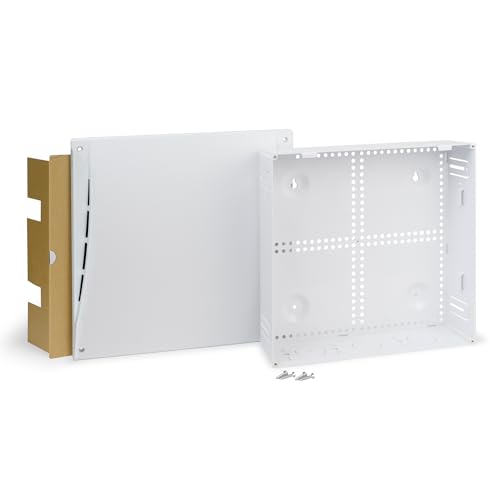
A 2.8-pound plastic box that goes in fast and gathers every cable in one place.
If you want the fastest install, this 2.8-pound plastic box is the lightest here and screws in with one hand. It is plastic and weighs 2.8 pounds, which is 7.3 pounds lighter than the VEVOR steel box — light enough to hold with one hand while you drive a screw with the other. The 14-inch body is sized for a single-family home’s voice, data, video, audio, and security cabling, all landing in one recessed spot between 16-inch studs.
The module grid is the useful part. A universal hole pattern gives you 8 module spaces that take ICC and most standard modules set either horizontally or vertically. You also get 4 knockouts on top and 3 on the bottom plus 4 tie points, so cable routing stays tidy. It ships with the enclosure, a vented snap-on cover, a cardboard mud guard, and mounting screws — the mud guard keeps drywall compound out during finishing.
Understand the scope before you buy: this is the enclosure only, and connectivity modules, AC outlets, and cable grommets sell separately. It is also indoor-use only and not for fire-rated walls. Those limits are normal for this category, but they mean you budget for the modules you actually want later. Plastic also means less rigidity than a 20-gauge steel body, so treat the cover gently.
Who it suits: a remodeler wiring a house for the first time who wants a light, UL-listed plastic box and a snap-on cover.
Plan around: modules and outlets are extra purchases, so map out which ones you need before the drywall goes up.
Get this if: you are roughing in a home network and want the lightest, quickest box to handle.
Pass if: you need a fire-rated wall install or a rigid steel shell — this one is indoor, non-fire-rated plastic.
5. Benner-Nawman 14144-MMH Structured Wiring Cabinet
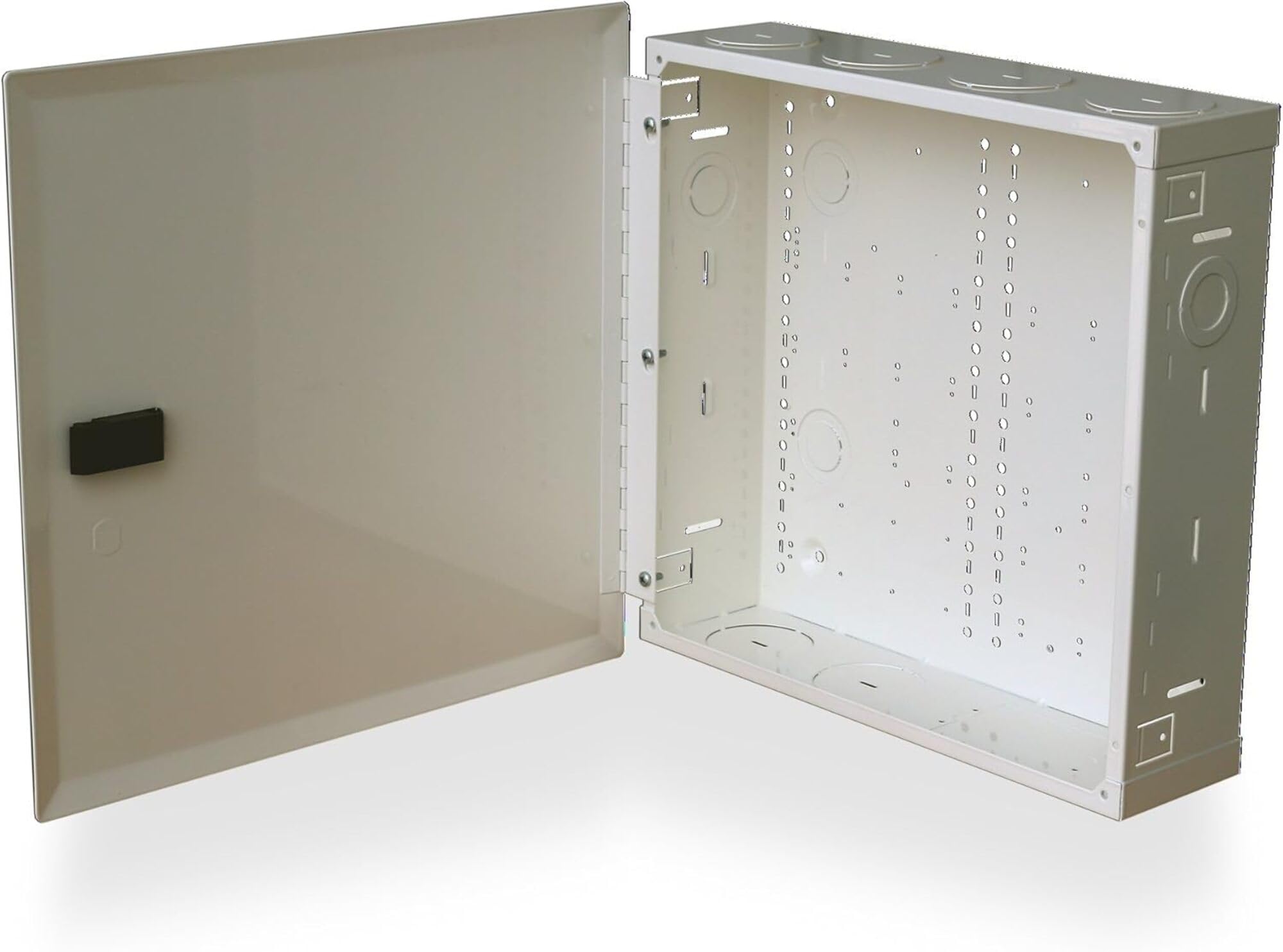
The compact steel cabinet built around a grid that takes almost any brand’s modules.
Brand lock-in is a real annoyance in structured wiring, and this box’s universal mounting pattern accepts most major brands of modules. The universal mounting pattern accepts most major brands of modules, so you are not married to one maker’s shelves and brackets. It gives you 746 cubic inches of space inside a 14.25-inch wide, 14-inch tall, 4-inch deep steel body, with a hinged lid that swings open instead of unscrewing.
The steel is a two-layer build — 18-gauge on the door and 20-gauge on the body — finished in zinc-coated steel with a powder-coated white surface. It arrives with mounting screws, grommets, an instruction sheet, and a cardboard overspray shield to protect the interior during drywall work. Width of 14.25 inches is 2.25 inches narrower than the Legrand EN1400 at 16.5 inches, so it tucks into tighter bays.
Where this one asks for care is the small-install side of things — the module ecosystem it accepts is broad, but the box itself is compact, so a router plus a switch plus a power strip will feel tight. If you want the largest box on the wall, look at the 28-inch options instead.
What makes it flexible
- Universal grid accepts most major brands of modules
- Hinged lid opens without tools for quick access
- Ships with grommets and an overspray shield for the install
Fit notes
- 746 cubic inches gets tight with a router, switch, and power strip together
- 18-gauge door over a 20-gauge body — solid, but not a heavy vault
The right call for: anyone who already owns modules from mixed brands and does not want to rebuy brackets.
Look past it if: you need to pack multiple active devices inside — go bigger.
6. Benner-Nawman BN14304F Foldable Structured Wiring Cabinet

A 28-inch cabinet that arrives flat and lets your Wi-Fi straight through.
Two things set this one apart from every steel box here: polypropylene construction and a flat-pack foldable body. First, it is polypropylene, and the maker states plainly that the material does not block Wi-Fi signal — so a router inside keeps talking to the house. Second, it ships flat and folds into shape using flexible hinges and locking insertion tabs, which means you can store it easily and assemble it in seconds on site.
The interior runs 28 inches tall, giving you real vertical room for shelves and stacked modules. It mounts between 16-inch center studs with tabs on the side, prior to drywall. A ventilated hinged door comes standard and installs to open from the left or the right, so tight corners are less of a fight. You also get five 2-inch knockouts on top and either four 1.3-inch knockouts or two 1.3-inch plus two AC knockouts on the bottom.
The honest trade is that fold-up construction trades rigidity for convenience — it is 6.8 pounds and assembled by tabs, not welded steel. It is fine behind a wall, but do not expect the solid feel of a 20-gauge sheet-metal box. The 28-inch height is also more box than a small apartment usually needs, so measure before you commit.
The scene it fits: a closet where the router has to live and still reach the living room — that is exactly what the Wi-Fi-friendly plastic is for.
Fair warning: folded tabs and light plastic are not built to be battered, so handle it carefully during the drywall stage.
Worth picking when: your wireless router sits inside the wall box and you need the signal to survive.
Skip when: you want a heavy steel vault and have no router going inside.
7. Legrand OnQ 20 Inch Media Enclosure

A 22.2-inch ABS box that lets the signal out and the door swing fully open.
Twenty-two inches of height plus a wireless-transparent ABS shell — this is the balance point between size and signal. The body is ABS plastic, chosen so wireless devices integrate without interference, and it measures 22.2 inches tall, 17.5 inches wide, and 5.5 inches deep. That depth pairs with an extruded cover that adds 1.2 inches of extra headroom for cables and third-party gear.
Everyday access is where it shines. The reversible hinged door snaps into the trim ring without tools and swings a full 180 degrees, so you can reach the far corner of the box without working around a plate. The universal mounting grid takes third-party products without needing extra brackets, and the whole unit is made in the USA from wireless-transparent ABS. For hiding telephone punch downs and small equipment, it does the job cleanly.
Here is the catch worth knowing before you decide: the plastic shell draws mixed feelings on how substantial it feels — some buyers call it sturdy, others read it as cheap next to a steel box. If you want the feel of heavy-gauge steel, this is the wrong pick. If you want a large wireless-transparent enclosure that mounts easily, this is the one.
What works in your favor
- ABS shell lets a router inside keep its signal
- Extruded cover adds 1.2 inches of cable headroom
- Tool-free reversible door opens a full 180 degrees
The trade you accept
- Plastic body feels less substantial than 20-gauge steel
- Large footprint needs a wide stud bay to sit right
Pick this for: a router-friendly install where the box doubles as a wireless distribution point.
Not this if: you want the reassuring heft of a sheet-metal enclosure — go steel.
8. Leviton 28″ Wireless Structured Media Center

A full-height plastic center that keeps gear cool and lets the door open wide.
For a box that houses active electronics, airflow matters as much as size. This Leviton center is a 28-inch plastic enclosure with enhanced tri-plane venting built into the door, so heat from a switch or router has somewhere to go. The plastic body is Wi-Fi-transparent, which means better signal reception and a wider coverage area from a router sitting inside.
The door design is the standout. It installs tool-free with a ratcheting hinge and latch that accommodates different drywall depths and imperfections, so a wall that is not perfectly even is not a problem. It opens a full 180 degrees, adds 1.25 inches of extra depth, and can be positioned left- or right-opening to suit tight spaces. It works alongside Leviton modules, brackets, and accessories for a full connected-home setup.
The mixed signals here are about stiffness and cost. Build quality draws solid approval and it installs without drama, but feedback splits on durability — some find it sturdy, others want more rigidity for the price tier — and some feel it sits at the pricier end for a plastic box. None of that changes the fit for a Verizon Fios setup, which is what most people report using it for. Weigh it against the On-Q ENP2050-NA if 22 inches is enough.
Cooling and access, solved: the vented 180-degree door is what you want when a switch and router both live inside and you need to get back in.
Where it may not satisfy: if you equate heft with quality, a 9-pound plastic box will not match a steel enclosure’s feel.
Best matched to: fiber and full-home networking where a router inside needs to stay cool and reach out.
Consider the alternative if: 28 inches is more room than you need, in which case the shorter ABS Legrand box saves wall space.
9. On-Q 28″ Structured Media Enclosure

The largest steel box here, with a locking hinged door for a full wiring hub.
When you want a big, locked enclosure with cold-rolled steel around it, this is the heavyweight. The body is 20-gauge cold-rolled steel with drywall depth indicators on the cover for a flush set.
The hinged, flanged door hides drywall openings and includes a literature pouch for dealer paperwork. Mounting tabs give you the correct flush position for standard installs, and you can choose flush or surface mounting. It takes Legrand pop-in shelves, which owners note works well, so you are not stuck with one shelving brand. The same enclosure comes in 14-, 20-, 28-, and 42-inch sizes if this one is overkill.
The split in feedback is rigidity. Quality, install ease, and value all land positive, and it accommodates a good pile of network components — but durability prompts disagreement, with some units reading as sturdy and others as flimsy. That is the honest risk on a 14.1-pound steel box. At 28 inches you also need a tall clear wall bay, so check your stud bay height before ordering.
The full-hub option: locking door, 28 inches of height, and a locking steel shell make it right for a dedicated wiring closet.
Read the reviews on rigidity: if you want maximum stiffness, look hard at the 20-gauge body and mount it to solid studs.
Choose it when: you want a large steel enclosure with a lockable door for a whole-home networking hub.
Reconsider if: your router goes inside — the steel shell costs you wireless reach, and the plastic boxes beat it here.
Know the Specs
Material and Wi-Fi transparency
Material decides whether a router inside the box keeps its reach. Steel bodies like the 20-gauge cold-rolled steel in the Legrand EN1400 are rigid and hold their shape, but a metal shell can block radio waves. ABS and polypropylene, used in the Leviton 49605-28P and the Benner-Nawman BN14304F, are Wi-Fi-transparent, so a router inside keeps talking to the room. Pick steel for strength and plastic for signal.
Knockouts and module grids
Knockouts are the pre-scored openings you push out to run cable. More of them, in more sizes, means coax, ethernet, and power each get their own clean route. A universal module grid is the pattern inside the box that accepts shelves and brackets from the major brands, so you can add a splitter mount or a shelf without hunting for one maker’s parts. Both specs make the box easy to grow into.
Size and stud spacing
Most enclosures are built to sit between 16-inch center studs, so width is partly fixed by your wall. Height and depth are yours to choose. A 14-inch box handles a modem, a switch, and a splitter, while a 20-inch or 28-inch box leaves room for a router, shelves, or AV gear. Depth decides whether a power strip or chunky adapter fits behind the cover.
Cover type: flush vs hinged
A flanged screw-on cover hides a rough drywall cut and sits flush for a finished look, as on the Legrand EN1400. A hinged door, as on the On-Q EN2850, swings open without tools for quick access and can add extra depth. Vented hinged doors push cooling further, which matters when active electronics live inside. Choose hinged if you will open the box often.
Common Questions
Will a steel enclosure block my Wi-Fi router?
Do structured media enclosures fit between 16-inch studs?
Is a plastic enclosure as strong as a steel one?
What is the difference between a screw-on cover and a hinged door?
Do I need a 14-inch or 28-inch enclosure?
Are connectivity modules included with the enclosure?
Can I install a structured media enclosure in a fire-rated wall?
How much depth do I need for a power strip inside the box?
What are knockouts and why do they matter?
Can I surface mount these enclosures or must they be recessed?
The Bottom Line
If you want the safest all-round pick and do not need the router inside the box, the Leviton 47605-140 is the strongest choice — its alloy steel build, two 2-inch top knockouts, and base cutout for J boxes and power modules do everything a standard install asks. If your router lives in the wall, reach for the Legrand OnQ ENP2050-NA, where the ABS shell and 1.2-inch extruded cover keep signal and cable headroom on your side. And for a full-height hub with airflow, the vented Leviton 49605-28P is the one that keeps active gear cool behind a door that opens wide. Size up on height and depth now, because swapping a 14-inch box for a 28-inch one after drywall means cutting the wall open again.
How we choose
We do not accept paid placement. Every pick is matched to a real buyer and a real use-case; we do not hands-on test units.
Sources
Specifications: manufacturer listings and product documentation. Review insights: verified customer reviews, as of November 2026. Pricing: not shown on this page (it changes often); check the current price via the retailer link.
As an Amazon Associate, Tactical Gear Guy earns from qualifying purchases. This does not affect which products we feature.