Specs are compiled from manufacturer listings and verified buyer reviews and can change over time — please confirm the key details on the product page before buying.
If your dirt bike spends more time on asphalt than you planned, the cheapest fix is a street-biased dual-sport rear tire. A pure off-road knobby squirms on every corner and wears flat in a few hundred miles, while a dual-sport tire with a denser tread block keeps enough bite for fire roads. Below are six dual-sport rears, ranked by load capacity, tread bias, and what buyers report after real miles.
This guide is built by comparing the manufacturers’ published specifications and the patterns across verified customer reviews, so you get each pick’s real strengths and trade-offs instead of marketing spin.
Every set below is measured by bead size, load index, and how it behaves when the pavement ends. Each pick lists its size code, load index, and tube type, so you can match one to your rim and your commute before you buy.
Top Picks


How To Choose The Best Street Tires for Dirt Bike
Start with the numbers stamped on your sidewall, not with a brand name. The size code (say 130/90-18) fixes the width, the sidewall height, and the rim it mounts to, and no tread pattern makes up for a tire that won’t seat on your wheel. Get that right, then work down to load index, tube type, and how the tread behaves at highway speed.
Match the size code before anything else
A size code tells you three things at a glance. The first number is the tire’s width in millimeters, the middle number is the sidewall height as a percentage of that width, and the final number is the rim diameter in inches. A tire with a 17-inch rim requirement will not fit an 18-inch wheel, and a 4.60-18 style size uses an older inch-based format. Check what is on your bike right now and buy the same format, not the closest-looking one.
Load index, explained in one line
The load index is a coded number for how much weight one tire can carry when inflated properly. Higher is stronger. A tire built for a heavy adventure bike carries a higher index than one meant for a light dual-sport, so match the index to your bike’s weight and your luggage, not to whatever is on sale. Running a tire below your bike’s weight demand is a genuine safety problem, not a comfort trade.
Street tread versus a full knobby
A street-biased dual-sport tire packs its tread blocks closer together. That gives you a quieter ride, less vibration through the bars, and more rubber touching the road in a corner. A full knobby spaces those blocks wide open for mud clearance, and the trade is a lumpy, wandering feel on asphalt. The tires below lean toward the street-safe end of that scale while keeping enough edge for gravel and hard-packed dirt.
Tube type and how it changes the job
A tube-type tire needs an inner tube inside it to hold air — it is built for spoked wheels that cannot seal at the bead. Tubeless designs hold air at the rim, but they still need a sealed rim to work. Buy the same type your wheel already uses. Swapping types means changing rims or adding a tube, and that is added cost and effort on the day you want to ride.
Side-by-Side Comparison
| Model | Best For | Size | Load Index / Capacity | Tube Type | Amazon |
|---|---|---|---|---|---|
| Dunlop D606 Rear★ Best Overall | Serious mixed-terrain riding | 130/90-18 | 69 / 716 lb | — | Amazon |
| Kenda K761 Radial 110/80R18Top Performer | Pavement-heavy dual sport | 110/80R18 | — | — | Amazon |
| Kenda K761 120/90-17 | Highway miles with curve handling | 120/90-17 | 64 / 617 lb | Tube type | Amazon |
| CYBER 80/100-17 | Supermoto and city commuting | 80/100-17 | — | — | Amazon |
| Dunlop D605 Rear | Value adventure on a budget | 4.60-18 | 63 / 600 lb | Tube type | Amazon |
| Kenda K270 100/90-18 | Budget 40/60 dirt-to-road split | 100/90-18 | 56 | Tube type | Amazon |
Detailed Reviews
1. Dunlop D606 Dual Sport Rear Tire – 130/90-18
Our pick — 4.5+★ from 350+ verified ratings; the strongest balance of quality and price.
The 716-pound brute that still holds gravel at speed.
If your riding week is half tarmac and half loose fire road, this is the tire that makes the compromise feel deliberate rather than a penalty. It carries a load index of 69, which is a coded rating for how much weight the tire can shoulder, and that index pairs with a stated load capacity of 716 pounds. That is the strongest capacity figure on this list. For a rider hauling gear or riding two-up to the trailhead, that headroom is what keeps the sidewall from feeling sloppy when the bike is loaded.
Where it pulls ahead of the Kenda K270 in the budget slot is outright strength — index 69 against 56, and 716 pounds against the K270’s smaller load figure. The customers-say read backs the tread design up: these tires handle pavement and off-road without falling apart at either job, and loose gravel and fire roads at speed come up as a specific strength. Grip, road performance, and the dual-sport balance all land in the positive column. The one thing the summary does not call out is a weak spot, which is unusual for a tire that has to do both jobs.
Here is what to plan for. At 14.2 pounds this is a heavy rear, and heavier than the 9-pound K270 by a wide margin — you will feel that in mounting effort and in how the bike tips into a slow corner. It is also the premium-tier cost of the group, so the value read is honest: you pay for the capacity and the reputation, not for a bargain. Fit it if your bike is heavy or you ride two-up and need the 716-pound capacity.
Where it pulls ahead
- Load index 69 with 716 pounds of stated capacity — the most load-bearing rear here
- Handles both pavement and off-road, with loose gravel and fire roads named as a strength
- Wins on grip and road performance in the buyer consensus
What to budget for
- 14.2 pounds makes mounting and slow-speed handling heavier work
- Premium-tier spend compared with the value Kendas
- 130/90-18 sizing must match your rim exactly
Reach for this if: your bike carries real weight and you want one rear that handles tarmac and gravel without excuses.
Look elsewhere if: you are chasing the lightest possible rear or riding a small-displacement dual-sport where a 56 index already covers you.
2. Kenda K761 Dual Sport Radial Tire – 110/80R18
Built for the rider who admits the trail is the detour.
Kenda says it outright in the description: if you lean more toward street than trail, this is your tire. That one line tells you who it suits. It is a radial-construction dual-sport tire (the casing is built in a ring around the wheel), and it is designed around pavement first. The casing layout is meant to keep the contact patch (the part of the tire touching the road) steady when the bike is upright and rolling at speed. A bias-ply knob (a tire with a criss-cross casing and blocky tread) tends to flex under you instead.
The size is 110/80R18, which means an 18-inch rim, a 110-millimeter width, and a sidewall at 80 percent of that width. That is narrower than the 130/90-18 Dunlop D606, so it suits a lighter bike that does not need the extra load capacity. If your machine is a mid-size dual-sport doing mostly commuting with the odd gravel road, the narrower profile turns in quicker and feels less like a truck at low speed.
What the data does not give you is a load index or capacity figure for this specific size, so treat that as the open question before you buy. Check your bike’s own weight requirement against the sidewall stamp on the exact tire you receive. For the rider who wants a street-first radial and rides an 18-inch rear, this is the cleanest fit on the list.
Why it earns the slot: the radial build and the maker’s own street-leaning framing make this the most pavement-focused 18-inch option here.
The honest gap: no load index or capacity is published for this size, so verify the sidewall figure against your bike’s weight before you commit.
Fits your garage if: you run an 18-inch rear and want a radial tire that treats asphalt as the main event.
Skip the swap if: you need a published load figure up front to match a heavy adventure build.
3. Kenda K761 120/90-17 Tt Dual Spt F/r Adventure Pn:04761791b1

The 17-inch workhorse that takes curvy roads in stride.
Owners keep coming back to ride quality on this one — highway speeds and curvy roads both come up as places where it holds its line. That matters for a street-biased tire, because a dual-sport that wanders at speed wears you out on a long day. The tread sits on a 4-ply nylon casing, which is a construction rated for how many fabric layers wrap the tire body, and that build is what steadies the contact patch when you are leaned over on tarmac.
Numbers-wise, this tire carries a load index of 64 and a stated load capacity of 617 pounds, with a maximum pressure of 35 psi. It is a tube-type tire, so it needs an inner tube inside it to hold air — plan on buying one if your wheel does not already have a serviceable tube. The 120/90-17 sizing puts it on a 17-inch rim at 120 millimeters wide, narrower than the 130/90-18 Dunlop D606 but wider than the 110/80R18 radial in the slot above.
The recurring theme in owner feedback is straightforward value: quality and price both score in the positive column, and easy installation comes up as well. What you give up is the load headroom of the D606 — 617 pounds against 716 — so if you ride two-up or carry luggage, check the math against your bike’s rated weight first.
The real draw: a 4-ply casing, 617-pound capacity, and a ride that stays composed on twisty tarmac and at highway speed.
The trade you make: less load capacity than the D606, and it is a tube-type tire, so add an inner tube to your order.
Reach for this if: you ride a 17-inch rear, log real highway miles, and want a tire that tracks straight through curves.
Look elsewhere if: your bike is heavy enough to need more than 617 pounds of carrying capacity per tire.
4. CYBER 80/100-17 Street Tire
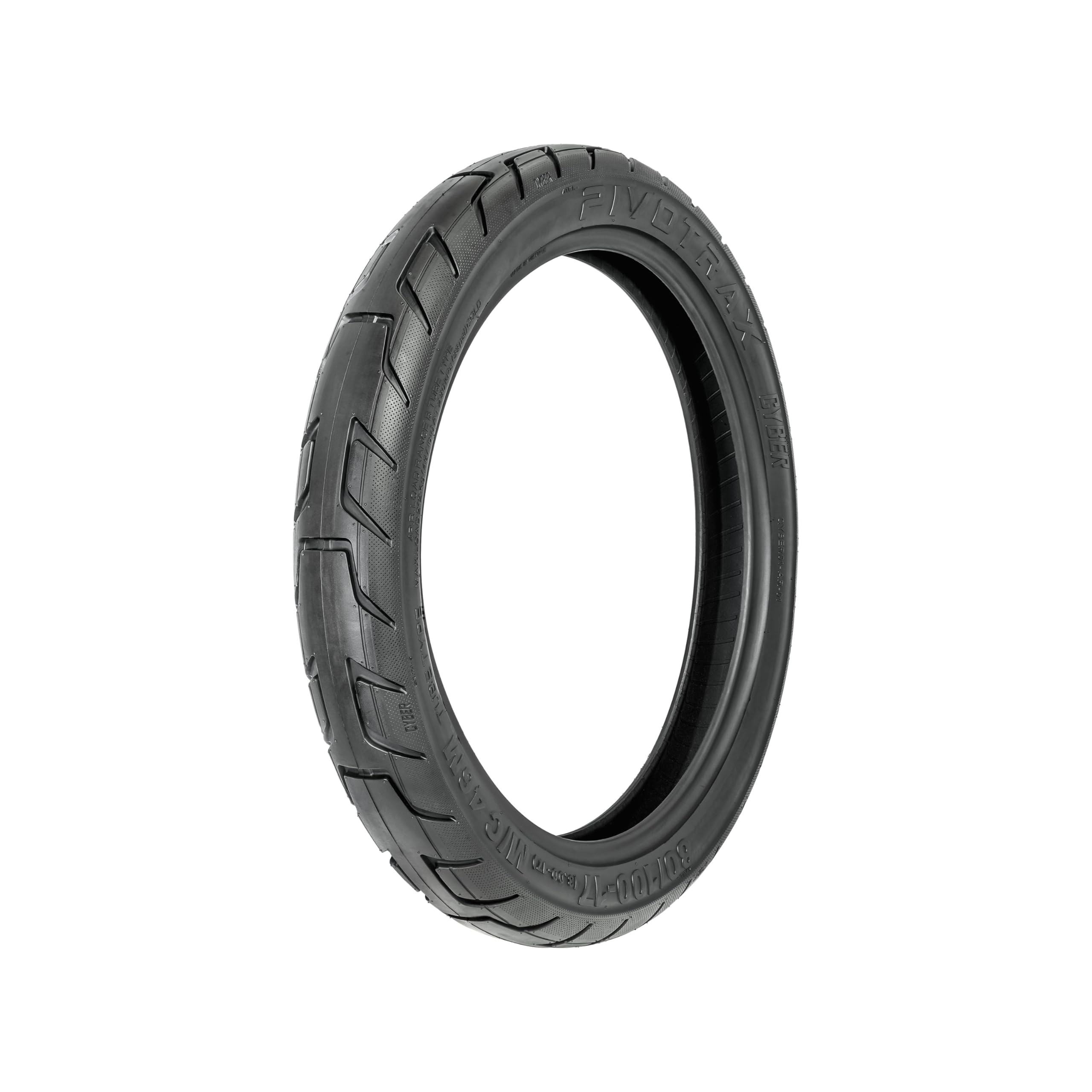
A pure pavement tire for the rider who never leaves the tarmac.
This is the one tire on the list that does not pretend to be a dual-sport. It is built for supermoto and city riding, with a street-specific tread and a high-wear rubber compound, and the maker is explicit that the design is for paved surfaces. If your “dirt bike” is really a Light Bee, an E-Ride PRO SS, or another 17-inch supermoto-wheel machine that lives on asphalt, this is the right tool. Its 80/100-17 size fits a 17-inch rim at 80 millimeters wide with a full-height 100 ratio sidewall.
What wins people over here is the build quality — that is the aspect the buyer consensus dwells on, followed by fit. Owners mention the sizing lines up with their rims, the ride stays smooth (one common note is a smooth ride at 22 psi), and traction holds with no slipping under acceleration. The look gets its share of praise too, which makes sense given the aggressive supermoto profile the maker designed into it.
The honest snag is cost. Value for money is the mixed note in the feedback, with a real split between riders who feel it is worth it and riders who find it steep for a single tire. Radial construction and year-round seasonal rating round out the spec sheet. Buy it if you run a 17-inch supermoto wheel and stay on pavement; skip it if you still ride gravel.
The pavement case
- Street-specific tread with a high-wear compound built for asphalt
- Fit and build quality lead the owner feedback
- Stable cornering with minimal vibration at speed
The compromise
- Value for money splits opinion — some riders find it steep for one tire
- No off-road tread intent, so gravel and mud are out of scope
- 80/100-17 sizing only suits 17-inch supermoto wheels
Built for you if: your bike runs a 17-inch supermoto wheel and the trail is not on your route.
Wrong tool if: you split your weekends between fire roads and pavement.
5. Dunlop D605 Rear Dual Sport Tire 4.60×18

Full tread depth and a street-legal speed rating without the premium tag.
Two things make this tire stand out for the money. First, it carries a P speed rating, which is a DOT-legal rating for speeds up to 94 mph — so highway transit at legal speeds is fine. Second, it has a 63 load index and a stated 600-pound capacity, which is enough for a mid-size dual-sport with a rider and some kit. Compare that to the D606’s 716 pounds and you see where the savings come from: it is a lighter-duty rear, not a lighter-quality one.
The tread is a full-depth pattern meant to keep bite in dirt while staying stable on changing surfaces. In owner experience, that shows up as a tire that does well on both road and dirt, with quiet pavement operation standing out — a genuine plus if you commute and hate the hum of a knobby. Traction off-road and a smooth ride on tarmac both come through in the positive column. Quality is the strongest theme by a distance.
You pay for that in weight and setup. At 14.5 pounds and built as a tube-type (it needs an inner tube inside), it is heavier than the K270’s 9 pounds, so mounting takes two hands. Grip feedback draws more mixed comments than build quality does, so hard-riding riders may want the D606 instead. On a mid-size dual-sport with a solo rider and light kit, its 600-pound capacity is the balance.
What earns it the label: 600 pounds of capacity, a 94 mph DOT speed rating, and a quiet ride on pavement — a lot of capability for the value tier.
What to keep in mind: 14.5 pounds and a tube-type build make mounting heavier work, and grip divides opinion more than build quality does.
The right tire if: you want a street-legal dual-sport rear for a mid-size bike and value quiet pavement miles.
Step up if: your bike is heavy enough that 600 pounds leaves no margin.
6. Kenda K270 Rear Motorcycle Bias Tire 100/90-18

The 9-pound entry ticket that still clears highway speed ratings.
Start with the split. This tire is DOT approved and rated 40 percent dirt to 60 percent road, so the maker is telling you it leans street. If you just bought a used dual-sport and want to replace the tired original rubber without spending on a premium rear, this is the lowest-cost way in. It comes in a 100/90-18 size on an 18-inch rim, at 100 millimeters wide — the narrowest 18-inch here, which makes it a natural fit for a smaller-displacement bike.
The build is bias construction (an older, stiffer casing style than radial) with 4 and 6-ply rated casings and a 33 psi maximum pressure. It weighs 9 pounds, which makes it the lightest rear on the list by a wide margin compared with the 14.2-pound D606 — and lighter tires mount faster and spin up easier on a small bike. Performance is what buyers praise most, with town-and-trail riding the specific use that keeps showing up.
Here is the caveat that matters. Grip is the mixed note in the feedback, so if you ride aggressively on wet tarmac you may want a tire with a stronger grip consensus. And the 56 load index is the lowest here, which is fine for a light bike but not for a loaded adventure machine. As the cheapest rear here, it covers town-and-trail riding on a light 18-inch bike.
The entry-ticket case
- Lightest rear here at 9 pounds — fast to mount on a small bike
- DOT approved with a 40/60 dirt-to-road rating
- Performance praised most, with town-and-trail riding named as the fit
What you give up
- Grip is the mixed note in owner feedback
- Load index 56 is the lowest on the list — light bikes only
- Bias casing and tube-type build, with a 33 psi ceiling
The budget entry if: you run a light 18-inch dual-sport and want DOT-legal rubber without the premium spend.
Pass it up if: you ride hard in the wet or your bike is heavy enough to need a higher load index.
Know the Specs
Load Index and Load Capacity
The load index is a coded number for how much weight one tire can support when inflated correctly. Higher index equals more carrying strength. It always pairs with a stated capacity figure in pounds on the spec sheet. Match both to your bike’s weight plus your body, gear, and any passenger. A tire sitting below that demand is a real safety risk, not a comfort preference. On this list the range runs from index 56 on the Kenda K270 up to index 69 on the Dunlop D606, which is a meaningful spread for heavier bikes.
Bias versus Radial Construction
Bias construction stacks fabric plies at an angle across the tire body, which makes an older, stiffer ride that is tough and cheap to build. Radial puts the plies running across the tire instead, which lets the sidewall flex more and keeps a steadier contact patch at speed. For street riding the radial tends to feel more planted in a corner. Neither is “better” in a vacuum — the right choice depends on the bike, the wheel, and how much of your riding is pavement.
Speed Rating and PSI
A speed letter like P is a DOT classification for the top speed a tire is rated to sustain. It is a legal and safety label, not a suggestion, and it tells you the tire is street-legal. Maximum pressure is the highest cold inflation the tire will safely hold. Run what your bike’s manual specifies, and never use the tire’s max psi as your normal pressure — the max is a ceiling, not a target.
Size Codes and Rim Match
A metric size like 130/90-18 means 130 millimeters wide, a sidewall at 90 percent of that width, and an 18-inch rim. An inch-format size like 4.60-18 uses an older way of measuring and still means an 18-inch rim. Changing rim diameter means changing wheels, so buy the format already on your bike. Confirm the rim diameter first, then the width, then the rest.
Common Questions
Will a 130/90-18 tire fit an 18-inch rim on my dual-sport?
What load index do I need for a dual-sport rear tire?
Does a tube-type tire need an inner tube?
What does the P speed rating on the Dunlop D605 mean?
Can I put a street tire on a dirt bike and still ride trails?
Is a radial tire better than a bias tire for street riding?
What tire pressure should I run on a dual-sport rear?
How do I know the tire size on my bike right now?
Will a 17-inch tire fit an 18-inch wheel?
The Bottom Line
If you split your riding between tarmac and gravel, the street tires for dirt bike pick to beat is the Dunlop D606. It carries the highest load index and capacity on this list, at 69 and 716 pounds (the load index is a code for how much weight the tire can carry), and owners keep calling out its mixed-terrain grip. If you only ride pavement on a 17-inch supermoto wheel, the CYBER 80/100-17 is the cleaner match. Want a street-legal dual-sport rear at the value end? The Dunlop D605 gives you a 94 mph speed rating and 600 pounds of capacity without the premium spend. Match the size code to your rim first, then confirm the load index covers your bike’s loaded weight.
How we choose
We do not accept paid placement. Every pick is matched to a real buyer and a real use-case; we do not hands-on test units.
Sources
Specifications: manufacturer listings and product documentation. Review insights: verified customer reviews, as of November 2026. Pricing: not shown on this page (it changes often); check the current price via the retailer link.
As an Amazon Associate, Tactical Gear Guy earns from qualifying purchases. This does not affect which products we feature.