Specs are compiled from manufacturer listings and verified buyer reviews and can change over time — please confirm the key details on the product page before buying.
The stand that keeps ruining your take usually is not broken — it is just the wrong type for your setup. A straight stand (a single upright pole with no boom arm or articulating arm hanging off it) holds a microphone directly above or in front of the base, so there is no swinging arm to drift or droop mid-session. The trick is matching the base type and height range to how you actually work. If you sing standing up, you want a weighted floor model with real reach. If you record at a desk, a compact tripod sitting inches away beats a tall pole you have to keep walking around.
This guide is built by comparing the manufacturers’ published specifications and the patterns across verified customer reviews, so you get each pick’s real strengths and trade-offs instead of marketing spin.
Below you will find the models that hold their footing, from floor stands that reach past head height to desk tripods small enough to fold into a bag, so you can start with the straight mic stand that matches your room and your voice.
Top Picks


How To Choose The Best Straight Mic Stand
A straight stand is judged on one thing above all: does the microphone stay exactly where you left it for the whole session? The finish, the packing and the brand name matter far less than those three numbers. Three numbers do most of the deciding for you: the base weight, the height range, and the thread size on the clip.
Start With The Base, Not The Pole
The base is the part that keeps a straight stand upright, because the pole itself gives you nothing to brace against. A weighted round or square base sitting flat on the floor resists a knock far better than a folding tripod, which balances on three thin legs. Tripods win on portability — they fold small and store easily — but they need their weight spread evenly or a nudge will send them over.
Match The Height Range To Your Posture
A seated singer and a standing performer need different reach. Short-range desk stands top out well below eye level, which is right for a podcast setup where you lean toward the mic. Floor stands climb high enough for a standing vocalist or a guitar player who needs the mic above the instrument. Check the low end of the range too — a stand that cannot drop low enough forces you to hunch.
Check The Thread Size Before You Buy
Microphone clips attach through a threaded screw, and the two sizes you will see are 3/8 inch and 5/8 inch. Many stands ship with an adapter so both fit, but not all do. Check that the listing names the thread sizes your mic clip needs, because the wrong one means the clip never screws on securely, no matter how good the stand is.
Decide How Much Flex You Actually Want
A gooseneck is the bendy section at the top of a straight stand that lets you angle the mic. It is genuinely useful for a singer who shifts position, but it also has to support the weight of your microphone without sagging. Heavier dynamic mics and large condenser mics want a stiffer gooseneck or a solid fixed top; light headset-style mics are forgiving.
Side-by-Side Comparison
| Model | Best For | Max Height | Base Type | Thread Sizes | Amazon |
|---|---|---|---|---|---|
| InnoGear Microphone Stand Floor★ Best Overall | Standing singers and full-room use | 70 inches | Weighted Round | 3/8″ to 5/8″ adapter | Amazon |
| Shure by Gator SH-DESKTOP1Desk Standard | Podcast and broadcast desks | 16 inches | Round, 6″ weighted | — | Amazon |
| Gator Frameworks GFW-MIC-0601Travel Ready | Moving between rooms and mics | 15 inches | Round, 6″ weighted | — | Amazon |
| Gooseneck Mic Stand with Heavy Duty Base | Stage and live broadcasting | 66 inches | Square, 6.6 lb | 3/8″ to 5/8″ and 3/8″ to 1/4″ | Amazon |
| Pyle PMKS40 | Gigging and stage placement | 57 inches | Round Metal | 5/8 inch M-6 holder | Amazon |
| Gator Frameworks GFW-MIC-1001 | One-handed height tweaks | 65 inches (5.41 feet) | Round, 10″ weighted | 3/8″ and 5/8″ | Amazon |
| JCWINY Desk Mic Tripod | Compact home studio starter | 18 inches | Tripod | 1/4″ and 5/8″ | Amazon |
| Mictop 2-Pack Desktop Mic Stand | Two mics on one table | — | Tripod | 3/8″ to 5/8″ | Amazon |
Detailed Reviews
1. InnoGear Microphone Stand Floor
Our pick — 4.5+★ from 600+ verified ratings; the strongest balance of quality and price.
Reaches 70 inches and still keeps its footing — the floor stand for people who sing on their feet.
Seventy inches of reach is the headline. That is tall enough to put the microphone above a standing singer or set it over a guitar, and it drops to 32 inches when you want to sit. Notice the height span here versus the desktop models: this stand tops out at 70 inches while the Shure by Gator desktop stand stops at 16 inches, so one is a floor fixture and the other lives beside a laptop. Here it is all done with one clutch (the tightening collar that locks the pole) plus a separate extension pole joined by a long screw adapter, which InnoGear says improves stability over the three-clutch design you see on other stands.
The base is where the stand earns its keep. It weighs 4.5 lbs across a 9.8-inch diameter, and the underside carries 6 non-slip pads. An upgraded fixing loop sits where the base meets the pole to cut down wiggle. What wins people over most is the overall build quality, with stability a close second in the feedback — this is a stand that behaves the way a weighted floor base should. The 360° gooseneck gives you free aiming, and the included clip rotates 180° so you can flip the mic to face the other way. It breaks into four parts in seconds, which is how it handles stage, studio, road show and outdoor work without needing a van.
The honest catch: a few owners find the base could be heavier, and build quality draws mixed notes — a bendy gooseneck on a heavy condenser mic will show it. The stand is rated to hold up to 2.04 kg (about 4.5 lbs), so a big studio mic is near the ceiling of what it wants. Compatibility covers the usual suspects — Blue Yeti, Snowball iCE, Audio-Technica AT2020 and AT2035, Shure SM58, SM7B and more — but note that a shock mount is not included.
Where it wins
- The 32″ to 70″ span covers seated and standing work in one stand.
- A 4.5 lb, 9.8-inch round base with 6 non-slip pads resists knocks.
- The 360° gooseneck and 180°-rotating clip let you aim the mic freely.
- Breaks into four parts, so it travels without a case fight.
- Fits a wide list of mics, from Blue Yeti to Shure SM7B.
Where to look twice
- Build quality draws mixed notes, and the gooseneck can sag under a heavy mic.
- The 2.04 kg weight limit is close for a large condenser mic.
- A shock mount is not in the box.
Grab this one if: you perform standing up and need a base that does not chase you across the stage.
Think it over if: your mic is a heavy studio condenser, which may push past what the gooseneck wants to hold.
2. Shure by Gator Desktop Mic Stand SH-DESKTOP1
A six-inch slab of weighted steel that sits on your desk and refuses to dance.
For podcast hosts and streamers who never stand up mid-episode, this is the desk answer. It adjusts from 10.5 to 16 inches — the whole range sits at or below the height of your laptop screen, which is exactly where a seated talker wants the capsule. That is a sharp contrast with the InnoGear floor stand above, which stretches to 70 inches and 2.04 kg of holding capacity versus this one’s 2.4 lb weight limit. Do not expect it to carry a heavy mic for long.
The build is the story. Black powder-coated steel, a 6-inch weighted round base with a rubber gasket that soaks up vibrations, and an ergonomic twist clutch that locks the height where you set it. Owners call it well-built and functional, and it gets a nod for streaming setups specifically.
Here is where you should think twice. The height draws mixed feedback — some find the range fantastic, while others find it too tall for comfortable use at a standing desk. If your workstation shifts between sitting and standing, check the numbers before you commit. Weight it at 3.2 lbs and you get a stand that stays where it is put, but only within that narrow window.
The desk-first read: if your mic sits at talking height and you want a base that will not creep across a wooden desk, this is the brand-name safe bet — Shure’s own desktop stand, built by Gator.
One real limit: a 2.4 lb ceiling means heavy broadcast mics push it, and standing-desk users may find the top of the range short of comfort.
Suits you when: the microphone lives on the same desk, at the same height, day after day.
Look elsewhere if: your desk converts between sitting and standing modes.
3. Gator Frameworks Desktop Mic Stand GFW-MIC-0601
A soft-grip clutch, a six-inch base, and a short height window built for one job.
This Gator Frameworks desk stand is a close cousin of the Shure by Gator above — same 6-inch round base concept, same ecosystem — but the height window is 10 to 15 inches rather than 10.5 to 16. That single inch matters if your mouth naturally sits low. The clutch has a soft grip, so changing height is a matter of a light twist instead of a knuckle-bruising crank, and it locks smoothly through the whole range.
The base carries a no-slip gasket that cuts down movement and noise. It is powder-coated alloy steel, and it lists at 1.3 kg — heavier-feeling than the Shure sibling, which helps when a cable gets tugged. The microphone compatibility is the selling point for the podcast crowd: it fits the Shure SM7B and MV7, the RODE Procaster and the RODE PodMic, which is basically a who’s-who of broadcast mics. What people praise most is the sturdiness, with quality right behind it, and one reviewer’s MXL 3000 gets a specific nod for holding up well.
The trade-off is simply the range. Fifteen inches is a desk number, not a floor number, so it does not substitute for a full floor stand, and it does not pretend to. If you record at a desk and want a stand that folds into a bag, this is your model.
Why it earns a spot: the soft-grip clutch makes one-handed height tweaks painless, and the 6-inch weighted base with a no-slip gasket keeps a broadcast mic where you aimed it.
The realistic catch: at 15 inches max, this is a desk-only stand — anyone recording standing up needs the InnoGear or the Gooseneck floor pick instead.
The right call for: a podcaster who packs a bag each week and wants a desk stand that disappears into it.
Not the one for: a floor setup where 15 inches cannot reach your chin.
4. Gooseneck Mic Stand with Heavy Duty Base
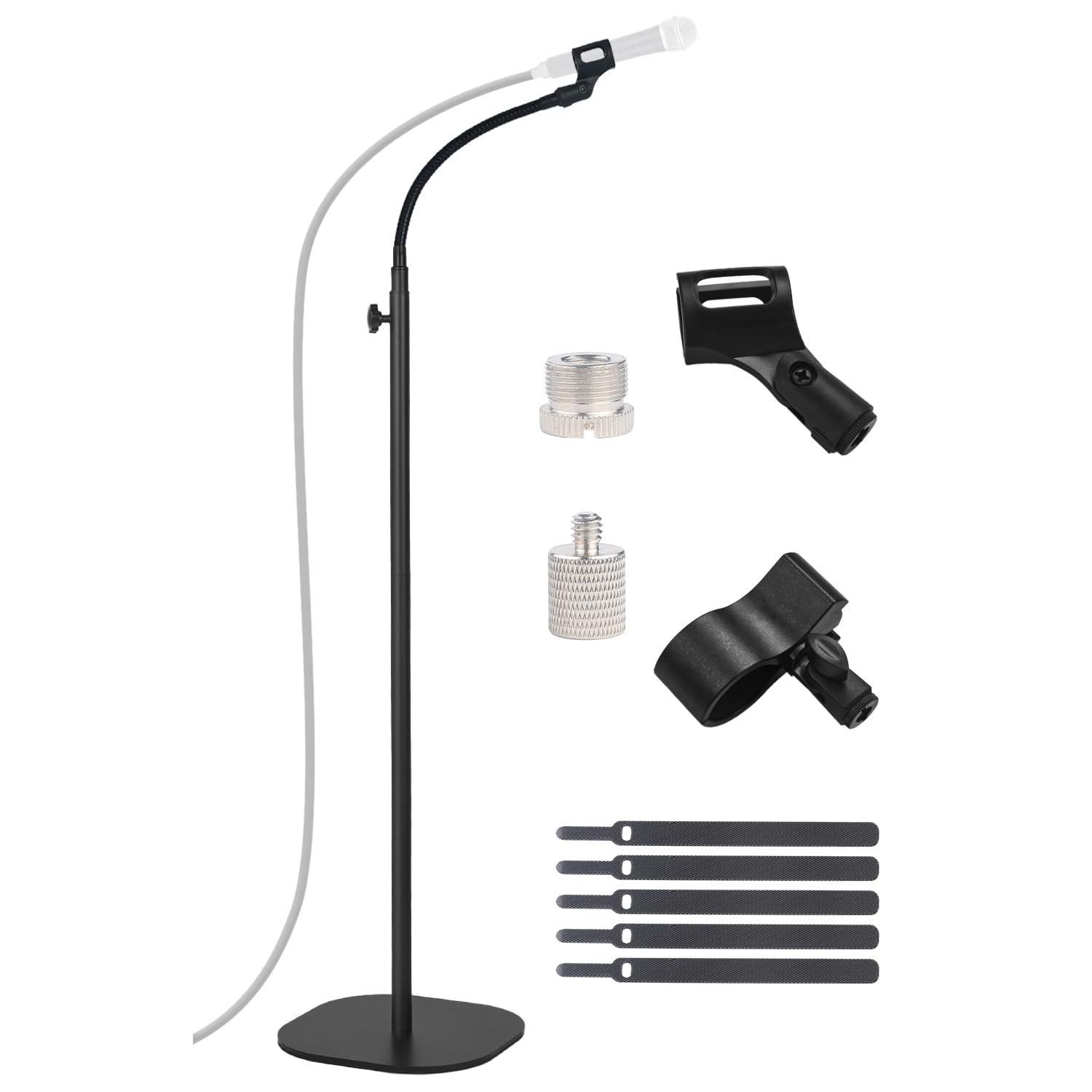
A square, low-profile foot that saves floor space and stops the tripod trip hazard.
Most floor stands give you three legs and a trip-wire risk. This Lemxadd model gives you a square, rounded-corner base that weighs 6.6 lbs at just 0.2 inch thick. That thin slice of steel sits flat on a stage, takes up far less room than a tripod spread, and gives you almost nothing to kick. It is a straight pole with a retractable support rod and gooseneck hose, and it adjusts from 36 to 66 inches, which covers singing, speaking, recording and live broadcasting.
The neat part is the modular height. The kit includes 2 fixed-length support rods, 1 retractable rod and a gooseneck hose. You can leave the gooseneck off entirely, or drop a fixed rod, to bring the minimum height down to 14.5 inches for a low, seated setup. Two mic clips ship in the box — a standard one for mics like the Samson Q2U and Fifine K6, plus a bigger clip for the Fifine K669B, Razer Seiren X, AT2020 and AT2035. Both adapters are present: 3/8″ to 5/8″ for Blue Yeti and Snowball, and 3/8″ to 1/4″ for Blue Yeti Nano, Razer Seiren mini, and Elgato Wave 1 and Wave 3.
Value is what carries it, and the feedback agrees. The base is the reason to pick this one over a tripod floor stand — a 6.6 lb square foot does not slide under a mic swing the way thin legs can. The one caveat is that the accessory count is high (two clips, two adapters, four pole sections), so the first assembly takes a little reading rather than a quick twist and go.
Reasons it stands out
- A 6.6 lb square base only 0.2 inch thick — stable, low-profile, no leg spread to trip over.
- Drops to 14.5 inches with the gooseneck removed, or reaches 66 inches with it on.
- Two mic clips included, covering both slim and large-bodied mics.
- Two adapters cover 5/8″ and 1/4″ mics, including Blue Yeti Nano and Elgato Wave.
The honest limits
- Four pole pieces and two clips mean the first build takes a manual read.
- The gooseneck hose is a single control point, so a heavy mic wants the fixed-rod setup.
Choose it when: you want a floor stand with a flat, space-saving base that will not catch a foot mid-set.
Look further if: you would rather not manage four swappable pole sections on the first day.
5. Pyle Universal Microphone Stand PMKS40
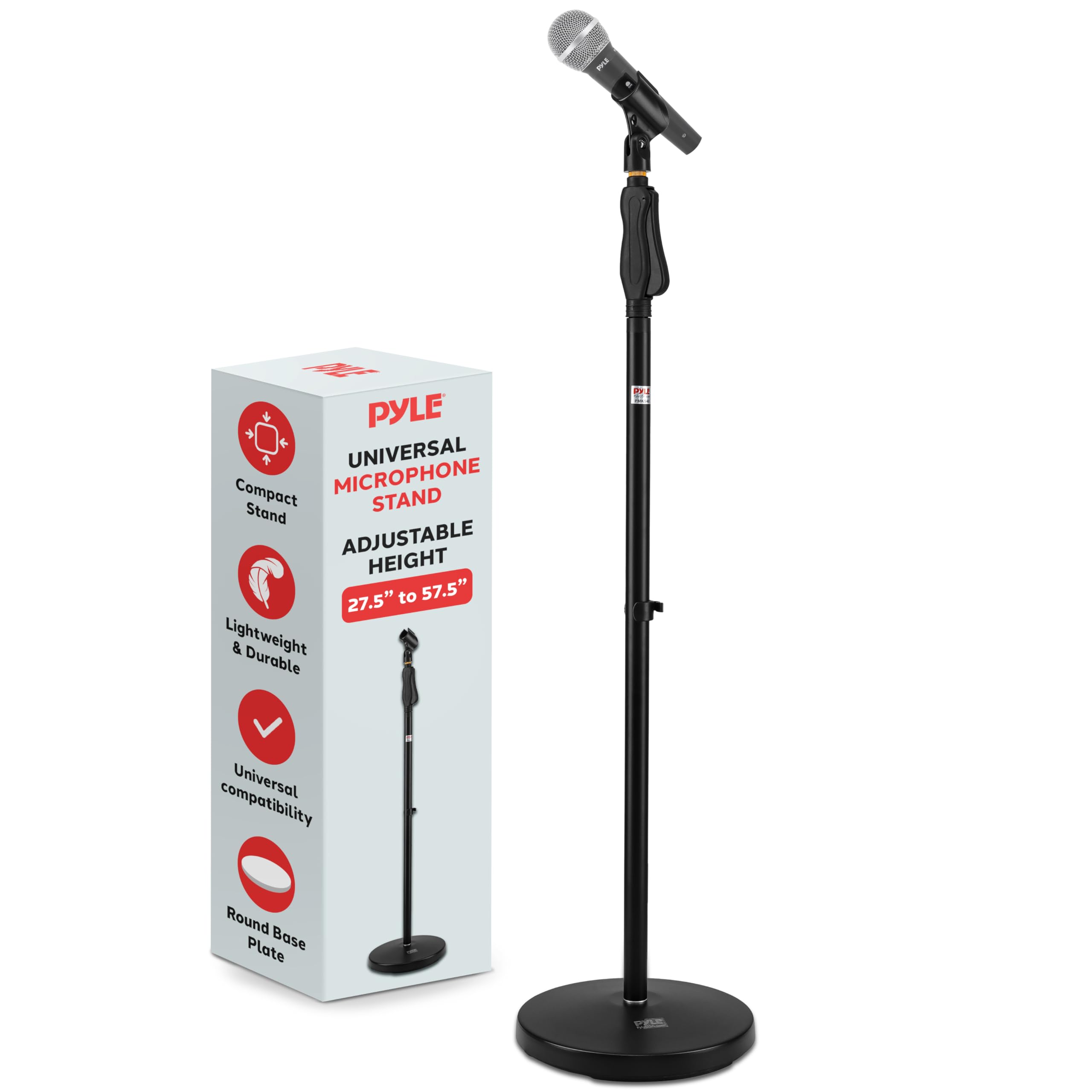
A gloss-finished steel pole with a lock-tight knob, built for the stage and the studio floor.
Pyle’s PMKS40 runs from 36.6 to 57.5 inches, which is a shorter window than the InnoGear’s 70-inch top — but it is aimed at studio and stage performances where the mic sits lower than a belting vocalist’s chin. The pole is a steel metal alloy with a glossy charcoal finish, mounted on a round metal base. The M-6 mic holder screws on through USA-standard 5/8 inch threading, and a quick-setting lock-tight knob holds the height where you leave it so it does not slide down mid-performance.
Assembly is deliberate rather than fiddly, and worth knowing before you buy. You unscrew the bolt from the end of the tube, feed it through the base, screw the pole back on, then tighten from underneath — and it needs an adjustable wrench, which is not in the box. Easy to assemble is the top-line feedback, though, and owners find the round base steadier than a tripod. If you gig often, a lighter desk model like the Gator Frameworks GFW-MIC-0601 would not suit a floor position at all, because its 15-inch ceiling is not tall enough — this one is.
At 10.7 lbs it is the heaviest stand in this group, and that mass is exactly why a round base on the floor does not wander. The trade-off is transport — you will notice the weight when you carry it into a venue, and the wrench requirement means one more thing to pack.
The stage read: a round metal base, 5/8 inch M-6 threading, and a lock-tight knob make this a simple straight stand that holds height on a real stage floor.
What to plan for: the wrench-based assembly needs a tool you supply yourself, and the 57.5-inch ceiling sits below full-standing height for a tall singer.
Best if: you want a low, weighted floor stand that will not budge between songs.
Skip the comparison if: you perform standing tall and need reach past 57.5 inches.
6. Gator Frameworks Microphone Stand GFW-MIC-1001

A ten-inch weighted slab on a squeeze-clutch pole — the stand you adjust with one hand mid-song.
The GFW-MIC-1001 puts a 10-inch round weighted base on the floor and climbs from 36 to 65 inches (5.41 feet). Compare that reach to the Pyle PMKS40’s 57-inch max — the Gator climbs higher, and its base is a full inch wider than the 9.8-inch InnoGear base. A no-slip gasket under the base cuts vibrations, and the base’s heft means it does not lean or fall over even when a cable snags.
The squeeze clutch is what you will love. It is a soft-grip collar you can squeeze and slide, so one hand changes height while the other stays on the mic. The finish is chrome-plated steel, and cable management is built in, keeping a run of cord tidy. It fits both US and Euro mic clips through 3/8 inch and 5/8 inch threading. What owners single out most is the quality, then the sturdiness. Adjustability is cited as a selling point too — the ability to adjust with one hand, and a grip that lets a singer set their height fast, both come up.
The catch: 4.3 kg is real weight on the base, and that is intentional — it is what stops the lean — but you will feel it on a long walk.
The one-handed pitch: squeeze the clutch, slide the pole, let go — a height change without putting the mic down, backed by a 10-inch weighted base and built-in cable management.
The honest note: the stand weighs in heavy and the chrome picks up fingerprints; neither is a defect, but both show up in day-to-day use.
Point it toward: a singer or broadcaster who wants rapid height changes without fumbling for a knob.
Weigh the alternative if: a heavier base and a 65-inch ceiling are more than you need.
7. JCWINY Desk Mic Tripod

Everything you need to get a podcast mic off the desk, in one box, minus the mic and the cable.
The bundle is the point: stand, shock mount, pop filter, clip and adapter in one box. You get the tripod stand, a shock mount, a double-layer pop filter, a mic clip, and a 1/4″ to 5/8″ adapter — so a first-time desk recordist does not have to buy each part separately. Height adjusts across two levels from 11.5 to 18 inches, and the whole thing folds down for travel. At 0.49 kg it is the lightest pick in this group, which makes it easy to move around a room or tuck into a laptop bag.
The pop filter is a double screen and the gooseneck is 360° adjustable. Together they cut down plosives — the burst of air you make on P and B sounds — and mouth noise that a bare mic picks up. The shock mount fits mics with an outer diameter of 40-52mm and wraps them in high-elasticity rope to soak up desk bumps. Buyers appreciate the versatility for desktop recording, and several call out how compact and stable it is — one notes it never wobbles or topples over. The tripod legs have a center-of-gravity drop in use that keeps it planted.
The catch to flag: the shock mount does not fit a Blue Yeti, so you will need to use the clip with that mic or add a different mount. And height tops out at 18 inches — the height feedback is mixed, with some noting it does not get tall enough when raised. It reaches across the desktop, not up to your face.
Ideal for: a first desk streaming or podcast setup where you want the pop filter and shock mount bundled in.
Not suited to: a Blue Yeti owner expecting the shock mount to fit, or anyone needing stand-up height.
8. Mictop 2 Pack Desktop Mic Stand

Two foldable tripods, one box — a spare for a second mic or a second table.
Two stands at once is a specific reason to buy. If you and a co-host record at separate tables, or you keep a spare in the travel bag, this Mictop two-pack covers both without buying twice. The tripod design drops its center of gravity in use, so it sits steady and resists roll-over, and the whole thing folds. The clip is anti-slip and compatible with ATR2100-USB, AT2005-USB, Q2U, Xm8500, SM58 and PGA48/PGA58, and the included 3/8″ to 5/8″ adapter opens it to Yeti, Snowball, SM7B, MV7 and PodMic.
Note it lists 6.6 lbs as the item weight and the maximum weight recommendation, so this is a heavier-footed desk stand than its folding-pod look suggests. What owners single out most is the size — compact enough to fit the job — and the functionality. The setup itself is two parts: tripod and clip holder, screwed together through the internal 3/8″ thread. Use it for desktop recording, singing, screencasts, podcasts, video chats, lectures and broadcasts.
Here is the practical caution from the maker itself: keep one of the three legs to the front of the mic or the stand will topple. It is a two-part build and the top can get wobbly if the load is uneven. Sturdiness draws mixed notes, with some calling it very sturdy and others noting a cheaper feel. Treat it as a light-duty desk stand and it does the job.
What it solves: a second mic position for the cost of one tripod, with the 3/8″ to 5/8″ adapter covering the popular desk mics.
Where it asks for care: the leg-to-front rule and a mixed sturdy feel mean this is a light-duty stand, not a stage piece.
Buy this when: you need two folding desk stands and want them to share one order.
Pass if: you record with a heavy condenser mic and want a stand that will not need leg-placement babysitting.
Know the Specs
Base Weight and Diameter
A heavier, wider base is what keeps a straight stand from tipping when you nudge the pole. A weighted round base spreads the weight like a paperweight on a stack of papers; a tripod relies on three legs and a low center of gravity. A 4.5 lb base at 9.8 inches across, or a 6.6 lb base, resists a bump far better than a folding tripod. Check the weight figure — the makers here range from 6.6 lbs down to 0.49 kg — because the lightest stands are the ones that move when a cable is tugged.
Height Range and How It Fits You
Height range in inches tells you whether a stand is a floor model or a desk model. The shortest desk stands top out around 15 to 18 inches — the height of a laptop screen — while floor stands reach 57, 65, 66 or 70 inches. A floor stand for a standing singer needs to clear your chin; a desk stand for a seated podcaster wants to sit below eye level. Buy the range that matches your posture, not the tallest number you can find, because an over-tall desk stand forces you to lean back.
Thread Sizes: 3/8″, 5/8″ and 1/4″
The clip screws onto the pole through a threaded adapter. The 5/8 inch size is the common broadcast and stage standard, while 3/8 inch runs smaller and 1/4 inch small again. Many stands ship with adapters so a mic designed for one thread drops onto a stand made for another — the InnoGear and Gooseneck models both include an adapter, and the Mictop and JCWINY kits bundle them too. Confirm the sizes against your clip and mic before buying, or the clip will spin loose no matter how solid the stand is.
Gooseneck Flex and Load Capacity
A gooseneck is the bendable neck near the mic clip, and it is only as good as the load it holds. The InnoGear’s 360° gooseneck is rated to hold up to 2.04 kg, while the Shure by Gator desk stand tops out at 2.4 lbs — different designs, different ceilings. A heavier mic asks for a stiffer gooseneck or a fixed top, while a light mic works on a flexible one. Check the maximum weight recommendation on each stand, since a gooseneck that cannot bear the mic will slowly droop over a recording session.
Common Questions
Will a 5/8 inch mic clip fit every straight stand on this list?
What is the difference between a straight stand and a boom stand?
Can I use a straight mic stand for a Blue Yeti?
How tall does a floor mic stand need to be for a standing singer?
Will a weighted round base tip over if I knock it on stage?
Is a tripod desk stand or a round base better for a home desk?
How much mic weight can a desk stand hold?
Do these stands need assembly, and what tools do I need?
Will a gooseneck stand hold a heavy microphone without drooping?
How do I stop a desk stand from picking up keyboard clicks and bumps?
The Bottom Line
For most people after the straight mic stand, the winner is the InnoGear Microphone Stand Floor because its 32 to 70 inch range covers seated and standing work, and its 4.5 lb weighted base keeps the mic where you leave it. If you record at a desk and want a brand-name stand with a solid 6-inch base, the Shure by Gator SH-DESKTOP1 is the one to grab. And for a first desk setup where you want the pop filter and shock mount bundled, the JCWINY Desk Mic Tripod gets you started. Each of these stands holds its aim and stays put, at every price tier.
How we choose
We do not accept paid placement. Every pick is matched to a real buyer and a real use-case; we do not hands-on test units.
Sources
Specifications: manufacturer listings and product documentation. Review insights: verified customer reviews, as of November 2026. Pricing: not shown on this page (it changes often); check the current price via the retailer link.
As an Amazon Associate, Tactical Gear Guy earns from qualifying purchases. This does not affect which products we feature.