Specs are compiled from manufacturer listings and verified buyer reviews and can change over time — please confirm the key details on the product page before buying.
You already own a good circular saw. What you do not own is a way to keep it tracking dead straight across a full sheet of plywood — and that is why half your rips wander a blade’s width off the line. The fix is a straight edge clamp that grabs the panel and gives your saw a rigid rail to ride, and the right one depends entirely on how long your cuts are. Short cabinet work? A 24-inch clamp. Breaking down eight-foot sheet goods? You want the long rails.
This guide is built by comparing the manufacturers’ published specifications and the patterns across verified customer reviews, so you get each pick’s real strengths and trade-offs instead of marketing spin.
Below you will find short rails for detail work, long rails for sheet goods, and a couple of angle-cutting jigs that do more than clamp. Each one is matched to the cut it actually handles well, so you buy the rail your projects need rather than the one with the longest spec sheet. straight edge for skill saw picks here start with the length of your average cut.
Top Picks


How To Choose The Best Straight Edge for Skill Saw
The first decision is not brand and it is not material — it is length. A straight edge only helps if it reaches across the material you are cutting in one pass. Buy a 24-inch rail to break down an eight-foot sheet and you will be sliding and re-clamping mid-cut, which is exactly where wander creeps in. Buy a 98-inch rail to trim cabinet shelves and you will be wrestling a long aluminum bar around a tiny workpiece. Match the rail to the cut first, then work through the rest.
Clamp rail versus plain cutting guide
A clamp-style guide has jaws built into the rail. One jaw hooks the far edge of your board and an adjustable jaw tightens against the near edge, so the rail locks itself down with no separate C-clamps. A plain cutting guide is just an aluminum bar you position by hand or bolt down with clamps you already own. The clamp style is faster to set up on a fresh sheet; the plain guide gives you more freedom in how and where you anchor it, and it usually costs less for the same length.
How thick a panel can the jaws grab
Jaw opening decides whether a clamp rail will hold at all. A clamp that grabs work surfaces up to one and a half inches thick will handle standard sheet goods and most dimensional lumber without fuss. Thicker stock, or a stack of panels you are cutting together, may sit outside the jaw range. Check the clamping thickness against your thickest regular cut before you commit.
Rigidity on long rails
Aluminum flexes. On a 98-inch rail assembled from shorter sections, the joint in the middle is where a saw can dip and leave a shallow gouge in the cut. Longer rails also weigh more, and the weight sits out at the ends where you have the least control. If your cuts are mostly under four feet, a single-piece rail in that range is the more rigid tool. If you routinely break down full sheets, accept the length and support both ends of the rail.
Side-by-Side Comparison
| Model | Best For | Guide Length | Weight | Type | Amazon |
|---|---|---|---|---|---|
| 50″ ProGrip Straight Edge Clamp and Guide★ Best Overall | Full-sheet rips and dados | 50 in | 2.25 kg | Clamp rail | Amazon |
| POWERTEC 24 Inch Circular Saw GuideBest Value | First-timers and tight benches | 24 in | 1.06 kg | Clamp rail | Amazon |
| Kreg Rip-Cut Circular Saw Guide KMA2685Rip Cut Specialist | Repeated rip cuts on sheet goods | Cuts up to 24 in wide | 2.5 pounds | Sled and rail | Amazon |
| ProGrip 24″ Straight Edge Clamp Saw Guide | Trim work and small panels | 24 in | 1.5 pounds | Clamp rail | Amazon |
| Johnson Level & Tool J4900 Cutting Guide | Long rips on doors and drywall | 98 in | 2.2 pounds | Plain guide | Amazon |
| Bora QuickCut Circular Saw Guide | Angled cuts without a miter saw | 16 in | 14.4 ounces | Angle jig | Amazon |
| 36″ ProGrip Straight Edge Clamp and Guide | Cabinet panels and crosscuts | 36 in | — | Clamp rail | Amazon |
| BORA Circular Saw Guide Rail 36in | Track-saw feel on a budget | 36 in | 1.8 pounds | Clamp rail | Amazon |
| Kreg Straight Edge Guide XL KMA4700 | Breaking down eight-foot sheets | 98 in | 7.2 pounds | Clamp rail | Amazon |
Detailed Reviews
1. 50″ ProGrip Straight Edge Clamp and Guide
Our pick — 4.5+★ from 800+ verified ratings; the strongest balance of quality and price.
Fifty inches of self-clamping aluminum that turns one sheet of plywood into a straight-cut job.
Fifty inches is the length that covers most real rips — wide enough to span a sheet for crosscuts, short enough to handle without a second pair of hands. The rail body is a 2-3/16″ aluminum tube (a hollow bar roughly two and three sixteenths of an inch across), and that tube shape is what keeps it from bowing under the weight of your saw. One jaw sits fixed against the far edge of the board. The other jaw slides to meet the near edge, then locks, so the guide clamps itself down and you stop hunting for C-clamps mid-project.
Compared with the Johnson J4900 rail at 98 inches, this is a shorter bar built for one-pass cuts rather than full-length rips on doors and drywall. That trade is worth naming: if your work is cabinet sides and shelf stock, 50 inches is the more manageable tool. The 2.25 kg weight sits under most of a sheet’s edge without feeling like a workout.
The low-profile rail is flat enough that you can run your saw’s base right along it and also clamp accessories or build a custom jig onto it. Dados are its other strength — clamp the rail across the stock, and your saw follows the line for a repeatable groove. It is rated 4.5+ stars across 800+ ratings, and the feedback matches the specs: firm clamping, straight cuts, and no reports of jaws losing their bite.
What earns it the top spot
- Fifty-inch rail covers most sheet-goods crosscuts in a single pass
- Self-clamping jaws eliminate C-clamps and setup fiddling
- 2-3/16″ aluminum tube rail holds rigidity under saw weight
- Low-profile body works for circular saw cuts and routed dados
Where it asks patience
- Long rail needs support at both ends on a full sheet
- Shorter than a 98-inch rail, so very long rips need a different guide
Top pick for: anyone cutting cabinet panels, shelf stock, and plywood dados who wants a rail that clamps itself.
Reconsider if: your work is mostly eight-foot sheet goods — you will want the longer Kreg XL instead.
2. POWERTEC 24 Inch Circular Saw Guide/Straight Edge Guide
Half the weight of the fifty-inch ProGrip, and the friendliest first clamp rail on the list.
At 1.06 kg this is the lightest guide here — less than half the 2.25 kg of the 50″ ProGrip. That matters on a bench where you are setting up and breaking down cuts all afternoon. The body is a 2-3/16″ wide aluminum bar with the same jaw arrangement as its bigger sibling: a fixed clamp that locks with a lever, and an adjustable end clamp you draw in against the opposite edge of the stock. Push the lever down, and the rail bites.
The clever bit is the low-profile jaws. They let you use the clamp inverted, which opens up the work area underneath instead of burying it — handy when you need room for the saw base to clear the workpiece. Twenty-four inches is genuinely enough rail for trim, small panels, and jigsaw or router work, and the aluminum body is built to resist bending when a router is pushing against it. For a beginner working out how a straight edge actually behaves, this is a forgiving place to start.
What it will not do is span a full sheet in one go. If your cuts run long, plan to re-clamp or step up to a longer bar — that is a length limit, not a fault. Rated 4.5+ stars across 90+ ratings, it earns its keep as the value pick for short cuts on a small bench.
The value read: cheapest full clamp-style rail in this lineup, and the lightest, at 1.06 kg.
Set your expectations: 24 inches covers trim and small panels — not sheets.
Reach for this if: you are new to clamp rails and cutting trim, cabinets, or routed slots.
Look elsewhere if: your regular workpiece is wider than 24 inches.
3. Kreg Rip-Cut Circular Saw Guide KMA2685
Not a bar you clamp — a sled that carries your saw and holds a set rip width.
The Rip-Cut solves a different problem from every other guide here. Instead of clamping a rail and steering the saw by eye, you bolt the saw into a universal sled that rides a guide rail, and the sled sets the distance from the edge. Cuts up to 24″ wide, so you can strip a sheet down to consistent widths over and over without re-measuring. It is 8.75 inches wide across the frame — the widest footprint in this lineup, compared with the 2.63-inch width of the Johnson J4900, because that extra span is what carries the sled.
What wins people over is how well it handles sheet goods break-down and cabinetry work — quality and functionality are the two things this guide is known for, and it has the volume of owner experience to back it: It holds 4.0+ stars across 10,000+ ratings.. Left- and right-bladed saws both work, corded or cordless.
The honest catch is the clamp. The plastic locking clamp on the sled is the recurring weak point in the feedback, and a few owners find the sled does not stay as locked-down as they would like. It also will not accept every saw — worm drive models are out because the base or motor housing interferes, and saws with a bulky plastic upper blade guard can foul the sled seating flat. Check your saw against those limits before you buy.
It replaces the pencil line: the sled holds a set width, so repeated rips come out identical.
The one to check compatibility on: no worm drive saws, and plastic upper guards can interfere with the sled.
Best for: cabinet builders stripping sheet goods to repeated widths with a standard side-blade saw.
Skip if: you run a worm drive saw or one with a bulky plastic blade guard.
4. ProGrip 24″ Straight Edge Clamp Saw Guide

The short ProGrip with a lock lever that sets in three positions instead of one.
One and a half pounds of aluminum and plastic, and 24 inches of rail — this is the smallest of the ProGrip family. The feature that earns it a spot over a plain bar is the jaw lock: three positions for varying clamping pressure instead of a single on/off bite. Add the claim of no side play in the clamp, and the rail sits still while your saw runs the length of it.
Weighing 1.5 pounds puts it in the same family as the POWERTEC 24-inch, which comes in at 1.06 kg — the ProGrip is the lighter carry, the POWERTEC the cheaper. Where this one differs is the fit and finish of the clamp and the fact it is built as a clamping straight edge first and an accessory platform second. It also takes custom jigs, so you can bolt a stop or a router fence onto it later.
Twenty-four inches of rail is the limit. Plywood crosscuts and dados in smaller stock — yes. Breaking down a full eight-foot sheet — you will be re-positioning. Straight edge clamps of this length do their best work on the bench, not on the driveway. Rated 4.5+ stars across nearly a hundred ratings, with feedback calling it well-made and easy to use, and saw cuts landing straight where they should.
Its one distinguishing part: the three-position lock lever, which lets you dial clamping pressure rather than slam it on.
Length is the ceiling: 24 inches of rail, so think panels and dados, not full sheets.
Right tool for: bench work on smaller plywood and dados where a light 24-inch rail is all you need.
Not the one for: full-sheet rips — you need length a 24-inch bar does not have.
5. Johnson Level & Tool J4900 Aluminum Cutting Guide, 98″

Two 49-inch rails joined into one 98-inch guide — a full sheet’s length in a 2.2-pound package.
Here is a number worth staring at: 98 inches. That is the full span of a sheet of plywood, and it is the longest guide in this article — a four-point-one-times gap over the 24-inch POWERTEC. It gets there by joining two 49-inch aluminum rails with a connector and joiner plate, clamped down with the two included C-clamps. That is a plain cutting guide, not a self-clamping rail, so setup means placing it and clamping it yourself.
The 98-inch reach is what makes it a fit for plumbing, carpentry, and general construction work — ripping doors, timber, drywall, and plywood with a router, jigsaw, utility knife, or circular saw riding the edge. For cutting large pieces in one continuous pass, nothing shorter gets there. At 2.2 pounds it is also lighter than the long Kreg XL by a wide margin, which matters when you are handling a bar that long overhead.
The honest trade is in the build. This is the lowest-rated pick at 4.0+ stars across 200+ ratings, and the recurring themes are a joint that can flex in the middle during a cut and hardware that occasionally shows up incomplete. The 2.63-inch width is the narrowest rail here — good for clamping clearance, less surface for a saw base to ride. Treat it as a straight edge for long, single-pass work and support the join when you can.
Why it made the list
- 98-inch reach covers a full sheet in one pass
- 2.2 pounds, lighter than the big Kreg rail
- Works with routers, jigsaws, utility knives, and circular saws
- Two C-clamps and connector hardware included
The trade-offs you accept
- Plain guide — no built-in clamping jaws, you clamp it
- The join in the middle can flex during a long cut
- Occasional reports of incomplete hardware on arrival
Choose it for: long single-pass rips on doors, drywall, and sheet goods where 98 inches is the whole point.
Go another way if: you want self-clamping jaws — spend for the Kreg XL or a ProGrip.
6. Bora QuickCut Circular Saw Guide with Angle Assist, 16in

A 16-inch guide that also cuts 22.5°, 45°, 60°, and 90° angles — no miter saw needed.
Most straight edges exist purely to keep a cut parallel. The QuickCut adds angles: four presets at 22.5°, 45°, 60°, and 90°, which means framing and crown molding cuts come without the tri-square math. A 14-inch (35.5cm) guide rail runs inside the 16-inch frame, and the ruler carries both imperial and metric marks, so you can measure flush and cut without recalculating.
The grip is the other design choice. A large curved handle gives you a firm hold on the saw and the guide at once, which is meant to stop the edge from slipping as you start the cut. Strong aluminum extrusion keeps the body stiff, and the whole thing weighs 14.4 ounces — the lightest guide here, under the 16-ounce mark and well under the long rails.
Balance the praise honestly. Cutting accuracy gets mixed feedback, with angle accuracy the specific sticking point, and stability is the other complaint — it can slip on smoother surfaces if you do not get a grip on it. Performance is what it is known for, and 4.0+ stars across 500+ ratings reflects a tool that does a lot but demands care in setup. Clamp it or grip it firmly before you cut.
Does the math for you: four angles, dual-unit ruler, and a guide rail in one 14.4-ounce frame.
Needs a firm hand: angle accuracy is the mixed part, and it slips on smooth surfaces if not held.
Worth it for: framing and molding cuts where you want angles without dragging out a miter saw.
Think twice if: your priority is dead-straight long rips — this is an angle tool first.
7. 36″ ProGrip Straight Edge Clamp and Guide

The middle child of the ProGrip line — 36 inches, self-clamping, and built for cabinet panels.
Thirty-six inches splits the difference most buyers eventually notice they need. It is long enough to crosscut a cabinet side or rip a shelf, and short enough to carry one-handed to the bench. The clamp does the work a C-clamp would: one jaw against the far edge, the adjustable jaw drawn in on the near side, and the rail locks flat. Rip cuts, crosscuts, and layout work all ride that rail.
It does double duty as a router guide. Because the aluminum rail clamps without side play, the router base tracks it the same way a saw base does — one rail, two power tools. Compared with the 50″ ProGrip above, you lose the extra span but gain a lighter rail to handle on tighter work, and you are paying for the same clamping design in a smaller package. What it is known for is simply the quality of the clamp and the fact it does the job without ceremony.
The scale of the feedback is small here — enough to confirm it works, not enough to call it a crowd favorite. Consider that an honest caveat rather than a knock: 4.5+ stars across a modest batch of ratings. If your cuts fit inside 36 inches, it is the sensible middle length. If they exceed it, this is not the tool.
Fits when: your workpiece is cabinet-sized and you want the ProGrip clamp design in a handier length.
Step up if: your rips run past 36 inches — the 50″ ProGrip covers more sheet.
8. BORA Circular Saw Guide Rail 36in

A 36-inch rail with a one-sided lever clamp that grabs work up to an inch and a half thick.
The feature that makes this rail different is the clamp direction. Instead of jaws on both ends, a quick-lock lever clamps from one side, which means you position once and lock — no reaching across a sheet to work the far jaw. It grabs work surfaces up to one and a half inches thick, so standard sheet goods and most dimensional stock are inside the range. The rail itself is aluminum with a T-track groove along it, so you can add accessories or build out a custom jig later.
Thirty-six inches is the workhorse length for standard cuts, and it can be extended with additional NGX components if a longer rail is needed later. It handles circular saws, routers, and jigsaws, and at 1.8 pounds the rail is one of the lighter 36-inch options here — the ProGrip 50″ weighs 2.25 kg by comparison, so this is a noticeably easier carry.
The one-sided clamp is also where this rail draws the most scrutiny. Clamping is the recurring complaint — it can be stiff to slide and not as firm as buyers expect — and the rolling quality read is mixed rather than glowing. Cutting performance likewise splits: straight lines work well for a lot of owners, while others struggle to hold the line. Call it a rail that rewards careful clamping — set it properly and it performs; rush the lock and it can slip.
Setup shortcut: the one-sided quick lock saves reaching across the sheet, and the T-track takes accessories.
Lock it properly: clamping is the most-discussed weak point, so give the lever a firm set every time.
Go for it when: you want track-saw-style clamping on a 36-inch rail without track-saw cost.
Hold off if: you cut stock thicker than one and a half inches — the clamp will not span it.
9. Kreg Straight Edge Guide XL KMA4700
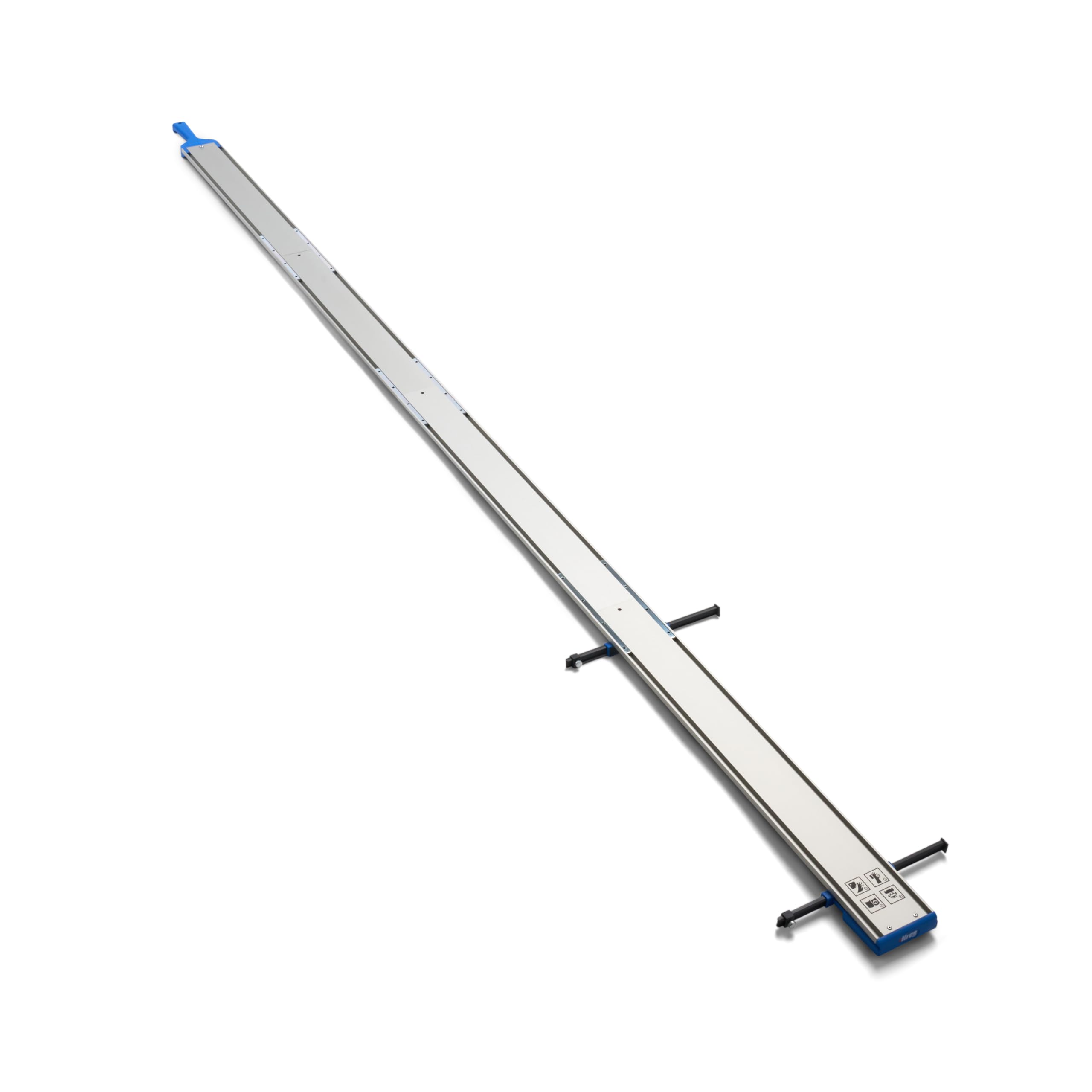
Ninety-eight inches with a self-clamping head — the full-sheet rig for anyone who will not buy a track saw.
This is the longest self-clamping guide in the lineup, and the heaviest at 7.2 pounds. Where the Johnson 98-inch guide makes you set separate C-clamps, the Kreg XL carries its own anti-slip clamp head on the rail and adds a cutline indicator bar so you can line the blade up to the mark before you commit. Sections join with connector bars, and the rail works with left- or right-handed circular saws, jigsaws, and trim routers. It spans materials up to eight feet in a single pass.
The cutline indicator is the part that quietly earns its price. You set the rail once against the mark rather than creeping up on the line with a test cut. Both ends clamp, and the two-piece connector design holds the length together — but this is where the honest trade lives. Assembly takes real time. Dialing the rail to the right length eats at least five minutes, and the instructions are the weakest part of the experience. The aluminum also has a habit of flexing through the middle on a long cut.
What it does well is accurate straight cuts on sheets, and it does them easily once set up — 4.0+ stars across 600+ ratings reflects a tool that performs but asks for setup patience. If you break down full sheets regularly and want the clamping built in, this is the long guide to beat. Support the middle on big cuts and the flex stays under control.
What it brings to a full sheet
- 98-inch reach with an integrated anti-slip clamp head
- Cutline indicator lines the blade up before the cut
- Works with left- or right-handed circular saws, jigsaws, and trim routers
- Cuts materials up to eight feet
Where it costs you time
- 7.2 pounds — the heaviest guide here
- Setup takes at least five minutes to dial in the right length
- Aluminum can flex through the middle on a deep cut
Best for: regular full-sheet breakdown where you want the clamp built into a 98-inch rail.
Not for: quick one-off cuts — setup time is real, and the rail is heavy to handle.
Know the Specs
Guide length and cut length
Guide length is the number to match against your material first. A 24-inch rail handles trim, shelf stock, and cabinet panels. A 36-inch rail covers standard crosscuts and most shelf rips. A 98-inch rail spans a full sheet so a long rip becomes one continuous pass instead of several re-clamped ones. Buying longer than you cut means extra weight to handle around small workpieces; buying shorter means sliding and re-clamping mid-cut, which is where a saw drifts.
Clamping thickness and jaw type
Clamping thickness is how thick a panel the jaws can bite. A clamp rated for work surfaces up to one and a half inches thick will hold standard sheet goods and most lumber. Fixed-jaw-plus-adjustable-jaw designs are the common clamp arrangement — the fixed jaw registers against the far edge, the adjustable jaw draws in on the near side, and a lever locks the rail. Three-position locks let you choose pressure rather than an on/off bite, which is useful on softer stock.
Common Questions
Will a straight edge clamp work with my cordless circular saw?
How long a straight edge do I need for a full sheet of plywood?
Can I cut a bevel or angle with these guides?
How do I stop the rail from slipping during a cut?
What is the difference between a clamp rail and a plain cutting guide?
Do these guides cut dados and grooves as well as straight rips?
Can a 24 inch straight edge be extended to a longer length?
Is a rail guide a cheaper alternative to a track saw?
How thick a board can these clamps hold?
Do the long rails flex in the middle?
The Bottom Line
For the majority of shoppers, the straight edge for skill saw winner is the 50″ ProGrip Straight Edge Clamp and Guide because it hits the length most home cuts actually need and clamps itself down without extra hardware. If you are breaking down full sheets and want the clamping built into the long rail, the Kreg Straight Edge Guide XL is the one to reach for. And for trim and small panels on a tight bench, the POWERTEC 24 Inch Circular Saw Guide is the lightest, friendliest place to start. Match the rail length to the cut in front of you, and the saw follows it straight.
How we choose
We do not accept paid placement. Every pick is matched to a real buyer and a real use-case; we do not hands-on test units.
Sources
Specifications: manufacturer listings and product documentation. Review insights: verified customer reviews, as of November 2026. Pricing: not shown on this page (it changes often); check the current price via the retailer link.
As an Amazon Associate, Tactical Gear Guy earns from qualifying purchases. This does not affect which products we feature.