Specs are compiled from manufacturer listings and verified buyer reviews and can change over time — please confirm the key details on the product page before buying.
Here is the short answer most travelers need: if you are moving to or visiting a 220–240V country and want your American appliances to work, buy a converter that steps that higher voltage down to 110–120V and matches your device’s wattage with headroom to spare. A cheap plug adapter only changes the shape of the pins — it does nothing to the voltage, and it will not save a 110V blender from a 220V wall socket. That single difference is where most overseas appliance disasters start. One honest note before you read on: this list uses flexible, human-like matching for step-down conversion only (220–240V input down to 110–120V output, with step-up units and plain travel adapters excluded), so not every pick is the exact number you typed into the search bar — the nearest same-type wattage serves the same purpose.
This guide is built by comparing the manufacturers’ published specifications and the patterns across verified customer reviews, so you get each pick’s real strengths and trade-offs instead of marketing spin.
Wattage, waveform and plug type decide whether your gear survives the trip or sits dead in a hotel room, so the picks below are grouped by exactly that. Here is how to read a label and land on the right step-down voltage converter without guessing.
Top Picks


How To Choose The Best Step-Down Voltage Converter
Start with the appliance, not the converter. Flip the device over and read the nameplate — it will list an input voltage (something like 110–120V for US gear) and a wattage or amperage figure. That wattage number is the whole decision in one line, because a converter that cannot carry it will either shut down or overheat. Everything below follows from that first look.
Wattage and startup surge, explained simply
A hair dryer or coffee maker pulls its full rated watts the moment you switch it on, and motor-driven gear can briefly draw more than the label suggests. That is why you leave headroom — pick a converter whose continuous rating sits comfortably above your appliance’s stated watts rather than matching it exactly. The UMI 2400W, for instance, states a continuous rating of 2400W and an intermittent rating of 4600W, a 5-minutes-on, 15-minutes-off duty cycle that tells you exactly how hard you can push it. The ZHENGXI 3000W takes a different route, advising you to size at 1.25 times your appliance’s power and to keep the connected load under 2400W.
Pure sine wave versus modified sine wave
Pure sine wave means the converter reproduces the smooth, curving AC wave your appliances were designed for. Modified or chopped wave is a rougher approximation. Heating elements and simple motors tend not to care much, but sensitive electronics and some motors run hotter or buzzy on a modified wave. The HYTED 1600W and the LVYUAN 1600W both specify pure sine wave output, and both note that the output frequency follows whatever the local grid supplies — 50Hz in, 50Hz out.
The plug-shape half of the job
Voltage is only half of it; the prongs still have to fit the wall. Type C and Type E/F cover much of continental Europe, Type G handles the UK and Ireland, and Type I is the Australian and Chinese pattern. Multi-plug bundles like the Ceptics SWadAPt set and the BESTEK kit cover several at once, which is why travelers lean toward them for multi-country itineraries.
Side-by-Side Comparison
| Model | Best For | Continuous Rating | Output Waveform | Outlets / Ports | Amazon |
|---|---|---|---|---|---|
| BESTEK MRJ201SU★ Best Overall | Compact travel kit | 300W peak | — | AC + USB-C 35W + USB-A | Amazon |
| DOACE C15Best Charging Hub | Charging six devices | — | — | 6 outlets total | Amazon |
| ELC T-500Most Portable | Hair tools and laptops | 500W | — | 1 outlet | Amazon |
| Ceptics LX-C2000 | Hair dryer plus small gear | 2000W and 200W outlets | — | 3 outlets + 4 USB | Amazon |
| VEVOR HYDXOG-2000VA | Monitoring two circuits | 1600VA at 80% load | — | 2 US sockets + USB + Type-C | Amazon |
| HYTED AC120V | Any load type | 1600W | Pure sine wave | Adapters C, G, I + E/F cord | Amazon |
| LVYUAN LY-PCK-CONVERTER-1600B-D | Live voltage readout | 1600W | Pure sine wave | 2 outlets | Amazon |
| UMI LX-2400 SD | Heavy continuous loads | 2400W | — | 2 outputs | Amazon |
| ZHENGXI JYK-Down-3000W | Kitchen appliances | 3000W | — | — | Amazon |
Detailed Reviews
1. BESTEK 220v to 110v Converter
Our pick — 4.5+★ from 650+ verified ratings; the strongest balance of quality and price.
A 300W travel converter with a fan rated 50% quieter than the older model.
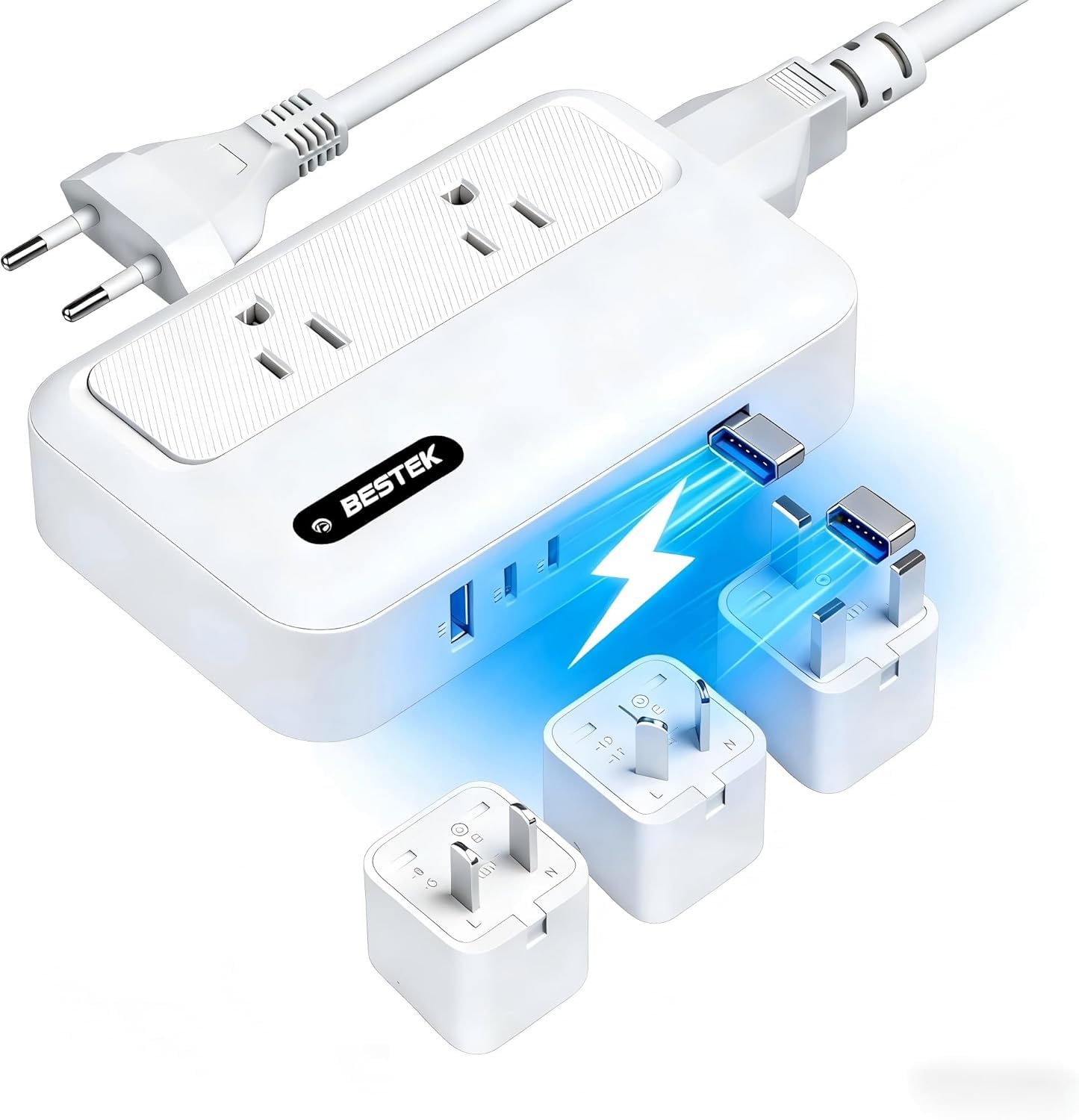
If your travel kit is a straightener, a laptop and a phone, this is the pick to start with. The BESTEK MRJ201SU steps 220V down to 110V with a 300W peak AC ceiling, then throws in a USB-C port at 35W and one USB-A port for older gear. That 35W USB-C figure matters because the maker compares it to the 12W USB-C ports on older adapters — a bigger number, and the practical difference is that your phone or tablet tops up between sightseeing stops instead of overnight. It is the crowd favorite too, sitting at 4.5+ stars across 600+ ratings, the highest score on this list.
What wins people over is the build and the plug count — quality is the theme that runs through owner feedback, followed by appreciation for how many things you can plug in at once. The kit ships with a European power cord plus Type-G, Type-A and Type-I adapters, which the maker says covers use in over 90% of regions worldwide. It is also the answer to a specific annoyance: traditional transformer cooling fans whir all night, and this quieter version claims to be 50% quieter than the old model. Its footprint has been cut 30% too — roughly the size of a mobile phone, per the listing — so it slots into a side pocket.
The catch is the ceiling, and it is a real one. Do not exceed 300W, and the maker flatly warns against hair dryers, irons, coffee makers, kettles, juicers and rice cookers on this unit. That rules out exactly the appliances many people buy a converter for, so read this as a grooming-and-electronics converter, not a kitchen one. Put against the ELC T-500, the BESTEK wins on outlets by a wide margin — 6 versus 1 — but the ELC carries a 500W ceiling the BESTEK cannot touch.
What it does well
- USB-C at 35W plus USB-A in one travel body
- Quieter fan design rated 50% lower than the older model
- European cord plus Type-G, A and I adapters in the box
- Two-year warranty backs the build
Where it stops short
- 300W peak ceiling rules out hair dryers, kettles and irons
- The nameplate is step-down only, so low-voltage-to-high-voltage is off the table
Reach for this if: you are packing straighteners, laptops and phones for Europe, the UK or Australia and want one tidy block to handle all of it.
Look elsewhere if: a hair dryer or coffee maker is on your must-run list — that 300W ceiling is the wall.
2. DOACE C15 220V to 110V Converter, 2000W, 6-in-1 Travel Combo
Two transformer sockets plus four USB ports (two PD, two QC) from one wall outlet.
Families and couples traveling together hit the same wall: one hotel outlet and four dead gadgets. The DOACE C15 answers that with a 6-in-1 layout — two US-style transformer sockets plus four USB ports, two of them PD and two QC USB-A, for 6 outlets in total. Two PD and two quick-charge ports mean your phone and tablet do not crawl while the transformer handles a laptop or a fan. Its headline advantage over a plain travel adapter is that it actually converts 220–240V down to 110V rather than just reshaping the pins.
Interchangeable plugs cover Type A/I, C, F and G, which the maker says reaches more than 200 countries. One clever detail worth knowing: the Type A and Type I mini plug swap into each other by rotating the two pins, so you carry one fewer piece. Safety comes from NRTL testing plus overcurrent, overload, overheating and short-circuit protection. Against the ELC T-500, the outlet count is the story — 6 versus 1 — so if you are charging a family’s worth of devices, the DOACE is the one that clears the queue.
Where it asks for your attention is the load split. Two of those sockets are transformer sockets, and the rest are USB — so your heavy AC appliance count is smaller than the “six” headline suggests. Pair it with the appliance you actually plan to run and leave one socket free for the hotel kettle.
Room for everything: Two transformer sockets plus four USB ports (two PD, two QC) is genuinely more charging surface than most travel converters offer.
Read before you pack: It is a converter-and-adapter combo, not a converter with six AC sockets — count your AC appliances first.
The sweet fit: one or two travelers with several USB gadgets and one or two AC appliances to keep alive.
The mismatch: someone hauling three high-wattage AC appliances — the USB-heavy layout will leave you one socket short.
3. ELC 500-Watt Voltage Converter – Step Down 220v to 110v
A 2-pound toroidal unit with a 500W ceiling for straighteners and laptops.
The ELC T-500 sits at a 500-watt ceiling, a comfortable middle zone for hair straighteners, hair dryers, laptops and chargers. Its toroidal transformer — a donut-shaped core rather than a chunky square one — is the reason the unit comes in at 2 pounds, and the maker puts it at 20% lighter than traditional transformer builds. That is a bag you can actually lift with one hand. Portability is the theme that runs through owner feedback, and for good reason.
It takes 240V in and puts 110V out through a single Type C plug and one outlet, so this is a dedicated unit for one appliance at a time. Its footprint is tighter too — 4.02 x 3.5 x 2.01 inches against the BESTEK MRJ201SU at 7.17 x 6.34 x 1.73 inches, which is a meaningful difference if your suitcase is already groaning. There is a three-year warranty attached, longer than most converters offer.
The honest trade-off is heat. Owner feedback on heat runs mixed, with some reporting no heat issues at all and others noting warmth in use. Keep the vents clear and run heavy appliances in shorter bursts rather than one long session. Weigh it against the Ceptics LX-C2000 and the ELC carries a higher wattage ceiling than the Ceptics 200W outlet, but it cannot match the Ceptics 2000W hair-dryer socket or its six-device charging spread.
The selling point: A 500W ceiling in a 2-pound body, with a toroidal core the maker rates 20% lighter than traditional transformers.
One caveat to plan around: Heat feedback is split — give it airflow and avoid marathon sessions on a single appliance.
Built for: the solo traveler who wants one converter for a straightener, a laptop and a phone charger.
Not your answer if: you are running a hair dryer and a coffee maker — one outlet and 500W will not carry both.
4. Ceptics Voltage Converter

A 2000W outlet and a 200W outlet on separate sockets, both live at once.
The Ceptics LX-C2000 is the pick for anyone whose hair routine needs serious wattage. It splits into a 2000W outlet for a hair dryer and a 200W outlet for a curling iron or straightener, running both at once across separate sockets. That split is the whole idea — you do not choose between drying and styling. Then it adds three USB-A ports and one USB-C with QC 3.0 for 6 devices total, and a 5-foot cable gives you reach from a hotel outlet to the bathroom mirror.
The SWadAPt system covers Type C, G and E/F for Europe, South America, Asia and the Middle East, with Type A, B and I plugs for China, Australia, New Zealand and Africa. It weighs 1.5 pounds, making it 33% lighter than the ELC T-500 at 2 pounds, and it is a genuinely large set of plug options in one bag. Silent fan cooling plus auto shut-down surge protection, over-current, over-temperature and short-circuit protection round it out, along with a 24-month warranty.
Read the fine print, because it is specific. The 2000W port will not operate in the US when the AC input is 100–125V, and the maker says it will not work with Dyson or other electronic hair dryers — it will work with Revlon, ConAir and similar. Some hair dryers plain are not compatible with converters, so check your dryer’s voltage and instructions first. Functionality is the thing that earns the most praise here by a clear margin, followed by how easy it is to pack — a good sign for a unit this versatile.
Why it earns the space
- 2000W and 200W outlets run simultaneously
- Six plug standards cover most of the world
- 1.5 pounds — 33% lighter than the ELC T-500 at 2 pounds
- QC 3.0 USB-C plus three USB-A ports
Before you buy
- Will not drive Dyson or other electronic hair dryers
- The 2000W port stays off on US 100–125V input
- Not every hair dryer plays nicely with converters — verify yours first
Right at home: a traveler whose hair dryer and styling iron both need to run on the same 220V trip.
Biggest limitation to note: a Dyson dryer owner will find this converter simply will not drive their tool — check the label on yours before buying.
5. VEVOR Step Down Voltage Converter

Two backlit LCDs, one per US socket, each reporting its own output voltage.
The VEVOR HYDXOG-2000VA is the pick for anyone who wants proof, not trust. Two backlit LCD screens each monitor the output voltage of a separate US socket, meaning you can confirm both circuits at a glance rather than hoping the converter is behaving. Its rating reads 2000VA with a maximum load of 80% for 1600VA of usable capacity — worth knowing before you size an appliance against the headline figure. Two US sockets plus one USB and one Type-C output let you power several things at once.
Six protections cover overload, under- and over-voltage, short-circuit, overheat, a damp-proof circuit board and high-temperature insulating material. The toroidal coil keeps noise and heat down, and it is UL listed, which is more formal certification than most travel converters bother with. Efficiency and quiet operation are the design goals here — it is built to sit on a floor and run for long stretches.
Weigh the trade-off honestly: 13.2 pounds is a permanent-installation weight, not a suitcase one. This belongs in an apartment on an overseas assignment, not a carry-on. That said, if you are setting up a US appliance in a 220V country for months rather than weeks, that heft is exactly why it can take the load.
The standout: Dual backlit LCDs reporting each output socket separately — a rare transparency feature in this category.
Size the load properly: 2000VA with a stated 80% max load is 1600VA of working capacity, so plan against that and not the box number.
Made for: a long stay or an overseas apartment where the converter will live on a shelf, not in a bag.
Wrong tool if: you are packing light — 13.2 pounds is too much suitcase for a two-week trip.
6. HYTED 1600W 220V to 110V Converter, Pure Sine Wave

1600W continuous pure sine wave with no stated load-type restrictions.
What sets the HYTED AC120V apart is the combination of pure sine wave output and a stated lack of load-type restrictions. Heating, motor, electronic, sensitive and mixed loads all fall inside its remit, which few converters in this list can say. It steps 220–250V down to a stable 120V at up to 1600W continuous, and it specifies a 13.5A current rating. The maker reports a 24-hour full-load test on the design — note, though it is the manufacturer’s own figure.
Its startup-current handling is where it earns its keep. Motor-driven appliances can pull two to three times their normal operating current on switch-on, and HYTED’s intelligent startup control limits inrush to roughly 35A at 120V. In plain terms, that means an appliance that would trip a weaker converter has a better chance of spinning up cleanly here. Safety includes overheating, overload, over-current, surge and short-circuit protection, plus CE certification and UL safety testing, and it comes with a 24-month warranty and a Type E/F cord plus Type C, G and I adapters.
Two things to know before you commit. Weight feedback is genuinely split — some find it portable at 1.6 pounds, others call it bulky, and noise gets a similar mixed read. Sizing is worth thinking through too: 1600W is generous for most travel devices but short of what a large kitchen appliance might demand. Against the LVYUAN at 1600W, this one costs nothing in wattage and gains a claimed no-restriction load profile.
What makes it flexible
- Pure sine wave with no load-type restrictions
- Startup inrush limited to roughly 35A at 120V
- 1600W continuous at a 13.5A current rating
- CE certified and UL safety tested
What to weigh
- Weight opinions split between portable and bulky
- Noise feedback is mixed
- 1600W will not cover a big kitchen appliance
Best matched to: a traveler with a mix of motor-driven and electronic devices who wants pure sine wave without a load-type lecture.
Think again if: you plan to run a large kitchen appliance — 1600W is the ceiling and it will not stretch.
7. LVYUAN 1600W Voltage Converter
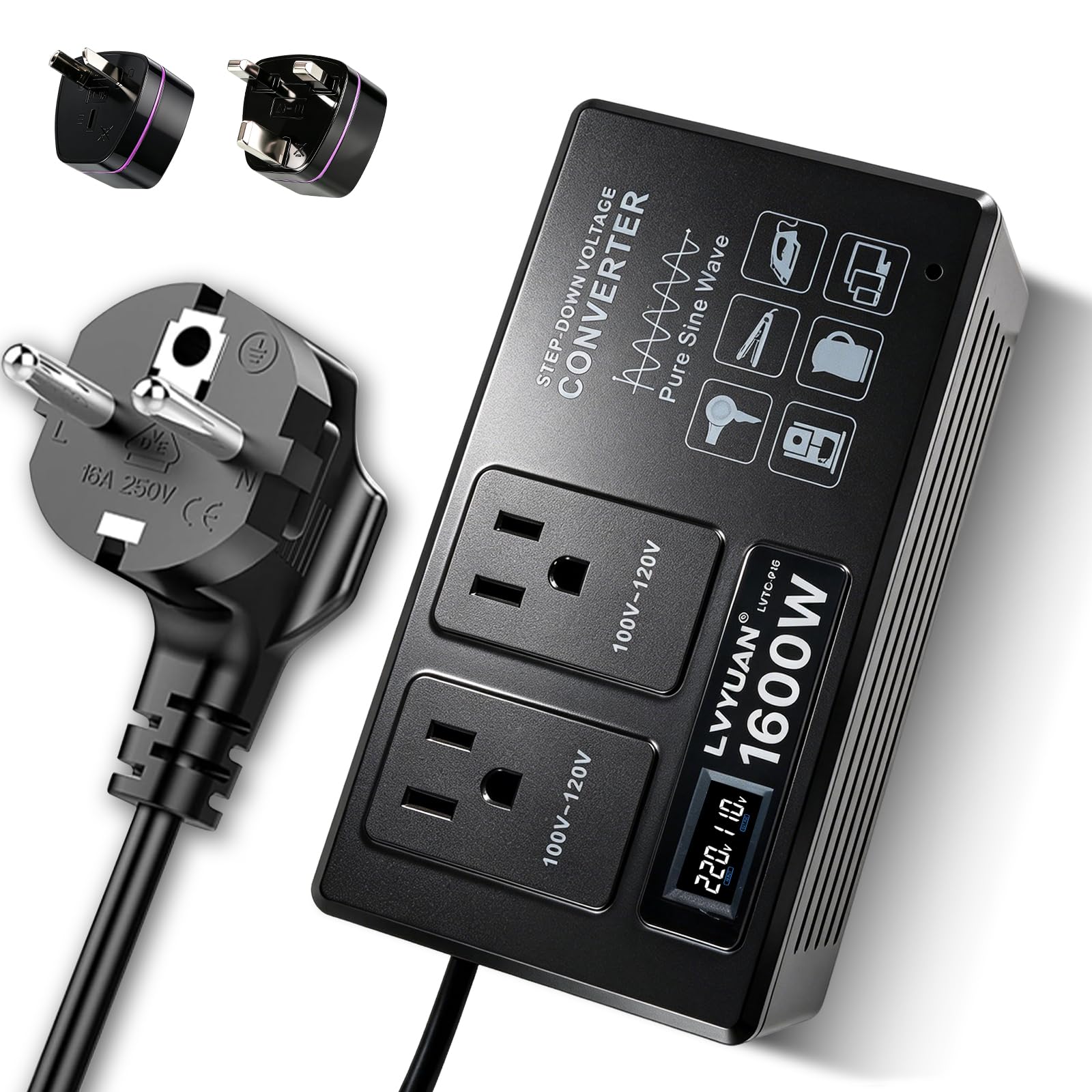
A real-time LCD showing input and output voltage on a 1600W pure sine wave unit.
The LVYUAN LY-PCK-CONVERTER-1600B-D gives you something rare in a travel converter: an LCD screen showing real-time input and output voltage, so you can confirm the output is stable before you switch an appliance on. That is a genuinely useful ritual in countries where the grid wanders. It converts 200–240V down to 100–120V in pure sine wave form, handles loads up to 1600W, and includes Type E/F, Type G and Type I travel adapters for Europe, the UK, Australia and New Zealand.
Soft-start technology reduces the sudden current spike at switch-on, and on-screen error codes help you troubleshoot if a protection mode kicks in. Protections run deep: over-current, overload, short-circuit, over-temperature, input and output over-voltage, input and output under-voltage and frequency protection. It fits two outlets into 6.57 x 3.58 x 2.64 inches at 1.8 pounds, and unlike the HYTED AC120V on paper the two share the same 1600W ceiling — the LVYUAN just pairs it with a live readout and a lower weight figure.
One limitation is built into the physics: it is step-down only. It cannot convert 110V up to 220V, and the output frequency follows local input — 50Hz in means 50Hz out, 60Hz in means 60Hz out. Quality is the clear high point in owner feedback, but functionality is a genuine split, with some units doing the job and others arriving not working at all. Buying from a seller with straightforward returns is the sensible hedge.
Where it shines: Real-time input and output voltage on an LCD, plus soft-start and frequency protection — a lot of oversight in a 1.8-pound unit.
Notable limitation: Some units arrive dead, so a quick test on arrival before your trip is worth the two minutes.
A strong fit for: the cautious traveler who wants to see the output voltage with their own eyes before plugging anything in.
The deal-breaker for some: step-down only — if you also need 110V up to 220V, this is not the tool.
8. UMI 2400W Step Down 220v to 110v Voltage Converter

A stated 2400W continuous rating, with a 4600W intermittent burst on a 5-on, 15-off cycle.
Most converters quote a peak and quietly deliver less. The UMI LX-2400 SD does the reverse: it states a continuous rating of 2400W and a 4600W intermittent rating with a 5-minutes-on, 15-minutes-off duty cycle, and the maker points out that rival units claiming 2000W may only hold 1600W. If you want to run a 2400W device without babysitting it, this is the pick that says so plainly. Its toroidal transformer with a toroid core and pure copper coils is what makes the stable output and low consumption possible.
The 20A current rating, LED display for input voltage and power consumption, and nine separate protections — surge, over-power, over-current, thermal, overload, short circuit, anti-leakage, anti-trip and anti-fall — give you a long checklist of safety nets. It weighs 18.7 pounds, so this is a floor or shelf unit rather than a carry-on companion. It happily bridges US 120V gear to UK, France, Germany, Italy and other 220–240V countries, and it even handles Japanese 100V devices.
The weight and value feedback both come in mixed — some find the heft and the cost harder to justify than the output alone would suggest. Compare it to the ZHENGXI 3000W and the UMI gives up headline wattage, but it is explicit that the 2400W is continuous, while the ZHENGXI advises keeping connected loads under 2400W despite its 3000W nameplate.
Why load matters here: A stated 2400W continuous rating with a 4600W intermittent burst, verifiable through the LED display — a converter you can size against real appliances.
The physical reality: At 18.7 pounds it is a stationary install, and the price is at the top of this list.
Choose it when: you need a 2400W appliance to run for extended periods and want the rating stated plainly.
The wrong buyer: a light packer — 18.7 pounds belongs in a cabinet, not a suitcase.
9. ZHENGXI 3000W Step Down Transformer

Built for air fryers and coffee makers, with a 3000W nameplate and a 2400W caution.
The ZHENGXI JYK-Down-3000W is aimed squarely at the kitchen. Air fryers, coffee makers and other US appliances are named in the listing, and the 3000W step-down transformer is the biggest nameplate number in this roundup. It runs at 50/60Hz and is CE certified. The maker also spells out how to size it: choose 1.25 times the power of your appliance, and keep connected loads under 2400W to avoid stressing the transformer. That advice is more useful than the headline wattage.
The design avoids the classic complaints: no noise, no smell, no heat, and it is thinner than older bulky converters, with suction cups on the bottom to keep it planted on a countertop. Ten protections cover overload, over-voltage, low voltage, soft start, delayed protection, short-circuit power-off, overheating, circuit-board protection against water seepage, insulation rated to resist more than 320°F, and the suction cup anti-fall feature. Soft start is the one you will notice — no tripping the breaker when the appliance spins up.
There is a real reliability caveat worth respecting. Quality earns praise, and so does quiet operation, but reliability is the most-discussed topic overall and it is genuinely mixed, with some reporting a unit that stopped working after four months. Weight is a common complaint too — it is a heavy, stationary unit. That is why it suits a long-term overseas kitchen rather than a two-week trip.
The case for it: A 3000W ceiling, ten protection functions and suction-cup feet make it a plausible countertop kitchen converter.
Honest caution: Reliability feedback is the most-discussed topic and it is split, so keep the warranty and return window in reach.
Right for you if: you are outfitting an overseas kitchen and need the air fryer and coffee maker running daily.
Wrong tool if: the unit needs to survive a suitcase — heavy and stationary by design.
Know the Specs
Continuous watts versus peak or intermittent watts
Continuous watts means the power the converter can deliver all day without straining. Peak or intermittent watts is a short burst — the UMI 2400W spells this out as a 4600W intermittent rating with a 5-minutes-on, 15-minutes-off cycle. Always size your appliance against the continuous figure. If you run a hot appliance that draws near the peak number for hours, you are working the unit outside its stated comfort zone.
What VA actually tells you
VA stands for volt-amperes, and in a converter listing it is close to watts but not identical. The VEVOR rates itself at 2000VA with a stated 80% maximum load for 1600VA of usable capacity. When a listing gives you VA, treat the practical ceiling as that derated figure, then leave extra headroom for a motor that pulls hard at startup.
Pure sine wave, in everyday terms
Pure sine wave means the converter recreates the smooth alternating current that grid power normally delivers. Modified or chopped wave is a rougher approximation. For sensitive electronics and certain motors, the clean waveform is worth paying for; for simple heating elements, the difference is less pressing. Both the HYTED 1600W and the LVYUAN 1600W specify pure sine wave output.
Input voltage and frequency matched to your destination
Check what your destination grid actually supplies. Most of Europe runs higher than the US, and the LVYUAN notes a detail many miss: output frequency follows the input. A 50Hz supply in means a 50Hz output, so a clock radio’s timekeeping can drift. That is fine for a hair dryer, worth knowing for anything with a timer.
Common Questions
Can I use a step-down converter with a hair dryer?
What is the difference between a plug adapter and a voltage converter?
How much wattage headroom do I need for a converter?
Will a step-down converter work in the UK and Ireland?
Can I use a step-down converter with a coffee maker or air fryer?
Does a step-down converter work in reverse to raise 110V to 220V?
Will a pure sine wave converter work with my laptop and CPAP machine?
How heavy is a step-down converter to travel with?
Why does my converter’s output frequency matter?
What protections should I look for on a voltage converter?
The Bottom Line
For most people traveling with electronics and grooming tools, the step-down voltage converter that wins is the BESTEK MRJ201SU because it steps 220V down to 110V, packs USB-C at 35W and a USB-A port, ships with a European cord plus Type-G, Type-A and Type-I adapters, and does it all in a body roughly the size of a mobile phone. The 4.5+ star score across 600+ ratings backs that up. The one honest caveat is that 300W peak ceiling — this is a grooming-and-electronics converter, not a kitchen one.
If your trip involves a hair dryer or a curling iron, the Ceptics LX-C2000 is the one to reach for, with a 2000W outlet and a 200W outlet that run at the same time. For a mix of motor-driven and sensitive electronics with no load-type restrictions, the HYTED 1600W and its pure sine wave output is the safer bet. And if you are setting up an overseas apartment for the long haul, the UMI 2400W states its continuous rating plainly — 2400W, with a 4600W intermittent burst — and lets you watch it on the LED display.
The practical rule that ties every pick together: check the nameplate on your appliance, match its watts against a converter’s continuous rating rather than its peak, confirm the plug type for your destination, and leave room for startup surge. Do that, and the tool in your bag will not be the reason your trip starts with a dead hair dryer.
How we choose
We do not accept paid placement. Every pick is matched to a real buyer and a real use-case; we do not hands-on test units.
Sources
Specifications: manufacturer listings and product documentation. Review insights: verified customer reviews, as of November 2026. Pricing: not shown on this page (it changes often); check the current price via the retailer link.
As an Amazon Associate, Tactical Gear Guy earns from qualifying purchases. This does not affect which products we feature.