Specs are compiled from manufacturer listings and verified buyer reviews and can change over time — please confirm the key details on the product page before buying.
Your trailer sits on two small contact patches, and the wrong ST175/80R13 tire turns a lake weekend into a shoulder-of-the-highway repair job. The quick answer: buy on load range and ply rating before anything else, then match the tread depth and speed rating to how far you actually tow. The picks below are all the correct ST175/80R13 fitment and all tires only — no rims included — so you can mount them straight onto the wheels you already own.
This guide is built by comparing the manufacturers’ published specifications and the patterns across verified customer reviews, so you get each pick’s real strengths and trade-offs instead of marketing spin.
Trailer tires live a harder life than car tires because they sit still for months and then get loaded to their limit. That is why load range, ply count and pressure rating matter more here than brand name. Below you will find the six strongest options that fit this exact size, ranked so the toughest all-rounder comes first and the specialist picks follow. Here is the shortlist of the st175/80r13 tire only options worth your money.
Top Picks


How To Choose The Best ST175/80R13 Tire Only
The ST175/80R13 size is a small trailer fitment, so almost every tire in this size looks the same in a photo. The differences that actually matter sit in the sidewall numbers: load range, ply rating, maximum pressure and speed rating. Match those numbers to your trailer’s loaded weight per tire and the tire will carry it. Get them wrong and you will be changing a tire on the shoulder.
Start with load range, not price
Load range is a letter that tells you how much weight a tire can carry at its rated pressure. A Load Range C tire in this size carries around 1,360 pounds at 50 psi, while a Load Range D tire pushes to roughly 1,610 pounds at 65 psi. If your trailer plus cargo sits anywhere near the top of a C-rated pair, step up to D. Heavier-rated tires also run cooler under load, which is the single biggest factor in how long a trailer tire lasts.
Match the ply rating to your towing
Ply rating is an old measurement that survived because it is useful shorthand for how tough the carcass is. A 6-ply rated tire suits a light utility trailer or a small boat. An 8-ply rated tire is the better call for a car hauler, a pontoon trailer, or anything you load to the limit. More ply does not automatically mean a harsher ride at this size, but it does mean more heat resistance on a long summer drive.
Read the tread depth in millimetres
Tread depth is where budget trailer tires separate from better ones. Some cheaper tires in this size run about 5.6 mm of tread, while a stronger option offers 7 mm — that extra rubber is what gives you mileage before the wear bars show. Deeper tread also sheds water better and helps the tire run cooler because there is more material between the road and the belts.
Check the speed rating against your towing speed
Speed rating is a letter stamped on the sidewall that caps the sustained speed the tire is built for. N-rated tires are certified to 88 mph, L-rated tires to 75 mph, and M-rated tires sit somewhere between. You will rarely tow near those numbers, but the rating is a good proxy for how much heat margin the tire carries on a hot day. A higher rating generally means a more conservative, stronger build.
Confirm the tire-only listing before you buy
Nearly every listing in this size shows a tire mounted on a shiny wheel. That wheel is almost never included. Look for words like “tires only” or “rims not included” in the description, and ignore the picture. If you also need wheels, buy a mounted set separately rather than assuming the photo is what ships.
Side-by-Side Comparison
| Model | Best For | Load Range | Ply Rating | Max Load / Pressure | Amazon |
|---|---|---|---|---|---|
| Free Country 8PR LRD 97N w/Scuff Guard★ Best Overall | All-round heavy towing | D | 8 | 1610 lbs @ 65 psi | Amazon |
| GT Radial Maxmiler ST C/6PLYBudget Pick | Light trailers on a tight budget | C | 6 | — | Amazon |
| Transeagle ST Radial II 8 Ply Two Tires | Boat and utility trailers | D | 8 | 1609 lbs @ 65 psi | Amazon |
| Free Country 6PR LRC 91N w/Scuff Guard | Lighter pop-ups and utility trailers | C | 6 | 1360 lbs @ 50 psi | Amazon |
| Travelstar HF288 8 Ply Special Trailer Tire | Long-haul highway towing | D | 8 | 1610 lbs @ 65 psi | Amazon |
Detailed Reviews
1. Free Country ST175/80R13 8PR
Our pick — 4.5+★ from 900+ verified ratings; the strongest balance of quality and price.
Seven millimetres of tread and a full-tread nylon overlay make this the toughest all-rounder in the size.
The standout number here is 7 mm of tread depth, which is deeper rubber than the 5.6 mm many budget competitors in this size offer. That extra material is what buys you mileage before the wear bars appear, and it is the reason this tire sits at the top of the list for a trailer that actually earns its keep. It is a Load Range D tire with an 8-ply rated carcass, carrying a 97 load index and a maximum load of 1,610 pounds at 65 psi. Put simply, that is the heaviest rating you will find in a mainstream radial at this size, so it suits a car hauler or a loaded utility trailer without breathing hard.
The build detail that separates it from the rest is the nylon overlay running across the entire tread area, not just the shoulders. Most tires at this price cap the extra nylon at the shoulder zone, so full coverage means more protection where the tread meets the road — useful when you are dragging a trailer over gravel or a rutted launch ramp. The sidewall also carries a scuff guard ring, a raised band of rubber that takes the abuse when you clip a curb while parking. The 25-inch overall diameter and a 5-inch rim width keep fitment straightforward on standard 13-inch trailer wheels.
What wins people over is the quality: buyers describe tires that simply do their job for a long stretch, with no drama in the reviews. One report describes 500 miles of towing with no trouble at all, and another owner is still running the same set a year and a half on. Sway gets mentioned too: a yard of dirt, close to a ton, tracked straight on every trip. There is a running theme of buyers holding 65 psi steady and recommending high-pressure valve stems as cheap insurance. If there is a catch, it is that this is a trailer-only tire — it is not built for a passenger car, so do not buy it for a utility vehicle that carries people.
Where it pulls ahead
- 7 mm tread versus the 5.6 mm on cheaper tires — more rubber before replacement.
- Load Range D at 1,610 lbs and 65 psi, the strongest rating in this lineup.
- Nylon overlay across the full tread area rather than just the shoulders.
- Scuff guard ring on the sidewall protects against curb rash at the ramp.
What to plan around
- At 35 pounds it is the heaviest single tire here — fine on a hub, awkward to carry as a spare.
- Trailer use only, so it cannot double as a spare for a car or SUV.
Reach for this if: you tow a loaded utility trailer, car hauler or boat and want the most load margin and tread life in one purchase.
Think twice if: you want a featherweight spare to hang on the trailer tongue — the 17-pound Travelstar is the easier lift.
2. GT Radial Maxmiler ST ST175/80R13 C/6PLY
The light-duty entry point: a 91 load index and 6-ply rated casing for trailers that never run near the limit.
If you are hauling an empty utility trailer to the hardware store twice a month, you do not need a Load Range D carcass, and this is the tire built for exactly that job. It carries a 91 load index in Load Range C with a 6-ply rated radial construction, which is a sensible match for a small flatbed, a light pop-up, or a jon boat trailer. The 13-inch item diameter also keeps this one of the more compact tires in the lineup, so fitment on a smaller wheel is straightforward.
GT Radial builds it with a polyester casing and a sturdy sidewall, which the manufacturer credits with reducing trailer sway and helping it carry a heavy load. High-modulus dual steel belts reinforce the tread area for handling stability and resistance to punctures — worth knowing when a stray screw on a driveway is a real risk. The full-width tread design spreads the contact patch wider than a narrow rib pattern, which is aimed at grip and braking rather than long tread life. You are buying steady tracking, not maximum mileage.
The honest note with this one is a listing problem, not a tire problem. The photo shows a wheel, and the description does not spell out clearly that no rim is included, so a share of buyers opened the box expecting one. That mismatch shows up in the ratings more than any comment about how the rubber performs. If you shop here, order on the clear understanding that this ships as a bare tire. It is a good value at the entry end, provided you already have rims waiting in the garage.
What the casing buys you: polyester sidewall construction and dual steel belts under a full-width tread — a reasonable formula for a trailer that spends its life on paved roads under a light load.
The thing to get straight first: budget-tier and light-duty. This is not the tire for a loaded car hauler, and the wheel in the picture is not in the box.
Buy it for: a light utility or small boat trailer where the budget matters and the load stays modest.
Pass it over for: anything that runs near a ton of payload — go up to a Load Range D tire instead.
3. Transeagle ST Radial II ST175/80R13

Two Load Range D tires in one box, rated to 1,609 pounds each and 75 mph.
This is the pick for the owner who wants both tires on the trailer replaced at once and does not want to think about it again for a few seasons. It is a Load Range D, 8-ply rated steel-belted radial with a 97 load index, and the pair is rated to carry 1,609 pounds per tire in single fitment or 1,433 pounds in dual. Compare that to the Free Country 6PR below, which tops out at 1,360 pounds, and the extra margin on a loaded trailer is obvious. The speed rating is L, certified to 75 mph, which suits a highway run with a boat in tow.
Construction is a two-black-sidewall radial with all-season traction, and each tire weighs 34 pounds, so you are not wrestling a boat anchor onto the hub. The 65 psi maximum pressure is the same working pressure a Load Range D tire typically wants, and it tracks the ratings pattern you would expect in this tier. Mounting goes smoothly by the plain accounts — good tread, fit onto standard 13-inch rims, and balance out without drama. For a car dolly or a smoker trailer, this is a straightforward swap.
Quality is what carries it: buyers report these tires outlasting expectations rather than impressing on day one. Buyers describe sets running several years before needing replacement, then ordering another pair for spare rims. A boat owner reports the set holding up a 3,600-pound load nicely, and fitment on a boat trailer has been a clean match. The tread arrives clean-cut with no flashing to trim. If it holds a slight edge over the Free Country 8PR for you, it is the two-tire packaging rather than the spec sheet.
One clear head-to-head: this tire carries a 97 load index against the 91 on the GT Radial, so it leads on payload capacity — 1,609 pounds versus 1,360 on the Free Country C-rated tire.
Fair caveat: the 75 mph L speed rating is lower than the 88 mph N rating on the Free Country tires, so if you tow at higher highway speeds the Free Country is the more conservative choice.
The case for it: you want a matched pair of Load Range D tires that fit standard 13-inch rims and track well behind a boat or utility trailer.
Where it gives ground: the L speed rating caps it at 75 mph, and the tread depth is not published — you cannot compare wear life on paper.
4. Free Country ST175/80R13 6PR
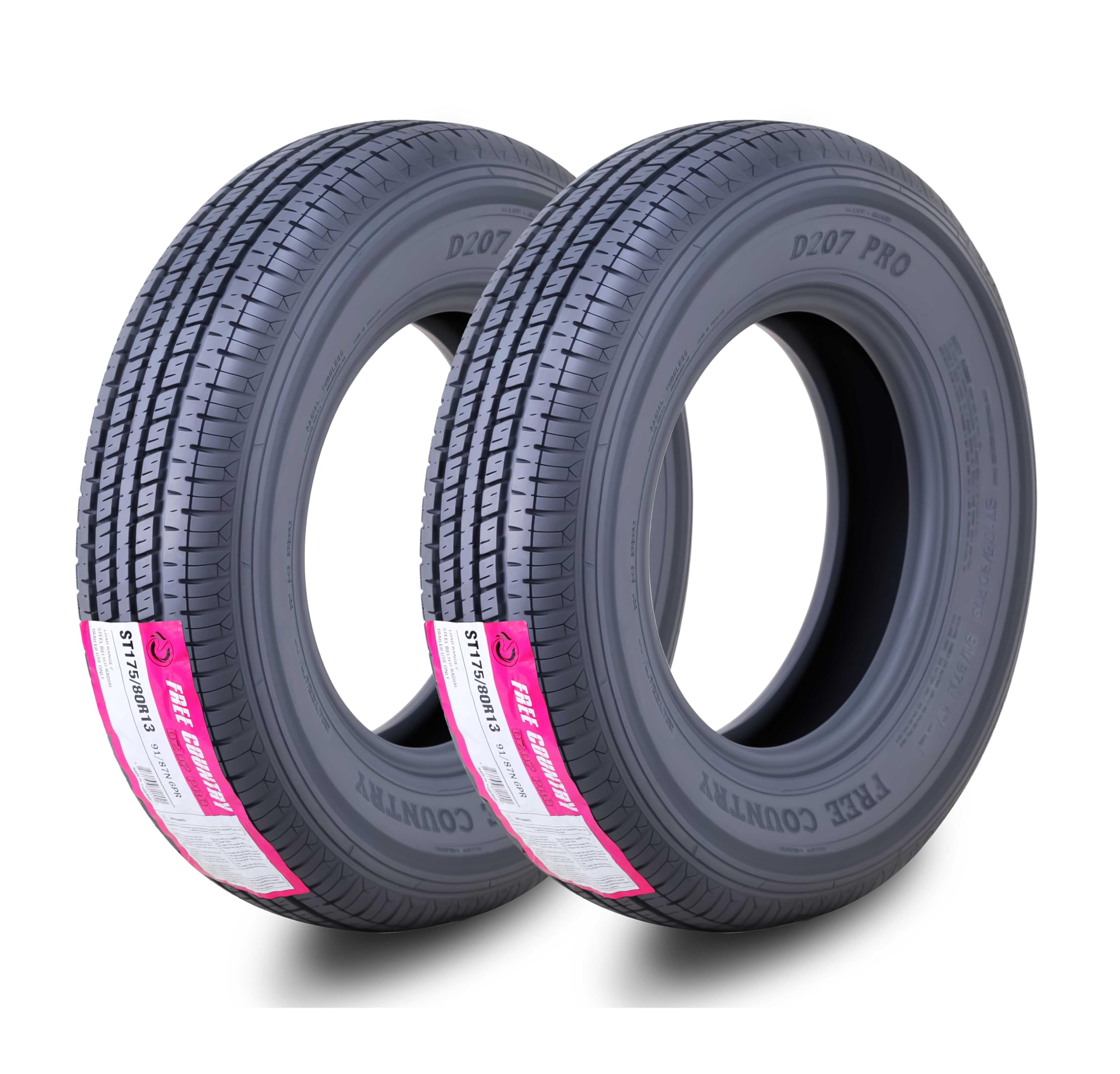
The same 7 mm tread and chassis reinforcement as the top pick, just rated for a lighter trailer.
Here is the version to buy when your trailer never gets near a ton. It is Load Range C and 6-ply rated, with a 91 load index and a maximum load of 1,360 pounds at 50 psi. That 50 psi ceiling is the real difference: the 8-ply Free Country above wants 65 psi and carries 1,610 pounds. The gap between the two is exactly the gap between a small pop-up and a loaded car hauler, and picking the wrong one means either wasted capacity or a tire running past its rating.
Everything else about the build mirrors the bigger Free Country. The nylon overlay runs across the entire tread area rather than just the shoulders, which is more coverage than most tires at this end of the market offer. You still get the scuff guard ring on the sidewall, and the same 7 mm tread depth, so the wear story does not get downgraded just because the load range did. The 31-pound weight makes it easier to hang on a spare carrier than the 35-pound 8-ply version, and the 5-inch rim width and 13-inch diameter keep fitting simple.
The feedback is narrow but consistent: buyers rate the quality highly and call it good value, with no complaints in either direction — exactly what you want from a trailer tire. The one thing worth weighing before you buy is that 1,360-pound ceiling. Add up your trailer’s dry weight, the cargo and the tongue load, and if the total pushes past that number per tire, spend the extra and go up to the 8-ply.
Why it earns a place: identical reinforcement to the top pick — full tread nylon overlay, scuff guard, 7 mm tread — at a lighter load rating that suits lighter trailers.
The number to check first: 1,360 pounds per tire at 50 psi. It is 250 pounds less capacity than the 8-ply version, and that difference is not negotiable once you are loaded.
Settle on this one when: your trailer is a pop-up, a light utility or a small boat and the weight math comfortably fits under 1,360 pounds per tire.
Step up instead if: you are anywhere near that ceiling — the 8-ply sibling carries the load with more headroom.
5. Travelstar HF288 ST175/80R13
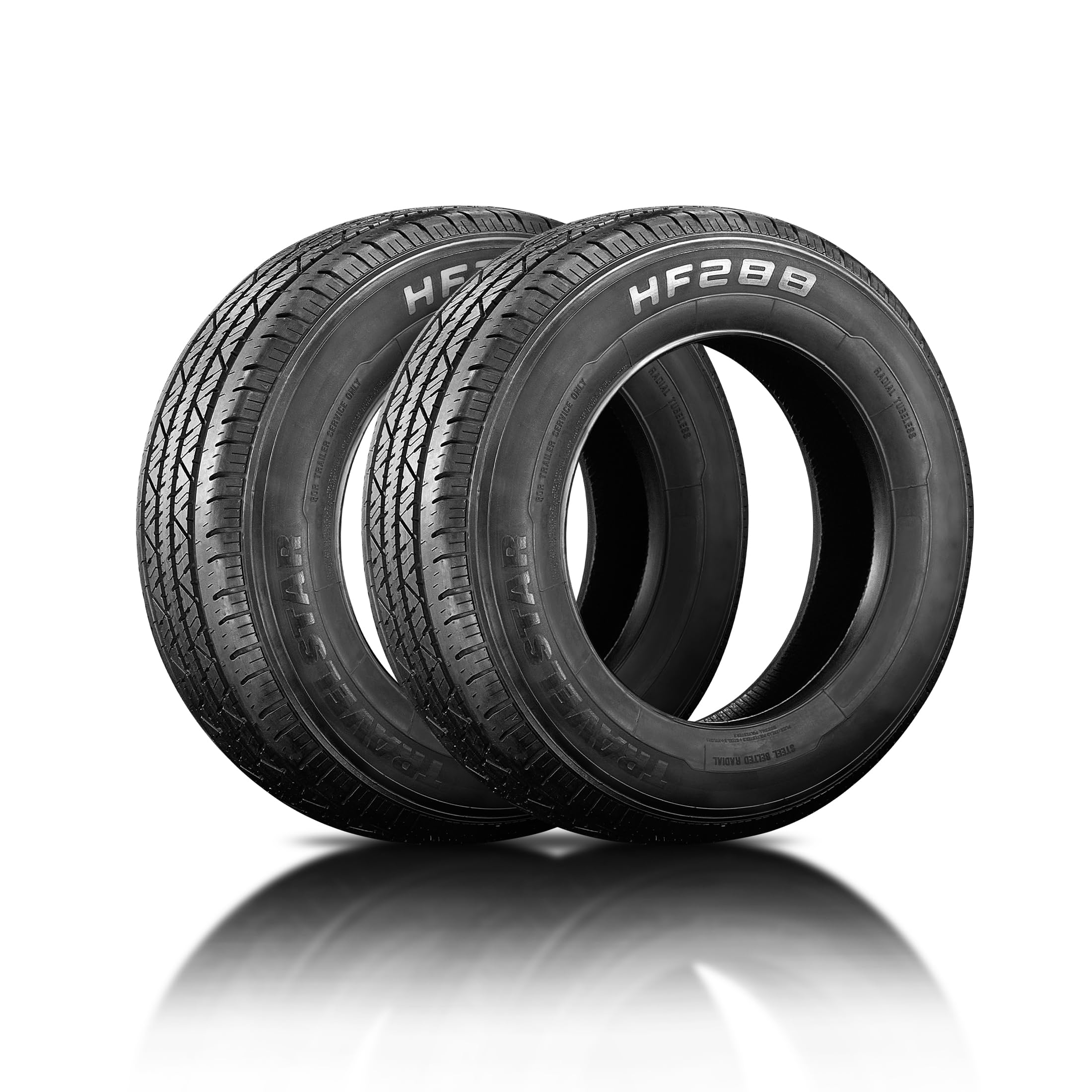
Seventeen pounds a tire with the warranty paper to back it — the long-highway specialist of the group.
The first thing you notice is the weight: 17 pounds per tire against 35 pounds for the Free Country 8PR. If you regularly swap a spare off a tongue mount or carry one in a truck bed, that is the difference between a one-hand lift and a two-hand grunt. Beyond the weight, this is a genuine Load Range D, 8-ply rated radial with a 97 load index, rated to 1,610 pounds single and 1,430 pounds in dual fitment at 65 psi. The N speed rating is good for 87 mph, so it matches the Free Country tires on highway margin.
Travelstar builds it around double steel belts, which the maker says improve towing stability and shock absorption, plus solid shoulder ribs for even pressure across the contact patch. The 13-inch rim size and 24-inch diameter keep it inside standard trailer fitment. What is unusual here is the road hazard coverage bundled with each tire — a three-year program on top of a nationwide warranty — which is not something you find sitting on the sidewall of every budget trailer tire. The tire itself ships bare, no rim included.
Owners describe the fit and finish as clean and the look as good, with a 5×8 trailer among the setups this has served well. One report covers about 200 miles with nothing to complain about. On durability, the feedback consistently points to a long run before replacement. If there is a limit, it is that this is a highway-focused trailer tire — the shoulder rib construction is aimed at steady tracking at speed, so it is not the pick for off-road or gravel-heavy use.
The weight story: 17 pounds versus 35 pounds for the Free Country — the easiest tire here to handle as a spare or swap roadside.
Worth knowing: the three-year road hazard program is the standout extra, and the 97 load index matches the best tire in this lineup.
Best matched to: long highway hauls where easy handling and warranty coverage matter as much as raw capacity.
Look elsewhere if: you tow mostly on rough gravel or back roads — a full-tread-overlay tire handles that environment better.
Know the Specs
Load Range and Load Index
Load range is a letter — C, D or higher — that bundles a tire’s max load and its rated pressure into one badge. In this size, Load Range C tires typically carry about 1,360 pounds at 50 psi, while Load Range D tires push to roughly 1,570 to 1,610 pounds at 65 psi. The load index is the same information in number form: a 97 index corresponds to 1,610 pounds, and a 91 index to 1,360. Match the number to your trailer’s loaded weight per tire, never to the dry weight alone.
Ply Rating and Sidewall Construction
Ply rating is shorthand for how many layers of cord the carcass is built to, and it is the best single guide to how a trailer tire handles heat and load. A 6-ply rated tire suits light trailers; an 8-ply rated tire is the working choice for anything loaded toward its limit. Radial construction flexes and runs cooler at speed, while bias-ply construction stays stiffer and suits slow, heavy work. The nylon overlay and steel belts sit under the tread and are what hold the tire’s shape when the load presses down.
Speed Rating and Tread Depth
Speed rating caps the sustained speed a tire is certified for — N means 88 mph, L means 75 mph, M sits between. You will rarely reach those numbers, but a higher rating usually signals a stronger, cooler-running build. Tread depth in millimetres tells you how much rubber stands between you and the wear bars. A 7 mm tread outlasts a 5.6 mm tread by a useful margin, and deeper tread also runs cooler because there is more material between the road and the belts.
Maximum Pressure and Tire-Only Listings
Maximum pressure is the psi the tire is designed to hold cold, and it partners with load range — a 65 psi tire is built to run harder than a 50 psi tire. Inflate to the trailer’s placard, not to the tire’s maximum, and check it cold. Every tire in this size ships bare, with no rim, even when the listing photo shows a wheel. Look for “tires only” or “rims not included” in the description before you order, and if you want ready-to-bolt wheels, buy a mounted set separately.
Common Questions
Will an ST175/80R13 tire fit my trailer’s existing 13-inch wheels?
Is Load Range D better than Load Range C for a trailer tire?
Do these tires come with rims or wheels included?
What does an 8-ply rating mean on a trailer tire?
Should I choose a radial or a bias-ply trailer tire?
What pressure should I run in an ST175/80R13 trailer tire?
How long does a trailer tire last before it needs replacing?
Can I use an ST175/80R13 tire on a passenger car or SUV?
Do I need to replace both trailer tires at the same time?
What is the difference between ST175/80R13 and ST175/80D13?
The Bottom Line
For most buyers, the strongest st175/80r13 tire only choice is the Free Country 8PR LRD w/Scuff Guard, because it pairs the deepest documented tread at 7 mm with the highest load rating here — 1,610 pounds at 65 psi — and a full-tread nylon overlay that most rivals cap at the shoulders. If you want a matched pair of Load Range D tires with a 75 mph rating and a clean reputation for tracking behind a boat, the Transeagle ST Radial II is the one to reach for. And for easy handling plus bundled road hazard coverage on long highway hauls, the lightweight Travelstar HF288 earns its place. One honest nudge: the top pick holds 4.5+ stars across 900+ ratings, and that kind of consensus in a commodity trailer size is the clearest signal you can ask for.
How we choose
We do not accept paid placement. Every pick is matched to a real buyer and a real use-case; we do not hands-on test units.
Sources
Specifications: manufacturer listings and product documentation. Review insights: verified customer reviews, as of November 2026. Pricing: not shown on this page (it changes often); check the current price via the retailer link.
As an Amazon Associate, Tactical Gear Guy earns from qualifying purchases. This does not affect which products we feature.