Specs are compiled from manufacturer listings and verified buyer reviews and can change over time — please confirm the key details on the product page before buying.
You want to know that the hotel room, the rental, or the changing cubicle is actually private before you relax in it. A spy cam detector helps you check for yourself in a couple of minutes, instead of trusting that nothing is pointed at you. The summary below is simple: a good detector either listens for the radio signal a wireless camera gives off, or shines light so a tiny glass lens glints back at you. The best of them do both — and the picks on this page tell you which ones actually handle that job well.
This guide is built by comparing the manufacturers’ published specifications and the patterns across verified customer reviews, so you get each pick’s real strengths and trade-offs instead of marketing spin.
Detectors work in two main ways: some listen for radio frequencies (the wireless signal a hidden camera sends out), some look for the reflective glint of a lens, and a few do both at once. Below are the features that matter, the trade-offs that don’t, and a clear pick for each kind of trip, so choosing the right spy cam detector depends on matching one spec to your situation.
Top Picks

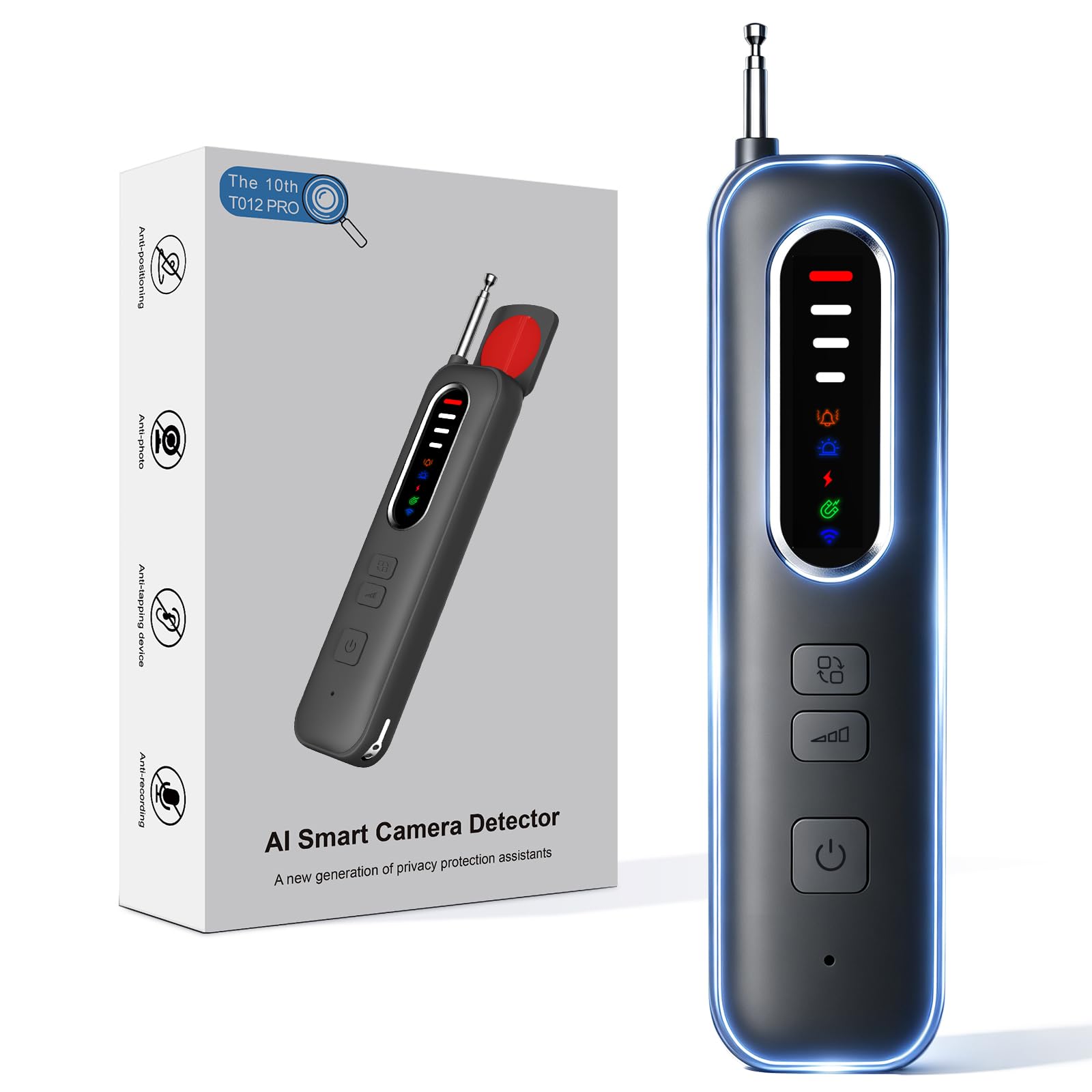
How To Choose The Best Spy Cam Detector
The first thing to understand is that “hidden camera” covers two very different devices. A wireless camera sends out a radio signal you can hear with an RF detector. A camera that records to a memory card sends out nothing at all — the only way to find it is to make its lens reflect light back at you. If you only buy one kind of tool, you are only checking half the room.
Radio-frequency scanning versus lens hunting
Radio-frequency (RF) detection works like a very sensitive radio that listens for the chatter a wireless camera or audio bug produces. You sweep the device slowly across a wall or a smoke detector and the alarm speeds up as you get closer to the source. This catches anything transmitting, including a camera streaming to a phone in another room.
Infrared lens detection is the opposite approach. The detector flashes a burst of infrared light — invisible to your eye but very bright to a camera lens — and any glass lens in the room bounces it back as a small bright dot or ring. That is how you catch a camera that records locally and never transmits. The trick is that this mode only works in a dim room, so you dim the lights first.
What frequency range and sensitivity actually mean
Frequency range tells you the span of signals a detector can hear, written in MHz (megahertz, millions of cycles per second) and GHz (gigahertz, billions). A wider range like 1MHz–10GHz covers far more of the wireless gadgets cameras and trackers use than a narrow one, so a wider span means fewer cameras slip past your sweep. Sensitivity levels then let you turn the device down when a room is full of ordinary Wi-Fi and Bluetooth, so the alarm only fires for something new.
Battery, size, and the false-alarm problem
A detector you have to recharge every hour is a detector you stop carrying. Look at the standby and working figures on the box, because a unit that runs for weeks on standby is the one that lives in your travel bag. Size matters too: a pen-shaped or pocket-sized unit gets used in a bathroom or a rental because it slips into a wash bag without a second thought. And false alarms are the quiet killer of any sweep — a router or a phone will set off a cheap detector constantly, so adjustable sensitivity and interference filtering are worth paying for.
Side-by-Side Comparison
| Model | Best For | Detection Modes | Battery / Runtime | Carry Weight | Amazon |
|---|---|---|---|---|---|
| Hidden Camera Detector 6-in-1 (WRKLLY)★ Best Overall | All-round checking of rentals and hotel rooms | Camera, GPS, infrared (3 functions) | Up to 30 days standby | 0.29 kg | Amazon |
| VigilEye Hero Privacy Pen (10th-Gen)Best for Travel | Pocket carry and travel sweeps | RF, wireless camera, magnetic, alarm | 2000 mAh, up to 60 days intermittent | 1.28 ounces | Amazon |
| JAXTIN G9 Pro | Fast sweeps with minimal learning curve | Camera, GPS, listening devices | 72 hours working time | Under 30 g | Amazon |
| Prepared Hero Privacy Pen | Overnight door alerts plus room checks | RF, infrared, door motion alarm | — | 1.76 ounces | Amazon |
| Knight Electronics KT-8000 | Five-mode sweeps on a tighter budget | RF, magnet, infrared, camera locate, smart scan | 1 lithium-ion battery included | 13.76 ounces | Amazon |
| SROTIO 9-in-1 AI Detector | Deep inspection with false-alarm filtering | 9 functions incl. RF, magnetic, infrared, laser | 2000 mAh, 8 hours scanning | — | Amazon |
| Knight Electronics KT-9000 | Longest-range sweeps and professional builds | RF, magnetic field, camera discovery, smart detection | 20–45 hours continuous | 6.4 ounces | Amazon |
Detailed Reviews
1. Hidden Camera Detector 6-in-1
Our pick — 4.5+★ from 100+ verified ratings; the strongest balance of quality and price.
Three detection jobs in one handset — and it sits in a travel bag for a month without a charge.
This one wins the top slot because it covers the three things you actually need to check in a room. It hunts wireless and wired cameras plus eavesdropping devices, it finds a GPS tracker by sensing the magnetic field the tracker gives off, and it has an infrared mode for cameras that record locally and send nothing out. That infrared mode is the piece most cheap detectors leave off, so pairing it with radio scanning means you check both kinds of camera in one sweep.
What wins people over is how well it keeps up with the job. Accuracy is the praise that turns up again and again, with the strong majority of the buyers who bring it up finding it works better than they expected. The build feels solid in the hand rather than toy-like, and the 0.29 kg body is light enough to leave in a carry-on. The rechargeable battery holds up to 30 days on standby per charge, so it is ready at a late check-in rather than dead in a drawer.
The honest catch is the learning curve. Usability is the one mixed note here: a portion of buyers find the button combinations take more effort than they expected. You press the mode button and the sensitivity button to cycle through functions, which is quick once you have done it twice but not obvious on the first night. Read the manual on the plane rather than in the hotel room.
Where it earns its place
- Three functions in one unit: camera detection, GPS tracker finding, and infrared lens checking
- Up to 30 days standby from a single charge, so it is ready on arrival
- Solid build quality that buyers describe as a real device, not a toy
- Accuracy is what it is praised for most — it does the job it advertises
Before you commit
- Mixed feedback on usability — the button cycling takes practice
- 0.29 kg is heavier in the pocket than the pen-style options
- You will want a read of the manual before your first sweep
Reach for this if: you want one handset that checks for wireless cameras, wired cameras and GPS trackers without juggling three tools.
Worth knowing: the button cycling is the one part that asks for patience on the first run.
2. VigilEye Hero Privacy Pen (10th-Gen)
A pen you forget is in your bag until the moment you need to sweep a room.
The number that matters here is the range: 1MHz to 10GHz. That span covers a wide slice of the wireless gadgets a hidden camera or tracker might use, so a single slow sweep across a room picks up far more chatter than a narrow-band unit would. It listens for RF signals, spots wireless cameras, senses the magnetic field of a tracker, and throws in an anti-theft alarm mode for good measure.
It also handles the part most buyers dread: knowing whether it found something. Real-time vibration and sound fire together the moment a suspicious signal turns up, so it warns you in a loud bar and in a silent bedroom alike. The 1.28-ounce body slips into a pocket or a wash bag without a thought, and the 2000 mAh battery runs up to 60 days on intermittent use, topped up in roughly an hour over USB-C. Buyers consistently describe it as easy to use and genuinely useful for finding cameras around a house.
The spec worth double-checking against the marketing is sensitivity. The listing mentions both a 1.32 oz and a 1.28 ounce weight, close enough that it makes no practical difference in your hand. The bigger point: you need to tune the sensitivity so ordinary Wi-Fi does not set the alarm off constantly. Turn it down in a signal-heavy apartment, and up in a bare hotel room.
The range read: 1MHz–10GHz in a pen-shaped body is the reason this one earns a travel slot — you get wide coverage without a second bag.
Real use check: the dual vibration and sound alarm means it works whether or not you can hear it, which matters in a noisy lobby or a silent rental.
Pick this for: frequent travellers who want a detector that disappears into a pocket and runs for weeks between charges.
Think twice if: you want a screen or a detailed readout to interpret signals — this is an alarm-first device, not a lab analyser.
3. JAXTIN G9 Pro Hidden Camera Detector

Sweeps at 3000 scans per second and still fits under 30 grams in a jacket pocket.
Speed is what sets the G9 Pro apart. It scans at 3000 scans per second, and its AI chip (a processor that spots signal patterns on the device itself) is claimed by the maker to respond 40% faster than the previous generation. That means you can walk a hotel room at a normal pace instead of creeping along the skirting boards. It flags hidden cameras, GPS trackers and listening devices with sound, vibration and LED alerts at once, so a warning reaches you in a loud lobby or a silent room.
Daily use backs that up. It weighs less than 30 g and charges over USB-C (the oval, reversible connector most phones now use) in 60 minutes, then runs for 72 hours of working time. A weekend trip fits inside a single charge, so you are not hunting for a cable on the second night. Buyers report it works well, with the overwhelming majority who mention functionality finding it holds up. Ease of use follows close behind, and owners mention how well it travels.
Two honest notes. The beep is divisive — some find the audible alert too noisy, so if you want to check a room quietly you will lean on the vibration and LED instead. The printed instructions also split opinion, with some buyers finding them clear and others confusing. Function beats documentation here: press the mode and sensitivity buttons, watch the LED, and the pattern clicks fast.
What it does well
- 3000 scans per second gives you a fast walk-through sweep
- Under 30 g, so it rides in a jacket without a bulge
- 72 hours of working time and a 60-minute USB-C charge
- Triple alerts — sound, vibration and LED — so you catch the warning in any setting
The trade-offs to weigh
- The audible beep is too loud for some buyers’ liking
- Instruction clarity is hit and miss
- You will rely on the vibration mode for quiet sweeps
Built for: travellers who want a quick, quiet sweep with an LED and a buzz to confirm the find.
The caveat: if you need printed guidance you can follow step by step, this is not the smoothest teacher.
4. Prepared Hero Privacy Pen
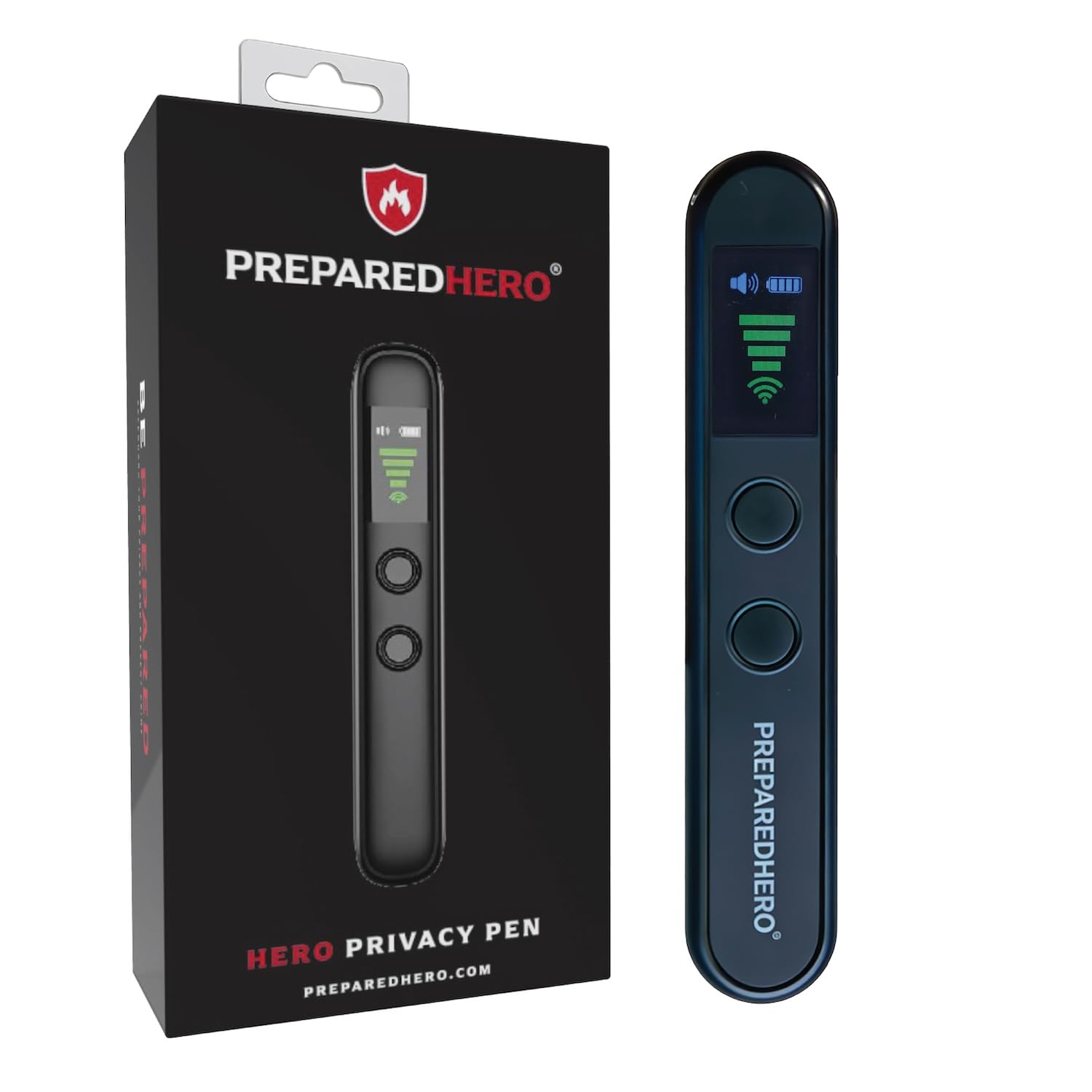
Detects the room before bed, then guards the door while you sleep.
This is the only pick here that keeps working after your sweep ends. It combines an RF (radio frequency) wireless signal detector, an infrared lens finder, and a door motion alarm in a pen-sized body measuring 5.31″ x 0.87″ x 0.47″ — small enough to toss in a carry-on and slide into a bag pocket. Hang it on the door handle at night, and if the door moves the built-in alarm fires. For a light sleeper in a motel, that is a genuinely different layer of awareness.
The two detection modes work in clearly different ways, which is worth understanding before you buy. RF mode sweeps for wireless signals and raises its beep or silent vibration as you get closer to the source, with adjustable sensitivity to cut down on background Wi-Fi and Bluetooth noise. Infrared mode is the dim-the-lights check: point it at mirrors, clocks, vents and smoke detectors, and any camera lens reflects the light back as a small bright dot or ring. That catches locally recording cameras that emit no wireless signal at all.
Power is the catch. Battery life is the recurring complaint, with buyers describing the charge dying in roughly ten to fifteen minutes of active use. Plan to keep a power bank nearby, or treat each sweep as short and targeted rather than a long walkthrough. Buyers also describe overall quality as mixed. It runs app-free with no setup and no Wi-Fi, which keeps the door-alarm feature simple — just do not expect it to run all night without a charge.
What stands out: the door-motion alarm is the spec that turns this from a detector into an overnight companion, and no listing here pairs that with RF and infrared checking in one pen body.
The honest limit: short active battery life means a quick, focused sweep is the right use — not a slow, thorough crawl through the whole room.
Worth choosing for: the traveller who wants a quick pre-bed sweep plus a door alarm on the handle overnight.
Look elsewhere for: marathon room inspections — the battery rewards short, targeted passes.
5. Knight Electronics KT-8000 Premium Anti Spy Detector

Five separate detection modes in an aluminium-shell body that feels built to travel hard.
Count the modes and you see the pitch: radio-frequency signal detection, magnet detection, infrared camera scanning, hidden camera location, and a smart scan mode. That last one is the difference from the older Knight K18, K68 and K88 models the maker compares itself against — the KT-8000 includes it where those do not. In practice you get more ways to check the same room, which is useful when a wireless sweep comes back quiet and you still want a lens check.
The shell is ABS plastic with aluminium in the mix, and at 13.76 ounces you can feel the mass in your hand. That weight is the cost of the sturdier build: this is a hand-carried, sweep-the-room tool, not a pen you forget about. The maker is an American company with a US-based team and includes an instructional video plus a clear step-by-step manual, which matters here because five modes need some explaining. It is built to replace flimsier detectors, and it carries itself that way.
One honest placement note: with no customer review data on record for this model, you are buying on the spec sheet and the maker’s claims rather than on owner experience. That makes it the pick for someone comfortable reading a manual and testing for themselves, not for someone who wants thousands of buyers to have vetted it first. The magnet mode is the standout reason to consider it — that is how you locate a GPS tracker stuck under a bumper or a seat.
The mode count matters: five detection methods in one handset means you can cross-check a room, not just listen once — and the smart scan mode is the piece the older Knight models lack.
Weight as a trade-off: at 13.76 ounces this is a deliberate room-sweeping tool, so it earns its place in a bag rather than a pocket.
Suits the buyer who: wants five detection modes with magnet finding for trackers and an aluminium-reinforced shell.
skip it if: you want an established owner track record to lean on — this model has none on record here.
6. SROTIO 9-in-1 AI Hidden Camera Detector
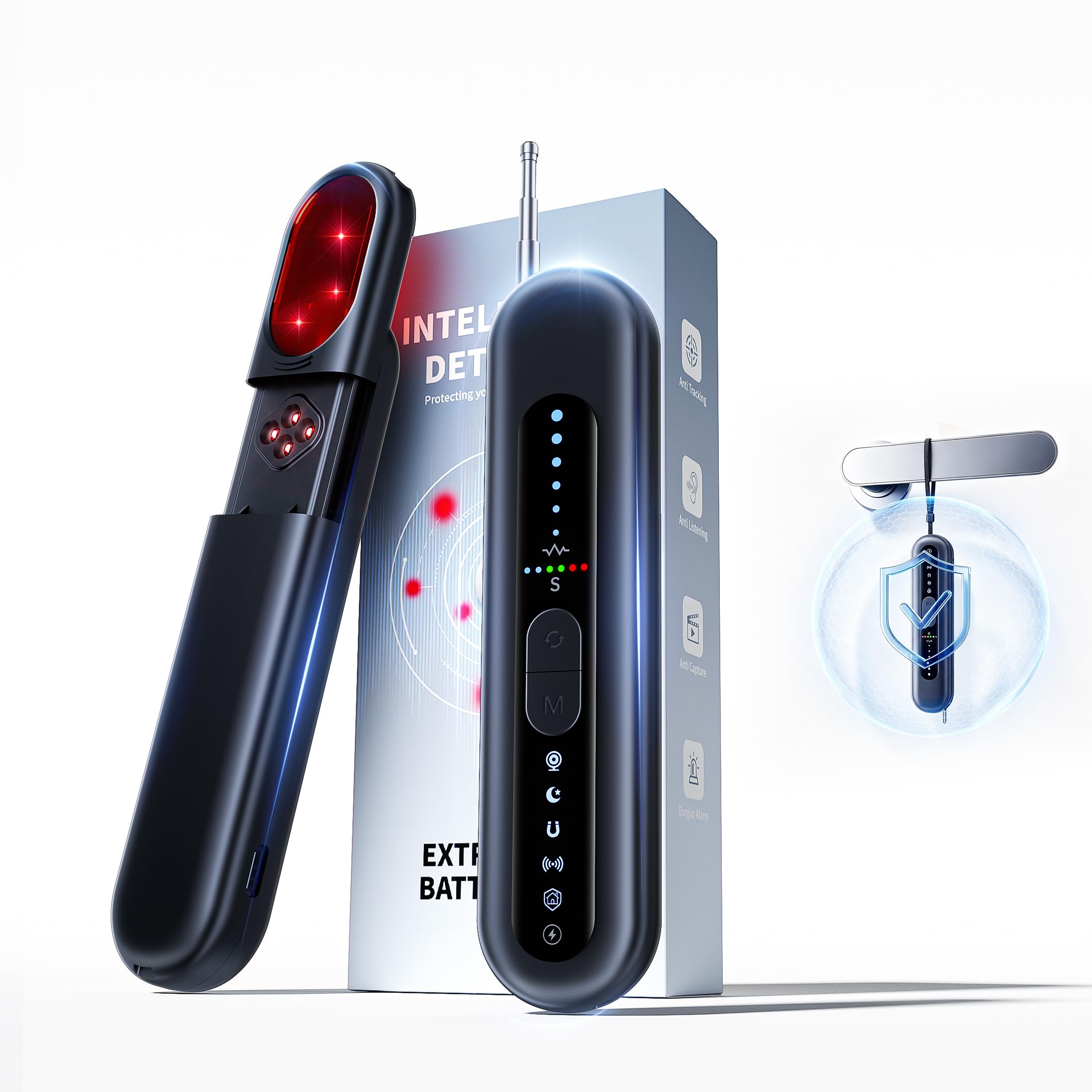
The on-device AI chip that filters out your own router and phone before it rings.
False alarms are the problem this detector is built to solve. Its multi-sensor AI chip (a processor that reads several inputs at once on the device itself) runs locally, with no cloud computing. It cross-analyses RF radio waves, magnetic induction (the magnetic field a device gives off) and infrared lens reflection at the same time. That cross-check filters out interference from routers, phones and household electronics — the maker claims it cuts false alarms by over 90% — so the alarm fires for a pinhole camera or a tracker rather than for the hotel’s Wi-Fi.
Nine functions come in that package: hidden camera scanning, RF signal detection, magnetic GPS tracker locating, audio bug tracing, infrared lens recognition, laser detection for night vision cameras, interference filtering, an SOS emergency alarm, and abnormal motion detection. Six sensitivity levels let you dial it down in a signal-heavy apartment, and segmented signal attenuation (a way to weaken the signal reading step by step) helps you walk toward the source. The concentrated IR (infrared) array is designed so even a pinhole camera hidden in a wall hole shows up as a glint you can see.
The practical side is solid too. A 2000 mAh battery charges in about an hour over USB-C and gives 8 hours of continuous scanning, or 50 days of standby between trips. The ABS shell passed a 1 meter anti-drop test, has a matte, scratch-resistant finish, and includes a lanyard hole for a backpack clip. The thing to go in knowing: nine functions and six sensitivity levels mean a setup you must actually learn, so this rewards a buyer who reads the manual and practices rather than one who wants a single button.
Why the tech earns its keep
- On-device AI cross-analyses RF, magnetic and infrared data to cut false alarms
- 6 sensitivity levels for tuning out a crowded wireless environment
- 8 hours of continuous scan time, 50 days standby, 1-hour charge
- Passed a 1 meter anti-drop test with a scratch-resistant matte finish
What to plan for
- Nine functions and six sensitivity levels need real learning time
- The deepest feature set here needs practice before a first trip
- You get the most out of it by reading the manual
The right call if: you want the widest feature set here and will put in the time to learn it before a trip.
Not for: anyone who wants one-button simplicity — this rewards practice.
7. Knight Electronics KT-9000 Premium Hidden Devices Detector

A 6 meter RF range and an aluminium alloy shell that turns a sweep into a serious search.
Reach is the reason this one is worth a look. Its 6 meter RF detection range is the longest here, so one slow pass covers a whole room rather than a single wall. Four modes cover radio-frequency signal detection for spy cameras and audio bugs, magnetic field detection for GPS trackers, a hidden camera discovery scan for viewing lenses directly, and a smart detection mode that runs the search automatically.
This one is built for heavy duty rather than pocket carry. Its aluminium alloy exterior is sturdier than the plastic shells on the pen-style units, and the maker positions it for police, military and security professions. At 6.4 ounces and 8.5″ long, though, it is a deliberate, hand-held tool rather than something you forget in a coat. The rechargeable battery gives 20–45 hours of continuous operation on a single charge, which covers several days of hotel or car checks before you need a cable.
Where the KT-9000 asks for care is accuracy. Buyers’ feedback is mixed on functionality — some report it does exactly what it should, while others struggle to pinpoint a source, particularly small trackers like AirTags. That is the point to weigh before buying: this is a long-reach, professional-shaped unit, not a guaranteed pinpoint locator, and it rewards a methodical sweep over a quick wave. The aluminium build quality is the part that holds up best.
The reach read: 6 meters of RF range lets you sweep a room from one spot, and the aluminium alloy shell makes it the toughest build here.
The honest caveat: pinpointing a small tracker is where feedback splits — some buyers nail it, others find it struggles to close in on the source.
Worth it for: professional or methodical users who want long-range coverage and an aluminium build that lasts.
Look elsewhere if: you want guaranteed pinpoint accuracy on a tiny GPS tracker — that is where owner reports divide.
Know the Specs
RF Detection Range in Meters
Range tells you how far a detector can hear a wireless signal, and it is measured in meters. A longer range, like the 6 meters on the KT-9000, means you can stand in the middle of a room and sweep the walls from a distance. A shorter range, like the 4 inches on the KT-8000, means you move the detector close to each surface and check it point-blank. Longer is not automatically better — a very long range also picks up more background noise from the building’s own networks, which is why sensitivity control and interference filtering matter just as much.
Frequency Range in MHz and GHz
Frequency range is the span of signals a detector is built to hear, and it is written in MHz (megahertz) and GHz (gigahertz). A wider window, like the 1MHz–10GHz range on the Hero Privacy Pen, means the detector covers more of the wireless bands that cameras, bugs and trackers use, so fewer devices slip past. A narrower window catches less, but it can also mean fewer false alarms because the detector is not listening to everything in the room. Always check the range before you buy, and match it to how many smart devices surround you.
Common Questions
Will a spy cam detector find a camera that records to a memory card?
Why does my detector beep near ordinary Wi-Fi and phones?
Can a detector find a GPS tracker on a car?
What frequency range should I look for in a bug detector?
Is RF detection or infrared detection better for hotel rooms?
How long does the battery last on these detectors?
Can I take a spy cam detector through airport security?
What does the number of detection modes actually give me?
Do I need an app or Wi-Fi for these detectors to work?
Are these legal to use in a hotel or rental?
The Bottom Line
For most buyers, the strongest pick among these spy cam detector options is the WRKLLY 6-in-1 Hidden Camera Detector. It covers wireless cameras, wired cameras, GPS trackers and infrared lens checks in one handset, and holds up to 30 days on standby so it is ready when you reach for it. If you want something that disappears into a pocket and runs for weeks between charges, the VigilEye Hero Privacy Pen delivers a 1MHz–10GHz range (the radio band most wireless cameras and trackers use) in a 1.28-ounce body. For an overnight stay where you also want the door guarded, the Prepared Hero Privacy Pen adds a door-motion alarm that no other pick here carries.
How we choose
We do not accept paid placement. Every pick is matched to a real buyer and a real use-case; we do not hands-on test units.
Sources
Specifications: manufacturer listings and product documentation. Review insights: verified customer reviews, as of November 2026. Pricing: not shown on this page (it changes often); check the current price via the retailer link.
As an Amazon Associate, Tactical Gear Guy earns from qualifying purchases. This does not affect which products we feature.