Specs are compiled from manufacturer listings and verified buyer reviews and can change over time — please confirm the key details on the product page before buying.
You do not need to chill the whole house to fix one sweltering corner. That is exactly what a spot air conditioner is built for — it aims cold air at the person, the workbench, the tent, or the patio where the heat actually hurts. This guide lines up eight of them, from a 650 sq ft room cooler down to a rolling outdoor unit that works in temperatures up to 109 degrees Fahrenheit, so you can match the machine to the job instead of guessing.
This guide is built by comparing the manufacturers’ published specifications and the patterns across verified customer reviews, so you get each pick’s real strengths and trade-offs instead of marketing spin.
The catch with this category is that BTU ratings and room-size claims rarely tell the whole story. Some units here are built to cool one bedroom and vent out a window, while others roll into a garage or an open-sided canopy and simply lower the air around you. The picks below are sorted by what they are actually good at, not by a spec sheet fantasy, and that is how you choose the right spot air conditioner.
Top Picks

How To Choose The Best Spot Air Conditioner
The first decision is not brand or budget — it is whether you are cooling a closed room or a person. A portable room air conditioner sits on the floor and vents hot air out a window through an exhaust hose, lowering the temperature of a sealed space. A true spot cooler blows a directed stream of cold air at a workspace, a patio chair, or an equipment rack, and it does not care how big the room is. Buying the wrong one of those two is the single most common mistake in this category.
Match the BTU figure to the job, not the brochure
BTU (British thermal units) is simply a measure of how much heat a unit can pull out of the air per hour. Higher BTU tends to mean a bigger space, but the coverage number beside it is the maker’s own claim. A 10,000 BTU unit here is rated for rooms up to 550 sq. ft, while a 14,000 BTU unit is rated for 650 sq. ft. Those two figures are close because each maker sets coverage its own way, so read the listed square footage rather than assuming BTU alone decides it.
Single hose or dual hose
Most portable units use one hose to push hot air out the window. A dual-hose design uses a separate intake and exhaust, so the unit stops pulling your already-cooled indoor air outside. That matters if you are cooling a bedroom you want to hold at a set temperature, and it matters less if you are just knocking the edge off a garage. Check the listing for “dual hose” before you assume it is there.
Where the water goes
Every air conditioner pulls moisture from the air, and that water has to go somewhere. Some units self-evaporate most of it and only need a manual drain now and then. Others offer a continuous drain hose, so you can run a line to a nearby drain and forget it. A bucket with an auto shut-off and an alarm is the third option, and it means you are the one emptying it. Think about which of those three you can live with day to day.
Side-by-Side Comparison
| Model | Best For | Cooling Power | Coverage | Weight | Amazon |
|---|---|---|---|---|---|
| SereneLife 14000 BTU Inverter★ Best Overall | Whole-room cooling with heat too | 14,000 BTU | 650 sq ft | — | Amazon |
| Electactic 10,000 BTU Portable ACBest Value | Mid-size rooms on a smart timer | 10,000 BTU | 550 sq ft | 44.6 lb | Amazon |
| BLACK+DECKER BPACT10WTMost Trusted Name | Bedrooms and easy window setup | 10,000 BTU | 450 sq ft | — | Amazon |
| BAYKUL 6-in-1 Cool Heat AC | Tents and campers, heat included | 6,800 BTU cool / 7,500 BTU heat | — | 35.7 lb | Amazon |
| Whynter ARC-1230WN | Holding a set temp in a home | 14,000 BTU | — | — | Amazon |
| ProAire 5,300 BTU Spot Cooler | Patios, garages and worksites | 5,300 BTU | — | 61 lb | Amazon |
| Uninex SAC1800 KoolZone | Focused cooling for one work zone | 6,293 BTU | 77 sq ft | 51 lb | Amazon |
| Uninex KoolZone N407-TC | Big industrial spot cooling | 8,920 BTU | — | — | Amazon |
Detailed Reviews
1. SereneLife 14000 BTU Portable Inverter Air Conditioner
Our pick — 4.0+★ from 3,500+ verified ratings; the strongest balance of quality and price.
One box that cools a large room in summer and heats it in winter — and the compressor leans on you instead of the grid.
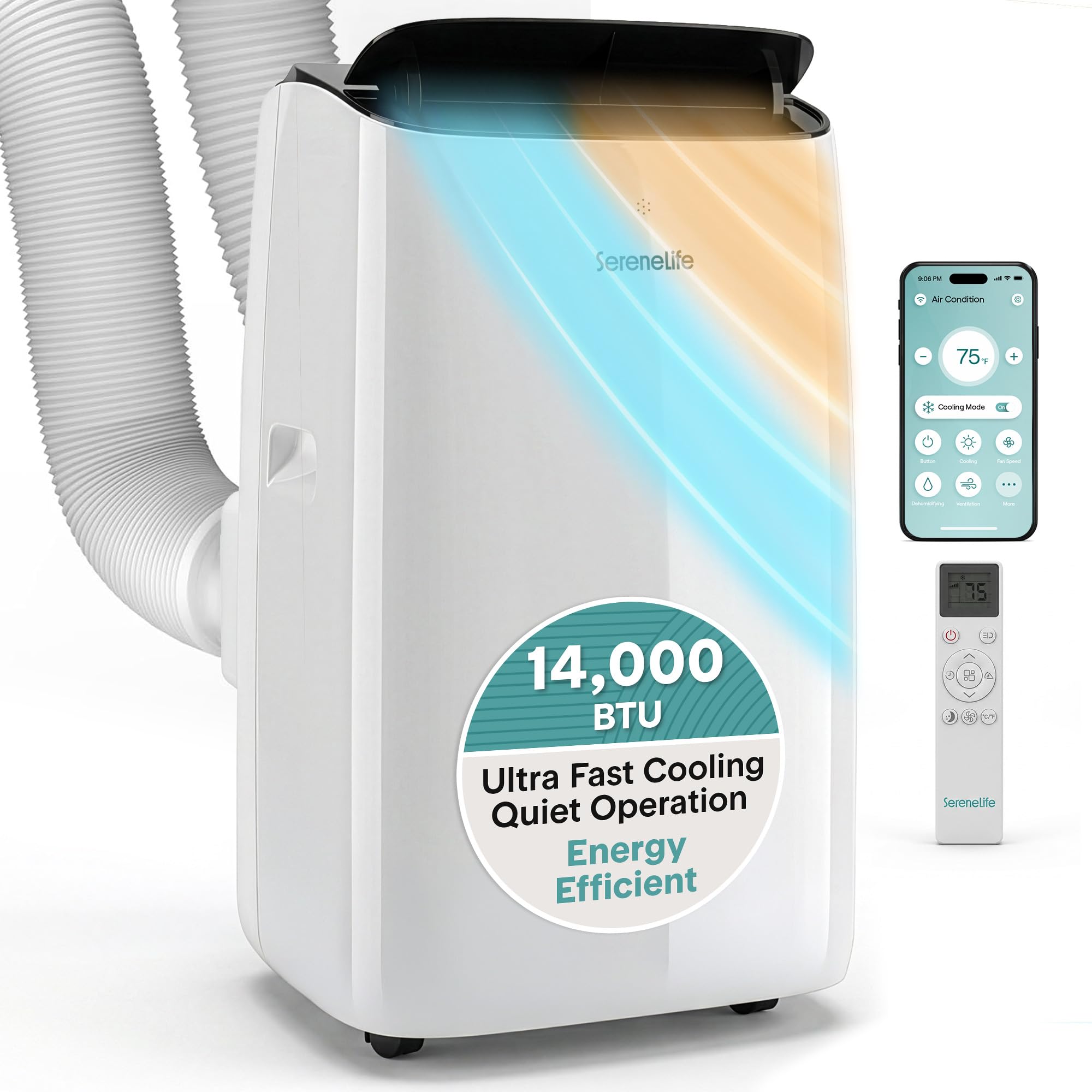
This is the pick for someone who wants the whole bedroom or living room handled by one machine, not just a cold stream pointed at a chair. The headline figure is 14,000 BTU (British thermal units, the standard measure of how much heat it pulls out per hour) with coverage rated up to 650 sq. ft — comfortably the widest floor-area claim on this list. Put it another way: the Electactic below is rated for rooms up to 550 sq. ft, so the SereneLife is the one to reach for when your open-plan space runs bigger than a standard bedroom.
The inverter part is what buyers feel day to day. An inverter compressor (one that ramps its speed up and down instead of slamming on and off) is listed at 43 dBA — roughly the level of a quiet conversation — and the maker rates it up to 40% more efficient than a standard portable AC motor. Four modes cover cooling, heating, dehumidifying and fan, and Wi-Fi lets you set any of them from your phone. For year-round use in one room, that spread of functions is hard to match.
What wins people over is raw cooling muscle: 961 buyers single out the cooling performance, and a widely shared story has the room dropping from 88°F to 80°F in about 10 minutes. Setup is friendly too — a universal window mount kit is in the box, and the washable filter pulls out for rinsing. The recurring gripe is noise. Some find it quiet, plenty find it loud enough to notice, so do not buy this expecting a silent sleeper.
What earns it first place
- 14,000 BTU inverter cooling rated for rooms up to 650 sq. ft
- Cooling, heating, dehumidifying and fan modes in one cabinet
- 43 dBA operation and a maker claim of up to 40% better efficiency than standard motors
- Universal window kit and a washable, removable filter
Where it makes you work
- The noise rating splits opinion — some rooms will hear it
- Durability is the weakest theme in the feedback, so treat the filter and hose fittings gently
- It is a full-size floor unit with casters, not something you tuck on a shelf
Built for: anyone cooling a large bedroom, living space or office who wants heat in the colder months from the same machine.
Think twice: light sleepers in a small room should plan on earplugs or a spot cooler instead.
2. Electactic 10,000 BTU Energy Saving Portable Air Conditioner
The mid-size room cooler that drains itself and keeps its own schedule.
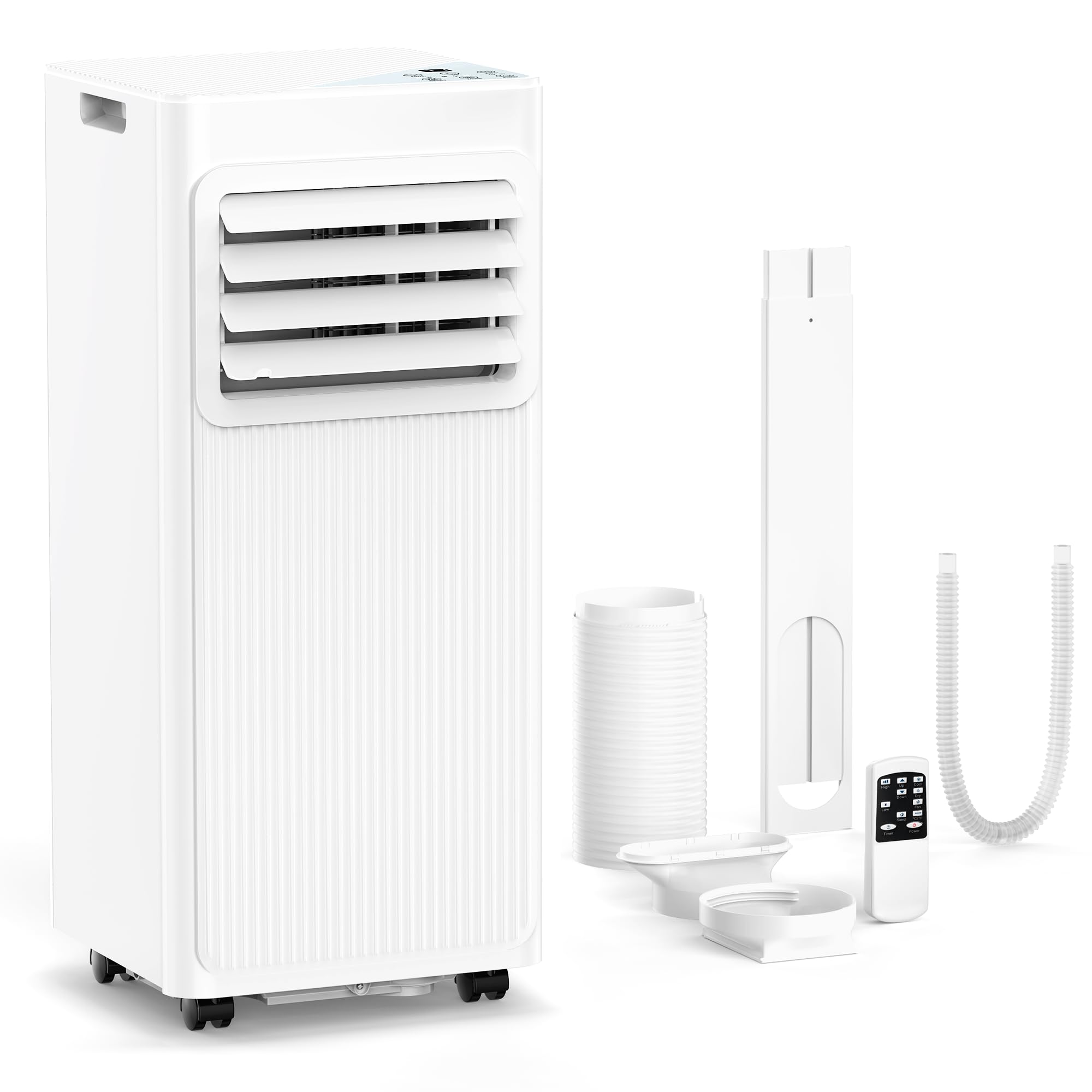
If your problem is a bedroom or apartment that turns into an oven by afternoon, this is the unit built to solve exactly that. It delivers 10,000 BTU and is rated for spaces up to 550 sq. ft, with a temperature range from 61°F to 90°F you set yourself. Against the SereneLife’s 650 sq. ft claim, this one is the smaller room’s machine — and that is fine, because most people cooling a single bedroom do not need the bigger cabinet.
The self-evaporating system is the quiet hero here. It pulls condensed water out of the air during normal running and handles most of it internally, so you are not lugging a tank to the sink every evening. There is a smart full-tank shutoff that powers the unit down when the reservoir does fill, which saves you from a wet surprise. A 24-hour timer lets you set it to kick on before you get home, and the top-mounted LED display keeps the settings readable without crouching.
Four modes cover cooling, dehumidifying, fan and sleep, and the dehumidifier pulls up to 40 pints a day — useful in a damp basement. Two fan speeds and a sleep mode round it out. One honest note: it is a newer listing with a smaller review base than the big-name picks here, so you are buying a promising unit rather than a proven workhorse.
The drain-free appeal: self-evaporation plus a full-tank shutoff means this is one of the least fussy units on the list to live with day to day.
Room-size reality check: 550 sq. ft of rated coverage and a 61°F to 90°F range suit a bedroom or apartment, not an open-plan space.
Reach for this if: you want a mid-size room cooled on a schedule without emptying a water tank constantly.
Look elsewhere if: you need a long track record before you commit — the review base here is still small.
3. BLACK+DECKER BPACT10WT Portable Air Conditioner
A familiar badge, a remote that doubles as your thermostat, and a window kit that goes in without swearing.
The Follow Me function is the feature that makes this one different. The remote carries a sensor and acts as a thermostat, so the unit reads the temperature where you are sitting rather than where the machine is parked. Leave the remote on the nightstand and the bedroom cools to that spot. Combine that with casters on the bottom and handles on both sides, and you have a unit you can roll between rooms without a second person.
It runs 10,000 BTU across three jobs — cooling, dehumidifying and fan — with a top-mounted control panel and LED display. Rated coverage is 450 sq. ft, the smallest room claim among the indoor units here, so this is a bedroom or small office machine rather than a living-room solution. A 70-inch cable gives you some slack to reach a wall outlet.
Setup is the theme that carries this pick: buyers consistently find it easy to get installed, and the included window kit is the reason. Cooling is more of a split verdict — it cools a room well for many owners, while others find it slow to hit a low set temperature. Know going in that this is a three-in-one room AC, not a spot cooler, and size it to a 450 sq. ft bedroom or small office.
Why it stays on the shortlist
- Follow Me remote works as a thermostat for the exact spot you sit in
- Easy window install carried by the included kit
- Casters and dual side handles for moving room to room
- Three functions — cool, dehumidify and fan — from one cabinet
What to weigh before buying
- 450 sq. ft coverage is the smallest among the indoor picks here
- Cooling and noise both draw a divided response — some rooms and some sleepers will find it slow or loud
- Reliability is the theme that recurs most in the critical feedback, so buy with a return window in mind
Works best for: a bedroom or small office where you want the remote to hold the temperature right where you are sitting.
Not the one for: a large living space that needs more than 450 sq. ft of rated coverage.
4. BAYKUL Portable Tent Air Conditioner & Heater, 6-in-1
A carry-bag-sized box that both chills and warms a tent, a camper or a home office.
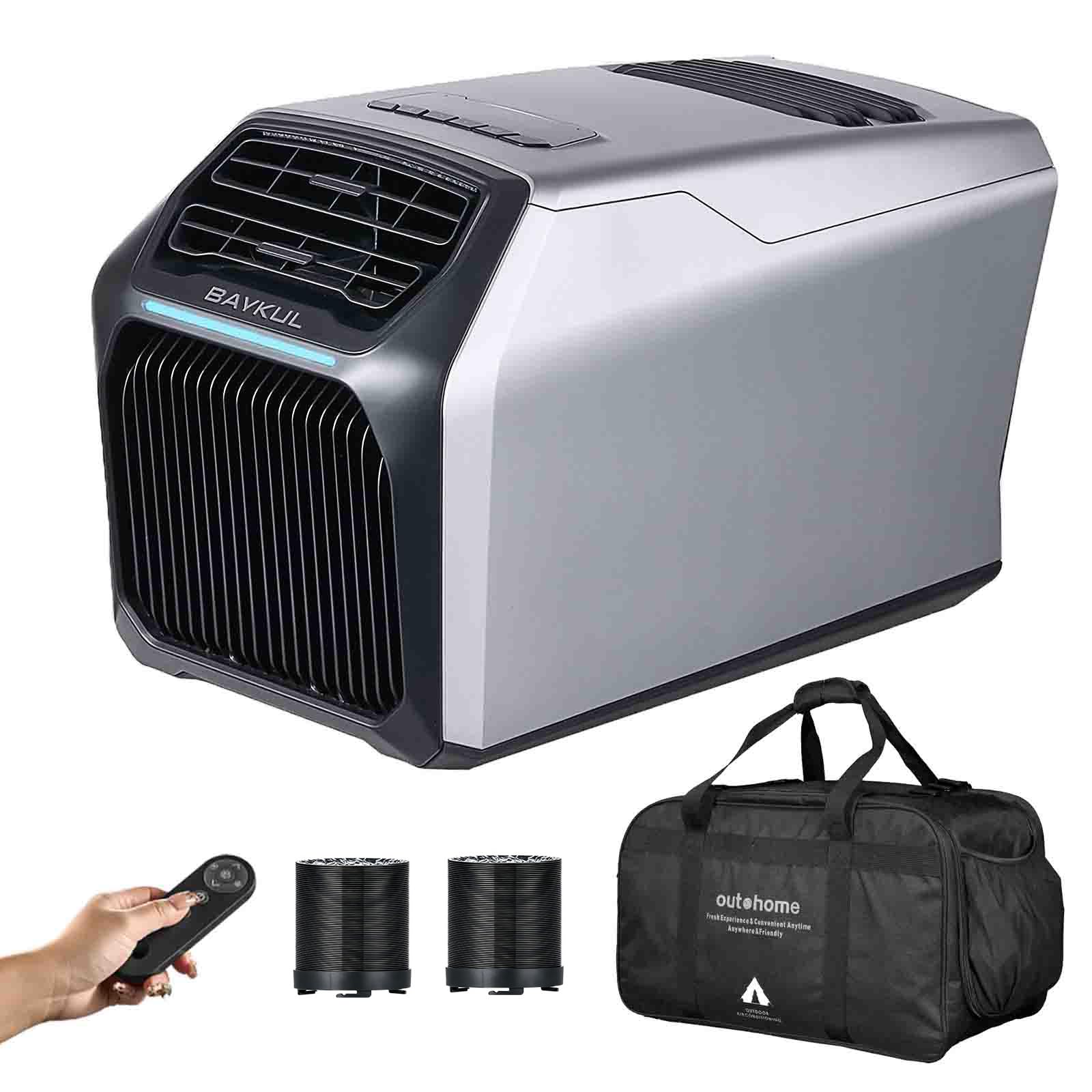
Campers and van-lifers get the most out of this one. It delivers 6,800 BTU of cooling and 7,500 BTU of heating, so a cold morning and a hot afternoon are both handled by the same unit. Compare that with the Whynter’s 14,000 BTU of cooling only — the BAYKUL gives up raw cooling power to gain a heater. For a tent or a small camper, that trade is usually the right one.
Portability is the whole pitch here. It weighs 35.7 lb and comes with a custom carry bag for one-handed moving, which is the lightest body among the units with a listed weight. It runs on R-32 refrigerant and draws an average of about 550 watts thanks to sensors that adjust output to the surrounding conditions. Noise is listed at 46 dB, and the controls cover app, remote, touch and voice.
Cooling is where expectations need managing. Some buyers report it holds a camper about 5 degrees cooler than the outside air; others find it weak. That is a real split, and it tells you this is a personal-space cooler for a small, enclosed volume — not a room air conditioner. Set it within a few feet of where you sit, seal the tent or camper, and it holds its own.
The two-season trick: 6,800 BTU of cooling plus 7,500 BTU of heating and a carry bag makes this the only true go-anywhere unit here.
The honest limit: the 5-degree-cooler-versus-outside reports mean you should size it to a tent or camper, not a room.
Pick it for: tent, camper and van setups that need warmth as much as cold air.
Pass if: you are cooling an actual room — the spot-cooling design works best in a small sealed space.
5. Whynter ARC-1230WN Portable Air Conditioner Inverter
Two hoses instead of one so the unit stops shoving your cooled air out the window.
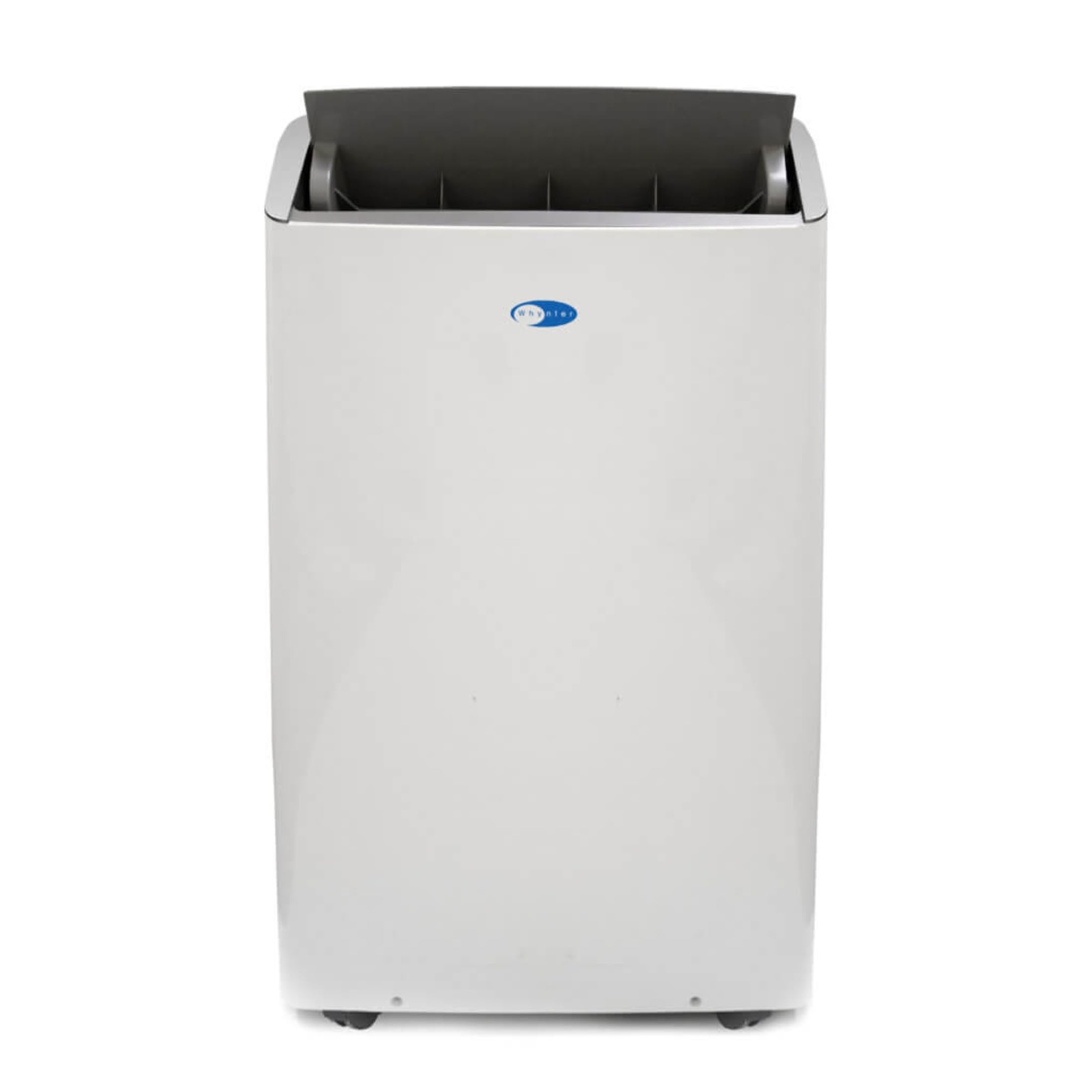
Most portable units use a single hose and quietly pull your cold indoor air outside as they exhaust. This one runs a separate intake and exhaust hose, which means it recirculates the room’s air instead of dumping it. The result is a unit that holds your set temperature with less effort — noticeable in a bedroom you want to stay at one number all night. It carries 14,000 BTU, the same headline cooling figure as the SereneLife, but it stops there: no heater.
The inverter design is the other half of the comfort story. It modulates rather than cycling hard on and off, and drains 87 pints as a built-in dehumidifier, so a muggy room gets handled without a second appliance. Set temperature, mode and timer from the app, or use voice control if your hands are full. With 310 mentions and a strong set of cooling and noise comments, this is the model that quietly earns its keep — its efficiency figure of 12.3 is among the better ones on this list.
Feedback puts a real number on the cooling: households report dropping the temperature by about 8 degrees. Quiet operation and easy install come up again and again, and the airflow is described as strong. The one theme to watch is durability, which reads mixed — treat the hoses and fittings with care and it should serve you well. This is the machine for someone cooling a room they live in, not a corner they visit.
Best suited to: anyone who wants a bedroom or living room held at a steady temperature with less energy waste from the hose setup.
Skip if: you need heat as well — this one cools and dehumidifies only.
6. ProAire 5,300 BTU Portable Outdoor Spot Cooler
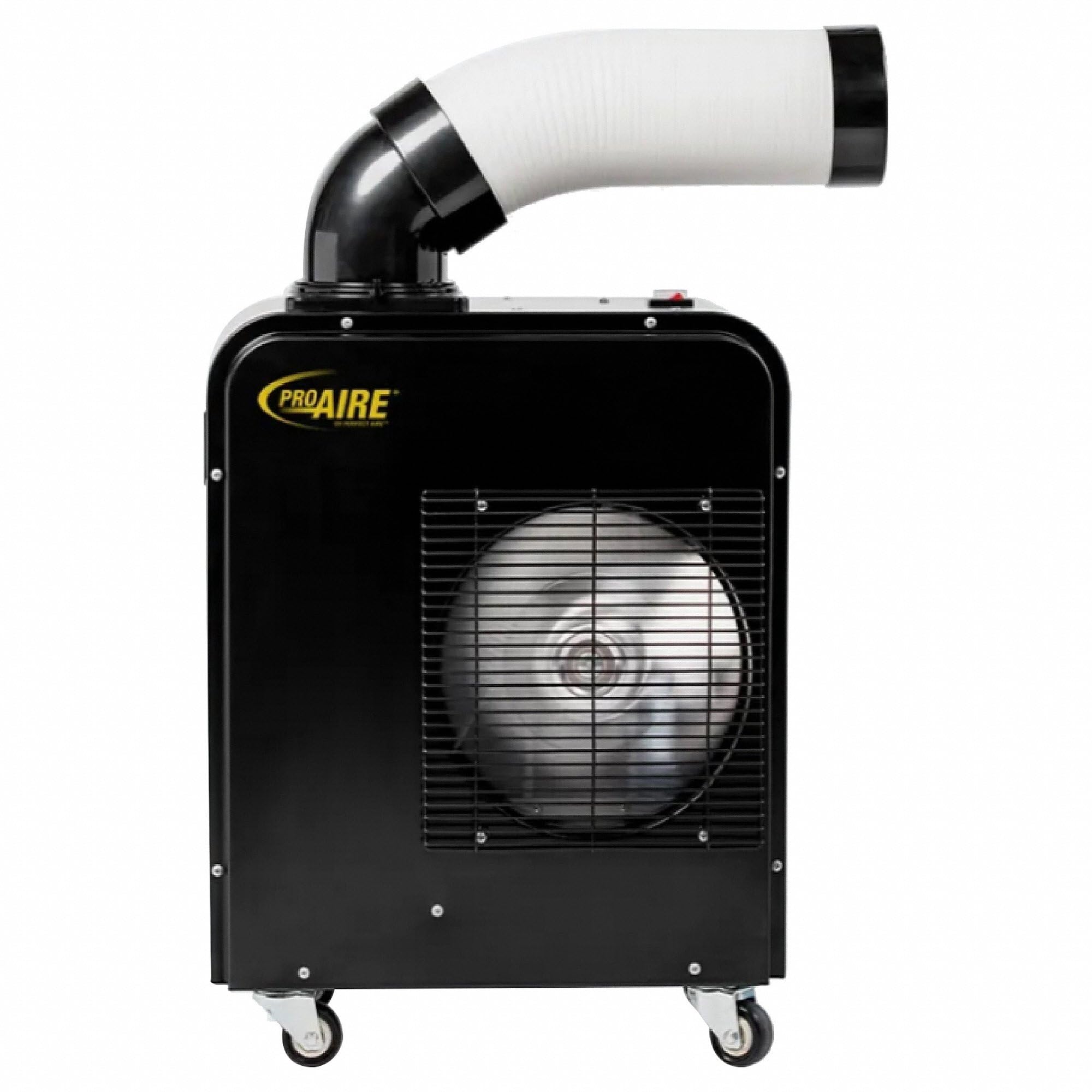
Rolls into a patio or garage, bends its blower at your chair, and needs no installation at all.
This is a true spot cooler, and that is a different animal from the window units above. You plug it in and point it — no window kit, no hose out the frame. The adjustable blower extends and bends to aim cold air at your workspace or grill, and the 360-degree spinner wheels let you push it wherever the shade is. It is rated to run in temperatures up to 109 degrees Fahrenheit, which is the number that matters if you work outside in a real summer.
It puts out 5,300 BTU and weighs 61 lb, the heaviest body with a listed weight here — that is the price of a machine built to sit outdoors. Two drainage options keep it practical: a 6-foot hose for continuous draining to a nearby drain, or a bucket with an auto shut-off and alarm when it fills. A washable, reusable filter means no replacement filters to buy, and a compressor overload shut-off guards the unit from overheating.
Cooling is what owners talk about most — reports of taking 10 to 15 degrees off the temperature and a focused stream of cold air, including a run on a 100-plus-degree day. Where it splits is value: several buyers question whether what you get matches what you pay. That is a fair note for a premium-tier outdoor unit, so weigh the price against 5,300 BTU of spot cooling before you buy.
What it does better than the room units: zero installation and a directed blower that works in open air up to 109 degrees Fahrenheit.
What you accept up front: 5,300 BTU, a 61 lb body, and premium-tier pricing that some buyers find steep for spot cooling.
Choose this when: you are cooling a patio, garage or worksite where a window unit simply cannot go.
Choose differently when: you want to cool an enclosed room — a ducted indoor unit is the better tool.
7. Uninex SAC1800 KOOLZONE Mobile Spot Cooler

Industrial-certified spot cooling in a compact 51-pound body you point where it hurts.
This is for a specific worker: someone who needs a focused stream of cold air over a bench, a canopy or a machine, not a cooled room. It is ETL certified (independently tested to a recognized safety standard), delivers 6,293 BTU of cooling and carries a CER rating of 9.55 — the efficiency number the industrial side of this market trades on. For a tighter controlled zone, it is rated for 77 sq. ft, the smallest coverage figure here, because it is built to cool a spot rather than a space.
R-32 refrigerant runs through the updated cooling design, and the built-in evaporator removes most condensate during operation, so you are not draining it constantly. Its maker publishes a per-hour running cost based on 120 days at 8 hours a day and a national average electricity rate. Knob controls keep it simple and shrug off dirty hands — no touchscreen to fight. It weighs 51 lb and rolls on its own wheels with no assembly required.
The honest picture: functionality is the theme that holds up best, and owners like the nice volume of cool, dry air it produces. Cooling gets a split response though, and some buyers feel it is expensive for what it covers. That puts it squarely in the “buy it for a defined task” bucket. If you need a spot cooler for a canopy or a garage bay, it delivers; if you expected it to chill a room, it will not.
Where it delivers
- ETL certified and rated 6,293 BTU with a 9.55 CER efficiency figure
- Self-draining evaporator removes most condensate so tanks are not a constant chore
- Knob controls and 51 lb on wheels, no assembly needed
- Focused 77 sq. ft zone suits a bench or workstation
Where to manage expectations
- Cooling gets a divided response — treat it as a spot cooler, not a room unit
- Some buyers find it a lot to pay for the coverage it offers
- The 77 sq. ft zone means it is not the pick for a large room
Right call for: a canopy, workbench or garage bay that needs a defined stream of cool air.
Wrong call for: whole-room cooling, where a ducted unit will do what this cannot.
8. Uninex KoolZone N407-TC Mobile Spot Cooler

The biggest cooling number among the spot coolers here, aimed at a workspace rather than a living room.
Where the SAC1800 above is compact, this N407-TC goes for power. It delivers 8,920 BTU of spot cooling with a 9.22 CER efficiency rating and 0.7 ton of capacity — the largest cooling figure among the spot coolers here and the one to pick when a job site or workshop zone needs real muscle. It is ETL certified, and it meets California Title 20, Section 1607 requirements and is listed on the California Energy Commission database, which matters if you are buying in that state.
The setup is deliberately simple: no assembly, indoor and outdoor capability, wheels for moving it where the work is, and built-in dehumidification from an evaporator that removes most of the condensate. R410A refrigerant handles the cooling, and the maker puts energy cost at roughly per hour based on 120 days at 8 hours a day and a national average rate. Remote and button controls keep operation straightforward.
This is a specialized industrial tool with a modest track record behind it, so buy it for the job it is built for — a defined work zone that needs a high-output stream of cold air — rather than as a budget-friendly alternative to a room air conditioner. Roll it to the hot zone, aim the blower at the task, and let the 8,920 BTU do the work.
The output case: 8,920 BTU, 0.7 ton of capacity and a 9.22 CER put this at the top of the spot-cooling pile here.
The practical case: a small review base and industrial-grade pricing mean you buy it for a defined work zone, not for general home comfort.
Worth it when: a workshop or facility zone needs the highest cooling output on this list pointed right at it.
Overkill when: you are cooling a normal room — a ducted portable AC is the more sensible spend.
Know the Specs
BTU and what it really means
BTU (British thermal units) measures how much heat a unit removes per hour. A higher number usually points to a bigger space, but the coverage figure beside it is the maker’s own claim — the same number can be rated differently from brand to brand. Always read the listed square footage alongside the BTU, because one tells you the power and the other tells you the actual area the maker stands behind.
Single hose versus dual hose
A single-hose unit exhausts hot air out the window but pulls some of your cooled indoor air with it. A dual-hose design keeps intake and exhaust separate, so it recirculates instead of dumping. That shows up most in a room you are holding at a set temperature — dual hose tends to hold it with less effort. Look for the words “dual hose” in the listing, because plenty of units do not have it.
Drainage: drain hose, evaporator or bucket
Every unit pulls moisture out of the air, and that water has to go somewhere. A continuous drain hose lets you run a line to a nearby drain and forget it. A built-in evaporator removes most of the condensate during normal running. A bucket means you empty it, usually with an auto shut-off and alarm when it is full. Choose the setup that matches how much babysitting you will tolerate.
Spot cooler versus room air conditioner
A room air conditioner cools a sealed space and needs a window and exhaust hose. A spot cooler blows a directed stream of cool air at a person, a bench or a task, and works in open air. They are not interchangeable. Match the tool to the job — the coverage figure and whether it needs a window tell you which one you are looking at.
Common Questions
Do I need a window to run a spot air conditioner?
How many BTU do I need to cool one room?
What is the difference between a spot cooler and a portable room AC?
How often will I have to empty the water tank?
Can a spot cooler cool more than one room?
Why does my portable AC feel noisy?
Is a dual-hose unit worth choosing over a single hose?
Can I use a portable air conditioner in a garage or on a patio?
What does the CER rating on the industrial units mean?
How much power does a spot cooler draw?
The Bottom Line
For most people, the spot air conditioner that earns the top slot is the SereneLife 14000 BTU Inverter — it holds the rare combination of 14,000 BTU of muscle, coverage rated to 650 sq. ft, and heat for the colder months, all from one cabinet. If you live in a camper or a tent and need warmth as well as cold, the BAYKUL 6-in-1 gives you both. And if your heat problem is out on the patio or in the garage, the ProAire spot cooler needs no window and aims where you point it. One honest nudge before you click: the SereneLife is the crowd favorite, and its strong cooling reputation is the reason it leads here, so start your shortlist with it unless your space is open-air.
How we choose
We do not accept paid placement. Every pick is matched to a real buyer and a real use-case; we do not hands-on test units.
Sources
Specifications: manufacturer listings and product documentation. Review insights: verified customer reviews, as of November 2026. Pricing: not shown on this page (it changes often); check the current price via the retailer link.
As an Amazon Associate, Tactical Gear Guy earns from qualifying purchases. This does not affect which products we feature.