Specs are compiled from manufacturer listings and verified buyer reviews and can change over time — please confirm the key details on the product page before buying.
Two small speakers behind your couch decide whether surround sound works or not — not the bar under your TV. Get them right and a helicopter travels over your left shoulder. Get them wrong and you have paid extra for two silent boxes. The picks below all ship with dedicated rear speakers, from a 5.1 setup (five speakers plus a subwoofer) that punches above its tier to an 11.1.4 flagship (eleven ear-level channels, one subwoofer channel, four height channels) with four up-firing channels.
This guide is built by comparing the manufacturers’ published specifications and the patterns across verified customer reviews, so you get each pick’s real strengths and trade-offs instead of marketing spin.
You will see how channel counts, up-firing drivers, and room calibration change what you hear in an ordinary living room. The short version: match the channel layout to your ceiling and seating before your budget.
Top Picks


How To Choose The Best Soundbar with Wireless Rear Speakers
Start with the rear speakers, because they are the whole point of this category. A bar with a big subwoofer and two weak surrounds gives you thump from the front and nothing from behind — that is loud television, not surround sound. The differences between the picks below come down to four things: how many channels the system decodes, whether any channels fire upward, how the system adapts to your room, and whether the surrounds need a wire to a power outlet or a wire to the bar.
Channel count versus your actual room
A 5.1 system means five speakers (left, center, right, and two rears) plus one subwoofer — the “.1” is the bass channel. A 7.1.4 adds two more surround positions and four height channels that fire at the ceiling. More channels only pay off if your seating gives the rear speakers somewhere to sit behind you. If your couch is flush against the back wall, a 5.1 with well-placed surrounds often images better than a 7.1.4 squeezed into the same footprint. Look at the rear speaker kit included with each system: some are small bookshelf-style boxes, others are up-and-side-firing units that throw sound over your head.
What “wireless” really covers
Wireless rear speakers means no audio cable runs from the bar to the back of the room. It does not always mean no power cable. Most systems here still need each rear speaker plugged into a wall outlet, so plan two sockets behind the couch before delivery day. A few designs go further. The JBL Bar 700 uses detachable battery-powered surround speakers, which you lift off the bar and place behind you. The LG S90TR sends audio to its rears wirelessly with no separate receiver box. Read the included-parts list carefully — it tells you exactly what arrives in the box.
The height channel and your ceiling
Dolby Atmos height effects work by bouncing sound off a flat, hard ceiling back down to your ears. Up-firing drivers need a ceiling roughly flat and reflective, and they work best when you sit a reasonable distance from the bar. A room with a textured or very high ceiling will soften those overhead cues. This is why the flagship Samsung HW-Q990C lists 4 up-firing channels and its rear kit is described as up/side firing — it is aiming sound above and beside you, not just behind.
Calibration and dialogue control
Room calibration uses a microphone (built into the bar or the setup process) to measure your space and adjust the output. Samsung calls it SpaceFit Sound Pro on the HW-Q990C and SpaceFit Sound Pro Plus on the HWQ990F; TCL uses AI Sonic Auto Room Calibration; LG uses its own Advanced Room Calibration. Separately, dialogue clarity is its own feature set — a dedicated center channel, or a voice-boost mode like Polk’s VoiceAdjust or Samsung’s Active Voice Analyzer. If you watch a lot of dialogue-heavy drama at low volume, weight that above raw power.
Side-by-Side Comparison
| Model | Best For | Channel Layout | Subwoofer Driver | Key Format Support | Amazon |
|---|---|---|---|---|---|
| Samsung HW-Q990C★ Best Overall | Full-room Atmos flagship | 11.1.4 | Included, wireless | Dolby Atmos | Amazon |
| TCL S65K S SeriesBest Value | Best value surround | 5.1 | 6.5 inches, wireless | Dolby Atmos, DTS:X | Amazon |
| Amazon Fire TV Soundbar PlusBest for Fire TV | Fire TV households | 5.1 | Included, wireless | Dolby Atmos, DTS:X | Amazon |
| JBL Bar 700 | Rentals and flexible rooms | 5.1 | 10 inches, wireless | Dolby Atmos | Amazon |
| Sony BRAVIA Theater System 6 | BRAVIA TV owners | 5.1 | Included, wired | Dolby Atmos, DTS:X | Amazon |
| ULTIMEA Skywave X70 | Uncompromised wireless layout | 7.1.4 | 10 inches, wireless | Dolby Atmos | Amazon |
| LG S90TR | LG OLED pairings | 7.1.3 | Included, wireless | Dolby Atmos, DTS:X | Amazon |
| Polk Audio MagniFi Max AX SR | Dialogue control and inputs | 7.1.2 | 10 inches, wireless | Dolby Atmos, DTS:X | Amazon |
| Samsung HWQ990F | Certified refurb flagship | 11.1.4 | Included, wireless | Dolby Atmos, DTS:X | Amazon |
Detailed Reviews
1. Samsung HW-Q990C 11.1.4ch Soundbar with Wireless Dolby Audio
Our pick — 4.5+★ from 500+ verified ratings; the strongest balance of quality and price.
The reference point for this whole category — four height channels and rears that fire up and sideways.
If you want a living room that sounds like a cinema from every seat, this is the system the others are measured against. The 11.1.4 layout means eleven front and surround speaker channels, one subwoofer channel, and four up-firing channels — so audio arrives from in front of you, beside you, behind you, and from the ceiling. The included rear kit is up/side firing, which is the important detail: those boxes throw sound diagonally as well as straight at your ears, so the rear effect holds up even when you are not sitting dead centre.
What wins people over on this bar is the sound itself — the depth and the sense of a full room. The second thing you hear about is how little work setup takes: the rear speakers and subwoofer pair themselves and the whole system is running in minutes. One buyer described it as feeling and sounding like a movie theatre. Voice clarity gets its own dedicated attention through Active Voice Analyzer, which breaks down room noise so onscreen dialogue stays intelligible. With companion Samsung TVs, Q-Symphony runs the TV speakers and the soundbar together as one system — so a Samsung television adds its own speakers to the mix instead of sitting silent.
The catch is honest and worth knowing up front. Connectivity and long-term durability draw more divided feedback than the sound quality does — the occasional unit misbehaves, as happens with any complex multi-box system. SpaceFit Sound Pro is the answer to a difficult room: the bar analyses your environment and optimises the audio automatically. Bluetooth range is listed at 10 meters. It also ships with a wall-mount kit, an HDMI cable, and a remote with batteries in the box.
Where it takes the lead
- 11.1.4 channels with four up-firing drivers, more height channels than any other pick here
- Up/side firing rear speakers included, so surround holds up off-centre
- Q-Symphony pairs a Samsung TV’s own speakers with the bar
- SpaceFit Sound Pro calibrates to your room automatically
Reasons to look elsewhere
- The most complex setup in this list — four boxes to place and calibrate
- You need a flat, reflective ceiling to get the full height effect
- Some buyers report reliability niggles over time
The system for a dedicated room: a viewer with space behind the couch and a hard ceiling who wants the most rich sound this category delivers.
One warning before you order: every rear speaker and the subwoofer still needs a power outlet, so measure your wall sockets first.
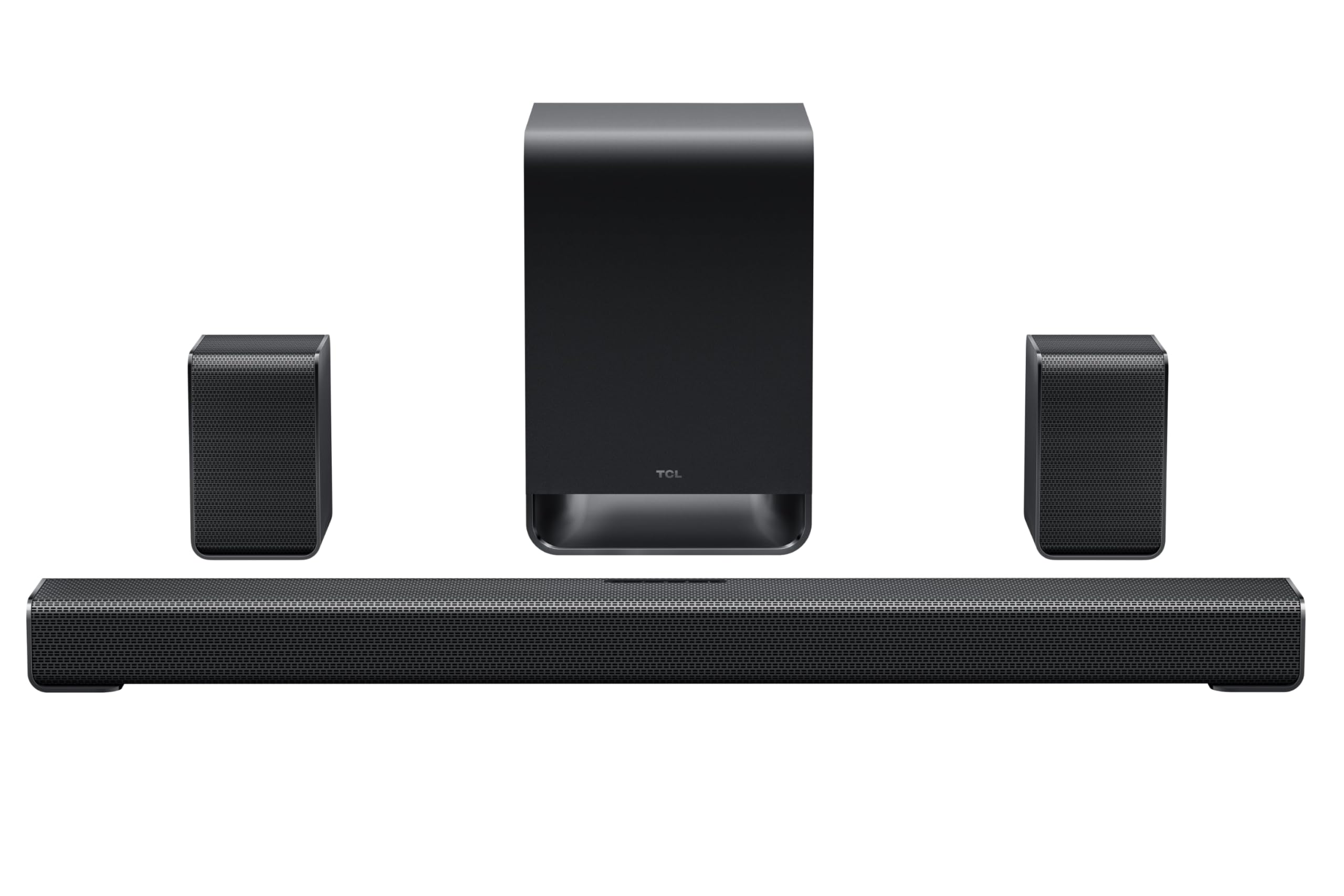
2. TCL S65K S Series 5.1 Channel Soundbar System
A true 5.1 with real rears for buyers who thought wireless surround was out of reach.
This is the value play in this list, and it does not cut corners on the parts that matter. You get a 5.1 system (five speakers plus a subwoofer) with a wireless subwoofer driven by a 6.5-inch driver and a pair of flexible wireless surround speakers — an actual rear channel, not a virtual one. Dolby Atmos and DTS:X decoding (two surround formats that add height and rear cues) put those cues into the mix. The subwoofer is where this one quietly surprises people: the 6.5-inch driver with Bass Boost is the smallest sub in this comparison, and the punchy bass is precisely what most owners single out as the standout from the very first film.
Setup gets close behind. A single HDMI cable is all the wiring the bar needs, and the built-in HDMI eARC connection lets you run volume from the TV remote. Bluetooth streaming works cleanly from a phone or tablet. A built-in center channel speaker and center tweeter keep dialogue clear during loud action scenes, and ChoruSound runs your TV speakers in harmony with the bar for a wider soundstage. Ray Danz Technology spreads the soundstage wider across the room, and AI Sonic Auto Room Calibration tailors the output to your space. Curiously, a Windows 11 computer also works fine as a source once the settings are sorted on the PC side.
Sizing notes from owners are worth taking seriously. The bar stacks a modest footprint of sound into a room — a workout room and a smaller TV setup come up as happy homes for it, and the rich quality of the rear speakers is what turns movies and games into something you lean into. What it will not do is match the raw scale of the 11.1.4 flagship further up this list; that system fires four height channels from twelve speaker positions, where this one works with five and a sub. For most people, the 5.1 experience and the honest value to start with is the reassuring bit.
The trade you are making: a 5.1 layout instead of a 7.1.4, so you get a convincing rear and overhead effect rather than a fully dimensional one — and you save meaningfully against the flagships.
What you actually gain: the easiest single-HDMI hookup here, eARC volume control from your TV remote, and the most approachable starting point in this category.
Reach for this if: you want genuine rear-channel surround without committing flagship money, especially with a TCL TV in the room.
Look elsewhere if: your room is large and you expect the 7.1.4-scale sound of the top picks.
3. Amazon Fire TV Soundbar Plus
The one-remote route into real surround for anyone already living inside Fire TV.
A 5.1 setup with a subwoofer and two surround speakers, Dolby Atmos and DTS:X decoding, and a center dialogue channel — the Fire TV Soundbar Plus covers the fundamentals. The advantage you will feel every night is the remote: one clicker runs both the TV and the bar, and the movie, music, sports, and night modes retune the output to what is on. Reviewers call the sound excellent for the size and report it holds up well in small spaces, including a Tiny Home or RV where a tall speaker tower would never fit. The automatic Bluetooth pairing with phone audio apps gets a mention too, and the sheer simplicity of the wireless setup is repeated claim after claim.
The dedicated center dialogue channel does what it promises: conversations stay clear under the action. Rear speakers sync up on their own every time the system wakes, several EQ modes let you shape the sound, and the dialog-level control lets you lift voices without cranking the whole mix. The one requirement the box is honest about: your subwoofer and surround speakers each need a power connection before they join the bar, so you are running three power cables, not signal cables.
The main thing to weigh is that this is a 5.1 system priced as a mid-tier one, where the TCL delivers true 5.1 for noticeably less and the JBL adds a bigger sub and detachable battery-powered rears on top. Reliability feedback leans more mixed here than the sound quality does — some units arrive sounding out of sync with the picture. If that happens, exercise your return window rather than living with it. The Fire TV audio settings let you customise the sound further on select models.
Hidden advantage: one remote controls TV and bar, and Fire TV’s own audio settings give you extra tuning — a benefit no other system here duplicates.
How it compares: a true 5.1 with a dedicated center dialogue channel for households already committed to the Fire TV interface.
Pick it if: your streaming runs through a Fire TV and you want surround without a second remote or a second app.
Skip the complication of seeking it if: you have a different TV platform — the remote advantage evaporates and the value case weakens.
4. JBL Bar 700 Soundbar
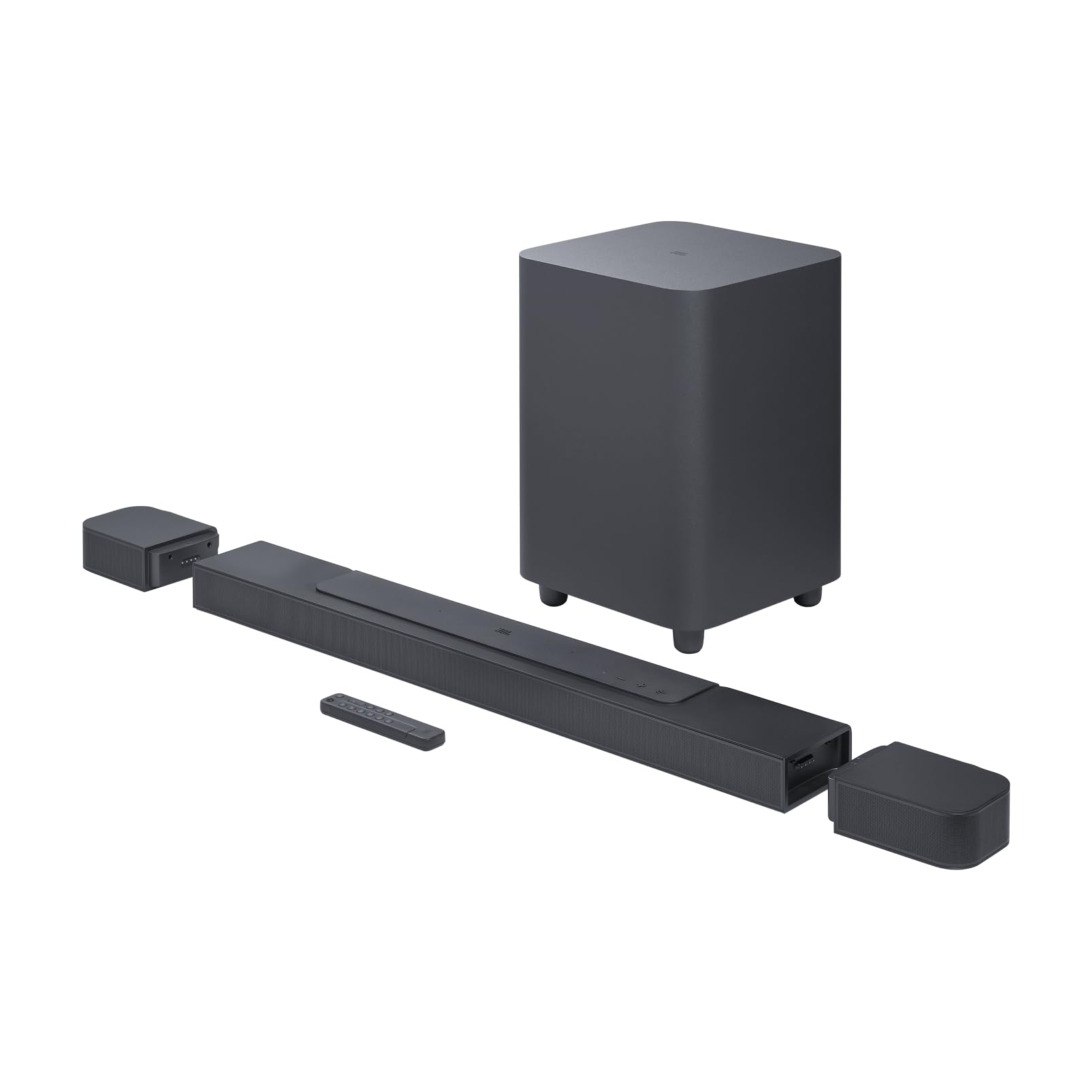
Rears you lift off the bar, batteries and all — surround anywhere you point them.
This is the cleverest rear-speaker design in the whole list. The Bar 700’s two surround speakers are detachable and battery-powered — you lift them off the soundbar, place them behind you, and you get true surround with no power cables running across the floor. For renters and anyone tired of fishing cables around a couch, that single change removes the biggest obstacle to the whole category. Total output is listed as 620 watts, the 10-inch wireless subwoofer is the biggest in this comparison alongside the ULTIMEA and Polk units, and Dolby Atmos sends height cues up and over. Built-in Wi-Fi with AirPlay, Alexa Multi-Room Music, and Chromecast built-in opens up streaming options well beyond Bluetooth, and the App control plus JBL One setup makes fine-tuning easy from a phone.
The bass is what owners find themselves showing off — it is precise and it hits, on top of an otherwise clean overall tone that reviewers describe as shaking the floor. Detachable rears get their own devoted following. There is an easy way to judge the flexibility: place the rears behind the couch for movies on a weekend, then clip them back onto the bar for a plain TV evening so you do not have to dodge them on the way to the kitchen.
The honest trade-off here is durability. Reliability and longevity feedback is more divided than the sound quality praise, with the occasional early fault reported. Wi-Fi also means the bar wants to be near your router’s usable range. And the detachable rears need their batteries topped up — clipping them back to the bar is part of the routine, not an optional extra. If those maintenance habits fit your week, the flexibility is worth it.
The clever part
- Detachable, battery-powered surround speakers — no power cable behind the couch
- 10-inch wireless subwoofer delivering precise, floor-shaking bass
- 620W system output power
- AirPlay, Chromecast built-in, and Alexa Multi-Room Music over Wi-Fi
- Native app control via JBL One
The maintenance bill
- Battery rears need recharging — plan to dock them on the bar regularly
- Mixed long-term reliability feedback in a minority of cases
- Wi-Fi features require a stable home network
The renter’s answer: no cable runs, no permanent speaker mounts, and a subwoofer that delivers real weight — ideal for apartment and flexible-room living.
The catch: recharging the detachable rears is a routine you have to keep up with.
5. Sony BRAVIA Theater System 6

Engineered to disappear into a BRAVIA television — right down to one menu for both.
Sony’s entry into this category is a 5.1 system: three front-firing speakers, two rear speakers, and an included subwoofer. Read that subwoofer description carefully — it is the wired kind, and the rear speakers use a wireless rear amp box, so this is not a fully cable-free design the way the JBL or ULTIMEA are. Pair it with a compatible BRAVIA TV, though, and the payoff is genuine: one TV menu controls the soundbar, and Voice Zoom 3 lifts dialogue through the television’s own processing. Dolby Atmos and DTS:X handle the cinema tracks, a dedicated center channel sharpens the dialogue, and Multi Stereo plays the same signal from all speakers for a room-filling boost when you just want volume and presence.
What reviewers keep coming back to is the scale of the thing. A small lounge ends up sounding like a theatre, and the general reaction is that Sony got the fundamentals right. Setup is reported as close to plug-in-and-play, with the soundbar and BRAVIA TV working together to do most of the work for you. The BRAVIA Connect app covers volume, sound profiles, and advanced settings from a phone, and Bluetooth streaming lets you play music from the handset. The frequency response reaches down to 20 hertz, which is the low rumble you feel as much as hear.
The part to plan around is cable management. The wired subwoofer needs its HDMI connection routed, and that run is fiddly in a tight entertainment unit — and because the rear amp box needs power too, you are still managing a few cables. Several owners also report intermittent popping from the rear speakers. Neither kills the appeal of the sound; both are cables-and-power realities you should budget an afternoon for before movie night.
Where Sony wins: deep integration with BRAVIA TVs — one menu, one remote, and Voice Zoom 3 handling dialogue at the television level.
The reality check: the subwoofer is wired and the rear speakers run through a powered amp box, so plan your cable runs before you lift the unit into place.
Best suited to: a Sony BRAVIA household that wants the menu integration and is happy to route a couple of cables.
Think twice if: a cable-free installation is a hard requirement for your room.
6. ULTIMEA Skywave X70
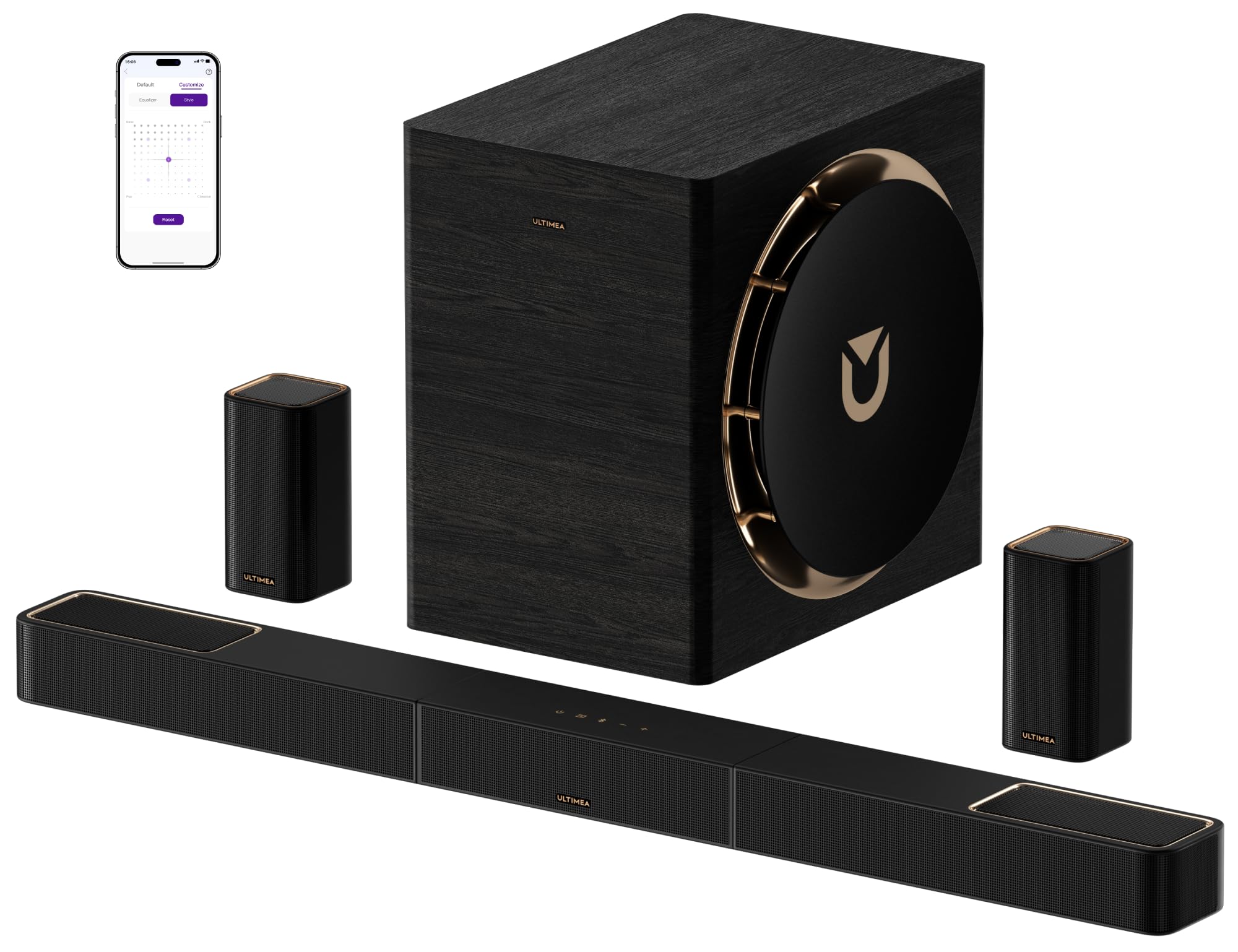
A 7.1.4 layout on dual 5GHz links — height and rear effects without a single signal cable.
Here is where wireless stops being a compromise. The Skywave X70 runs a 7.1.4 configuration through dual 5GHz transmission, with advanced RF and networking protocols designed to hold a stable connection and cut interference. That matters for this category specifically: wireless rear speakers are only as good as the link that feeds them, and a stuttering rear channel is worse than no rear channel at all. In terms of raw output, the 10-inch subwoofer is rated to 980W peak and reaches down to 20Hz — the same 20Hz figure as the Sony’s frequency response floor, arrived at from a different direction.
The immersion is what sells it. Height channels put rain overhead, a helicopter above you, and thunder rolling across the room, and the subwoofer pushes bass you feel through the furniture as much as hear. A triple-core DSP and dual-core MCU drive the NEURACORE engine, delivering 24-bit/192kHz audio at under 0.5% distortion and processing power rated up to 2,000 MIPS across up to 17 channels. The GaN amplifier is claimed at up to 98% efficiency and 8x faster response than silicon, with 50% less heat. Around the back, 4K HDR pass-through keeps the picture intact, CEC lets the TV remote wake and control the system, and the ULTIMEA app handles OTA updates along with a 10-band EQ and 121 sound presets.
The one recurring frustration is centre-channel control. There is no dedicated centre-channel volume adjustment in the app, so dialogue can get lost under the mix when you push the volume. Balanced against that, the build quality, the wireless reliability, and the metal grille with rose gold accents and wood-finished subwoofer win a lot of people over. ULTIMEA also backs it with 12 months of after-sales service, 24/7 technical support, and a 60-day replacement policy.
Why it earns its position: 7.1.4 channels over dual 5GHz wireless, a 10-inch sub reaching 20Hz, and 4K HDR pass-through — a full professional layout with no signal cables.
The honest caveat: no dedicated centre-channel volume control, so dialogue can sink under heavy bass.
The pick for a room you are building around: a 7.1.4 layout that needs no audio cables, with a subwoofer that reaches 20Hz.
The caution: if dialogue intelligibility under bass-heavy mixes is your priority, this system gives you fewer levers than the Samsung or Polk.
7. LG S90TR 7.1.3ch OLED evo TV Matching Home Theater Soundbar

Rears that connect with no receiver box, and a centre channel that fires upward at dialogue.
A 7.1.3 layout built around Dolby Atmos and DTS:X, with rear speakers that use wireless connectivity and no special receiver box. The detail that stands out in this category is the exclusive up-firing center channel — instead of aiming dialogue straight out, it angles upward so conversations sit in the room rather than pinned to the bar. WOW Orchestra syncs the LG TV and soundbar speakers into one performance, WOW Interface lets a single remote run both, and WOWCAST built-in delivers wireless Dolby Atmos without visible wires, lag, or loss in audio quality. Advanced Room Calibration uses a built-in microphone to measure your room’s dimensions and optimise accordingly.
For gaming, this is the bar with the specification that matters: VRR (variable refresh rate, which stops screen tearing) and ALLM (auto low-latency mode, which cuts input lag) support with a passthrough refresh rate up to 120Hz, so the sound keeps pace with a fast console and the picture is not downgraded on its way through. rich 3D Spatial Sound widens the scene, and multi-platform support covers Google Assistant, Alexa, Chromecast, and AirPlay 2 through the LG Soundbar app. The audio output itself earns the strongest reaction — reviewers describe it as wide and explosive, and the wireless rear connection alone is enough for some buyers to call it worth every penny.
Two things to weigh. Connectivity is the mixed area: it pairs at its best with an LG TV, and outside that pairing some setups fight the handshake. It is also, by design, a match for LG screens rather than a universal fit. Second, room calibration wants the microphone to hear your space properly, so avoid burying the bar inside a cabinet. One clear advantage over the Sony system: no separate rear amp box to place and power, and over the Samsung flagship, three height channels instead of four — a smaller but still genuine overhead effect.
The gaming edge: VRR/ALLM passthrough at up to 120Hz keeps both picture and sound responsive — the only pick here that calls that out explicitly.
The honest limit: you get the most out of it with an LG TV; broader brands work via optical or HDMI ARC but lose the WOW handshake.
Made for: an LG OLED owner who wants matching cinema sound, calibrating rears, and a gaming-ready passthrough in one box.
Consider the ULTIMEA instead if: you want a 7.1.4 layout that is not tied to a particular television brand.
8. Polk Audio MagniFi Max AX SR
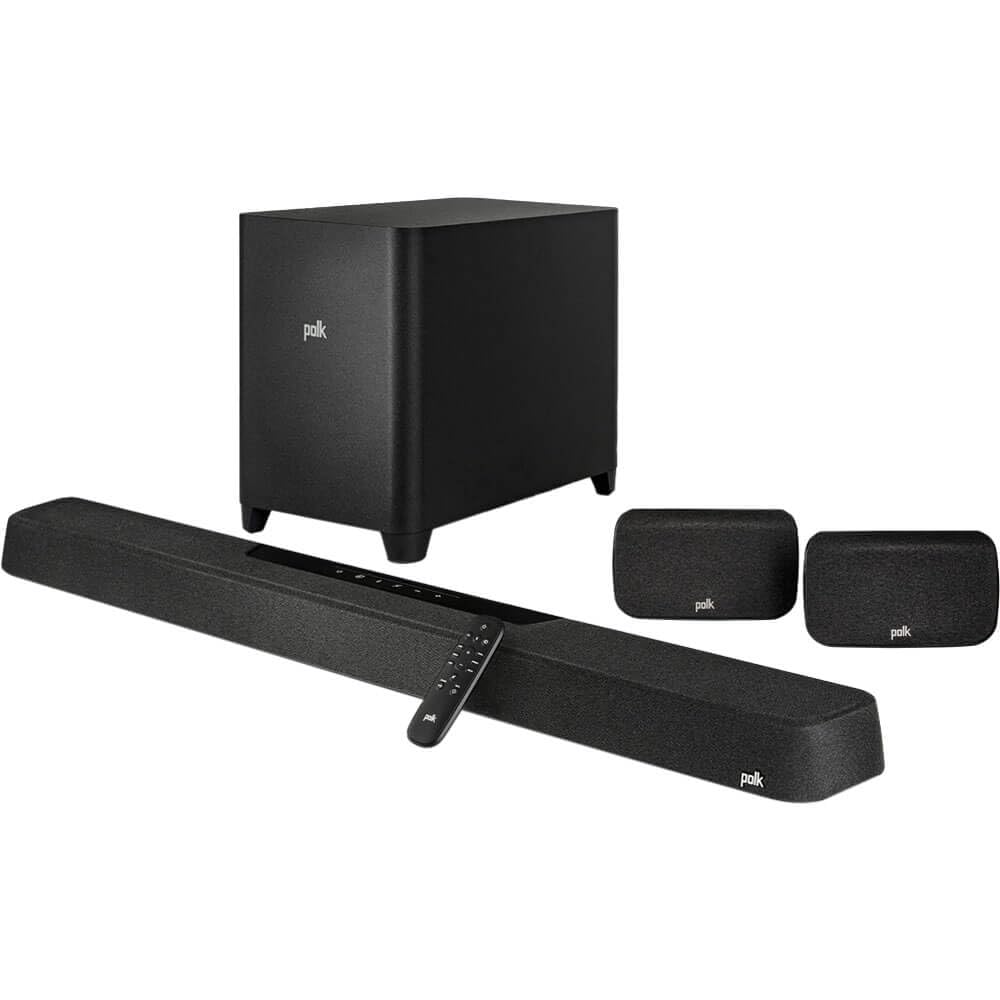
The all-rounder: a 10-inch sub, two up-firing speakers, and more HDMI inputs than anything here.
Polk’s flagship bundle pairs the MagniFi Max AX soundbar and subwoofer with a pair of SR2 surround speakers, giving you a 7.1.2 layout with audio from every corner of the room, including overhead. Two up-firing speakers create the height layer from certified Dolby Atmos and DTS:X tracks, and Polk’s patented SDA 3D technology spreads the soundstage. The 10-inch wireless subwoofer connects the instant you power it on and delivers bass that is surprising for its size.
For anyone tired of swapping cables, the connection list is the real selling point: three 4K HDMI inputs alongside HDMI eARC, an optical input, and a USB-A port for firmware updates. Three games consoles or a console plus a streaming box can all stay plugged in at once. VoiceAdjust technology works with the integrated center channel to raise vocal levels without touching the rest of the soundtrack — the single most useful feature if you struggle with murmured dialogue. And for people who like the controls at their fingertips rather than buried in an app, the remote has direct buttons for vocals, bass, mid, and treble. Wireless home audio covers Wi-Fi, Bluetooth, Apple AirPlay 2, Chromecast, Spotify Connect, and AlexaMRM.
The counterweight: this is the second most expensive system here, and it earns that with connectivity and control features rather than a showier spec. There is also the occasional report of a unit dropping its input or Bluetooth pairing, and a durability failure after the warranty window in rare cases. Check the input settings first if a source keeps resetting — often the fix is in the menu, not the hardware.
What sets the connection game apart
- Three 4K HDMI inputs plus eARC, optical, and USB-A — the most input flexibility in this list
- VoiceAdjust dialogue boost on the remote, adjustable without the app
- 10-inch wireless subwoofer with instant auto-connect
- Apple AirPlay 2, Chromecast, and Spotify Connect built in
What to keep an eye on
- Some units have trouble holding a set input or Bluetooth pairing
- Rare reports of hardware failure past the warranty window
- Rooms without a flat ceiling lose some of the height effect
The gear-head’s pick: a household with several 4K sources and a dialogue-boost need, where direct remote controls beat app menus.
The alternative: if you just want maximum immersion per tier, the ULTIMEA packs more height channels; Polk trades that for inputs and vocal control.
9. Samsung HWQ990F Soundbar

The flagship layout, refurbished and covered — 11.1.4 channels for less than new.
The same True 11.1.4-Channel Configuration as the top pick, in a manufacturer-refurbished unit that shows limited wear and arrives with all essential components plus a 90-day warranty. That certified-refurbished status is the headline: you get the full flagship channel count, wireless Dolby Atmos and DTS:X playback, and an 8-inch subwoofer driver, on a unit Samsung has tested back to like-new performance. This is the widest channel configuration in the comparison, matched only by the HW-Q990C above it.
The feature list reads like the flagship it is: SpaceFit Sound Pro Plus calibrates to your room, Active Voice Amplifier Pro keeps dialogue on top of the mix, and Game Mode Pro with 3D Sound optimises for a console. The rear and side speakers and the subwoofer pair automatically, so the setup that could feel intimidating is actually one of the quickest here. With Atmos content the system opens up impressively, and with a Q-Series television the entire chain syncs into one ecosystem.
The trade-off is the refurbished route itself. You get a 90-day warranty instead of a full manufacturer term, so the sensible move is to test every input, the rear speakers, and the subwoofer within that window. The equalizer and voice controls also offer less granular adjustment than some buyers like, so lean on the presets rather than expecting full manual tuning.
Spec-for-spec: 11.1.4 channels with wireless Atmos and DTS:X at a refurbished outlay — the flagship experience with a shorter warranty.
Where the compromise lives: not in the sound, but in the 90-day coverage and the limited equalizer depth.
Best fit for: a Samsung TV household willing to bet on a certified refurbished flagship to get 11.1.4 channels at a lower outlay.
Look to the HW-Q990C above if: you want a new unit and a full warranty term over a refurbished one.
Know the Specs
Channel Numbers (5.1 vs 7.1.4 vs 11.1.4)
The first number is your speaker count excluding the sub; the middle number is the subwoofer channel; the last number, if present, is the height layer. A 5.1 system gives you front left, center, right, and two rears plus a sub. A 7.1.2 or 7.1.4 adds height channels that fire at the ceiling. An 11.1.4 like the Samsung HW-Q990C spreads eleven main channels plus four height channels — it needs the room to justify the extra positions, or you are paying for speakers that cannot do their job. Match the layout to your seating, not the other way round.
Up-Firing Drivers and Height Effects
Dolby Atmos height channels work by reflecting sound off your ceiling. Up-firing speakers sit angled at the top of the bar or the rear boxes and bounce the audio back down to you. The Samsung HW-Q990C puts 4 height channels on the job; the Polk uses 2 up-firing speakers for its 7.1.2 layout; the ULTIMEA reaches 7.1.4. The effect is strongest with a flat, reflective ceiling and a seat a few feet from the bar. Vaulted or heavily textured ceilings scatter that reflection and soften the effect.
Subwoofer Driver Size and Low-Frequency Reach
The subwoofer handles the “.1” — the deep rumble that makes explosions land and music feel alive. The bigger the driver, the more air it moves: 10 inches on the JBL Bar 700, ULTIMEA, and Polk; 6.5 inches on the TCL; 8 inches on the Samsung HWQ990F. Frequency response matters too, and a figure reaching 20Hz like the ULTIMEA and Sony means it dips well into the range you feel. Note whether the sub is wireless (most here) or wired (Sony) — wired means another cable to route.
Room Calibration and Dialogue Processing
Calibration listens to your space and rebalances the output — names to know include Samsung’s SpaceFit Sound Pro and SpaceFit Sound Pro Plus, TCL’s AI Sonic Auto Room Calibration, and LG’s Advanced Room Calibration. Dialogue processing is a separate toolset: a dedicated center channel, Polk’s VoiceAdjust, Samsung’s Active Voice Analyzer. Hard floors and bare walls make calibration worth more than extra wattage. If you mostly watch dialogue-driven drama, weight the voice tools above raw power.
Common Questions
Do wireless rear speakers still need a power outlet?
Is 5.1 or 7.1.4 better for a small living room?
Will a soundbar with wireless rear speakers work with any TV brand?
How high should I place the rear speakers?
What is the difference between Dolby Atmos and DTS:X?
How do I stop dialogue getting lost in the action?
Can I use the rear speakers as normal stereo speakers?
Does a refurbished flagship soundbar make sense over a new mid-range one?
How many HDMI inputs do I need on a soundbar?
Will height channels work with a vaulted or textured ceiling?
Do these systems support Bluetooth music streaming from a phone?
The Bottom Line
The soundbar with wireless rear speakers that earns the top spot is the Samsung HW-Q990C, because its 11.1.4 layout with four up-firing channels and an included up/side firing rear kit is the most complete surround package in this list — and 500+ owners rate it 4.5+ stars. If wireless freedom matters most and you cannot run a cable behind the couch, the JBL Bar 700 and its detachable battery-powered rears solve that problem outright. For a room where dialogue keeps getting buried, the Polk MagniFi Max AX SR gives you VoiceAdjust and three 4K HDMI inputs. And if you want the full 7.1.4 height experience without paying flagship money, the ULTIMEA Skywave X70 delivers dual 5GHz wireless rears and a 10-inch sub reaching 20Hz. One honest nudge before you pick: read the included-parts list on each product page and count your wall outlets behind the seating — that single step prevents the most common surprise in this category.
How we choose
We do not accept paid placement. Every pick is matched to a real buyer and a real use-case; we do not hands-on test units.
Sources
Specifications: manufacturer listings and product documentation. Review insights: verified customer reviews, as of November 2026. Pricing: not shown on this page (it changes often); check the current price via the retailer link.
As an Amazon Associate, Tactical Gear Guy earns from qualifying purchases. This does not affect which products we feature.