Specs are compiled from manufacturer listings and verified buyer reviews and can change over time — please confirm the key details on the product page before buying.
If your turntable hums, your speakers buzz, or your mixer drops a channel when someone walks past, the cable is the first thing to suspect — and the fastest thing to fix. This guide covers seven real sound system cables, matched to the job each one actually does: RCA interconnects for a turntable or CD player, XLR runs for a microphone, quarter-inch speaker leads for a bass rig, and bare speaker wire for in-wall runs.
This guide is built by comparing the manufacturers’ published specifications and the patterns across verified customer reviews, so you get each pick’s real strengths and trade-offs instead of marketing spin.
The picks below are grouped by connector type, because plugging the right cable into the wrong jack is the mistake that wastes the most money here. The short answer: buy the connector that matches your gear and the shield that matches your room — and this breakdown of the best sound system cables shows you exactly which one does both.
Top Picks
How To Choose The Best Sound System Cables
The first decision is not brand, length, or price — it is the connector. A cable only helps if its plug physically fits the jack on your gear and carries the right kind of signal. Get that wrong and no amount of shielding saves you.
Match the connector to the jack, every time
RCA plugs (the round push-on pair, red and white) carry unbalanced analog audio between a turntable, CD player, or DAC and an amplifier. XLR plugs (the three-pin locking barrel) carry balanced audio to microphones, mixers, and preamps. Quarter-inch TS plugs (the big guitar-style jack) feed amplifiers and speakers in pro audio gear. Bare speaker wire is unterminated copper you clamp into spring posts or binding posts yourself. Buy one type and try to force it into another and you get silence, hum, or a damaged jack.
Shielding is what kills the hum
Hum is electromagnetic interference (EMI) — stray electrical noise from power supplies, dimmers, and routers getting picked up by the cable. A foil wrap helps, but a braided copper shield laid over the conductor does more at audio frequencies. Two braids laid one over the other is better still, because the coverage is denser and the resistance to ground is lower.
Capacitance decides how much treble survives
Capacitance is the cable’s tendency to store a little charge as the signal travels, and it is measured in picofarads per foot (pF/ft). Higher capacitance rolls off high frequencies, so cymbals and strings go dull over a long run. A low-capacitance coax keeps the top end intact, which matters most with low-output sources like a moving-magnet phono cartridge.
Gauge and length for speaker runs
Gauge (AWG) is the thickness of the copper inside the jacket — and lower numbers mean thicker wire. A 12 AWG cable carries more current with less resistance than a 14 AWG one, which matters for long runs to speakers and for bass-heavy rigs that pull real power. Short runs at modest volume are far more forgiving.
Side-by-Side Comparison
| Model | Best For | Connector Type | Length | Shield / Gauge | Amazon |
|---|---|---|---|---|---|
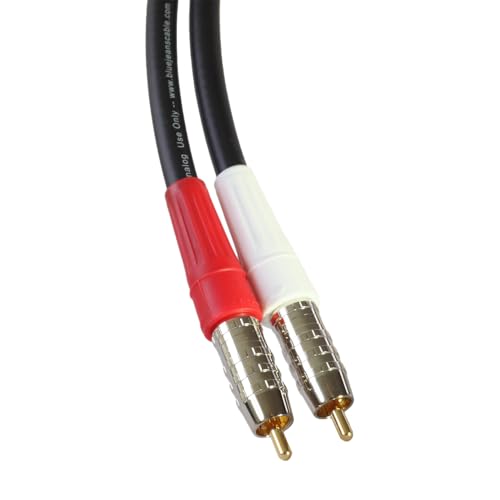
| Blue Jeans Cable LC-2★ Best Overall | Turntables and low-level analog sources | RCA | 3 feet | Double copper braid, ~12 pF/ft | Amazon |
| Aqdocvf 2-Pack XLRLongest Run | Mic and mixer runs on stage or in studio | XLR | 25 feet | OFC conductors, PVC jacket | Amazon |
| Auidophile 2RCA Gold Plated | HiFi systems on a sensible budget | RCA | 3 feet | 4N oxygen-free copper, gold plating | Amazon |
| Hosa HRR-005X2 | Repairable studio interconnects | RCA | 5 feet | 24 gauge | Amazon |
| Cable Matters Braided 1/4 Inch | Amps, mixers, and bass rigs | 1/4 inch TS | 6 feet | 12 AWG, braided jacket | Amazon |
| Amazon Basics 14-Gauge Speaker Wire | Home theater and surround installs | Bare wire | 100 feet | 14 AWG, 99.9% oxygen-free copper | Amazon |
| AudioQuest Tower RCA | Compact premium interconnects | RCA | 0.6m | Solid long-grain copper, NDS | Amazon |
Detailed Reviews
1. Blue Jeans Cable LC-2 Stereo Audio Cables (Black, 3 Foot)
Our pick — 4.5+★ from 900+ verified ratings; the strongest balance of quality and price.
The turntable cable that keeps hum out and high frequencies in.
Here is the number that decides this one: capacitance sits around 12 pF per foot. Capacitance is how much of the signal the cable stores as it travels, and lower is better for treble. At roughly 12 pF/ft the LC-2 keeps cymbals and strings from going dull on a phonograph run — exactly where a weak signal suffers most.
Blue Jeans built it as a coax (a center conductor wrapped inside a shield) rather than a stock RCA lead. The shield is two bare copper braids laid one directly over the other, which gives dense coverage and low resistance to ground. That low resistance to ground is what suppresses ground loop hum — the low buzz from gear sharing a noisy outlet.
It is a thick cable, yet the soft PVC jacket and foam dielectric keep it flexible enough to route behind a rack. The double-braid design also dodges triboelectric noise — the crackle a cable can generate when it flexes — which matters at low signal levels. Heavy shielding that earns this much trust is rare: the crowd favorite here, 4.5+ stars across 900+ ratings, and it also stacks up against the AudioQuest Tower on paper.
Where the LC-2 earns its keep
- Capacitance around 12 pF/ft keeps the top end intact on long phono runs.
- Two bare copper braids laid one over the other press hum down at audio frequencies.
- Flexible enough to route behind a rack despite the thick jacket.
- Built for amplifiers, CD players, and turntables over a 3-foot run.
Where it asks something of you
- 3 feet is short — plan the rack before you buy, not after.
- Custom coax construction puts it in the premium tier for a single cable.
Buy it for: any turntable, CD player, or amp pull where a faint background buzz is ruining quiet passages.
Measure first: you get 3 feet of length, so check your rack spacing before ordering.
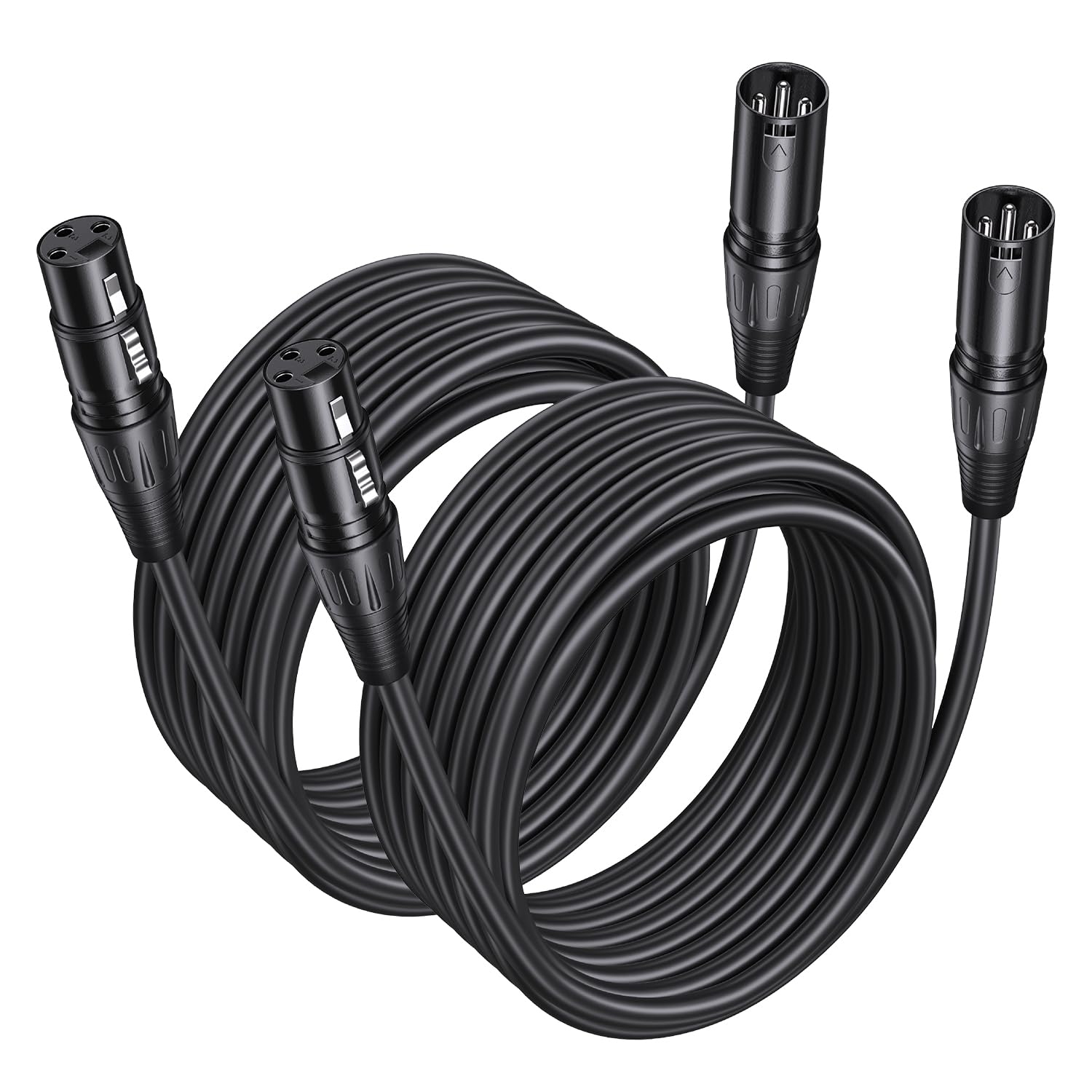
2. Aqdocvf 2-Pack XLR Cable 25ft
Two 25-foot balanced runs that click in and stay put across a stage.
If your mic is on a stand at the far side of a stage and the mixer is at the back, length stops being a detail and starts being the whole point. This pair gives you 25 feet each, so you can cross a performance space without a splice. Both cables are in the bag, which covers a stereo pair or a main and a spare.
They use oxygen-free copper conductors (copper refined to strip out oxygen so it resists corrosion) in a balanced design. Balanced means the signal is carried in a way that cancels noise picked up along the run — the reason a long mic lead can still arrive clean. A soft PVC jacket adds a layer of physical protection without stiffening the cable.
The connectors are 3-pin XLR with a self-locking collar, so they seat with a click and hold. That fit is the part owners single out: build quality leads the way, followed by how well it just works in real setups. The maker rates these XLR cables for over 20,000 bends and 10,000 plug cycles — a lab figure, not a field record. At 15.84 ounces for the set, these are not featherweight — but a long XLR run rarely is.
The practical win: 25 feet of balanced XLR in a two-pack covers a full stage run, and the locking collars mean the plug stays where you seated it.
What to keep in mind: the cables carry real heft at 15.84 ounces, so coiling them properly between gigs saves tangles later.
Right call if: you move mics and mixers around a stage or a home studio and need length plus a locking plug.
Look elsewhere if: you only need a short patch between two nearby boxes — this much cable is wasted.
3. Auidophile 2RCA Male Audio Cable 3 Feet

A short, gold-plated RCA pair that fits firmly and kills a stubborn hum.
The most common complaint about cheap RCA leads is a loose plug that wiggles and crackles. This one takes the opposite approach: tight connectors that seat firmly in the jack. That firm fit is what silences a hum-ridden RCA connection, and buyers report systems that buzzed before going quiet once this pair is in.
The conductors are 4N oxygen-free copper (copper of high purity, graded for low impurity) with a high-density shield against electromagnetic interference. The connectors are 3U gold-plated and polished metal, and gold resists the corrosion that dulls a connection over time. Red and white color coding on the plugs makes left-and-right hookups quick. The metal rings carry arrow marks so you can point signal the right way from a CD player into an amplifier.
At 3 feet it is a rack or shelf cable, not a room-crosser. Set that against the Hosa on this list: the Auidophile runs 3 feet to the Hosa’s 5 feet, so the Hosa wins on reach while this one wins on price. It also carries a 12-month manufacturer warranty, which is more coverage than most cables at this rung offer.
Reasons this earns a spot
- Gold-plated connectors resist corrosion and seat firmly in RCA jacks.
- 4N oxygen-free copper with a high-density shield cuts outside interference.
- Arrow-marked metal rings and red/white coding make hookup direction obvious.
- Backed by a 12-month manufacturer warranty.
Where it stops
- 3 feet limits it to gear that sits close together.
- Color shown is red — check that it matches the look you want.
For the money: the tightest-fit RCA pair here for a shelf setup chasing a hum it can’t seem to lose.
Not for: long runs — 3 feet is a tight leash, so measure the gap between your amp and source.
4. Hosa HRR-005X2 Dual RCA Cable

Five feet of studio interconnect you can open up and repair yourself.
Here is a cable built for people who own a soldering iron. The connectors can be taken apart, which means a worn joint gets fixed instead of throwing the whole lead away. That single feature separates it from every sealed molded plug on this list.
It runs 5 feet, and the gauge is 24. Set that beside the Cable Matters 12 AWG — 24 AWG here versus 12 AWG there — and the Hosa is the slimmer, more flexible interconnect for line-level signal, while the Cable Matters handles speaker-level current. They do different jobs, and mixing them up is the mistake this list is here to prevent.
Inside, it is dual REAN RCA ends feeding a stereo pair, so left and right travel together and stay labelled. Owners mention quiet, noise-free line-level signal and connectors that survive repeated plugging. For patching a mixer to a headphone amp or a music player to a small speaker, the 5-foot reach sits in a comfortable middle — long enough to stretch across a desk, short enough not to coil into a knot.
The quiet performer: 24 gauge wire and dual REAN plugs keep line-level audio clean between a mixer, headphone amp, or music player.
The trade-off: thinner conductor than a speaker lead — do not run it to drive speakers.
Made for: the tinkerer who wants a 5-foot interconnect that can be opened and re-soldered instead of replaced.
Not the pick for: speaker-level runs, where you want the thick 12 AWG wire instead.
5. Cable Matters 12 AWG Speaker Cable 6ft
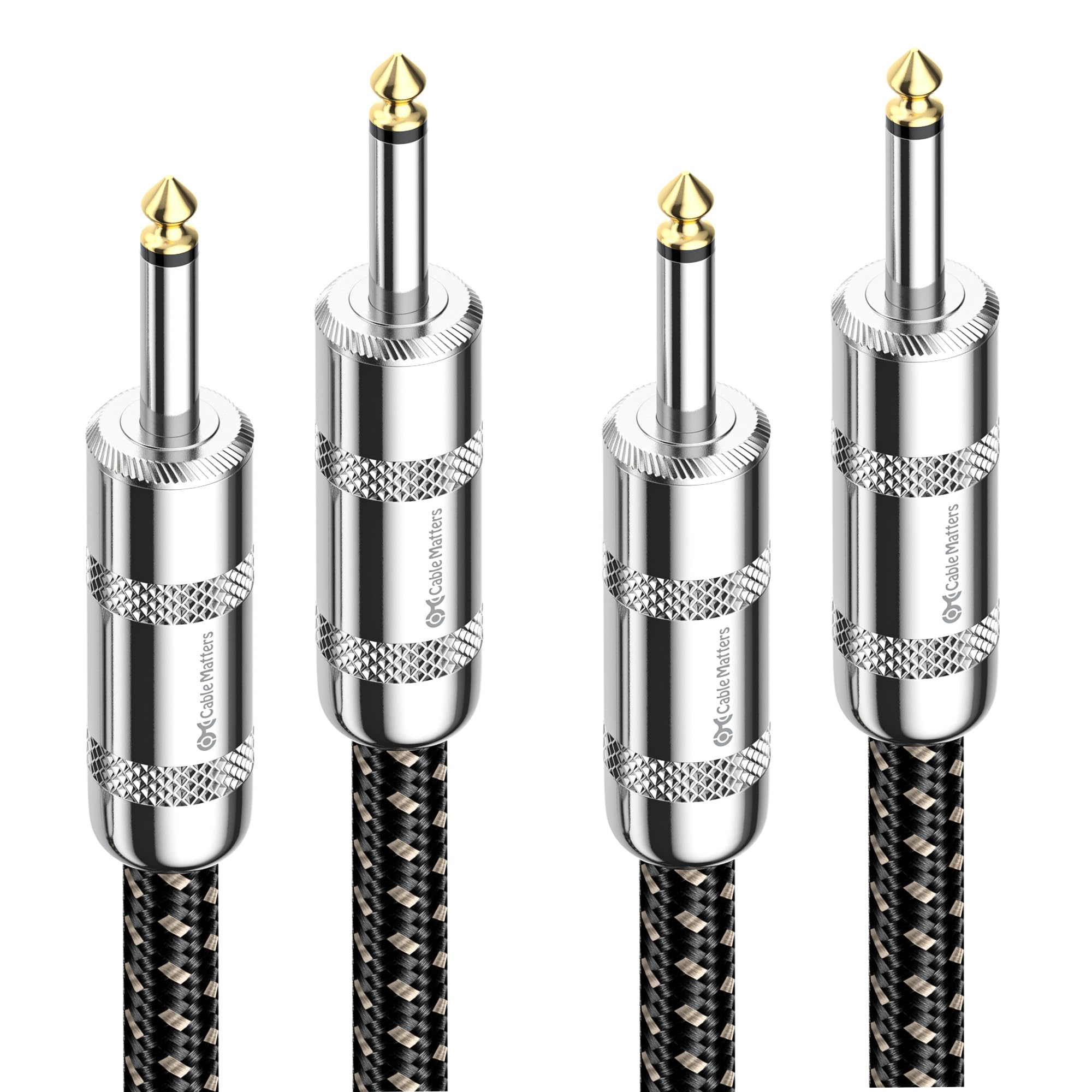
Thick 12 AWG quarter-inch leads built to feed an amp and a speaker cabinet.
Twelve gauge is the whole reason this pick exists. Gauge is the thickness of the copper — and lower numbers mean more metal carrying the current. At 12 AWG, this speaker cable moves amplifier power to a cabinet with less resistance than a thin line-level lead, which is exactly what a bass rig or a mixing board run needs.
The plugs are two-pole TS quarter-inch connectors, the same jack on a guitar amp or pro audio gear. This is not an RCA or an XLR — it will not fit those jacks, and it should not try to. The metal connectors are made for frequent plugging and unplugging, and the braided jacket protects the cable from tangling and fraying when you coil it at the end of a session. You get two in the pack, enough for a left and a right feed to an amp.
Owners find them well-made and stable in the electrical connection. Where the fit meets real-world setups, they suit a bass rig well; where it gets mixed is whether the bulk suits tight spaces. If your cabinet sits close and free of kinks, that bulk is a strength.
Why it fits the job
- 12 AWG wire carries amplifier current with lower resistance.
- Braided jacket resists tangling and fraying on a coiled run.
- Metal two-pole TS connectors handle repeated plugging.
- Two cables per pack cover left and right feeds.
The honest catch
- Thick and heavy — it needs room to bend cleanly behind a cabinet.
- Quarter-inch TS only — will not connect RCA or XLR gear.
Best suited to: a bass amp, mixer, or speaker cabinet fed by quarter-inch TS jacks that want a stout 12 AWG lead.
Think twice if: your rig is tight on space or your jacks are RCA or XLR.
6. Amazon Basics 14-Gauge Speaker Wire 100-Foot

A 100-foot spool of 14-gauge copper for wiring speakers around a room.
This one is a spool, not a finished cable — you terminate it yourself into spring posts or binding posts. The reel gives you 100 feet, enough to wire a surround setup across a room with slack left over. That length is why it tops out as the biggest value of the bare-wire options here.
Inside is 99.9% oxygen-free copper, two conductors, color coded white so polarity stays straight during installation. Getting positive and negative right on every speaker is the step people rush, and clear coding is the fix. The insulated jacket protects the copper and stands up to repeated handling while you route it behind a wall or along a baseboard. At 2.65 kg for the spool, it is a real pickup — plan on carrying it, not tucking it in a pocket.
Here is the honest part: stripping this wire to bare copper is the recurring friction. Some find it easy to handle and install, others find it stiff to strip, so a proper wire stripper earns its place in your toolbox. The 14 gauge is also the trade-off a bass-heavy long run will feel — it is thinner than the 12 AWG Cable Matters lead, so keep this for surround speakers and moderate runs. It suits surround speaker runs, where the 14-gauge copper carries signal cleanly at moderate distances.
The value read: 100 feet of 14-gauge oxygen-free copper in one spool covers a full surround install with room to spare.
The honest cost: this wire fights back when you strip it, so keep a real stripper handy and pace yourself.
Pick this when: you are wiring surround or in-wall speakers across a room and want one long spool to cut to length.
Skip the spool if: you run a bass-heavy long speaker run where 12 AWG wire would serve you better.
7. AudioQuest Tower RCA Cable 0.6m

A short premium RCA pair for a compact shelf system where every inch counts.
Tower is a name AudioQuest gives to its budget-tier line, but the construction here is not budget-minded in spirit. The conductors are solid long-grain copper (one continuous metal path rather than many fine strands), paired with expanded polyethylene insulation and AudioQuest’s NDS system — a metal-layer stack designed to disperse the noise that rides along a cable.
It uses double-balanced asymmetrical geometry, with cold-soldered gold-plated connectors. At 0.6m the pair is short by design — it is a shelf connector between a source and an amp, not a room run. The stated weight is 100 g, so it sits light and tidy behind compact gear.
Owners praise the Tower’s sound and build, and it makes a clean, quiet RCA connection on a shelf system. The counterweight is real: reliability shows mixed results in owner reports, and some units have failed where others kept working. That is a fit-and-care trade-off, not a verdict on the whole line — treat the connectors gently and it behaves. Weigh that against the Blue Jeans above, which costs more but carries the heavier 4.5+ rating over a larger base.
What the Tower brings
- Solid long-grain copper keeps the signal path continuous.
- Double-balanced asymmetrical geometry plus NDS noise dispersion.
- Cold-soldered gold-plated connectors for a clean contact.
What to weigh
- 0.6m is a shelf length only — not a room run.
- Reliability reports are mixed; a gentler hand on the connectors helps.
Go for it if: you want a compact premium RCA pair for a shelf system and prize the AudioQuest geometry.
Look to the Blue Jeans instead if: you want the stronger owner record, at a higher price.
Know the Specs
Capacitance (pF/ft)
Capacitance is how much signal the cable stores as it travels, measured in picofarads per foot. Higher capacitance bleeds off high frequencies over a long run, so cymbals and strings sound dull. A low-capacitance coax, like the Blue Jeans LC-2 at around 12 pF/ft, keeps the treble intact — most important with a low-output phono cartridge.
Shielding and Braid
The shield is the conductive layer that intercepts electromagnetic interference before it reaches the signal. A braided copper shield laid over the conductor gives dense coverage and low resistance to ground, which is what suppresses ground loop hum. Two braids stacked are denser than one, and denser coverage means less stray buzz in a room full of power supplies and dimmers.
Gauge (AWG)
Gauge is the thickness of the copper conductor inside the jacket — and lower numbers mean thicker wire. A 12 AWG speaker cable carries more current with less resistance than a 14 AWG one, which matters on long runs and bass-heavy rigs. A thin 24 gauge interconnect is fine for line-level signal but is not built to drive a speaker.
Connector Types
RCA plugs carry unbalanced analog audio between a turntable, CD player, or DAC and an amplifier. XLR is a three-pin balanced connector for microphones, mixers, and preamps. Quarter-inch TS is the larger two-pole jack on pro audio amps and speakers. Bare wire is unterminated copper you clamp into a binding post. Each one fits only its own jack, so matching the plug to the socket comes before any other choice.
Common Questions
Will a 3-foot RCA cable reach from my turntable to my amplifier?
How do I stop my audio cable from humming?
What is the difference between RCA and XLR cables?
Do I need 12 AWG or 14 AWG speaker wire?
Can I use a quarter-inch speaker cable with my RCA amp?
Does a more expensive cable really improve sound?
How long do audio cables usually last?
Is it worth stripping and terminating speaker wire myself?
What does oxygen-free copper do in a cable?
Can a short RCA cable still be worth buying?
The Bottom Line
For most turntables, CD players, and amps, the sound system cables winner is the Blue Jeans Cable LC-2 because its double copper braid and roughly 12 pF/ft capacitance keep hum out and treble in over a 3-foot run. If you need reach across a stage, grab the Aqdocvf 2-Pack XLR with its 25-foot balanced runs and locking plugs. And for wiring surround speakers across a room, the Amazon Basics 14-Gauge Speaker Wire is the one to reach for, with 100 feet of 99.9% oxygen-free copper on a single spool. If your rig runs on quarter-inch jacks and wants stout wire, the thick 12 AWG build of the Cable Matters speaker pair earns the call.
How we choose
We do not accept paid placement. Every pick is matched to a real buyer and a real use-case; we do not hands-on test units.
Sources
Specifications: manufacturer listings and product documentation. Review insights: verified customer reviews, as of November 2026. Pricing: not shown on this page (it changes often); check the current price via the retailer link.
As an Amazon Associate, Tactical Gear Guy earns from qualifying purchases. This does not affect which products we feature.