Specs are compiled from manufacturer listings and verified buyer reviews and can change over time — please confirm the key details on the product page before buying.
Your room echoes back at you — a podcast sounds hollow, every game shot bounces off the wall, and the neighbor’s TV leaks through the drywall. Sound resistant foam soaks up those reflections, which is why a room sounds loud and muddy in the first place. Below, eight real foam packs get compared on density, thickness, coverage, and how they actually stick to a wall, so you can quiet your specific space.
This guide is built by comparing the manufacturers’ published specifications and the patterns across verified customer reviews, so you get each pick’s real strengths and trade-offs instead of marketing spin.
You’ll see how thickness and density change what a panel does in your room. You’ll learn where self-adhesive backing saves you a trip to the hardware store, and which packs cover a full wall without a second order. The right sound resistant foam turns a boomy room into one you can actually record in.
Top Picks


How To Choose The Best Sound Resistant Foam
Acoustic foam does one job: it soaks up sound that would otherwise bounce off a hard wall and come back at your ears as echo. It does not block noise from passing through a wall — that job needs mass and sealing instead. Knowing that difference keeps you from buying the wrong product and being disappointed.
Thickness and density are the two numbers that matter
A thicker panel gives sound waves more material to cross before they reach the wall behind it. That is why 2-inch foam generally absorbs more low-end rumble than a thin sheet, so boomy rooms sound tighter. Density works the same way: a denser panel holds its shape and absorbs more energy. Thinner panels still tame high-frequency slap and flutter echo, so they are not useless — they just work in a narrower range.
Self-adhesive versus tape-and-spray mounting
Peel-and-stick backing means you unbox the pack and press panels straight onto a clean wall. That is the fastest route, and it keeps your deposit safe on a rental. Packs without backing let you choose double-sided tape, spray adhesive, or hook-and-loop strips, which is handy on ceilings or surfaces where you want to reposition panels later. Either way, a flat, dust-free wall is what makes the adhesive hold.
Match the pack to the wall, not to the photo
Coverage is listed either in square feet or as panel count times panel size. A 12-pack of 12-by-10-inch panels treats roughly 7.5 square feet, which is a small reflection zone — think behind a monitor or a vocal mic, where the first bounce hits you. A 48-pack of 12-by-12-inch panels covers far more wall and suits a full studio corner. Measure the area you want to treat before you order, so you are not sticking up a half-finished pattern.
Side-by-Side Comparison
| Model | Best For | Panel Size | Thickness | Pack Count | Amazon |
|---|---|---|---|---|---|
| Dailycooper 12 Pack Self-Adhesive★ Best Overall | Renters treating a small reflection zone | 12″ x 10″ | 0.4 inches | 12 | Amazon |
| 24 Pack Acoustic Panels WedgeBudget Champion | Whole-room coverage on a tight budget | 12″ x 12″ | 1 inch | 24 | Amazon |
| Amantech Hexagon 12 PackBest Looking | Design-forward walls that still absorb echo | 12″ x 10.23″ | 0.4 inches | 12 | Amazon |
| Sonicism 12 Pack Pyramid | Deep 2-inch absorption with peel-and-stick speed | 12″ x 12″ | 2 inches | 12 | Amazon |
| Knightsacoustic 48 Pack | Treating a large studio wall in one order | 12″ x 12″ | 1 inch | 48 | Amazon |
| AUSLET 36 Pack Pyramid | Thick panels for a full recording corner | 12″ x 12″ | 2 inches | 36 | Amazon |
| Yaolabjer 4 PCS Egg Crate | Big single slabs for a ceiling or large panel job | 48″ x 24″ | 2 inches | 4 | Amazon |
Detailed Reviews
1. Dailycooper 12 Pack Self-Adhesive Acoustic Panels
Our pick — 4.0+★ from 850+ verified ratings; the strongest balance of quality and price.
The panel that sticks straight to the wall and quietly kills the ring in a small room.
It earns the top spot on density at 9.4 lb/ft3, a measure of how much foam mass is packed into each cubic foot. Denser foam holds its shape and soaks up more sound energy, so this 0.4-inch panel absorbs more than its slim profile suggests. You get echo gone by the weekend without owning a drill.
Each panel measures 12 by 10 inches, and the whole 12-pack gives you about 7.5 square feet of treated surface. That is enough for the wall behind a mic or a monitor, where reflections hit you first. Because the backing is already on the panel, you peel, press, and you are done — no tape or spray to buy.
The Y-lined beveled edge gives it a finished, almost architectural look, so it can hang like wall art in a room guests see. It is made from 100% polyester fiber that is flame retardant and odorless, and you can cut it with a knife for custom shapes.
The honest trade-off is thinness. At 0.4 inches this panel handles flutter echo and high-frequency slap, but it will not dig into low-end rumble the way the Sonicism 2-inch pack will. The self-adhesive is also the recurring weak point — buyers report the glue only holds as well as the wall it meets. Press it hard and prep the wall, because a dusty or painted surface gives the glue less to bite.
What this pack does well
- 9.4 lb/ft3 density gives real absorption from a 0.4-inch panel
- Self-adhesive backing means no tape or spray to buy
- Y-lined beveled edge looks intentional, not improvised
- Roughly 7.5 square feet of coverage for small zones
Where it asks for care
- 0.4-inch profile does little for deep bass rumble
- Adhesive needs a clean, flat, dust-free wall to hold
- 12 panels treat a modest zone, not a whole room
Reach for this if: you want a fast, good-looking fix for echo on a bedroom or office wall and you are not chasing low-frequency bass.
Go bigger instead if: your goal is a full recording corner — the thinner profile here leaves deep rumble alone.
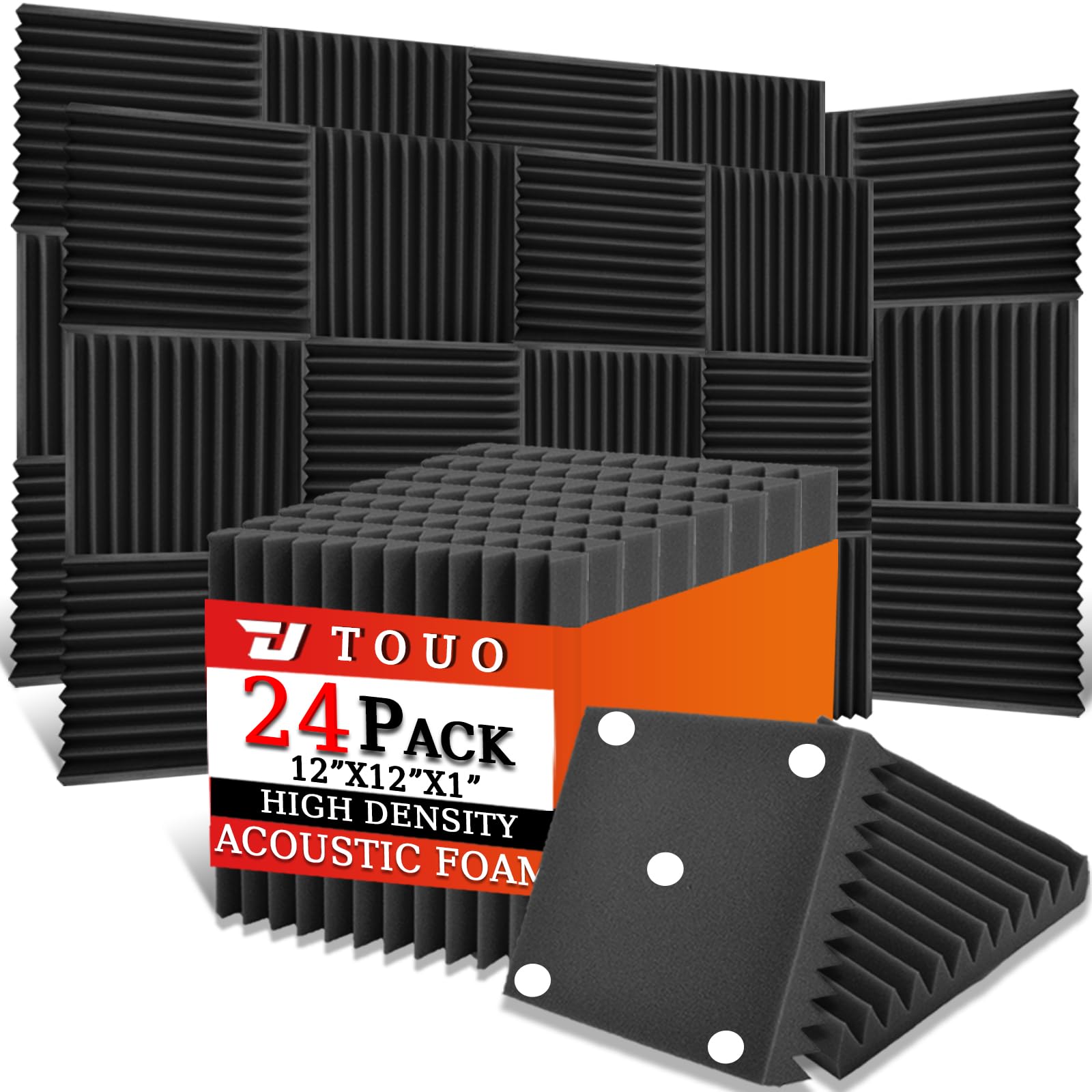
2. 24 Pack Acoustic Panels Wedge 12″x12″x1″
Twenty-four wedge panels for the price of a takeout dinner — the cheapest way to cover real wall area.
The number that sets this pack apart is 24 panels at 12 by 12 inches and 1 inch thick. That dwarfs the Dailycooper pack: 24 panels versus 12, and a full 1 inch of foam versus 0.4 inches — roughly 2.5 times thicker material for deep reflections. If you are treating a home studio or gaming room on a shoestring, this is the pack that stretches furthest.
The wedge profile — a 3D triangle surface — adds angled faces that scatter reflections, so it cuts down flutter echo and standing waves in a room. It arrives vacuum-sealed and puffs back to shape over 24 to 48 hours, or you can speed it up with warm water and a dryer. The pack includes 120 pieces of double-sided adhesive tape so you can mount without tearing paint, and the maker describes the foam as flame retardant, aiming to self-extinguish within 1 minute of exposure to fire.
The catch is consistency. These are polyurethane panels, and the recovery process means you need patience before the wedges look full and even. A few panels can arrive with slight shape variance after vacuum packing. Budget foam also asks you to hang each panel yourself with the included tape, so the install takes longer than a peel-and-stick pack.
The case for the wedge pack
- 24 panels at 1 inch thick give serious coverage for the money
- 120 adhesive tapes included, no extra purchase needed
- Wedge surface manages flutter echo and standing waves
What to expect on arrival
- Vacuum-sealed panels need 24 to 48 hours to fully expand
- You hang each panel by hand with tape, so install takes time
- Budget foam can show slight shape variance
Best fit for: the builder treating a whole wall on a lean budget who does not mind taping panels up.
Less ideal if: you want instant, uniform panels from the start — the expansion wait is real.
3. Amantech 12 Pack Hexagon Acoustic Panels
Honeycomb-shaped foam that treats a wall and looks like you hired a designer.
The honeycomb shape is what wins people over. Because the hexagons lock together, you get broad, gap-free sound-absorbing coverage from a set of small panels — sound hits foam rather than wall. Arrange a cluster over a desk, a strip down a hallway, or a full honeycomb wall behind a streaming setup.
Each panel measures 12 by 0.4 by 10.23 inches, so a full set of tiles covers far more wall than one tile implies. It is a snow-white polyester panel, made from 100% polyester fiber that is odorless, non-toxic, and formaldehyde-free. A knife cuts it easily if you want custom tile shapes, and the back already carries glue, so you peel the protective layer and press.
Adhesion is the one spot to watch. The peel-and-stick layer is convenient, but owners mention the glue can come away from the panel over time, so a clean, flat, primed wall matters here. Thin 0.4-inch foam also means it is a high-frequency and echo tool, not a bass solution — press firmly, give it a smooth surface, and it holds.
Shape pays off: the tessellating hexagons let you build a smooth acoustic wall out of small tiles — a genuine advantage over square panels that leave seams.
Prep the wall first: the adhesive is the weak link on rougher surfaces, so wipe the wall clean and press hard on install to keep panels from lifting.
Pick this if: you want echo reduction with a real design statement — the hex tiles are meant to be seen.
Look elsewhere if: you are chasing deep bass control — at 0.4 inches this treats treble and mid echo, not rumble.
4. Sonicism 12 Pack Pyramid Acoustic Panels

A full 2 inches of pyramid foam that snaps back to shape in seconds, not days.
A full 2 inches of thickness is why this pack earns its place — five times the depth of a 0.4-inch panel like the Dailycooper. That gives sound much more material to dissipate in, so low-end flutter and high-frequency noise both get managed. For anyone who has waited anxiously on vacuum-packed foam, the recovery here is the real draw.
These panels are 12 by 12 inches and press back to shape within seconds of opening — no soaking, no 24-hour wait. The maker says they are pressed from 100% ultra-high resilience PU sponge, which is what allows that fast bounce-back. The self-adhesive layer is already on the back: peel the kraft paper and press, no spray glue or tape to buy.
The 3D pyramid surface adds angled faces that break up reflections, which helps reduce reverb and standing waves. Coverage runs to 1728 square inches of 2D coverage across the set, and the black-and-gray pyramids can be arranged into patterns for a game room or home office.
The one thing to plan for is the pyramid face: the 3D profile is meant to be seen, and the adhesive is strong but permanent-feeling, so lining panels up straight on the first press matters. It is also polyurethane foam, which has a mild new-foam scent that fades.
Depth you can feel: 2 inches of pyramid foam is a real step up from thin decorative tiles — this is a treatment panel, not a wall sticker.
Plan your layout: strong self-adhesive means your first press is your last, so dry-fit the pyramid pattern before peeling the backing.
Worth grabbing if: you want deep 2-inch absorption with peel-and-stick speed and hate waiting for foam to puff up.
Not the pick if: you plan to reposition panels often — the adhesive is meant to stay put.
5. NEPIS 20 Pack Brick Acoustic Panels
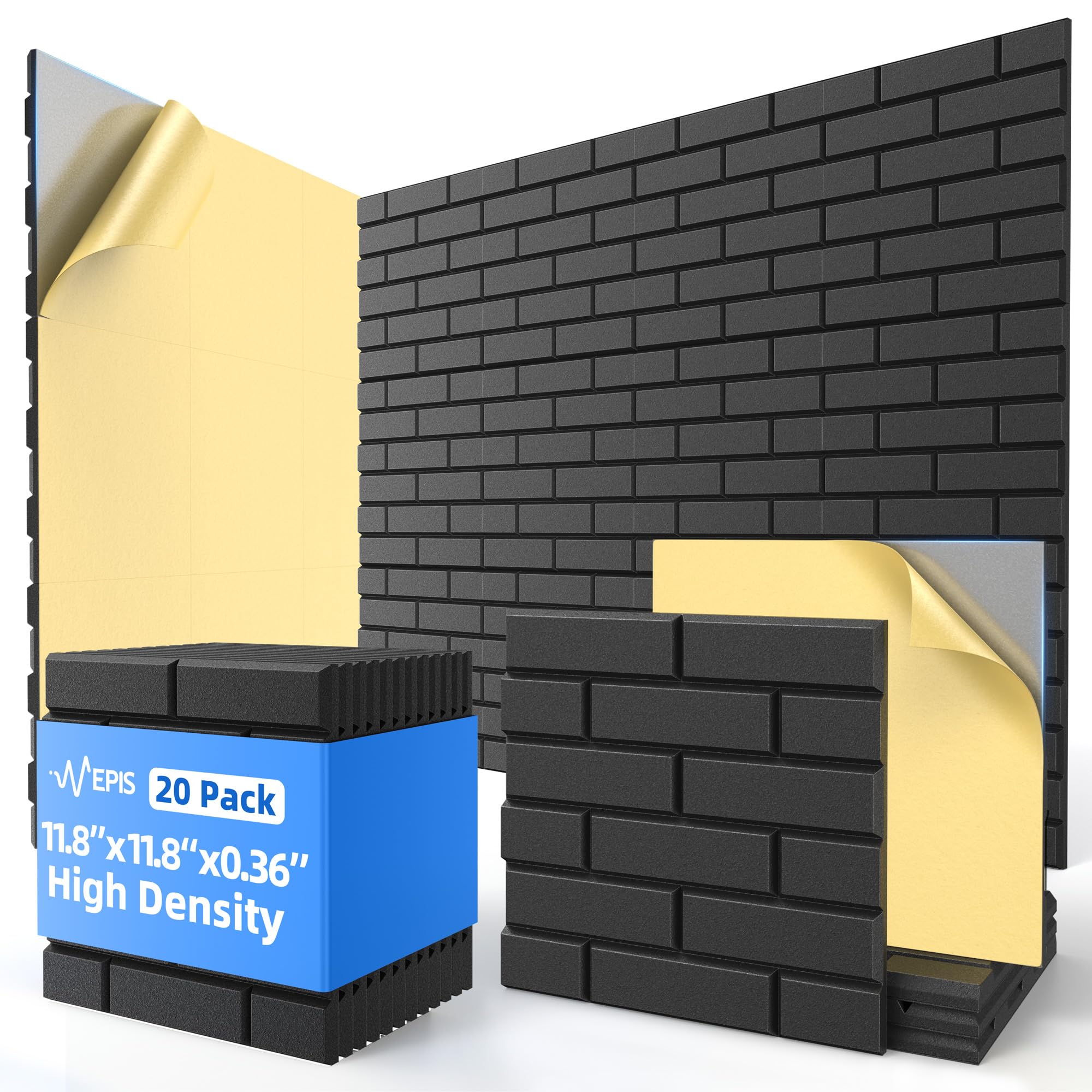
Brick-textured panels that cover a tired wall and soak up echo in the same pass.
Twenty panels at 11.8 by 11.8 by 0.36 inches cover an area of about 20 square feet. That means one order treats a substantial wall rather than a token patch, and the 3D brick shape hides flaws while treating the room. If your wall is scuffed, cracked, or just boring, this pack does double duty.
You peel the kraft paper and stick — no tape, no spray adhesive. That is where this pack earns its keep on doors, windows, and ceilings as well as walls. The finish is what lands with buyers — a believable brick wall look that turns a plain home studio into a backdrop.
It is 100% polyester, odorless and non-toxic, and it cuts easily to size if your wall has outlets or corners to work around. For recording studios, control rooms, and home theaters, the 20-square-foot coverage keeps the project to a single purchase.
Sound reduction is where expectations need calibrating: it is a thin 0.36-inch panel, so it eases echo and daytime clatter rather than blocking traffic noise or deep bass. It improves the room’s sound but does not turn a wall into a soundproof barrier.
Why this pack measures up
- 20 panels deliver about 20 square feet of treated wall
- 3D brick finish rescues a worn or plain wall
- Peel-and-stick install handles doors, windows, and ceilings
- Trims easily around outlets and corners
What to keep in mind
- 0.36-inch profile eases echo but does not block traffic noise
- No deep bass control from a panel this thin
The right call for: making a room look finished while cutting the echo — the brick texture does half the decorating work.
Think twice if: your complaint is noise coming through the wall, not bouncing off it — thin foam cannot seal sound out.
6. Knightsacoustic 48 Pack Sound Proof Foam Panels
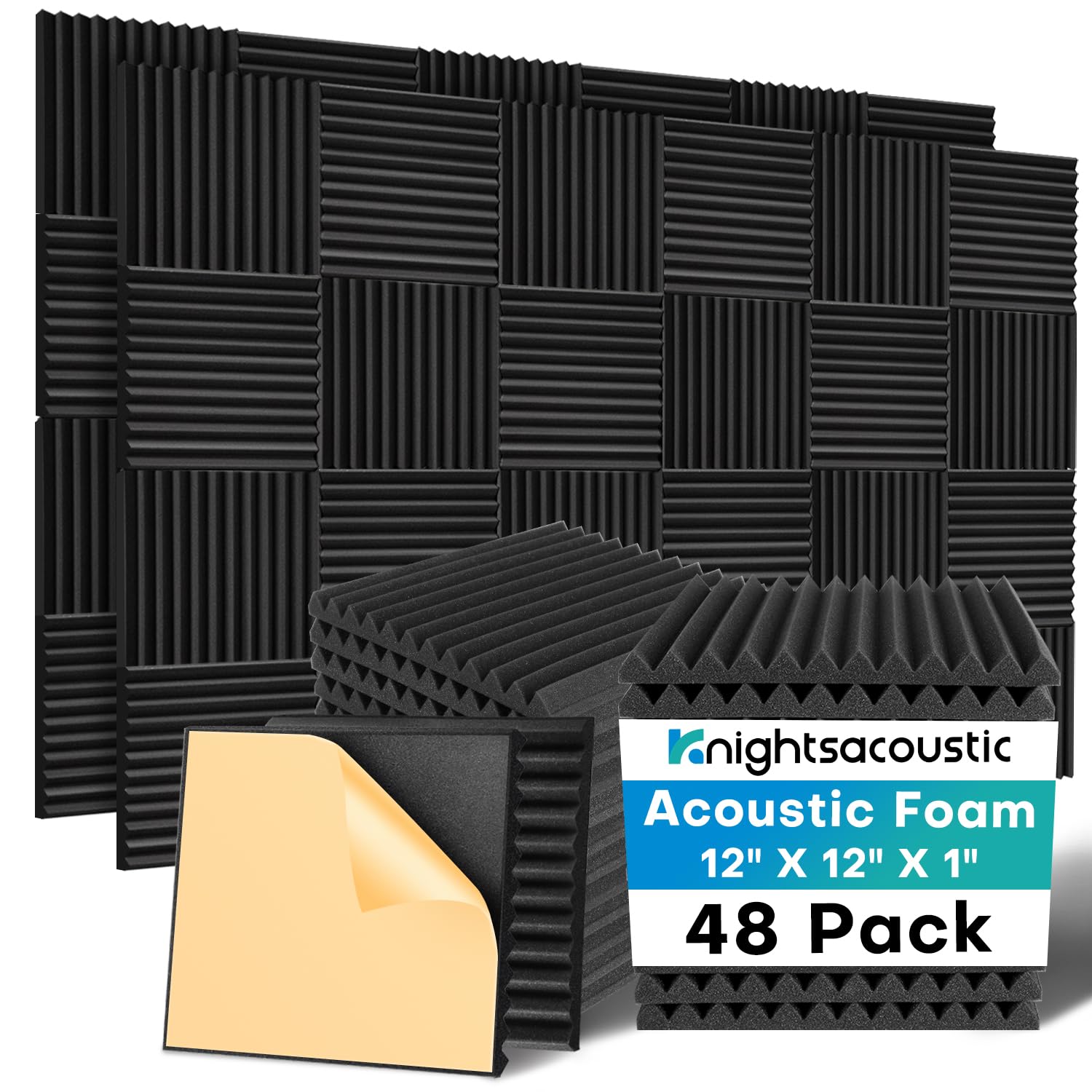
Forty-eight panels that treat a whole studio wall in one order, no reorder needed.
The 48 square feet of coverage is what makes this the volume pick — four times the treated area of a 12-pack. Forty-eight panels at 12 by 12 inches and 1 inch thick add up to that, so it suits a full recording booth, control room, or rehearsal corner in a single purchase. When one wall is not enough, this is the pack that finishes the job.
For pure sound management, the design is straightforward: it absorbs rather than blocks, minimizing echoes, standing waves, and flutter in studios, recording booths, and radio rooms. The 1-inch profile is thin enough to keep a low ceiling from feeling crowded, and the foam flexes onto walls, doors, and ceilings. The maker says the foam is designed to recover its shape within hours of unboxing and stays resilient under compression.
One honest note the maker puts on the label: the flame-retardant treatment can make the foam smell strong out of the bag. It is safe, but air it out for 24 hours after opening before you fill a small room with it. Buyers also praise how the panels upgrade the look of a space, so a big order does not have to feel utilitarian.
Volume play: 48 square feet in one box means you can line a full booth wall without mixing packs — the simplest route to coverage.
The smell caveat: the flame-retardant foam can arrive pungent, so let it air out for the stated 24 hours before installing it in a tight room.
Best suited to: anyone outfitting a full studio or booth who wants one order to cover the entire treated wall.
Consider the smaller packs instead if: you only need to fix one reflection point — 48 panels will outlast your wall space.
7. AUSLET 36 Pack Pyramid Acoustic Foam Panels
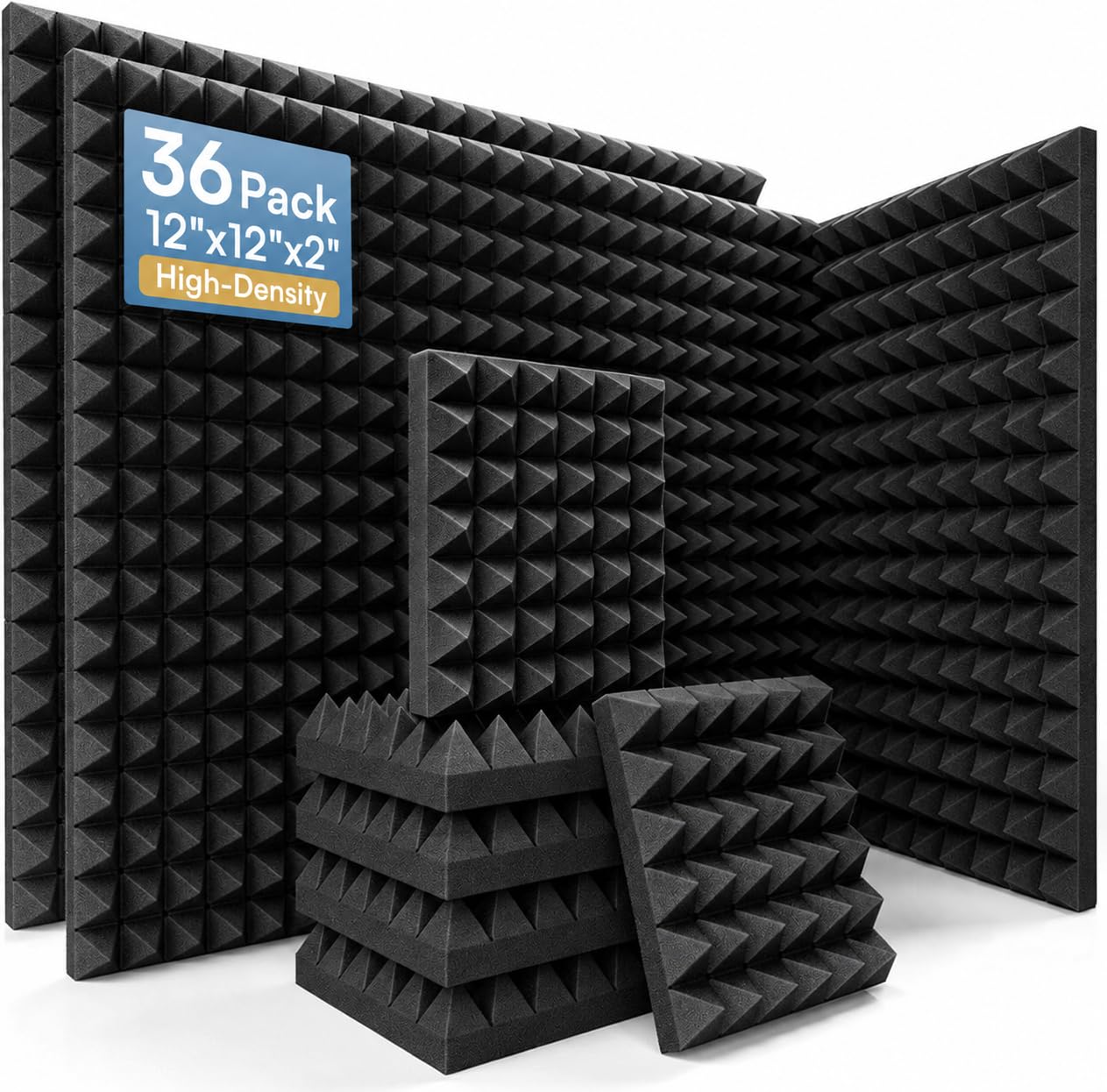
Thirty-six thick pyramid panels with real density and no adhesive — you pick the mount.
A stated 30 kg/m³ density is why the pyramids stay firm instead of floppy against the wall — that is kilograms of foam per cubic meter. Each panel is 12 by 12 inches and 2 inches thick, and 36 of them reach up to 36 square feet of coverage. You get more acoustic material depth than thin decorative foam, so vocals and speech come through cleaner.
The pyramid surface adds angled faces that scatter reflections, which helps manage echo and reverb for clearer vocals, speech, and recordings. The foam is flame-retardant polyurethane sponge, suited for studios, podcast rooms, gaming rooms, and home theaters. Because there is no adhesive backing, you are free to choose double-sided tape, spray adhesive, or hook-and-loop strips — the right move on ceilings or surfaces you would rather protect.
That missing adhesive is the obvious trade-off: the pack is bare foam, so you must buy the mounting method yourself and do the install. Some buyers also find the panels don’t isolate as much noise as they hoped, which is worth understanding up front — these are treatment panels for controlling reflections, not soundproofing barriers.
The absorption argument
- 36 panels at 2 inches thick reach up to 36 square feet
- 30 kg/m³ density holds a firm pyramid shape
- Pyramid profile manages echo and reverb for cleaner recordings
- No adhesive means you choose the mount for your surface
What you handle yourself
- No backing included — you supply tape or spray adhesive
- Treats reflections, not through-wall noise isolation
The one to choose if: you want thick, firm pyramid foam plus the freedom to mount it your way on a tricky ceiling or wall.
Only if you plan to install it: there is no peel-and-stick backing here, so budget for adhesive and a bit of time.
8. Yaolabjer 4 PCS Egg Crate Acoustic Foam
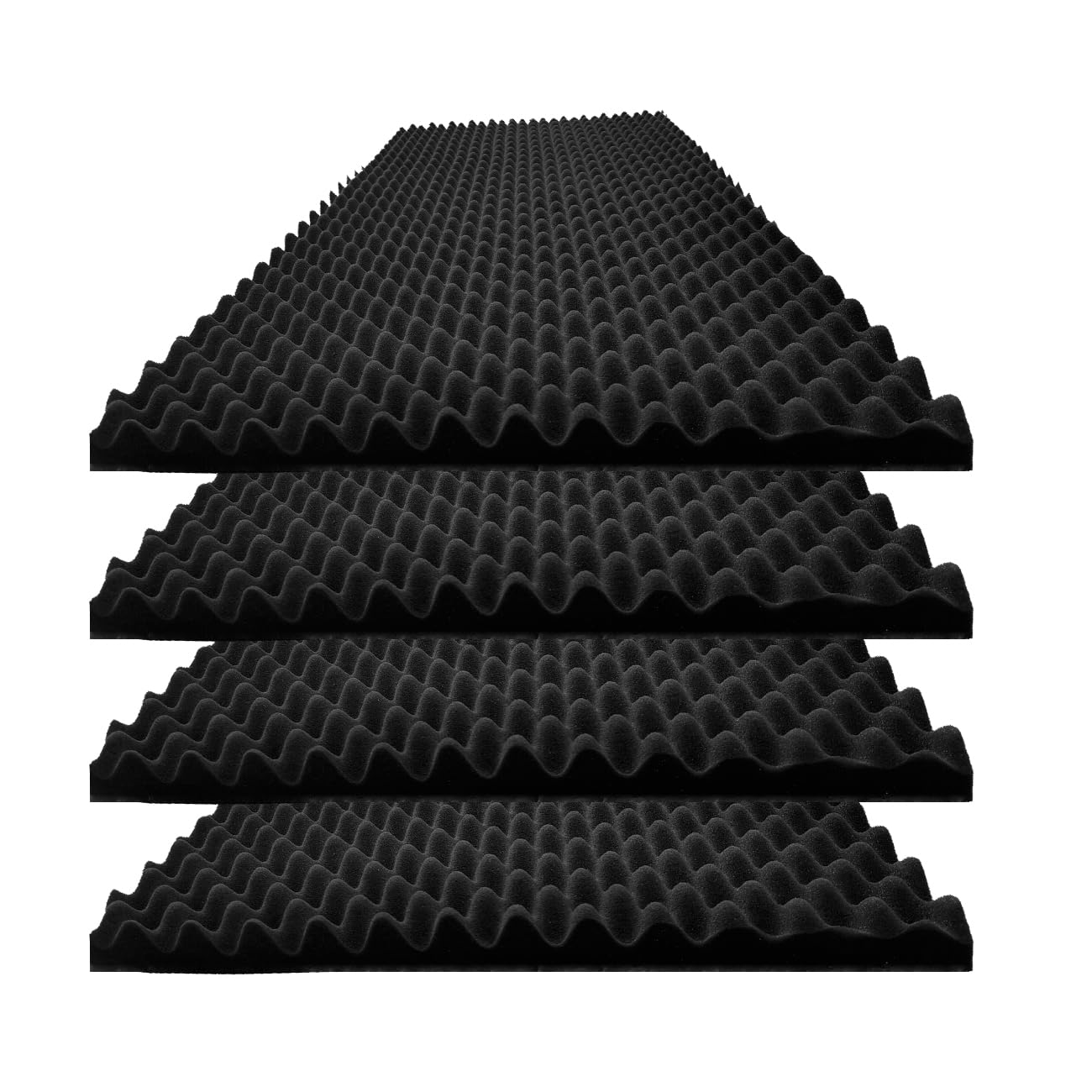
Four huge egg-crate slabs for the big flat areas small panels cannot cover.
Four pieces at 48 by 24 by 2 inches each are what separates this pack — a single slab covers a large flat zone in one go. That is a very different install from squares: fewer seams, fewer press points, and a quicker way to treat the reflective surface above a desk or behind a drum kit. Sometimes you do not want a mosaic of small tiles; you want one big sheet on a ceiling or a broad wall.
The foam is high-density polyurethane with flame-retardant properties, and the recovery time is short — the maker lists 2 to 8 hours for a return to normal size rather than the 2-3 days some foam needs. The egg-crate profile is the classic studio look, and because the panels are large, you can cover more air volume with less fuss. It is built for recording studios, bedrooms, game rooms, and home theaters. Buyers who got the good units rate the quality highly and say it does its job.
Do check the size on arrival. Several customers note the slabs measuring closer to 44 by 23 inches than the advertised 48 by 24, and some find the foam thinner than expected. There is no adhesive included, so plan for spray, pins, tape, or command strips — and clean and flatten the wall first, as the maker advises.
Big panel, big impact: 48-by-24-inch slabs cover a wide flat area with minimal seams — ideal for ceilings and large reflection zones.
Measure what arrives: a recurring report is slabs landing a little under the listed dimensions, so have a tape measure handy and plan the layout with a small margin.
Great for: covering a large ceiling or broad wall where you want fewer, bigger panels rather than a grid of small squares.
Check before you mount: confirm the slab size and buy your own adhesive — none is in the box.
Know the Specs
Thickness and density
Thickness is how much foam the sound crosses before hitting the wall, and density is how tightly that foam is packed. A 2-inch panel with a stated density like 30 kg/m³ gives sound more material to lose energy in, so it manages lower frequencies better — that is the rumble that makes a room feel boomy. A 0.4-inch panel still handles echo and high-frequency slap; it just works in a narrower range. Match thickness to your complaint: thin foam for vocal echo, thick foam for boomy rooms.
Coverage and panel count
Coverage is the area a pack actually treats, listed in square feet or in the number of panels times their size. A 12-pack of 12-by-10-inch panels covers roughly 7.5 square feet, while a 48-pack of 12-by-12-inch panels reaches about 48 square feet. Measure the wall behind your mic, monitor, or seating position before ordering, and remember that edge-to-edge coverage works better than scattered single panels. Attach the panels to the wall or ceiling using double-sided tape or spray adhesive, and clean the surface first so the foam holds.
Common Questions
Will acoustic foam actually stop noise from the neighbors?
How much wall does a 12-pack of panels cover?
Do self-adhesive panels damage paint when removed?
How long does vacuum-packed foam take to expand?
Is 2-inch foam better than 1-inch foam?
Are these panels safe to sleep near or keep in a bedroom?
Do I need adhesive, or should I buy a self-adhesive pack?
Should I cover the whole wall or just a few spots?
What does flame-retardant actually mean on acoustic foam?
Can I cut acoustic foam to fit around outlets and corners?
The Bottom Line
For most rooms, the sound resistant foam that wins is the Dailycooper 12 Pack Self-Adhesive Acoustic Panels, because 9.4 lb/ft3 density gives you real absorption from a peel-and-stick panel you can hang in an afternoon. If you need deep bass control with a full 2-inch face, grab the {“@context”: “https://schema.org”, “@graph”: [{“@type”: “ItemList”, “name”: “8 Best Sound Resistant Foam”, “url”: “https://tacticalgearguy.com/best-sound-resistant-foam/”, “numberOfItems”: 8, “itemListElement”: [{“@type”: “ListItem”, “position”: 1, “name”: “Dailycooper 12 Pack Self-Adhesive Acoustic Panels”, “url”: “https://tacticalgearguy.com/best-sound-resistant-foam/#product-1”}, {“@type”: “ListItem”, “position”: 2, “name”: “24 Pack Acoustic Panels Wedge 12\”x12\”x1\””, “url”: “https://tacticalgearguy.com/best-sound-resistant-foam/#product-2”}, {“@type”: “ListItem”, “position”: 3, “name”: “Amantech 12 Pack Hexagon Acoustic Panels”, “url”: “https://tacticalgearguy.com/best-sound-resistant-foam/#product-3”}, {“@type”: “ListItem”, “position”: 4, “name”: “Sonicism 12 Pack Pyramid Acoustic Panels”, “url”: “https://tacticalgearguy.com/best-sound-resistant-foam/#product-4”}, {“@type”: “ListItem”, “position”: 5, “name”: “NEPIS 20 Pack Brick Acoustic Panels”, “url”: “https://tacticalgearguy.com/best-sound-resistant-foam/#product-5”}, {“@type”: “ListItem”, “position”: 6, “name”: “Knightsacoustic 48 Pack Sound Proof Foam Panels”, “url”: “https://tacticalgearguy.com/best-sound-resistant-foam/#product-6”}, {“@type”: “ListItem”, “position”: 7, “name”: “AUSLET 36 Pack Pyramid Acoustic Foam Panels”, “url”: “https://tacticalgearguy.com/best-sound-resistant-foam/#product-7”}, {“@type”: “ListItem”, “position”: 8, “name”: “Yaolabjer 4 PCS Egg Crate Acoustic Foam”, “url”: “https://tacticalgearguy.com/best-sound-resistant-foam/#product-8”}]}, {“@type”: “Product”, “position”: 1, “name”: “Dailycooper 12 Pack Self-Adhesive Acoustic Panels”, “image”: “https://m.media-amazon.com/images/I/71N+siVJBQL.jpg”, “brand”: {“@type”: “Brand”, “name”: “Dailycooper”}, “url”: “https://www.amazon.com/dp/B0BTD95KC4/?tag=tacticalge083-20”, “offers”: {“@type”: “Offer”, “url”: “https://www.amazon.com/dp/B0BTD95KC4/?tag=tacticalge083-20”}}, {“@type”: “Product”, “position”: 2, “name”: “24 Pack Acoustic Panels Wedge 12\”x12\”x1\””, “image”: “https://m.media-amazon.com/images/I/71AZALseVCL.jpg”, “brand”: {“@type”: “Brand”, “name”: “24”}, “url”: “https://www.amazon.com/dp/B0F6DCZJ7T/?tag=tacticalge083-20”, “offers”: {“@type”: “Offer”, “url”: “https://www.amazon.com/dp/B0F6DCZJ7T/?tag=tacticalge083-20”}}, {“@type”: “Product”, “position”: 3, “name”: “Amantech 12 Pack Hexagon Acoustic Panels”, “image”: “https://m.media-amazon.com/images/I/61SUZ1iv3IL.jpg”, “brand”: {“@type”: “Brand”, “name”: “Amantech”}, “url”: “https://www.amazon.com/dp/B0BGS6D7QP/?tag=tacticalge083-20”, “offers”: {“@type”: “Offer”, “url”: “https://www.amazon.com/dp/B0BGS6D7QP/?tag=tacticalge083-20”}}, {“@type”: “Product”, “position”: 4, “name”: “Sonicism 12 Pack Pyramid Acoustic Panels”, “image”: “https://m.media-amazon.com/images/I/81U1sV-CP6L.jpg”, “brand”: {“@type”: “Brand”, “name”: “Sonicism”}, “url”: “https://www.amazon.com/dp/B0BRTVW9LC/?tag=tacticalge083-20”, “offers”: {“@type”: “Offer”, “url”: “https://www.amazon.com/dp/B0BRTVW9LC/?tag=tacticalge083-20”}}, {“@type”: “Product”, “position”: 5, “name”: “NEPIS 20 Pack Brick Acoustic Panels”, “brand”: {“@type”: “Brand”, “name”: “NEPIS”}, “url”: “https://tacticalgearguy.com/best-sound-resistant-foam/#product-5”}, {“@type”: “Product”, “position”: 6, “name”: “Knightsacoustic 48 Pack Sound Proof Foam Panels”, “image”: “https://m.media-amazon.com/images/I/71UsYWof6VL.jpg”, “brand”: {“@type”: “Brand”, “name”: “Knightsacoustic”}, “url”: “https://www.amazon.com/dp/B0DZXGH6CY/?tag=tacticalge083-20”, “offers”: {“@type”: “Offer”, “url”: “https://www.amazon.com/dp/B0DZXGH6CY/?tag=tacticalge083-20”}}, {“@type”: “Product”, “position”: 7, “name”: “AUSLET 36 Pack Pyramid Acoustic Foam Panels”, “image”: “https://m.media-amazon.com/images/I/71l4FAptwiL.jpg”, “brand”: {“@type”: “Brand”, “name”: “AUSLET”}, “url”: “https://www.amazon.com/dp/B0B12KHN51/?tag=tacticalge083-20”, “offers”: {“@type”: “Offer”, “url”: “https://www.amazon.com/dp/B0B12KHN51/?tag=tacticalge083-20”}}, {“@type”: “Product”, “position”: 8, “name”: “Yaolabjer 4 PCS Egg Crate Acoustic Foam”, “image”: “https://m.media-amazon.com/images/I/71WE8V-5l9L.jpg”, “brand”: {“@type”: “Brand”, “name”: “Yaolabjer”}, “url”: “https://www.amazon.com/dp/B0CD5SP86D/?tag=tacticalge083-20”, “offers”: {“@type”: “Offer”, “url”: “https://www.amazon.com/dp/B0CD5SP86D/?tag=tacticalge083-20”}}, {“@type”: “FAQPage”, “mainEntity”: [{“@type”: “Question”, “name”: “Will acoustic foam actually stop noise from the neighbors?”, “acceptedAnswer”: {“@type”: “Answer”, “text”: “Not on its own. Acoustic foam absorbs sound inside the room so it does not bounce back as echo, which is why it helps recordings and cuts the ring in a space. Blocking noise traveling through a wall needs mass and sealing — foam is a treatment layer, not a barrier. If neighbors’ sound is your complaint, foam will soften the echo but not stop the transmission.”}}, {“@type”: “Question”, “name”: “How much wall does a 12-pack of panels cover?”, “acceptedAnswer”: {“@type”: “Answer”, “text”: “It depends on panel size. A 12-pack of 12-by-10-inch panels (like the Dailycooper pack) covers about 7.5 square feet — a small reflection zone behind a mic or monitor. A 12-pack of 12-by-12-inch panels covers a little more. If you need a whole wall treated, look at 20, 24, 36, or 48-panel packs and match the listed square footage to your measured wall.”}}, {“@type”: “Question”, “name”: “Do self-adhesive panels damage paint when removed?”, “acceptedAnswer”: {“@type”: “Answer”, “text”: “Peel-and-stick backing is designed to mount without extra tape, but how cleanly it lifts depends on the wall. On a smooth, clean, painted surface it tends to come away better. On textured walls, or where paint is already loose, the adhesive may pull finish with it. Clean the wall first, press firmly, and if you rent, test one panel in a hidden spot before covering a whole wall.”}}, {“@type”: “Question”, “name”: “How long does vacuum-packed foam take to expand?”, “acceptedAnswer”: {“@type”: “Answer”, “text”: “It varies by brand. The Sonicism pyramid panels recover within seconds, according to the maker, because they are made from high-resilience PU sponge. The 24-pack wedge panels take 24 to 48 hours, or can be sped up with warm water and a dryer. The Yaolabjer egg-crate slabs recover in 2 to 8 hours. Give compressed foam time to puff to full shape before judging its thickness.”}}, {“@type”: “Question”, “name”: “Is 2-inch foam better than 1-inch foam?”, “acceptedAnswer”: {“@type”: “Answer”, “text”: “For deep or boomy rooms, yes — the extra material depth handles more of the lower frequencies. A 1-inch panel still cuts echo and high-frequency reflections and saves wall space and cost. If you are treating a small podcast corner or just want to soften a hard-sounding office, 1-inch foam does real work. For a music room where rumble matters, 2-inch pyramid panels are the better starting point.”}}, {“@type”: “Question”, “name”: “Are these panels safe to sleep near or keep in a bedroom?”, “acceptedAnswer”: {“@type”: “Answer”, “text”: “The panels in this list are described as polyester or polyurethane foam with flame-resistant treatment, and several are marketed as odorless and non-toxic. A few flame-retardant foams do arrive with a strong smell, and the Knightsacoustic listing specifically advises airing the foam for 24 hours after opening. Let any new foam breathe before you fill a small bedroom with it.”}}, {“@type”: “Question”, “name”: “Do I need adhesive, or should I buy a self-adhesive pack?”, “acceptedAnswer”: {“@type”: “Answer”, “text”: “If speed matters and your wall is smooth, a self-adhesive panel saves you a trip and install time. If you are mounting on a ceiling, on a surface you want to protect, or you plan to reposition panels, a pack with no adhesive (like the AUSLET pyramid or Yaolabjer egg-crate) lets you pick double-sided tape, spray, or hook-and-loop strips. Choose based on the surface, not just the panel.”}}, {“@type”: “Question”, “name”: “Should I cover the whole wall or just a few spots?”, “acceptedAnswer”: {“@type”: “Answer”, “text”: “Start with the reflection points — behind your speakers or monitor, and the flat wall behind your mic or listening seat. A few well-placed panels there often do more than a thin layer across the entire room, because that is where the sound hits first and bounces back at you. Add more panels later if the room still rings.”}}, {“@type”: “Question”, “name”: “What does flame-retardant actually mean on acoustic foam?”, “acceptedAnswer”: {“@type”: “Answer”, “text”: “It means the foam is treated to resist ignition and slow the spread of fire. The 24-pack wedge panels, for example, are described as self-extinguishing within 1 minute of fire exposure. Flame retardancy is about giving you time and slowing spread — it does not mean the foam is fireproof. Keep any foam away from heaters and open flame regardless of the rating.”}}, {“@type”: “Question”, “name”: “Can I cut acoustic foam to fit around outlets and corners?”, “acceptedAnswer”: {“@type”: “Answer”, “text”: “Yes. Most of these panels cut easily with a sharp knife, and several listings call it out, including the hexagonal polyester panels and the brick-textured NEPIS pack. Measure and mark the outlet or corner, then cut slightly inside the line so the panel tucks neatly. Cut on a scrap board so you do not score the wall behind it.”}}]}]}