Specs are compiled from manufacturer listings and verified buyer reviews and can change over time — please confirm the key details on the product page before buying.
If you want the shortest answer: buy the right material for the noise problem you actually have. Foam and polyester panels swallow echo and sharp reflections inside a room. Butyl mats kill vibration and road roar in a car. Buying an absorber when you needed a blocker is the most common way people waste money here — and why some buyers swear panels “do nothing” while others call them magic. This guide separates the two jobs clearly, so you match the product to your room, your walls, and your ears.
This guide is built by comparing the manufacturers’ published specifications and the patterns across verified customer reviews, so you get each pick’s real strengths and trade-offs instead of marketing spin.
You will learn which thickness, coverage area, and mounting method actually change what you hear — and which numbers on the box are mostly decoration. Below are the picks that hold up across real rooms, cars, and studios, with the honest trade-offs spelled out so you can choose with confidence. The right sound insulation depends far more on matching material to your noise source than on spending more.
Top Picks


How To Choose The Best Sound Insulation
Start by naming the noise. Is it echo bouncing off hard walls inside a room — a hollow, ringing sound on calls and recordings? Or is it noise travelling through a surface, like road roar coming up through a car floor? Echo calls for an absorber, meaning a soft porous panel that soaks up sound energy. Noise passing through a panel calls for mass and damping, which is the butyl-mat job. Get that fork right and the rest is fine-tuning.
Match the material to the surface
Polyester-fiber and foam panels mount flat on interior walls, doors, and ceilings, and they are the fix for a room that sounds hollow. Butyl mats are peel-and-stick sheets that go on metal panels inside a vehicle, where they add mass and stop the metal from vibrating. A wall panel will not quiet a car floor, and a butyl mat is not the tool for a podcast booth.
Do the coverage math before you buy
Coverage is quoted in square feet or square inches, and it is where most buyers get caught out. A 12-pack of foam panels at roughly 7.5 square feet total covers one small focal area, not a whole wall. Larger panel sets climb toward 10 to 31 square feet and suit a real studio wall. Measure the wall you want to treat, then compare that figure to the listed coverage rather than trusting the pack photo.
Thickness and density set the ceiling on performance
Thicker, denser material tends to absorb lower frequencies, which are the boomy sounds a thin sheet lets pass. Thickness shows up in inches or mils (thousandths of an inch) depending on the product type, so compare like with like. Density like 9.4 lb/ft3 tells you how tightly the fibers are packed, and it is a fair signal of how much sound the panel will soak up.
How it sticks matters as much as how it sounds
Self-adhesive backing is the fastest route and needs no extra tape. Nano glue and separate sticky squares give you repositioning room on rented walls. A few panels in this list arrive with no adhesive at all and expect you to supply strips. Think about how permanent you want the install, and whether you will ever need to take the panels down cleanly.
Side-by-Side Comparison
| Model | Best For | Coverage | Thickness | Material | Amazon |
|---|---|---|---|---|---|
| Siless Hybrid 3in1★ Best Overall | Car cabins | 25 sqft | 0.2 inches | Butyl rubber | Amazon |
| 12 Pack Self-Adhesive Acoustic PanelsBudget Champion | Small room focal walls | 7.5 sq ft | 0.4 inches | Polyester | Amazon |
| Butyl Sound Deadening 80milMost Coverage | Full-vehicle coverage | 36 sq ft | 80 mils | Butyl | Amazon |
| JaneTech Art Acoustic Panels | Decor-friendly studios | 10.33 sq ft | 0.4 inches | Polyester fiber | Amazon |
| 4 Pack Acoustic Foam Panels | Fast-expanding wedges | — | 2 inches | Polyester foam | Amazon |
| TONOR Dual-Layer Panels | Bedrooms and living rooms | ≈1104 sq in per panel | 0.72 inches | Polyester | Amazon |
| Acadian Vortex Wall Panels | Wood-look statement walls | 3348 sq in (6-pc) | — | Polyester | Amazon |
| Art3d Wood Slat Panels | Feature walls and ceilings | 31.5 sq ft | — | Wood laminate over MDF | Amazon |
Detailed Reviews
1. Siless Hybrid 3in1 200 mil 25 sqft Car Sound Deadening Mat
Our pick — 4.5+★ from 900+ verified ratings; the strongest balance of quality and price.
Three jobs in one sheet: quiet, cool, and free of exhaust rumble.
Most car deadening mats do one thing. This one layers butyl mastic, PE foam, and a mass-loaded butyl membrane into a single 0.2-inch sheet so it damps vibration, blocks low-frequency exhaust and road noise, and reflects heat all at once. That composite build is the reason this takes the top slot: it removes the job of buying and stacking three separate products. If you are chasing hush in a daily driver, the triple-layer design is the spec that earns the placement.
The coverage tells a similar value story. At 25 sqft against the 36 sqft of the Butyl Sound Deadening 80mil below, you get less area per pack, so plan for door skins or a floor section rather than a full shell. Installation is a peel-and-place job: trim to fit, peel, and hand-roll for adhesion. No spray adhesive, no curing wait. The catch is that it flexes around curves better than it covers corners, and a few buyers find the adhesive needs a firm roll to sit flush. That is an install note, not a flaw — clean the panel and hand-roll the mat flat.
What owners rave about is the quality of the composite and its effectiveness at killing road noise. The vibration damping earns especially warm praise, and plenty find it performs on par with pricier name-brand mats. One buyer notes it works even better paired with an additional mat layer underneath, which is a fair hint that the hybrid is a foundation piece rather than a solo act. Siless built this as a base layer for a larger deadening job, so plan on adding coverage.
What earns it the crown
- Triple-layer build in one 0.2-inch sheet: damping, noise blocking, and heat reflection together
- Peel-and-place install with no spray adhesive or curing time
- Owners consistently rate it close to premium mats on quietness
- 25 sqft gives enough to treat doors or a floor section per pack
Where it asks for patience
- The adhesive wants a firm hand-roll to sit flush on curved panels
- Coverage is one pack too small for a full vehicle shell, so budget for multiple
Reach for this if: you want a single product that quiets the cabin and keeps heat out, and you are working on doors or a floor section.
Look elsewhere if: you need to cover an entire car in one order — the larger butyl mat below stretches further per pack.
2. 12 Pack Self-Adhesive Acoustic Panels 12″ X 10″ X 0.4″
The starter kit that sticks straight to the wall — no tape, no drama.
Twelve panels, each 12 by 10 inches and 0.4 inches thick, arrive with adhesive already on the back. That combination is the whole pitch: you peel and press, and an afternoon of echo smoothing needs no extra tape or glue. The density is quoted at 9.4 lb/ft3, which is the number that signals how much sound these will soak up, and it is respectable for this tier. The Y-lined beveled edge gives them a look buyers describe as leaning futuristic rather than plain.
Coverage is where you need to be honest with yourself. Twelve panels total roughly 7.5 square feet — enough to treat one focal wall or the corners of a small office, not a full studio. The JaneTech Art Acoustic Panels below stretch to 10.33 sq ft; the Art3d Wood Slat Panels reach 31.5 sq ft. Size the pack to your wall or you will be ordering a second set. At 100 percent polyester fiber and flame retardant, they are also safe to have around a household with kids and easy to cut with a knife to fit.
The honest trade-off is that these absorb inside a room, not soundproof through a wall. Owners split on that exact point: some hear exceptional reflection reduction, others expect a barrier and feel let down. That mismatch is about the job, not the panel — for echo and reverb in a small office they absorb well, and the beveled finish looks good. For a home office or podcast corner, the peel-and-press backing makes this the easiest way to start.
Where they shine: the self-adhesive backing means you can mount them in an afternoon without hunting for tape. The beveled Y-line finish makes them feel like decor rather than a foam afterthought.
Where they stop: at 7.5 sq ft total they cover a focal spot, and they quiet reflections rather than blocking sound passing through a wall.
Picks up when: you have a small room — an office, a closet booth, a bedroom corner — and want a self-stick fix you can cut to size.
Sets back down when: you need to treat a large wall in one go; buy a bigger pack for that.
3. Butyl Sound Deadening 80mil 36sqft
For the whole car, not just a door — 36 square feet across 33 pieces.
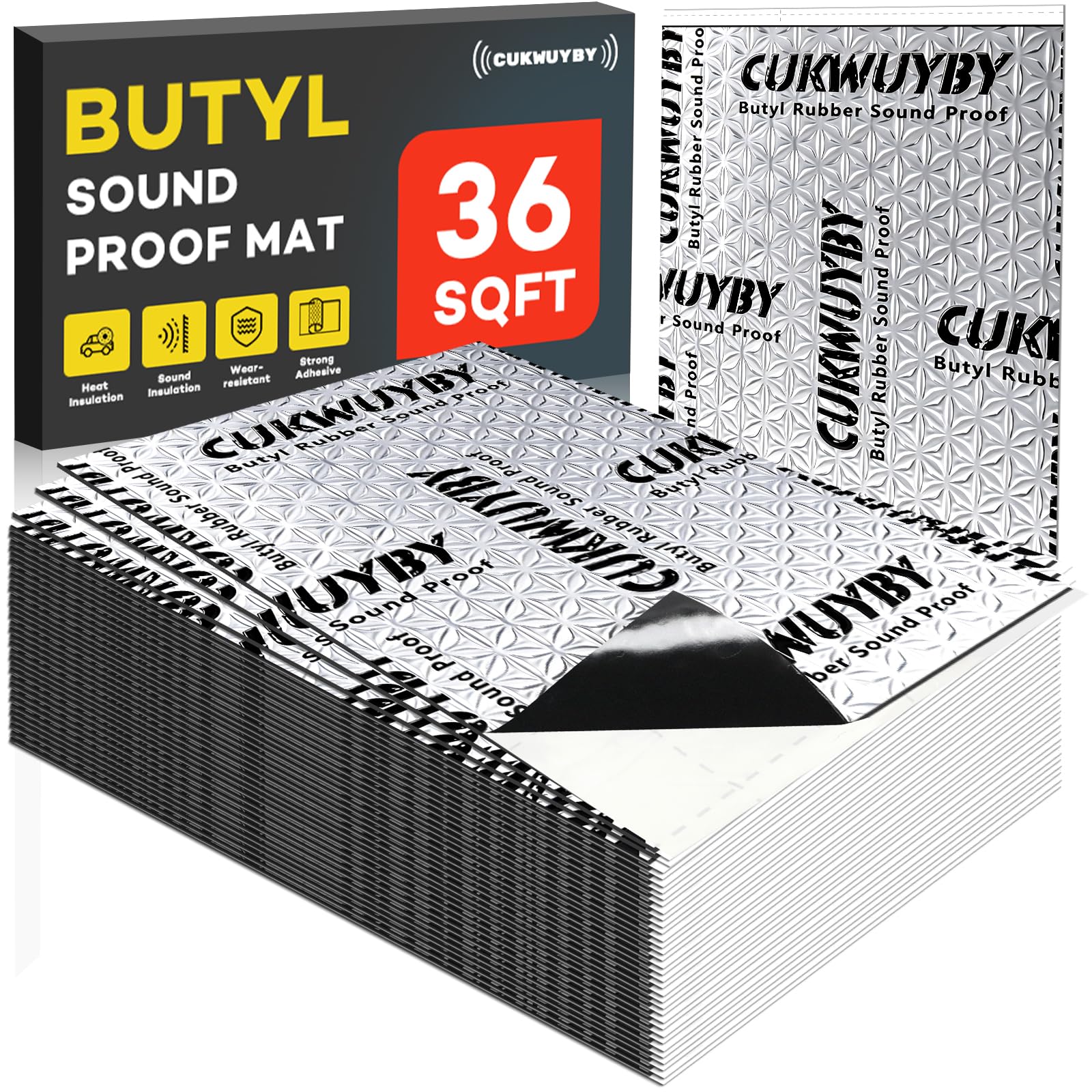
Start with the number that separates it from the Siless above. This mat gives you 36 square feet against the Siless’s 25, spread across 33 pieces, and that extra area is what lets you treat doors, trunk, and floor from a single order. The build is three layers: an 8-wire reinforced foil that reflects heat, a butyl rubber core that blocks sound, and a strong adhesive backing. At 80 mils it is a genuinely thick sheet, and the working range is quoted at -50°F to 300°F, so it tolerates a hot door skin in summer.
Install is about as simple as deadening gets: clean the surface, cut, peel, and press. The high-tack adhesive grabs instantly and needs no roller, which is a real saving when you are contorted under a seat. The foil surface is wear-resistant and waterproof, so a door card or wheel arch does not demand extra protection. The mixed reviews cluster on thickness — some buyers feel it is thinner than the 80 mils suggests, so manage your expectations on hand-feel rather than dreading it.
The quiet is the thing owners appreciate most. The deadening effect on road noise and vibration earns steady praise, and doors start shutting with a solid, heavy thunk. That heavy thunk is the butyl mass damping the door skin. If you are building out a full vehicle and want the most square footage per pack of the two butyl mats here, this is the one that stretches to cover the shell.
The coverage case: 36 sqft across 33 pieces does more of a car than any other deadening mat on this list, and the pre-applied adhesive skips the roller.
The honest note: thickness is the recurring split in feedback — some find it feels thinner than the number suggests, so measure what matters to your build.
Built for: a full-vehicle job where brute coverage per order matters more than a heat-reflecting composite.
Skip if: you want one sheet that also reflects exhaust heat — the Siless hybrid does that job better.
4. JaneTech 8-Pack Art Acoustic Panels Sound Absorbing Panels

Wall art that actually kills echo — and hides the fact it is acoustic treatment.
Eight panels at 16 by 12 inches and 0.4 inches thick, made of high-density polyester fiber, with nano glue included. That is a step up in coverage from the 12-pack above: roughly 10.33 square feet, enough to dress a 4-by-2.7-foot focal wall. The appeal here is the double duty — a decorative finish that also disperses sound, so a living room or conference room does not have to look like a recording booth to sound cleaner. The maker positions it firmly against plain acoustic foam, and the flame-retardant, wear-resistant polyester backs that up.
Where it earns its keep is on the wall. The nano glue sticker makes mounting a three-step job and sticks cleanly to doors, windows, and ceilings. Buyers love how it changes the look of a space while calming the echo on calls and recordings. The panels cut and arrange easily, so you can build a pattern rather than a grid. If your room doubles as a background for video, this is the pick that treats the sound and the on-camera look at once.
The trade you accept is that a decorative panel set is not the cheapest way to cover a big wall, and 10.33 square feet is a focal area rather than a full-room treatment. The Art3d Wood Slat Panels below cover 31.5 sq ft for a feature wall. For a studio corner, a home theater, or a conference room where looks matter, JaneTech solves both problems in one purchase — and that is exactly the situation it was designed for.
Best fit for: a home studio, podcast booth, or office where the acoustic panels will be seen every day.
Less suited to: anyone who needs to blanket a large wall — go bigger on coverage.
5. 4 Pack Acoustic Foam Panels, 48 x 24 x 2″

Two inches thick and back to full shape in five seconds flat.
The headline here is 2 inches of thickness, which is on the deeper side for wall foam and helps it tame lower frequencies a thin sheet lets through. Each panel runs 48 by 24 inches in a 4-pack, and the studio-wedge shape gives uniform density and firmness for consistent absorption. The material is flame-retardant polyester, which is a sensible property to look for near a studio desk. The standout spec is the recovery time: these panels regain their original shape within 5 seconds of opening, so you are not staring at a vacuum-flattened block for days.
That fast recovery is the detail that makes them feel ready to use. The foam is high-elasticity and easy to cut to size, and trimming does not affect how it absorbs. Buyers routinely note the echo in a home studio dropping and recordings sounding tighter straight away. The wedge profile catches reflections at an angle, which is why it suits treating a specific wall area rather than a whole room.
The catch sits in the packing. The panels arrive vacuum-sealed, and the listing itself asks for 24 to 48 hours for the foam to return to full size after opening, so a little patience is written into the process despite the speedy claim. Adhesion is the other split point — some want stronger backing than the foam carries. Plan on your own mounting method and these deliver a thick, tidy treatment for a focused wall.
Why the thickness wins
- 2 inches thick handles lower frequencies better than a thin sheet
- Fast 5-second shape recovery out of the pack
- Wedge profile catches angled reflections for targeted wall treatment
- Cuts easily without losing performance
What to plan around
- Vacuum packing means a 24 to 48 hour wait for full size per the listing
- Adhesion is a recurring split — bring your own mounting tape
Worth it for: a home studio wall where you want thick, deep wedges that recover fast and cut cleanly.
Think about the wait: the foam needs time to fully puff back out after shipping, so do not plan a same-day install.
6. TONOR Dual-Layer Thickened Acoustic Wall Panels, 4 Pack

Big panels for a whole room wall — double-layer and peel-and-stick.
Each of the four panels measures 47.2 by 23.6 inches and 0.72 inches thick, and the build is a dual-layer thickened material designed to disperse echo and noise. That is a large footprint per panel — roughly 1104 square inches each — so a four-pack covers a substantial wall without the gaps a small foam kit leaves. The classic stripe pattern makes them usable as plain decor, and durability is rated across the panels’ seams rather than the face. If you are quieting a bedroom or living room that shares walls, the surface area here is the reason to look at this one.
Install is a strong self-adhesive back that peels and sticks with no extra tape. The polyester fiber is high-density and safe to touch and breathe around, and the panels cut to fit awkward rooms. Buyers report it meaningfully dropping sound, with highway noise on a shared wall being a specific case that comes up. The stripe finish reads as felt-like rather than glossy, which suits a living space better than a bare acoustic tile.
The honest limit is durability at the seams, which is the one point of disagreement in feedback. Treat the panels gently when trimming and mounting and that concern stays minor. For a room where you want broad, good-looking coverage rather than a studio-grade build, this is a solid, honest choice.
The room-read: four big 47.2 by 23.6 inch panels add up to serious wall coverage, and the dual-layer thickness backs it with real absorption.
The seam caveat: seams are where durability draws mixed feedback, so handle the panels with a light touch during install.
Choose it for: a bedroom or living room wall that needs broad coverage in a clean stripe finish.
Pass on it if: you want a studio-grade build you can move between rooms often — the seams prefer a settled install.
7. Acadian Vortex Acoustic Wall Panels, 6-Pack
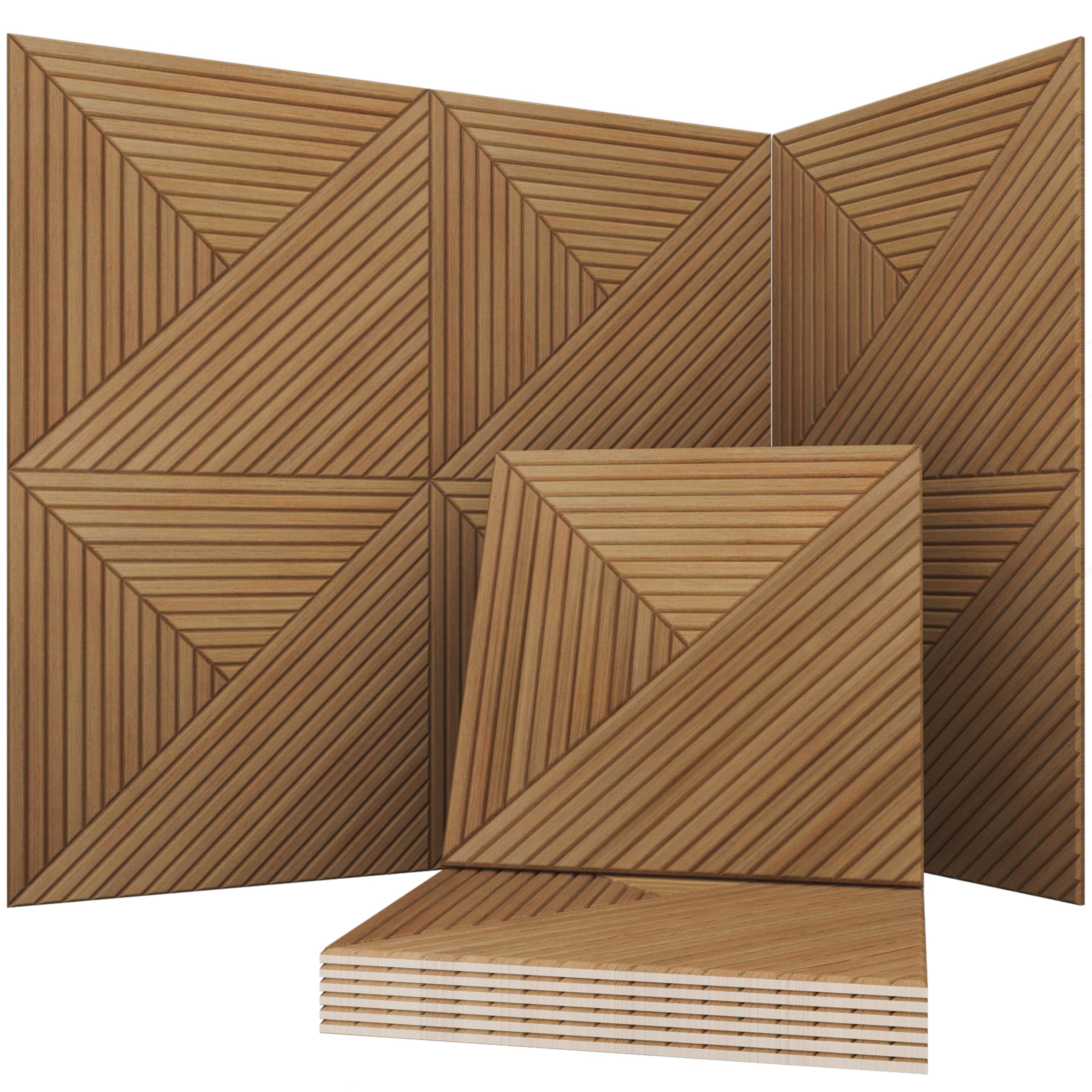
Wood-look grooves that diffuse sound and pass for real paneling.
You get six square panels, each 23.62 inches a side and covering 558 square inches, for roughly 3348 square inches across the pack. The groove pattern is what separates it: linear channels trap and diffuse sound, so echo drops across a large wall. Underneath, high-density polyester fiber does the absorbing, and the printed decorative finish gives a warm wood-grain look with continuous lines between panels. This is the pick if you want a feature wall that sounds as good as it looks — the visual continuity makes adjoining panels read as one smooth surface. skip it if you need maximum coverage per panel for a large room, since each panel covers 558 square inches.
Mounting is genuinely tool-free: the 6-pack ships with 30 transparent double-sided adhesive squares, so no nails or drills are needed. The panels hold their shape and structure, stay light on the wall, and can be arranged in any configuration. Buyers return again and again to the appearance — the wood-look finish is the single most praised trait, and it completes a room’s look rather than sitting on top of it. For a home theater, a workspace, or a living room, this is where function and finish meet.
The thing to watch is stability over time. Some panels stay put for months, while a few work loose from the wall. Using the supplied squares on clean, flat surfaces is the way to keep adhesion solid. The wood-grain look is a printed finish rather than solid timber, which is the trade for the light weight and the price tier. As a statement wall that also calms echo, the Acadian Vortex earns its place — just mount it with care.
The one to grab for: a feature wall in a home theater or living space where the wood-grain finish is the star.
The one to pause on: if you need guaranteed long-term hold, check and press the adhesive squares over the first few months.
8. Art3d 6-Pack Soundproof Wood Slat Wall Panels
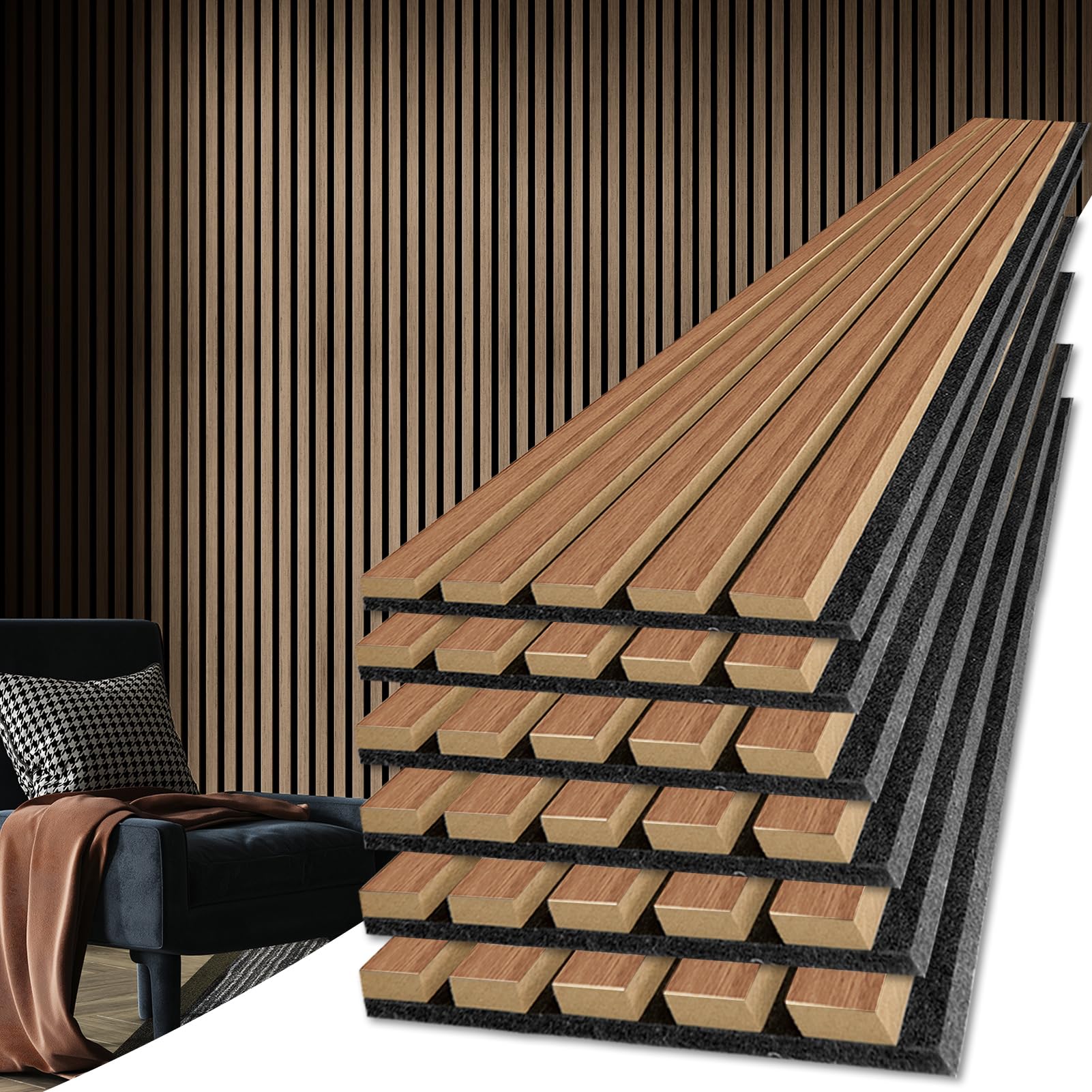
The luxury build: walnut slats that cover 31.5 square feet of wall.
Six fluted panels at 94.5 by 7.9 inches each cover about 31.5 square feet — the largest single coverage figure of any wall panel here. The construction is quality MDF with high-density polyester fiber, and Art3d notes low TVOC levels (total volatile organic compounds, the fumes that give new materials a chemical smell) and no harmful chemical emissions. The walnut wood-laminate finish gives a natural, warm look that lifts a room rather than cluttering it. If you are treating a feature wall or a ceiling and want it to double as interior design, this is the top-tier choice.
Install is quick with basic tools, and the panels cut easily to fit around outlets and corners. Owners describe the walnut finish completing a room’s look, and one account of a full wall going up in 45 minutes sums up how forgiving the slats are to work with. The panels are sturdy and hold up as a real architectural surface, not a foam tile. The sound barrier and noise reduction are the quieter wins, but they are there — the density of the MDF and fiber does the work behind the finish.
The honest caveat is value: as the most premium wall option on this list it costs the most, and buyers split on whether that is worth it. Art3d itself suggests ordering a sample pack first to confirm the finish before a full order — worth heeding, since walnut is a commitment in a room’s palette. For a feature wall where the look and the acoustic treatment share a budget, this delivers both in one surface.
Why the coverage leads
- 31.5 sq ft across six 94.5-inch panels — the most wall per pack on this list
- Quality MDF and high-density fiber with low TVOC levels and no harmful emissions
- Walnut wood-laminate finish doubles as a real design feature
- Cuts easily and mounts with basic tools
The premium math
- The highest-tier finish here, and value is the point buyers split on
- Order a sample first — the walnut tone is a real palette commitment
Reach for this when: you want a feature wall or ceiling where the walnut finish and acoustic treatment are one and the same purchase.
Hold off if: you only need to treat a small focal area — this is a full-wall commitment.
Know the Specs
Coverage (sq ft and sq in)
Coverage is the total surface a pack will treat, and it is the number that most often surprises buyers. Foam panels here range from about 7.5 square feet for a 12-pack up to 31.5 square feet for the wood slat set, while car deadening mats are quoted in tens of square feet per pack. Measure your target wall or door and compare it to the figure on the listing. A pack that looks generous in the photo can leave half your wall bare if you skip this step.
Thickness and density
Thickness is quoted in inches for panels and mils for mats, where a mil is a thousandth of an inch — so 80 mils is a genuinely thick sheet. Thicker, denser material tends to soak up lower, boomier frequencies that a thin sheet lets bounce. Density like 9.4 lb/ft3 is a fair signal of how tightly packed the fibers are. Neither number alone guarantees a quiet room, but together they tell you how seriously a product is built for absorption.
NRC and absorption scores
NRC stands for Noise Reduction Coefficient, a 0-to-1 scale for how much sound a material absorbs, and it appears on only some listings. A score near the top of the scale signals a genuine acoustic panel rather than decor. When a product publishes an NRC, you can compare it against another that does; when a listing stays silent, rely on density and thickness and treat the claims more cautiously.
Mounting method
Self-adhesive backing is the fastest install and needs nothing extra. Nano glue and supplied sticky squares give you repositioning room. Some panels expect you to supply strips, so check the box contents. The right method depends on how permanent you want the wall to be: removable strips suit renters, while spray adhesive and permanent backing suit an owned studio you plan to keep for years.
Common Questions
Do acoustic panels actually soundproof a room?
How much wall coverage do I need for a small studio?
Will foam panels reduce noise coming through the floor?
What does the NRC number on acoustic panels mean?
Can I install sound insulation panels on a rented wall without damage?
Are acoustic foam panels a fire risk near a studio desk?
How do I stick acoustic panels to a wall that keeps losing adhesion?
Do car sound deadening mats work on doors and floors?
How long does foam insulation take to reach full size after shipping?
What is the difference between acoustic absorption and sound blocking?
The Bottom Line
For most people chasing a quieter car, the winning sound insulation pick is the Siless Hybrid 3in1, because its three-layer composite damps vibration, blocks road noise, and reflects heat in one 0.2-inch sheet instead of three separate purchases. If you want the most square footage per pack for a full-vehicle job, grab the Butyl Sound Deadening 80mil at 36 square feet. And for a room where the panels will be seen every day, the JaneTech Art Acoustic Panels double as decor while calming the echo. Match the material to your noise source and do the coverage math before you order.
How we choose
We do not accept paid placement. Every pick is matched to a real buyer and a real use-case; we do not hands-on test units.
Sources
Specifications: manufacturer listings and product documentation. Review insights: verified customer reviews, as of November 2026. Pricing: not shown on this page (it changes often); check the current price via the retailer link.
As an Amazon Associate, Tactical Gear Guy earns from qualifying purchases. This does not affect which products we feature.