Specs are compiled from manufacturer listings and verified buyer reviews and can change over time — please confirm the key details on the product page before buying.
If your room rings and bounces, more furniture won’t fix it. You need a sound insulation board that absorbs sound instead of bouncing it back at you. Nine real options follow, from peel-and-stick panels you can hang in an afternoon to semi-rigid fiberglass boards used in proper studios. Each one fits a different room, wall, and tolerance for drilling.
This guide is built by comparing the manufacturers’ published specifications and the patterns across verified customer reviews, so you get each pick’s real strengths and trade-offs instead of marketing spin.
The picks below are split by what they actually do — diffuse a harsh echo, dampen a noisy neighbour, or simply calm a room down — so you can match the board to the problem. Read on for the honest breakdown of the best sound insulation board options for rooms you actually live in.
Top Picks


How To Choose The Best Sound Insulation Board
Most buyers walk into this expecting a magic wall covering that silences the neighbour’s television. That is not what an acoustic board does. A sound insulation board absorbs the sound already bouncing around inside your room — the echo, the reverb, the harsh slap off bare drywall. It softens what you hear. Blocking noise from travelling through a wall is a different job, and it usually needs mass and sealing, not a 0.4-inch panel.
Start with the number that measures absorption
Look for the NRC — noise reduction coefficient — which is a score from 0 to 1 for how much sound a material soaks up rather than bounces back. A felt panel rated 0.97 absorbs nearly all the sound that reaches it; a hard board rated 0.10 reflects most of it back into the room. Compare NRC before you compare finishes.
Then work out how much wall you need to cover
Coverage is listed in square feet per pack, and it is the spec buyers most often get wrong. A six-pack that covers 8 square feet is a small accent treatment, not a whole-wall solution. Measure the wall you want to treat, then buy enough packs to cover a meaningful share of it — the more surface you treat, the more echo you remove.
Match the mounting to your wall and your landlord
Self-adhesive panels peel and stick, which is fast and needs no tools, but the adhesive is the single most mixed area across every product here. Panels mounted with construction adhesive or small screws hold more reliably but put holes in the wall. If you rent, decide up front which trade-off you can live with.
Decide whether looks count
Plain foam and felt panels disappear into a studio wall. Wood slat panels are the opposite — they are a design feature first and an acoustic treatment second. If the wall is in a living room rather than a booth, that visual difference is worth weighing as heavily as the absorption figure.
Side-by-Side Comparison
| Model | Best For | Coverage | Thickness | Pack Size | Amazon |
|---|---|---|---|---|---|
| NeatiEase Wood Panels for Wall★ Best Overall | Statement wall with acoustic benefit | About 33 sq ft | — | 4 pieces | Amazon |
| Thickened Acoustic Panels (Felt)Most Absorbent For Its Size | Doors and small rooms | 8 sq ft | 0.5 inches | 6 pieces | Amazon |
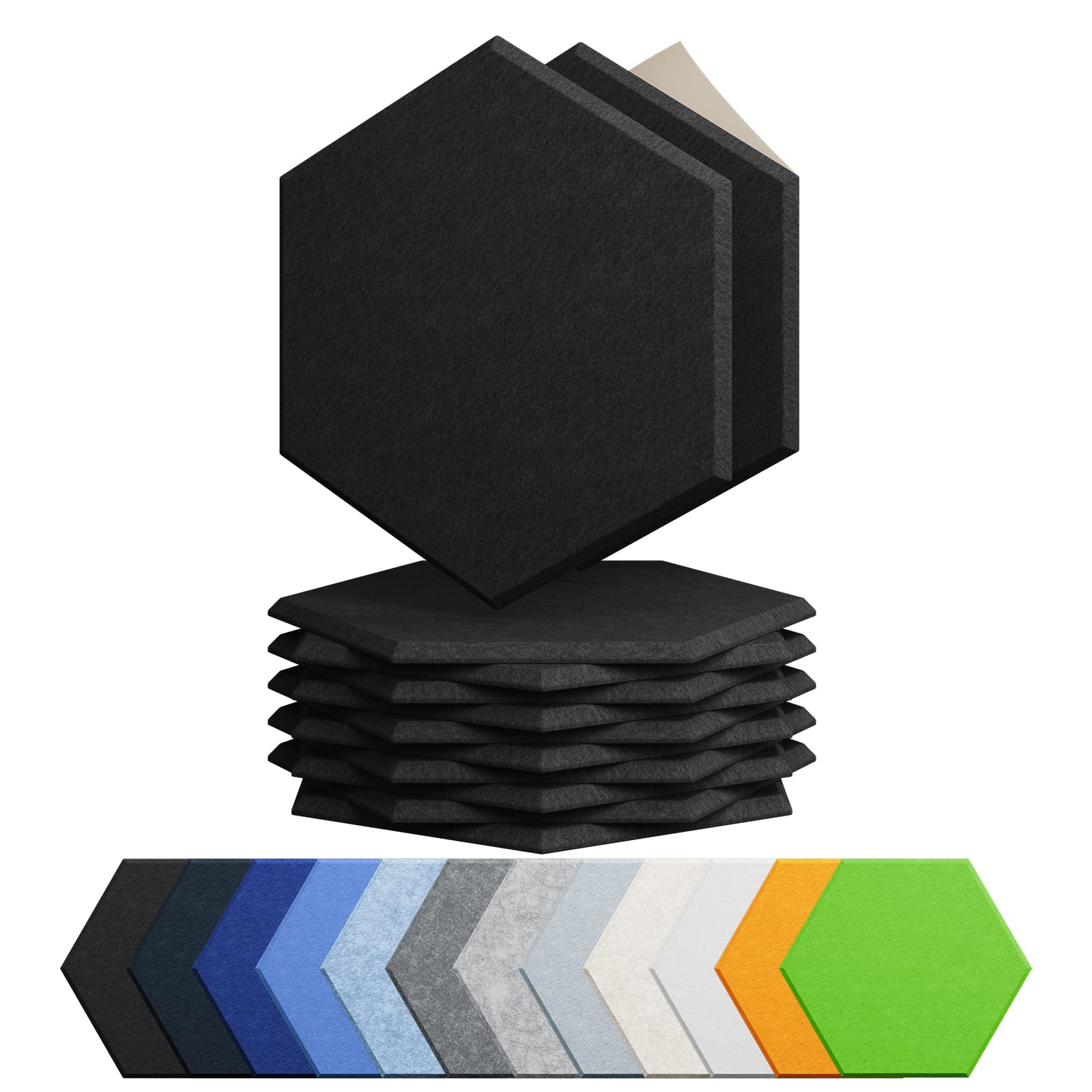
| Amantech Hexagon Acoustic PanelsBest Looking Wall Pattern | Design-led wall pattern | — | 0.4 inches | 12 pieces | Amazon |
| Dailycooper Self-Adhesive Panels | Quick peel-and-stick treatment | 7.5 sq ft | 0.4 inches | 12 pieces | Amazon |
| NEPIS Brick Acoustic Panels | Covering a worn or damaged wall | 20 sq ft | 0.36 inches | 20 pieces | Amazon |
| ROOME Self-Adhesive Panels | Large rooms needing full coverage | — | 0.4 inches | 18 pieces | Amazon |
| Art3d Fluted Wood Slat Panel | Warm wood look with sound control | 23.3 sq ft | 0.01 inches | 2 pieces | Amazon |
| Fiberglass Acoustic Panels (Charcoal Grey) | Rooms where echo is the problem | — | 2 inches | 4 pieces | Amazon |
| Owens Corning 703 Fiberglass Board | Building your own studio panels | 48 sq ft | 2 inches | 6 pieces | Amazon |
Detailed Reviews
1. NeatiEase Wood Panels 4-Piece 96″ x 12.6″
Our pick — 4.5+★ from 600+ verified ratings; the strongest balance of quality and price.
A wall treatment that quietly does the acoustic work while looking like you hired a designer.
Four panels, each 96 inches long and 12.6 inches wide, covering about 33 square feet — that is a genuine feature wall, not a token patch. Slats that long run floor to ceiling in a standard room. The louvred face scatters sound as it passes, so the hard slap you get off bare drywall softens into something closer to a hush.
Where this pulls ahead of the smaller felt packs here is sheer scale. Compared with the Dailycooper panel set, which covers 7.5 square feet from 12 pieces, the NeatiEase covers about 33 square feet from just 4 — you are treating a whole wall rather than decorating a corner. The construction is MDF with high density polyester fibre underneath, not a printed wood-look sticker, and that is the combination doing the acoustic work.
Quality is what wins people over most here — owners describe the strips as realistic-looking, and the teak finish photographs like actual timber. Installation turns out simpler than the size suggests: screws or superglue, mounted horizontally or vertically, and the panels can be cut to shape. Two honest notes. The colour can vary between panels in the same order, so open every box and dry-fit before committing a layout. And the wood-look reads convincingly but the slats are an MDF product, which some buyers discover only after delivery.
Where this earns its place
- About 33 square feet from 4 panels — a full feature wall in one order
- 96-inch length runs floor to ceiling without seams
- MDF with high density polyester fiber, not printed vinyl
- Mounts horizontally or vertically and cuts to shape
What to plan around
- Shade can shift between panels in the same pack — check before fixing
- Screws or adhesive needed; nothing is pre-applied
- Heavier than felt panels, so wall anchors matter
The verdict: This is the pick when the treated wall is also the wall people look at — living rooms, home offices, a bedroom behind the headboard.
Worth knowing: Order with a layout in mind and dry-fit first, because colour matching across panels is the one thing that varies.
2. Thickened Acoustic Panels Pack of 6
Half an inch of dense felt with a 0.97 absorption rating — the quietest small pack on this list.
Read the absorption figure before anything else. These felt tiles carry an NRC of 0.97, meaning they soak up almost all the sound that reaches them rather than bouncing it back. That is the highest absorption number in this whole roundup, and it comes in a six-pack covering 8 square feet. For a door, a small vocal booth, or the inside wall behind a desk, that is exactly the right amount.
The 0.5-inch thickness is the reason it works so well. Thicker than the 0.4-inch foam and hexagon panels here, and made from 100% polyester fiber at a density of 9.4 lb per cubic foot, so it holds its shape instead of crumbling. It also will not oxidise and go yellow the way traditional acoustic foam eventually does. Class B1 flame retardant, per the maker, and formaldehyde-free.
Sound dampening is the thing buyers bring up most, and the pattern holds — these panels do the job in tight spaces like a Jeep cabin or a closet studio. Fitting them is where the story splits. They mount with construction adhesive, double-sided tape, or small screws, and using separate adhesive rather than a sticky back means far less wall damage when you take them down. The catch: they are firm, and trimming them to fit an awkward shape is fiddly rather than easy. The white option also reads cooler than pure white in person.
Best use of this pack: Two on a hollow door and four on the wall behind a mic stand changes how a small room records far more than you would expect from 0.5 inches of felt.
The one thing to accept: Cut them with a sharp knife and a straight edge before mounting — freehand trimming is where owners get frustrated.
Reach for this if: your problem is a small, echoey space like a door, booth, or closet, and you want the highest absorption per square foot here.
Look elsewhere if: you need to treat a full 10-foot wall — 8 square feet will not stretch that far, and the larger packs below will serve you better.
3. 12 Pack Hexagon Acoustic Panels
Twelve honeycomb tiles that turn a boring treated wall into an actual design feature.
Twelve hexagonal tiles at 0.4 inches thick, cut with glue already on the back. Peel, press, done — no tools, no adhesive tube, no screws. The hexagon shape is doing double duty: the angled walls between tiles scatter reflections while the pattern itself looks deliberate rather than improvised.
Buyers keep coming back to the look. The honeycomb arrangement is what people point to when they describe the finished wall, and installation is described as genuinely unfussy, including cutting shapes with a knife. On sound, the panels do reduce echo and take the edge off a noisy room. That is noticeably better in an office or podcast corner than a bare wall, though nobody should expect a 0.4-inch foam tile (about 1 cm of foam) to silence a road outside the window.
Here is the honest catch. The self-adhesive back is the most inconsistent part of this product — some tiles grip firmly and stay put, while others lift at the edges within weeks, particularly on a dusty or slightly textured wall. Clean the wall first, press each tile firmly for a slow count, and this is one of the better-looking panels in the roundup. Made from 100% polyester fiber, odorless, non-toxic and formaldehyde-free.
The pattern payoff: Hexagons tile without visible joints, so you can run them up a full wall or frame a single alcove and it still reads as intentional design.
Before you stick: Wipe the wall down and let it dry completely — the adhesive is the weak link, not the panel.
Pick this one when: the wall is visible and you want acoustic help that looks like a choice rather than a fix.
Hold off if: your wall is textured or freshly painted — the sticky back needs a clean, flat surface to hold.
4. 12 Pack Self-Adhesive Acoustic Panels Y-Lined

A dense, bevel-edged panel set that looks like wall art and installs in a single afternoon.
Twelve panels at 12 by 10 inches each, 0.4 inches thick, and a density figure of 9.4 lb per cubic foot. That density is what does the absorbing — a denser polyester panel pulls more energy out of a sound wave than a loose, airy foam does. The pack covers approximately 7.5 square feet, so it suits a focused treatment rather than an entire room.
The beveled edge and Y-line pattern are the visual hook, and it works — the finish is described as attractive enough to hang like art rather than hide. Compared with the hexagon set above, this one is squarer, more architectural, and less playful. The peel-and-stick backing saves you the adhesive tube altogether, and the panels cut easily with a knife for a custom shape.
Two things to weigh honestly. The sound result is the most polarised of any panel here. Some rooms get a clean, audible drop in echo and others barely shift. That usually depends on how much wall you cover and whether the room already has soft furnishings. The sticky back is the recurring gripe: press firmly, use every panel on a clean wall, and expect a few to need extra tape. The material is 100% polyester fiber, flame retardant, and odorless.
What the density buys you: A tighter fibre structure than a cheap open-cell foam, so the panel absorbs rather than just sits there looking acoustic.
Fair warning: Treat at least a quarter of the wall for a real change — a token six panels on a big room will disappoint.
Good match for: a home office or music corner where you want a tidier, more graphic look than foam and a denser panel than the budget tiles.
Think twice if: your wall is bare and echo is severe — buy two packs to hit meaningful coverage rather than one.
5. 20 Pack Acoustic Panels Brick Design
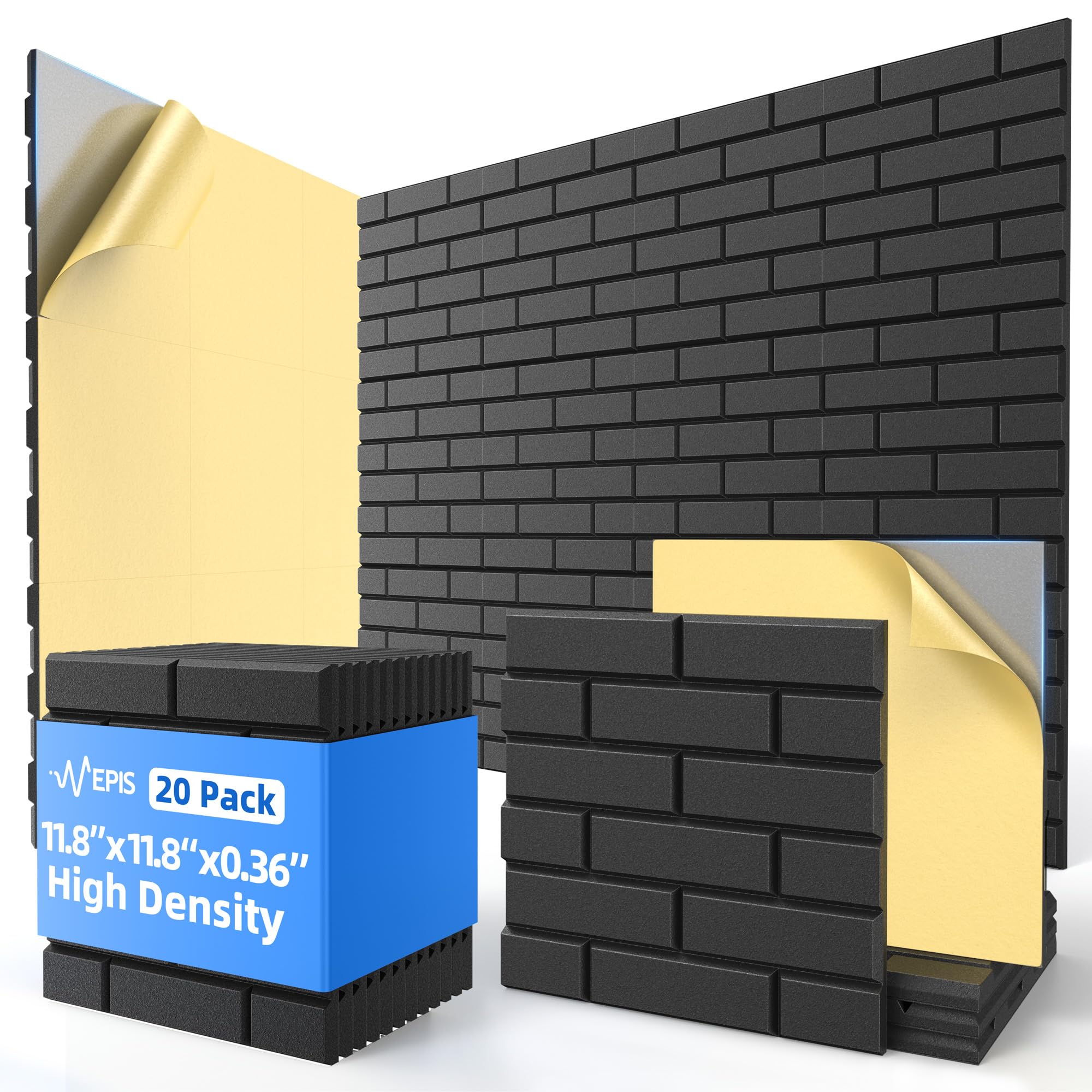
Twenty brick-pattern tiles covering 20 square feet, at a density that punches above the price.
Twenty pieces at 11.8 by 11.8 inches, 0.36 inches thick, covering about 20 square feet. That is a large treatment from a single order — enough to cover a full accent wall behind a desk or sofa. The density figure of 14.35 lb per cubic foot is the highest of any polyester panel here, which is the number worth checking when one pack outperforms another on paper.
Being denser, these also claim a noise reduction coefficient above 0.95, so they pull a lot of reflection out of a room compared with a thin foam tile. The brick pattern gives you an option the flat panels cannot — it can cover a worn or damaged wall and act as a decorative surface at the same time. Installation is a peel-and-press job with a kraft paper backing, and the panels cut easily, which owners mention specifically.
The truth about sound results: they are mixed, in the same way they are for most foam-style panels. Used generously and combined as the maker suggests, the noise fades; used as a small decorative patch, the change is modest. The adhesive is well liked as a rule — the tiles grip and can be peeled and repositioned — but a few lift over time on imperfect walls. 100% polyester, odorless and non-toxic.
What makes it a smart buy
- 20 square feet in one pack — a real wall treatment, not a sample
- Density of 14.35 lb/ft3, higher than the thinner tiles here
- Brick pattern hides scuffs and damaged drywall
- Peel-and-reposition adhesive backing, easy to cut to shape
What to keep in mind
- Sound results depend heavily on how much wall you actually cover
- Only 0.36 inches thick — a surface treatment, not a sound blocker
- A few tiles may need extra pressure on textured walls
Choose this when: you want the most square footage of treated wall from a single order and a pattern that hides an ugly wall underneath.
Not the one for: stopping noise travelling between rooms — for that you need mass and sealing, not a 0.36-inch tile.
6. ROOME 18 Pack Self-Adhesive Acoustic Panels

Eighteen 12-inch squares with a 0.95 absorption coefficient — the workhorse of the roundup.
Eighteen squares at 12 inches wide and 0.4 inches thick, with a stated absorption coefficient of 0.95. That is not a decorative panel that happens to be called acoustic — it is a proper absorber aimed at everyday echo, standing waves and general room noise. The beveled edge and multi-line pattern let you arrange the squares into pinwheel or ring shapes if you want something other than a grid.
What sets this one apart in the pile is how little it asks of you afterwards. It is self-adhesive, so it goes onto walls, doors, windows and ceilings with no tools and no glue tube. Buyers consistently report it sticks and stays put, which is rarer in this category than it should be. Quality and noise reduction are the two things people praise most about it, and the 18-piece count gives you enough material to line up a genuine pattern across a wall.
Two honest notes on fit rather than fault. At 0.4 inches it treats the surface of a room; it will not stop bass or block sound through a party wall, so it is the wrong tool if isolation is the goal. And the pattern only looks deliberate if you plan the layout — squares lined up casually read as squares. 100% polyester fiber, B1 class flame retardant and odorless, per the maker.
The standing-out detail: An 18-piece count means fewer seams and a fuller wall than the 12-piece sets here, and the adhesive holds up in use.
The limit worth naming: This softens a room, it does not soundproof one — for blocking, look at the fiberglass boards further down.
Best fit: a full wall in a game room, podcast corner or home theatre where you want enough panels for a pattern and adhesive that behaves.
Skip if: you are chasing a bass problem or sound leaking through a shared wall — neither is what a 0.4-inch adhesive square solves.
7. Art3d 2-Pack Fluted Acoustic Wood Slat Wall Panel

Fluted walnut slats that make a wall look expensive and behave acoustically at the same time.
Two panels, each 47.2 by 23.6 inches, covering about 23.3 square feet. The fluted face is a row of narrow vertical slats, and the gaps between them are what disrupt sound reflections as the wave passes. It is the same principle as the NeatiEase panels above, executed in a shorter, wider format that suits a feature panel behind a sofa or a bed rather than a full floor-to-ceiling run.
Quality is what buyers single out most — the panels feel sturdy rather than flimsy, and they mount with basic tools in an afternoon. The walnut finish is described as exactly what people were hoping for. The acoustic side gets less attention than the looks, which tells you something honest: most people buy this because of how the wall ends up looking, and the sound absorption is a welcome bonus.
Two practical notes. The panels are easy to cut to size, but the cut edges do not always come out perfectly even, so a fine saw and a guide help enormously. And at 0.01 inches thickness on the specification sheet, this is a surface-mounted slat assembly, not a deep absorber — it diffuses and takes the harshness off, but deep absorption comes from boards like the fiberglass options below. MDF with high density polyester fiber, low TVOC levels.
Why it earns the premium label: Walnut fluted slats are a design decision, and the acoustic benefit rides along with it — this is the pick when the wall is part of the room’s look.
Handling advice: Cut with a fine-tooth blade and clamp a straight edge — ragged edges are the one thing that spoils an otherwise crisp finish.
Reach for this if: the treated wall is in a living space and you want it to look like walnut panelling rather than acoustic foam.
Look elsewhere if: you need deep absorption for recording — this softens reflections, while the 2-inch fiberglass boards further down absorb properly.
8. 4 Pack Acoustic Fiberglass Panels
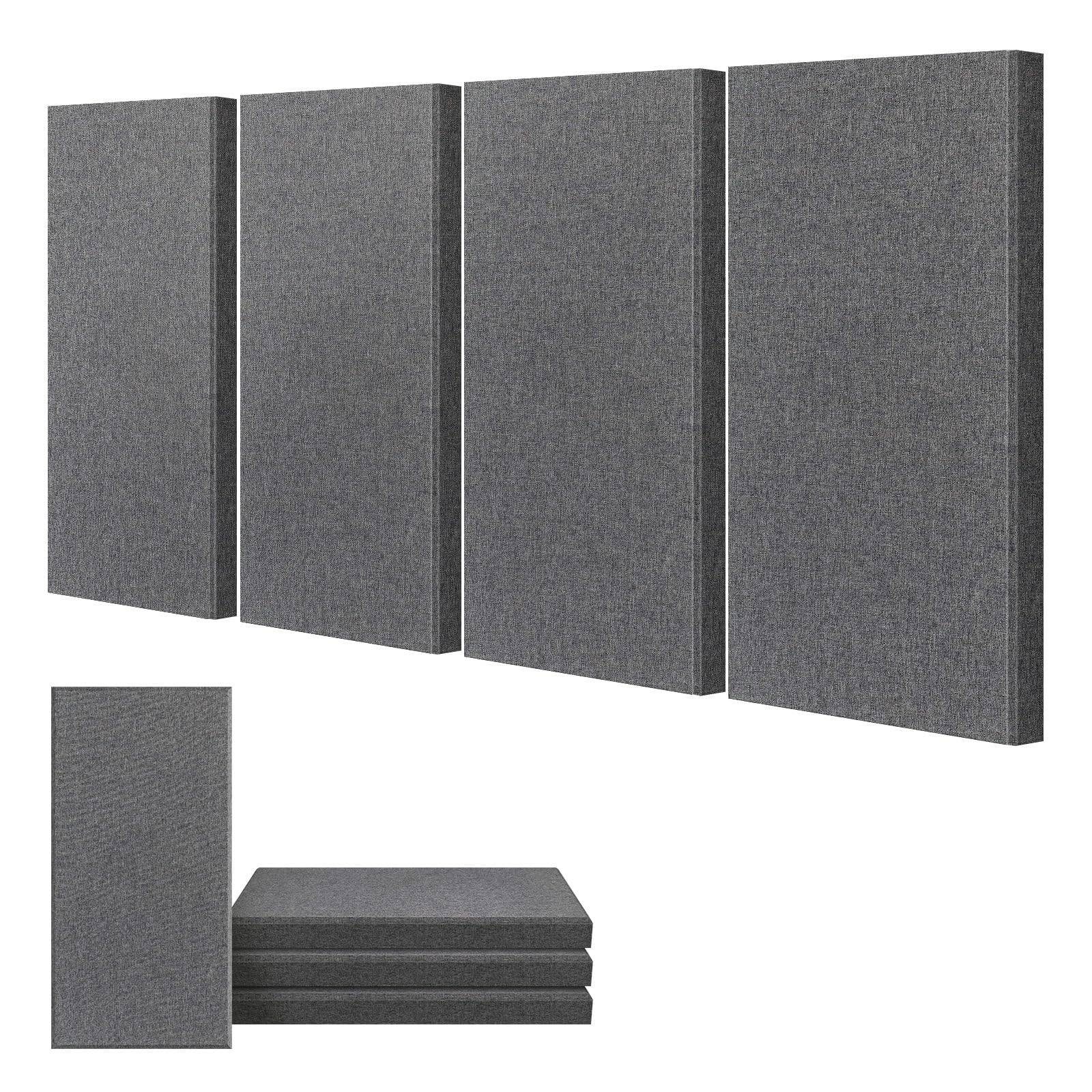
Two full inches of fiberglass wrapped in charcoal fabric — this is studio-grade absorption, not decoration.
You get four panels, each 23.6 by 11.8 inches and a genuine 2 inches thick, with an NRC of 0.95 (Noise Reduction Coefficient — a 0-to-1 score for how much sound a surface soaks up, where 1.0 absorbs nearly all of it). Thickness is the spec that separates this from every 0.4-inch tile in this article. The maker states outright it outperforms a 1-inch poly fiber panel, and the physics backs it: deeper material absorbs lower frequencies that a thin tile simply passes by. If your problem is a booming, echoey room rather than a dead-sounding one, this is where absorption actually begins.
The build is a 100% polyester fabric wrap over a 100% white fiberglass core with an E0 environmental rating, which the maker presents as better than yellow fiberglass. In practice that means a cleaner-looking panel with no loose fibres on the face. In a hall, meeting room, gym or studio, that wrap is what keeps the panel from looking like raw insulation.
The mounting is where you need to think. The panels come with installation accessories, and some buyers find the adhesive extremely strong once it grips, while others have the opposite experience and watch a panel drop. Treat the supplied fixing as a starting point and use proper mechanical anchors on anything but flat, clean drywall. Value is genuinely mixed here too — this is priced as a serious acoustic product, so buy it knowing you are paying for depth, not piece count.
Why the depth matters
- 2 inches thick — reaches frequencies a 0.4-inch tile cannot touch
- NRC 0.95 with fabric-wrapped finish that looks finished
- White fiberglass core with E0 environmental rating
- Suits halls, studios and gyms as well as living rooms
The honest trade-offs
- Only 4 panels in the pack — plan for more than one box
- Supplied adhesive is unreliable; use proper wall anchors
- Pricier per square foot than any felt tile here
The right call for: a room with a real echo problem — a studio, a gym, a hard-surfaced living room — where 2-inch absorption actually changes the sound.
Be prepared to: budget for a second pack and your own anchors, because four panels treat a spot, not a room.
9. Owens Corning 703 Semi Rigid Fiberglass Board 6 Pack

The raw material behind most studio acoustic panels — six boards, 48 square feet, full absorption.
Six boards at 24 by 48 inches and 2 inches thick, covering 48 square feet. The headline figure is the NRC of 1.0 — the highest absorption rating in this entire article, and the number that explains why this material turns up inside so many commercial studio panels. Nothing on this list absorbs more per square foot.
What you are buying is the board itself, unfaced and semi-rigid, so you build the finished panel around it. A wooden frame, some fabric, and you have a professional-grade absorber at a fraction of the cost of a pre-wrapped panel. The material is also rated Class A or Class 1 for fire performance under ASTM E84, and contains an average of 53% recycled glass content. It carries an R-Value of 8.7, so it does double duty as thermal insulation if you are finishing a basement or garage.
The catch is exactly what makes it cheap: it arrives bare. No fabric, no frame, no adhesive — and you will want gloves and a mask when handling it, then wrap it before it goes on a wall. It is also the bulkiest item here, so the boards need space to lie flat before installation. For anyone building out a studio properly, that prep work is the whole point rather than a downside.
What 1.0 actually means: a perfect absorption coefficient — the board takes in essentially all the sound that reaches it, which is why it is the standard inside homemade bass traps and wall panels.
The build reality: order fabric and framing timber at the same time, because the boards arrive unfinished and cannot go up as they are.
This is for you if: you are building your own panels and want the best absorber per square foot — 48 square feet in six boards is a serious amount of material.
Look elsewhere if: you want to peel and stick something on the wall this weekend — this needs a frame and fabric before it is finished.
Know the Specs
NRC — Noise Reduction Coefficient
A 0-to-1 score for how much sound a material absorbs rather than reflects. A felt panel rated 0.97 or a fiberglass board rated 1.0 soaks up nearly everything that hits it, while a hard, thin surface bounces most of it back. It is the most useful number for comparing two boards, because it describes performance rather than appearance.
Coverage — Square Feet Per Pack
How much wall one box will treat once the panels are laid out edge to edge. A six-pack covering 8 square feet is a small treatment; a six-board pack covering 48 square feet can wrap a whole studio wall. Buy enough to cover a meaningful share of the surface; a handful of tiles on a large bare wall changes very little.
Thickness — Inches
How deep the absorbing material is. A 0.4-inch foam or felt tile handles the higher frequencies — the slap, the hiss, the sharp echo. A 2-inch fiberglass board reaches lower down and calms a boomy room a thin tile cannot. Thicker is not automatically better, but a thin tile has a hard ceiling on how much it can absorb.
Density and Material
Measured in pounds per cubic foot, density describes how tightly packed the absorbing material is. A polyester panel at 9.4 or 14.35 lb per cubic foot holds its shape and absorbs more than a loose, airy foam. Material matters too — MDF and polyester slat panels diffuse sound, while fiberglass boards absorb it deeply and need a fabric wrap.
Common Questions
Does a sound insulation board actually stop noise coming through the wall from next door?
How many panels do I need to hear a difference?
Will the adhesive backing damage my wall when I take the panels down?
Can I cut these boards to fit around a window or socket?
What is the difference between a wood slat panel and a felt acoustic panel?
Are these acoustic panels safe to have in a bedroom or a child’s room?
Do acoustic panels work on a ceiling as well as a wall?
Will a 2-inch fiberglass board work better than a thin foam tile?
Can I paint acoustic panels to match my wall?
How do I know the panels will stay on the wall over time?
The Bottom Line
The strongest all-round pick for the sound insulation board job is the NeatiEase Wood Panels for Wall. Four panels give you 33 square feet of MDF and polyester slat panelling, mounted horizontally or vertically. It softens reflections while looking like a deliberate design choice. If your space is a small, echoey door or booth, grab the Thickened Acoustic Panels and their 0.97 absorption rating in a compact 8-square-foot pack. And for anyone building out a proper studio, the Owens Corning 703 boards give you a full 1.0 absorption coefficient across 48 square feet — the raw material behind most finished acoustic panels you can buy. Match the board to your problem, cover more wall than you think you need, and judge the result by ear.
How we choose
We do not accept paid placement. Every pick is matched to a real buyer and a real use-case; we do not hands-on test units.
Sources
Specifications: manufacturer listings and product documentation. Review insights: verified customer reviews, as of November 2026. Pricing: not shown on this page (it changes often); check the current price via the retailer link.
As an Amazon Associate, Tactical Gear Guy earns from qualifying purchases. This does not affect which products we feature.