Specs are compiled from manufacturer listings and verified buyer reviews and can change over time — please confirm the key details on the product page before buying.
If your roof faces the wrong way, is shaded by trees, or isn’t structurally ready for panels, a ground mount puts the array where the sun actually hits it — and lets you tilt the panels to chase a better angle. The three racks below are all real ground-mount kits, and each one solves that problem differently: one bolts down with anchor screws on flat surfaces, one is a heavy expandable steel frame for large panels, and one is an adjustable aluminum kit you can move by hand.
This guide is built by comparing the manufacturers’ published specifications and the patterns across verified customer reviews, so you get each pick’s real strengths and trade-offs instead of marketing spin.
You’ll see exactly which rack fits your panels, how much tilt control each one gives you, and what each kit includes in the box. Here is the honest breakdown of the best solar system ground mount options for a backyard, shed, or off-grid setup.
Top Picks
How To Choose The Best Solar System Ground Mount
A ground mount is not a universal part. It is matched to your panel count, your panel size, and the weather it has to survive. Get those three wrong and you will be re-drilling holes in your yard. Get them right and the rack stays anchored for years.
Match the rack to how many panels you own
The first number to check is how many panels a single rack holds. A kit built for 1–3 panels needs rails long enough to span them, while a rack rated for 2 large modules needs a frame big enough to carry the weight of both. If you plan to grow the array later, look for a rack the maker describes as expandable, so you can add another frame instead of starting over.
Check the tilt range, not just the word “adjustable”
Tilt is how far your panels lean back from flat. A rack with a 0–90° range covers everything from flat storage to near-vertical, which helps if you want to tilt panels steeply for low winter sun. A rack with a 20°–40° or 30–45° range is built around matching your local latitude. Both are useful — the difference is how much swing you get and whether the bracket locks at the angle you need.
Read the load capacity in pounds
Load capacity is the weight a rack is rated to hold, and it is your best clue about wind and snow behavior. A rack rated at 260 pounds can carry a panel array with margin to spare. Anchor screws and ground clamps do the rest of the wind-resistance work, so check that your kit includes them rather than selling them separately.
Material tells you the maintenance story
Aluminum alloy resists rust and stays light enough to carry during installation. Galvanized steel brings more mass and a stiffer frame but weighs considerably more. Zinc-plated and powder-coated finishes add a protective layer. None of these is a forever promise — the honest read is that the finish slows corrosion, and the anchor method is what keeps the rack planted.
Side-by-Side Comparison
| Model | Best For | Panels per Rack | Tilt Range | Material / Weight | Amazon |
|---|---|---|---|---|---|
| FAHKNS 45inch Mounting Brackets (4 Sets)★ Best Overall | Flat surfaces like RV roofs, sheds and caravans | 4 sets of brackets | 0–90° | Aluminum alloy / — | Amazon |
| SGPWATT Modular Expandable Ground Mount | Two large panels in a backyard or lot | 2 large panels (300W–590W) | 20°–40° | Galvanized steel / 48 pounds | Amazon |
| CMYYANGLIN Adjustable Ground Mounting Bracket | 1–3 panels in a yard or open space | 1–3 panels | 30°–45° | Aluminum alloy + plastic / — | Amazon |
Detailed Reviews
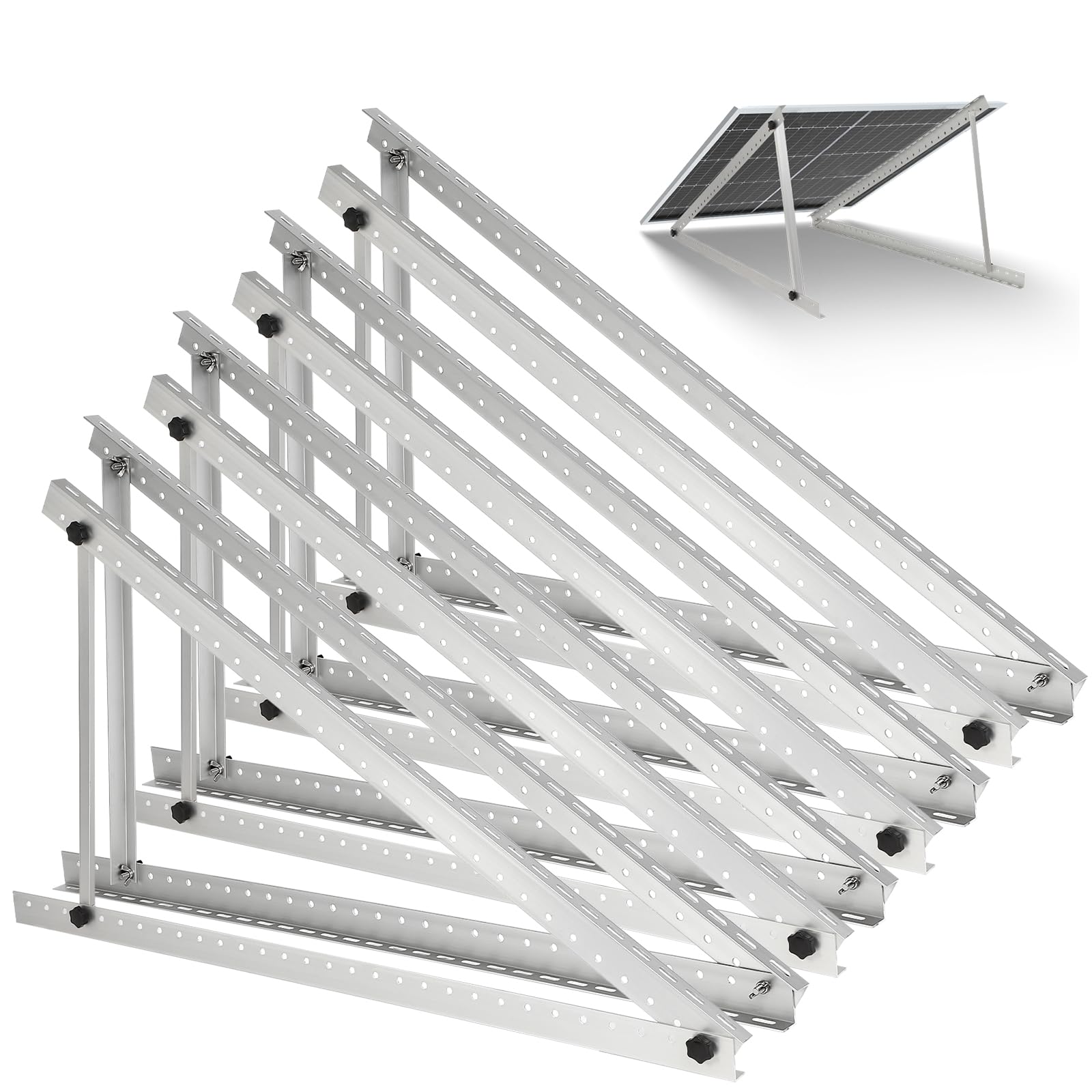
1. FAHKNS 45inch Solar Panel Mounting Brackets, 4 Sets
Our pick — 4.5+★ from 100+ verified ratings; the strongest balance of quality and price.
The kit that sweeps a full 0–90° so you can lay panels flat or stand them nearly upright.
Most ground mounts hand you a narrow window of tilt and call it adjustable. This one goes from 0 to 90 degrees, which means you can drop the panels flat against an RV roof or a shed deck, or tilt them steeply toward a low sun. For anyone mounting on a caravan, a boat deck, or a flat shed surface, that full sweep is the whole point.
The frame is aluminum alloy, so it resists rust and corrosion and keeps the overall weight of the array down while you are lifting panels into place. FAHKNS rates the rack at 260 pounds of load capacity, and the kit ships with ground anchor screws to hold it against wind. You get 16 aluminum mounting rails, 8 aluminum tilt brackets, 24 knob screws, 23 self-drilling screws, 16 M6*20 hex bolts with nuts, and an installation manual. Four sets of brackets arrive as one Count 4 purchase, so you are outfitting a whole array, not a single panel.
For the money, this is the highest-rated kit here at 4.5+ stars across 120+ owners, and the crowd favorite status holds up when you look at what people actually use it for. Reviewers praise its plain functionality — the brackets do exactly what they claim. Mounting quality and sturdiness get the next-most attention, and installation draws mostly praise. The honest catch is the thin rails: the item dimensions run 45 x 0.1 x 22.6 inches, and that 0.1-inch profile is why a handful of buyers found the assembly more fiddly than expected. It is a fine kit for flat surfaces and light arrays. It is not the frame to buy if you are hanging two 500W modules off a freestanding tower.
What earns it the top slot
- Full 0–90° tilt range, the widest here, so flat and steep mounting both work
- 260-pound load rating plus ground anchor screws in the box
- Aluminum alloy resists rust and keeps the array light to move
- Four complete sets — full hardware list included with a written manual
Where it stops short
- Rails measure 0.1 inches thick, so assembly rewards patience
- Built for flat surfaces and lighter arrays, not a large freestanding frame
- Unfinished silver finish offers no extra coating against the elements
Reach for this if: you are mounting on an RV, caravan, boat deck, or shed roof and want to dial in tilt by hand.
Think twice if: you need a rigid freestanding frame for two oversized panels — the thin rails are not that job.
2. SGPWATT Solar Panel Mount Brackets, Modular and Expandable
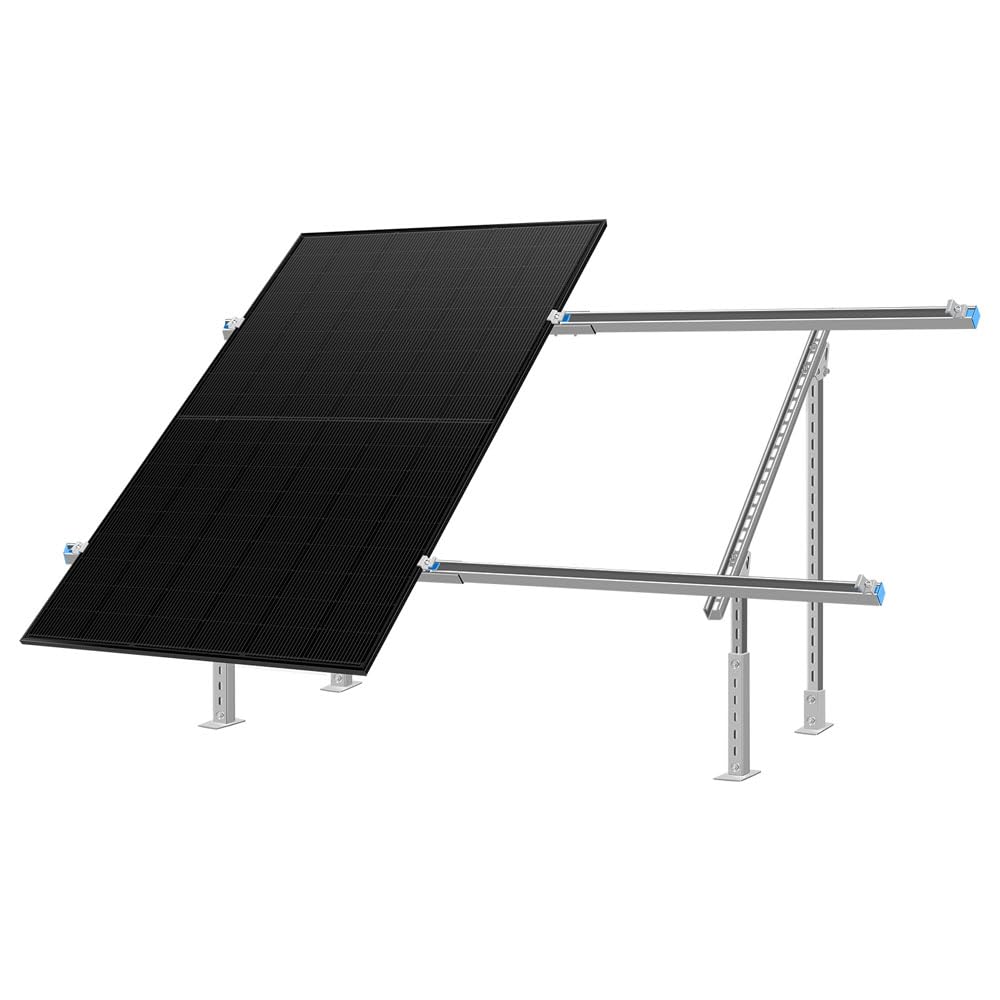
A 48-pound galvanized steel frame built to carry two large panels and grow with your array.
Here is the size difference in plain terms. This rack measures 94.5 x 47.5 x 41.7 inches. The FAHKNS kit measures 45 x 0.1 x 22.6 inches. That is roughly twice the footprint in each direction — because this one is designed to hold two large solar modules, from 300W up through 590W, per rack. Backyard, lawn, parking lot, campsite: it is a freestanding ground frame, not a surface bracket.
The galvanized steel frame adds mass against wind and snow, and SGPWATT describes the load-bearing design as reinforced. Pre-drilled holes and semi-assembled components cut installation time, which matters when you are wrestling a 48-pound frame into position before you even bolt a panel on. The tilt adjusts between 20 and 40 degrees — enough to match your latitude and shift with the seasons. Add a second rack by connecting them, and the array grows without a new frame design.
Functionality, installation, quality and sturdiness each draw steady praise from the 20-odd owners who have rated it, and the theme running through all of it is that it holds up. What buyers notice first is how solid the whole assembly feels once it is anchored. Stability is the selling point — you trade portability for a 48-pound frame that does not shift. The genuine limitation is the narrow tilt window: 20°–40° is a working range, not a full sweep, so if you want to lay panels flat for storage or stand them near-vertical, this is not that rack. It is also a two-person lift at 48 pounds.
If weight is your trade-off: the steel frame and 48-pound frame weight are exactly why it feels planted. You buy this for a frame that stays put, not for carrying it around.
One thing to plan for: the 20°–40° tilt covers seasonal adjustment but stops well short of the full 0–90° swing the aluminum kits above offer.
Suits you best when: you have two big modules and a fixed spot in the yard that is not moving.
Worth passing on if: you need a wide tilt swing or one-person portability.
3. CMYYANGLIN Adjustable Solar Panel Ground Mounting Bracket
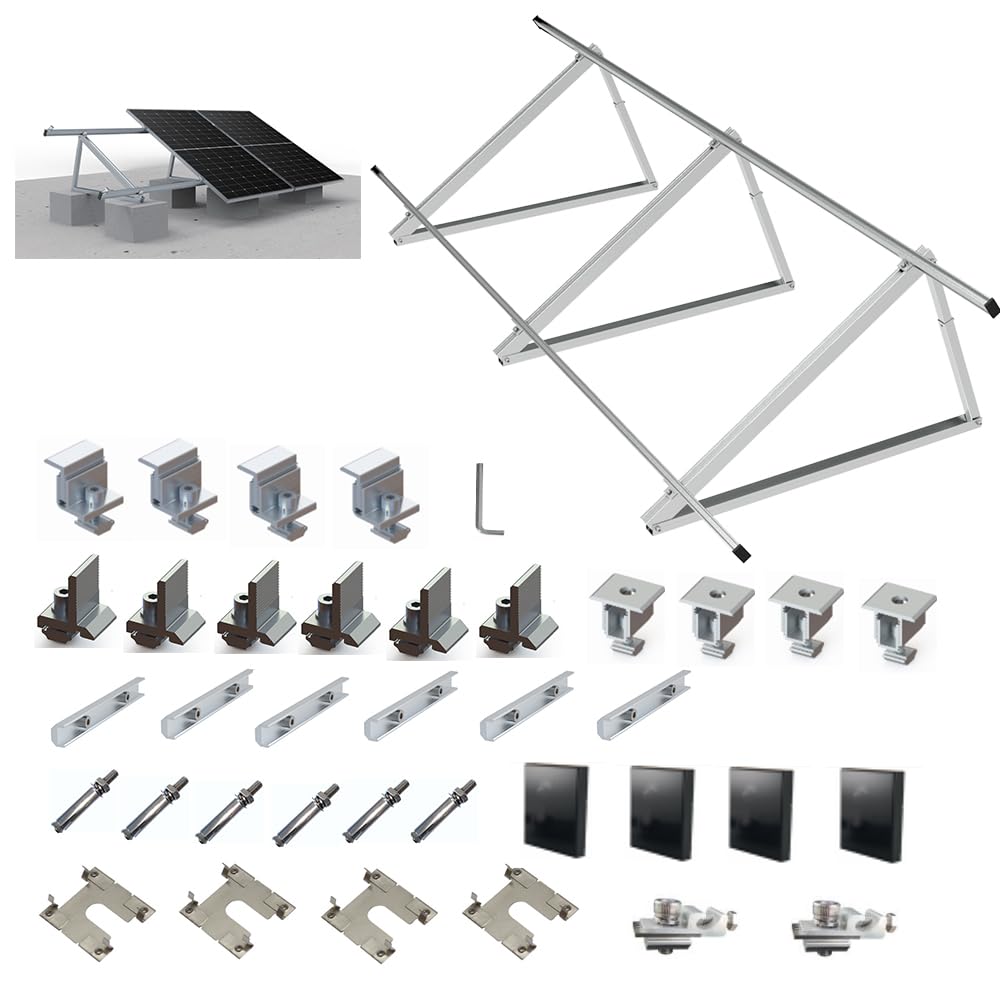
A three-panel aluminum kit you can set at 30 to 45 degrees and lift by yourself.
The angle range is the pitch: these ballasted tilt triangle brackets adjust between 30 and 45 degrees, so you can dial the rack to your local latitude. CMYYANGLIN claims the right azimuth and tilt can add 1–2% more annual energy over a fixed setup — small, but free once the bracket is set. Rails connect into 3565mm of length, enough to build out one to three panels.
Aluminum alloy keeps the whole kit rust-free and light enough to carry to the install spot, which is a real difference from the 48-pound steel frame above. The box is genuinely complete: 4 adjustable end clamps, 4 adjustable mid clamps sized for 30mm and 35mm panels, 6 rail fixture blocks, 3 ballasted tilt triangle brackets, 8 rails, 6 rail connectors, 2 grounding clips, 4 rail end caps, 2 ground clamp groups, 1 L spanner, and 6 stainless steel expansion bolts. The plastic rail end caps protect the rail edges and the grounding clips handle the electrical side.
Stability is the trait owners bring up most often, and assembly earns clean marks — the parts fit together without a fight. Quality feedback is solid too. Where it asks for care is the ballasted design itself: a few buyers found the frame needed extra attention to feel locked down in rough weather. That is the trade-off of a light aluminum rack — it rewards careful anchoring. It is the least-reviewed of the three at 4.0+ stars, so expect a smaller pool of owner experience behind it.
Pick this one if: you want a 1–3 panel kit with a latitude-matched tilt and hardware for the whole job in one box.
Look elsewhere if: you want the widest tilt swing or a heavy steel frame that resists wind on its own weight.
Know the Specs
Tilt Angle in Degrees
Tilt is how far your panels lean back from flat, measured in degrees. A 0° panel lies flat; a 90° panel stands upright. Wider ranges give you more control — the FAHKNS kit’s 0–90° lets you store flat or face a low sun, while the SGPWATT’s 20°–40° and the CMYYANGLIN’s 30°–45° are tuned to match a fixed latitude. Match the range to how much you plan to adjust.
Load Capacity and Anchor Method
Load capacity is the weight a rack is rated to hold, and anchor hardware is what keeps it there in wind. A higher rating with included ground anchors means more margin against uplift. Check that the kit ships with its own anchor screws or expansion bolts — buying them separately is an easy detail to miss.
Common Questions
How do I know which ground mount fits my solar panels?
What tilt angle should I set my ground mount to?
Can a ground mount handle high wind and snow?
Is aluminum or galvanized steel better for a ground mount?
Do these kits include all the bolts and clamps I need?
Can I move a ground mount if I relocate my array?
How many panels can I connect to one rack?
Will a ground mount work on a flat shed or RV roof?
What does “expandable” mean on a solar ground mount?
Do I need to ground the panels once they are mounted?
The Bottom Line
For most setups, the solar system ground mount winner is the FAHKNS 45inch Mounting Brackets because its 0–90° tilt range covers flat and steep mounting, it is rated at 260 pounds, and it includes anchor screws and a complete hardware set. If you have two big modules and a permanent spot in the yard, the SGPWATT Expandable Ground Mount brings a galvanized steel frame with reinforced load-bearing for wind and snow. And if you want a 1–3 panel aluminum kit that matches your latitude at 30 to 45 degrees, the CMYYANGLIN Adjustable Bracket is the one to reach for. The FAHKNS holds the top spot on both rating and convenience — with a full tilt sweep and the complete four-set hardware, it is the safest first buy for most flat-surface and backyard installs.
How we choose
We do not accept paid placement. Every pick is matched to a real buyer and a real use-case; we do not hands-on test units.
Sources
Specifications: manufacturer listings and product documentation. Review insights: verified customer reviews, as of November 2026. Pricing: not shown on this page (it changes often); check the current price via the retailer link.
As an Amazon Associate, Tactical Gear Guy earns from qualifying purchases. This does not affect which products we feature.