Specs are compiled from manufacturer listings and verified buyer reviews and can change over time — please confirm the key details on the product page before buying.
Most solar camp fans fail at the same moment: the sun goes down, the tent heats up, and the battery that looked so clever at noon is flat by midnight. The fix is not a bigger panel alone — it is matching panel wattage to battery capacity, then checking how long the fan actually runs on its low setting when everything is drained and refilled once. That is exactly what this breakdown does for you, fan by fan, using the published specs and what real buyers report after living with them.
This guide is built by comparing the manufacturers’ published specifications and the patterns across verified customer reviews, so you get each pick’s real strengths and trade-offs instead of marketing spin.
You will see which panels split from the fan on a cable so the battery stays cool in the shade, which motors run quiet enough to sleep beside, and which builds hold up to a dusty campsite. Here is what separates a workable solar camp fan from a dead weight in your pack.
Top Picks


How To Choose The Best Solar Camp Fan
A solar camp fan is really two devices in one shell: a solar panel that turns daylight into electricity, and a battery that stores it for the hours you actually need cool air. Buyers keep tripping on the same thing — they think a bigger panel means longer runtime. It does not. Runtime comes from battery capacity (measured in mAh, or milliamp-hours) and how hard the motor works at each speed. The panel only decides how fast that battery refills in the sun.
Panel wattage versus battery capacity
Look at both numbers together. A 10W panel paired with a 20000mAh battery is a common pairing, and the manufacturer’s own claim is roughly five hours of full sun for a full charge. A 7W panel on a similar battery often needs about six hours. Neither is wrong — it is a trade between panel size and how much patience you have on a cloudy day. If you charge mostly by wall USB and only top up with the panel, panel wattage matters less than the battery figure.
Split panel or all-in-one body
This is the decision that separates comfortable owners from frustrated ones. An all-in-one fan sits its panel directly on the body, so the whole unit bakes in the sun while it charges. A split design runs a cable (often 1M) from the panel to the fan, letting you park the panel in the light and keep the battery in the shade. That keeps the battery out of direct heat, which is what degrades a rechargeable cell fastest. If you plan to sit in shaded cover with the fan on you, the split cable is worth more than a slightly larger panel.
Runtime on each speed
Manufacturers publish the low-speed runtime because it is the best-looking number, and that is fine — you should read the high-speed figure too. A fan claiming long low-speed hours may only run a handful of hours at full blast. Plan your sleep: if you want airflow all night on a mid setting, compare the medium figure across the candidates before you decide.
Side-by-Side Comparison
| Model | Best For | Battery / Runtime | Panel | Noise | Amazon |
|---|---|---|---|---|---|
| 14” Solar Powered Floor Fan (Micosong)★ Best Overall | Whole-area cooling | 40–60 hrs low / 4–6 hrs high | Monocrystalline (AC 4 hrs, solar 5–6 hrs) | Quiet brushless motor | Amazon |
| Ausic Solar Misting FanBest for Brutal Heat | Mist cooling in brutal heat | 8–35 hrs | 10W monocrystalline | Low-noise brushless | Amazon |
| WESTTREE Solar Camp FanMost Colorful | All-in-one tent fan | 16–50 hrs | Built-in monocrystalline | Brushless | Amazon |
| Art In Real 20000mAh Solar Fan | Long overnight runs | 13–36 hrs | 10W split, 1M cable | <30 dB | Amazon |
| Art In Real 10W Solar Fan | Simple solar backup | Not stated | 10W | <30 dB | Amazon |
| Innopower Portable Camping Fan | Light packers | 9000mAh, 18–58 hrs | Solar panel | <28 dB | Amazon |
| ZIZIWIN 14″ Greenhouse Fan | Barn and coop airflow | 38600mAh, 30–60 hrs low | 25W monocrystalline | Quiet brushless | Amazon |
Detailed Reviews
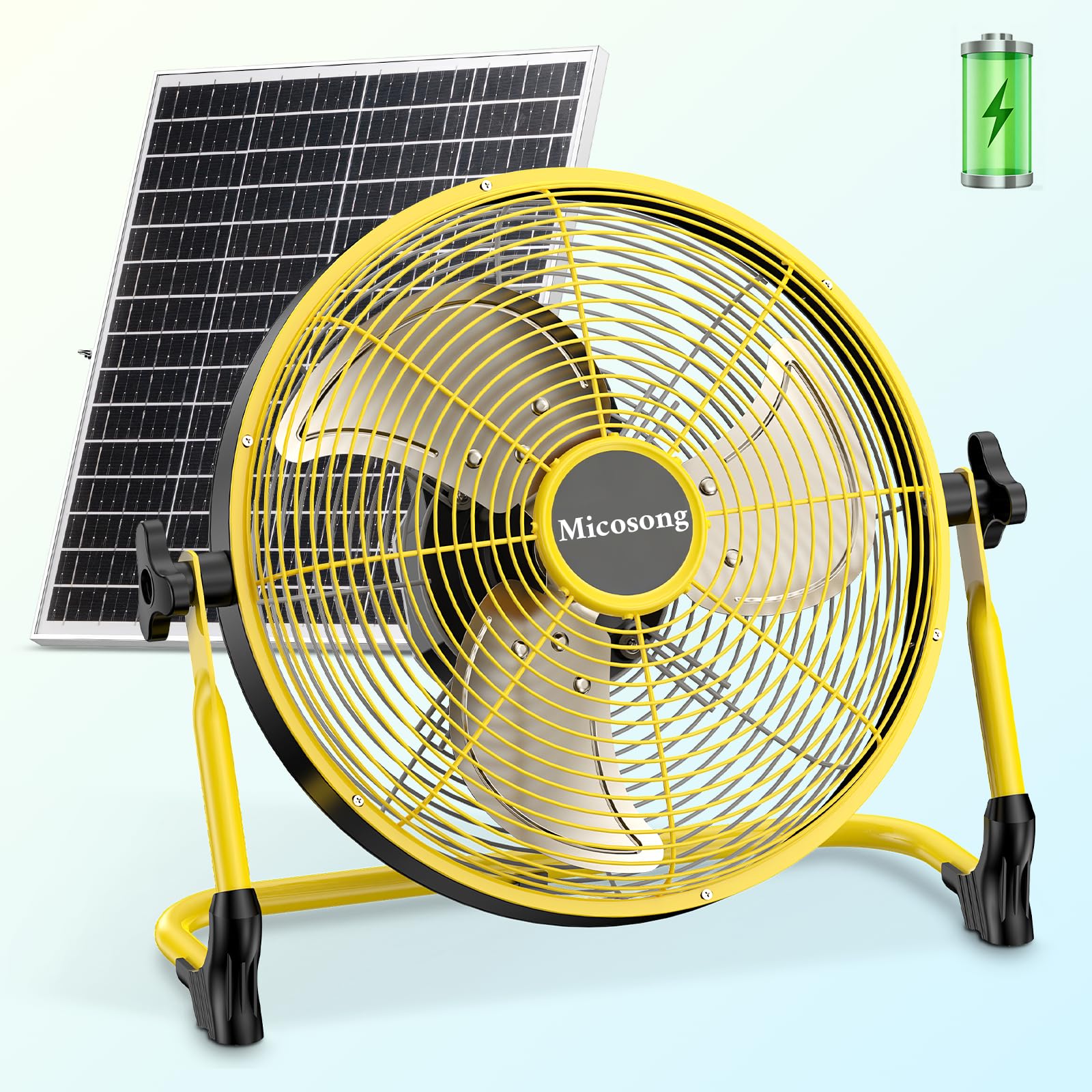
1. 14” Portable Solar Powered Floor Fan (Micosong)
Our pick — 4.0+★ from 200+ verified ratings; the strongest balance of quality and price.
The floor-standing brute that pushes 2800 CFM and still sips power on a slow setting.
If you are cooling a gazebo, a greenhouse, or a workshop rather than one sleeping bag, this is the pick to start with. It moves a maximum 2800 CFM of air (CFM is cubic feet per minute — the raw volume of breeze the fan throws), and that is a genuine step above the small tent fans here, several of which publish no airflow figure at all. The all-metal frame is waterproof, dustproof, and rustproof, so a damp greenhouse or dusty barn does not shorten its life.
Battery planning is where this one earns its place. The maker rates it 4–6 hours on high and 40–60 hours on low, and a full charge from the included AC adapter takes about 4 hours while the monocrystalline solar panel needs 5–6 hours of good sun. The battery is rated for over 2800 recharge cycles and the motor for a 4+ year lifespan, so a patio or greenhouse fan should outlast several cheap plastic units. A USB-A output port turns the same battery into a backup charger for your phone or a lamp when the power is out.
The honest trade-off is size and heat. This is a 14-inch floor fan with a footprint of L 16″D x 15″W x 9″H, versus the compact Innopower table fan at 6″D x 9″W x 2″H, so it is a car-camp or patio fan, not a backpack one. Its panel also sits integrated on the body rather than on a split cable, so the whole unit bakes while it charges. What wins people over is the performance — it stays charged all night in a camper and keeps pushing strong airflow — though a few buyers find durability does not always match expectations, so treat the frame with normal care.
Where it earns its keep
- 2800 CFM of airflow cools a whole patio or greenhouse, not just one bunk.
- 40–60 hours on low means it can run through several nights between charges.
- Metal frame rated waterproof, dustproof, and rustproof for damp or dusty sites.
- USB-A output doubles as a phone charger during an outage.
What to weigh first
- Large 14-inch floor footprint of L 16″D x 15″W x 9″H — not packable.
- Integrated panel means the whole unit sits in the sun while charging.
- A few owners mention the durability fell short of their expectation over time.
Reach for this if: you are cooling a fixed outdoor spot — gazebo, greenhouse, campsite base camp — and want volume over portability.
Pass it by if: you need a fan that disappears into a daypack; the 14-inch floor body is far too big for that.
2. Ausic Solar Misting Fan
A fan that sprays fine mist as it blows — the only pick here that cools the air, not just moves it.
On a still, humid afternoon a plain fan just pushes warm air around. This one adds a 250ml water tank and two mist modes to actually cool you down: intermittent mist runs up to 150 minutes and continuous mist up to 100 minutes. The 10W monocrystalline panel is a real upgrade over the typical 4W or 7W panels, and — crucially — it is a split panel on a cable, so you can leave the panel soaking up sun while the fan sits in the shade with you. The 330° adjustable angle and folding hook let you aim it from a branch, a car rail, or a table.
Battery life is rated 8–35 hours on a charge, which covers a long day on a mid setting, and the 8-inch body weighs 1.12 kg so it travels without drama. Cooling performance is the thing that lands with buyers — it holds up in genuinely hot climates — and the built-in LED has two brightness settings for after dark. Three brushless-motor speeds keep the noise down to a low hum you can sleep beside.
The catch is the mist itself and consistency. Some find the spray not very strong, so if you want a soaking fine mist you may be let down; if you want a light cooling lift it is pleasant. Runtime is also shorter than the big 20000mAh fans when you are misting hard — 100 minutes of continuous spray drains it faster than plain airflow. For a hot patio, a sideline, or a chicken coop with animals that need relief, that exchange is fair.
The plain-words read: this is the only pick that lowers the air temperature around you, and the split 10W panel keeps the battery cool while it charges. That combination is why it costs the same as the all-in-one WESTTREE but serves a different job.
Go this way if: dry, searing heat is your problem and a light mist plus strong airflow is exactly the relief you want.
Look elsewhere if: you need a full-night fan on the lowest draw — a big-battery model will outlast this one when misting.
3. WESTTREE Solar Camp Fan with LED Lantern
Four speeds, a 0–90° tilt, and a charge setup that works off sun or USB-C in about three hours.
The dual-charge design is the point here. A built-in monocrystalline panel soaks up daylight, and the included 5V2A USB-C cable tops the battery back up in roughly 3 hours when you have a wall socket or power bank. Four speeds give you fine control — rated up to 50 hours at the lowest and 16 hours at the highest — so you can dial down to a whisper for sleeping or open it up for a hot afternoon. The tilt range runs 0–90°, and the ABS body shrugs off drops and blows, which matters when it lives in a kit bag.
The LED lantern has three brightness settings, bright without glare, and there is a 2-4-8 hour timer that doubles as a gentle alarm reminder. Owners lean on the performance and airflow more than anything else, and the orange shell is easy to find inside a dark tent. For everyday camp use where you want one device for breeze and light, it does both jobs without extra kit.
Here is the fit note worth hearing: some units charge slowly or stop charging altogether, and a few report the fan giving out after a few months. That is a mixed picture on electronics reliability, not the airflow — the airflow itself is praised. Buy from a seller with easy returns, and test the panel charge on day one so any issue surfaces before your trip.
What stands out: the 4-speed range down to 16 hours on high gives better control than the 3-speed Innopower, while the built-in panel keeps it self-sufficient on a sunny trip.
What to keep an eye on: electronics reliability is uneven across units, so a quick charge test when it arrives is smart planning, not paranoia.
Best matched to: campers who want one device covering breeze plus lantern and who mostly charge by USB-C with solar as backup.
Skip if: you need proven long-term electrical reliability above all else — the split-panel Art In Real fans hedge that risk better.
4. Art In Real 20000mAh Solar Fan with LED Lantern

A 20000mAh tank with a panel on a 1M cable, built to keep airflow going from dusk to dawn.
Two numbers define this one: the 20000mAh battery and the 13–36 hours of continuous cooling it is rated for. For a tent that gets sticky at night, that is the kind of reserve you want — set it on a low setting and it crawls through the dark hours without drama. The 10W monocrystalline panel, rated up to 23% energy conversion, sits on a 1M cable so the panel charges in full sun while the fan and its battery stay in the shade. That split design keeps the cell out of the sun’s heat, the main cause of fast battery wear in a rechargeable fan.
Charging is flexible: about 5 hours of sunlight for a full solar charge, or about 2 hours over the included USB cable when you find a socket, and it supports working while charging. The 9-inch body, compared with the Micosong floor fan’s L 16″D x 15″W x 9″H frame, slots into a car-camping kit without eating space. A built-in LED has three brightness settings and a hook to hang it at tent height, and the ABS housing is made to take an anti-drop hit.
The trade is weight and a slight power blind spot. It carries a real battery, so it is heavier in the pack than the tiny Innopower, and customers note it takes a while to climb toward full — several hours to reach about 75% — so top it up early rather than at the last minute. Airflow, though, is stronger than some expect, and the punk-style shell keeps it looking sharp at base camp.
The case for it: the biggest overnight reserve in this list’s mid group, with the split-cable panel that keeps the battery cool.
Weather the wait: a full charge takes a few hours, so treat topping up as a daytime task, not an evening emergency.
Pick this one for: multi-night tent camping where you want the fan running at low speed through the small hours.
Think again if: you need the lightest possible pack — the large battery adds weight you will feel on a long carry.
5. Art In Real 10W Solar Fan with LED Lantern
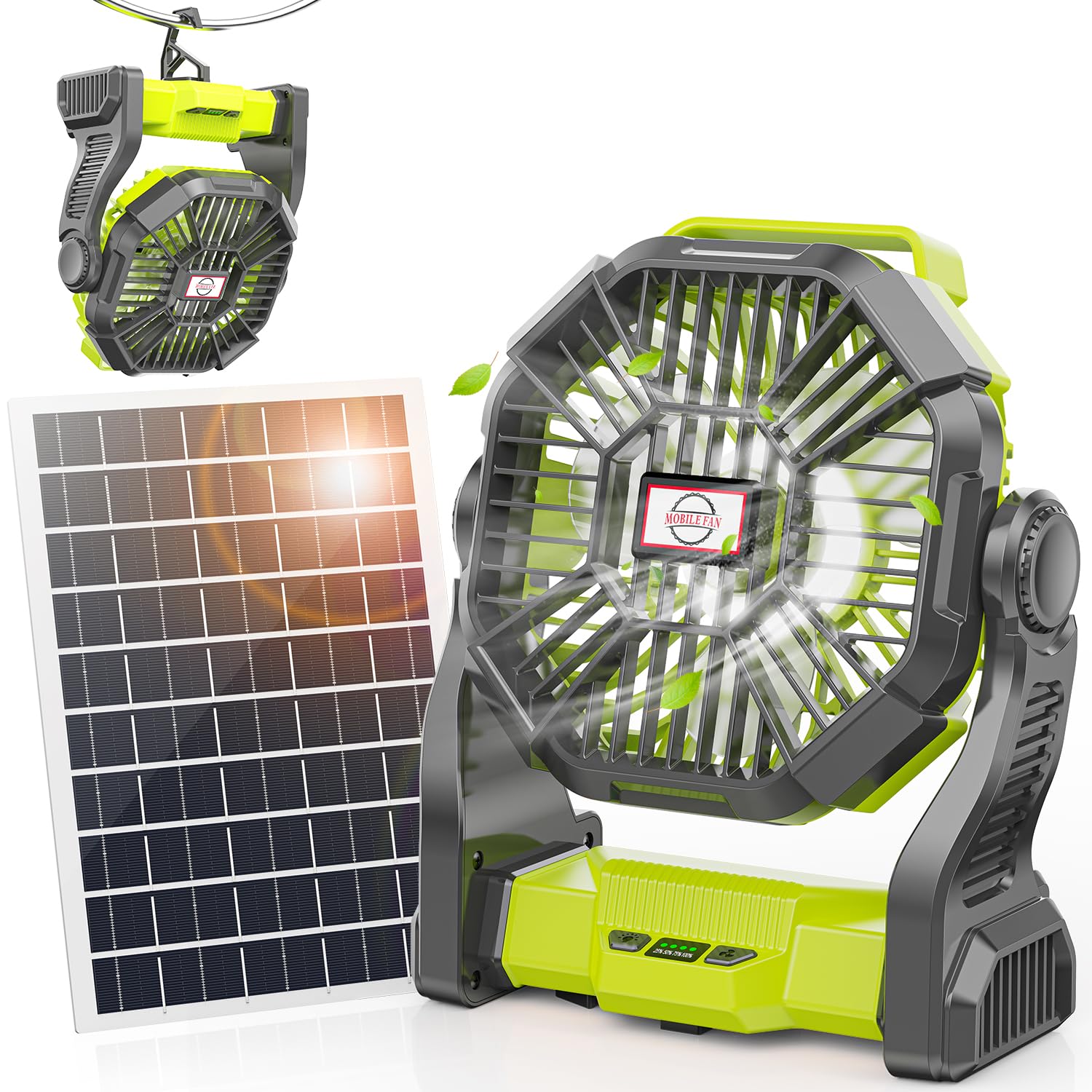
A no-fuss table fan that runs off solar or USB-C and keeps a <30 dB whisper at every speed.
Some buyers just want airflow without a spreadsheet of runtimes, and this is that fan. The 10W panel and brushless motor deliver strong airflow at under 30 dB — a level quiet enough to read or sleep next to — and there is a USB-C port for charging phones or a flashlight in an outage, which is why it doubles as hurricane-season backup. The push-button controls are simple, and it works the same indoors as it does in a tent. Performance is the part that holds up: it runs well through power cuts, and the solar panel itself gets a solid nod from owners.
Where this differs from the bigger models here is transparency on runtime. The listing does not publish an mAh battery figure or a low-to-high hour count, so you are trusting the maker’s build rather than a stated scope. If your nights are long and your fan use heavy, the 20000mAh options above give you a number to plan around; this one is better read as a light-use and backup fan than an all-night workhorse. For a nightstand, a small tent, or a power-cut spare, it earns its keep.
Quick take: quiet, USB-C-flexible, and easy to stash — a sensible secondary fan or power-outage spare rather than a primary all-nighter.
The known gap: no stated battery capacity means you plan around the maker’s airflow, not a published runtime hour count.
Go here if: you want a quiet little fan for a bedside table or a small tent and don’t need a stated all-night runtime.
Not for you if: you want a published hour count for planning multi-night trips — pick a 20000mAh model instead.
6. Innopower Portable Camping Fan with Solar Panel
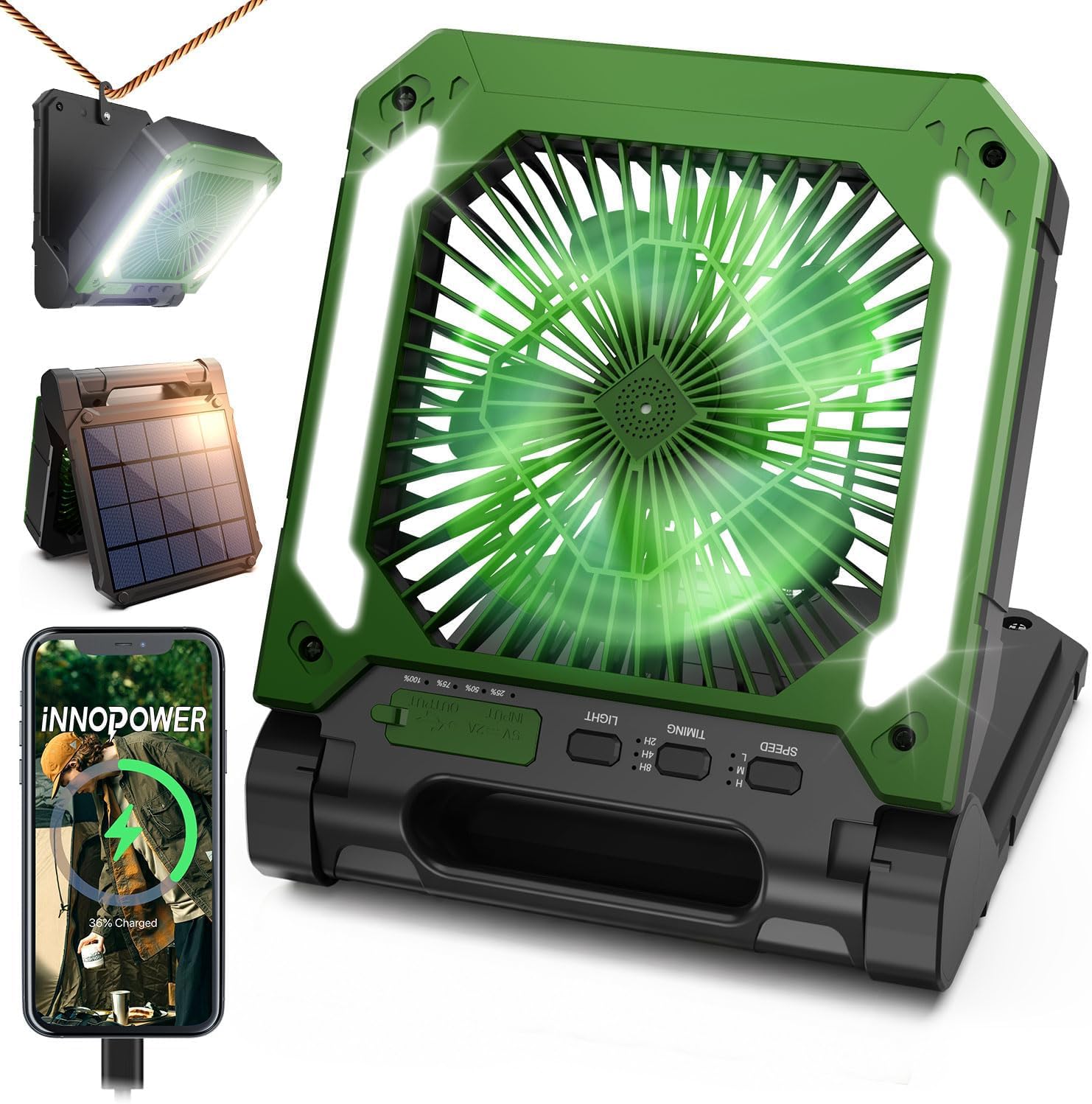
A pocketable 6″D x 9″W x 2″H body that folds to stand, hangs, and even holds a scent pad.
Pack space is the reason this one exists. The 6″D x 9″W x 2″H body folds 90° to sit as a table fan and has a rotatable hook so it can hang inside a camper, van, or small room to move air around. The 9000mAh battery is rated 18 hours on high, 32 on medium, and 58 on low, and there is a USB port to charge a phone or camera — handy off-grid. Three auto-rest timer settings (2h/4h/8h) mean you can have it shut itself off once you have dropped to sleep, saving battery for the early hours.
The personal-comfort extras are what set it apart from the plain table fans here. A <28 dB brushless motor keeps it quieter than the sub-30 dB group, so it is genuinely sleep-friendly, and its built-in lantern runs low at 100 lumen or high at 200 lumen for reading or finding gear. There is even an aromatherapy slot at the front where you drop a scent pad and add essential oil for a fresher breeze — a small luxury no other pick here offers.
That said, be clear-eyed about consistency. Quality and portability are what buyers praise, but the battery and functionality records are mixed: some get a whole trip out of a charge, others see it fade in a couple of hours, and a few units stop working for no clear reason. If you mostly need a featherweight personal fan with a lantern and don’t demand all-night airflow, its size and timer make it a lovely companion. If you need guaranteed hours, size up to the 20000mAh fans.
Where it shines: the fold-and-hang design and the 2h/4h/8h auto-off timer make it the easiest fan here to carry and the simplest to leave running as you nod off.
Choose it for: gram-conscious travel where a foldable, hangable personal fan with a lantern and scent slot is worth more than raw runtime.
Choose bigger if: you need reliable full-night airflow — its mixed battery record means smaller runs are safer.
7. ZIZIWIN 14″ Solar Greenhouse Fan

A 25W panel and a 38600mAh battery built for sheds, coops, and greenhouses that bake all day.
This is the heavy-duty end of the list, and the numbers back it. The 38600mAh battery is rated 8–12 hours on high and 30–60 hours on low, and the 25W monocrystalline panel needs 4–6 hours of sun for a full charge — the largest panel here by a clear margin over the 7W and 10W fans. With the included AC adapter it charges in about 3 hours. The battery is rated for over 1500 recharge cycles and the motor for a lifespan of over 5 years, and the all-metal frame is waterproof, dustproof, and rustproof for damp coops and dusty barns. Maximum air volume is 2180 CFM through a pure-copper brushless motor.
Its real home is a fixed structure you cannot easily run power to: a chicken coop, greenhouse, gazebo, shed, or barn. It weighs 9.48 pounds, so it is a set-down-and-leave-it fan rather than a backpack one, and the 360° tilt lets you aim airflow where animals or plants need it. A USB-A (5V/1A) socket keeps a phone or lamp alive during an outage. Unlike the smaller tent fans, this is built to be rained on and forgotten about outdoors.
Weigh the portability before you buy. At 9.48 pounds and a 14-inch frame this is a chore to move often, and its 25W panel is integrated, so it sits with the unit in the sun rather than on a shade-friendly cable. If you want a fan you clip up in a tent each night, this is the wrong tool — but for year-round airflow in a structure, its 38600mAh reserve is the reason to choose it.
Why it earns a spot: the biggest battery here at 38600mAh plus the largest 25W panel make it the one fan built to survive a whole season in a coop or greenhouse.
Set the expectation: it is a stationary fan — 9.48 pounds and a 14-inch frame — not something you fold into a pack.
Reach for this if: you need one hard-wearing fan to keep air moving in a coop, greenhouse, barn, or shed through hot months.
Pass it by if: you carry your cooling gear on your back — the 9.48-pound build is meant to be left in place.
Know the Specs
Battery capacity in mAh (and what runtime really means)
mAh stands for milliamp-hours — a measure of how much charge the battery holds, and the best single guide to how long the fan runs. A 20000mAh model and a 38600mAh model hold far more energy than a 9000mAh one, so they stay cool longer between charges. But read the runtime hours the maker publishes on all speeds. The same battery can run 60 hours on low or 16 on high, so match the setting you will actually use to the hour count you need.
Solar panel wattage and split-cable design
Panel wattage (W) is how fast the panel refills the battery in sun — a 10W panel generally charges faster than a 7W one, and a 25W panel faster still. Equally important is whether the panel is built into the fan body or split off on a cable. A split panel lets the battery sit in the shade while the panel bakes, which keeps the cell cooler. Cooler batteries tend to last longer, so a split 7W panel can outlast an integrated 10W over years of charging.
Airflow (CFM) versus noise (dB)
CFM, cubic feet per minute, is how much air the fan moves — the higher the figure, the wider the cooling zone. A 2800 CFM floor fan cools a patio; a small tent fan moves less air but sits closer to you. dB is decibels, the loudness you hear. Models rated under 30 dB are quiet enough to sleep beside, and one here runs under 28 dB. In a small tent, low noise often matters more than raw airflow.
Split versus integrated panels, and power-bank output
Many fans here double as a power bank through a USB output, so the same battery that cools you can top up a phone or flashlight during an outage. The USB-A or USB-C output voltage matters less than the fact that it exists — it is a genuinely useful backup feature in hurricane season. Pair that with an LED lantern mode and the fan becomes a small, self-contained utility for the camp.
Common Questions
How long will a solar camp fan actually run overnight?
Do I need to charge by USB if I have a solar panel?
Is a split solar panel better than one built into the fan?
Can a solar camp fan charge my phone?
How loud is a solar camp fan in a tent?
Will a solar camp fan cool a large tent or just one person?
What maintenance does a solar panel fan need?
How do I store a solar fan battery between trips?
Is a misting fan worth it over a plain airflow fan?
Can I run these fans while they charge?
The Bottom Line
For most campsites the winner is the 14” Solar Powered Floor Fan (Micosong) — 2800 CFM to cool a whole gazebo or greenhouse, 40–60 hours on low, and a rustproof metal frame meant for damp and dust. If searing dry heat is your enemy and you want actual temperature relief, grab the Ausic Solar Misting Fan with its 250ml tank and split 10W panel. And for a fixed coop, barn, or shed that needs airflow all season, the ZIZIWIN 14″ Greenhouse Fan is the one to reach for, with its 38600mAh battery and 25W panel.
How we choose
We do not accept paid placement. Every pick is matched to a real buyer and a real use-case; we do not hands-on test units.
Sources
Specifications: manufacturer listings and product documentation. Review insights: verified customer reviews, as of November 2026. Pricing: not shown on this page (it changes often); check the current price via the retailer link.
As an Amazon Associate, Tactical Gear Guy earns from qualifying purchases. This does not affect which products we feature.