Specs are compiled from manufacturer listings and verified buyer reviews and can change over time — please confirm the key details on the product page before buying.
Most baseball and softball mats sold for sliding and stance work are batting turf, not true sliding surfaces — and that mismatch is why so many players end up with a mat that bunches under their feet or tears apart in a week. What you actually want depends on one thing: are you teaching a body to slide feet-first, or are you giving a batter a clean place to plant and swing? This guide separates the two jobs and points you at the six picks worth your money, from a folding foam slider with real cushioning to a regulation-style turf mat with a stitched-in batter’s box.
This guide is built by comparing the manufacturers’ published specifications and the patterns across verified customer reviews, so you get each pick’s real strengths and trade-offs instead of marketing spin.
Keep reading for the softball sliding mat that fits how you actually train.
Top Picks

How To Choose The Best Softball Sliding Mat
The first decision is not brand or budget — it is purpose. A sliding mat is a cushioned runway a player dives onto feet-first, so it needs thickness and give. A batting mat is a turf rectangle a player stands on to groove a stance, so it needs a stable, spike-resistant surface with a visible box. Buying one when you need the other is the single most common mistake in this category.
Match the surface to the drill
If you are teaching a young player to slide, look for foam fill and a thickness measured in inches — the cushioning is the whole point. If you are working on stance and swing path, look for turf height in millimeters and a dense root count, because that is what holds a cleat without shredding. A stitched or inlaid batter’s box also outlasts a painted one, which fades and flakes over a season outdoors.
Read the backing before the turf
The backing is what keeps the mat where you put it. Rubber and EVA grid backing grips concrete, garage floors, and turf fields. Foam-filled pads rely on their own weight and bulk instead. A mat that walks or bunches mid-drill is worse than no mat at all, so treat backing as a safety feature, not a footnote.
Portability is a real spec
Coaches haul these things to cages, backyards, and fields, so how a mat travels matters. Rollable turf with a carry strap and foldable foam with an elastic band solve the same problem in different ways — one rolls tight, one folds flat. Check the weight in kilograms or pounds if you will be moving it alone, because a heavy mat becomes a garage ornament fast.
Side-by-Side Comparison
Detailed Reviews
1. ZivPlay Baseball Hitting Mat
Our pick — 4.0+★ from 100+ verified ratings; the strongest balance of quality and price.
The turf mat that makes a backyard feel like a batter’s box, plate and all.
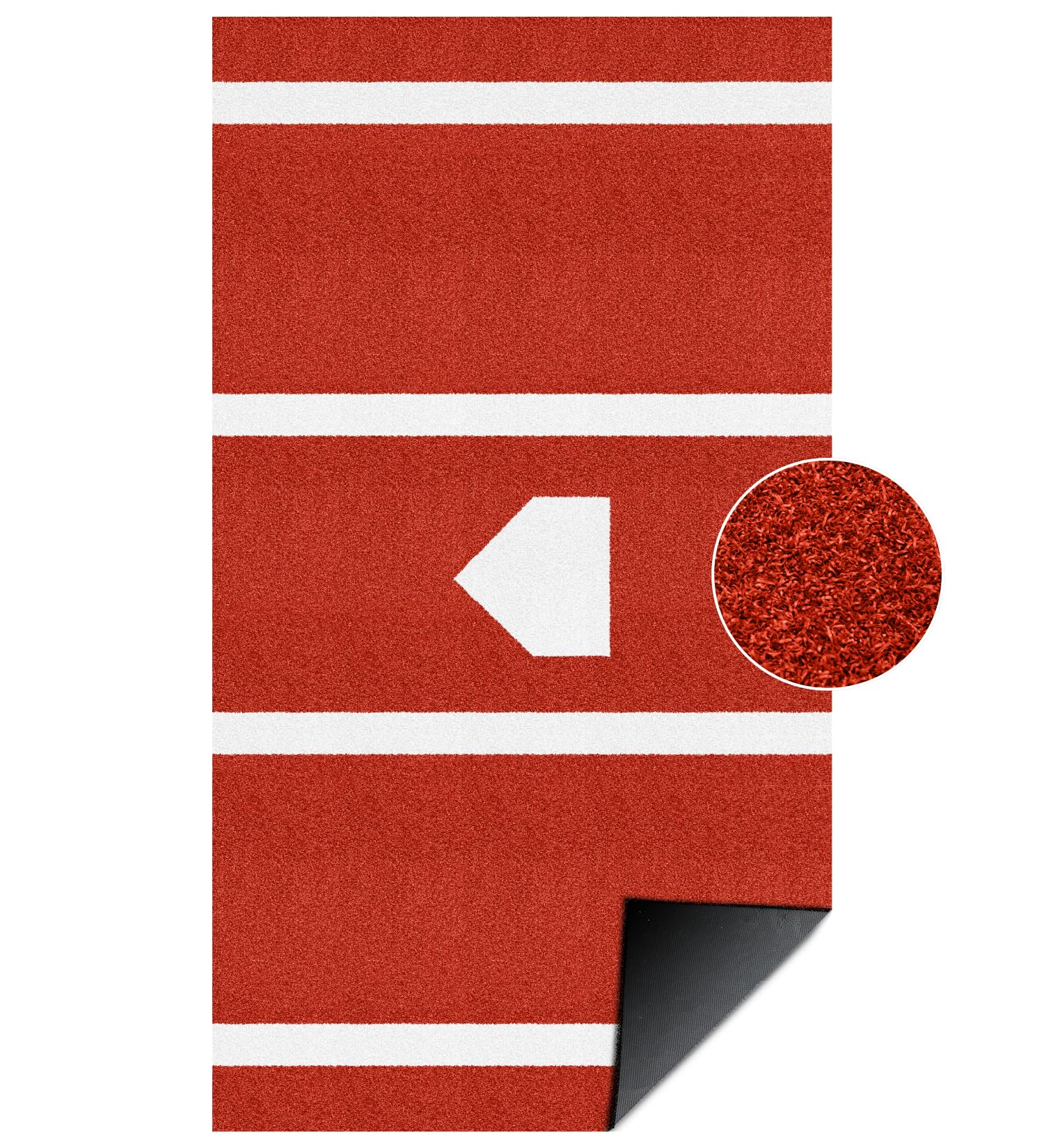
This is the pick for the parent or coach who wants a stance surface that looks the part and stands up to real cleats. It measures a regulation-style 6 feet by 4 feet and includes a home plate and batter’s box, so both left- and right-handed hitters have a marked spot to plant. The turf stands 15 millimeters tall with 79,800 roots per square meter — dense enough that a cleat bites instead of skating across a bald patch.
What wins people over is the all-around build: quality is the thing buyers talk about most, and versatility comes second. The grass is new synthetic turf rather than recycled fiber, and the brand says it resists fading and fraying outdoors. A 5mm anti-slip rubber backing sits underneath to protect a garage floor from scratches and hold the mat on a batting cage surface. Between the stitched-in box and the dense pile, this is the most complete stance mat in this group for year-round outdoor use.
The honest catch is stability. Several buyers report the mat can slide and bunch under the weight of a hard swing, and the box paint has been known to fade over time. Its 0.2-inch profile is also dramatically thinner than the ROYALAY sliding pad’s 1.8 inches — about nine times the difference in cushion — so do not buy this expecting a soft landing pad. It is a stance and hitting surface, not a sliding runway.
What earns it first place
- Regulation-style 6 ft x 4 ft layout with a home plate and batter’s box already marked for both left- and right-handed hitters.
- 15mm turf height with 79,800 roots per square meter gives a cleat real bite and a lifelike ball roll.
- 5mm rubber anti-slip backing protects garage floors and adds grip on cage surfaces.
- New synthetic turf built to hold its color outdoors rather than fade in the sun.
Where it asks for care
- Can shift and bunch under a hard swing, so it wants a firm, flat surface beneath it.
- The painted home plate markings can wear and fade with heavy use.
- At 0.2 inch thick it offers no meaningful cushioning for slide drills.
Reach for this if: you want one turf mat that handles stance work, tee drills, and both-handed batting practice in the backyard or a cage.
Look elsewhere if: your drill is feet-first sliding — this thin pile was never built to absorb that impact.
2. HOYWOUL Baseball Hitting Mat 6×4 FT
Stitched lines instead of paint, and a strap that lets the whole thing roll up and travel.
Start with the feature that matters most over a season: the markings on this 6-foot by 4-foot mat are stitched into the turf, not painted on. That means the white batter’s box and home plate hold their shape rather than flaking off the way a painted plate does on the ZivPlay above. The 12mm PE grass fibers and upgraded EVA bottom are built to resist spike punctures, and the 5mm EVA backing uses a grid-embossed pattern for grip on indoor floors, backyard turf, and cage surfaces.
Getting it home is simple — the mat rolls up and comes with its own carry strap, so moving it from garage to field is a one-person job. It covers the whole package for a batter, with bright white lines that make the strike zone easy to find whether you hit right or left. The manufacturer backs it with a one-year warranty.
What to weigh: the turf is 12mm tall, a bit shorter than the ZivPlay’s 15mm pile, so the grass feel is slightly less plush underfoot. If the stitched markings and a strap to carry it are what you want, that is a fair trade for a stance mat in the value tier.
Where it shines: a stitched box that will not flake, a spike-resistant surface, and grip that suits a garage floor or a turf field without extra anchoring.
Go with this one if: fading lines have burned you before and you want markings that survive a season of swings.
Pause if: you need a soft landing surface — this is a hitting mat, not a sliding pad.
3. BWZYdy Baseball & Softball Hitting Mat

A true cushioned slider — 1.8 inches thick and wide enough for a full-speed dive.
Here is the mat that actually does the sliding job. It is 120 inches long, 43 inches wide, and 1.8 inches thick, and that thickness is filled with 30D high-density foam to soak up the impact of a feet-first slide. The surface is Oxford cloth — sturdy, easy to clean with a damp wipe, and machine washable — while the foam interior gives the cushion a real dive needs. Compared with the Domivans turf above at roughly 0.2 inches, this pad carries roughly nine times the thickness, which is exactly the cushion a slider needs.
When practice is over it folds and cinches with an elastic band, so it stores in very little space. It is versatile beyond the diamond too — the brand lists it as usable for yoga, as a folding bed, or as a travel mat, which stretches the value if a batter in the house also does floor work.
The buyer-fit: if the goal is teaching a kid to slide without flinching, the 1.8-inch foam cushion and wide 43-inch surface are the whole point, and that puts it in a different class than a thin turf mat.
The thing to know: the Oxford cloth is easy to clean but not built for cleats digging in like turf, and this pad is a heavier, bulkier item to haul than a rollable turf mat, so plan its spot before practice day.
Your mat if: you are running sliding drills and want cushioning plus a folding, storable footprint.
Look past it if: you want a stance turf with marked lines for hitting — this pad has none.
Know the Specs
Turf Height in Millimeters
Turf height is the length of the grass fibers, measured in millimeters, and it decides how much a cleat bites. A mat at 15mm of pile feels thicker and holds a spike more firmly than one at 12mm. Higher millimeters suit outdoor, real-dirt practice, while a shorter pile can be a bit fussier to clean. On the flip side, a foam sliding pad is measured in inches of fill — that number is cushion, not grass, so the two figures are not the same thing.
Backing and Anti-Slip Grip
The backing is the underside of the mat, and it is what keeps the mat planted. A 5mm rubber or EVA backing grips concrete, garage floors, and cage surfaces and stops the mat from walking. A heavy-duty grid-embossed rubber base does the same job on grass or turf. If the backing is thin or missing, the mat shifts and bunches under a swing — so treat backing as a safety feature, because a moving mat underfoot in a batting box is a slip risk.
Rollable vs Foldable
Rollable turf mats with a carry strap roll tight and move like a poster tube. Foldable foam pads fold flat and cinch with an elastic band or Velcro, which is easier to store in a car or a corner. If you will carry the mat alone, check the weight — a low pound or kilogram figure makes a big difference over a season of hauling it to the field.
Markings That Last
A painted home plate can flake and fade over a season, especially outdoors in the sun. Stitched markings and lines inlaid into the turf hold up far better and keep the batter’s box readable for the life of the mat. That matters most for the pitcher’s practice and for right- and left-handed hitters who need a clear, consistent spot to set their feet.
Common Questions
Can the same mat teach sliding and hitting practice?
Why does a baseball mat bunch up under my feet when I swing?
Do painted home plate lines really fade over time?
Is a thicker sliding mat safer for young players?
Can I use a sliding mat on a garage floor or hardwood?
What size mat fits a backyard batting cage?
Will a soft sliding mat work when the weather turns wet?
How do I store a sliding or batting mat between practices?
Can a slide mat double as a yoga or floor mat?
Why do some turf mats say they are for both baseball and softball?
The Bottom Line
For hitting and stance practice, the ZivPlay 6×4 Batting Turf earns the top spot with its marked home plate, dense 15mm turf, and anti-slip backing — the most complete stance mat here. If fading lines worry you and you want stitched markings that hold up, the HOYWOUL 6×4 Hitting Mat is the value pick. And when the goal is teaching a kid to slide feet-first, the ROYALAY Foldable Sliding Mat spends its 1.8 inches on 30D foam cushioning that actually softens the landing.
The thing most buyers miss is that these are two different tools — a thin turf mat for stance, a thick foam pad for sliding. Match the tool to the drill, and you will get more out of every practice. For a technique-first sliding lesson with a built-in four-step guide, the SlideMVP 108 is the one to reach for.
How we choose
We do not accept paid placement. Every pick is matched to a real buyer and a real use-case; we do not hands-on test units.
Sources
Specifications: manufacturer listings and product documentation. Review insights: verified customer reviews, as of November 2026. Pricing: not shown on this page (it changes often); check the current price via the retailer link.
As an Amazon Associate, Tactical Gear Guy earns from qualifying purchases. This does not affect which products we feature.