Specs are compiled from manufacturer listings and verified buyer reviews and can change over time — please confirm the key details on the product page before buying.
If someone you love lives alone, the watch only helps if it can call for help when they cannot. That is why automatic fall detection matters most — the watch notices the impact and starts the alert itself, with no button press. Everything else comes second. All six watches below have that automatic detection built in. The real differences are how long the battery lasts, whether you pay a monthly fee, and how the alert actually reaches someone who can help.
This guide is built by comparing the manufacturers’ published specifications and the patterns across verified customer reviews, so you get each pick’s real strengths and trade-offs instead of marketing spin.
You will see how each watch raises the alarm, what it costs you to keep the service running, and which ones suit a healthy independent senior versus a wearer with memory loss. A good pick here is the one whose alert path you can actually rely on when the worst happens — which is the whole point of a smartwatch with fall detection.
Top Picks

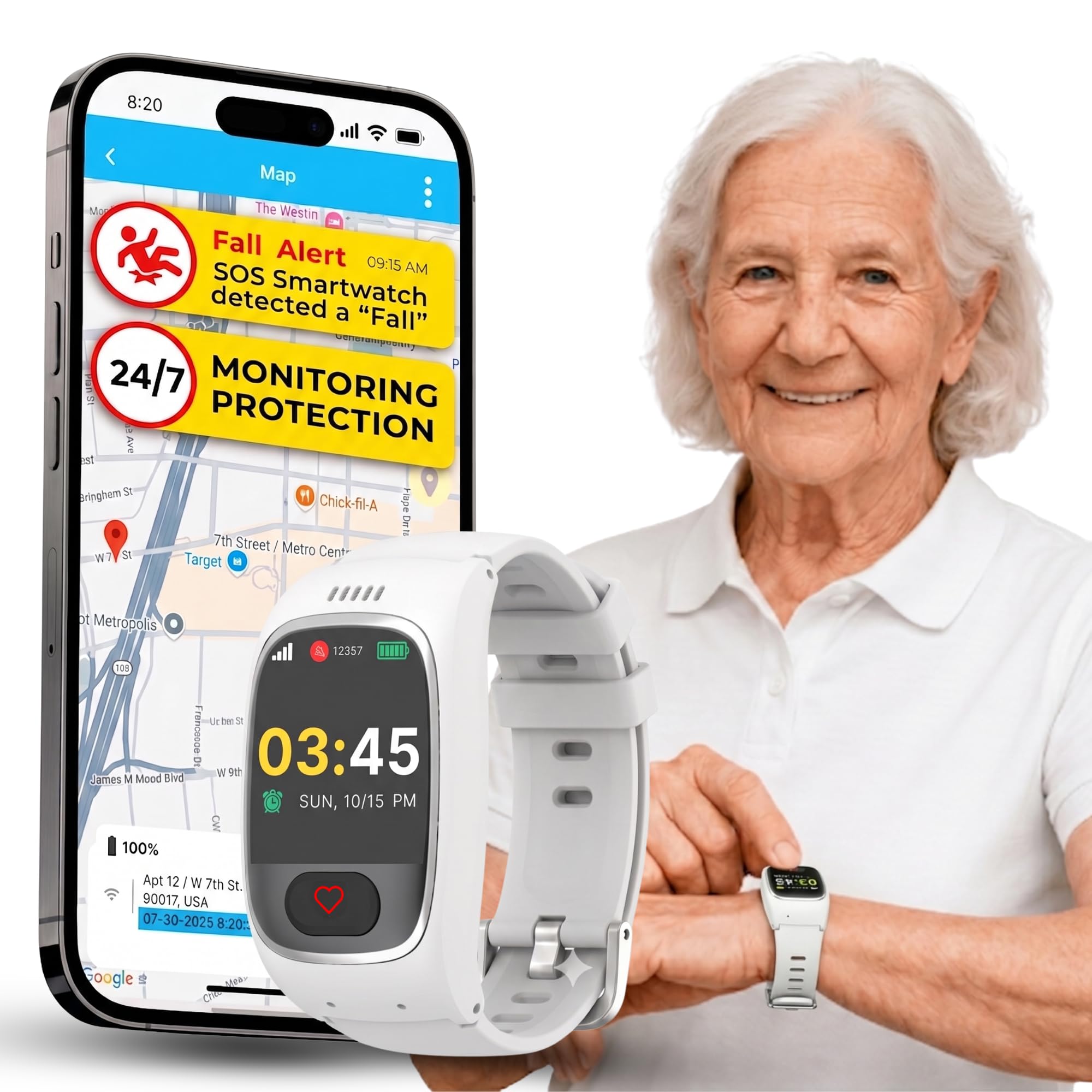
How To Choose The Best Smartwatch with Fall Detection
A fall detection watch is only as useful as the chain of events it sets off. The first link is the sensor noticing the fall. The last link is a human being hearing about it and acting. Most disappointment with these devices comes from a break somewhere in that chain, not from the watch looking cheap on the wrist. So before you compare screens or step counters, decide who is supposed to answer the alarm and how they will be reached.
Decide who answers the alarm first
Some watches call a family member directly. Others dial into a monitored care team. One dials 911 from the wrist. Each path has a different failure mode. A family-forwarded alert depends on someone having their phone nearby. A 911 dial depends on the wearer being conscious enough to speak. Ask honestly which of those your situation supports before you buy anything.
Understand the subscription question before you buy
A cellular watch needs a data connection to send a GPS location or place a call away from home. That connection is usually paid for monthly. Watches advertised as no-monthly-fee typically use whichever cellular tower is nearby without a recurring plan, which keeps the cost one-time but can vary with local coverage. Neither approach is wrong — they simply move the cost and the risk to different places, and you should know which one you are signing up for.
Check the battery in real terms
A watch that needs charging every single day is a watch that spends hours off the wrist. Battery capacity in milliamp-hours (mAh — how much charge the cell holds) and the rated day count tell you how much babysitting the wearer or caregiver takes on. Longer rated life matters most for someone who will not remember to dock it.
Match the interface to the wearer
A large SOS button and simple menus suit a wearer with limited dexterity or memory. A full-featured health watch with rotating crowns and a hundred watch faces suits a capable, tech-comfortable senior. Buying more watch than the wearer can operate is a common and avoidable mistake — the emergency button is useless if nobody can find it.
Side-by-Side Comparison
| Model | Best For | Battery Life | Battery Capacity | Water Rating | Amazon |
|---|---|---|---|---|---|
| Samsung Galaxy Watch 4 44mm R875★ Best Overall | Tech-comfortable seniors wanting a full smartwatch | — | 361 mAh | 5 ATM / IP68, 50 m | Amazon |
| Seculife Medical Alert SmartbandDirect to Family | Direct-to-family alerts without a call center | 1 days | 680 mAh | IP67 splash resistant | Amazon |
| Fall Detection Watch for Seniors (Fajocru) | Real-time tracking and video calling | — | 600 mAh | IP67 | Amazon |
| COCO Emergency Alert Smartwatch | Medication reminders plus health monitoring | 4 days | 280 mAh | — | Amazon |
| Audar E2 Senior Smartwatch | Remote monitoring across 20+ countries | 7 days | 280 mAh | IP67 | Amazon |
| No Monthly Fee Medical Alert Watch | One-time cost and a straight line to 911 | 72 hours | 480 mAh | Totally waterproof | Amazon |
Detailed Reviews
1. Samsung Galaxy Watch 4 44mm R875 Smartwatch
Our pick — 4.0+★ from 200+ verified ratings; the strongest balance of quality and price.
The one watch here built like a proper smartwatch first and a safety device second
This is for the senior who still wants a real smartwatch — one that handles Samsung Pay and Google Pay, tracks runs and sleep, and does not announce itself as a medical device to everyone at the table. The screen is the reason to pick it: a 1.4-inch Super AMOLED panel at 450 x 450 pixels, which works out to roughly 321 pixels per inch. In plain terms, that is a sharp, bright display where text and caller names stay readable in daylight — no squinting at a tiny monochrome readout.
The durability is where it beats a typical alert band. Gorilla Glass DX+ covers the front, the watch carries MIL-STD-810G compliance (a military durability standard for shock and temperature), and it is rated 5 ATM with IP68 and 50 m water resistance. That translates to showering, washing up, and a rainy walk without taking it off. A 361 mAh battery keeps it running, which is the honest limit here — this is a daily-charge watch, not a weekly one.
It keeps a connection over LTE (cellular data), Bluetooth, Wi-Fi, and GPS (satellite location), so alerts and location still work away from your phone. The health side runs deeper than the senior-focused models: ECG certification (a heart-rhythm reading), a blood pressure monitor, and SpO2 measurement (blood-oxygen level) using red LEDs and infrared rays to estimate the oxygen in your blood. Note this is the Renewed listing, so the unit arrives refurbished rather than sealed new. If the buyer is comfortable with a fitness-first watch and a charging routine, this is the most fully featured device on the list — and buyers back it at 4.0+ stars from 200+ ratings.
Why it earns the top slot
- 1.4-inch Super AMOLED at 450 x 450 pixels — sharp enough to read a caller’s name at arm’s length
- MIL-STD-810G rating plus 5 ATM / IP68 and 50 m water resistance for daily wear
- LTE means fall alerts can travel without a phone in the room
- Full smartwatch duties: Samsung Pay, Google Pay, GPS, sleep and cycle tracking
Where it asks something back
- 361 mAh cell means a daily charge routine the wearer has to keep
- Renewed condition, not sealed new stock
- More watch than a memory-loss wearer can navigate
The right wrist for it: a capable senior who wants real fitness tracking and contactless pay, and will not mind docking the watch each night.
The honest catch: at 361 mAh it is the smallest battery of the mid-tier picks that publish a figure, so plan on a charger every day.
2. Seculife Medical Alert Smartband for Seniors
Skips the call center entirely and rings your family instead
Help goes straight to your people: when the band senses a fall, or when the SOS heart button is held for 3 seconds, it dials your pre-selected emergency contacts directly. No middleman. No monitored call center repeating your address back. The watch also auto-answers when an approved contact calls, so the wearer never has to hunt for a green button — exactly the detail that makes or breaks a device for someone with shaky hands.
Build quality is what wins people over, and the reported experience around GPS tracking follows close behind. Real-time location plus geofence zones (virtual boundaries you draw in the app) means the app pings the family when the wearer leaves or enters a safe area — designed for elderly with dementia or Alzheimer’s — with a full year of location history kept in the app. Voice calling runs over 4G LTE (fast cellular), and the 680 mAh battery (a measure of charge the cell holds) is the largest published cell among the senior-focused picks here, well ahead of the 280 mAh cells on the COCO and Audar models.
The trade-off is structural, not cosmetic: activation requires a monthly subscription from per month, which open up the unlimited fall alerts, unlimited live tracking, unlimited voice minutes, and the assistive speakerphone. That recurring bill is the real decision point — the hardware is one thing, the service is the commitment. The other thing to weigh is that the rated battery average life is 1 days on the spec sheet, so despite the big 680 mAh cell, treat this as a nightly-charge device. It is IP67 splash resistant, so rain and hand washing are fine, but this is a daily-wear band rather than a swim watch.
Best fit: a household that wants alerts landing straight on family phones, with a caregiver willing to watch the app and pay the monthly plan.
Worth knowing: the subscription is the spine of the product — the safety features, tracking, and calling all ride on it.
Choose it if: your family wants the alert to land with a named relative rather than through a monitoring service.
Think again if: a recurring monthly plan is a deal you would rather avoid — three other picks here run without one.
3. Fall Detection Watch for Seniors by Fajocru
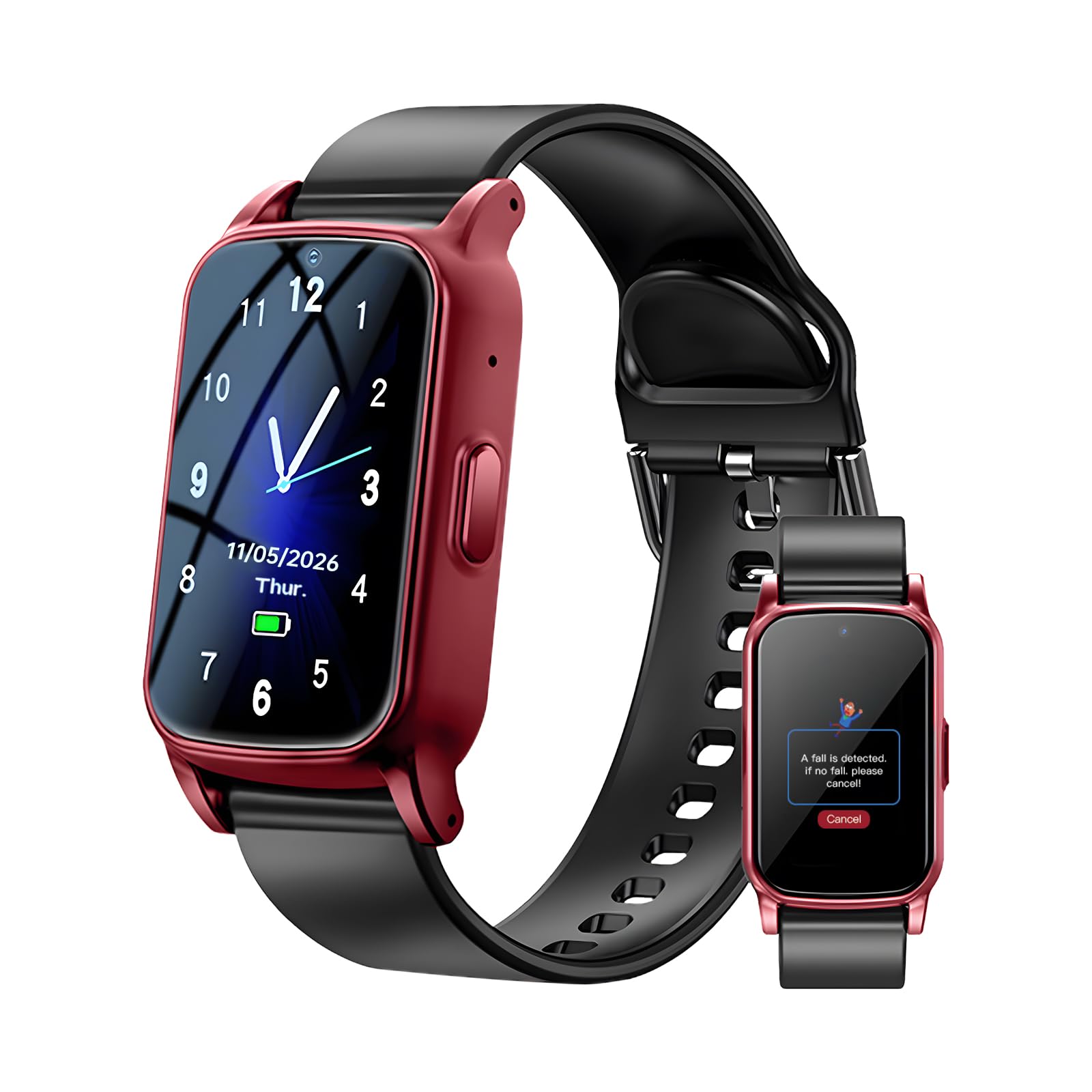
A wrist phone that lets grandparents see faces, not just hear voices
The angle here is emotional rather than medical. This watch makes 4G HD video calls over a built-in camera, so family can see the wearer rather than just hear them. For a senior who lives alone and misses the visual check-in, that is a meaningfully different product than a buzzer that only fires in an emergency. It connects on both iPhone-compatible and Android setups and works as a standalone wrist phone, no separate smartphone required.
On the safety side, the fall detector senses a sudden fall and pushes an SOS notification to preset emergency contacts, so help still gets moving even if the wearer cannot press anything. GPS positioning lets caregivers watch location live through the app, and geofence zones fire an alert if the wearer wanders outside a safe area — the kind of thing memory care families will recognise as essential. Heart rate, blood pressure reference, sleep tracking, and a step counter round it out, with a sedentary reminder nudging activity.
Charging takes a little longer here: the published battery is a 600 mAh cell (a measure of charge the cell holds) that charges in 2 hours, though no day rating is listed. For comparison, it charges in 2 hours versus the COCO’s 1.5 hours, so it asks for half an hour more at the plug. The band runs 11 inches long, which the data places ahead of the COCO’s 9.5 inches, so larger wrists get more room. It is IP67 waterproof (sealed against dust and brief water) for hand washing and rain, and the magnetic charging cable is a nice touch for hands with limited dexterity. The 4.0+ star early read is strong, but this is a newer listing, so the track record is shorter than the older names on this list.
What you are really buying: a video-calling wrist device that also watches for falls — connection and safety in one band.
The one trade-off: the 4.0+ rating comes from a small base of owners so far, so you are trusting the spec sheet more than a long history.
Reach for this if: face-to-face contact with family matters as much as the fall alarm itself.
Look elsewhere if: you need proof from hundreds of long-term owners before committing.
4. COCO Emergency Alert Smartwatch for Seniors

Four days between charges — and a countdown before the alarm fires
Left alone, a fall detection watch is only useful if it is still on the wrist when the fall happens. That is the whole case for this one: a rated 4 days of battery life on a 280 mAh cell (a measure of charge the cell holds), which recharges in 1.5 hours. Compare that with the Seculife, rated at 1 days on the same spec sheet — 4 days against 1 days is the biggest gap on this list, and it means a wearer who forgets to charge still has cover through the weekend.
The alert design is worth explaining carefully. When the watch detects a serious fall it starts a 20-second countdown, then either you tap “Call Now” or it notifies your Emergency Care Team automatically. That countdown matters — a stumble that does not need help gives the wearer time to cancel, which cuts down on nuisance alerts to family. A dedicated SOS button on the crown handles anything the sensors miss. Health tracking covers heart rate, blood oxygen, sleep, stress, and breathing, all fed into the CoCo App so a caregiver can watch trends remotely.
The medication reminder is the feature that separates it from every other watch here. Caregivers can schedule and manage reminders remotely through the app, so the wearer gets a nudge without anyone having to call. Add Bluetooth calling, an AI voice assistant, a large 1.85-inch HD display, and 100+ watch faces, and this is a capable everyday device. The honest caution is setup and simplicity for the wearer — some households find it does what it says without fuss, others find the menu depth trips up a senior. Pair it with a family member who can set it up once, and it settles in fine.
Points in its favour
- 4 days rated battery life — six times the Seculife’s 1 days figure
- 20-second countdown before the alert fires, so a minor stumble can be cancelled
- Remote medication reminders set from the caregiver app
- Large 1.85-inch HD display with a rotating crown for easier navigation
Where to look twice
- The deeper menu system suits a caregiver-led setup, not a solo octogenarian
- Small 280 mAh cell means the 4-day rating depends on light use
The scenario it suits: a caregiver who can spend an evening configuring it, then hand a watch to a parent who wants days of cover and gentle medication nudges.
The real limitation: it wants a helper at setup time — hand it over fully configured, not fresh from the box.
5. Audar E2 Senior Smartwatch with Fall Detection & SOS

Built-in cellular in 20+ countries, no smartphone needed at all
If the wearer cannot be trusted with a phone — or never wanted one — this is the pick that keeps working without one. The Audar E2 has a built-in SIM that connects straight to low-cost IoT networks in 20+ countries with no roaming charges. No smartphone, no app, no Wi-Fi, and no Bluetooth required on the wearer’s end. Connectivity is included for the first year, then a annual subscription. That is the entire network bill, and for cross-border families it is a real advantage over a watch that needs a domestic plan.
The health monitoring is the most configurable of the group. Built-in sensors track heart rate, blood pressure, blood oxygen (SpO2), and body temperature at intervals you set — every 30 minutes, 1 hour, 2 hours, or 4 hours, or on demand. Trend charts for the day, week, month, and year live on the Audar Health Platform, visible to multiple carers from anywhere. Emergency signalling covers automatic fall detection plus a manual panic button, firing the wearer’s location to designated contacts by SMS, voice message, email, or the platform dashboard.
The battery carries the pitch: up to 7 days with hourly measurements and up to 30 days of standby on a 280 mAh cell (a measure of charge the cell holds). That is the longest rated life here, and for a wearer who will not remember to plug anything in, it is a serious safety argument. The IP67 body (sealed against dust and brief water) resists water, dust, and sweat, and the magnetic strap adjusts for wrist sizes from 135–238 mm. The honest caveat is the alert service itself — the alarm functionality rates as mixed in owner feedback, and public emergency numbers like 999 or 911 cannot be set as contacts, so this watch alerts your family rather than the emergency services. Some landlines may not accept the SMS either. Know that going in, and the rest holds up fine.
Sharpest detail: a 7-day rated battery plus a built-in SIM that works in 20+ countries — no phone in the house required.
Buyer beware on this one point: it reaches your family, not 911, so the contact list is doing the heavy lifting.
Built for: the phone-free wearer, the frequent traveller, and the household spread across borders.
Not built for: someone expecting the watch to dial emergency services directly — it cannot.
6. No Monthly Fee Fall Detection Medical Alert Watch

One button, one call, and a 911 operator on the other end
Every other watch on this list sends your alarm to a family member, a care team, or an app. This one dials 911 directly. Automatic fall detection triggers the call on its own, and when the wearer is conscious there is a single button to press and speak to a 911 operator from the wrist. If you have been quietly worried that a family-forwarded alert might land on a phone that is in the other room, this is the shortest possible path to someone who will respond.
It uses any available 2G, 3G, or 4G cellular tower, which is how it gets away with no monthly fee and no subscription — the purchase is a one-time cost, and no cellphone is needed alongside it. The 480 mAh battery is rated at 72 hours, so it covers three days on a charge and refills in 2 hours. The silicone band is described as totally waterproof, enough for a shower or a swim, and the buckle closure keeps it on through the night.
Where it asks for caution: the setup is deliberately minimal and the listing is plain-spoken, which some households will read as reassuringly simple and others as thin on guidance. The 3.0+ rating reflects that split. If your priority is an unconditional line to emergency services without a monthly bill, this is the one device here that delivers exactly that — and for a wearer who lives alone with no nearby family, that can outweigh everything else on the list.
Why some families want it: automatic fall detection that calls 911 instead of a relative, on a one-time cost with no plan to maintain.
Do not overlook: the setup support is sparse and the owner ratings are low — buy it for the 911 dial feature, not for polish.
Pick it when: there is no family member close enough to answer a forwarded alert, and emergency services are the right first call.
Think twice when: you need hand-holding through setup or a large feature set beyond the emergency essentials.
Know the Specs
Battery Capacity in mAh
Milliamp-hours (mAh) measure how much charge the battery cell holds — think of it as tank size. A 680 mAh cell like the Seculife’s holds more charge than a 280 mAh cell like the COCO’s or the Audar’s. But tank size is not the same as days of use: screen brightness, GPS polling, and cellular standby all drain the same tank at different rates. That is why the watch with the larger cell can still be rated at fewer days than a watch with a smaller one — always trust the rated day count for daily planning and use mAh as the hardware baseline.
IP and ATM Water Ratings
IP67 and IP68 rate dust and water resistance under a standard test — IP67 means it survives brief immersion, and IP68 is a deeper, longer version. ATM is a separate scale used by watch makers, where 5 ATM corresponds to the 50 m water resistance the Samsung lists. In practice, IP67 covers hand washing and rain, while 5 ATM and above is where swimming becomes reasonable. Check the exact rating on the model you choose, because “waterproof” alone on a listing is a marketing word rather than a measurement.
Common Questions
How does automatic fall detection work without pressing a button?
Do I need a monthly subscription for a fall detection watch to work?
Will these watches call 911 directly?
Can a fall detection watch be worn in the shower or pool?
How long does the battery actually last on these watches?
Is a Samsung Galaxy Watch 4 a good choice for an elderly parent?
Can the wearer call family, or only receive alerts?
What happens if the wearer wanders out of a safe area?
Do these watches work without a smartphone nearby?
The Bottom Line
For the strongest all-round smartwatch with fall detection, the Samsung Galaxy Watch 4 44mm R875 is the pick because it pairs a sharp 1.4-inch Super AMOLED display (a bright, high-contrast screen) and MIL-STD-810G durability (a military ruggedness standard) with LTE fall alerts — the most complete device here at 4.0+ stars. If the goal is alerts landing directly on family phones, grab the Seculife Medical Alert Smartband and its 680 mAh cell (a measure of charge the cell holds). And for a wearer who will never remember to charge, the Audar E2 is the one to reach for, rated up to 7 days on a single charge with no phone required — a combination worth weighing seriously before you decide.
How we choose
We do not accept paid placement. Every pick is matched to a real buyer and a real use-case; we do not hands-on test units.
Sources
Specifications: manufacturer listings and product documentation. Review insights: verified customer reviews, as of November 2026. Pricing: not shown on this page (it changes often); check the current price via the retailer link.
As an Amazon Associate, Tactical Gear Guy earns from qualifying purchases. This does not affect which products we feature.