Specs are compiled from manufacturer listings and verified buyer reviews and can change over time — please confirm the key details on the product page before buying.
You want to tap your phone and have the garage door close behind you — not buy a whole new motor. That is the key thing to understand here: two of the picks in this list are complete openers with motors inside them, and the rest are small add-on bridges that make the opener you already own talk to SmartThings. Buying the wrong type is the single most common mistake in this category. Match the pick to the opener already on your ceiling and the setup is genuinely simple.
This guide is built by comparing the manufacturers’ published specifications and the patterns across verified customer reviews, so you get each pick’s real strengths and trade-offs instead of marketing spin.
Every pick below was checked for a real SmartThings handshake, not just a wifi logo on the box. Below you will find full openers with battery backup, compact bridges that run locally, and multi-door units for bigger garages, so you can pick the smartest path to a SmartThings Garage Door Opener for your home.
Top Picks

How To Choose The Best SmartThings Garage Door Opener
Start with one question: does your garage already have a working motor on the ceiling? If yes, you almost certainly want a bridge, not a new opener. If the motor is old, noisy or dead, buy a full opener and get smart control as part of the package.
Bridge or full opener — decide this first
A bridge is a small box that wires into your existing opener’s wall button or motor terminals. It costs far less and installs in minutes. A full opener replaces the whole overhead unit and brings its own motor, lights, remotes and safety sensors. The Genie units below mount to the wall beside the door instead of hanging from the ceiling, which frees up overhead storage space.
Check your opener’s learn button colour before you buy a bridge
Chamberlain, LiftMaster and Craftsman openers use a coloured learn button to identify their security generation. One of the bridges here works with yellow round, purple, brown, red and orange buttons. It will not work with the white button used on newer Security+ 3.0 units. Look at the back of your opener before you order, because this one detail decides whether the box talks to your door.
Match door height and weight to the opener’s rating
Residential sectional doors are commonly 7 ft high. A standard rail opener is typically rated to that height, while the wall-mount units here are rated up to 14 ft and 850 lbs. If you have a tall or heavy door, that rating decides the choice for you. Extension-spring and one-piece doors need a different mechanism again, so check the door type on the spec sheet.
Side-by-Side Comparison
| Model | Best For | Type | Door Rating | Drive / Motor | Amazon |
|---|---|---|---|---|---|
| Genie StealthDrive Connect 7155-TKV★ Best Overall | Whole-garage replacement | Full opener with rail | 7 ft high, 500 lbs | 1.25 HPc DC, steel-reinforced belt | Amazon |
| Konnected GDO blaQLocal Control Pick | Local control of a Chamberlain or LiftMaster | Add-on bridge | — | — | Amazon |
| Remootio 2 | Garage and gate control from one app | Add-on bridge | — | — | Amazon |
| ismartgate LITE | One door, HomeKit-first homes | Add-on bridge | 1 door | — | Amazon |
| ismartgate PRO | Three doors plus camera feeds | Add-on bridge | Up to 3 doors | — | Amazon |
| Genie B6172H Wall Mount | Tall, heavy doors and side-mount space saving | Full wall-mount opener | 14 ft high, 850 lbs | 24V DC | Amazon |
Detailed Reviews
1. Genie StealthDrive Connect 7155-TKV
Our pick — 4.0+★ from 5,000+ verified ratings; the strongest balance of quality and price.
A 1.25 HPc belt drive that turns your whole garage into one smart device.
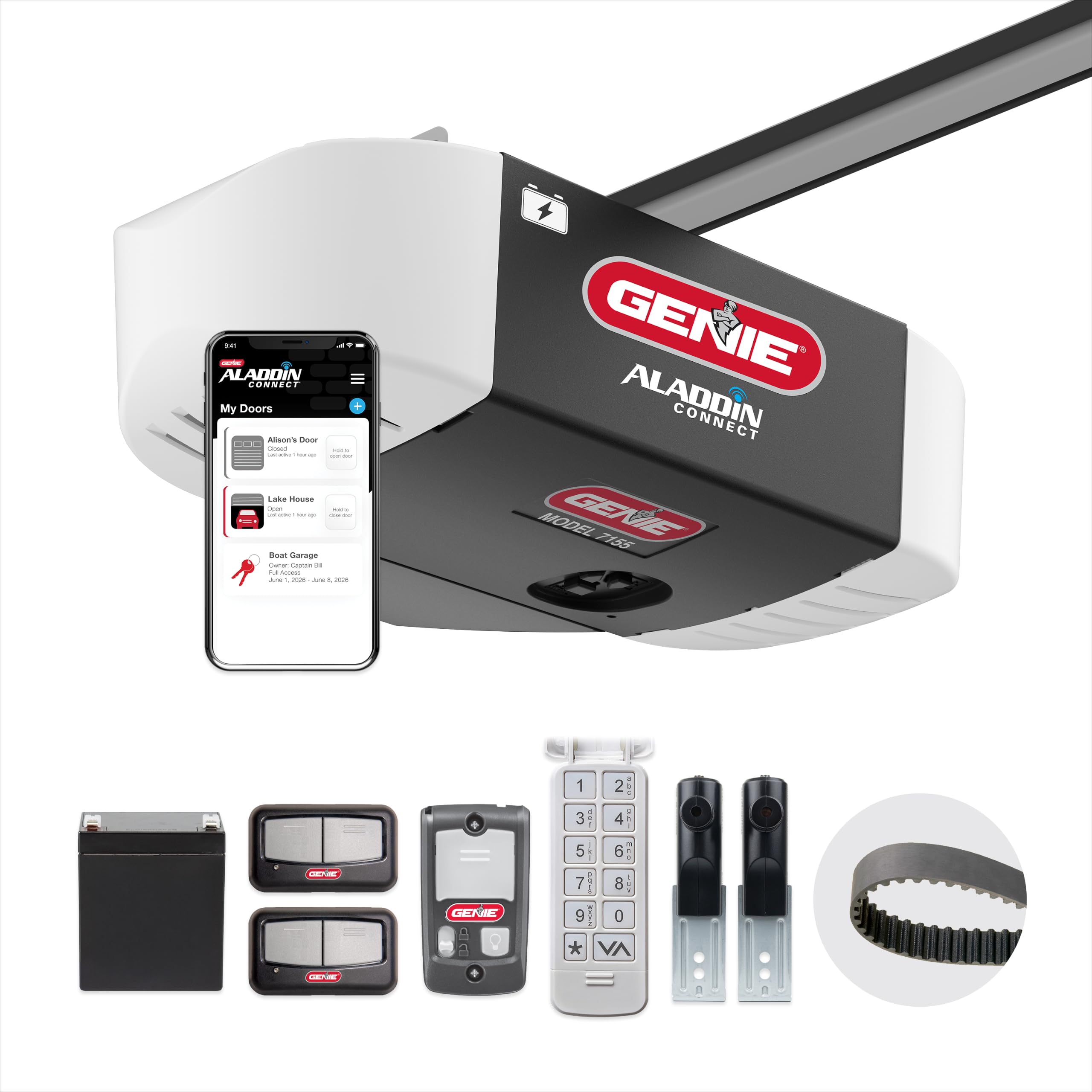
If your current opener is wheezing, this replaces the entire unit and adds SmartThings control in one job. The motor is a 1.25 HPc DC unit — a high-torque direct-current motor — driving a steel-reinforced belt instead of a chain. That combination is why it runs so quietly: there is no chain rattling against a rail overhead. Owners consistently report they cannot hear the door from inside the house, and quiet operation is what buyers praise most.
Smart control comes through built-in Aladdin Connect, Genie’s own wi-fi bridge. It connects to Alexa, Google Assistant, SmartThings and Amazon Key In-Garage Delivery, so your garage can join the same routines as the rest of your home. In practice that means you can check the door from your phone at work and let a courier drop a parcel inside. The box includes two pre-programmed remotes, a wireless keypad, a multi-function wall console and the Safe-T-Beam safety sensors — enough to run a household without buying extras.
The honest limit is door size. This opener is designed for sectional doors up to 7 ft high and 500 lbs, and an 8 ft door needs an extension kit sold separately. Measure before you order. The other thing worth knowing is speed: the door travel is deliberately slow and quiet rather than quick. If you tap the button and expect the door to fly, you will notice it. And long-term, a few systems have needed attention after several years of use, so the 5-year parts and limited lifetime motor warranty is worth holding onto.
What this opener brings to the ceiling
- 1.25 HPc DC motor on a steel-reinforced belt keeps the door near silent
- Integrated battery backup keeps the door working in a power cut
- Aladdin Connect reaches SmartThings, Alexa and Google Assistant without an extra hub
- Remotes, keypad, wall console and safety beams all in the box
- Interactive 3D install instructions through the BILT app
Where it stops short
- Rated for 7 ft doors only; 8 ft needs a separate extension kit
- Door travel is noticeably slow by design
- Heavier doors above the 500 lb rating are out of range
Reach for this if: your door is a standard 7 ft sectional and you want a quiet smart opener with backup power in one purchase.
Think twice if: you have an 8 ft door or a gate — this is a sectional-door opener, not a retrofit bridge.
2. Smart Garage Door Opener blaQ
The small box that frees a LiftMaster from the cloud without touching the motor.
You already like your Chamberlain or LiftMaster opener — you just want it to answer SmartThings. This connects with two wires and a power adapter, both included, into your opener or wall button. It measures 2.75 x 1.9 x 1.2 inches — roughly 30% larger than the Remootio 2 — but installs more compactly because there is no sensor to mount on the door.
The big draw is local control. It talks directly to Home Assistant, Hubitat, HomeBridge, Control4 and HomeSeer over your own wi-fi, and reaches SmartThings and Alexa through Konnected’s free cloud service. No subscription, no batteries to replace. Setup is the strongest theme in owner feedback — pairing is quick and it holds the connection where the old myQ module dropped it. Partial open and close is a real bonus: you can crack the door for a cat or a delivery without a full cycle.
Here is the catch you must check first. It needs a Chamberlain, LiftMaster or Craftsman opener with Security+ or Security+ 2.0 and a yellow round, purple, brown, red or orange learn button. It will not work with Security+ 3.0 openers carrying a white learn button. Buy it blind and it simply will not pair, so glance at that button before checkout. Owners who wanted local control got exactly that; those who expected it to run every door brand were the ones disappointed.
The compatibility gate: a two-wire install that only earns its keep on the right opener generation — match the learn button first and it is a clean, fee-free upgrade.
What it costs you: one cloud hop for SmartThings and Alexa, while Home Assistant and Hubitat stay fully local.
Pick this: if your Chamberlain-family opener has the right learn button and you want Home Assistant or SmartThings without a monthly fee.
Leave it: if you run a newer Security+ 3.0 opener with a white learn button.
3. Remootio 2

One tiny box for the garage door and the driveway gate, with a Bluetooth backup.
Few devices in this category handle both a garage door and a gate, and that dual role is what makes the Remootio 2 worth a look if your driveway has both. It sticks on with double-sided adhesive and measures 2.12 x 2.12 x 0.78 inches. At 6.7 ounces it weighs less than half the 16-ounce ismartgate LITE, the other bridge here.
Connectivity is the headline. It joins your wi-fi to reach the door from anywhere, then falls back to Bluetooth when wi-fi drops — a genuinely useful safety net for a detached garage with weak signal. The included sensor reports whether the door is open or closed, and you get open and close alerts. Security is 256-bit end-to-end encryption, and the subscription-free app issues virtual keys for up to 20 people, shared by QR code.
The trade-off lives in the setup and voltage. This version runs on 5V DC only, so check your opener’s output before buying — Remootio makes a wide-voltage Remootio 3 for other setups. Some owners found the instructions thin and the sensor unreliable, and a few reported issues pushing commands through Google Home. Compatibility with older openers is the other thing to verify on Remootio’s site. Get those two checks right and it is a fast, tidy install.
The dual-door angle: garage and gate from one app is rare here, and Bluetooth fallback keeps it usable when the wi-fi is patchy.
The voltage snag: 5V DC only — confirm your opener matches or the box will never power up.
Best matched to: a home with a garage door and a gate, both on openers that meet the voltage and compatibility list.
Skip the gamble: if you cannot confirm 5V DC and opener compatibility first.
4. ismartgate LITE Smart Garage Door Opener Remote

A single-door bridge that Apple users tend to land on first.
If your home runs on Siri and Apple Home, this is the bridge that fits that world. It wires into your opener’s motor or wall button and attaches a wired sensor to the door, then controls one sectional door from the ismartgate app on iPhone or Android. Setup follows a step-by-step online guide, and installation is the theme owners praise most.
Outside of HomeKit it reaches Amazon Alexa, Google Home and Assistant, Samsung SmartThings and IFTTT, all with no subscription. The sensor is required for any third-party connection, so do not skip mounting it. Owners describe the app and the wi-fi link as solid once everything is wired, and the door status alerts are the practical payoff: you stop asking whether you shut the garage on the way out. The one-door limit is deliberate — this LITE model controls a single door, while the PRO version below handles three.
The weak link is the wireless sensor. Its batteries are non-standard alkaline cells, and at least one owner saw them drain within a couple of months, after which the system does not fully function. A separate concern is the app dropping its connection for some users. Both are fixable with fresh batteries and a stable wi-fi signal, but they are real. Weigh the HomeKit-first fit against the small maintenance chore of sensor batteries.
The Apple-home fit: a wired sensor and clean HomeKit integration make it a natural pick for a Siri household on one door.
The maintenance note: non-standard sensor batteries can run down in months — keep spares on hand.
Made for: an Apple Home household with one sectional door and an opener that wires up cleanly.
Not for: multi-door garages — this LITE unit tops out at a single door.
5. ismartgate PRO Smart Garage Door Opener Remote

Three doors, camera feeds and GPS auto-open in one app.
For a house with more than one garage bay, the PRO earns its place by controlling up to three doors from one bridge. It wire-connects to your existing openers — including a Genie, Chamberlain or LiftMaster with the right adaptor — and adds SmartThings, Alexa, Google Home, Apple HomeKit and IFTTT with no subscription. If all three bays move independently, this is the cheaper way to smarten them than buying three separate boxes.
The extras are where the PRO separates itself from the LITE. You can link up to three existing IP cameras for live video and recording inside the app, set separate user accounts restricted by time, door and location, and upload a photo of your garage that shows open or closed. It can even auto-open as you approach and auto-close as you leave through IFTTT GPS or a schedule. A visual acoustic alarm and a distinct tone per door round out the package.
The reality check is reliability and network behaviour. Setup is well liked — a step-by-step guide walks you through the wiring — but the app can drop its HomeKit connection repeatedly for some owners, and a handful found the sensor should be left unhooked. A Genie or Chamberlain opener with a yellow learn button needs the ismartgate switch adaptor sold separately, and roller doors need the gate kit instead. Confirm those before you plan the install.
Why multi-door homes pick it: up to three doors plus camera feeds and scheduled automation from a single unit.
The connection caveat: recurring HomeKit disconnects and the separate adaptor for yellow-button openers are the things to plan for.
Suits: a multi-bay garage that wants one app for every door with camera monitoring built in.
Not ideal for: a single-door home or a roller door, which needs different hardware entirely.
6. Genie B6172H Wall Mount Smart Garage Door Opener

Wall-mounted muscle for a door too tall and heavy for a rail opener.
When your door is 14 ft tall and pushes 850 lbs, an overhead rail opener is not the answer. This one mounts to the side of the door’s tube spring instead, so there is no track overhead eating your ceiling storage. A 24V DC motor — a low-voltage direct-current drive — lifts standard, high-lift and vertical-lift doors up to 14 ft and 180 sq ft, and it is built compact at 6.8 in wide, 12 in tall and 9 in deep.
The add-on SmartThings control rides on Aladdin Connect again, plus Alexa, Google Assistant, Amazon Key In-Garage Delivery and other platforms. Battery backup, a pre-programmed three-button remote, a wireless wall console, a wireless LED light and an automatic door lock all come in the box. Owners who install it themselves praise the build quality and the smooth, clean operation, and the side-mount design wins people over for clearing the ceiling.
The honest limits are mechanical and smart-side. It will not work on reverse-wound springs, extension springs, one-piece doors or a low-headroom outside hook-up, so match the door mechanism first. It also needs a standard outlet within 6 ft of the unit. On the app side, a few users found the Aladdin Connect link flaky and some report the door shuddering at the top of its travel. One 68-year-old owner installed it solo, but a couple of serious reports of the door dropping mean you should have the spring and coupler checked by a pro.
The capacity headline: 850 lbs on a 24V DC wall-mount motor clears tall doors the rail units cannot reach.
What to verify: torsion-spring type, headroom and a nearby outlet — get these wrong and the install stalls.
Choose it when: you have a tall, heavy sectional door with a standard torsion spring and want the ceiling back.
Hold off if: your door uses extension springs, reverse-wound springs or is a one-piece design.
Know the Specs
Belt Drive vs Wall Mount
A belt drive runs a rubber-reinforced belt along an overhead rail, which removes the metal-on-metal clang of a chain. That is why a 1.25 HPc belt unit can be near silent from inside the house. A wall-mount opener skips the rail entirely and mounts to the door’s torsion spring at the side, freeing the ceiling. Wall mount suits tall or heavy doors; belt drive suits a standard sectional door under a living space where quiet matters most.
HPc and Door Weight Ratings
HPc is the motor’s power rating in the belt-drive unit, and door weight ratings tell you what the motor can haul. One opener here is rated to 500 lbs on a 7 ft door; the wall-mount units are rated to 850 lbs and 14 ft. Exceed the weight or height and the motor works harder or fails. That single rating often settles which opener fits your garage before you look at smart features.
SmartThings Bridges and the Learn Button
A bridge wires into your existing opener’s wall button or motor terminals and translates it to SmartThings and other platforms. The opener’s learn button colour identifies its security generation. A yellow round, purple, brown, red or orange button works with the Konnected blaQ; a white button on newer Security+ 3.0 units does not. Check that button first — it is the make-or-break detail for a retrofit.
Local vs Cloud Control
Some bridges run local automation through Home Assistant or Hubitat, with no cloud in the path, while others reach SmartThings through a free cloud service. Local control means commands stay on your home network, useful if you dislike subscriptions or sketchy connectivity. Cloud integration widens the number of platforms but leans on an outside service. Both styles appear here, so pick based on if you want commands to stay on your home network.
Common Questions
Will a SmartThings garage door opener work with my existing opener motor?
How do I know if my Chamberlain or LiftMaster learn button is compatible?
What door height and weight can a standard belt opener handle?
Do these garage door openers need a subscription?
Can a wall-mount opener work on a reverse-wound spring or extension-spring door?
Will a bridge still open my door if the power or wifi goes out?
Can one bridge control more than one garage door?
What is the difference between local control and cloud control here?
Do I need the door sensor mounted for third-party apps to work?
Will a garage door opener set up for Alexa also answer SmartThings?
The Bottom Line
For most homes wanting the best SmartThings Garage Door Opener, the Genie StealthDrive Connect 7155-TKV is the strongest single buy — a 1.25 HPc belt drive, built-in battery backup and Aladdin Connect that reaches SmartThings without a hub, in one install. If you already own a Chamberlain or LiftMaster and want local control with no fee, the Konnected GDO blaQ is the retrofit that does it, provided your learn button matches. And for a multi-bay garage with cameras and schedules, the ismartgate PRO covers three doors from a single unit. Check one thing before you order — your door height, weight and learn button — and the right pick is the one that matches your ceiling today.
How we choose
We do not accept paid placement. Every pick is matched to a real buyer and a real use-case; we do not hands-on test units.
Sources
Specifications: manufacturer listings and product documentation. Review insights: verified customer reviews, as of November 2026. Pricing: not shown on this page (it changes often); check the current price via the retailer link.
As an Amazon Associate, Tactical Gear Guy earns from qualifying purchases. This does not affect which products we feature.