Specs are compiled from manufacturer listings and verified buyer reviews and can change over time — please confirm the key details on the product page before buying.
You buy a smart thermostat hoping your heating bill drops, then find the real work is wiring and scheduling. So these nine Wi-Fi programmable models are sorted by what actually matters in a house. First, whether a C-wire (the dedicated power wire some thermostats need) is required. Second, how the schedule gets built. Third, what happens when the internet drops.
This guide is built by comparing the manufacturers’ published specifications and the patterns across verified customer reviews, so you get each pick’s real strengths and trade-offs instead of marketing spin.
The picks below range from budget-friendly to premium, and each one is matched to a specific heating system so you do not end up with a thermostat that refuses to talk to your boiler. If you want the shortest path to a working schedule, this breakdown of the smart wi-fi programmable thermostat market shows exactly which model fits your wiring.
Top Picks

How To Choose The Best Smart Wi-Fi Programmable Thermostat
Before you compare screens and apps, answer one question: what kind of heat does your home run on? The answer eliminates half the market instantly, and it is the single mistake that sends more thermostats back to the box than any other.
Start with your system voltage
Central furnaces, air conditioners and heat pumps run on low-voltage wiring, usually 24V. Electric baseboard, convector and in-wall heaters run on line voltage, often 120V or 240V. A line-voltage thermostat will not run a furnace, and a low-voltage thermostat will not run a baseboard heater.
If you have electric baseboard, you are shopping in a much smaller pool — the Mysa LITE and the meross are built for exactly that job, and both list their voltage and watt ceilings openly.
The C-wire question
A C-wire is a constant-power wire that keeps the thermostat’s Wi-Fi radio fed without stealing power from your heating circuit. Many older homes do not have one.
Some thermostats, like the Sensi ST55 and the Google Nest Thermostat, are designed to work without a C-wire in most homes. Others require one outright, and a few — like the Cielo Eco — ship a free C-wire adapter in the box.
Scheduling that matches your week
Programmable means you set temperatures by time block, not just turn a dial. Look at whether the schedule is built as 7-day (every day different), 5-1-1 (weekdays plus Saturday plus Sunday), or 5-2. If your week is identical Monday to Friday, a 5-2 model saves you setup time.
Geofencing goes a step further: it uses your phone’s location to ease the heat when you leave and bring it back as you drive home. Both the Mysa LITE and the Cielo Eco list geofencing by name.
Side-by-Side Comparison
| Model | Best For | System Type | Display | Voice Platforms | Amazon |
|---|---|---|---|---|---|
| Sensi ST55★ Best Overall | No-C-wire homes | Low-voltage HVAC | LED | Alexa, HomeKit, Google, SmartThings, Vera | Amazon |
| Honeywell Home X2SMatter Ready | Matter smart homes | Low-voltage, 2H/2C | LCD | Alexa, Google, HomeKit | Amazon |
| Cielo Smart Thermostat EcoAdapter Included | Adapter-in-box installs | 24V, up to 2H/2C | LCD | Alexa, Google, Siri Shortcuts, SmartThings, IFTTT | Amazon |
| meross Smart Thermostat | Baseboard and wall heaters | Line voltage, 120V–240V | LCD | Alexa, HomeKit, Google, SmartThings | Amazon |
| Google Nest Thermostat | Google-home households | Low-voltage HVAC | LCD | Google Assistant, Matter assistants | Amazon |
| Mysa Smart Thermostat LITE | Electric baseboard, premium | Line voltage, 120V–240V | LCD | Alexa, HomeKit, Google | Amazon |
| Sensi 1F87U-42WF | Geofencing on low-voltage | Low-voltage HVAC | Digital | Alexa, HomeKit, Google, SmartThings, Wink | Amazon |
| Honeywell Lyric T6 | Heat-pump systems | 3H/2C heat pump or 2H/2C conventional | LCD | Alexa | Amazon |
| Google Nest Learning Thermostat | Self-programming comfort | Low-voltage HVAC | Digital | Google Assistant, Alexa | Amazon |
Detailed Reviews
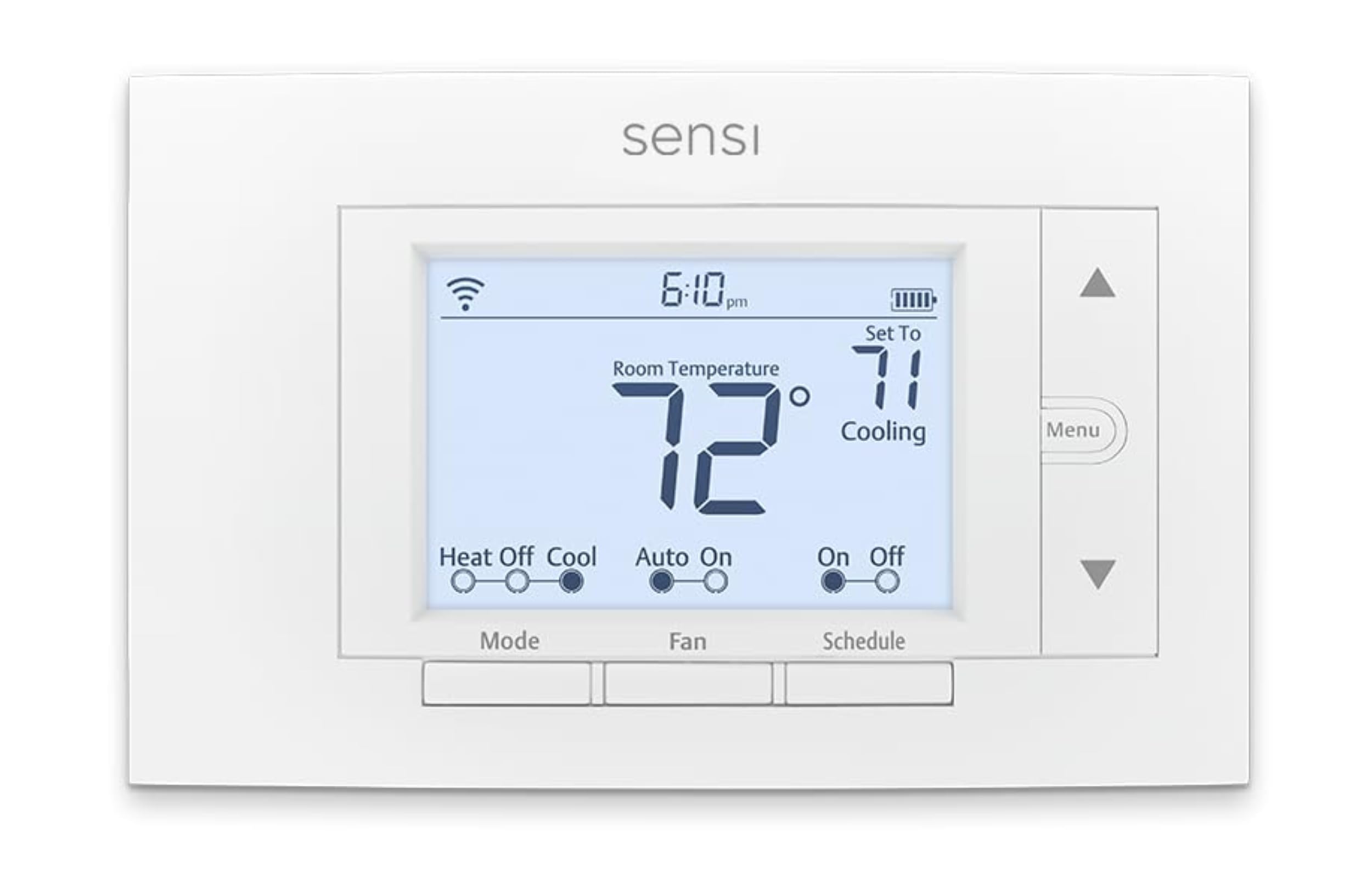
1. Sensi Smart Thermostat ST55
Our pick — 4.0+★ from 23,000+ verified ratings; the strongest balance of quality and price.
The thermostat for the house that never had a C-wire, and never wants to patch drywall either.
Here is the number that wins this category: the ST55 does not require a C-wire in most applications. That means a two-wire furnace setup installs without new cable through a wall or an electrician. It ships with a built-in level, two AA batteries, mounting hardware and wire stickers, so the whole job stays inside the app’s step-by-step instructions.
The second number is 5.88 inches across. Sensi designed it to fit the same wall space as the thermostat you are removing, so there is no patching, no painting, and no repainting the hallway wall in a slightly different shade. It looks and feels like a normal thermostat with real buttons, and its LED display stays readable without a glowing screen in the bedroom.
On the energy side, Sensi lists about 23% savings on HVAC energy, backed by ENERGY STAR certification, with flexible scheduling, remote access and usage reports in the app. The app goes past scheduling and sends filter reminders and equipment alerts when something in the HVAC system looks off. Control runs through Alexa, Apple HomeKit, Google Assistant, SmartThings and Vera, and Sensi states plainly that it will not sell your personal information to third parties.
Where The ST55 Pays Off
- No C-wire needed in most applications — a real fix for older two-wire homes.
- Same footprint as a traditional thermostat, so no drywall repair.
- ENERGY STAR certified, with about 23% HVAC energy savings listed.
- Works across Alexa, HomeKit, Google Assistant, SmartThings and Vera.
What To Watch For
- Wi-Fi connection drops are the recurring gripe in the review pages — a mesh point near the hallway helps.
- Button control rather than a touchscreen, which some buyers want at this level.
Reach for it if: your wiring is old, your wall is painted, and you want the install done in one afternoon.
Look elsewhere if: you want a touchscreen and are willing to pay for the glass.
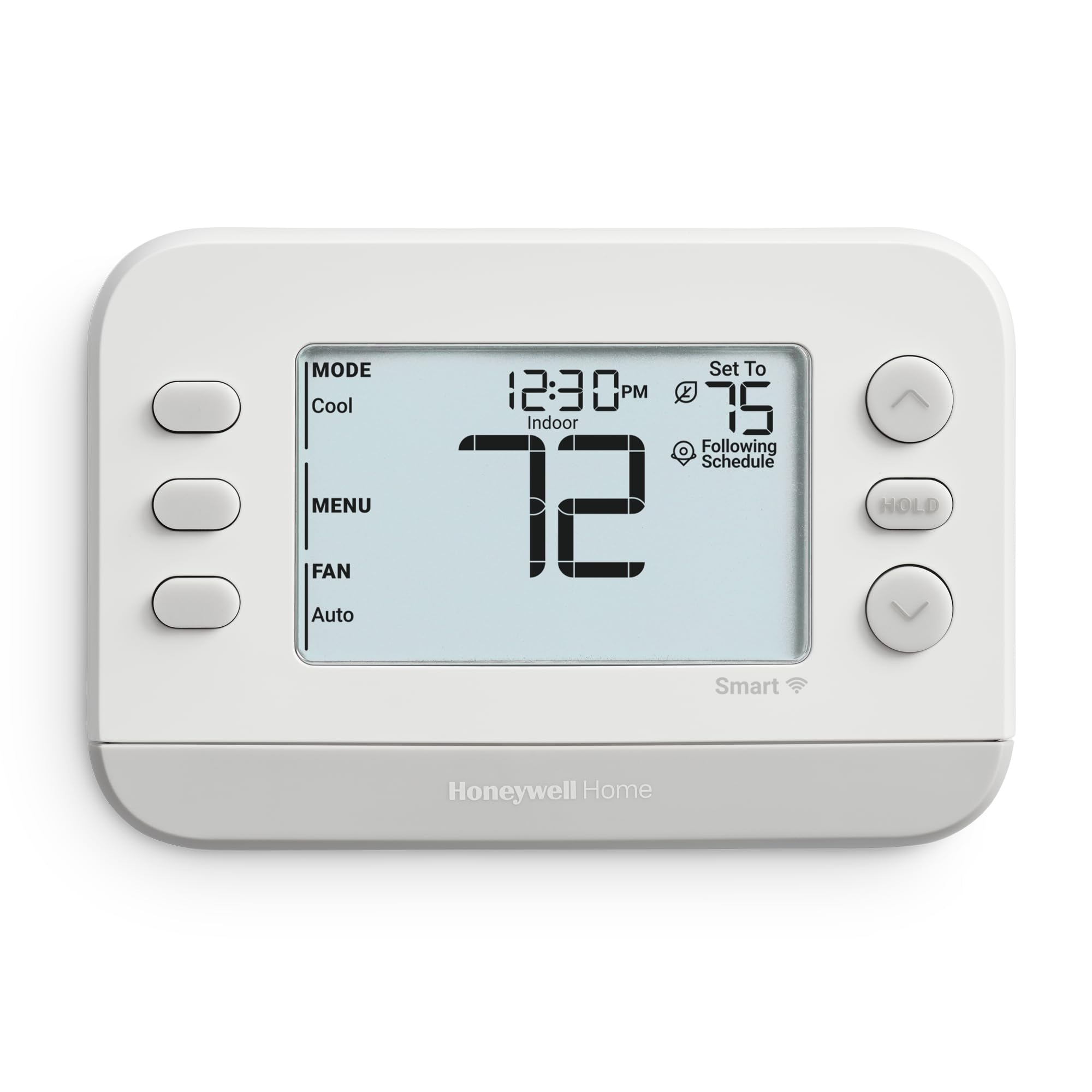
2. Honeywell Home X2S Smart Wi-Fi Thermostat, Gray
The one that speaks Matter, so it works inside the smart-home app you already have open.
Matter is a shared smart-home language that lets devices from different brands talk to one another without separate bridges. The X2S is Matter certified, which means it can be controlled from your existing platform — Amazon Alexa, Google Assistant, or Apple HomeKit — rather than a single manufacturer app. If your household already runs a mixed set of smart devices, that removes one more app from your phone.
The scheduling is where this model earns its place. You can build the program in 5-1-1 day, 5-2 day, 7 day, or one-week blocks, and there is even a non-programmable option if you just want a dial. Auto-away eases the temperature when the house empties, and the extended 32°F low-heat setpoint keeps a garage or a rarely used room above freezing.
Two practical extras: the display can show indoor humidity, and a change-filter reminder fires when the air handler needs attention. The RTH2CWF also serves as a replacement for the RTH6580 for systems up to 2 heat, 2 cool conventional or 2 heat, 1 cool heat pump. Be honest with yourself about the C-wire before ordering — Honeywell states directly that one is required and that a power adapter may be needed.
Easiest control path: voice and app control both run through Matter, so no proprietary lock-in.
Real question to ask: does your existing thermostat have a C-wire? If the answer is no, budget for the adapter or pick the Sensi ST55 above instead.
Fits best in: a home already running Matter or a mixed Alexa/Google/HomeKit setup.
Not the one for: a house with no C-wire and no appetite for adding one.
3. Cielo Smart Thermostat Eco
The box hands you the adapter you would otherwise have to buy separately.
A free C-wire adapter ships inside the Cielo Eco packaging. For a house without that constant-power wire, this quietly solves the most common installation roadblock — and you do not have to order a separate part and wait for it to arrive mid-install. The unit itself measures 1.02″D x 3.94″W x 3.94″H, a compact square that sits flush enough that the wall does not need patching.
The compatibility list is long and specific: gas, electric, oil, hot water, heat pump and geothermal systems, with two heating stages (W1, W2), two cooling stages (Y1, Y2), a single-stage fan, and heat pump O/B with auxiliary heat. If your system is more complex than a basic single-stage furnace, this is one of the few picks that spells out the exact stage counts instead of waving at them.
Scheduling covers Home, Away and Asleep presets plus custom weekly blocks, with geofencing for location-based control and a vacation mode that holds the house against extreme temperatures while you are away. Energy consumption insights break down where your heating and cooling hours actually went. Voice and platform support runs through Alexa, Google Assistant, Siri Shortcuts, SmartThings, IFTTT and Home Assistant.
Built for messy systems: the stage-by-stage compatibility list is what separates this from a basic single-stage unit.
The honest catch: HVAC monitoring is not part of the feature list here — you get energy insights, not equipment fault alerts.
Worth choosing when: your HVAC setup has two-stage heating or a heat pump and you want the adapter in the box.
Think twice if: you specifically want the thermostat to warn you about failing equipment.
4. meross Smart Thermostat
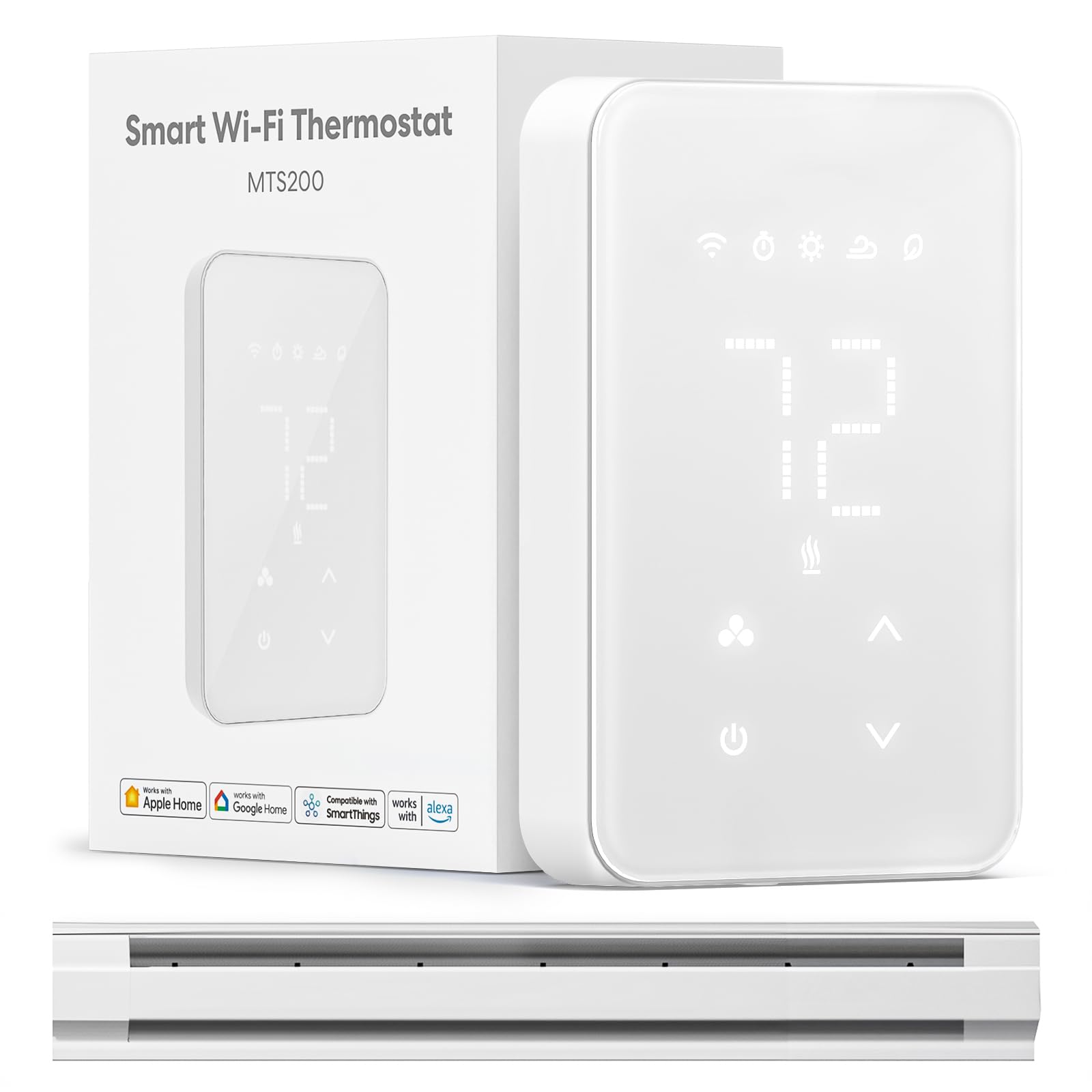
A high-voltage thermostat for baseboard heat that most low-voltage picks simply cannot run.
This is a line-voltage unit, meaning it handles the 120V or 240V current that electric baseboard, convector, fan-forced and in-ceiling radiant heaters pull. Its maximum output load is 16A, 1920W at 120V and 3840W at 240V. Put plainly: if your heat comes from a baseboard strip along the wall, this is the kind of thermostat you need, and a 24V model will not switch it.
meross claims an install under 30 minutes. The requirement that matters more: you need four or more wires in the electrical box to install it. Pull the old thermostat off and look at the back plate before you order — if you only see two wires, this will not work and neither will the Mysa LITE below.
Temperature control is listed at 1°F accuracy across an adjustable range of 41°F to 95°F, which is tighter than a lot of dial-based baseboard thermostats manage. The Meross app builds a 7×24-hour graphic schedule, and an internal electricity meter reports live power consumption plus historical data. Open-window detection pauses heating when a window is opened for ventilation, and a power-off memory restores your settings after an outage.
Why Baseboard Owners Choose It
- Handles up to 16A — 1920W at 120V and 3840W at 240V.
- 1°F accuracy across a 41°F to 95°F range.
- Open-window detection and power-off memory built in.
- Works with Apple Home, Alexa, Google Home and SmartThings.
The Real Preconditions
- Four or more wires required in the electrical box — check before buying.
- Wi-Fi connectivity is the mixed spot in the review pages.
Pick it for: an electric baseboard or in-wall heater circuit where a low-voltage thermostat is a non-starter.
Walk away if: your wall box only has two wires.
5. Google Nest Thermostat

Turns itself down when the house empties, and nudges you toward a cheaper schedule.
The headline behavior is simple: the Nest Thermostat eases off when you leave, so you are not paying to heat or cool an empty house. Owners tend to care about that auto-away behavior more than any screen setting.
It is designed to work without a C-wire in most homes, but Google qualifies that clearly: heating-only, cooling-only, zone-controlled and heat pump systems need a C-wire or another compatible power accessory. Check the online Nest Compatibility Checker against your system before you commit.
Savings Finder scans for further ways to trim the schedule and suggests tweaks inside the Google Home app. HVAC monitoring watches the heating and cooling equipment and sends an alert when something does not look right, along with maintenance reminders. The wireless spec covers Wi-Fi 802.11b/g/n 2.4 GHz and 802.11a/n 5 GHz, plus Bluetooth Low Energy and Matter-certified voice assistants.
Best in a Google house: the app, the assistant and the savings suggestions all live in the Google Home ecosystem.
Fair warning: reliability splits opinion on the review pages — some units run for years, others quit. That is worth weighing against the convenience.
Suits you if: your phone already runs Google Home and your system is a standard low-voltage setup.
Probably not for: heat-pump owners without a C-wire.
6. Mysa Smart Thermostat LITE for Electric Baseboard Heaters
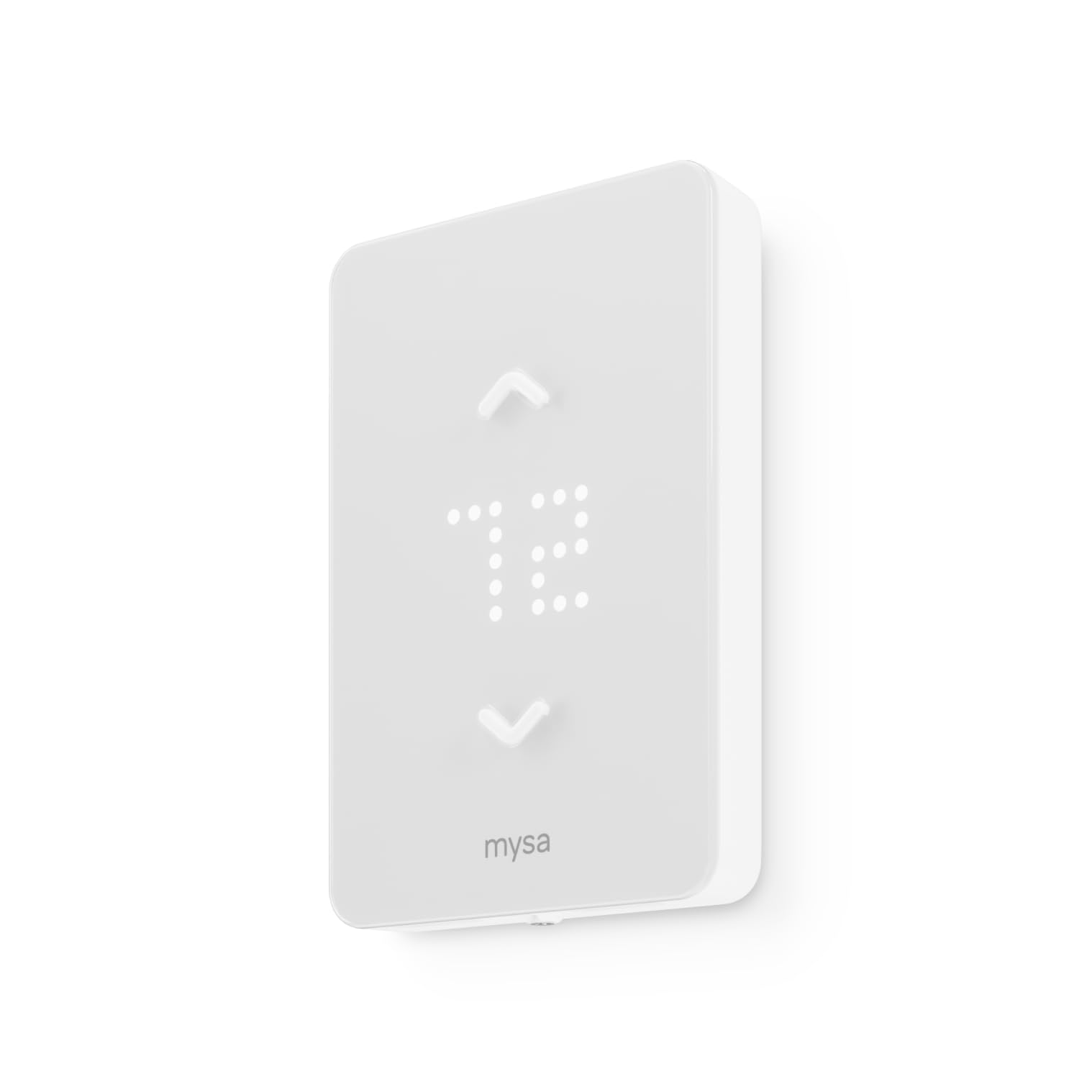
Mysa backs its baseboard thermostat with a five-year warranty and no monthly fee at all.
Scheduling, remote control, voice control, geofencing and the monthly runtime email all come included, and the Mysa app stays free. That combination is worth naming because subscription tiers are a common hidden cost in home climate gear.
Wiring rules matter here as much as anywhere. Mysa needs four wires including a neutral or a second live wire, and explicitly will not work on a two-wire switch loop or on 24V furnaces and central heat pumps. The load ceiling is up to 1,900W at 120V or 3,800W at 240V for electric baseboard, fan-forced, wall and convector heaters plus radiant ceiling heat. Use the compatibility checker before ordering.
After install, the app walks each wire step by step, and you set a schedule per day so the heat eases off while you are out and warms the room before you get home. Away, Vacation and geofencing handle longer trips, and HomeKit, Alexa and Google cover hands-free control. One practical detail: the monthly runtime email shows which rooms ran longest, while in-app energy charts and a humidity sensor live on the Mysa V2 instead.
What wins people over: the schedule does what it promises — set the heat back on a timer and the baseboard bill follows.
Size the trade-off: no in-app energy charts and no humidity sensor on the LITE, so if you want the graphs, that is the V2’s job.
Built for: electric baseboard and convector heaters where a free app and a five-year warranty matter more than graphs.
Wrong turn if: you are on a 24V furnace or only have two wires in the box.
7. Sensi Smart Thermostat 1F87U-42WF
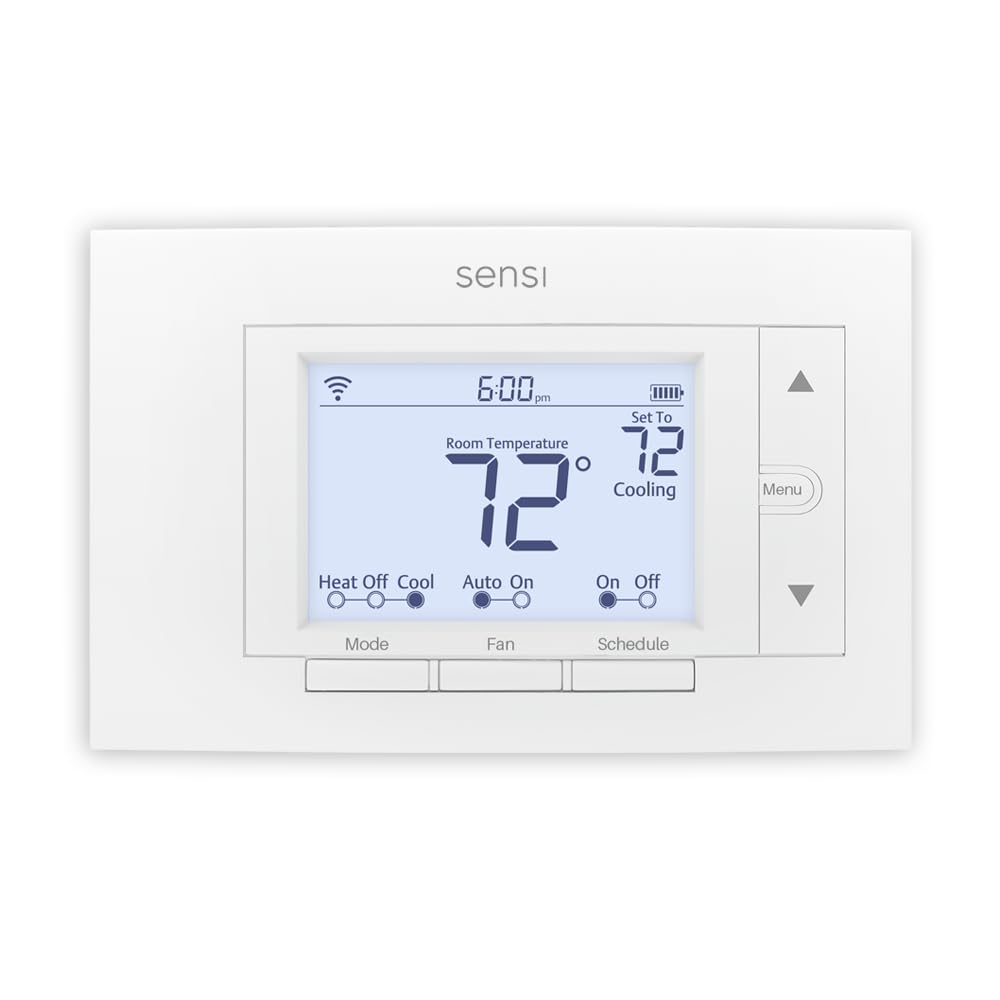
The step-up Sensi that adds geofencing and a seven-day calendar to the formula.
Where the ST55 leans on a simple 5-2 style schedule, this 1F87U-42WF goes to seven-day flexible scheduling plus geofencing. In practice that means you can give every weekday its own morning and evening setpoint instead of forcing one profile onto all five days.
It also carries two editorial honors: PCMag’s Reader’s Choice Best Smart Thermostat and USA Today’s Reviewed Editor’s Choice Best Value Smart Thermostat. Reputation is not a spec, but those two labels at least tell you the thing has been scrutinized.
Compatibility widens beyond the base model — a C-wire is required for heat-only, cool-only and heat pump systems, so check the online compatibility resource first. Sensi lists about 23% HVAC energy savings with ENERGY STAR certification, and adds smart alerts for extreme indoor temperature and humidity. That matters if you travel and leave pets behind, since the app can warn you before a room gets dangerously hot.
Why it earns a look: geofencing plus seven-day scheduling is the feature set most households actually use daily.
The trade-off: it costs more than the ST55 for the same brand and the same core install, so the added programming flexibility is the only reason to step up.
Choose this: if you want per-day schedules and location-based setback from a brand with a button-first design.
Stay with the ST55: if a single weekday schedule is enough and you would rather spend the difference elsewhere.
8. Honeywell TH6320WF2003/U Lyric T6 Thermostat
Three heat stages and two cool stages, for a heat pump that needs the extra switching.
The model number tells the story: this handles 3 heat / 2 cool heat pump systems or 2 heat / 2 cool conventional setups. If you have a heat pump with auxiliary or emergency heat, that third heating stage is not a luxury — it is the difference between a thermostat that can run the whole system and one that cannot.
It is built in the United States and measures 4.09″ x 4.09″ x 1.06″, so it covers a standard wall opening left by a prior thermostat. Control runs through the app and voice via Amazon Alexa, and auto-scheduling plus a programmable schedule covers the comfort side. The setup wizard walks through configuration step by step, which takes the guesswork out of matching the thermostat to an unusual system type.
The honest limitation: this is a bare-bones data set. There is no published humidity readout, no geofencing mention and no energy reporting listed here, so if those extras matter to you, the Cielo Eco above covers more ground on paper.
Its specific job: heat pump systems that need a third heat stage and a clear conventional/heat-pump switch.
Set expectations: a straightforward programmable thermostat rather than a feature buffet — no dual-fuel or multi-zone tricks beyond what the stage count covers.
Good match for: a heat pump house where the auxiliary heat stage must be wired correctly.
Less compelling if: you are on simple single-stage gas heat and want geofencing and energy reports in the same box.
9. Google Nest Learning Thermostat – 3rd Gen – Stainless Steel

The one that watches how you live for a week, then writes your schedule for you.
The Learning Thermostat watches your adjustments and the temperatures you pick, then programs itself around that pattern. It is the opposite approach to the button-and-menu scheduling on the models above — you stop editing a calendar and just nudge the dial for a week.
Home/Away Assist eases the house to an Eco Temperature when you leave, then brings it back when you return. Energy History shows on your phone how much energy you used and why, and the Nest Leaf appears on the display when you choose a temperature that saves energy. HVAC monitoring watches the heating and cooling systems and sends alerts when something looks off, plus maintenance reminders.
The stainless steel body measures 3.3″D x 3.3″W x 1.1″H and includes an optional trim kit that covers marks left by an older thermostat. It works with the Nest Temperature Sensor, sold separately, to hold a specific room at the temperature you want. Voice control runs through Google Assistant and Amazon Alexa, and the wireless spec covers Wi-Fi on both 2.4GHz and 5GHz plus Bluetooth Low Energy and 802.15.4 at 2.4GHz.
The reason to pay premium: self-programming plus room-level accuracy via the Nest Temperature Sensor, which no other pick here lists.
Weigh the value honestly: reliability and Wi-Fi connection both split opinion on the review pages, and this is the most expensive unit in the roundup, so the learning behavior has to be worth it to you.
For the household that never edits a schedule: let it learn for a week and stop fiddling with menus.
Harder to justify when: you already know your exact setpoints and want the same control for a smaller spend.
Know the Specs
C-Wire
A C-wire is a constant-power wire running from your HVAC system to the thermostat. It keeps the Wi-Fi radio fed without stealing current from the heating circuit. Homes without one can still run certain thermostats — the Sensi ST55 is designed to work without a C-wire in most applications, and the Cielo Eco ships an adapter in the box.
Line Voltage vs Low Voltage
Line-voltage thermostats switch the full 120V or 240V current that electric baseboard and wall heaters use. Low-voltage thermostats switch a 24V signal that tells a furnace or heat pump what to do. The two are not interchangeable — a 24V unit will not run a baseboard heater.
Stage Count (2H/2C, 3H/2C)
Stages describe how many separate heating and cooling outputs a thermostat can control. A 2H/2C unit handles two heating stages and two cooling stages. Heat pumps with auxiliary heat often need three heating stages, which is why the Honeywell Lyric T6 lists 3H/2C.
Scheduling and Geofencing
Scheduling sets temperatures by time block — 7-day, 5-1-1 or 5-2 formats all do this differently. Geofencing uses your phone’s location to ease the heat when you leave and restore it as you return. Both features appear across the picks here, but the exact combination differs by model.
Common Questions
Will a Wi-Fi thermostat work in a house with no C-wire?
Can I use one of these on electric baseboard heat?
How many wires do I need in the wall box for a baseboard thermostat?
What does the stage count 2H/2C actually mean for my furnace?
Is a Matter-certified thermostat worth choosing over a brand-specific one?
Which pick handles a heat pump with auxiliary heat?
Do these thermostats need a subscription for scheduling and remote control?
What happens to my schedule during a power outage?
Is a learning thermostat better than one I program myself?
Will a smart thermostat actually lower my heating bill?
The Bottom Line
For most people shopping for a smart wi-fi programmable thermostat, start with the Sensi ST55. It needs no C-wire in most applications, so you can often skip running new wire. Its footprint fits the old thermostat’s spot, so you avoid patching drywall. And its price sits comfortably below the premium tier. If your heating runs on electric baseboard, the meross handles line voltage (the higher household current baseboard heaters use) at a lower entry point than the Mysa LITE. The Mysa LITE adds a five-year warranty and a genuinely free app, so you are not paying a subscription to change the temperature. And if you would rather never build a schedule by hand, the Nest Learning Thermostat does the thinking for you.
How we choose
We do not accept paid placement. Every pick is matched to a real buyer and a real use-case; we do not hands-on test units.
Sources
Specifications: manufacturer listings and product documentation. Review insights: verified customer reviews, as of November 2026. Pricing: not shown on this page (it changes often); check the current price via the retailer link.
As an Amazon Associate, Tactical Gear Guy earns from qualifying purchases. This does not affect which products we feature.