Specs are compiled from manufacturer listings and verified buyer reviews and can change over time — please confirm the key details on the product page before buying.
You want the one monitor that actually tells you your sump pump failed — before the carpet gets wet. The short answer: a plug-in device with no separate sensors to bury in the pit is the easiest to live with, and a plain water-level float on a 5 ft wire is the most dependable backup. Everything below is sorted by how each one handles that job, and where each falls short.
This guide is built by comparing the manufacturers’ published specifications and the patterns across verified customer reviews, so you get each pick’s real strengths and trade-offs instead of marketing spin.
A basement flood rarely comes from a dramatic storm. It comes from a pump that quietly stopped, a float that stuck, or a power blip nobody noticed until the water was ankle-deep. Here is what separates a monitor you trust from a gadget you forget — and the best smart sump pump monitor makes that difference in one honest comparison.
Top Picks


How To Choose The Best Smart Sump Pump Monitor
The hardest part of buying a sump pump monitor is figuring out what it is actually watching. Some devices listen to the pump’s power draw through a smart outlet. Others sit a float in the water. Both tell you when something is wrong, but they fail in completely different ways. Get that choice right and the rest of the spec sheet falls into place.
Sensor or no sensor — the first fork in the road
A plug-in monitor with no separate sensor watches how the pump behaves electrically. It reads runtime and current draw, so it can flag a pump that runs too long or draws too much. You never have to open the lid or reach into the pit. The catch is that it only knows what happens at the outlet — it has no idea how deep the water is.
A float-based monitor puts a physical sensor at the water line. It tells you when the level crosses a height you set, which is closer to the thing you actually fear. Setup takes a bracket and a few minutes, but now a dirty pit or a snagged float can affect what you see.
Why 2.4 GHz Wi-Fi is the quiet dealbreaker
Nearly every device in this category connects to your home network on the 2.4 GHz band. That band travels farther through basement walls than the 5 GHz band, but it is also the crowded one. A weak router signal at the pit is the single most common cause of dropped alerts. Run a phone to the sump and check the signal before you buy, not after.
Subscription-free doesn’t always mean service-free
Several picks here charge no monthly or yearly fee, which matters for a device you will keep for years. A few also offer a free basic cloud portal or an optional remote monitoring service. Read which alerts come standard and which depend on a paid tier you may never sign up for.
What to do with a battery
A battery-powered sensor can keep reporting during an outage, which is exactly when you want it most. A plug-in unit usually loses its voice when the power dies, so check whether the model includes backup power if outages are a real risk in your area.
Side-by-Side Comparison
| Model | Best For | Power Source | Sensor Type | Alert Method | Amazon |
|---|---|---|---|---|---|
| PumpFuse WiFi Sump Pump Monitor & Protector★ Best Overall | No-pit-access setup | AC plug-in | No separate sensor | App notifications | Amazon |
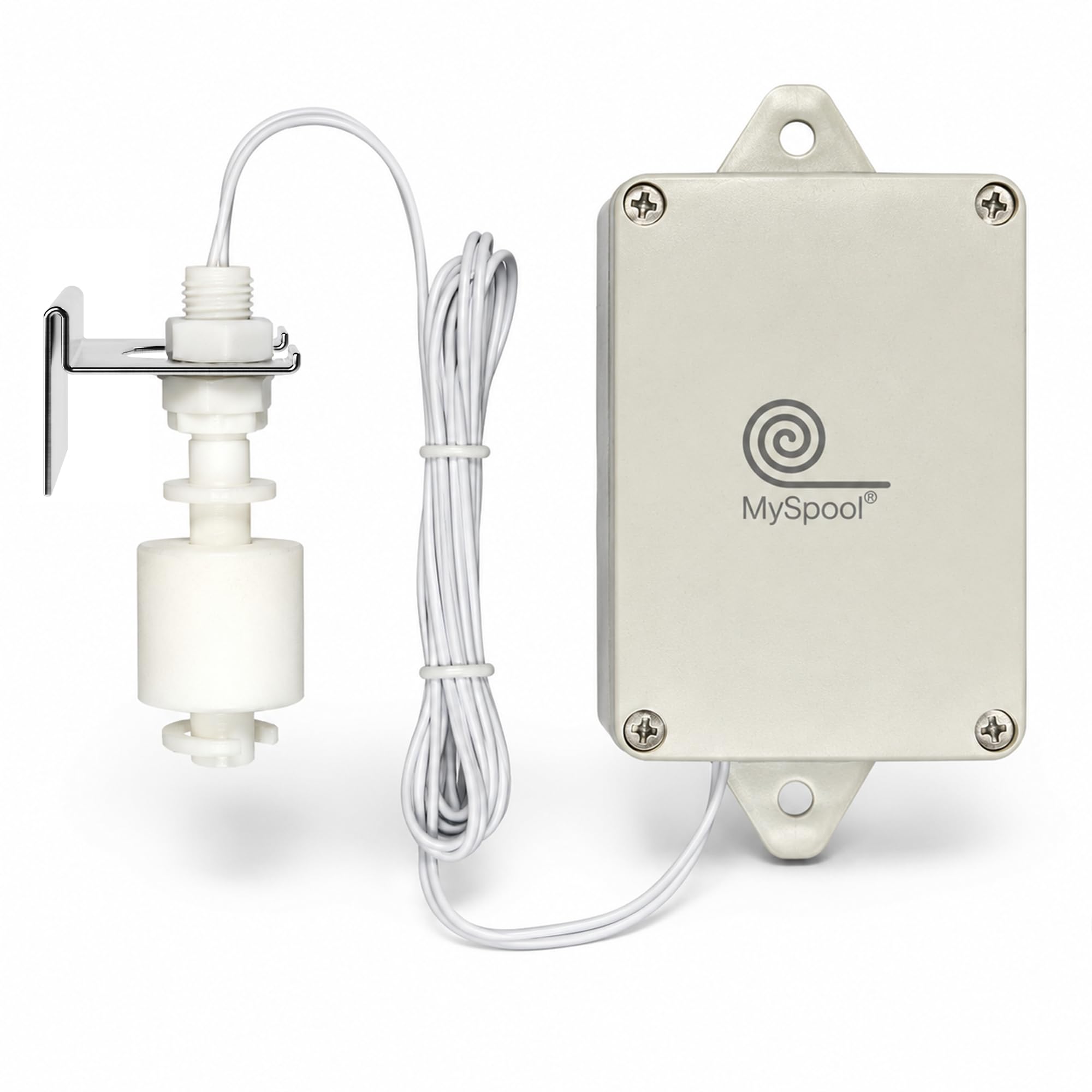
| MySpool WiFi Water Level Sensor (Battery)Battery Backup Pick | Outage-proof float alerts | 3 AAA batteries | Waterproof float, 5 ft cable | Text and email | Amazon |
| MySpool Plug-in WiFi Water Level SensorAlways-On Pick | Always-on float monitoring | AC plug-in | Waterproof float, 5 ft cable | Text and email | Amazon |
| Proteus L5 Wi-Fi Water Level Monitor | Long track record | Wall outlet | Contact sensor | Text, email, buzzer | Amazon |
| Basement Watchdog Wi-Fi Module 2.0 | Watchdog system owners | Battery powered | System data port | Email, text, push | Amazon |
| Basement Watchdog BW-WIFI | Older Watchdog systems | Battery powered | Dry contacts or USB port | Email, text, app | Amazon |
| PumpSpy Smart Outlet 2.0 | Outlet-based pump tracking | 120 VAC | Current and runtime | Push and email | Amazon |
| Level Sense Pro Wi-Fi Sump Alarm | Full environment watch | AC with backup battery | Float switch plus sensors | App, cloud portal | Amazon |
| Moen Smart Sump Pump Monitor S2000ESUSA | Moen smart-home owners | AC/DC | Water level sensor plus leak disc | App, text, email, call | Amazon |
Detailed Reviews
1. PumpFuse WiFi Sump Pump Monitor & Protector
Our pick — 4.5+★ from 200+ verified ratings; the strongest balance of quality and price.
The one that never asks you to open the pit — plug it in, and it starts learning your pump.
Most monitors make you mount a float inside a pit full of grimy water. This one skips that entirely. It plugs into AC power, joins your Wi-Fi, and auto-calibrates in minutes, which is the easiest setup in the category and the reason it takes the top spot. It is the crowd favorite too — 4.5+ stars across 200+ owners.
What it watches is behavioral. It tracks power usage, runtime charts, gallons pumped, and cost estimates, all free inside the app. From that history it flags dry runs, overloads, power loss, and short or long cycles. It also does more than warn: programmable auto-shutoff, remote control, and timer-based restarts let you protect the pump from burnout and clogs without walking downstairs. Anyone with two properties will like that you can add multiple pumps to one dashboard — and there is no login, no password, and no recurring fee.
The thing everyone raves about is reliability, and functionality sits right behind it in the feedback. The recurring gripe is the network — some units turn finicky and stop reconnecting, so a strong signal at the outlet is worth confirming first. It is also not waterproof; it lives indoors, or outdoors only in a weatherproof enclosure. Relative to the tiny MySpool sensor, it is a much bigger box at 4″L x 2.5″W x 3″H, which is the space you trade for all that analytics.
Where it earns its keep
- No float switch or pit access — plug in, connect, done
- Free unlimited history: power use, runtime, gallons, cost estimates
- Auto-shutoff and remote restarts protect the pump, not just alert you
- No account or subscription, data stored on a U.S.-based cloud
What to plan around
- Not waterproof — indoor use, or an outdoor enclosure
- Needs a steady 2.4 GHz Wi-Fi signal at the outlet
- It reads pump behavior, not actual water depth
Reach for this if: you want the fastest install and pump health data without touching the pit.
Look elsewhere if: you need a true water-level reading or a device that survives an outage on battery.
2. MySpool WiFi Water Level Sensor
The sensor that keeps reporting when the power does not — three AAA batteries and a 5 ft float.
Outages are the exact moment you need a monitor most, and that is where this one earns its place. It runs on the three included AAA batteries, so it keeps texting and emailing when the outlet goes dead. The float sensor rides on a 5 ft cable into the pit while the electronics stay sealed in a rugged enclosure rated to support 250 lb. Each alert even reports the remaining battery charge, so you know the unit is healthy.
The standout spec is the standby behavior: it draws no current at all until the float trips, and those batteries hold a 7 year shelf life with 500 or more alerts. Compare that with the plug-in MySpool and the difference is real — that one loses its voice in an outage, while this one is only limited by its batteries. Text and email land within seconds of the water reaching your set level.
Functionality is what wins people over here, with ease of setup close behind. One trick you may not expect: flip the float ring and it becomes a low-level alarm for a cistern, pond, or pool. The honest catch is the network — getting it onto a 2.4 GHz signal trips up plenty of buyers, and the printed guidance draws mixed feelings. Once connected it is dependable; getting there can be a fiddly evening.
Small footprint, big job: at 2″L x 2″W x 4″H it disappears on a shelf or bracket, unlike the larger plug-in MySpool at 6.5″L x 3″W x 1.75″H.
What to watch: verify your 2.4 GHz coverage at the pit and keep an eye on the reported battery charge.
Count on this one for: outage-prone areas and power loss you want to know about in real time.
The trade-off: you are swapping an always-on power source for batteries and a sometimes-stubborn Wi-Fi pairing.
3. MySpool Plug-in WiFi Water Level Sensor
One wall outlet, no hub, no battery anxiety — a float on a wire that keeps telling you until you act.
If your basement is never without power, the plug-in version of the MySpool float is the cleaner daily driver. It joins your 2.4 GHz network in about five minutes with no app and no hub, then watches the water day and night. It pings your phone and inbox within seconds and keeps notifying you until the problem is handled — a persistence that matters while you are asleep or away.
By default it warns the instant water rises in a sump pit or basement. Flip the float ring and it guards the opposite failure, alerting when a tank, aquarium, or pond drops too low. The waterproof float rides a 5 ft lead, and a stainless steel bracket is included to clamp it to a PVC pipe. Setup needs no tools and no wiring. What you do not get, compared with the battery model, is a device that survives an outage — it depends on the outlet staying live.
Functionality is the thing buyers rave about, with ease of setup right behind it. Two honest notes. Notifications get mixed marks — some get both text and email, while a few report text only or nothing at all, so run a test alert the day you install. The float also has to sit at the right height, so expect to slide the bracket a couple of times to land on your trigger level.
Why it suits a busy pit: once it is set, it keeps quiet until your threshold is crossed, then repeats until you respond.
Where it falls short: no battery means a power cut can silence it exactly when a storm is at its worst.
Best for: a single sump you want supervised with no app and no batteries to swap.
Skip if: your area loses power in the same storms that flood pits.
4. Proteus L5 Wi-Fi Water Level Sensor

The one that has been watching basements the longest — a cloud-enabled level sensor with a real buzzer inside.
This is the quiet veteran of the group, and the sheer volume of owner experience behind it is why it lands high. It is a cloud-enabled level sensor that joins your home or office Wi-Fi with no hub or gateway. A back-mount plug drops it straight into a wall outlet, and you get alerts whenever the level crosses the threshold you set — high or low. You can view the live reading on the cloud from any device.
What separates it from the plug-in MySpool above is the on-board buzzer. That local noise means anyone home hears the alarm even if a phone is in another room, which is a sensible second layer. Functionality is comfortably the most-praised trait here, and ease of setup follows. The form factor is a compact 3.5″L x 3.5″W x 2″H wall-mount box, close to what you would expect from a thermostat rather than a brick.
The catch most buyers run into is the same one that dogs the whole category: Wi-Fi. It links cleanly for some and misbehaves for others, and the buzzer itself draws split opinions — loud to some, not loud enough to others. Treat a strong signal at the outlet and a sensitivity check as part of the install, not an afterthought.
Reasons it has staying power
- No hub or gateway — connects straight to home Wi-Fi
- Local buzzer plus email and text to multiple devices
- Live cloud view of the current level whenever you want it
The honest fine print
- Wi-Fi reliability varies from one home to the next
- Alarm volume gets mixed verdicts
- Plug-in only, so an outage can knock it offline
Worth considering when: you want a local buzzer and a cloud live view in one wall-mounted unit.
Think twice if: your pit sits far from the router with a weak signal to the outlet.
5. Basement Watchdog Wi-Fi Module 2.0 (BW-WiFi2)
Not a standalone monitor — the bridge that lets your existing Watchdog backup talk to your phone.
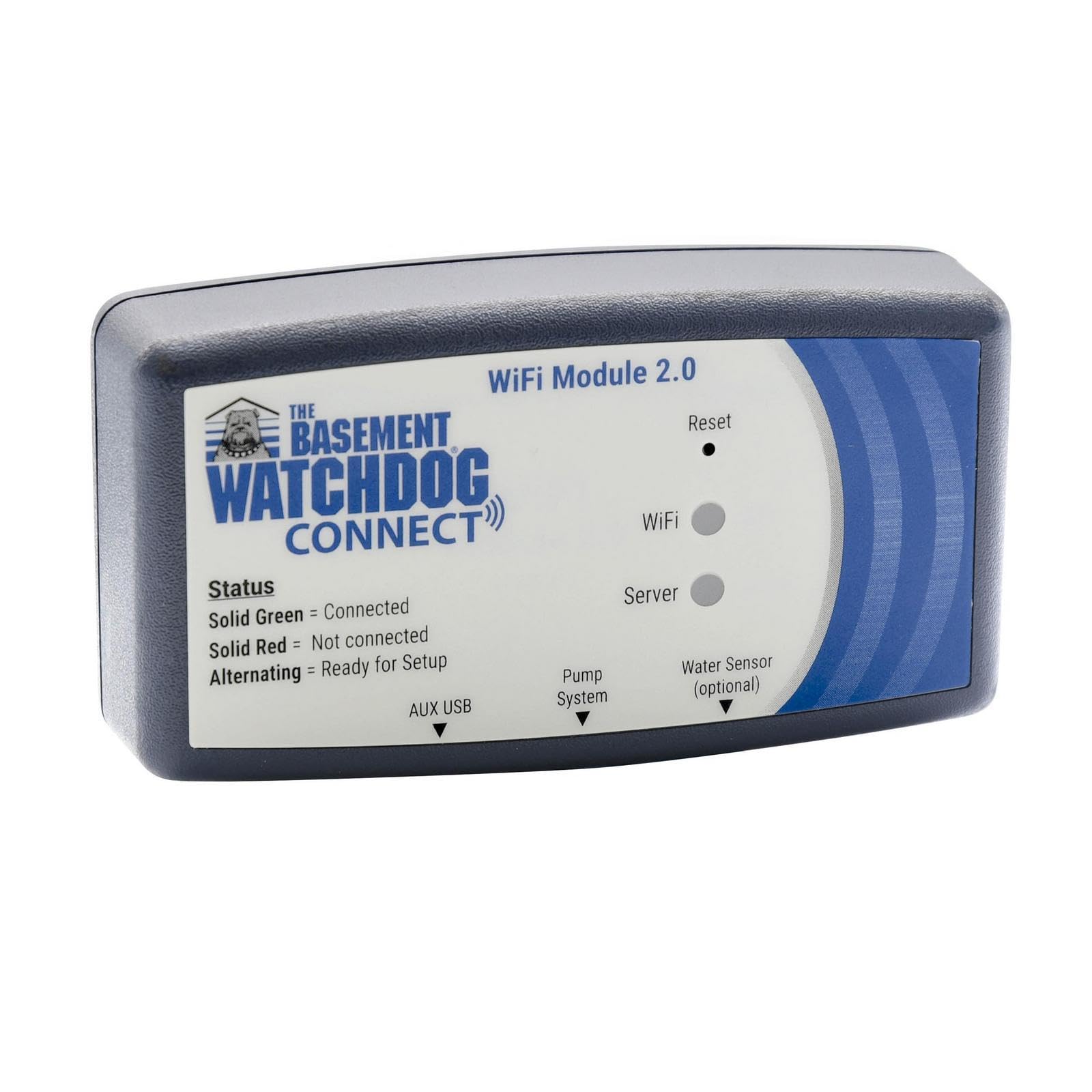
Buy this only for one reason: you already own a Basement Watchdog battery backup or combo system. It plugs into one of three compatible units (Big Dog, Special, or Big Combo) through its data port. From there it reports your backup pump status by email, text, or push notification while you are away, with no monthly or yearly fee.
The free Basement Watchdog Connect app is where you see that status, and you can layer on optional accessories — a 360 water sensor and a high-water add-on — for more ways to keep the basement dry. The body is aluminum, it weighs 4 ounces, and it draws on battery power rather than a wall outlet. Setup follows a Quick Start Guide to get it onto your home Wi-Fi.
This is the most honest “fit note” in the article, because the numbers are split. Setup draws praise and so does its value as an addition to an existing pump setup. But the operational side is genuinely mixed, and the Wi-Fi connection is the sore point — it can stop reconnecting. The value conversation is the weakest part of the story, with a chunk of buyers feeling it asks a lot for an add-on. If you do not already run a Watchdog system, this device has nothing to monitor.
Clear fit: a Watchdog owner who wants phone alerts from a system they already trust.
Clear miss: anyone without a compatible Big Dog, Special, or Big Combo base — there is no standalone sensor here.
The right buyer: a Basement Watchdog owner who wants remote status and no subscription.
The wrong buyer: anyone hoping to monitor a generic pump — this is a system-specific bridge.
6. Basement Watchdog Sump Pump WiFi Module (BW-WIFI)

The earlier Watchdog bridge — same idea as the 2.0, with two ways to wire it in.
This is the original Watchdog connectivity module, and it will suit an older battery backup system that predates the 2.0 version. It sends email, text, or app notifications about your backup pump status while you are away, and it connects over your home Wi-Fi with no monthly or yearly subscription fees. It gives you a choice of two hookups — the dry remote terminal contacts or the USB data port — which helps if your system uses one style and not the other.
Unlike the standalone float sensors here, this is purely a bridge for a Basement Watchdog backup pump. It has no water-level float of its own, so it reports what the pump system tells it. If you are pairing it with an older Big Dog or similar unit, confirm the connection method matches before ordering. It has been on the market since June 2017, which makes it the oldest module in this roundup.
Two specs matter for placement: it runs on battery power and it measures 2.5 x 7 x 8.25 inches, so plan a spot with room for the box. The 2.0 module above is the newer buy for most people; this one is for matching an existing system rather than upgrading past it. If you are unsure which your pump needs, the model number on your existing unit is the fastest way to decide.
Who it serves: owners of older Watchdog backups who need the matching module and no subscription.
Before you order: check your existing unit’s terminal style and give the module room for its 8.25-inch height.
Pick this when: your older Watchdog system needs the original bridge and you want subscription-free alerts.
Consider the 2.0 instead if: you are building a new setup and want the current model.
7. PumpSpy WiFi Sump Pump Smart Outlet 2.0

A smart outlet that reads the pump’s current draw and reports it from anywhere with internet.
This one plugs your sump pump into a 120 VAC outlet and measures what the pump is doing. It watches current draw and runtime, and flags excessive draw or a stuck float as signs of a blockage. It also ships with a high-water sensor and bracket, so you get a level warning alongside the electrical tracking. The PumpSpy app is available on iOS and Android, and a remote monitoring service watches the pump around the clock.
Where it differs from the PumpFuse at the top is the service layer: PumpSpy’s computers monitor your pump on a proprietary platform, and you can pull up cycle history, water level, power, and Wi-Fi status in the app. Alerts fire on malfunction, long runtime, high current, high water, power outage, and even a lost Wi-Fi connection. Assembly uses domestic and imported parts.
Installation is the bright spot, and pump monitoring draws approval, but reliability and quality come in mixed and Wi-Fi is the roughest area of the picture. A meaningful share of owners hit frequent disconnections and random signal loss, so a solid 2.4 GHz signal at the outlet is not optional here. It is a capable idea for outlet-level tracking — just approach the network side with eyes open.
What the outlet buys you
- Measures current draw and runtime to catch blockages
- High-water sensor and bracket included
- Alerts on power outage and Wi-Fi loss, not just water
- 24/7 remote monitoring service behind the app
Where it asks patience
- Wi-Fi disconnections are the frequent complaint
- Reliability verdicts come in mixed across owners
- Needs a dependable 2.4 GHz network at the outlet
Suits you if: you want outlet-level pump history plus a monitored service and can guarantee strong Wi-Fi.
Hold off if: your basement network is already unreliable — this is not the device to battle it with.
8. Level Sense Pro Wi-Fi Enabled Sump Pump Alarm

Watches more than the water — level, temperature, humidity, leaks, and power in one wall unit.
If you want the widest net of sensors from a single device, this is the pick. It monitors water level with a float switch, plus temperature, humidity, leak detection, and power outage. The thinking is sound: a frozen pipe or a leaky wall can wreck a basement just as thoroughly as a dead pump, and cloud check-in monitoring means you hear about it. An auto-recharging internal backup battery keeps it reporting when the outlet drops.
The on-board alarm is rated at 100 db, loud enough to carry through a floor, and a free basic portal shows current conditions and tank levels from any tablet, phone, or computer. It is made in the USA with support out of St. Louis, MO, and carries a 2 Year warranty. The unit measures 5″L x 1.2″W x 5″H and weighs 1.2 pounds.
Reliability is the most-praised trait and functionality sits next, which is why it earns a full-sensor recommendation despite a bumpy connection story. The catch is Wi-Fi: staying connected is a genuine struggle for a portion of owners, and notifications divide opinion between timely and missing. At the premium end of this roundup, it asks you to accept some setup patience in exchange for the broadest monitoring of the bunch.
The case for the sensor suite: one device covers water, temperature, humidity, leaks, and power, with a 100 db local alarm and battery backup.
The case against rushing: Wi-Fi stability and missed notifications are the recurring friction points — test the connection thoroughly before you rely on it.
Go here for: a finished basement where you want freeze, leak, and pump coverage from one unit.
Weigh the risk if: your network at the pit is weak — the sensor suite is only as good as its connection.
9. Moen Smart Sump Pump Monitor S2000ESUSA

Built to slot into a Moen smart water home, with a separate leak disc for the floor.
This is the monitor for someone already inside the Moen Smart Water ecosystem. It reports to the Moen Smart Water App and can reach you by text, email, or phone call — or sound an audible alert. You get exact water-level data to spot potential and actual pump failure, plus excessive pump running, loss of power, Wi-Fi status, temperature, humidity, and leak detection. A Remote Leak Sensing Disc is included to catch water on the ground near the pump.
A neat extra: it can test your battery backup system (if you have one) so you know it is ready. The box includes a 9V backup battery, the leak sensing disc, the monitor, and a water level sensor. Installation is the most-praised part of this device, and the detailed operational data draws approval too. That data focus is what makes the best smart sump pump monitor pitch convincing on paper.
Then the honest part. Reliability, quality, accuracy, and the alarm accuracy all come back mixed, and wireless connectivity is the roughest area — frequent disconnects and a hard Wi-Fi onboarding are the recurring themes. Value is the weakest verdict of the whole list. For a Moen smart-home owner who wants one app for everything, the integration is real; for everyone else, the connection and alarm consistency are the questions to answer before committing.
Its real strength: detailed pump data plus an included floor leak disc and 24/7 alerting through the Moen app.
Its real question mark: connectivity stability and false alarms are the recurring friction — a strong signal and a careful setup reduce the risk.
Made for you if: you already run Moen smart water gear and want sump monitoring in the same app.
Less compelling if: you are starting fresh and want the most dependable stand-alone connection.
Know the Specs
No-Sensor vs. Float Sensor
A no-sensor monitor watches the pump’s power draw and runtime instead of the water. It can flag a pump that runs too long or draws too much current, and it installs without opening the pit. A float sensor sits in the water and trips when the level reaches a height you set — closer to the flood you actually fear. Some picks use one, some use the other, and a few combine both.
Power Source and Outages
A battery-powered unit keeps alerting during a power cut, which is often when a pump fails. A plug-in AC unit depends on the outlet staying live. Some models add an internal backup battery that recharges itself. If storms regularly knock out your power, weigh the power source as heavily as the alert features.
2.4 GHz Wi-Fi Connectivity
This band reaches farther through basement walls, but it is crowded and can be weak at the pit. Dropped connections are the most common complaint in this category across most brands. Check the signal at the outlet or bracket with a phone before you commit, and plan for the occasional reconnect.
Subscriptions and Cloud Service
Many of these picks charge no monthly or yearly fee. A few include a free basic portal, and one offers an optional remote monitoring service. Read which alerts are included and which depend on a service tier before you buy, so you know what you are actually signing up for.
Common Questions
Do I need a sensor in the pit, or does a plug-in monitor work?
Will a smart sump pump monitor still alert me during a power outage?
Why do so many of these monitors struggle with Wi-Fi?
Can the Basement Watchdog module monitor any sump pump?
Is a subscription required to get alerts?
Can a monitor warn me about more than water level?
How long does a monitor last, and what about batteries?
Do I need to open the sump pit lid to install one?
Can one app watch pumps at more than one property?
The Bottom Line
If you want the smoothest install and real pump-health data without ever opening the pit, the PumpFuse WiFi Sump Pump Monitor & Protector is the one to buy. It auto-calibrates, tracks runtime, gallons, and cost, and adds auto-shutoff that protects the pump rather than just reporting on it — a genuine edge over the float-only MySpool, which can only tell you the water rose. For outage-prone homes, the battery-powered MySpool WiFi Water Level Sensor is the smarter backup because it keeps alerting when the power does not. And if you already own a Basement Watchdog system, the Wi-Fi Module 2.0 brings your backup into the app with no subscription. Whichever you choose, spend ten minutes testing the signal at the pit — it is the one thing these monitors all depend on.
How we choose
We do not accept paid placement. Every pick is matched to a real buyer and a real use-case; we do not hands-on test units.
Sources
Specifications: manufacturer listings and product documentation. Review insights: verified customer reviews, as of November 2026. Pricing: not shown on this page (it changes often); check the current price via the retailer link.
As an Amazon Associate, Tactical Gear Guy earns from qualifying purchases. This does not affect which products we feature.