Specs are compiled from manufacturer listings and verified buyer reviews and can change over time — please confirm the key details on the product page before buying.
If your outdoor lights flicker, die early, or switch on at the wrong hour, the transformer is usually the reason, not the fixtures. This guide separates the transformers that hold a schedule from the ones that drop off your Wi-Fi. You will know exactly which unit matches your wattage, your zones, and your phone.
This guide is built by comparing the manufacturers’ published specifications and the patterns across verified customer reviews, so you get each pick’s real strengths and trade-offs instead of marketing spin.
Start with your wattage total and your zone count, because those two numbers decide which of these units will actually run your yard without tripping.
Below you will find the practical, honest picks for the smart landscape lighting transformer that fits your yard and your phone.
Top Picks


How To Choose The Best Smart Landscape Lighting Transformer
The mistake most people make is buying a transformer that matches their current light count instead of the load they plan to add. A transformer rated at 300W running 240W of lights is working, but a transformer rated at 200W running 160W of lights has almost no headroom. Size the box so your connected load sits comfortably under the rating, and leave room for one more run of path lights later.
Watts: The Number That Decides Everything
Every fixture on your run draws wattage, and the transformer has to supply the total. Add up every bulb: a 300W unit handles a large yard with several runs, while a 200W unit suits a compact front bed and a walkway. Two of these picks publish an explicit ceiling below their rating — the SURAIELEC 300W units ask you not to exceed 240W connected, and the 200W two-zone model recommends staying at or under 160W. That is normal engineering headroom, not a defect, so plan your fixture count around it.
Zones: How Many Switches Do You Actually Need
A zone is a group of lights you switch together. Two zones let you light the front path while the backyard stays dark; three zones let you separate a deck, a driveway, and a garden bed. More zones mean more independent schedules, which is useful if you want accent lights on a shorter window than your safety lighting.
Control: App, Voice, and the Hub Question
Some transformers tie into the Smart Life app over 2.4GHz Wi-Fi, and some work with Alexa and Google Assistant for voice commands. Watch the hub requirement closely — the Philips Hue unit needs a Hue Bridge to open up app control, while the SURAIELEC and DEWENWILS units connect straight to your network with no extra hub. Also note that 2.4GHz is the band these boxes use, and that band travels further through brick and siding than 5GHz does.
Side-by-Side Comparison
| Model | Best For | Wattage | Zones | Enclosure | Amazon |
|---|---|---|---|---|---|
| Philips Hue Outdoor 100W Power Supply★ Best Overall | Hue-only yards already on a Bridge | 100 W | — | IP44 plastic | Amazon |
| SURAIELEC 200W Smart Wi-Fi TransformerBest Value | Small yards on a tight plan | 200 W | 2 | NEMA 3R lockable | Amazon |
| SURAIELEC 300W Wi-Fi Transformer | Big beds with two switchable runs | 300 W | 2 | NEMA 3R lockable | Amazon |
| SURAIELEC Wi-Fi Transformer, 2 Zones | Front-and-back yard separation | 200 W | 2 | Flame-retardant PC | Amazon |
| SURAIELEC Stainless Steel Wi-Fi Transformer | Coastal and harsh-weather yards | 300 W | 2 | Stainless steel | Amazon |
| DEWENWILS 300W WiFi Transformer, 3 Zones | Three separate lighting systems | 300 W | 3 | Metal casing | Amazon |
| DEWENWILS 200W Smart Transformer | App-managed automation routines | 200 W | 3 | All-metal | Amazon |
Detailed Reviews
1. Philips Hue Outdoor 100W Power Supply Black
Our pick — 4.5+★ from 650+ verified ratings; the strongest balance of quality and price.
The box that makes your whole Hue outdoor run behave like one system.
It earns the top slot on reliability: a 4.5+ star record across 600+ owners, on a box you bury once and never want to touch again. A 4.5+ star record across 600+ owners backs that up. This is a 100W outdoor power supply that feeds multiple Hue low-voltage fixtures up to a total of 100W, so one box carries the front door, the sidewalk, and the driveway plantings together.
At 2.6 pounds it is a genuinely compact piece of hardware, which matters when you are holding it overhead on a ladder to hit the mounting plate. It puts out 0.95 A and steps 120V household current down to low voltage for the fixtures. The weatherproofing is rated IP44, meaning it is protected against splashing water from any direction — fine for a covered patio wall, not something you sink into a planter.
The catch is the ecosystem lock: this box needs a Hue Bridge to give you app control and automations, and the Bridge is a separate purchase. If your yard is all Hue already, that is the point — one app, one schedule, one scene for the whole property. If you have generic path lights from another brand, this is not your transformer.
What earns it top spot
- Feeds multiple Hue low-voltage fixtures up to 100W total from one supply
- IP44 rating handles rain and splash on a wall mount
- 2.6 pounds — light enough to hang one-handed
- Matter compatible, so it talks to other smart-home platforms
Where it asks something of you
- Requires a Hue Bridge before app control or automations work at all
- 100W ceiling means you add fixtures thoughtfully, not freely
- The premium side of the price ladder for a single supply
The right buy if: your outdoor fixtures are Hue low-voltage lights and you already run a Bridge.
Think again if: you need to power generic 12V path lights or want three or more switchable zones.
2. SURAIELEC 200W Smart Wi-Fi Transformer
Two zones, no hub, and a metered 1.65 A draw for a modest yard.
For a yard with a front bed and a back path, this is the sensible entry into app-controlled lighting. It runs two independently scheduled zones off the Smart Life app, works with Alexa and Google Assistant, and needs no extra hub to get there. The 200W rating converts 120V down to 12V AC or 15V AC, and the built-in circuit breaker trips on an overload before your wiring takes the hit. That 1.65 A current rating compares with 0.95 A on the Philips Hue supply.
Setup is what draws the most praise in owner feedback — the transformer pairs to the app and the schedules fall into place. What you should know before buying is that the Wi-Fi link is the weak link for some units: connections that drop and hardware that quits early come up in the reviews more than once. Treat the 2.4GHz signal path seriously and mount it where your router actually reaches, not behind a metal shed.
The honest read: a budget two-zone box with real app features and a mixed long-term reliability record. If your yard is small and you want app control without a premium spend, it earns a look. If you want the highest confidence in five years, step up to the 300W SURAIELEC, which has a better track record across more owners.
Zone flexibility: two independent schedules from one box means your front walkway lights can run a different window than the backyard — useful when you want safety lighting to outlast accent lighting.
Fair warning on the connection: the 2.4G Wi-Fi dependency is the recurring complaint; a strong signal at the mounting spot is the difference between a smooth install and a frustrating one.
Reach for this if: you have a two-zone yard, no hub, and a budget to respect.
Look elsewhere if: your mounting wall is far from the router or you want the longest service life.
3. SURAIELEC 300W Wi-Fi Transformer

The 300W workhorse that carries a full bed without blinking.
Headroom is the whole story with this one. It is rated at 300W versus the Philips Hue supply’s 100W, but SURAIELEC tells you plainly not to exceed a 240W connected load. That 240W ceiling is your real number when you count bulbs, and it is a generous one for a yard with several runs of path lights and uplights.
The box itself measures 3.3″D x 6.1″W x 11.6″H, so check your wall space before you drill. Two zones get separate schedules through the Smart Life app, and it remembers those settings through a power outage. Installation is the aspect owners praise most here, and the setup steps really are the easy part.
Where it asks patience is the wireless and app side — connectivity and app behavior land in mixed territory, and reliability gets the same treatment from the crowd. It is not a reason to walk away from a 4.0+ star box with a large following, but it is a reason to mount it where the 2.4GHz signal is strong and to keep the firmware current. Pair it with the app and you can set sunrise and sunset triggers so the lights follow the seasons without you touching a thing.
Why it holds a top slot
- 300W rating with a stated 240W connected-load ceiling — real headroom
- Two zones with independent sunrise/sunset scheduling
- NEMA 3R lockable enclosure and built-in circuit breaker
- ETL listed and mounted on a standard wall plate
What to watch
- Wi-Fi and app behavior is mixed — signal placement matters
- Standby reliability draws the same mixed read from owners
- Taller 11.6″H body needs clearance on the wall
Best for: a substantial yard with two switchable lighting zones and room for expansion.
Skip if: your router cannot reach the mounting wall or you need three separate zones.
4. SURAIELEC Wi-Fi Transformer 2 Zones
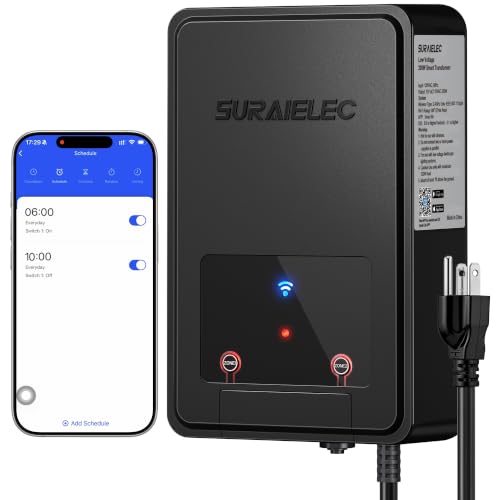
Magnetic cover, snap terminals, and schedule modes for people who hate wiring.
If the wiring is the part of this job you dread, this is the box built for you. The cover is magnetic and the terminals are quick-snap, so you are not fighting tiny screws with cold fingers in November. It runs at 200W and SURAIELEC recommends a load up to 160W (80% capacity) for stable performance — a ceiling note before you buy a fifth fixture.
This one carries more scheduling variety than its stablemates. You get schedule, astronomical, random, circular, and countdown modes, each assignable per zone. That means your front path can follow sunset while a back deck runs a countdown when you are out there. Two zones run independently through the Smart Life app over 2.4GHz Wi-Fi, with Alexa and Google Assistant for voice, and no hub in the chain.
At 9 pounds it is the heaviest box in this lineup, so plan on two hands and a solid mounting point. It measures 3.2″D x 5.7″W x 9.1″H, which keeps the footprint modest for its guts. The flame-retardant PC housing and automatic overload cutoff round out the safety package. Owners consistently report that the install and setup go smoothly, which lines up with the snap-terminal design.
Mode menu wins here: five scheduling modes per zone is more flexibility than most yards need, and the astronomical option handles the seasonal drift for you.
Weight reality: 9 pounds is a two-hand lift onto the wall — a wall anchor job, not a hook job.
Pick this one if: easy wiring and flexible scheduling matter more to you than maximum wattage.
Look past it if: you plan a heavy fixture count or need more than two zones.
5. SURAIELEC Wi-Fi Transformer Stainless Steel

Stainless steel for salt air, coastal wind, and years of weather.
Most landscape transformers hide a plastic box behind a shrub. This one wears stainless steel, and that rust-resistant shell is the reason it sits in the premium tier. Near the coast or in hard-winter climates, the stainless housing is the difference between a box that looks new after five years and one that looks tired.
The guts are serious too. It is a 300W unit that steps 120V down to 12V or 15V AC, with a toroidal core — a donut-shaped transformer coil that runs quieter and cooler than a standard stacked core — and built-in circuit protection against overload and overheating. The published ceiling is 240W connected, so count your fixtures against that, not the 300W badge. Two zones schedule independently, and the astronomical timer shifts the on/off times with the sunrise and sunset across the year.
It runs the Smart Life app over 2.4GHz Wi-Fi with Alexa and Google Assistant support, no hub needed. What wins people over in the feedback is reliability, with quality close behind — and the dusk-to-dawn scheduling earns specific praise. The mixed part is installation: some find it quick, some run into snags. It is ETL listed and built for indoor or outdoor mounting, and it draws 2.5 A.
The case for the metal shell
- Rust-resistant stainless steel for harsh and coastal conditions
- 300W rated with a 240W connected-load ceiling
- Toroidal core with overload and overheat protection
- Astronomical timer that tracks sunrise and sunset
The honest trade-offs
- Premium spend for the housing upgrade
- Installation feedback splits between easy and tricky
- Two zones, not three
Worth it for: coastal, windy, or heavy-snow yards where the enclosure takes a beating.
Not necessary if: your box hangs under a covered porch and never sees direct weather.
6. DEWENWILS 300W WiFi Smart Transformer

Three zones and 300W for a property with more than one lighting story to tell.
A three-zone box is a different tool from a two-zone one. Here you get three independent outputs, each selected by pressing the Zone button and each settable to 12V or 14V AC. That means a deck, a driveway, and a garden bed can run on three separate schedules from one 300W unit. It converts 120V household electricity down to that low 12/14V output for yard lights, pathway lights, and garden lights.
Wiring is the friendliest part: upgraded push-in wire terminals mean no screwdriver gymnastics at the terminal block. Setup pairs through the app by pressing the “+” button, and you get five timer modes — Schedule, Circulate, Random, Countdown, and Astronomical — so you can shape each zone’s on-time to its purpose. It connects over 2.4GHz Wi-Fi to the dewenwils app with no hub, and works with Alexa and Google Assistant for voice commands.
The metal casing handles rain, snow, dust, and wear, and buyers report it still running after a year of seasonal use — the strongest reliability signal in this lineup. The caveat is app connectivity, which draws mixed feedback: some connections are smooth, some are not. Treat the 2.4GHz network quality at the mounting location as part of the job.
The three-zone advantage: separate 12V and 14V selection per zone lets you compensate for long cable runs on the far side of the yard without buying a second transformer.
What to plan for: app connectivity is the recurring weak spot; a strong 2.4GHz signal where the box hangs solves most of it.
Your box if: you have three distinct lighting systems and want each on its own schedule.
Overkill if: your yard is one continuous run with a single switch point.
7. DEWENWILS Smart Transformer 200W

Three channels, a wattage readout in the app, and a dusk-to-dawn brain.
What makes this one worth a look is the app-side intelligence. The DEWENWILS app shows you the wattage the lighting system is drawing, so you can see exactly how close you are to the 200W ceiling before you overload anything. It uses an astronomical photocell schedule, which follows the actual sunset and sunrise times, and you can build dusk-to-dawn routines or any combination of timer and clock settings from your phone.
Three channel outputs are selectable per zone at 12V AC or 14V AC, so you can run three separate landscape systems — yard lights, walkway lights, and a deck run — from one box. It connects over Wi-Fi and Bluetooth to any 2.4GHz Android or iOS device with no hub, and hands off to Alexa or Google for voice. It is ETL certified and meets a DOE VI efficiency rating, with over-current and overload protection and very low no-load draw when the lights are off.
At 8.8 pounds in an all-metal housing, it is built for weather and for indoor or outdoor installation. Build quality and reliability draw the strongest feedback — owners use the phrase commercial-grade — and setup lands well too. Connectivity is the one area that splits: some units pair cleanly, some do not. Keep the phone close at install, put the box near your router’s reach, and this one is a strong pick for a three-system yard on a 200W budget.
What makes it smart
- In-app wattage readout keeps you under the 200W ceiling
- Three outputs selectable at 12V or 14V AC
- Astronomical photocell for true dusk-to-dawn timing
- ETL certified with DOE VI efficiency and overload protection
What to plan around
- Connectivity splits between easy and stubborn
- 200W rating caps a larger fixture count
- Heavier all-metal body at 8.8 pounds
Made for: a yard you want to automate heavily, with three systems and an app-based schedule.
Not the pick if: you have more than 200W of fixtures or want the simplest possible setup.
Know the Specs
Wattage and Connected Load
A transformer’s wattage rating is the ceiling it can supply. The published connected-load ceiling matters just as much: the 300W SURAIELEC models ask for no more than 240W connected, and the 200W two-zone SURAIELEC recommends 160W. Add up every fixture’s watts and stay under that ceiling with room to spare, so the box is not working flat out all night.
Voltage Step-Down and Taps
These boxes take 120V household current and drop it to a low 12V or 15V AC for the lights. Some units offer a 14V tap, which helps compensate for voltage drop on a long cable run to the far side of the yard. That is why a selectable tap matters more the wider your property spreads.
Zones and Scheduling Modes
A zone is a set of lights you schedule together. Two zones split front from back; three zones let you separate a deck, a driveway, and a path. Schedule modes include astronomical (follows the real sunrise and sunset), countdown, random, and circulate — useful if you want lived-in lights when you travel.
Enclosures and Wi-Fi
NEMA 3R and IP44 both describe weather resistance, but NEMA 3R is a heavier-duty outdoor rating than IP44’s splash protection. And every one of these boxes talks on 2.4GHz Wi-Fi, which carries further through walls and siding than 5GHz. Mount it where your router reaches, and the app control actually stays reliable.
Common Questions
Do I need a smart hub to run these landscape transformers?
Can I run more lights than the wattage rating says?
Will a two-zone transformer work if I have three separate lighting runs?
What does an astronomical timer do that a normal timer does not?
Why do so many of these transformers have Wi-Fi connection issues?
What is the difference between 12V and 14V or 15V output taps?
Can I install a landscape transformer indoors?
Do these transformers work with Alexa and Google Assistant?
Will the settings survive a power outage?
How much headroom should I leave for future fixtures?
The Bottom Line
For most people the right pick is the SURAIELEC 300W Wi-Fi Low Voltage Landscape Transformer, because it pairs real 240W of usable headroom with two independently scheduled zones and a NEMA 3R lockable enclosure. If your outdoor fixtures are Hue lights and you already run a Bridge, the Philips Hue Outdoor 100W Power Supply keeps everything in one app with the lightest, most compact build here. And if three separate lighting systems need their own schedules, the DEWENWILS 300W WiFi Transformer with 3 Zones is the one to reach for — its three-zone flexibility and push-in terminals make it the easiest big-yard install in this lineup. Whichever you choose, size the box above your fixture total and mount it where your 2.4GHz signal reaches; those two moves separate a smooth install from a frustrating one.
How we choose
We do not accept paid placement. Every pick is matched to a real buyer and a real use-case; we do not hands-on test units.
Sources
Specifications: manufacturer listings and product documentation. Review insights: verified customer reviews, as of November 2026. Pricing: not shown on this page (it changes often); check the current price via the retailer link.
As an Amazon Associate, Tactical Gear Guy earns from qualifying purchases. This does not affect which products we feature.