Specs are compiled from manufacturer listings and verified buyer reviews and can change over time — please confirm the key details on the product page before buying.
If your lawn is being watered by a dial-and-button timer from the garage wall, you are probably watering in the rain at least a few times a year. A smart controller fixes that by pulling your local forecast and skipping a cycle on its own. The nine picks below cover every budget tier and zone count, and the Rachio 3 leads the pack because it does the weather-skip job reliably and installs in about half an hour.
This guide is built by comparing the manufacturers’ published specifications and the patterns across verified customer reviews, so you get each pick’s real strengths and trade-offs instead of marketing spin.
You will see which controllers run eight zones and which run sixteen, what the app actually does on a rainy Tuesday, and where each unit tends to fall short. By the end you will know exactly which smart irrigation controller fits your yard, your wiring, and your phone.
Top Picks


How To Choose The Best Smart Irrigation Controller
The first thing to count is your zones — the number of separate watering areas your current system runs. A controller with too few zones leaves part of your yard dry. Too many zones just means unused terminals, which costs nothing but adds bulk to the box.
Match the zone count to your yard, not the brochure
Most suburban homes run four to eight zones. If you have a front lawn, a back lawn, a flower bed, a shrub row, and a drip line for vegetables, you are already at five. Buy an eight-zone unit and you have headroom for a future garden bed. Buy a sixteen-zone unit only if you have a large property or plan to expand.
Understand weather skipping before you pay for it
Weather skipping means the controller checks your local forecast and pauses a scheduled watering when rain is coming. Some units go further and use evapotranspiration — a calculation of how much water your lawn loses to sun, heat, and wind — to fine-tune run times. That is the feature that actually trims a water bill over a full season.
Check your Wi-Fi before you check the feature list
A controller in a garage or a shed is often at the edge of your home network. Several units in this list struggle with weak signal, and a few solve it with a wired Ethernet port. If your router is far from the controller, plan for that before you buy.
Decide if you need indoor or outdoor mounting
Most controllers are built for indoor mounting on a garage or utility wall. An outdoor-rated model can go on an exterior wall, but check the operating temperature range if you live somewhere with hard freezes. Some units list a low-end rating well below freezing and some do not list one at all.
Side-by-Side Comparison
| Model | Best For | Zones | Mounting | Weight | Amazon |
|---|---|---|---|---|---|
| Rachio 3 8-Zone★ Best Overall | Most yards, best all-rounder | 8 | Indoor | 16 ounces | Amazon |
| Rain Bird ARC6Budget Entry | Small yards on a tight budget | 6 | Indoor | 2.5 pounds | Amazon |
| Netro Spark 8 ZoneTouch Panel Pick | Touchscreen control at the panel | 8 | Indoor | 1.08 kg | Amazon |
| Rain Bird ARC8 | Indoor or outdoor mounting | 8 | Indoor/Outdoor | 3.6 pounds | Amazon |
| ImoLaza 8 Zone ET Master | Water savings without subscriptions | 8 | Indoor (case sold separately for outdoor) | 12.16 ounces | Amazon |
| ImoLaza Outdoor Ultra | Light commercial and weatherproof installs | 8 | Outdoor | 3.2 pounds | Amazon |
| Orbit B-hyve XR | Big yards with many zones | 16 | Indoor/Outdoor | 3 pounds | Amazon |
| Yardian Pro 8-Zone | Apple HomeKit and wired Ethernet | 8 | Indoor (IP56 enclosure sold separately) | 16 ounces | Amazon |
Detailed Reviews
1. Rachio 3 8-Zone
Our pick — 4.5+★ from 8,000+ verified ratings; the strongest balance of quality and price.
The controller that turns a dumb sprinkler dial into a forecast-reading phone app in about thirty minutes.
Rachio built its name on Weather Intelligence — a feature that reads local rain, wind, and freeze data and skips a watering cycle before it happens. That skip is what pays you back season after season, since it stops you watering a lawn a storm is about to soak. Setup takes 30 minutes or less according to the maker, and the unit is listed as compatible with 99% of existing sprinkler systems. For most homes with eight zones or fewer, this is the controller to beat.
The wiring swap is where it wins people over. Swap your old Hunter or similar timer out, match the wires, and the app walks you through naming zones and setting a schedule. Adaptive scheduling then adjusts run times as the seasons shift, so an April schedule is not the same as a July one. You can run a single zone, check an estimated usage figure, or pause everything from the phone while standing in the yard.
Here is the honest catch. Wi-Fi is where this unit splits buyers — some pair instantly and never drop, while others fight reconnection across routers and phones. If your controller lives deep in a garage behind a metal door, plan for a mesh node or an extender near it. The other trade-off is a frozen operating temperature rating of 4 °F, which is fine for most garages but worth knowing if your utility closet is unheated in a hard-freeze climate.
What earns it the top slot
- Weather Intelligence skips watering on rain, wind, and freeze automatically
- Fast DIY wiring swap — the maker rates it compatible with 99% of existing systems
- Full app control of every zone, schedule, and estimated usage figure
- Adaptive scheduling that reshapes run times as the weather changes
What to plan around
- Wi-Fi pairing is the recurring trouble spot in garages with weak signal
- 4 °F low-end operating rating leaves little margin in an unheated space
- Some units arrive with a power fault that only shows up after the return window
Best fit: the homeowner with eight zones or fewer who wants the weather-skip feature to just work and does not mind a short wiring session.
Think twice: if your router sits far from the controller and you cannot add an extender — the Wi-Fi gripes are real, not imagined.
2. Rain Bird ARC6 6-Station
Six stations of straightforward app-based watering for a yard that does not need a second mortgage.
If your yard tops out at six zones, the ARC6 covers every one of them and skips watering on a postal-code forecast that Rain Bird says can cut water use by up to 30%. Forecast-based skipping at the entry price tier is the whole pitch. At 2.5 pounds it is also 1.1 pounds lighter than the ARC8 in this list, which matters if you are mounting it on drywall.
The app does the usual set of chores — activate a schedule, delay watering, run a zone manually, check the local forecast. It also works with Alexa and Google Assistant, and Rain Bird lists support for Apple iOS 8 or greater and Android 6.0 or later. Wiring is described as simple, and the 6-foot power cord gives you some reach along the wall.
What holds up: the install and the forecast-based skipping are the two things this unit does without fuss, and the price tier reflects that focus. Alexa and Google Assistant voice control round out a clean package.
Where it pinches: there is no direct zone-select button on the app — you scroll through zones to reach the one you want, which gets old on a twelve-zone system but is rarely a problem at six. Wi-Fi also has a stubborn streak for a small share of buyers, so a strong signal at the wall is worth confirming first.
Reach for this if: six zones is all you run and you want forecast skipping without paying mid-range money.
Look elsewhere if: you need to jump straight to a single zone in the app — the scroll-through design will annoy you.
3. Netro Spark 8 Zone
The one that still lets you water by hand at the panel when the phone is in another room.
Most smart controllers strip the panel down to a couple of LEDs. The Netro Spark keeps a real touchscreen on the face — a grass icon for zone selection, a clock icon for run duration, and a kettle icon that fires an immediate manual watering. You can test a sprinkler head at the panel without pulling out your phone.
Behind the screen sits an eight-zone scheduler that lets you name each zone in the app and attach a photo to it, which makes the Front Lawn and the Drip Irrigation zones impossible to confuse. A plant database suggests humidity, light, and temperature settings for what you are growing, and the app keeps up to 60 days of irrigation history with start time and duration logged per session. Weather data comes from a provider Netro partners with, covering precipitation, temperature, humidity, and wind speed.
Know one hard limit before you commit: there is no battery backup, so the unit has to stay plugged in to run. Support is the other soft spot — email is the channel and replies can lag. If you want a phone number to call on a Sunday afternoon, this is not that brand.
The real draw: the touchscreen makes it the rare smart controller you can operate standing at the box, and the named, photo-tagged zones keep a complicated yard readable.
The trade-off: no battery backup means a power cut takes the schedule down with it, and support runs on email only, so a bad unit takes patience to resolve.
Who it suits: gardeners who want to see and touch the schedule at the panel as well as on the phone.
Who should pass: anyone in a storm-prone area who needs the controller to keep running through an outage — the missing battery backup rules it out.
4. Rain Bird ARC8 8-Zone

An eight-zone timer that can live on an exterior wall, with a temperature ceiling of 149 °F.
The ARC8 is the model to pick when the controller has to go outside — along a side wall, on a shed, anywhere an indoor-only unit would not survive. It carries a 149 °F top-end operating temperature, the highest rating on this list, and 149 °F against the Rachio 3’s 4 °F is a genuinely wide spread when you compare the two specs side by side. If your mounting spot bakes in summer sun, that headroom is the deciding detail.
You get the same app experience as the ARC6: eight zones, postal-code weather skipping that Rain Bird rates at up to 30% water savings, Alexa and Google Assistant support, and the same iOS 8 and Android 6.0 compatibility. The housing and size are what change. At 3.6 pounds it is heavier than the ARC6’s 2.5 pounds, so plan a solid anchor if you are screwing it to siding.
Be realistic about connectivity. This unit’s connectivity trouble is the loudest complaint in its history, and the app gets its share of frustration too. Easy install is what it is known for — the wiring swap is quick — but a garage or exterior wall with a weak signal is going to fight you. The EPA WaterSense certification is the one credential note, because it signals the unit is designed to meet water-efficiency criteria.
Why it earns a spot
- Indoor or outdoor housing with a 149 °F top-end operating rating
- EPA WaterSense certified for water efficiency
- Up to 30% water savings from forecast-based skipping per Rain Bird
- Quick wiring swap and full phone control of all eight zones
What will test your patience
- Connectivity is the most-discussed problem with this model
- The app is the other frequent frustration — plan for a learning curve
- 3.6 pounds needs a sturdier mount than its lighter sibling
Choose it for: an exterior wall install where the 149 °F rating and outdoor housing actually matter.
Skip it for: an indoor garage swap where its connectivity quirks buy you nothing over a steadier pick.
5. ImoLaza 8 Zone ET Master
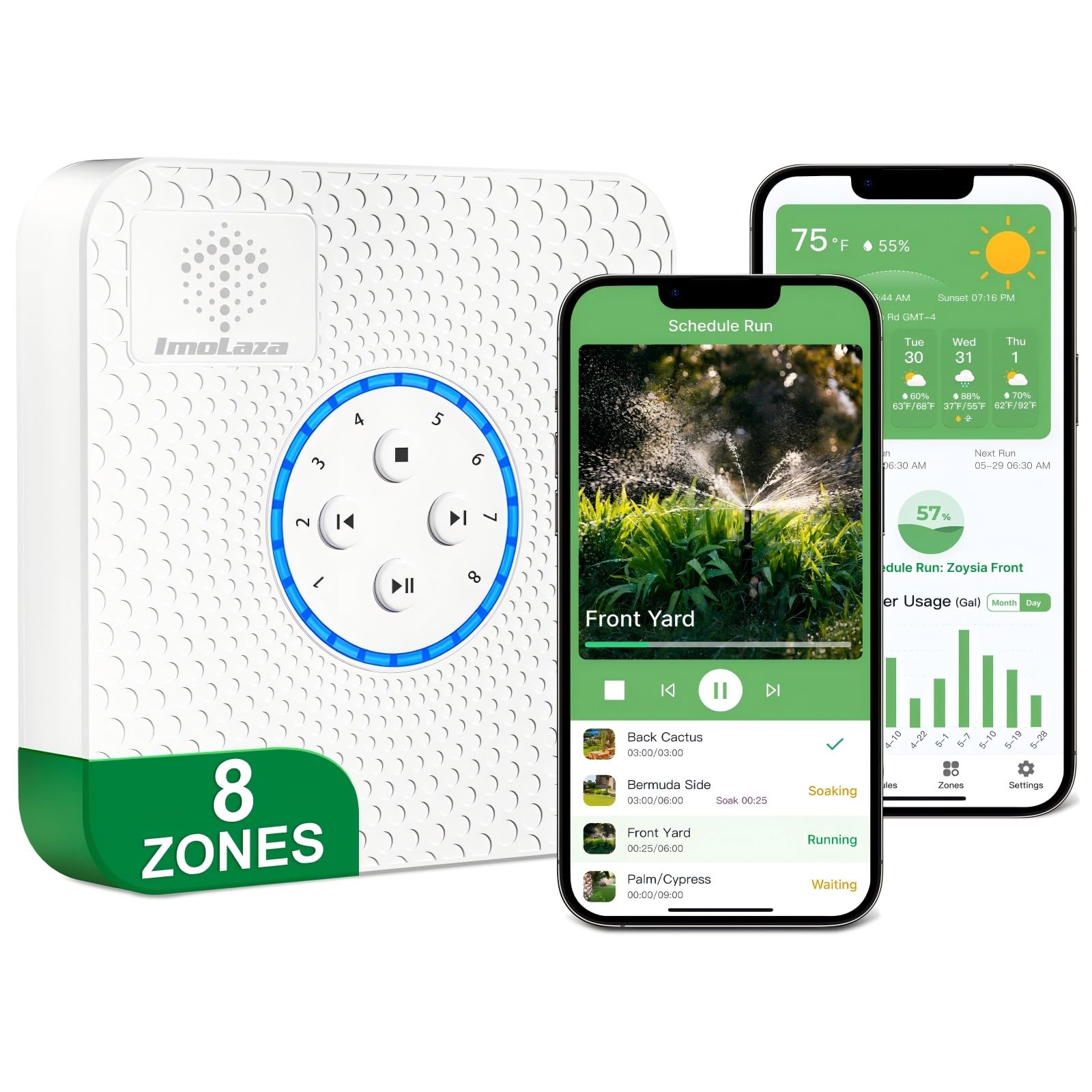
Real-time evapotranspiration and leak alerts without a monthly bill attached.
Evapotranspiration sounds like a biology lecture, but it is simply how much water your lawn loses to sun, heat, and wind on a given day. The ImoLaza ET Master pulls that figure in real time and uses it to decide how long each zone should run. ImoLaza claims that approach can save up to 60% on water, which is the boldest savings number on this list. There are no monthly fees to access the app or its features.
Two other things stand out. The New Grass schedule allows up to 24 start times per day for light, frequent watering — useful for fresh sod or seed — and the controller watches for open or short circuits, offline status, and flow problems through a flow meter, then sends alerts. It keeps working across -13 °F to 140 °F, a wider band than several units here. At 12.16 ounces it is the lightest controller in this comparison.
The nudge you need to hear: the housing is not weatherproof on its own. It goes in a garage or shed, and an outdoor wall install needs a waterproof case sold separately. Connectivity is fine for most but not universal. Also expect a 2.4 GHz network — some older dual-band routers need the band split before the unit will join.
Standout spec: real-time ET watering driving a claimed 60% water-bill savings with zero subscription cost is the strongest value argument in this group.
Add-on you will need: a separate waterproof case if the controller has to live outside, and a clean 2.4 GHz connection at the install spot.
Made for: the homeowner chasing a lower water bill who has a sheltered garage wall and no appetite for monthly fees.
Not for: an exterior install unless you are willing to buy the waterproof case on top.
6. ImoLaza 8-Zone Ultra
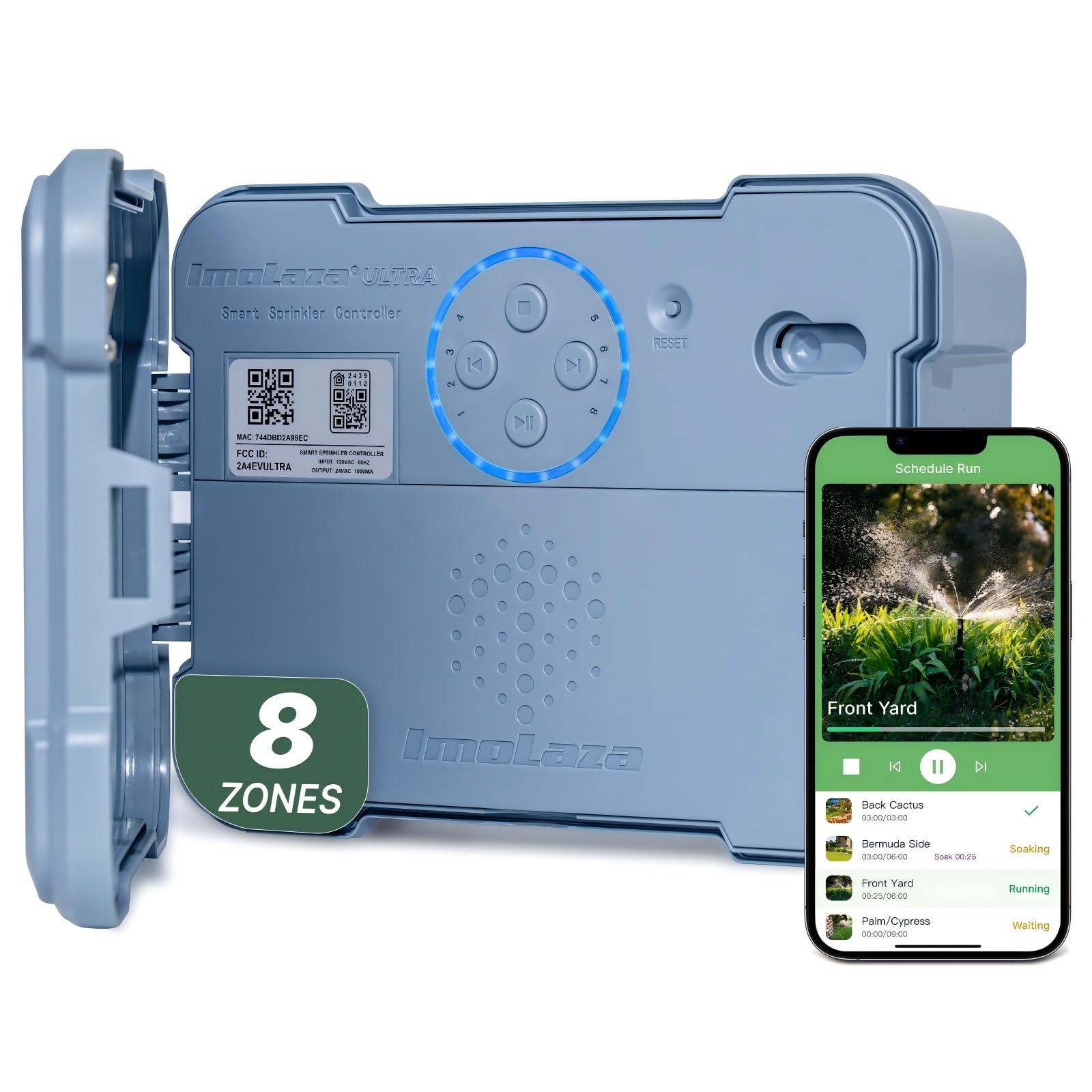
A genuinely weatherproof eight-zone unit built for a wall that takes direct sun and rain.
Where the ET Master needs a case to go outside, the ImoLaza Ultra is designed for it — weatherproof housing, hardwiring capability, and surge protection against lightning and over-voltage. Surge protection matters if you live where lightning strikes are routine. It also keeps a real-time clock running through power and network outages, so your schedule does not lose its place when the grid blinks.
The scheduling is the scientific kind: plant type, soil type, nozzle type, and sun exposure feed into each zone’s run time, then weather data and evapotranspiration adjust the duration and frequency day to day. A saturation skip holds off watering when the soil is already wet. The app is free forever including premium features, and Alexa and Google Assistant are both supported. ImoLaza rates the unit compatible with 99.99% of existing irrigation systems and lists a 15 to 30 minute install.
One caution on the numbers. This model’s customer base is still small, so the long-term track record is thin compared to the eight-thousand-strong crowd behind the Rachio. There is also a support thread of silence in the complaints — a failed connection that never got an answer. If you are the type who wants a big install base to lean on, the more established names are safer.
what separates it: it is built for outdoor mounting with surge protection and a real-time clock, and the premium app features stay free forever.
The measured risk: a small review base means less proven reliability, and support response has been inconsistent for some buyers.
Pitch it against: any indoor-only controller you would have to house in a shed — this one mounts outside and keeps time through an outage.
Weigh carefully: if you want a long, proven service history, the smaller install base here is a genuine unknown.
7. Orbit B-hyve XR 16-Zone
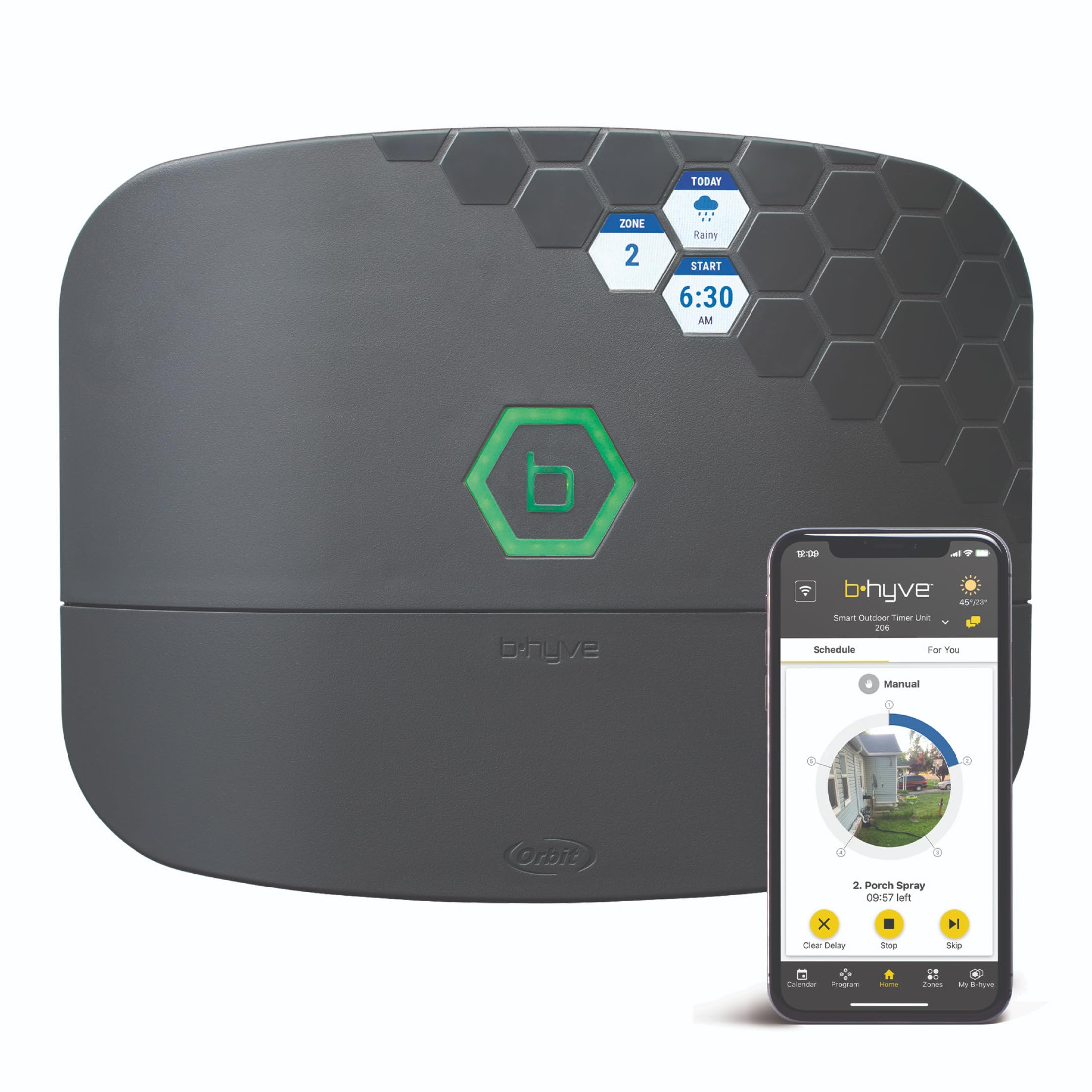
Sixteen zones in one box — double the reach of most picks here — for a property with a lot of separate beds.
Sixteen zones is the headline. Against the Rain Bird ARC6’s six stations, that is a much wider net for anyone running separate beds, a pool surround, and a drip line off one timer. The B-hyve XR also goes indoor or outdoor, weighs 3 pounds, and carries a two-year limited warranty on materials and workmanship for private use. Push-in wire connections replace the old screw terminals, which makes the wiring swap quicker than it used to be on Orbit units.
App control covers scheduling, monitoring, and quick adjustments from anywhere, and the weather-aware scheduling uses forecast data to trim cycles. Alexa is supported. Phone control means you can shut a zone off from the couch when it starts raining.
Plan for a rougher start than the price tier suggests. Reliability and Wi-Fi both land in mixed territory, and the labeling and wiring steps are not well documented — the common advice is to follow a video walkthrough before you start. The software is also not the slickest. None of that stops it from working once it is set up, but it does mean a first install deserves a free afternoon.
The case for it: 16 zones for a large property, indoor or outdoor mounting, and push-in wiring that speeds the swap.
The catch: Wi-Fi and long-term reliability are both hit-and-miss, and documentation is thin enough that a video guide before wiring is worth the time.
Pick it when: your yard genuinely needs more than eight zones and you want the option of mounting outside.
Pass it when: eight zones covers you — the extra terminals buy nothing and the setup is fussier than simpler units.
8. Yardian Pro 8-Zone

The only eight-zone controller here with a native HomeKit tie-in and a wired Ethernet port for a dead-signal garage.
If your garage kills Wi-Fi, this is the answer. The Yardian Pro has a built-in RJ45 Ethernet port so you can run a cable and forget about signal strength entirely — a feature the other eight controllers on this page do not offer. It also carries native Apple HomeKit support alongside Alexa, Google Home, and Home Assistant. For an Apple household that wants the sprinkler in the Home app with Siri voice commands, this is the only pick that does it.
Physical buttons on the face let you run a zone or test a sprinkler without a phone or internet, which is the fail-safe you want during an outage or when a contractor is on site. The ET-based scheduling pulls hyper-local weather data, and Yardian claims up to 50% savings on water bills. Flow sensors — wired or wireless — can be added to watch for leaks, burst pipes, or clogged valves with real-time alerts. A 100V–240V universal power adapter keeps it installable in more places.
The honest limit is outdoor mounting: the housing needs the custom IP56 weatherproof enclosure sold separately if it goes outside. A few units have also failed to earn their keep as an irrigation controller, though the overall picture is positive. If you are indoors anyway and want HomeKit plus Ethernet, this is the one.
The reason to choose it: native HomeKit with Siri and a wired Ethernet port solve two problems no other pick here addresses.
One more thing to budget for: the IP56 outdoor enclosure if the controller lives outside, and confirm flow-sensor compatibility if you want leak alerts.
Built for: Apple households that want sprinklers in the Home app and a garage where Wi-Fi cannot reach.
Look past it if: you are on Android with a strong Wi-Fi spot — the HomeKit and Ethernet premiums go unused.
Know the Specs
Zone Count
A zone is one watering area controlled by its own valve — a front lawn, a flower bed, a drip line. A six-zone controller handles six areas. Going with eight zones when you have five leaves room for a future garden bed. Going with sixteen only makes sense if you have a large property or plan to expand; empty terminals cost nothing but add bulk to the box.
Weather Skipping and ET
Weather skipping means the controller pauses a scheduled watering when rain is in the forecast. Evapotranspiration takes it further — it estimates how much water your lawn loses to sun, heat, and wind each day, then adjusts run times to match. Together they are the two features that actually move a water bill over a full season.
Wi-Fi Versus Wired
Controllers often sit in a garage or shed at the edge of your network, so signal strength decides whether the app works. A wired RJ45 Ethernet port sidesteps the problem entirely where you can run a cable. Without one, a mesh node or extender near the controller is the practical fix.
Operating Temperature
This is the range in which the unit can run. A top end of 149 °F handles a sun-baked exterior wall. A low end of 4 °F covers most garages, though an unheated utility space in a hard-freeze climate is worth checking. Some models list a wide band from -13 °F to 140 °F, which gives more margin in both directions.
Common Questions
Will a smart irrigation controller work with my existing sprinkler valves?
Do I need an extra wire or a neutral wire for the controller?
How long does a smart controller take to install?
What happens to my schedule during a power outage?
Do these controllers need a subscription for weather-based watering?
Why does my controller keep dropping Wi-Fi?
Can I mount a controller outside?
How does weather skipping actually decide to skip a cycle?
What is an RJ45 Ethernet port and why would I want one on a controller?
Can I control the sprinklers with voice commands?
The Bottom Line
For most homes with eight zones or fewer, the best smart irrigation controller is the Rachio 3 — its weather-skip feature does the work automatically, setup takes about half an hour, and the app keeps every zone at your fingertips. If water savings are the priority and you want no subscription in the mix, the ImoLaza ET Master brings real-time evapotranspiration (it adjusts watering to local weather and soil moisture) and a claimed 60% savings figure with zero monthly fees. For an Apple home that needs a wired connection, the Yardian Pro is the only pick with native HomeKit and an Ethernet port, and that combination earns its spot for the right household.
How we choose
We do not accept paid placement. Every pick is matched to a real buyer and a real use-case; we do not hands-on test units.
Sources
Specifications: manufacturer listings and product documentation. Review insights: verified customer reviews, as of November 2026. Pricing: not shown on this page (it changes often); check the current price via the retailer link.
As an Amazon Associate, Tactical Gear Guy earns from qualifying purchases. This does not affect which products we feature.