Specs are compiled from manufacturer listings and verified buyer reviews and can change over time — please confirm the key details on the product page before buying.
If your dog has learned exactly where the old wire fence ends and the neighbor’s driveway begins, a smart fence system gives you a boundary you can move and redraw. The real decision is simpler than the listings make it: pick a GPS system if your property is open and uneven, pick a transmitter-and-collar setup if you want a boundary that doesn’t rely on satellite signal. That choice drives everything else — range, battery, collar weight, and whether you pay every month.
This guide is built by comparing the manufacturers’ published specifications and the patterns across verified customer reviews, so you get each pick’s real strengths and trade-offs instead of marketing spin.
You will see range in feet and acres, battery in hours and standby days, and the difference between a collar that recalls your dog and one that just reminds them. Below is a straight read on the
best smart fence systems, sorted by how they actually hold a boundary.
Top Picks

How To Choose The Best Smart Fence Systems
Two technologies sit inside this category and they fail in opposite ways. A transmitter-based wireless fence broadcasts a radio circle from a box you plug in, so the boundary is rock-steady but stops at the plug. A GPS fence reads satellites from the collar itself, so the boundary travels with you but can drift under heavy canopy or during a storm. Decide which failure you can live with before you compare any spec sheet.
Radius, acres, and the number that actually matters
Listings quote range as a radius from the center point, and a radius grows into area fast — a boundary that sounds modest in feet can cover a serious chunk of land once you square it. Check whether the number is a radius or a diameter, because some systems describe the same circle two different ways. If your yard is long and narrow rather than round, a circular-only boundary will either leave a corner uncovered or push correction into the neighbor’s yard.
Standby days are not the same as running hours
A collar that claims months of standby is describing a sleeping battery, not a working one. With the fence actively broadcasting or the GPS locked on, runtime drops sharply — sometimes to a single day of use. Look for both numbers on the same listing, and plan your charging routine around the working figure, not the headline one.
Collar weight and neck fit on a smaller dog
A containment collar carries a receiver, a battery, and often a GPS module, so weight matters more here than on a simple training collar. Match the collar’s stated minimum weight to your dog honestly — a system built for dogs over 25 pounds will hang loose on a twelve-pound terrier. Neck range matters equally, because a strap that will not cinch tight lets the contact points lift off the skin and the warning never lands.
Side-by-Side Comparison
| Model | Best For | Max Range | Battery / Runtime | Waterproof Rating | Amazon |
|---|---|---|---|---|---|
| Zigpet GPS Wireless Dog Collar Fence (GC05)★ Best Overall | Big, irregular properties | 82–7000 ft | 60-day standby; 20 hrs GPS active | IP67 | Amazon |
| Htcuto Wireless Dog Fence for 2 Dogs (X3 1V2)Longest Standby | Two dogs, one remote | 25–3,500 ft (856 acres) | 185-day standby; 85 hrs in fence mode | IPX7 | Amazon |
| Dogtra GPS Fence (GF10UC)Best Waterproofing | Layered backup boundaries | Custom shapes, 3/4 acre+ | All-day rechargeable | IPX9K | Amazon |
| TTPet GPS Wireless Dog Fence (G726) | Open land, no wires | 33–1,999 yards | 24–36 hrs per charge | IPX7 | Amazon |
| FOCUSER Electric Wireless Dog Fence (007-2D) | Simple plug-in yard boundary | 25–300 m | Rechargeable; backup battery | IP67 | Amazon |
| PetSafe Guardian GPS Dog Fence (PIF00-17933) | App-managed, 3/4 acre+ | 3/4 acre and up | Up to 5 days per charge | Waterproof collar | Amazon |
| Halo Collar 5 | Tracking plus containment | Any yard size via cellular | — | IP67 | Amazon |
| Aweec Wireless Dog Fence (JC-B) | Budget two-dog kit | 10–990 ft radius | Rechargeable | IP65 | Amazon |
| PetSafe Wireless Fence, 2 Dogs (BND-142) | Portable plug-in use | Up to 1/2 acre | Up to 2 months per battery | Waterproof collar | Amazon |
| SpotOn Omni GPS Dog Fence Collar | Large, wooded acreage | 1/2 acre to 100k+ acres | 40+ hrs without a subscription | IP67 | Amazon |
Detailed Reviews
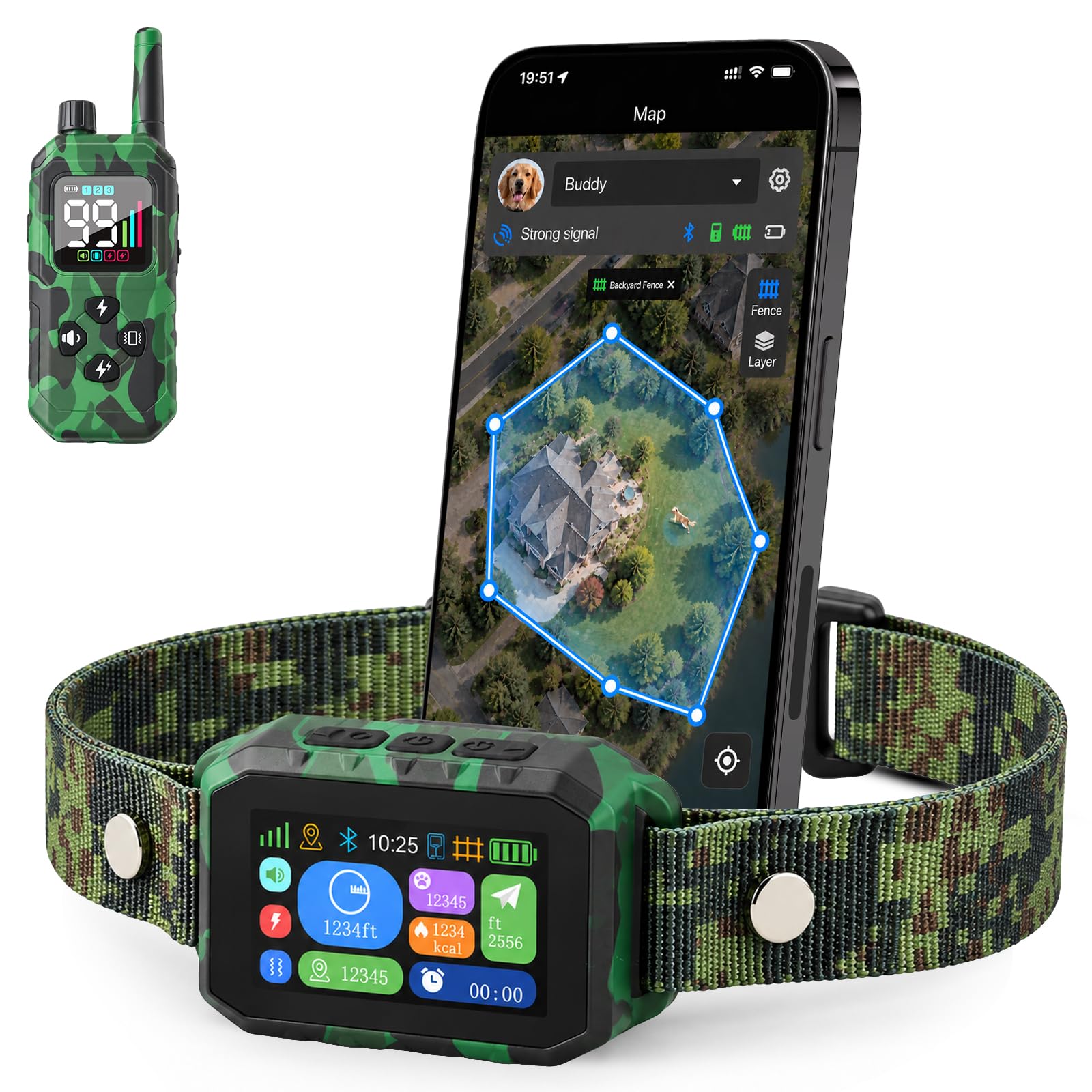
1. Zigpet GPS Wireless Dog Collar Fence System (GC05)
Our pick — 4.5+★ from 400+ verified ratings; the strongest balance of quality and price.
A custom polygon boundary out to 7,000 feet, with no monthly fee.
The headliner here is the polygon. Most GPS collars only let you draw a circle around a center point, which is useless on a lot that elbows around a barn. This system lets you map a custom polygon in the free app, stretching from 82 feet out to 7,000 feet — land the manufacturer lists as up to 3,534 acres. If you have ever walked a property line and wished you could trace it on your phone, that is exactly what this does.
It also runs two jobs off one piece of hardware. The same collar handles containment and remote training, and you can drive it either from the handheld remote at up to 1,640 feet or from the app inside 100 feet. Training options are deep: beep on 1–9 levels, vibration on 1–9 levels, and static correction on 1–99 levels. The progressive warning starts with a vibration roughly 5 meters, about 16 feet, before the boundary — a heads-up rather than an ambush.
For a collar that can take weather, the IP67 rating means full dust and water protection, and a 2–3 hour charge buys up to 60 days on standby or around 20 hours with GPS live. It fits necks from 8 to 25 inches and dogs from 10 to 120 lbs. The honest limits sit on the tracking side: live tracking only reaches about 98 feet over Bluetooth on a strong signal, and the dog count tops out at 2. Fencing itself, though, keeps working beyond that.
What earns the top slot
- Polygon boundaries up to 7,000 feet of range — the most flexible shape control in this lineup.
- No monthly fee for the fence function.
- Five correction levels plus a vibration pre-warning 5 meters before the line.
- IP67 body and a 2–3 hour charge cycle.
Where it asks patience
- Live tracking is capped at roughly 98 feet by Bluetooth range.
- Two dogs maximum.
- Fits dogs from 10 lbs, so very small breeds fit but deserve a close strap check.
Made for: multi-acre properties with odd shapes, hedgerows, or driveways cutting through the middle.
Less suited to: anyone who wants to watch their dog’s location on a map from the house — you need a cellular system for that.
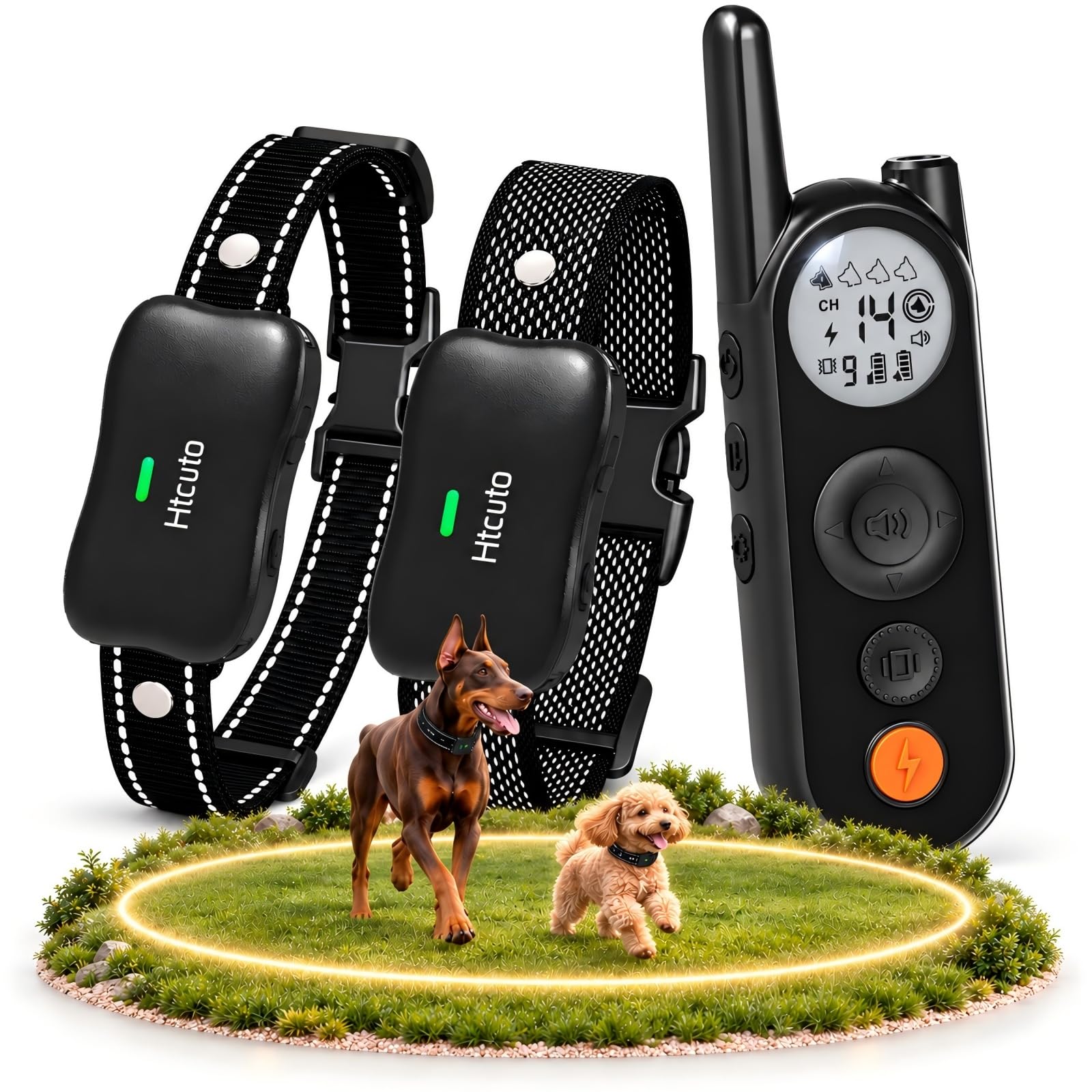
2. Htcuto Wireless Dog Fence for 2 Dogs (X3 1V2)
Two collars, one remote, and 185 days of standby per charge.
Charging is the chore that quietly kills these systems — a dead collar is a dog with no boundary. This kit answers that with 185 days of standby, and even with the fence continuously broadcasting you get about 85 hours per charge. Compare that to the Zigpet collar’s 60 days of standby and the gap is obvious: this one is built to sit idle without nagging you. Turn fence mode off between sessions and the drain all but stops.
Boundary range runs from 25 to 3,500 feet across 14 adjustable levels, covering up to 856 acres — enough for a working farm or a hunting lease. The remote reaches up to 5,900 feet, which is a long way past the fence line itself. Training options cover beep, 9-level vibration, and 30-level static, so a soft dog and a stubborn one can both be handled from one handset.
Two practical touches earn their place. A keypad lock stops a button from getting pressed in a pocket and firing a stray correction, and two LED flashlight modes let you light up the yard while you find a dog after dark. The collars are IPX7, so rain and creek water are fine. If there is a catch, it is that this is a transmitter-based system — you are tied to the plug, so it is a home boundary rather than a travel one.
Runner-up status: With an IPX7 collar, dual-directional signal for stable indoor and outdoor use, and a two-dog kit in one box, this is the closest thing to a no-fuss multi-dog answer here.
One thing to plan around: the transmitter has to live within reach of an outlet, so campers and vacation-home users should look at the GPS picks instead.
Grab it if: you have two dogs and one fixed yard, and you would rather charge once a season than once a week.
Pass for: properties you want to fence from a cabin with no power.
3. Dogtra GPS Fence (GF10UC)
Two backup fences behind the primary line, in an IPX9K housing.
Most containment systems give you one line in the sand. Dogtra gives you four layers: a warning zone, a primary fence, and two backup fences behind it. If the GPS drifts — and GPS does drift — the dog has to clear three more boundaries before freedom, not one. You draw those shapes in the free Dogtra app on a circular or custom layout matching your property, and the app is only needed during setup. After that the collar runs on its own, with no phone connection and no monthly fee.
Correction is user-selectable per boundary: tone, vibration, or stimulation, with 100 adjustable levels. Two details show real thought about the dog’s experience. Smart detection disables correction whenever the dog is heading home, and a continuous beeping tone guides them back rather than leaving them to guess. Up to 30 unique fences can be stored, and up to 3 dogs can share one fence profile through the app.
The IPX9K rating is the highest waterproof standard in this group — closer to a pressure-wash rating than a splash rating. It fits dogs from 15 lbs with neck sizes from 10 to 30 inches, and Dogtra recommends properties of 3/4 acre or larger, with the collar removed indoors. One honest limit: this is containment only, with no live tracking and no notifications. Flag training is recommended and flags are sold separately.
The layered thinking: backup fences are the difference between a boundary that works and one that works on a cloudy Tuesday — a genuine design advantage over the single-boundary picks above.
Set expectations: no live tracking means you cannot pull up your dog’s position in the app — this fence tells the dog where the line is, not you where the dog is.
Worth it for: owners of dogs who push boundaries and properties that get serious weather.
Look elsewhere if: you expect to see your dog’s location on a map — that requires a separate tracking product.
4. TTPet GPS Wireless Dog Fence System (G726)
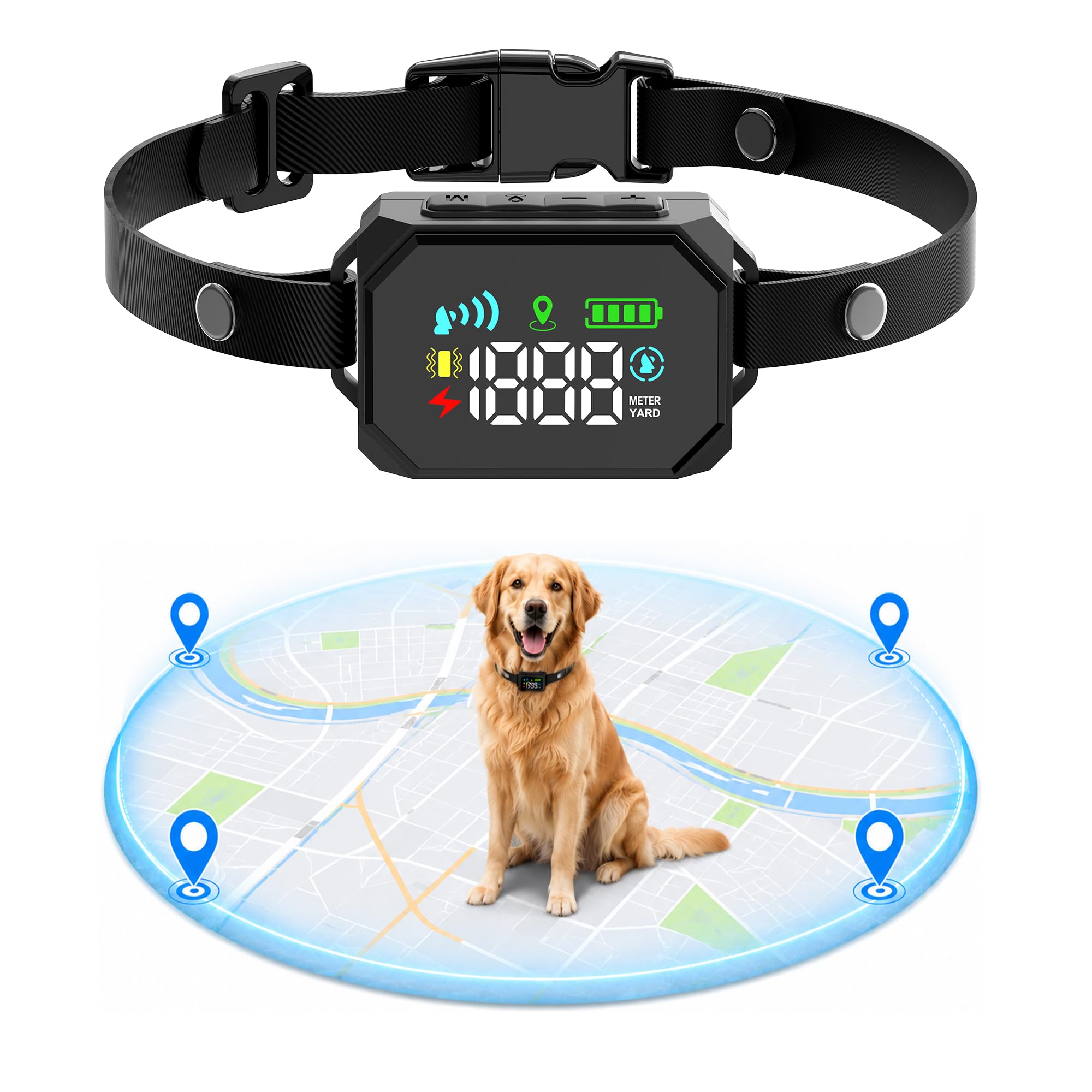
A Swiss u-blox chipset built to cut the drift that spoils GPS fences.
Boundary drift is the classic GPS weakness — the circle creeps, and a dog that was safely inside is suddenly getting corrected on the porch. This system attacks that with a premium Swiss u-blox GPS chipset plus AI-enhanced positioning, which the maker says reduces drift and signal fluctuation in open outdoor areas. The range is adjustable from 33 to 1,999 yards in a circular boundary covering up to 2,500+ acres. No digging, no base station, no Wi-Fi, and no monthly subscription.
At 10.5 ounces it is the lightest collar in this lineup — noticeably lighter than the 14.9-ounce Aweec unit below, and that difference matters on a dog that wears it all day. Correction is progressive: a beep first, then vibration or static across 24 adjustable levels. An automatic protection mode kicks in after two correction cycles to stop the collar piling on. The battery runs about 24 to 36 hours per charge, and the IPX7 rating covers rain, mud, splashes, and swimming.
The strap setting deserves attention. TTPet specifies dogs over 18 lbs and recommends capping continuous wear at 12 hours with regular breaks. That is a collar meant to come off at night, not a permanent fixture.
Smart memory earns its keep: once calibrated, the system remembers the center, radius, and correction settings at power-on — no repeating the whole ritual every morning.
The catch: you still recalibrate when you move the system or leave it off for several days, which makes this a home-boundary tool rather than a grab-and-go one.
Suits: larger properties with open sightlines where drift is the biggest worry.
Skip for: dogs under 18 lbs — the fit guidance simply doesn’t include them.
5. FOCUSER Electric Wireless Dog Fence (007-2D)

A plug-in circular boundary with a safety chip and a backup battery for outages.
Functionality is the whole story with this one — the buyers who like it talk about the system doing its job, day in and day out. Setup is straightforward: plug in the transmitter, pair the receivers, and you have a boundary without a shovel. The radius runs from 25 to 300 meters across 16 adjustable levels, and the transmitter talks to receiver collars automatically, so no manual pairing for a second dog.
Two safety touches stand out on a fairly basic system. A built-in safety chip limits over-correction so the collar will not keep pushing a dog that panics at the line, and a backup battery keeps the boundary live through a brief power cut. There are 4 correction levels to match a dog’s size, and the collar fits most dogs from 10 to 110 lbs with necks from 8 to 21 inches.
Both the transmitter and the receiver are rechargeable, and the receiver carries an IP67 rating for sprinklers and rain. It is a fixed-installation system by nature — the boundary is a circle centered on the transmitter, so odd-shaped yards get partial coverage. But for a straightforward suburban yard where the fence just needs to hold, it does that without fuss.
The dependable parts
- Safety chip and backup battery are rare at this level.
- 16 range levels from 25 to 300 meters.
- IP67 waterproof receiver for wet grass and rain.
- Collar fits 10–110 lbs, necks 8–21 inches.
The plain limits
- Circular boundary only — no custom shapes for an L-shaped lot.
- Four correction levels is coarse next to the finer dials on GPS units.
Right call for: a normal fenced-suburb yard where a stable circle is enough and you want outage protection.
Not for: sprawling acreage or properties with the house cutting through the middle of the yard.
6. PetSafe Guardian GPS Dog Fence (PIF00-17933)
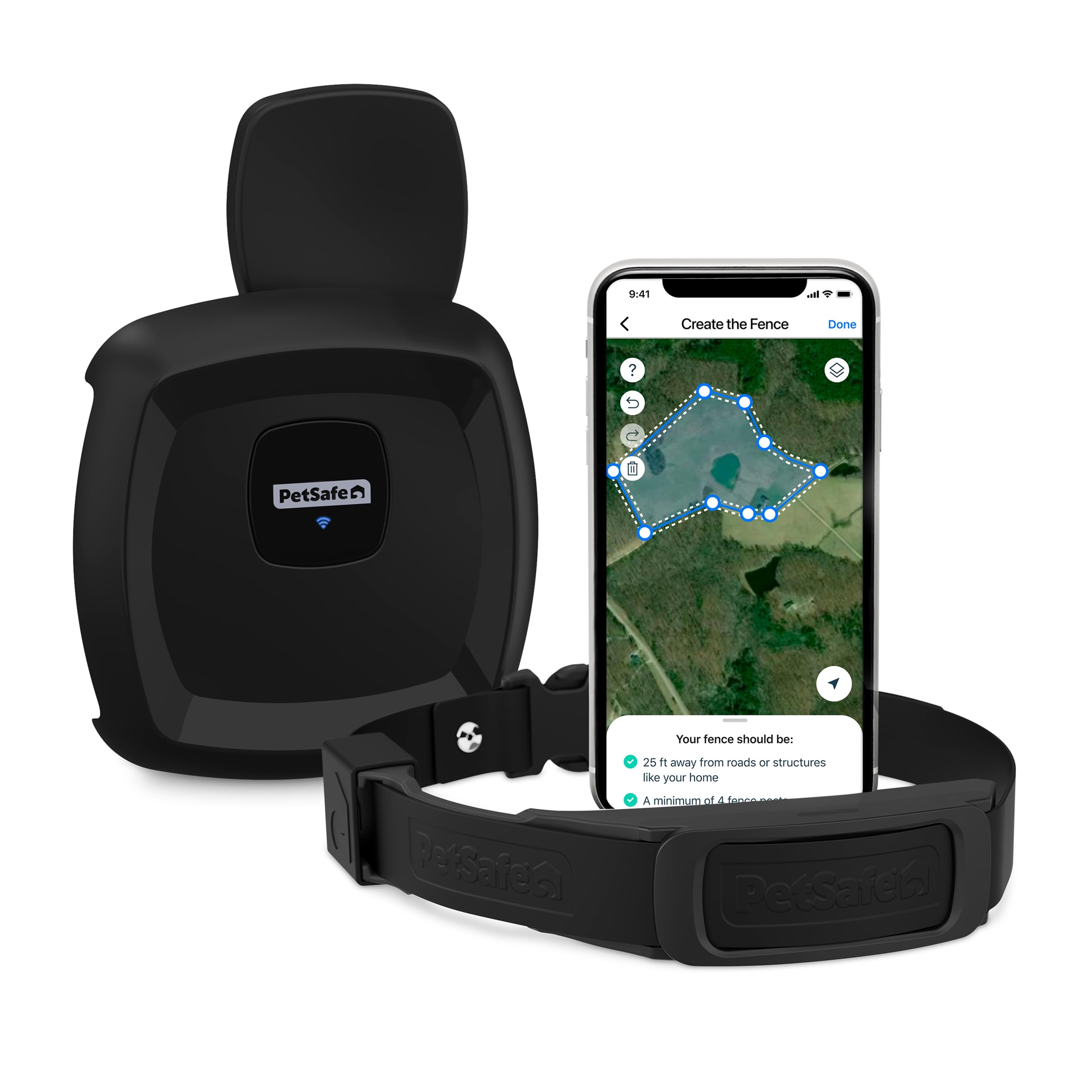
A slim collar with app-drawn boundaries and up to 5 days per charge.
Battery life is the draw: up to 5 days on a single charge from a redesigned collar the maker describes as slim and lightweight. That beats the day-at-a-time GPS collars in this lineup and means a midweek charge is not part of your routine. Guardian’s AccuGuard setup blends GPS satellite data with real-time motion detection and AI, and there is no subscription fee because the system carries no tracking or portability features.
Setup is app-driven without being fiddly. PetSafe claims installation in as little as 1 hour, and you draw the boundary in the My PetSafe app from the couch — the app then keeps an eye on battery level, lets you change collar settings, and sends notifications. Properties of 3/4 acre or larger are the intended scale. Correction runs on tone and vibration, or 10 levels of static, so you can start gentle.
The collar is rechargeable and waterproof, designed for dogs over 25 lbs with necks from 13 to 28 inches, and add-a-dog collars are available separately. The recurring note across buyers is reliability: the fence itself is easy to set up, but some find the collar’s day-to-day consistency uneven. That is worth weighing if your dog is a hard-charging escape artist.
Where it shines: a five-day battery and phone-based boundary drawing remove the two biggest chores — charging and crawling around with flags.
Where it wobbles: consistency is the sticking point; treat it as a fit for calm dogs on a well-mapped yard, not an ironclad guarantee for a determined bolter.
Good match: a dog over 25 lbs on a mapped half-acre-plus who mostly respects a line.
Not the pick for: a dog under 25 lbs, since the collar sizing doesn’t reach down that far.
7. Halo Collar 5 Wireless Dog Fence System

Dual-frequency GPS, cellular, and Wi-Fi in one collar, on a required membership.
Halo does something none of the others here do: it uses both L1 and L5 satellite frequencies with real-time corrections from a global ground-station network, and the maker claims accuracy within 2 feet of your dog’s actual location. It updates 20 times per second over Wi-Fi, Bluetooth, and cellular, and stores multiple fences — including on rural land, hiking trails, and remote spots where lesser GPS collars lose their fix. You also get AlwaysOn GPS with instant smartphone alerts at the boundary.
The membership is the price of admission, and it is not optional. GPS tracking, unlimited cellular data, fence creation, training guidance, live support, and activity reports all sit behind the plan you choose after purchase. That is the fundamental difference from the no-fee Dogtra above: Halo is a connected service, and it prices like one.
The collar itself is well-built — IP67 housing, a blaze color for visibility, and 30.5 inches of strap with a buckle closure. It suits dogs over 10 lbs across sporting, herding, working, hound, non-sporting, and terrier groups. The quality of the hardware is what wins people over. The system’s weaker spots are the connected parts: GPS drift and battery life are the recurring gripes, and reliability is a mixed picture.
Why it earns the tracking crown: nothing else in this group combines a live map, instant breach alerts, and a fence that follows you to a trailhead — that is a different job than plain containment.
Read the fine print: the subscription is required to turn on GPS and fence features, so budget for it as part of ownership, not an add-on.
Pick it for: an escape-risk dog you want to see on a live map, and a yard where the fence line moves around.
Reconsider if: you want a fence that works without a monthly plan — the no-fee systems above do that job.
8. SpotOn Omni GPS Dog Fence Collar

The acreage monster: fences from half an acre to 100,000-plus, even overlapping the same ground.
For sheer scale, nothing here competes. SpotOn builds fences from 1/2 acre to 100k+ acres, in any shape, with off-limits areas and correction-free zones carved out of the middle. It says it is the only GPS fence that supports overlapping fences — two boundaries sharing coordinates, so two dogs with different ranges can still be right next to each other. And it holds through heavy woods thanks to a dual-feed GPS antenna connecting to 128 satellites.
Portability is the other standout. Off-Grid mode lets you build fences with no cell service and no internet, and the fence stores on the collar so you can pack it to a new property and go. You draw the boundary either by walking the line or drawing it in the app, and it works from the start with no subscription — plus no hardware, base stations, or buried wires. It is IP67 waterproof for rain, snow, and swimming, and it offers two alert tones with 30 levels of optional static correction and vibration.
Battery splits by mode: 40+ hours without a subscription, or 25+ hours with tracking turned on, or 35+ hours using Extended Battery Life Mode with tracking active. The tracking add-on brings live location, activity maps, remote recall, breach alerts, and a night light for visibility. The fit is medium dogs with 12–18 inch necks. Buyer feedback is candid about reliability and battery, so plan on charging more often than the longest figure suggests.
What makes it capable
- Fences from 1/2 acre to 100k+ acres, any shape, with off-limits zones.
- Overlapping fences support — the only one here that does it.
- Off-Grid mode builds fences with no cell or internet service.
- 40+ hours per charge without a subscription.
What to weigh
- Tracking, alerts, and activity maps need the optional subscription.
- Fits medium dogs only — 12–18 inch necks.
- Reliability and battery draw mixed feedback from buyers.
Ideal for: big, wooded, or moving properties where acreage and off-grid setup are the whole point.
Look past it if: your dog’s neck is outside 12–18 inches, or you only need a suburban half-acre.
9. Aweec Wireless Dog Fence (JC-B)

Both containment and remote training in one box, for two dogs on a budget.
One transmitter, two receiver collars, and no pairing ritual — they connect automatically when powered on. Boundary range is adjustable across 10 levels from roughly 10 to 990 feet in radius from the transmitter, and the collars emit a warning tone followed by a 3.7V low-voltage static correction when a dog crosses the line. In training mode it drives up to 3 dogs at once with sound, vibration, and shock selectable straight from the panel.
Thought has gone into the details at this price. The collar strap is reflective fluorescent TPU, which improves visibility on evening walks. Four conductive posts come in the box — two short for short-haired dogs, two long for long-haired ones — plus four silicone caps to fit after training. The receiver is IP65-rated, so wet grass, sprinklers, and rain are survivable, and both the transmitter and the receiver recharge.
It fits dogs from 10 to 110 lbs, and a free two-year warranty is available on registration. The honest trade-off is the technology itself: this is a transmitter-based circle, so range and stability depend on the plug. Buyer consensus is genuinely split, with real praise for ease of setup sitting alongside real frustration. At its budget price, treat it as an entry point rather than a long-term solution.
Best part: the two-collar kit plus the included post and silicone-cap sets makes a two-dog setup genuinely turnkey without hunting for spare parts.
Fair warning: the IP65 receiver is a lower water rating than the IP67 and IPX7 collars above, so a dog that swims daily belongs on a different system.
Good entry point: a first containment system for two dogs on a suburban lot.
Step up instead if: you need a weatherproof collar for water play or a boundary that travels with you.
10. PetSafe Wireless Fence 2 Dogs
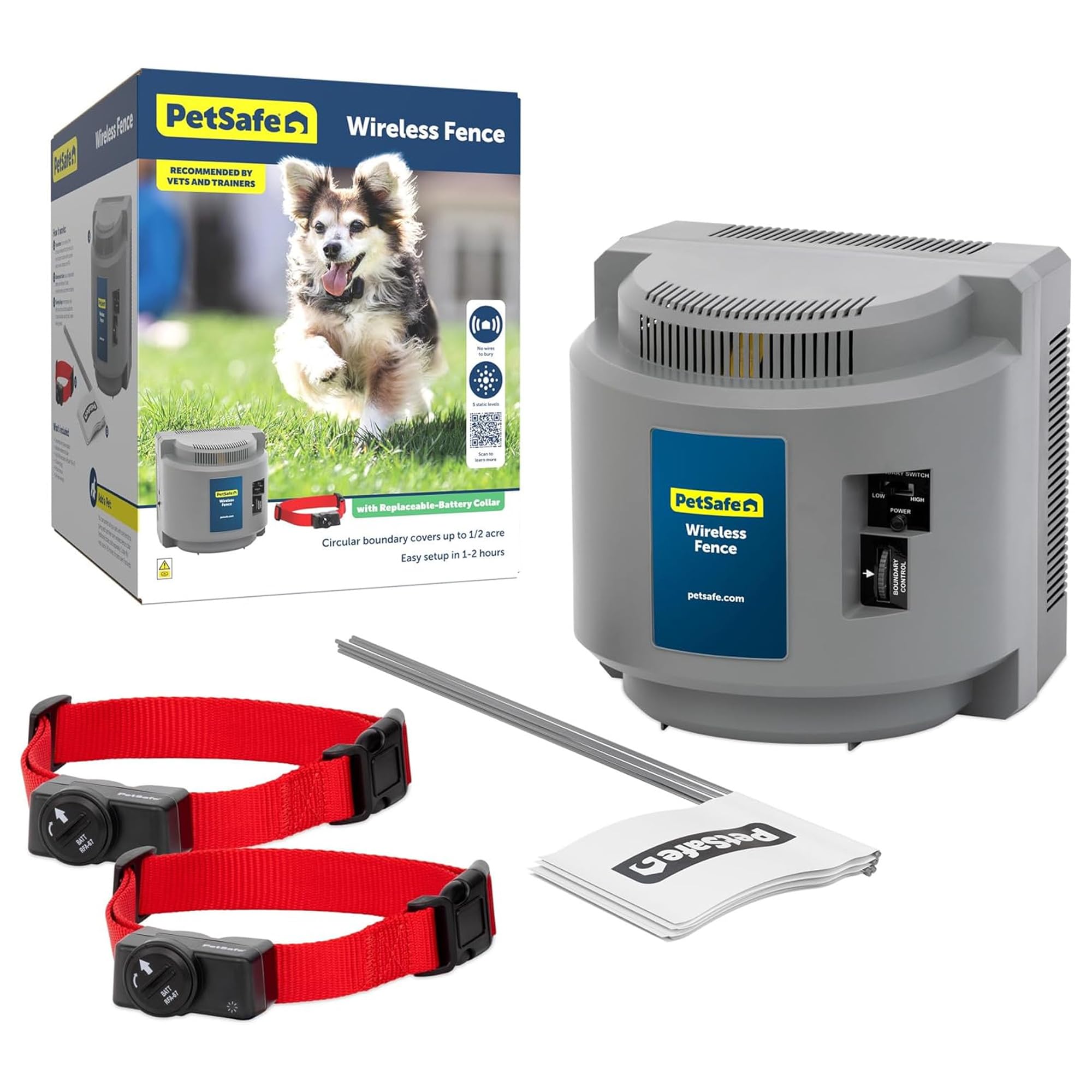
The plug-in classic with two collars and a boundary that forgives a returning dog.
Static-free reentry is the feature that makes this system worth a look. On a conventional in-ground fence, a dog that crosses out and then tries to come home gets corrected on the way back in. Here the correction stops once the dog turns toward the yard, so a dog that slips the line is not punished for returning. That single behavior difference is why owners who love it love it.
The kit ships with two collars and boundary flags, and the adjustable circular boundary covers up to 1/2 acre from a portable indoor transmitter. You can expand the coverage by adding a second transmitter. Setup takes a few hours with no digging or wire burying. The transmitter is genuinely portable, which makes this a legitimate option for a vacation home or camping with an outlet nearby.
The waterproof collar fits dogs from 8 lbs with necks from 6 to 28 inches — a much wider fit range than most collars here, and it covers a small dog that the heavier systems cannot. The collar battery lasts up to 2 months, then alerts you to swap it. Buyer sentiment is genuinely divided: many report strong results with both large and small dogs, and a vocal slice find it falls short. Battery life is one of the recurring criticisms.
The enduring strengths
- Static-free reentry — no correction on the way back in.
- Two collars and flags in the box from the start.
- Collar fits 8 lbs and up, 6–28 inch necks.
- Up to 2 months per collar battery.
The recurring complaints
- Battery life draws the most criticism from buyers.
- Coverage is a 1/2-acre circle; larger ground needs a second transmitter.
- The transmitter needs an outlet, so camping means a power hookup.
Works for: a small dog and a straightforward yard where the return-home forgiveness really matters.
Better elsewhere if: you need more than half an acre or a collar that charges instead of taking disposable batteries.
Know the Specs
Range in feet, yards, meters, or acres
This is how far the boundary reaches from its center or transmitter, and the units shift from brand to brand — feet on one listing, yards on another, meters on a third. Feet are the smallest unit, yards triple that, and meters sit in between. The area figure (acres) is what you actually live with, but it grows faster than the radius number suggests, so compare radius against radius before comparing acres. Ask whether a stated number is a radius or a diameter, because the same boundary can look twice as big described one way.
Standby days versus active hours
A collar’s standby rating is how long a charged battery sits mostly idle. The active figure — hours run with GPS or the fence broadcasting — is far shorter, often just a single day of use. A system advertising months of standby can still need charging daily while it is actually doing its job. When you see both numbers, plan around the smaller one, and switch the fence mode off between sessions to squeeze out the standby time.
IP ratings, decoded
The two-digit IP number measures dust and water protection. The first digit covers dust — 6 means dust-tight, 5 means protected against dust. The second covers water, where 5 handles splashes and 7 handles immersion. An X in a slot means the maker did not test that part. So IP67 means dust-tight and safe in water up to a declared depth, IP65 means dust-protected against jets, and IPX7 means immersion-rated with no dust claim. For a dog that swims, 7 matters; for a dog that wades in wet grass, 5 or better is the floor.
Correction levels and progressive warning
More levels give you finer control over how much correction a dog feels. A system with 5 or 10 levels lets you find the gentlest setting that still registers; a system with 99 or 100 offers a much wider staircase. Progressive warning is the other half — a beep or vibration fired before the correction itself, giving the dog a chance to turn around. If you are training a skittish dog, the presence of a pre-warning matters more than how many correction levels exist.
Common Questions
Will a GPS fence system work on a wooded property with heavy tree cover?
Do I need a monthly subscription to keep the fence running?
Can one system contain two dogs at the same time?
How often will I actually have to charge the collar?
What neck size and dog weight does each collar actually fit?
Will my dog get corrected on the way back into the yard?
How much land can a smart fence system realistically cover?
Can I move the fence to a campsite or a new house?
Is a smart fence better than burying a wire fence?
What is the difference between a fence mode and a training collar mode?
The Bottom Line
For most properties, the best smart fence systems winner is the Zigpet GPS Wireless Dog Collar Fence System, because it is the only pick here that lets you draw a custom polygon out to 7,000 feet without a monthly fee. If charging is the chore you want gone, the Htcuto Wireless Dog Fence for 2 Dogs covers two dogs with 185 days of standby and an 85-hour working stretch. And for the dog you need to see on a live map — the escape artist, the trail dog — the Halo Collar 5 puts GPS accuracy and instant breach alerts in one collar, provided you accept the membership that switches it on. If you want the fence to keep holding a line through trees, wind, and weather with no satellite fix to worry about, the transmitter-based FOCUSER system is the simplest honest answer.
How we choose
We do not accept paid placement. Every pick is matched to a real buyer and a real use-case; we do not hands-on test units.
Sources
Specifications: manufacturer listings and product documentation. Review insights: verified customer reviews, as of November 2026. Pricing: not shown on this page (it changes often); check the current price via the retailer link.
As an Amazon Associate, Tactical Gear Guy earns from qualifying purchases. This does not affect which products we feature.