Specs are compiled from manufacturer listings and verified buyer reviews and can change over time — please confirm the key details on the product page before buying.
Your old dial timer is watering through a thunderstorm and drying out your beds in July. The fix is a controller that pulls your local forecast, skips the rain days, and lets you shut a zone off from your phone without walking to the garage. The nine picks below cover everything from a simple six-zone swap to a twenty-four-zone system for a large property, sorted by what they actually do well rather than by marketing noise.
This guide is built by comparing the manufacturers’ published specifications and the patterns across verified customer reviews, so you get each pick’s real strengths and trade-offs instead of marketing spin.
Zone count and wiring style decide half the purchase, and the app plus weather data decide the rest. The guide below splits both, explains each spec in plain words, and flags the install catches before you buy. These are the smart controllers for irrigation systems worth wiring into your yard.
Top Picks


How To Choose The Best Smart Controllers for Irrigation Systems
The single mistake most buyers make is counting valves in their yard instead of counting zones they will realistically run. A controller with more zones than you have valves is fine — spare terminals sit idle. A controller with fewer zones than valves is a dead end you cannot fix without buying again.
Match the zone count to your valve box
To size your controller, open the old one and count the wires screwed into the terminal strip, minus the common wire. That count is your zone total, or very close to it. A six-zone unit handles a modest front-and-back yard. Eight zones is the common residential balance. Twelve and sixteen zones cover larger lots and drip lines split off from lawn lines. Twenty-four zones is estate and small-commercial territory.
Decide indoor or outdoor placement before you buy
Some controllers are built for a garage or shed wall and need a separate weatherproof case if they go outside. Others ship with a weatherproof housing already. If your old timer hangs on an exterior wall in full sun, buy an outdoor-rated unit or budget for the enclosure — this is the most common install surprise.
Check what the app actually automates
A basic connected timer lets you turn zones on and off remotely. A smart one layers local weather data on top: it skips a scheduled run when rain is forecast, when the wind is too high, or when the temperature drops toward freezing. Some add evapotranspiration (ET) figures — the water your lawn loses to sun and air each day — and adjust run times to match. Confirm the app includes that ET layer before you buy.
Side-by-Side Comparison
| Model | Best For | Zones | Mount | Weather Data | Amazon |
|---|---|---|---|---|---|
| Rain-Bird ESP-TM2 6-Zone★ Best Overall | Small yards wanting a proven brand | 6 | Indoor or outdoor | Daily run-time adjustments | Amazon |
| Netro Spark 8 ZoneTouchscreen Pick | Touchscreen simplicity indoors | 8 | Indoor use | Forecast, rain skips, plant library | Amazon |
| Orbit B-hyve 12-ZoneCrowd Favorite | Biggest install base and support | 12 | Indoor or outdoor | Weather-aware scheduling | Amazon |
| ImoLaza 8 Zone | Real-time ET on a budget | 8 | Indoor, case sold separately | Real-time ET plus hyperlocal forecast | Amazon |
| Orbit B-hyve XR 16-Zone | Large yards already in Orbit’s app | 16 | Indoor or outdoor | Forecast-driven cycles | Amazon |
| Yardian Pro 8-Zone | Apple HomeKit homes | 8 | Indoor, IP56 case optional | Hyperlocal ET scheduling | Amazon |
| Rachio 3 8-Zone | Hands-off automatic scheduling | 8 | Indoor | Patented Weather Intelligence skips | Amazon |
| Hunter Hydrawise HPC-400 | Growing up to 16 zones later | 4, expandable to 16 | Indoor or hardwired | Web-based local weather adjustments | Amazon |
| Hunter PRO-HC 24-Zone | Estates and commercial sites | 24 | Outdoor rated | Rainfall, temp, humidity, wind | Amazon |
Detailed Reviews
1. Rain-Bird ESP-TM2 6 Zone
Our pick — 4.5+★ from 450+ verified ratings; the strongest balance of quality and price.
Six zones, a back-lit screen you can read in noon sun, and a controller that tells your lawn when to skip a day.
This is the pickup for a straightforward suburban yard — six valves, one garage wall, and no appetite for a fiddly setup. The panel carries a large back-lit LCD (a liquid-crystal display lit from behind), so you can read the schedule in a dim shed or in direct afternoon glare without cupping your hand over the screen. Programming runs in three steps, and the unit ships with a factory-installed 6-foot outdoor-rated power cord, which saves you splicing an extension just to reach the outlet.
Weather automation is the part that earns its place here. The controller adjusts run times daily off local conditions, and Rain Bird rates the controller’s water savings at up to 50%. Delay Watering holds the whole schedule for up to 14 days and then resumes automatically when the delay expires — genuinely useful if your town restricts watering mid-summer or you are reseeding a patch. Contractor Default saves your custom schedule so you can restore it after a power event instead of rebuilding it from scratch.
It mounts as a compact box: 7.92 inches long, 3.51 inches wide, and 7.86 inches tall, and 1.7 kg on the wall. For scale, the Rain-Bird is 7.92 inches long and 3.51 inches wide, while the Orbit B-hyve 12-zone below is 9.38 inches wide, so the two look very different bolted to the same garage wall. What wins people over is the reliability of the daily weather adjustment — set a base schedule once and it quietly handles the rest. As owners put it: “Customers find the sprinkler controller easy to install and set up, taking less than 15 minutes to connect to Wi-Fi, and appreciate its intuitive app interface for programming.” The catch is the zone ceiling: six valves and it is full, so a yard with a seventh line needs a bigger cabinet.
Where it earns the top spot
- Back-lit LCD stays readable in low light and direct sun
- Delay Watering for up to 14 days, then auto-resumes
- Contractor Default saves and restores your custom schedule
- 6-foot outdoor-rated power cord included
Know before you wire it
- Six zones is the hard ceiling — no expansion path
- Weather savings are an estimate, not a guaranteed figure
Reach for this if: you have six valves or fewer and want a name-brand cabinet with a screen that survives sunlight.
Look elsewhere if: your valve box already has eight wires waiting for a home.
2. Netro Spark 8 Zone
A controller you can run by tapping grass and clock icons instead of digging for your phone.
The Spark puts the controls right on the face. A grass icon selects a zone and shows the live zone number above it. A clock icon sets duration with the remaining time displayed over the top. A kettle icon is the manual start button, and a solid white water drop stays lit while that off-schedule run is going — so anyone standing at the wall can water instantly without opening the app. For eight zones split across front lawn, backyard, flower bed, shrub, vegetable garden, and drip lines, that on-device control is the reason to pick it.
The companion app is where the smart side lives. Each zone can be renamed and given its own photo, so “Zone 4” becomes a picture of the side bed. The plant database suggests humidity, light, and temperature needs per plant, and schedules run on daily intervals, weekly patterns, or odd/even days. Netro pulls daily forecasts from a professional weather provider covering precipitation, temperature, humidity, and wind speed, and the app stores up to 60 days of irrigation history with start time and duration per session.
Functionality is the thing people come back to talk about most, with installation right behind it — the wiring and schedule setup read as straightforward on the review pages. The honest limit: there is no battery backup. It must stay plugged into its 24V adapter, and it is built for indoor use, so an exterior wall needs shelter or a case. Customizable, connected, and quick to learn — provided the outlet stays powered.
What it does best: on-device touch control plus a plant library make this the friendliest controller here for a household where more than one person waters.
The trade-off: no battery backup means a power cut wipes the schedule until the adapter comes back on.
Suited to: an indoor install where several people share watering duty and nobody wants to hunt for a phone.
Not the one for: an unsheltered outdoor wall or a home that loses power often.
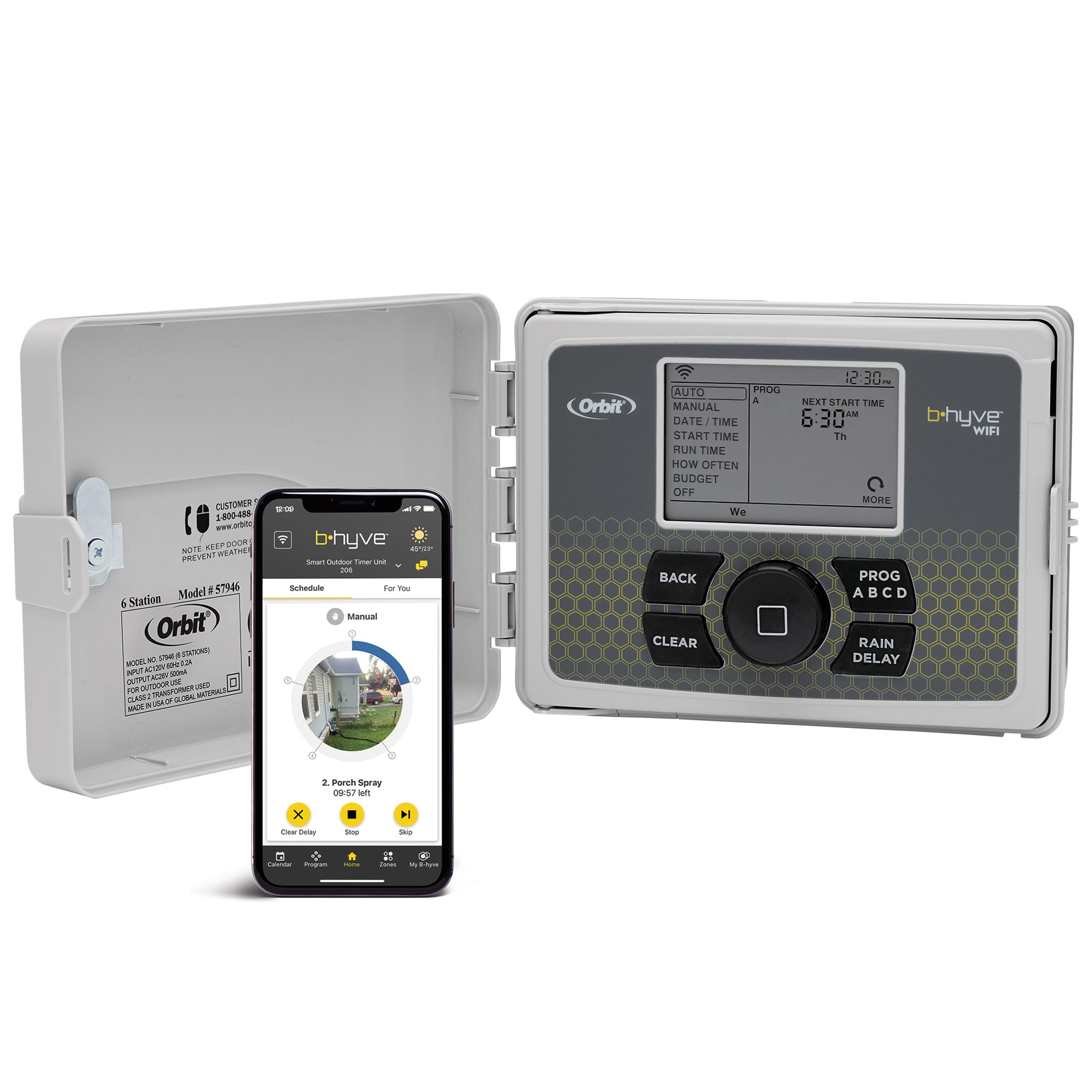
3. Orbit B-hyve 12-Zone 57950
Twelve zones in a weatherproof box that most people get online in under fifteen minutes.
If you want the safest bet on the list, this is it — the crowd favorite at 4.0+ stars across 6,900+ owners. Twelve zones covers a big residential lot with room to spare, and the protective weatherproof case means it can hang on an outdoor wall, sit in a garage, or live in a shed without a separate enclosure purchase. That housing is the practical difference between this and a bare indoor unit.
Setup speed is the headline in the reviews: folks report being connected to Wi-Fi in less than 15 minutes and program through an app interface that reads intuitive rather than technical. Remote control gets heavy use — flipping individual stations from your phone while standing in the yard, or adjusting a program from the office. The schedule is fully custom, and the app monitors each zone so you can see what ran and when.
Where it holds a physical edge: at 9.38 inches wide versus the Rain-Bird above at 3.51 inches wide — more panel, more room for terminals and wiring. The mixed signals live in connectivity and reliability: some units drop off Wi-Fi and need a reconnect, and the recurring gripe is that a controller can occasionally lose its link. Orbit backstops that with a two-year limited warranty against material and workmanship defects. What almost everyone agrees on is the functionality — that is the aspect buyers praise most by a wide margin, the app and hardware simply doing their job run after run. Just plan on a stable router nearby, because a weak signal in the garage is the usual culprit.
Why it leads the pack: twelve zones, an included weatherproof case, and an install most people finish inside fifteen minutes.
The honest catch: weak garage Wi-Fi shows up as flaky connectivity, so check your signal before you hang it.
Best for: a large yard that needs honest zone headroom and an outdoor-safe housing from the start.
Think twice if: your garage router signal is already patchy — a dead spot will follow you to the controller.
4. ImoLaza 8 Zone WiFi Smart Sprinkler Controller, ET Master
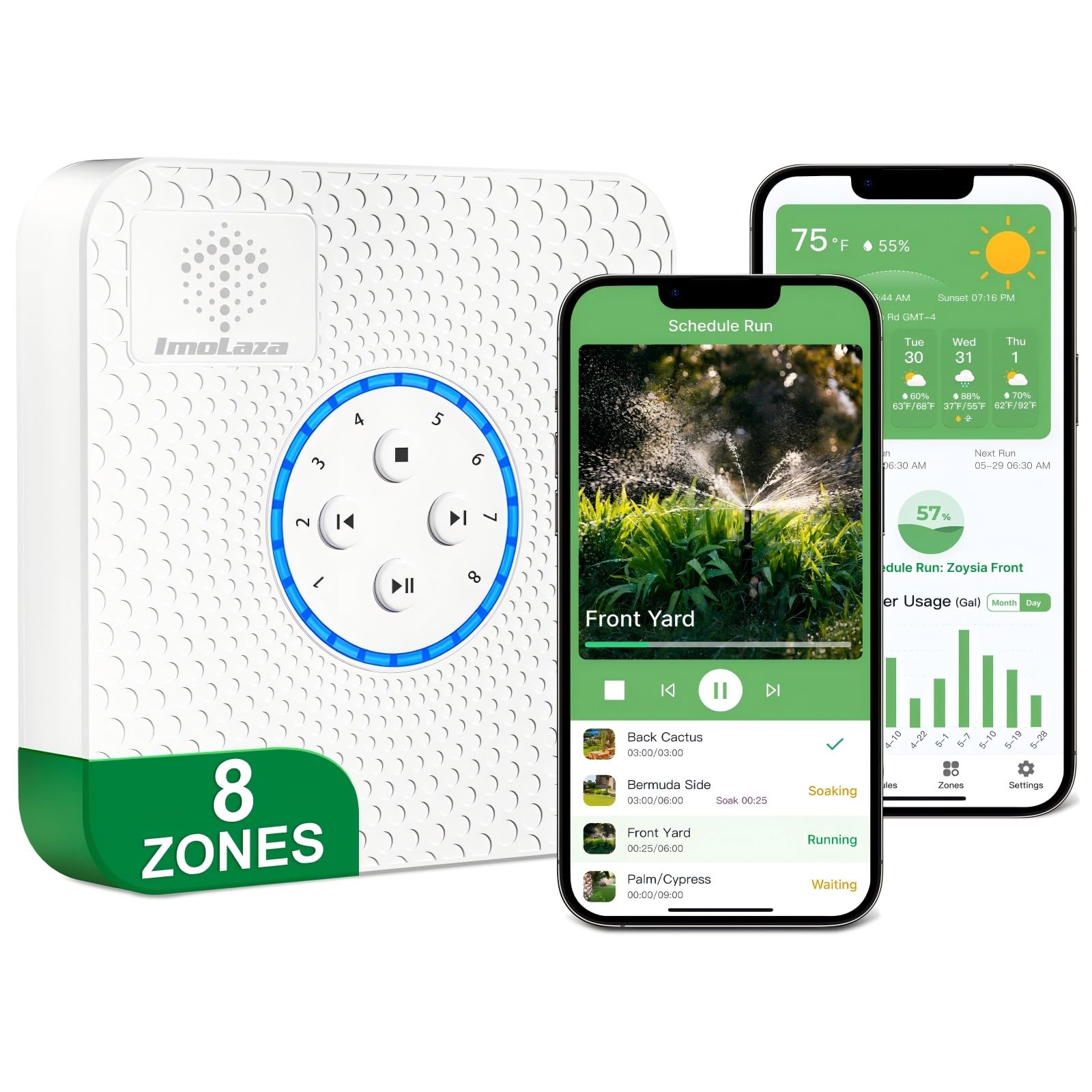
Real-time evapotranspiration math, run without a monthly fee, in a cabinet about an inch thick.
Most smart controllers look at the forecast. This one looks at evapotranspiration (ET) — the combined water your lawn loses to evaporation and plant transpiration — in real time, then combines it with hyperlocal weather to skip watering on rain, wind, freeze, or saturated soil days. ImoLaza rates the controller’s water savings at up to 60%. No subscription is required for any of it, which separates it from controllers that charge a monthly fee for weather features.
The New Grass schedule is the unusual extra: up to 24 start times per day for light, frequent watering, built for new seeding, sod, or delicate plants. It also suits orchards or any zone that needs small amounts at high frequency. Standard Smart ET and Fixed Cycle schedules are there for everything else. Fault detection is another layer — the unit watches for open or short circuits, an offline controller, weather-data outages past 24 hours, and with a flow meter it flags continuous low or abnormally high flow that signals a leak or burst pipe.
The 12.16-ounce, 1.18-inch-thick cabinet is the slimmest here. Against the Rain-Bird’s 7.86-inch height, this one is 1.18 inches thick, making it the easy pick for a tight interior irrigation box. It works with 99% of existing sprinkler systems, handles -13°F to 140°F, and installs in 15 to 30 minutes with no special tools. Retrofit was where buyers found the value, and the weather monitoring earns repeated praise, with heavy savings reported — one customer logged nearly 28,000 gallons saved. The trade-off: it wants an indoor wall, and an outdoor mount means buying the waterproof case separately.
The case for it
- Real-time ET plus hyperlocal weather, no subscription fee
- New Grass schedule with up to 24 start times per day
- Fault and leak alerts with a flow meter
- OTA updates keep adding features without new hardware
The catch
- Indoor mount only unless you buy the waterproof case
- Connectivity handles the bulk of the grumbling
Pick this one for: an eco-minded yard where water cost is the real enemy and you refuse another monthly bill.
Skip the wall-mount dream: it needs shelter, so an exposed exterior wall means adding the case.
5. Orbit B-hyve XR 16-Zone 57995
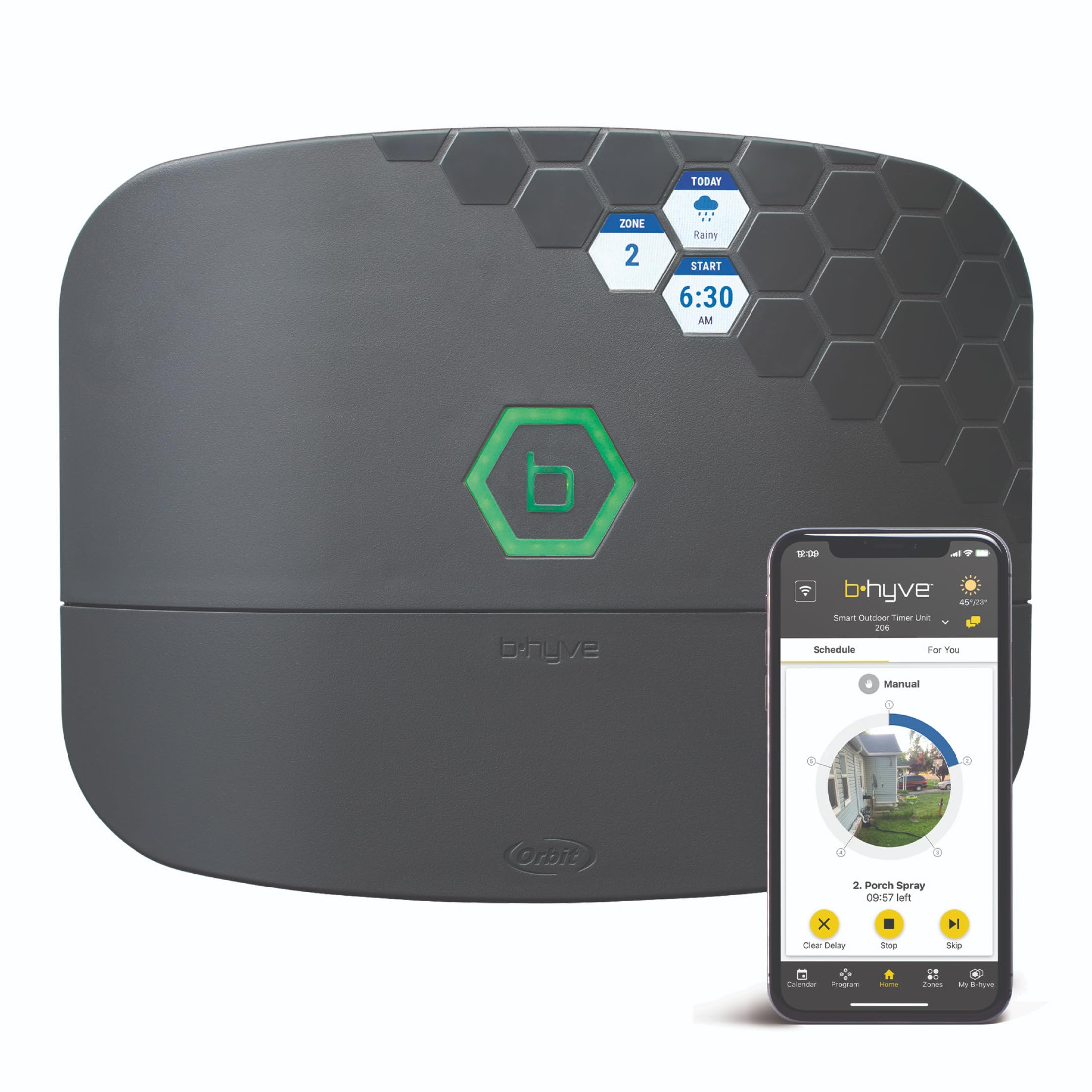
Sixteen zones of Orbit app control for the property that outgrew a twelve-station box.
Sixteen zones is the target here: large lots, multiple lawn and garden areas, and drip lines that each want their own program. The XR runs the same Orbit app ecosystem as the 12-zone model above, so if you already know that interface, this is a straight upgrade in capacity rather than a relearn. Weather-aware scheduling pulls the forecast and adjusts cycles to match, and the unit works with Alexa for voice control.
At 11 inches long by 9 inches wide by 4 inches tall and 3 pounds, it is narrower than the 12-zone sibling at 9.38 inches wide but has more terminals and more room to land wires. Remote management is the daily-use feature: quick adjustments, zone monitoring, and schedule edits from anywhere, all through the app. The weatherproof multi-zone housing means an outdoor wall is fine where the unit is protected.
Functionality is the strength — it is what the review pages praise most, and the schedule flexibility is what people bring up. Easy install sits right behind it. The mixed signals come from reliability, Wi-Fi connectivity, and value: some units need a reconnect, and a few think the price-to-capability math is tight for what you get. Orbit’s two-year limited warranty covers material and workmanship defects, which softens the reliability concern. For a large yard already invested in the Orbit ecosystem, the zone headroom is the whole reason to buy it.
Where it stands out: sixteen zones in the familiar Orbit app, with weather-driven scheduling and Alexa thrown in.
The honest note: connectivity gremlins show up here too, so a solid Wi-Fi signal at the mounting spot matters.
For the buyer with: a big property and more than twelve valves, who already trusts the Orbit app.
Not for you if: you only have eight zones — this is capacity you would pay for and never use.
6. Yardian Pro 8-Zone

The wired-in option for an Apple home — Ethernet when Wi-Fi is flaky, physical buttons when the internet is gone.
Two features put the Yardian Pro in a class of its own. First, a built-in RJ45 Ethernet port (a standard wired network jack) lets you plug into a router directly instead of fighting spotty garage Wi-Fi. Second, native Apple HomeKit support means it lives inside the Apple Home app alongside your lights and thermostat, with Amazon Alexa, Google Home, and Home Assistant also in play.
The physical buttons are the quiet hero. Run a zone or test a sprinkler straight from the panel, no phone and no internet needed — a real benefit for a contractor mid-install or a homeowner during an outage. ET-based smart watering pulls hyper-local weather data and automates schedules, with the maker rating water-bill savings at up to 50%. The unit handles 100V–240V through a universal power adapter and replaces an old controller in under 15 minutes.
Ease of use is what wins people over most, and functionality comes right behind it — the setup reads quick and the daily operation stays simple. At 6 inches by 6 inches by 1.38 inches it fits inside an existing irrigation box, and it weighs 16 ounces. An IP56 weatherproof outdoor enclosure (a rating for protection against dust and water spray) is a separate purchase if the unit goes outside. Flow-sensor support is the sleeper feature: it works with both wireless and wired sensors and alerts you to leaks, burst pipes, or clogged valves before they become repairs. HomeKit homes have an obvious single choice here, and the Ethernet jack is the bonus most competitors do not offer.
The standout features
- Native Apple HomeKit and Home Assistant support
- RJ45 Ethernet port for a wired, stable connection
- Physical buttons work without phone or internet
- Real-time leak and flow monitoring with sensors
Worth knowing
- IP56 outdoor case sold separately
- Eight zones with no expansion path
The right call if: your home runs on Apple Home and your garage router has a spare Ethernet port.
Not worth it if: you use no smart home platform — you would be paying for HomeKit you will never open.
7. Rachio 3 8-Zone

The controller built to think for you — patented weather skips that run without you touching a schedule.
Rachio’s whole pitch is that you stop programming it. Weather Intelligence is the company’s patented skip system: it holds a scheduled run for rain, wind, freeze, and more, then does the math again as the forecast changes. You can build your own schedule if you want, or let the adaptive engine adjust automatically, grow-in options included. For someone who wants the lawn handled without opening an app every week, that is the feature to judge it on.
The app runs everything — start zones, view schedules, and track estimated usage, so you can see what a season is actually costing in water. It installs in 30 minutes or less and works with 99% of existing sprinkler systems, and the maker lists Amazon Alexa compatibility as a secondary control path. The 9.1-inch by 1.4-inch by 5.6-inch body weighs 16 ounces and comes with the power supply and mounting screws.
Where it needs a warning label is Wi-Fi. While some buyers report locking in connection straight away, others hit connectivity trouble, and those who buy this unit expecting plug-and-play should size their router location first. On scheduling and weather intelligence, though, the consensus is clear — automatic skip behavior that saves water without manual tweaks is the reason people choose it. If you have come home to sprinklers running in the rain, this controller’s rain skips stop that.
what separates it: patented Weather Intelligence skips for rain, wind, and freeze, with adaptive schedules in place of manual programming.
The one snag: Wi-Fi pairing is the weak link — some installs connect instantly, others take fiddling.
Made for: a homeowner who would rather never touch a schedule and let weather data do the deciding.
Think twice if: your router is far from the controller — pairing is the most common snag here.
8. SPW Hunter Hydrawise HPC-400 4-16 Station Wi-Fi Controller

Four stations today, sixteen later — the controller you grow into instead of replacing.
Expansion is the reason to look at this one. It ships as a four-zone timer and accepts optional expansion modules to reach sixteen zones, so a yard that grows in phases does not need a second controller purchase. The Hydrawise software is web-based, meaning you configure and monitor through a browser as well as the iPhone and Android apps, and it pushes automatic schedule updates along with instant alerts when something goes wrong in the system.
Fault detection is built in: an internal milliamp sensor (a small current reader) checks the valve wiring for faults, so a damaged wire or valve gets caught rather than silently wasting water. It integrates local weather data to make water-saving scheduling adjustments. Compatibility reaches to the HC Flow Meter and to Roam and Roam XL remotes for on-site control. Power runs from an included 5-foot lead and plug, or you can remove the cord and hardwire it into a junction box for a permanent install.
Ease of use and controls are the two strengths that come up most, and the build quality earns steady praise alongside them. At 5.59 pounds it is a substantial box — versus the compact 1.08 kg Netro above — so a solid wall is the right home. Reviewers report lower water bills after installation. For a property that may add zones later, this is the smartest capacity plan on the list; the trade-off is that you pay premium-tier for a four-zone unit today and add modules as you go.
Why it makes the list: four zones from the start, expandable to sixteen, with Hydrawise web and app control on top.
The honest limit: extra zones mean buying expansion modules — the four-zone starting point is not the end of the spend.
Choose it if: your yard is being finished in stages and you want to add stations without swapping the cabinet.
Look past it if: your valve count is already fixed and small — a dedicated eight-zone unit is simpler.
9. Hunter PRO-HC WiFi Sprinkler Controller, 24 Zone
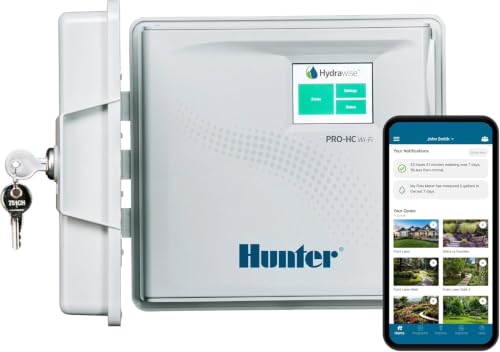
Twenty-four zones, a color touchscreen on the panel, and a weather-resistant housing for full-time outdoor duty.
Twenty-four stations puts this in estate and small-commercial territory — big properties, HOAs, parks, office grounds. It runs through the Hydrawise app or the web portal, so you can manage all twenty-four zones remotely from anywhere. Programming flexibility is the standout: 6 independent programs and 6 start times per zone, with station-based scheduling so each area of the landscape — lawn, garden, flowerbed — can be tuned separately to cut water waste.
The on-panel experience is better than most. A 2.75-inch full-color touchscreen handles setup and manual operation right at the wall. The engineered outdoor housing is weather-resistant, built for permanent exterior installation. Two sensor inputs, a P/MV output for a master valve or pump relay, and full Hunter Clik sensor compatibility round out the hardware. Weather-based watering adjusts on real-time rainfall, temperature, humidity, and wind, and integrated milliamp sensing catches wire issues before they become failures.
Comparing cabinets: this one is 8.6 inches long, 3.75 inches wide, and 7 inches tall, and 2.57 kg on the wall, versus the Yardian Pro’s 6 inches by 6 inches by 1.38 inches and 16 ounces, as you would expect for twenty-four terminals. The aspect buyers praise most is quality, with ease of programming and control close behind. The obvious limit is cost: it is the most premium pick here, and a residential yard with eight zones would pay for capacity it will never wire up. For a property that genuinely runs twenty-plus stations, though, this is the controller the big jobs actually need.
Where it delivers
- 24 zones with 6 programs and 6 start times per zone
- 2.75-inch color touchscreen for on-panel setup
- Weather-resistant housing built for outdoor install
- Milliamp wire-fault sensing and flow-meter compatibility
What to weigh
- Premium-tier cost for a residential yard that does not need 24 zones
- Heavier 2.57 kg cabinet needs a solid mounting wall
This is the one when: your site genuinely runs twenty-plus stations and you want touchscreen and weather automation at the source.
Not the pick for: a standard suburban yard — the capacity is real, but you would never use it.
Know the Specs
Zone Count
Zones are independent valve lines — each one controls a separate set of sprinkler heads or drip tubing. A six-zone controller runs six valves; an eight-zone runs eight. More zones means finer control over how each part of the yard gets watered, but also more wiring and more setup time. Match the zone count to your valve box first, not to a wish list.
Weather Data and ET
Weather-aware scheduling pulls a local forecast and skips a run when rain, wind, or freeze makes watering wasteful. Evapotranspiration (ET) goes a step further: it estimates how much water your lawn lost to sun and air that day, then adjusts run times to put that amount back. Controllers with real-time ET tend to save more water than ones that only look at the forecast.
Flow and Wire Fault Detection
Fault detection watches the system for problems before they waste water. A milliamp sensor checks valve wiring for faults, and a flow meter compatibility layer alerts you to leaks, burst pipes, or stuck valves. Instant alerts are what let you act on a leak while it is still small, instead of finding a soggy lawn a week later.
Indoor Versus Outdoor Mounting
An indoor-only controller needs a garage, shed, or utility closet — an exterior install means buying a separate weatherproof case. Outdoor-rated units ship with a weather-resistant housing and can hang on an exterior wall without extra parts. Check the operating temperature range too, since exterior walls in a hot climate get far hotter than an indoor closet.
Common Questions
Will a smart controller work with my existing sprinkler valves?
How many zones do I actually need?
Do I need a monthly subscription for weather-based watering?
Can I install a smart irrigation controller myself?
What is evapotranspiration (ET) and why does it matter?
What happens to my schedule if the power goes out?
Can a smart controller run a master valve or pump relay?
Is an indoor-only controller safe to mount outside?
Does Apple HomeKit support matter for a sprinkler controller?
What is a flow meter and do I need one?
The Bottom Line
For most six-valve yards, the smart controllers for irrigation systems pick is the Rain-Bird ESP-TM2 6-Zone. It pairs a readable back-lit screen and three-step programming with daily weather adjustments, so you set it once and it trims watering for you. If you want honest zone headroom and an outdoor-safe housing, the Orbit B-hyve 12-Zone is the safest all-around bet. And for an Apple Home, the Yardian Pro is the one to wire in, with its native HomeKit and Ethernet jack. For a property that may grow to sixteen zones, the Hunter Hydrawise HPC-400 is worth the expandable plan.
How we choose
We do not accept paid placement. Every pick is matched to a real buyer and a real use-case; we do not hands-on test units.
Sources
Specifications: manufacturer listings and product documentation. Review insights: verified customer reviews, as of November 2026. Pricing: not shown on this page (it changes often); check the current price via the retailer link.
As an Amazon Associate, Tactical Gear Guy earns from qualifying purchases. This does not affect which products we feature.