Specs are compiled from manufacturer listings and verified buyer reviews and can change over time — please confirm the key details on the product page before buying.
Which smart bird house is actually worth buying? Short answer: the one whose camera you will still be watching next spring. Plenty of these boxes get the camera right and then fail on solar charging, 2.4GHz range, or an entrance hole no bird will use. The picks below are judged on the things that matter after week one — how reliably the camera connects, whether the solar panel keeps up, and whether real birds actually move in.
This guide is built by comparing the manufacturers’ published specifications and the patterns across verified customer reviews, so you get each pick’s real strengths and trade-offs instead of marketing spin.
A nesting box and a feeder camera are different products: the box gives birds a cavity to raise young in, the feeder hangs seed and films quick visits. The Kiwibit leads this list of the smart bird house options because its lifetime AI and 4K camera remove the two biggest ongoing headaches. Expect honest notes on battery life, app quirks, and entry-hole sizing too.
Top Picks
How To Choose The Best Smart Bird House
Start with the job you want done. A nesting box gives birds a cavity to raise young in, and the camera looks inside at eggs and chicks. A feeder camera hangs seed and watches birds land. They look similar online but they attract different birds and show you different scenes.
Nesting box or feeder camera
The nesting boxes here run from about 1.5 inches to 1 9/16 inches at the entrance — that opening is what decides which species can get in. A feeder camera instead relies on a seed tray and a wide lens, so you get quick visits rather than a full nesting season. Decide which view you actually want before anything else.
The power math matters more than the megapixels
Most of these cameras run on a rechargeable battery topped up by a small solar panel. A 5200mAh battery with a 3W panel is the common pairing, and it works — until winter sun drops or the panel sits in shade. Check the cable length on the solar panel so you can move it to a brighter spot.
Wi-Fi band and app quality
Almost every unit listed here runs on 2.4GHz Wi-Fi only, and none support 5GHz. The 2.4GHz band reaches further through a garden but carries less data. A 5dBi or 5dB antenna helps hold the signal. Read the app reviews as carefully as the camera reviews, because a great lens behind a flaky app is useless.
AI identification and what “free” really means
Several brands now advertise AI identification of 10,000+ bird species with no subscription. Others include a limited membership that later expires. Confirm whether species ID stays free after any trial ends, and whether footage saves to a micro SD card when the Wi-Fi drops.
Side-by-Side Comparison
| Model | Best For | Camera | Seed Capacity | Power | Amazon |
|---|---|---|---|---|---|
| Kiwibit Solar Smart Bird Feeder★ Best Overall | Best bird ID without a subscription | 4K, 8MP, 132° | 1.5 liters | 5200mAh + dual solar | Amazon |
| Birdfy Bird House with Metal CladdingRemote Nest View | Remote-controlled nesting box | 2K QHD, infrared | — | 3W solar + battery | Amazon |
| Birdkiss Smart Bird House (Green)Three-Angle View | Three-angle nest viewing | 1080p, three-angle | — | 3W solar + 5000mAh | Amazon |
| Birdfy Smart Bird House (Solar) | Lifetime free cloud storage | 1080p FHD, infrared | — | Solar panel | Amazon |
| Netvue by Birdfy Solar Feeder | Established feeder camera | 2K QHD, 136° | 1.5 liters | 5200mAh + 3W solar | Amazon |
| Applewood Outdoor Cedar Bird House | USA-made cedar nesting box | App-based, solar | — | Solar panel | Amazon |
| IUUZEUL Wooden Bird House | Motion alerts on a budget | 2K, night vision | — | Solar panel | Amazon |
| APS Metal Bird Feeder with Camera | Biggest seed hopper | 2K, 160° | 4.3 liters | 5200mAh + solar | Amazon |
| ISENLAND Smart Bird House | Entry-level nest watching | 1080p, 850nm IR | — | Solar panel | Amazon |
Detailed Reviews
1. Solar Smart Bird Feeder with Camera
Our pick — 4.5+★ from 350+ verified ratings; the strongest balance of quality and price.
Sharpest picture here and no ongoing fee to keep the bird ID running.
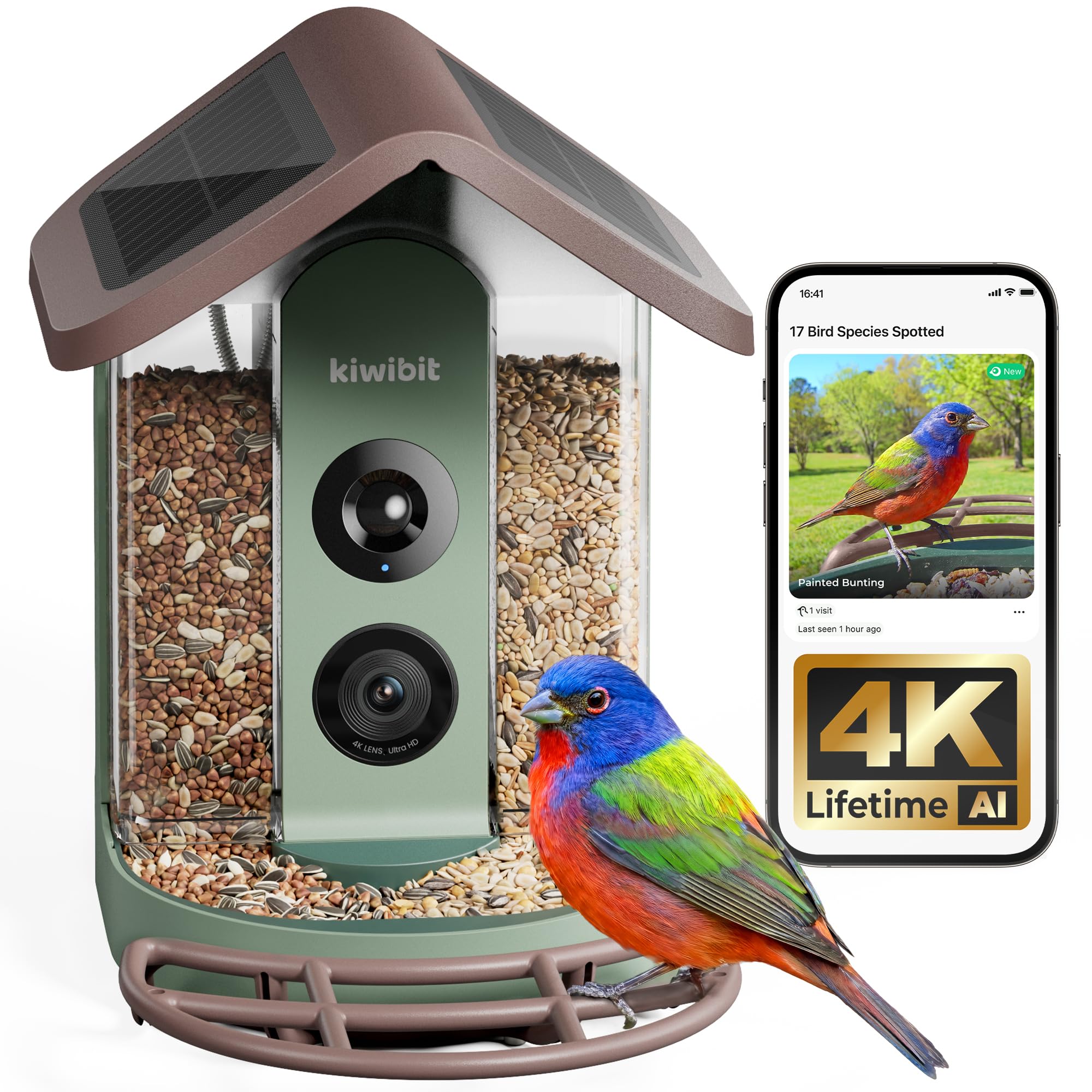
Two things sell this Kiwibit: the lens and the lack of a subscription. The camera shoots true 4K video and 8MP photos through a 132° wide-angle lens (a lens wide enough to keep a whole feeder in frame), so feather detail survives when you zoom in later. The built-in AI names over 10,000 bird species, includes up to 60 days of cloud storage, and stays free for life.
The 1.5-liter hopper keeps steady traffic at the feeder, and the 132° lens holds the whole feeding area in frame. Setup is quick, with wall, pole, and tree strap mounts in the box. Power comes from a 5200mAh battery paired with dual solar panels, so it tops itself up across the day rather than asking you to haul it inside. IP65 water resistance (protected against rain and dust) covers year-round outdoor use, and it stores footage locally on a micro SD card up to 512GB.
Here is where it differs from its closest rival. The APS feeder holds 4.3 liters of seed against this one’s 1.5 liters, so the APS goes longer between refills. This one instead gives you the sharper 4K image and the free lifetime identification. The recurring gripe is power in bad weather — the solar side keeps it charged for plenty of owners, yet some find it needs more hand-charging than expected. Weigh that if your yard sits in shade.
What earns it the top spot
- True 4K video and 8MP stills with a 132° wide-angle lens
- Lifetime AI ID across 10,000+ species with no subscription
- Dual solar panels plus a 5200mAh battery for all-day running
- IP65 weatherproof housing and a removable bowl for easy rinsing
What to weigh first
- 1.5 liter hopper means more frequent refills than the APS
- Solar top-up can lag in shaded or low-sun setups
- Cloud clip length runs up to 3 minutes per recording
Reach for this if: you want the clearest picture on the list and a bird-identification feature that never asks for a card.
Sit this out if: your yard stays shaded and you would rather not top up a battery by hand.
2. Birdfy Bird House with Camera
A 10-foot control box so you can charge or reboot without ever opening the nest.
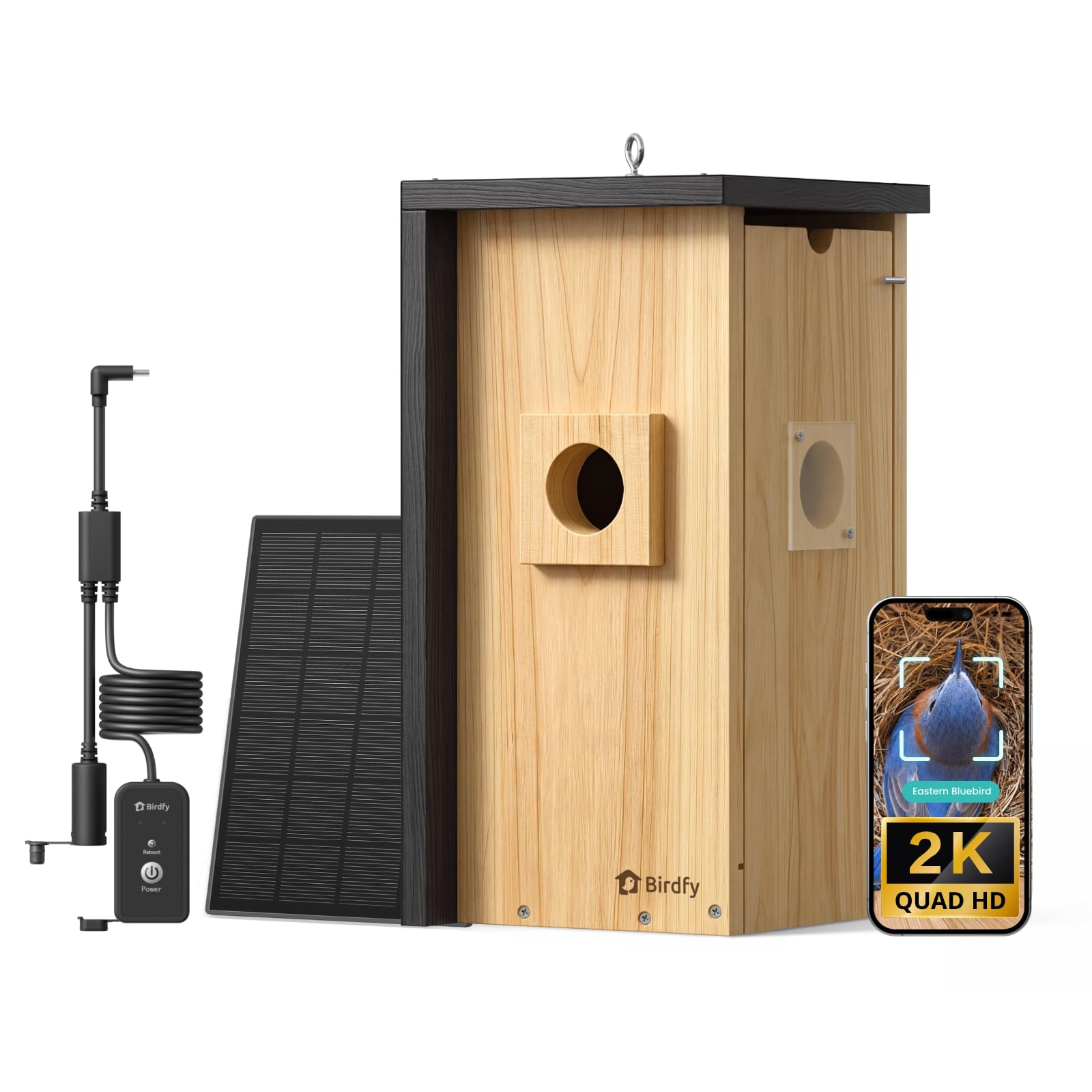
Nest cameras have an awkward problem: every time you open the box to charge it, you disturb the birds. This Birdfy solves that with an included 10-ft (3 m) extension and control box, so you can power-cycle or charge from a distance and leave the nesting space alone. That single piece of hardware is what makes it a genuine nesting box rather than a feeder with a camera bolted on.
The entrance hole measures 1.5 inches, sized to welcome bluebirds, wrens, tree swallows, and chickadees while keeping out larger unwanted occupants like European starlings. Building it is a quick job with the included hanging tool and mounting kit. The camera records in 2K QHD (sharper than full HD) with infrared night vision, identifies birds with free lifetime AI, and sends instant alerts. A 3W solar panel keeps it charged, and the IP65-rated camera handles rain and dust.
Quality and setup are what draw the best feedback — the fir wood and metal cladding feel solid in the hand, and assembly is quick. What holds it back is the power side. Some owners find the battery does not last long and needs cycling, which is the honest catch at this price. If full sun hits your mounting spot, that fades. If it does not, plan to top it up.
Built for the nest: the remote control box plus the 1.5-inch entrance make this the pick when the point is watching eggs and chicks, not watching a seed tray.
One catch to know: battery endurance is the weak link, so treat solar placement as part of the install, not an afterthought.
Best matched to: anyone who wants to follow a nesting season without a ladder and a screwdriver every week.
Not the one for: a shaded yard where a 3W panel will struggle to keep the battery ahead.
3. Smart Bird House with Camera (Green)
Three camera angles inside one cedar box, so you see the nest from more than straight on.
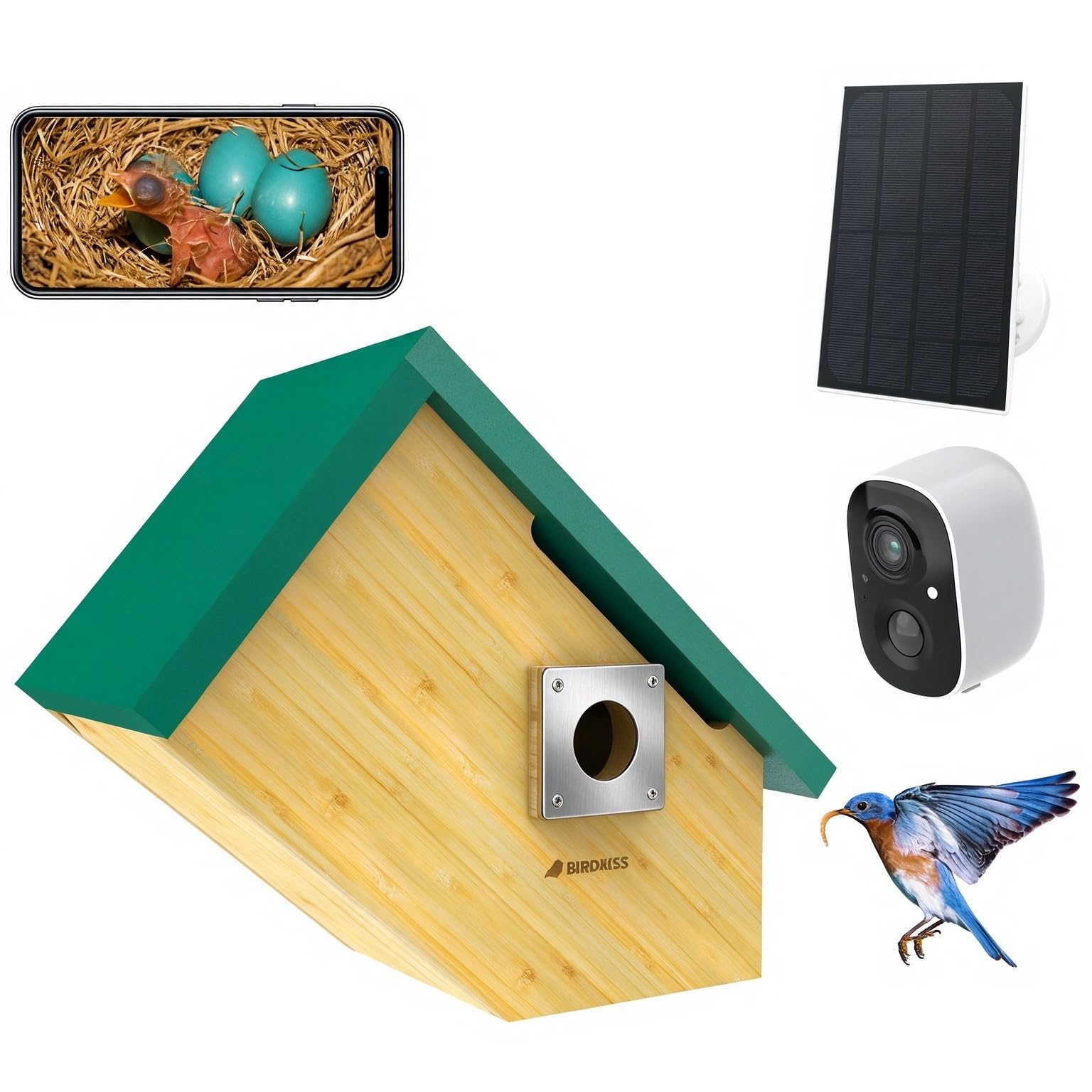
Most nest cameras give you one fixed view of a small dark space. The Birdkiss camera is a three-angle design, which means you get several perspectives on the same nesting activity — closer to a nest cam than a spyhole. Video is 1080p HD with a built-in microphone that picks up sound from the nest, and the app lets you follow along and share with family.
The nest itself is cedar wood and bamboo, with three interchangeable metal entrance guards in different hole sizes to resist damage at the opening. Frosted windows let light in, ventilation openings keep air moving, and wide roof overhangs shelter the nest from rain. A front-opening door makes cleaning between nesting seasons straightforward. Power runs from a 3W solar panel and a built-in 5000mAh battery, with a 3-meter panel cable so you can chase the sun.
The cedar box and metal entrance guards are solid; the camera is the weak link. Camera reliability and connectivity are the two things that get mixed responses — plenty of buyers report the camera working great, while others have had it quit or drop offline repeatedly. This is a camera that works well on a strong 2.4GHz signal and can frustrate in a weak one. Get the antenna high and close to your router before you judge it.
Why it earns a place
- Three-angle camera shows the nest from multiple perspectives
- 32GB micro SD card included for local recording
- Three interchangeable metal entrance guards in different sizes
- 3W solar panel with a 3-meter cable for flexible placement
Where it asks patience
- Connectivity struggles are the most-discussed issue here
- Durability has taken hits with roof cracking and peeling
- 2.4GHz Wi-Fi only, and the antenna placement matters a lot
Yes to this one if: a multi-angle view of the nest is worth a little Wi-Fi tuning to get stable.
Third-party competitor note: the IUUZEUL below is the safer first purchase if connectivity reliability worries you.
4. Birdfy Smart Bird House with Camera
It edits the whole nesting season into a video diary while you sleep.
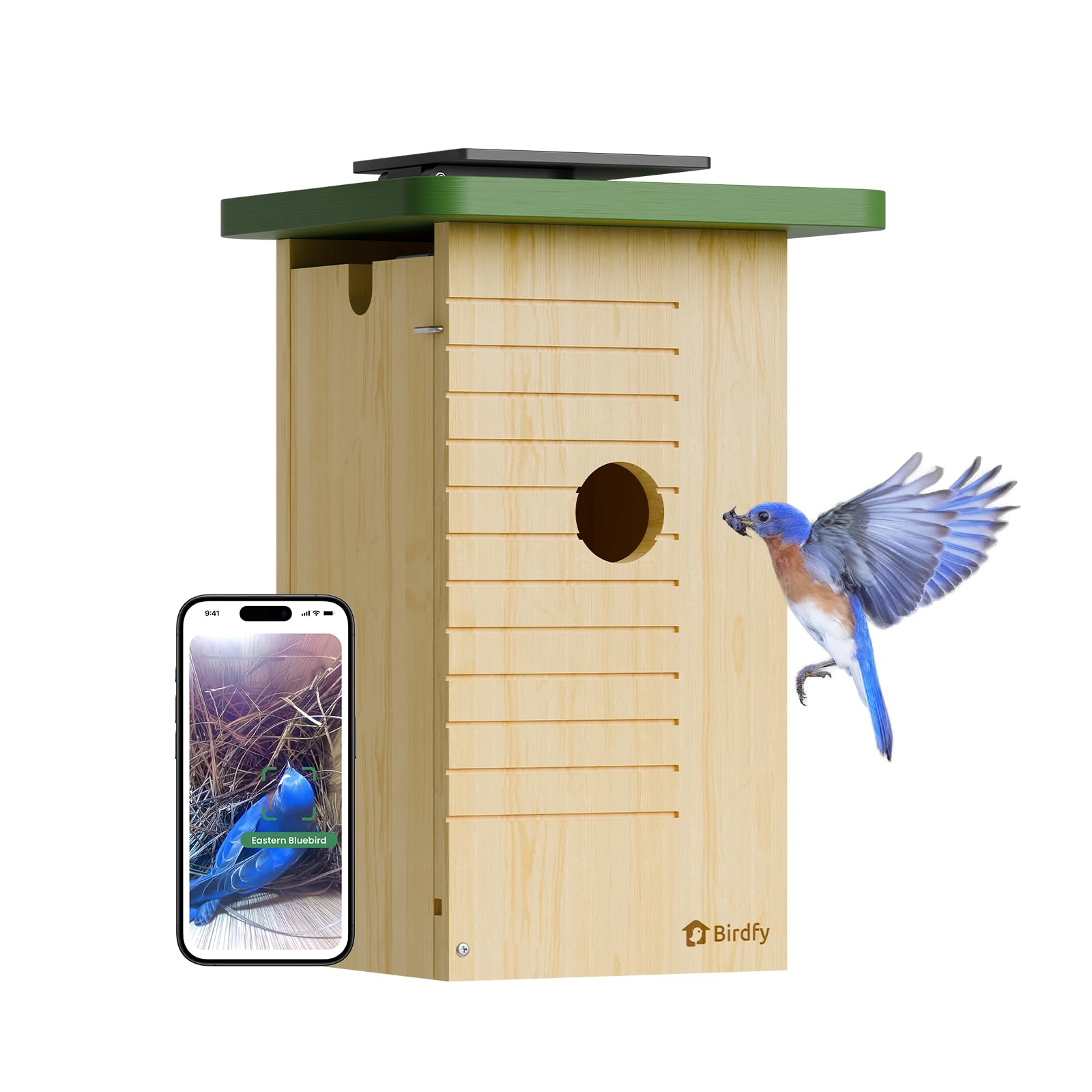
Its nesting-diary AI flags key stages — first twine, eggs laid, chicks hatched, fledglings leaving — and stitches them into one highlight video automatically. You get a keepsake of the season rather than an endless timeline to scrub through. It sits in fir wood with proper ventilation and drainage, and it bolts to a wall or pole with a tool-free design.
The camera gives a 1080p FHD view on your phone with infrared night vision that does not flood the nest with light, so the hidden moments at night stay watchable. Footage saves to the cloud at no charge through the whole breeding cycle, with an extra 30-day window afterward to download anything you want to keep. At 3 pounds it is one of the lighter housings in this group.
Durability is where it wins people over — the woodwork reads as solid, and it sets up in minutes. The honest caveat is power and reliability, both of which split opinion. Some units run for weeks without a blip on the solar panel; others have had the camera cut out. Full sun on the panel and a clean 2.4GHz signal are the two things in your control, and both are worth sorting before mounting.
The draw: a self-editing nesting diary and free cloud storage for the entire breeding cycle is a lot of value packed into a 1080p box.
The trade-off: this is a camera that can be brilliant or patchy on power, so buy it planning to keep the panel clear.
For the memory-keeper: if you want the nesting season captured and edited for you, nothing else here does that.
Look past it if: you need guaranteed all-day runtime in a low-sun spot.
5. Netvue by Birdfy Smart Bird Feeder
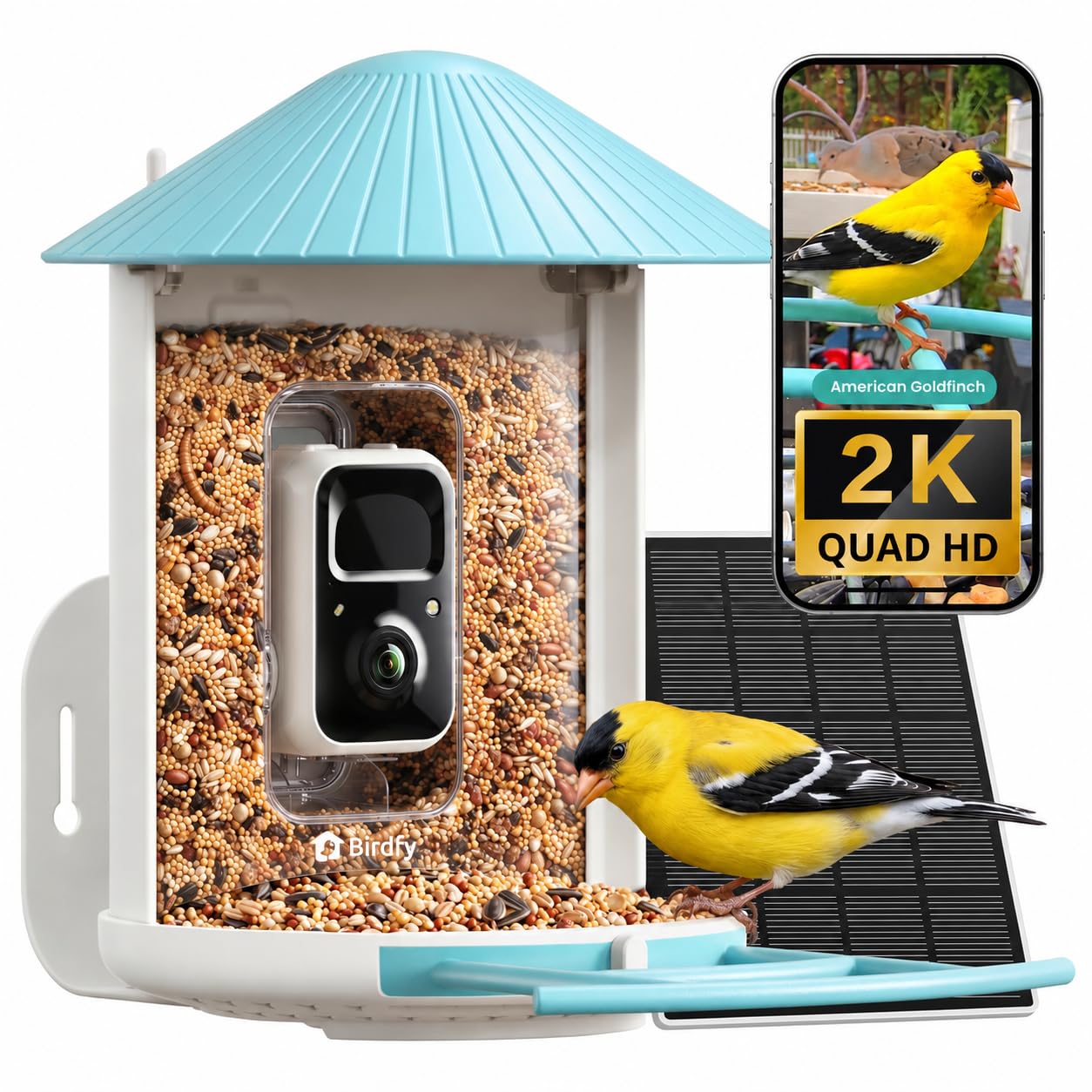
The long-runner of the group — a feeder camera with years of owner feedback behind it.
This is the Netvue-built Birdfy feeder, and it shows what happens when a design has matured in the field. The lens is 2K QHD with a 136° adjustable wide angle, so you can widen or tighten the frame depending on where birds land. Color and black-and-white night vision keep the late visitors visible, and motion detection auto-records each visit while pushing alerts to your phone.
Bird ID is free for life, and the purchase includes 6 months of the Plus membership for extras like automatic video highlights and expanded collection storage — after that, identification still stays free. A 5200mAh battery and 3W solar panel keep it running, a 5dBi external antenna holds the 2.4GHz signal, and the 1.5L seed container cuts down on refills. IP65 protection and wall, pole, or tree mounting round out the install options.
Compare it with the Kiwibit and the trade-off is simple. The Kiwibit records at 4K (about four times the pixels of 2K, so finer feather detail), while the Netvue tops out at 2K (2560 x 1440 pixels). But the Netvue costs less and includes six months of a paid membership on top of free bird ID (the app’s automatic species recognition). Pick the Netvue if you want the proven version of this camera rather than the newest.
Standout strengths
- 2K QHD with an adjustable 136° wide angle
- Lifetime free bird ID, plus 6 months of Plus included
- 5200mAh battery with 3W solar panel and a 5dBi antenna
- 1.5L seed container and IP65 weather protection
Where it holds back
- 2K tops out below the Kiwibit’s 4K image
- Plus features taper off once the included months run out
- 2.4GHz Wi-Fi only, so keep the antenna aimed well
The steady pick: six months of a paid membership plus free ID long after is a quiet bargain for a feeder camera.
Know before you buy: if 4K detail is the goal, the Kiwibit above beats it on the lens — 4K against 2K.
6. Made in USA, Rustic Cedar Bird Houses with Solar Camera
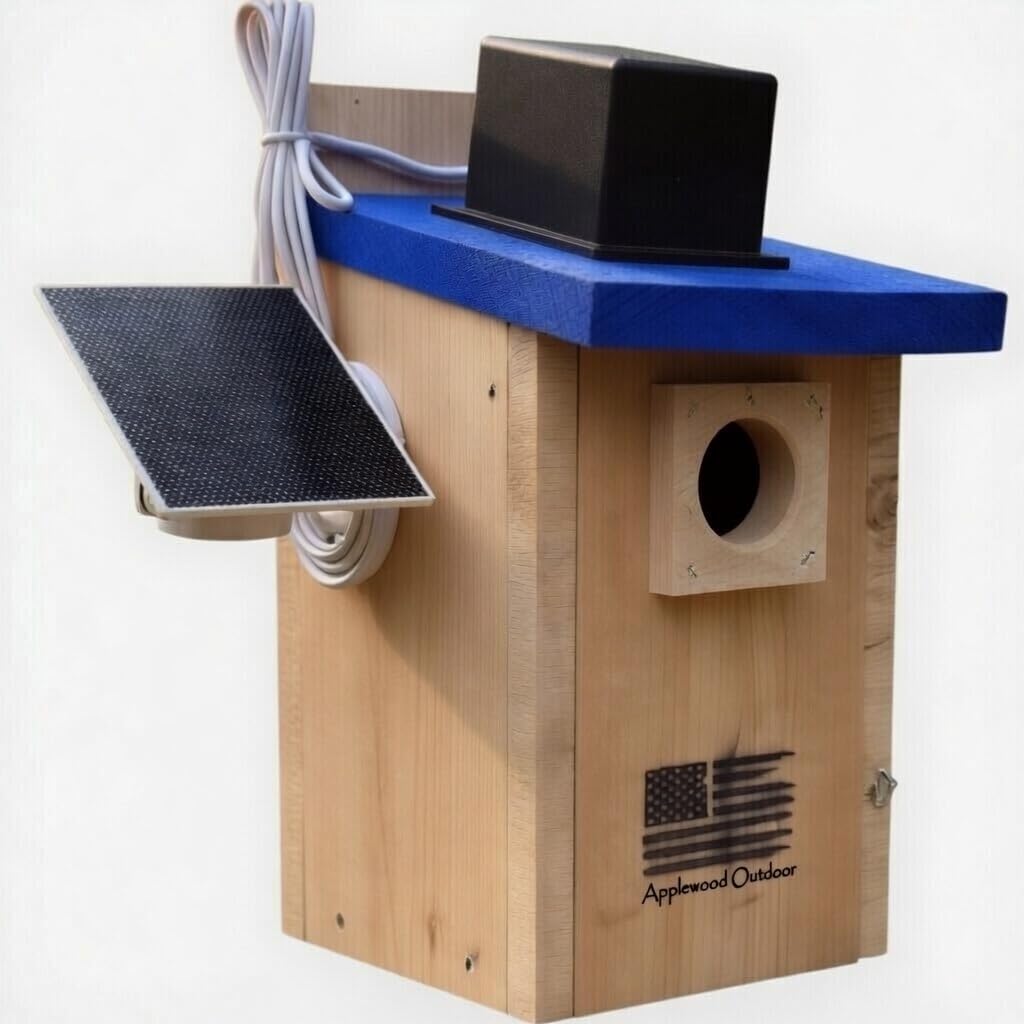
Rough-sawn western red cedar and a 1 9/16-inch opening with a predator guard.
This Applewood Outdoor box is built like a birdhouse first and a camera housing second. The entrance measures 1 9/16 inches and sits behind a predator guard, which stops larger animals from reaching inside to the nest. The rough sawn western red cedar (a wood that resists weather on its own) gives it a rustic look and, according to the maker, needs no finish to hold up outdoors. The front opens for the annual clean and the floor has vents and drains.
Construction is the story owners keep coming back to — the cedar panels feel solid rather than glued together, and the whole box is pre-drilled with mounting holes and two 2 ½ inch screws included. It arrives fully assembled, so installation is a few minutes on a wall or pole. The camera pairs with an Apple or Android app, and the solar panel can sit on the box or be moved to a sunnier spot if your mount sits in shade.
Want the honest bit? All materials except the camera system are North American sourced and made in Wisconsin — that is a real draw if local sourcing matters, and it explains the higher position here. The camera is a basic app-based unit below the 4K and 2K options here, so buy this for the cedar box and predator guard, not the lens.
Build with a pedigree: USA-made cedar, a predator guard, and pre-drilled mounting holes make this the most house-for-the-birds option on the list.
What you are not getting: the camera takes a back seat to the 4K and 2K lenses elsewhere here.
The craftsmanship choice: pick this when the nesting box itself matters as much as the app.
Not the first pick for: someone chasing the sharpest video feed available.
7. Bird House with Camera Solar Powered

A wooden nesting box whose motion alerts fire when a bird lands or an eggshell cracks.
The IUUZEUL captures in 2K with night vision, and the motion detection is tuned to catch everything — a bird landing, or an eggshell breaking — then fires a notification to your phone. Setup runs over 2.4G Wi-Fi or Bluetooth, which makes first pairing simpler than the Wi-Fi-only boxes here. It arrives pre-assembled, so mounting takes minutes.
The house itself is wood with a sloped roof for drainage, a front door that opens for cleaning once chicks fledge, and a small side window that lets light into the nest. The entry hole measures 1.57 inches with a perch below, sized for bluebirds, warblers, chickadees, and swallows. A built-in feeder on the side adds a food source. There is no 5G Wi-Fi support, so your router’s 2.4GHz band is the one to use.
Bird activity draws the best feedback here — the box pulls in steady visitors and the viewing stays fun. The catch is reliability, which is the honest split: some units run flawlessly, others work only part of the time, and the app has had trouble on newer phones. This is a good entry point into nest watching, but it is the least certain on the list for a long, uninterrupted season.
Points in its favor
- 2K resolution with infrared night vision
- Motion detection that records and alerts in real time
- Wood construction with a sloped drainage roof
- Connects over 2.4G Wi-Fi or Bluetooth
Where to set expectations
- Reliability splits opinion — some units work only part of the time
- App compatibility has been a problem on newer phones
- No 5GHz Wi-Fi support
Worth a look if: this is your first camera birdhouse and you want a low-cost way in.
Think twice if: a full uninterrupted nesting season matters more than keeping costs down.
8. APS Metal Bird Feeder with Camera
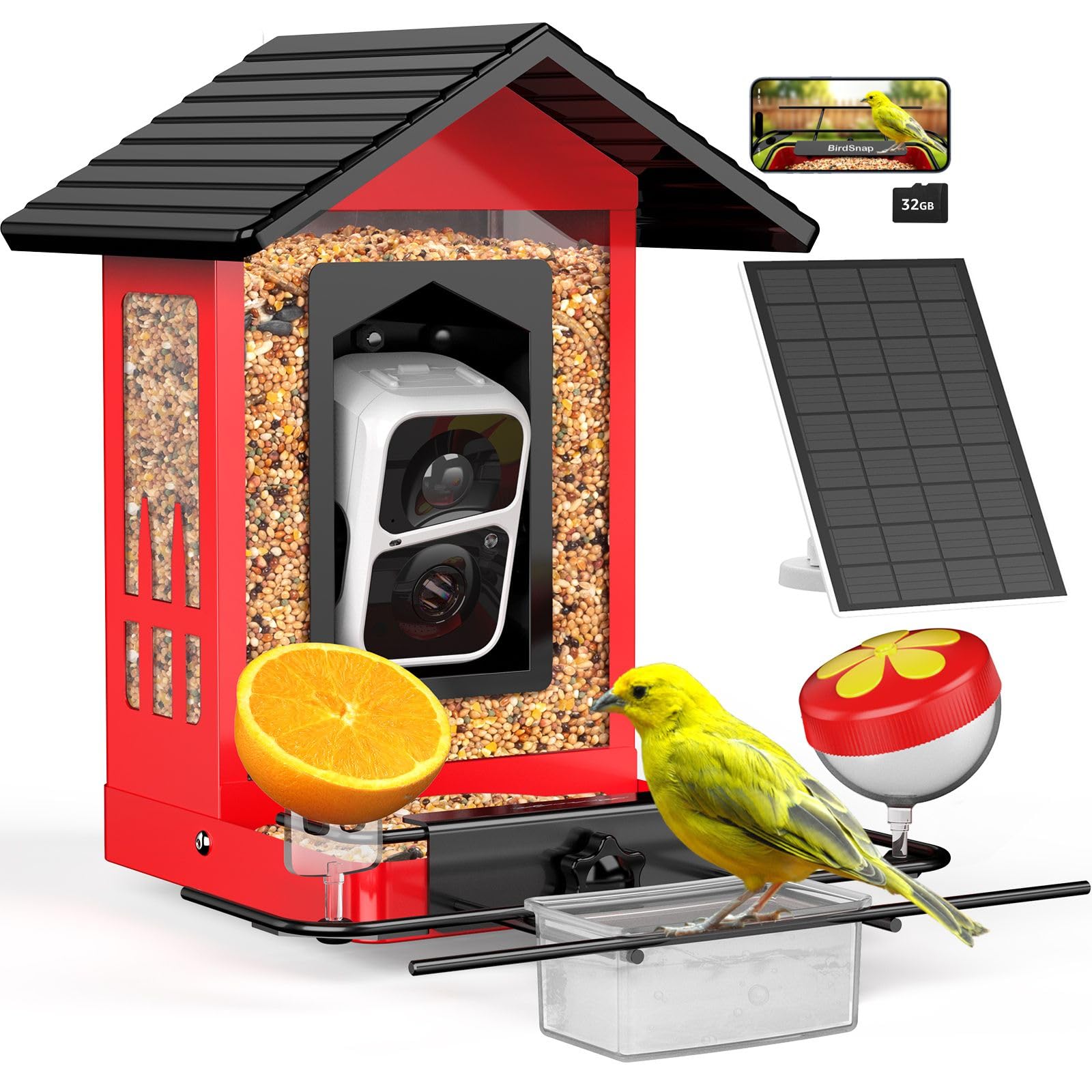
Holds 4.3 liters of seed — nearly three times what the Kiwibit carries.
If refilling a feeder is the chore you want to end, this is the one. The seed hopper holds 4.3 liters, which is 2.9 times the 1.5 liters the Kiwibit and Netvue feeders both carry. It also weighs 4.2 pounds, and comes in a metal casing built with drainage holes so seed stays dry through rainy and snowy stretches. Three DIY add-ons come in the box: a water box, a hummingbird feeder, and a fruit fork.
The camera is 2K with a 160° wide angle, wider than anything else on this list, so a broad slice of feeder stays in frame. It auto-captures and identifies 10,000+ bird species, and a 32GB card is included — enough for more than 20,000 ten-second clips — so footage saves even with no network. A 5200mAh battery and an adjustable solar panel keep it powered, and a 5dB antenna holds the 2.4GHz signal.
Sturdiness is what earns the strongest praise: the metal housing holds up through winter without complaint. The mixed bit is charging consistency, where the solar panel keeps some units topped up and others still need the battery coaxed. This is the feeder for someone who wants volume and a rugged build, and is willing to keep an eye on power through gray months.
Volume wins: 4.3 liters against 1.5 on the Kiwibit means far fewer trips with the seed scoop.
Rugged by design: metal casing and drainage holes make this the most winter-ready feeder here.
One caveat: expect to monitor charging, since solar performance is uneven.
The feeder for a full yard: choose it when capacity and metal build outrank a 4K lens.
Skip the upgrade if: you want the sharpest video stream — the Kiwibit’s 4K leads on that.
9. ISENLAND Smart Bird House with AI Identify Camera, 1080P
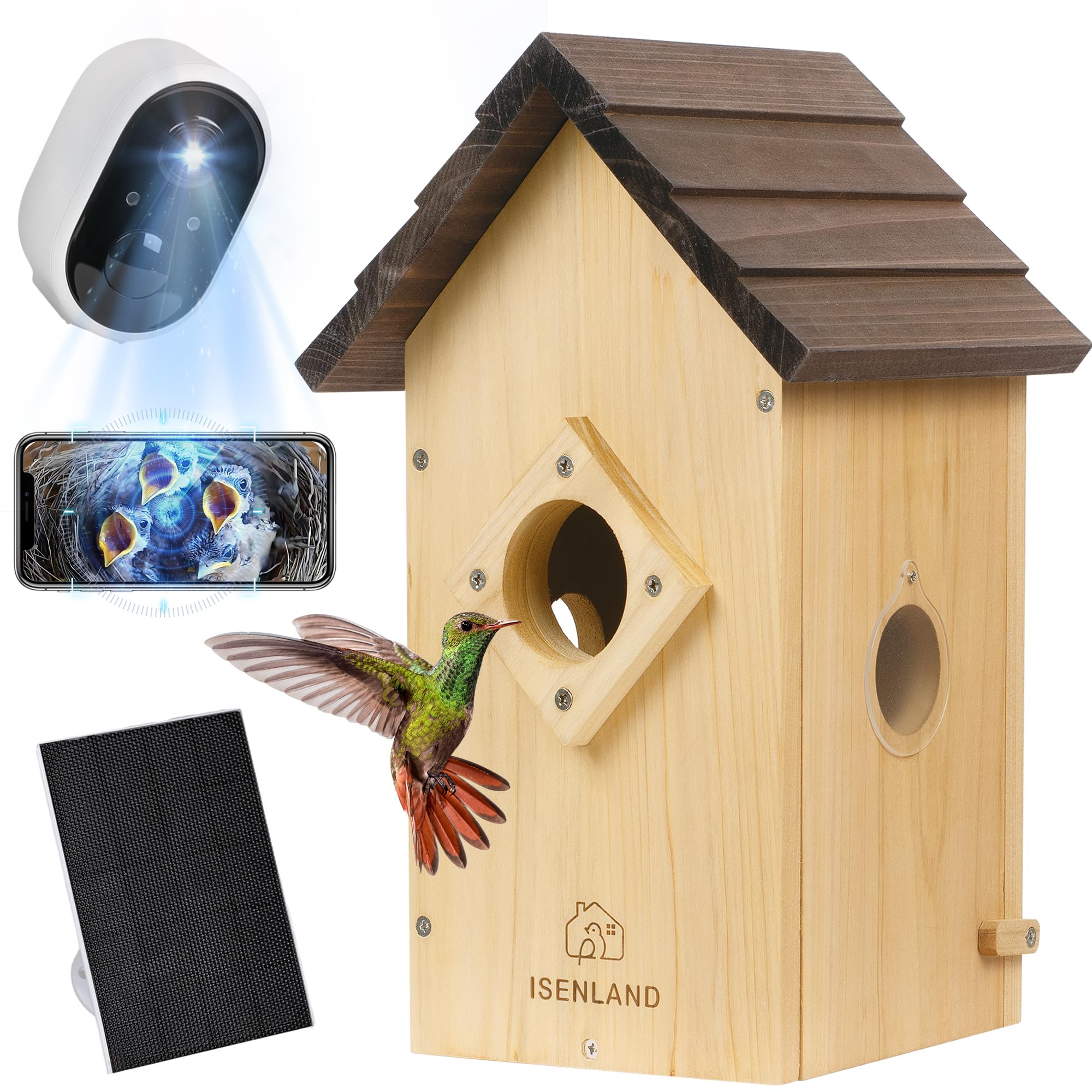
The gentlest entry into nest watching — wood, solar, and a 1080p cam.
For a first camera birdhouse, the ISENLAND makes the decision simple. The camera shoots 1080 HD, connects to a phone app, and includes a playback function so you can relive the moments you missed. It identifies 10,000+ bird species with PIR motion detection (a sensor that triggers on a bird’s movement) picking up arriving visitors and capturing a photo and details of each one. The 850nm night vision light keeps working after dark without disturbing the birds.
The house is wood, measures 5.91 by 5.91 by 12.2 inches, and weighs 2.29 kg — compact enough to hang on a tree or wall. A solar panel keeps it charged through the day, and the IP65 waterproof build handles rain and snow, though it cannot be immersed. As a garden gift for a nature lover, it earns its keep: the picture and video come through clearly.
As a nesting camera it is a basic build. It gives you a window into activity and nesting stages with a playback, but it is not the sharper-lens option and does not carry the AI nesting-story editing that the Birdfy housings offer. If you want a clean, low-cost start and clear images, this delivers. If you want rich footage of a full season, spend up the list.
Best value in the group: 1080p, 10,000+ species ID, and a solar panel in one affordable box.
The obvious limit: 1080 HD falls short of the 2K and 4K cameras here, so detail stops sooner when you zoom.
A good first step: for a gift or a starter, this covers the basics without the risk.
Look up the list when: you catch the bug and want sharper video and deeper AI.
Know the Specs
Camera resolution: 1080p, 2K, and 4K
Resolution is the amount of detail packed into each frame. 1080p is standard HD, 2K is sharper, and 4K is the sharpest — the Kiwibit’s 4K video and 8MP stills are the top example here. Higher resolution means clearer feather detail when you zoom, but also bigger files and more demand on the Wi-Fi link.
Battery and solar pairing
Most cameras here run on a rechargeable battery, often 5200mAh, topped up by a small 3W solar panel. Battery life depends on how much sun the panel gets and how much it streams. A longer panel cable lets you place it in a brighter spot.
Wi-Fi band and antenna
These systems connect on 2.4GHz Wi-Fi, and none support 5GHz. The 2.4GHz band reaches further through a garden but carries less data. A 5dBi or 5dB antenna holds a steadier signal, so place the camera within range of your router before mounting.
Entry hole and species
The size of the entrance decides who nests. A 1.5-inch or 1 9/16-inch hole welcomes bluebirds, chickadees, and wrens, while keeping out larger species like starlings. A predator guard around the opening stops bigger animals from reaching inside.
Common Questions
Do these smart bird houses work on 5GHz Wi-Fi?
Will birds actually nest in a house with a camera inside?
How long does the solar panel keep the camera running?
What is an entry hole and why does its size matter?
Do I need a subscription to identify bird species?
Can I save videos without Wi-Fi or cloud storage?
Will a smart bird house survive rain and snow?
Is a bird feeder camera or a bird house better for watching?
How do I clean and maintain a camera bird house?
Will the camera disturb birds at night?
The Bottom Line
The smart bird house worth starting with is the Kiwibit Solar Smart Bird Feeder — the 4K lens and lifetime free identification carry it, and the dual solar panels keep it running without a subscription. If you want a box built for the birds themselves, grab the Birdfy with Metal Cladding, whose 10-ft control box lets you charge it without disturbing the nest. And for a yard that empties a feeder fast, the APS Metal Feeder holds 4.3 liters against the Kiwibit’s 1.5, so you refill far less often.
How we choose
We do not accept paid placement. Every pick is matched to a real buyer and a real use-case; we do not hands-on test units.
Sources
Specifications: manufacturer listings and product documentation. Review insights: verified customer reviews, as of November 2026. Pricing: not shown on this page (it changes often); check the current price via the retailer link.
As an Amazon Associate, Tactical Gear Guy earns from qualifying purchases. This does not affect which products we feature.