Specs are compiled from manufacturer listings and verified buyer reviews and can change over time — please confirm the key details on the product page before buying.
A smart backlight TV lives or dies on one thing: how well it controls light. That means the difference between deep blacks and washed-out grey, between a bright room you can actually watch in and one you can’t. This guide breaks down the real specs — dimming zones, peak brightness, refresh rate — in plain English, and pairs them with what owners actually experience. You’ll finish knowing which set fits your room size, your console’s refresh-rate needs, and your tolerance for menu quirks.
This guide is built by comparing the manufacturers’ published specifications and the patterns across verified customer reviews, so you get each pick’s real strengths and trade-offs instead of marketing spin.
Mini-LED sets are now crowding every shelf, and the labels blur together fast. The crowd favorite this year — the Hisense U7 — sits at 4.0+ stars across 400+ owners, but it isn’t right for every wall. Below are eleven picks, from a 43-inch Mini-LED for small rooms to a 75-inch movie wall.
Top Picks
How To Choose The Best Smart Backlight TV
Most people shopping for a smart backlight TV get stuck on the wrong question: which screen is brightest? Brightness alone doesn’t fix a washed-out night scene. What matters is how the backlight is divided up, how fast the panel refreshes, and whether the coating kills reflections in your specific room.
Dimming zones and why they change everything
A dimming zone is an independent patch of backlight that can brighten or darken on its own. More zones means finer control — a streetlamp in a dark scene glows without bleeding a grey haze into the sky around it. A cheap edge-lit set has effectively one giant zone, so everything brightens together and dark scenes look milky. Mini-LED sets divide the panel into hundreds or thousands of small zones, which is why the whole category exists.
Refresh rate, VRR, and what your console needs
Refresh rate is how many times per second the screen redraws — 60Hz is the old baseline, 120Hz is now common, and 144Hz or 165Hz panels sit at the top. For sports and action, higher refresh keeps fast movement sharp. For gaming, variable refresh rate (VRR — the panel syncing its draw rate to the console’s output) removes screen tearing when frame rates dip. If you own a current-gen console, look for at least 120Hz with VRR support and auto low-latency mode.
The anti-glare factor most buyers overlook
A bright living room with windows behind the couch is the hardest test any backlight TV faces. Anti-reflection coatings reduce the mirror-like bounce of light off the glass, which keeps the picture readable when the sun is up. Not every set has one, and the ones that do vary in how aggressively they cut glare. If your TV faces a window, this single feature matters more than an extra few hundred nits of peak brightness.
Side-by-Side Comparison
| Model | Best For | Refresh Rate | Backlight Type | Size | Amazon |
|---|---|---|---|---|---|
| Hisense 55″ U7 Mini-LED★ Best Overall | All-round gaming and movies | 165Hz | Mini-LED | 55″ | Amazon |
| Samsung 43″ QN70HCompact Pick | Small rooms and desks | — | Mini-LED | 43″ | Amazon |
| Toshiba 65″ Z670RTop Performer | Big-screen value gaming | 144Hz | Mini-LED | 65″ | Amazon |
| Philips 65″ 7985 Ambilight | Ambient-lit movie nights | 120 PMR | QLED | 65″ | Amazon |
| Hisense 55″ U8 Series | Peak brightness and contrast | 165Hz | Mini-LED | 55″ | Amazon |
| Roku 65″ Pro Series | Simple interface and free content | 120Hz | Mini-LED | 65″ | Amazon |
| TCL 75″ Q65 | Big screen on a tighter budget | 120 VRR | LED | 75″ | Amazon |
| TCL 75″ QM8L | Home theater impact | 144Hz | Mini-LED | 75″ | Amazon |
| Sony 75″ BRAVIA 5 | PS5 owners and movie purists | — | Mini-LED | 75″ | Amazon |
Detailed Reviews
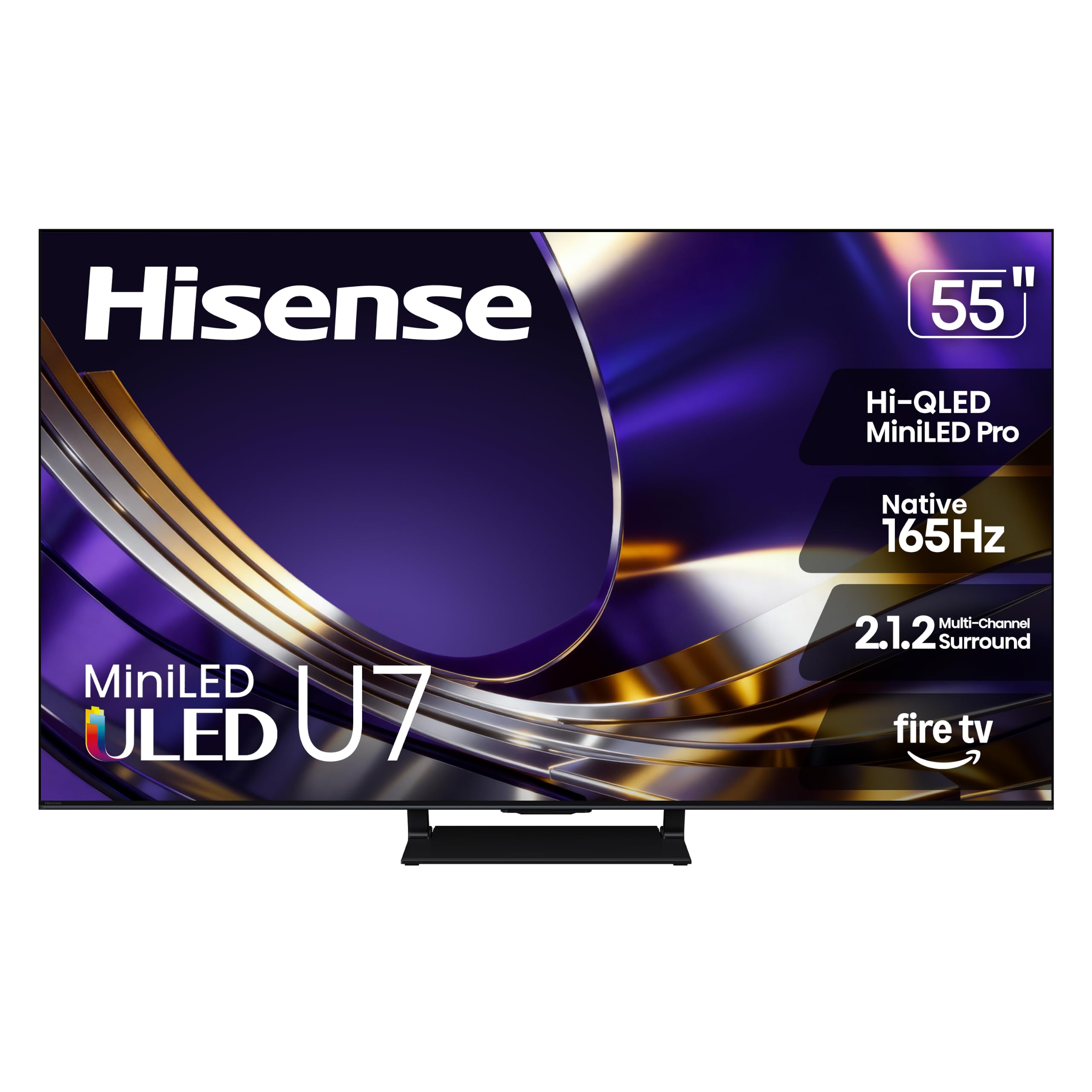
1. Hisense 55″ U7 Mini-LED ULED 4K Smart Fire TV
Our pick — 4.0+★ from 450+ verified ratings; the strongest balance of quality and price.
A gaming-first panel that also wins the living room, without asking you to compromise.
If you want one set that handles a bright Sunday football game and a late-night thriller equally well, this 55-inch Hisense is the pick to beat. It runs thousands of Mini-LED backlight zones — the tiny LEDs that brighten or darken independently — for pinpoint contrast. Peak brightness reaches up to 3000 nits, so outdoor-light-level highlights still carry punch in a room with windows open. And its anti-glare layer is a dual-layer treatment, which means it cuts reflections harder than a standard single-coating screen.
For gaming, the native 165Hz refresh rate (the panel redraws 165 times a second) runs ahead of the Toshiba Z670R’s 144Hz. That gap shows up as slightly smoother fast-panning shots and less smear on quick camera moves. Its Bluetooth is version 5.4, also newer than the Toshiba’s version 5. On the audio side, a 2.1.2 channel system with Devialet tuning delivers room-filling sound from the built-in speakers, backed by Dolby Atmos and IMAX Enhanced certification.
The one honest caveat: brightness this aggressive can look overdone at night, so plan to drop the backlight a notch after dark. Specs meet buyer reality here — the picture wins near-unanimous praise, and picture quality runs a close second to overall quality in what owners talk about. Owners with the larger U8 model prove the same core tech scales up well, but the U7 keeps more money in your pocket.
Where it pulls ahead
- Native 165Hz with VRR 330 for tear-free console gaming
- Up to 3000 local dimming zones and up to 3000 nits peak brightness
- Dual-layer anti-reflection coating keeps the picture readable in sunlit rooms
- 2.1.2 channel Devialet-tuned sound
What to weigh first
- Peak brightness needs backing off at night
- 55-inch size may feel small for a large room
Reach for this if: you split your viewing between console gaming and movie nights, and want one panel that handles both without a soundbar.
Think twice if: your couch sits far from the wall — size, not spec, is the limiter here.
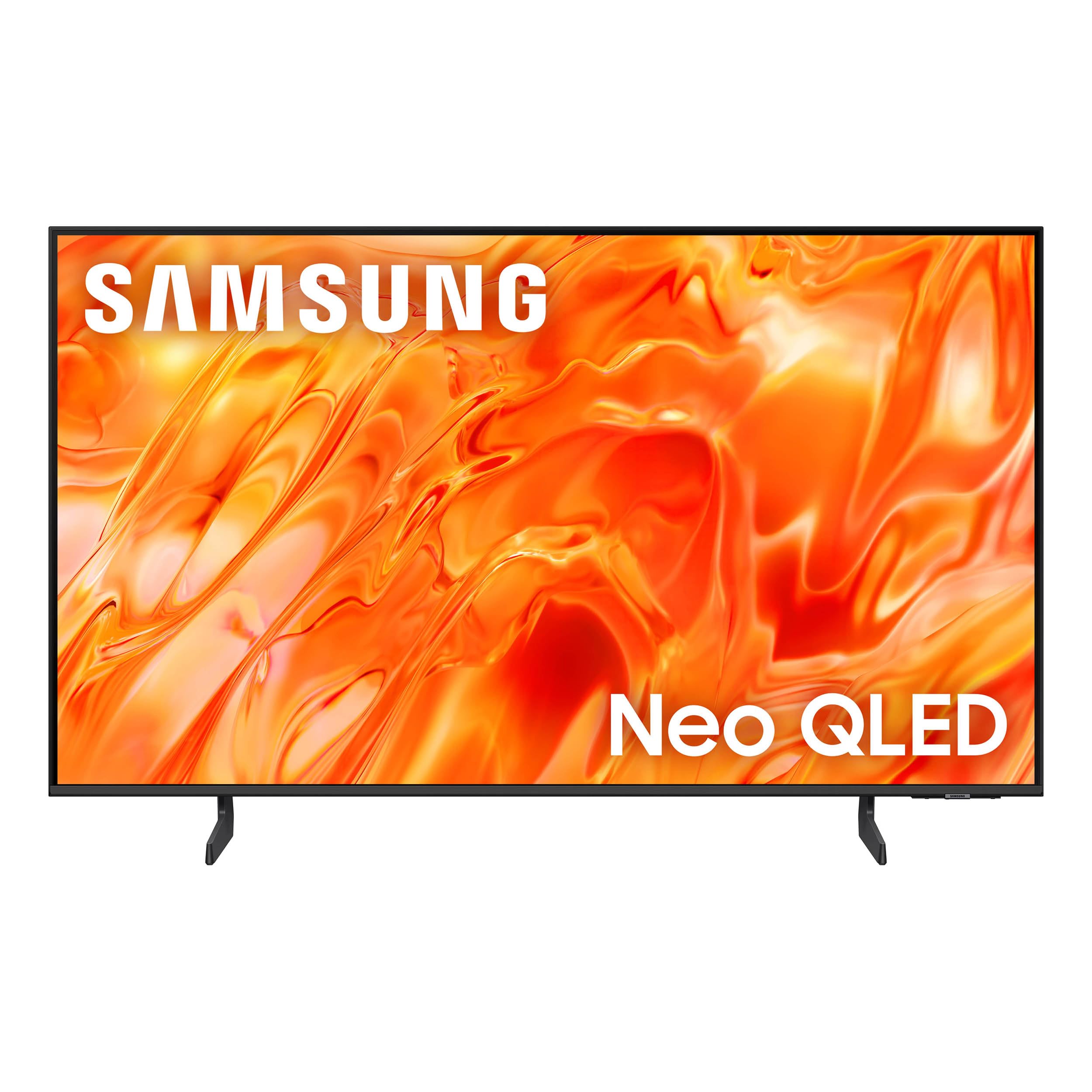
2. Samsung 43-Inch QN70H Neo QLED Mini LED Smart TV
A 43-inch Mini-LED that treats a small room like a real theater.
Most of this list is 55 inches and up, so a 43-inch panel with a genuine Mini-LED backlight stands out for apartments, bedrooms, and gaming dens. Samsung’s Quantum Mini LED gives the same contrast engine as the big sets, and 100% Color Volume with Quantum Dot means shades hold up even in bright scenes that usually wash out. The NQ4 AI Processor upscales lower-resolution content, so older shows don’t look fuzzy.
The trade-offs live in the software and remote. Navigating the menus earns mixed feedback — some find it easy, others wrestle with the options. The remote is the tougher pain point: several describe it as the worst TV remote they’ve used. Reliability feedback is also split — some say it works well, others report issues. That split matters for a set you’ll use daily, though the complaints center on interface and remote rather than the panel itself.
Best fit is a spot where the set won’t be doing eight hours a day of app-hopping. It’s a desk or guest-room companion, not a family-room workhorse. Contrast and color are the headline wins here; simple first-time setup also gets called out as a plus.
What it nails: Quantum Dot color on a genuinely compact footprint, with a 43-inch panel that keeps Mini-LED contrast in a small room.
The honest watch-out: Menu navigation and that remote split opinion, so budget a few evenings to learn the interface.
This one beats the rest on: footprint. No other pick keeps a real Mini-LED backlight in 43 inches.
Step past it if: you want a one-remote family TV — the remote gets the roughest feedback on this list.
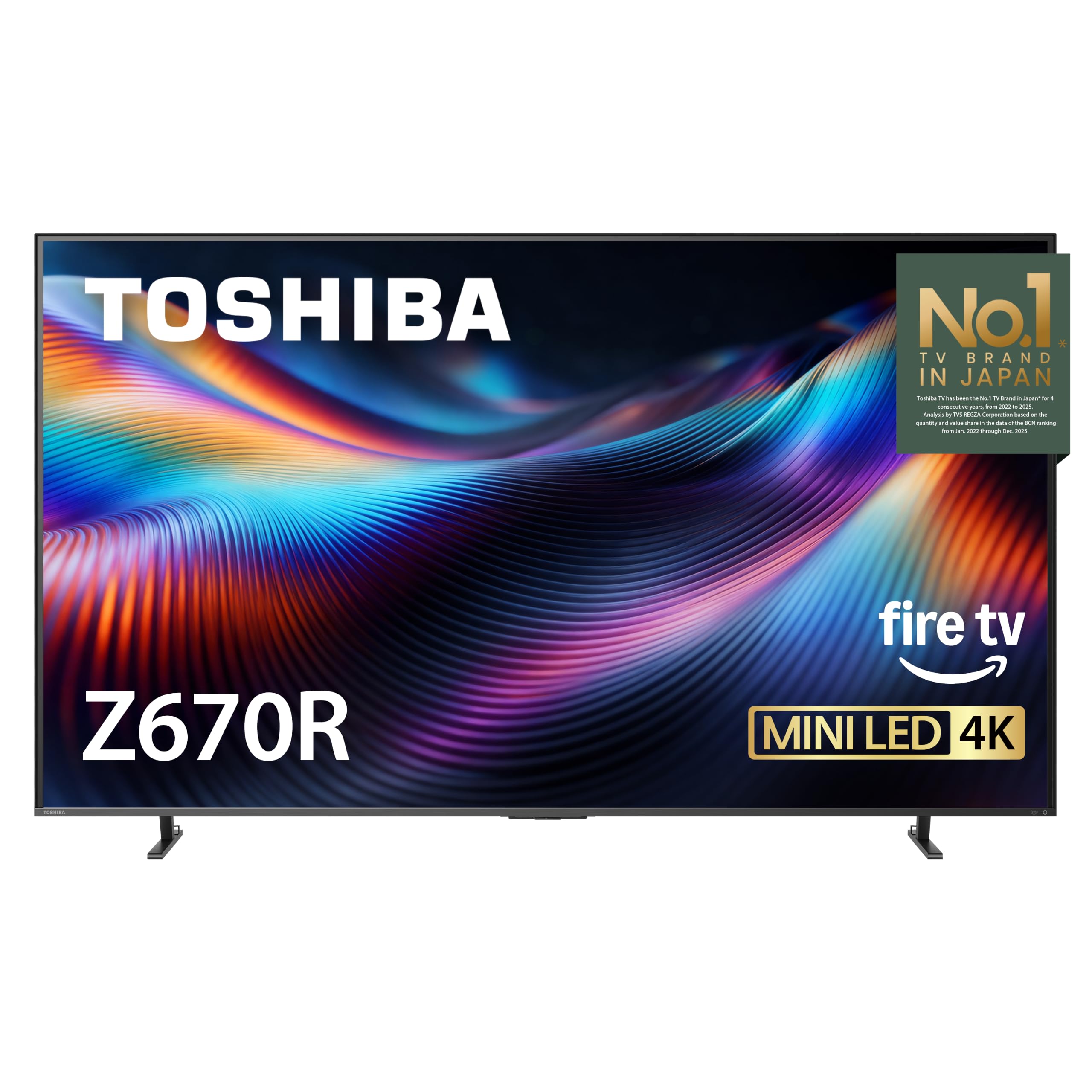
3. Toshiba 65″ Z670R Mini-LED 4K Smart Fire TV
A big-screen QLED that makes dark scenes look like they were shot in a cinema.
Mini LED with Full Array Local Dimming here means independently controlled light patches, so blacks stay deep and highlights stay bright at the same time. Add QLED color with over a billion shades and you get a picture that doesn’t fall apart in a brightly lit room. At 65 inches, it nails that “wall full of movie” feel without stretching to 75.
Motion is the story for gamers: native 144Hz, AMD FreeSync Premium, VRR 144Hz, and ALLM (auto low-latency mode — the TV flips into game mode the instant a console wakes). Streaming apps also run smoothly without lag, which is half the battle on a smart set. The REGZA Power Audio Pro with a bass woofer does the low-end without a soundbar. The one real follow-up question is durability: reliability feedback is mixed, with a minority reporting failures after a month. Reliability complaints appear across this list, and owners still rate the Z670R a good buy for the money.
What wins people over is the picture — stunning is the word that keeps surfacing — followed closely by the value. The other honest note: Bluetooth sits at version 5, older than the Hisense U7’s 5.4 and the U8’s 5.3. That affects pairing convenience for headphones but not the picture.
The case for it
- Native 144Hz with AMD FreeSync Premium and ALLM
- Full Array Local Dimming with a bass woofer built in
- QLED color over a billion shades
- Dolby Vision IQ, HDR10+, HDR10+ Adaptive, and HLG support
Where it gives ground
- Bluetooth version 5 trails newer picks
- Reliability feedback is mixed
For the movie-first buyer: REGZA engine tuning and Dolby Vision IQ deliver contrast that holds up in a bright room.
For the cautious buyer: buy with a plan for post-sale support — that’s the honest ask here.
4. Hisense 65″ E7 Cinema Series Hi-QLED Mini-LED Smart Fire TV
The only TV here that turns your wall into part of the show.
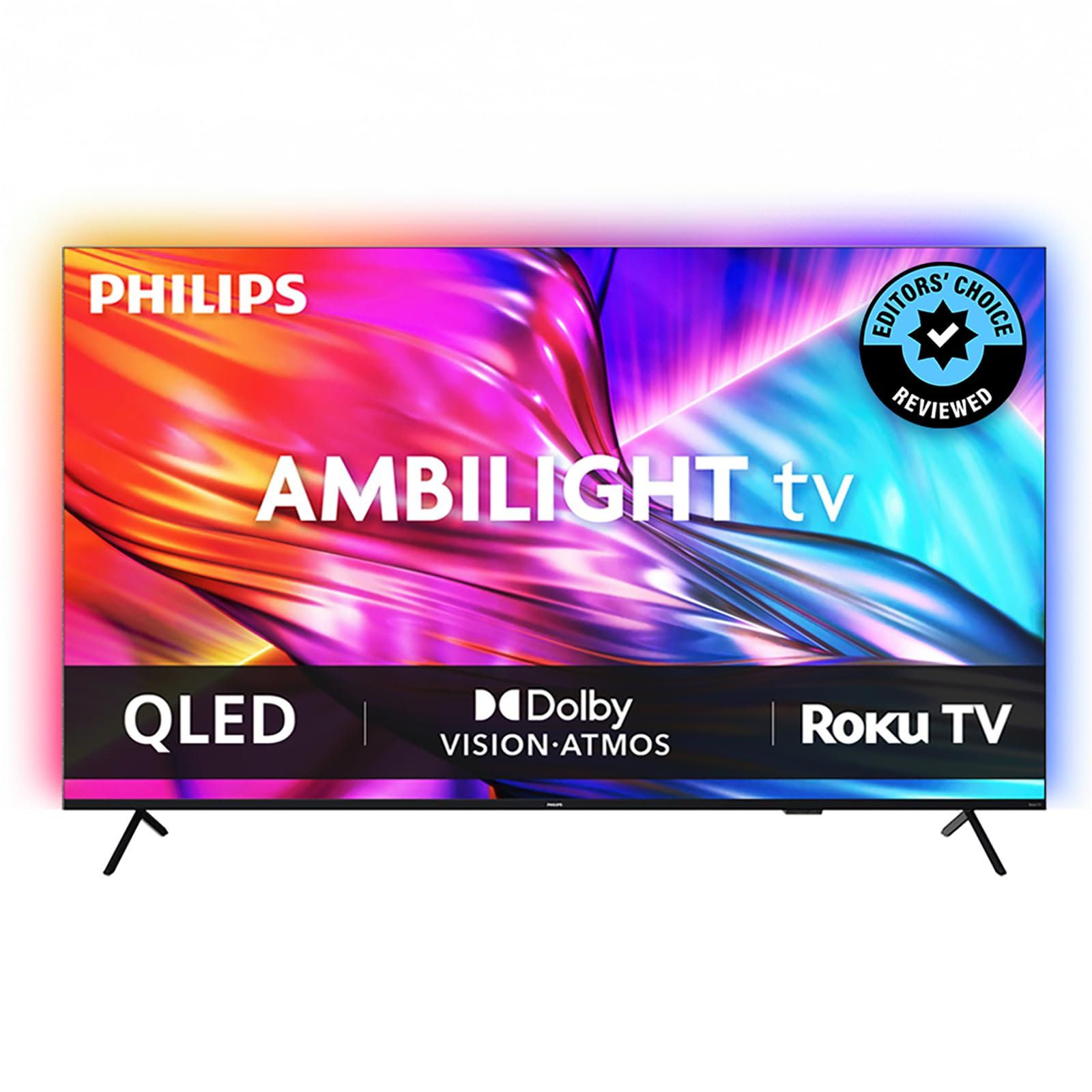
Ambilight is the hook: built-in rear LEDs read the 65-inch screen and project matching color onto the wall behind it. In Follow Video mode, the glow tracks the action; in Follow Audio, it pulses with music. A static glow stays on after the TV is off, so the wall doesn’t go dark. Bias lighting like this is the first thing guests comment on during a dark-scene movie.
The main screen is a 4K QLED with a 3840 x 2160 resolution (that’s the standard 4K pixel count) and quantum-dot color for wider range and contrast. Dolby Vision, HDR10, and HLG tune compatible content, and 120 PMR keeps sports moving cleanly. Two built-in speakers with Dolby Atmos handle the sound, and HDMI 1 carries eARC for a soundbar or AV receiver.
Streaming is Roku’s home turf — Netflix, YouTube, Prime Video, Disney+ and 500+ free live channels sit on one home screen. Four HDMI inputs take a cable box, console, soundbar, and streaming stick all at once. Picture quality and the ambient lighting are what owners highlight most; the one caveat is that QLED here lacks the local dimming of the Mini-LED picks, so night-scene blacks aren’t quite as deep.
The signature move: rear LED lighting reads the screen and paints matching color on the wall, so a movie night becomes a room-filling event.
Where it sits in the pack: QLED without local dimming means blacks trail the Mini-LED picks — great for bright rooms, less punchy in a dark cave.
The right buyer: someone who wants a TV that feels like a piece of furniture and a light show rolled into one.
The wrong room: a pitch-black home theater — that’s where local dimming matters more than ambient glow.
5. Hisense 55″ U8 Series ULED Mini-LED Smart Google TV
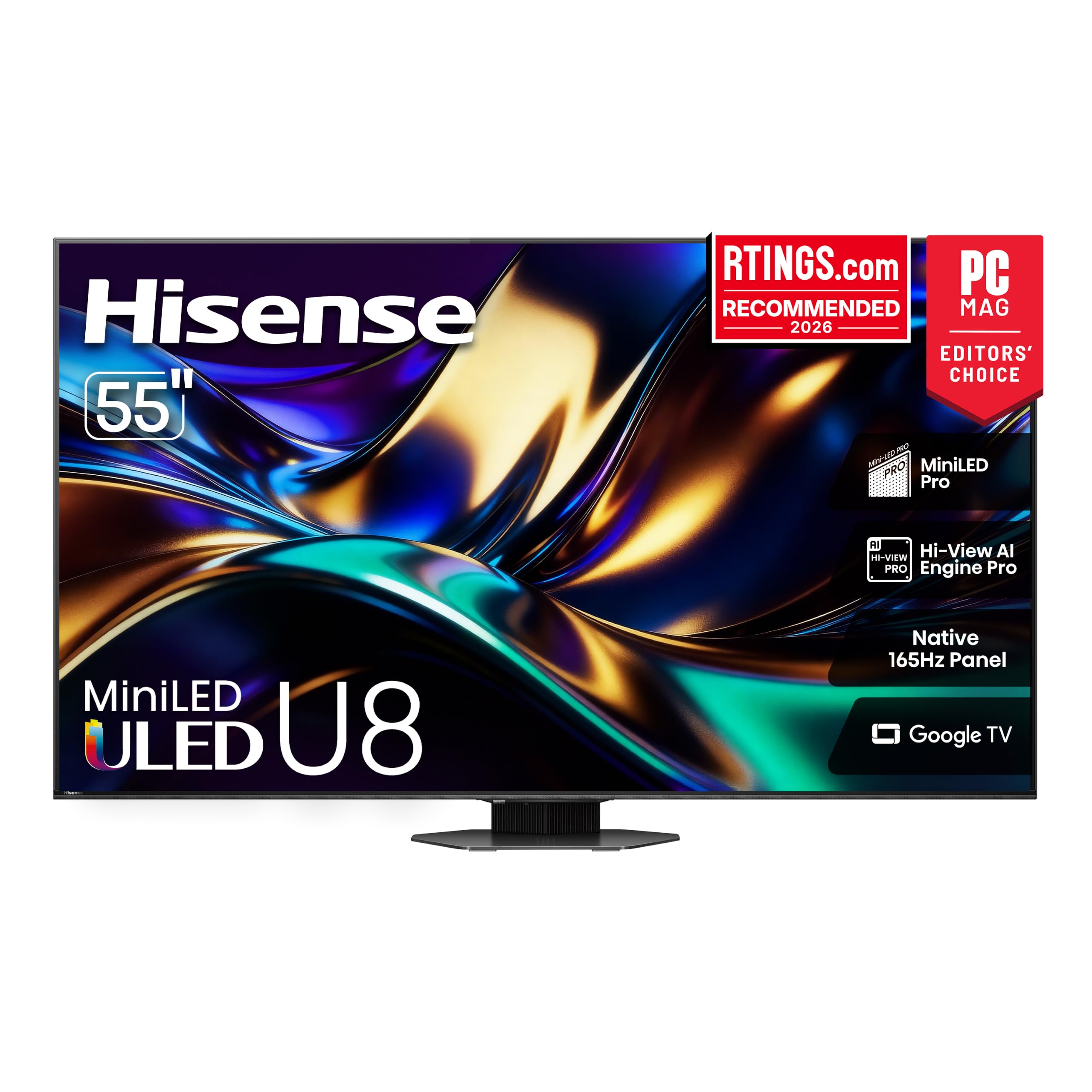
Peak brightness and dimming-zone count that leave the rest of this list behind.
The headline here is the backlight: up to 5000 nits peak brightness and up to 5600 local dimming zones. Translated, that’s more independently controlled light patches than any other pick, so halos around bright objects on dark backgrounds nearly disappear. Full Array Local Dimming doubles down on contrast, and QLED Color with Pantone Validation keeps team jerseys and skin tones honest. This is the brightest panel by a wide margin, which matters in a room with big windows.
Gaming gets real hardware: a native 165Hz panel with VRR 48Hz to 165Hz, AMD FreeSync Premium Pro, ALLM, and a Game Bar on screen. That’s a meaningful edge over the Toshiba Z670R’s 144Hz for anyone chasing high-refresh play. Audio is a 4.1.2 channel setup with two up-firing speakers and a built-in subwoofer — Dolby Atmos gets height, not just width. Anti-Reflection Pro applies a coating inside the liquid-crystal layer to cut glare further.
The honest trade-off is what owners call out when it goes wrong: some report the set periodically stops working or won’t power on. That mixed performance feedback is worth knowing. When it does work, the picture is the kind of bright, vivid thing people describe as OLED-adjacent
The number that matters: up to 5000 nits peak brightness is the most any panel here delivers.
Worth knowing: at 264 kilowatt hours per year estimated, this is one of the thirstier screens in the group.
Made for: a bright living room with windows you can’t close, and a gamer who wants the fastest panel on this list.
Think twice if: your priority is a set-and-forget screen with zero attention — performance feedback here is mixed.
6. Roku 65-Inch Pro Series 4K QLED Mini-LED TV

The TV the whole household can figure out without a manual.
Roku’s whole pitch is simplicity, and the Pro Series carries it into a Mini-LED QLED panel with thousands of mini-LEDs for vivid highlights and realistic depth. Dolby Vision IQ is on deck for compatible content, and Roku’s own Backdrops mode turns the idle screen into a wall of art or your own photos. The interface is the same one that made Roku famous — clean rows, easy to navigate, no learning curve.
Motion sits at a 120Hz refresh rate, which is not the fastest on this list, but it’s plenty for most console gaming and live sports. FreeSync Premium Pro, ALLM, and VRR take care of screen tearing and controller lag. Roku Smart Picture Max uses AI to clean up incoming signals. Sound is Roku Soundstage Audio with side-firing speakers and Dolby Atmos, and Bluetooth Headphone Mode lets you watch without waking the house.
The remote is the real upgrade: fully rechargeable, backlit, hands-free voice, and with a finder button that makes it chirp so you can track it down under the couch. Reliability feedback is split — some report no issues, others hit problems. The user-friendly interface and easy setup are the crowd favorites here.
What makes it the family pick
- Roku OS interface and setup are the friendliest here
- Rechargeable backlit remote with a finder button
- Free live TV, news, and sports channels built in
- Bluetooth Headphone Mode for quiet listening
Honest caveats
- 120Hz is slower than the 144Hz and 165Hz gaming picks
- Reliability feedback is split
Choose this: if you share the TV with people who don’t want a learning curve, and you like having free live channels built in.
Pass on it: if you want the highest refresh rate available — gamers have better options here.
7. TCL 75-Inch Q65 QLED 4K Smart TV with Fire TV

The biggest picture here — and the one that asks the most patience in return.
If you want 75 inches of QLED and Fire TV built in, this TCL is the way to get there. Quantum Dot color brings rich, vibrant images to life on a 4K panel with four times the resolution of 1080p. High Brightness+ LED backlight keeps the picture punchy, and HDR PRO+ with Dolby Vision, HDR10+, HDR10, and HLG handles the format spread. Motion Rate 240 with MEMC smooths fast action, and Game Accelerator 120 with up to 120 VRR keeps console play responsive.
Be clear on what this is: LED backlight, not Mini-LED. The Q65 doesn’t divide its backlight into hundreds of tiny zones the way the QM8L and Hisense sets here do. Dark scenes look less precise as a result, and it’s the one spec worth prioritizing if contrast is your thing. Picture quality and sound still win praise, and wall-mounting goes smoothly.
The harder conversation is reliability. A notable share of feedback describes malfunctioning units, laggy Fire TV performance, and screen damage reports. That’s a real concern, and it’s why this is the one pick where buying from a seller with clear returns is close to mandatory. Setup is easy, and when the set works it looks great — the risk tolerance is what you’re paying for size with.
Where it shines: 75 inches of QLED at a wall-filling size — nothing here is bigger for less commitment.
The gut-check: LED backlight rather than Mini-LED, and screen durability is the weakest feedback in this article.
Buy if: size is your absolute top priority and you’re comfortable with a return window covering the first weeks.
Look elsewhere if: you care more about deep, precise blacks or long-term confidence than about a bigger screen.
8. TCL 75-Inch QM8L Series SQD-Mini LED QLED Smart Google TV
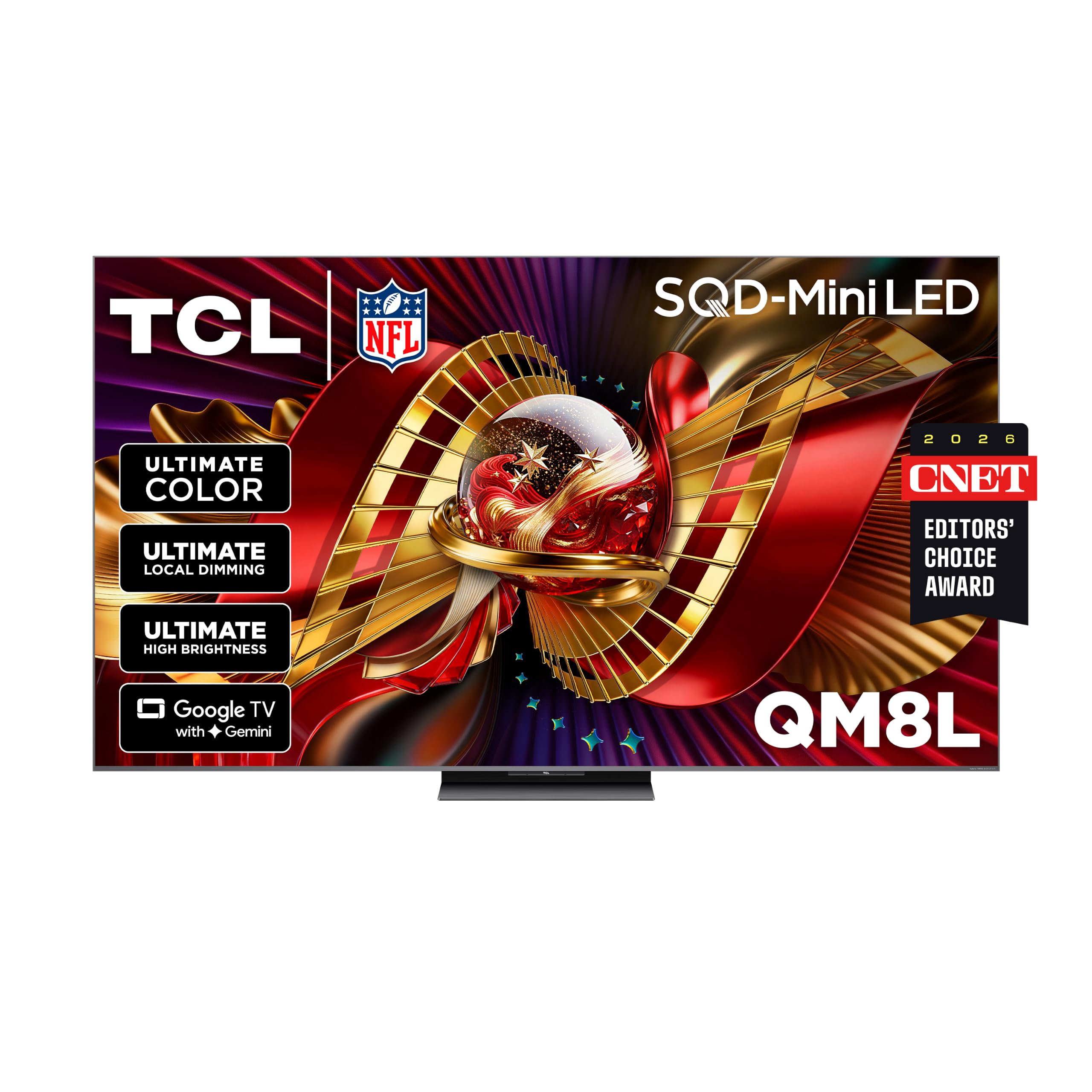
A 75-inch QD-Mini-LED built like a projector screen for your living room wall.
This is the family-room centerpiece on this list. TCL’s SQD-Mini LED pairs a 7000:1 contrast ratio with up to 4000+ discrete dimming zones and up to 6,000 peak nits to keep the picture bright, deep, and lifelike. A 5-nanometer Ultra Color Filter (versus standard 60-nanometer particles) tightens color accuracy. Google TV with Gemini means you can chat with the assistant to find content instead of scrolling endlessly. Audio comes tuned by Bang & Olufsen, with optional wireless subwoofer and satellite speakers to build out a surround system.
For consoles, the TCL Game Pack bundles Game Accelerator 288 VRR, a Game Bar overlay, and AMD FreeSync Premium Pro, on a 144Hz panel. That’ss the same native rate as the Toshiba Z670R and Hisense picks, but the 75-inch screen puts you in the action at a different scale. Setup is simple, and the set carries a premium look that owners specifically praise. On top of that, picture quality earns near-unanimous approval — the sharp contrast is the star.
The obvious caution is the price jump from the Q65 in this same size. You’re paying for the Mini-LED precision and the audio tuning, not just the diagonal. For a dedicated movie wall, that’s an easy call.
What makes it a movie wall
- Up to 4000+ dimming zones and up to 6,000 peak nits
- 7000:1 contrast ratio for deep, convincingly dark scenes
- Bang & Olufsen tuning with optional wireless subwoofer and surrounds
- 144Hz panel with Game Accelerator 288 VRR
The honest catch
- 75-inch footprint needs a wide wall and real viewing distance
- Adds to set up — big sets need two people to mount
The one to choose: if your room can fit 75 inches and you want movie-theater contrast from the couch.
The one to step past: if you can’t give the screen the wall it needs — a smaller Mini-LED fits tighter spaces.
9. Sony 75-Inch BRAVIA 5 Mini LED 4K HDR Smart Google TV

Sony’s image engineering, aimed squarely at the movie purist and the PS5 owner.
The BRAVIA 5 runs thousands of Mini LEDs through XR Backlight Master Drive — Sony’s own per-zone control — for bright, high-contrast images with real streetlight halos nowhere to be seen. XR Triluminos Pro opens up billions of real-world colors, and the XR Processor with AI enhances color, contrast, and clarity scene by scene. Studio Calibrated Picture modes for Netflix, Prime Video, and Sony Pictures Core keep the picture the way creators set it.
For PlayStation 5 owners, this set does things the others don’t. Auto HDR Tone Mapping and Auto Genre Picture Mode adjust the image specifically for PS5 gaming and streaming, and Game Menu centralizes gaming picture settings in one screen. Dolby Vision, Dolby Atmos, IMAX Enhanced, and DTS:X give films a proper cinema approach. Sony Pictures Core even ships with movies included and the largest IMAX Enhanced collection in the app.
Value is where Sony divides opinion — some buyers think it earns its keep, others balk. Brightness feedback is also mixed — some find it plenty, others want more pop. Reliability splits, with a subset reporting a set that stops turning on. The picture is the reason to buy here: clarity and color earn real praise. At 476 kilowatt hours per year estimated, it’s one of the more power-hungry picks here too.
What it’s genuinely great at: PS5 integration and studio-calibrated picture modes that no other set on this list offers.
The reality check: mixed feedback on brightness and value means this is a buy-if-you-love-the-picture call, not a spec-sheet one.
The buyer it fits: a PS5 owner who also wants Sony Pictures Core films and studio-calibrated picture modes from the start.
The buyer to warn off: anyone who needs maximum peak brightness for the money — the U8 outshines it on paper.
Know the Specs
Local dimming zones
Local dimming means the backlight can brighten or dim in independent patches. More zones equals finer control — a few hundred is good, a few thousand is excellent. The Hisense U7 and U8 lead this list on zone count, which is why they keep dark scenes clean and bright scenes punchy at the same time. Fewer zones means halos around bright objects.
Peak brightness (nits)
Nits measure how bright a screen can go. A bright living room wants at least a strong spec here, because sunlight washes out dim panels. The U8’s up to 5000 nits is the tallest claim in this group; the U7’s up to 3000 is close behind. Just remember: peak brightness only punches in the brightest scenes, not all the time.
Refresh rate (Hz)
Refresh rate is how often the panel redraws. 120Hz is smooth for most viewing; 144Hz is better for fast action; 165Hz is the fastest here, on the Hisense U7 and U8. If you mostly watch sitcoms, 120Hz is plenty. If you game competitively, 144Hz and 165Hz pay off with cleaner motion.
HDR formats
HDR (high dynamic range) expands contrast and color beyond standard video. Dolby Vision is the most premium format; HDR10+ is a strong alternative; HLG is common for broadcast sports. A set that supports many formats handles more content types without conversion. Most of the Mini-LED picks here support all four — Dolby Vision IQ, HDR10+ Adaptive, HDR10, and HLG.
Common Questions
Is Mini-LED better than regular LED for a bright room?
What refresh rate do I need for a gaming console?
Will a 75-inch TV fit in a normal living room?
Do I need a soundbar with these TVs?
What does anti-glare coating actually do?
Is Dolby Vision worth having over HDR10+?
How much power does a large Mini-LED TV draw?
Can I wall-mount these TVs, and what bracket do I need?
Which smart platform is easiest to live with?
Do these TVs support Bluetooth headphones?
Is Mini-LED better than OLED for a bright room?
The Bottom Line
For most rooms, the smart backlight tv to buy is the Hisense 55″ U7 Mini-LED. It pairs a native 165Hz panel with up to 3000 dimming zones and a dual-layer anti-glare coating, so it handles both a bright Sunday game and a dark thriller. If you want the brightest picture and don’t mind a smaller screen, reach for the Hisense 55″ U8 with up to 5000 nits. And for a 75-inch movie wall with Bang & Olufsen audio, the TCL QM8L is the one to put on your wall.
One last nudge: the U7 is the highest-rated set on this list at 4.0+ stars across 400+ owners, which is a real signal for a category where reliability feedback varies. Buy from a seller with a clear return window and register the warranty on arrival — that covers the reliability variance across these picks.
How we choose
We do not accept paid placement. Every pick is matched to a real buyer and a real use-case; we do not hands-on test units.
Sources
Specifications: manufacturer listings and product documentation. Review insights: verified customer reviews, as of November 2026. Pricing: not shown on this page (it changes often); check the current price via the retailer link.
As an Amazon Associate, Tactical Gear Guy earns from qualifying purchases. This does not affect which products we feature.